Custom Walk in Lille, France by sara22cande_3f97e created on 2025-05-10
Guide Location: France » Lille
Guide Type: Custom Walk
# of Sights: 14
Tour Duration: 4 Hour(s)
Travel Distance: 6.8 Km or 4.2 Miles
Share Key: PKGBT
Guide Type: Custom Walk
# of Sights: 14
Tour Duration: 4 Hour(s)
Travel Distance: 6.8 Km or 4.2 Miles
Share Key: PKGBT
How It Works
Please retrieve this walk in the GPSmyCity app. Once done, the app will guide you from one tour stop to the next as if you had a personal tour guide. If you created the walk on this website or come to the page via a link, please follow the instructions below to retrieve the walk in the app.
Retrieve This Walk in App
Step 1. Download the app "GPSmyCity: Walks in 1K+ Cities" on Apple App Store or Google Play Store.



Step 2. In the GPSmyCity app, download(or launch) the guide "Lille Map and Walking Tours".
Step 3. Tap the menu button located at upper right corner of the "Walks" screen and select "Retrieve custom walk". Enter the share key: PKGBT
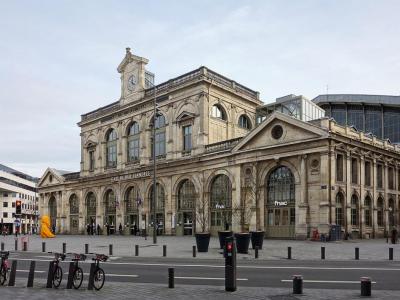
1) Gare de Lille Flandres (Lille-Flandres Railway Station)
Lille-Flandres Railway Station (Gare de Lille Flandres) is the primary railway station in Lille, renowned for its significant historical and architectural value. The station's building, showcasing a Neoclassical design, was conceived by architects Léonce Reynaud and Sidney Dunnett, affiliated with the Chemins de fer du Nord (Northern Railway Company). A unique aspect of its construction is the front façade, which was originally part of Paris’s Gare du Nord. This façade was meticulously dismantled and reassembled at Lille, imbuing the station with a Parisian architectural heritage.
The origins of the station date back to 1848 when it was inaugurated with just a ground floor. It was later expanded in 1867 to include an additional floor and a striking pediment featuring a large clock. This addition was timed to align with the creation of the Place de la Gare, enhancing the station's prominence and its surroundings.
Subsequent years saw further enhancements to the station's infrastructure. In 1880, renovations included the replacement of the old roof over the waiting lounge. The heating system was expanded, and in 1883, the waiting hall underwent a complete redecoration. By 1887, the Hôtel des Voyageurs was integrated into the station's complex, followed by the addition of a new rooftop in 1892.
Today, Lille-Flandres holds the distinction of being the busiest TER (regional train) station in France outside of Paris and is second only to Lyon-Part-Dieu station in terms of provincial attendance. The name "Flandres" was appended in 1993, coinciding with the opening of the nearby Lille-Europe station, situated on the high-speed LGV Nord line, to help distinguish it from its modern counterpart. This station not only serves as a crucial transport hub but also as a historical landmark reflecting the rich railway heritage of northern France.
The origins of the station date back to 1848 when it was inaugurated with just a ground floor. It was later expanded in 1867 to include an additional floor and a striking pediment featuring a large clock. This addition was timed to align with the creation of the Place de la Gare, enhancing the station's prominence and its surroundings.
Subsequent years saw further enhancements to the station's infrastructure. In 1880, renovations included the replacement of the old roof over the waiting lounge. The heating system was expanded, and in 1883, the waiting hall underwent a complete redecoration. By 1887, the Hôtel des Voyageurs was integrated into the station's complex, followed by the addition of a new rooftop in 1892.
Today, Lille-Flandres holds the distinction of being the busiest TER (regional train) station in France outside of Paris and is second only to Lyon-Part-Dieu station in terms of provincial attendance. The name "Flandres" was appended in 1993, coinciding with the opening of the nearby Lille-Europe station, situated on the high-speed LGV Nord line, to help distinguish it from its modern counterpart. This station not only serves as a crucial transport hub but also as a historical landmark reflecting the rich railway heritage of northern France.
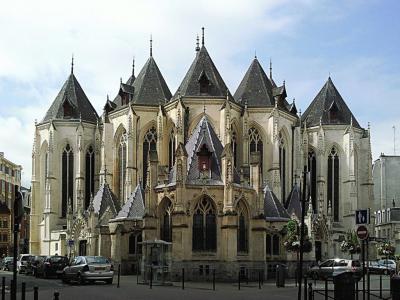
2) Église Saint-Maurice de Lille (St. Maurice Church)
Saint Maurice Church, located on Paris Street in Lille, features both Gothic and Neo-Gothic architectural styles. The construction spanned almost five centuries, beginning in the late 14th century and concluding in the late 19th century.
The earliest record of a church at this location, known as Saint Maurice de Fins, is from 1066. It details the founding of the collegiate church of Saint Peter, which was financed by the church of Saint Maurice. Although the precise origin date of Saint Maurice de Fins is unclear, it's possibly linked to a public tribunal held in Lille in 875, but the 1066 charter indicates it might have been established later. No evidence of earlier churches in the vicinity exists.
There's speculation that Saint Maurice was built atop a Roman temple dedicated to Mars, which would explain its unusual dedication within the Tournai diocese. The term "Fins" in its name is derived from the Latin "fines," meaning border or frontier.
During the French Revolution, the church was plundered, but it recovered some of its confiscated items and paintings from local convents in the early 19th century. Noteworthy among these are works by Jakob van Oost the Younger (1639-1713) and Louis Joseph Watteau (1731-1798), depicting various religious scenes.
The church also houses the grave of Charles Ferdinand d'Artois, Duke of Berry, who was assassinated in 1820. He was the youngest son of Charles X, the King of France, and Maria Theresa of Savoy.
In the 19th century, under the direction of Philippe Cannissié, the church underwent restoration. It was enhanced with Neo-Gothic furniture and new stained glass windows, and it was declared a historic monument in 1840.
The earliest record of a church at this location, known as Saint Maurice de Fins, is from 1066. It details the founding of the collegiate church of Saint Peter, which was financed by the church of Saint Maurice. Although the precise origin date of Saint Maurice de Fins is unclear, it's possibly linked to a public tribunal held in Lille in 875, but the 1066 charter indicates it might have been established later. No evidence of earlier churches in the vicinity exists.
There's speculation that Saint Maurice was built atop a Roman temple dedicated to Mars, which would explain its unusual dedication within the Tournai diocese. The term "Fins" in its name is derived from the Latin "fines," meaning border or frontier.
During the French Revolution, the church was plundered, but it recovered some of its confiscated items and paintings from local convents in the early 19th century. Noteworthy among these are works by Jakob van Oost the Younger (1639-1713) and Louis Joseph Watteau (1731-1798), depicting various religious scenes.
The church also houses the grave of Charles Ferdinand d'Artois, Duke of Berry, who was assassinated in 1820. He was the youngest son of Charles X, the King of France, and Maria Theresa of Savoy.
In the 19th century, under the direction of Philippe Cannissié, the church underwent restoration. It was enhanced with Neo-Gothic furniture and new stained glass windows, and it was declared a historic monument in 1840.
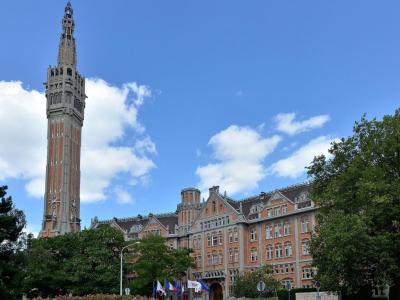
3) Beffroi de l'Hôtel de ville de Lille (Belfry of Lille Town Hall Belfry) (must see)
Has there ever been a belfry without bells? If no bells, why a belfry? That is a question for wiser heads. We know of a belfry with no bells. In Lille, France, the town hall belfry is the tallest municipal building in France and it has no bells.
The belfry tower was inaugurated in 1932. It is part of a reconstruction project to replace the old town hall, destroyed in World War I. It was built by architect Emile Dubuisson. Dubuisson was inspired to resonate his style with the traditional triangular gables of old Flemish houses.
The belfry is built of red bricks and concrete. It is slender and modernistic, attached to the stolid, grandiose town hall. They make a strange but harmonious ensemble. The city had previously three other bell towers. One was demolished in 1601. Another in 1856. The last came down in the Great War.
The current town hall and its tower were erected off-center, in the depressed Saint-Sauver district as a part of an urban renewal project of Socialist Mayor Gustave Delory.
The hall and the belfry show Classic Art-Deco and neo-Flemish elements common to the region. The tower utilizes a sculptured stone style of reinforced concrete. This allows for more strength. The belfry rises to a height of 338 feet. If you love heights, at the top there is a belvedere with nets. It is windy and high, an adventure!
The belfry tower was inaugurated in 1932. It is part of a reconstruction project to replace the old town hall, destroyed in World War I. It was built by architect Emile Dubuisson. Dubuisson was inspired to resonate his style with the traditional triangular gables of old Flemish houses.
The belfry is built of red bricks and concrete. It is slender and modernistic, attached to the stolid, grandiose town hall. They make a strange but harmonious ensemble. The city had previously three other bell towers. One was demolished in 1601. Another in 1856. The last came down in the Great War.
The current town hall and its tower were erected off-center, in the depressed Saint-Sauver district as a part of an urban renewal project of Socialist Mayor Gustave Delory.
The hall and the belfry show Classic Art-Deco and neo-Flemish elements common to the region. The tower utilizes a sculptured stone style of reinforced concrete. This allows for more strength. The belfry rises to a height of 338 feet. If you love heights, at the top there is a belvedere with nets. It is windy and high, an adventure!
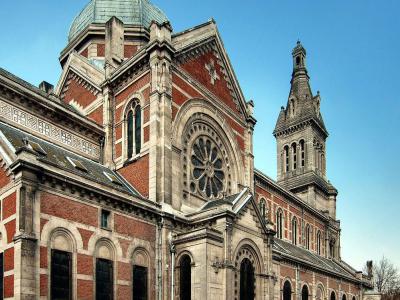
4) Église Saint-Michel de Lille (Saint-Michel Church)
Saint-Michel Church (Église Saint-Michel), situated in Lille, is a remarkable testament to the city's architectural heritage, particularly from the period of urban restructuring under the Second Empire. A competition for the design of Saint-Michel Church along with a Presbytery was held in 1868 and was won by architect Alfred Coisel. Construction of the church spanned from 1869 to 1874.
Designed in a Roman-Byzantine style reminiscent of the grand Romanesque basilicas, the church is constructed with limestone used in the bell tower, spire, and facings, while brick fills the structural gaps. Its layout includes three naves; the central nave features two levels, flanked by single-level side aisles. These are adorned with semi-circular arcades supported by twelve monolithic Tournai stone columns with Corinthian capitals, and oak wood coffered ceilings. An octagonal dome crowns the transept crossing.
The interior of the church boasts significant artistic elements. The choir area is particularly ornate, surrounded by murals of the 12 apostles painted by Alphonse Colas, eighteen stalls, and a modest high altar complemented by five stained glass windows depicting various religious figures, topped with a fresco of Christ in majesty.
Saint-Michel Church is also notable for its historical organ, constructed in 1898 by Joseph Merklin. Having undergone modifications, the organ now features three keyboards and a pedal board, housing 2700 pipes. Its design echoes the organ at the Church of the Holy Trinity in Paris, used by Olivier Messiaen, creating a stylistic parallel between the two instruments.
Designed in a Roman-Byzantine style reminiscent of the grand Romanesque basilicas, the church is constructed with limestone used in the bell tower, spire, and facings, while brick fills the structural gaps. Its layout includes three naves; the central nave features two levels, flanked by single-level side aisles. These are adorned with semi-circular arcades supported by twelve monolithic Tournai stone columns with Corinthian capitals, and oak wood coffered ceilings. An octagonal dome crowns the transept crossing.
The interior of the church boasts significant artistic elements. The choir area is particularly ornate, surrounded by murals of the 12 apostles painted by Alphonse Colas, eighteen stalls, and a modest high altar complemented by five stained glass windows depicting various religious figures, topped with a fresco of Christ in majesty.
Saint-Michel Church is also notable for its historical organ, constructed in 1898 by Joseph Merklin. Having undergone modifications, the organ now features three keyboards and a pedal board, housing 2700 pipes. Its design echoes the organ at the Church of the Holy Trinity in Paris, used by Olivier Messiaen, creating a stylistic parallel between the two instruments.
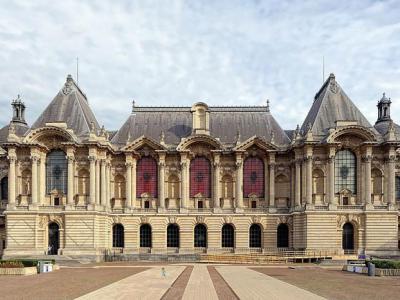
5) Palais des Beaux-Arts (Palace of Fine Arts) (must see)
Facing the fountains enclosing the sculpture "Group Of Three" on the Republic Square, is the Palace of Fine Arts. On the other side of the square is the imposing limestone structure, the Prefecture of Lille.
The museum is a grandiose building made in a French end of century style of official architecture. It has elements of the Italian Renaissance with columns, pediments and a French roof. There are two domed pavilions on either side of the monumental façade. The façade is set off with moldings. The wings have loggias and balusters.
The original museum was established by Napoleon in 1801. The Emperor's decree selected 15 French cities to house art seized from churches and occupied lands. The new Museum was opened in 1892 and renovated extensively in 1997. The museum now has 71,500 square feet of exhibition space making it one of the largest museums in France.
The ground floor has military fortification models by Sebastien de Vauban, the famous military engineer of Louis XIV. Sebastien shares this space with 135 French sculptures. On the second floor (French first floor) is a collection of Flemish and Dutch paintings. There are 19th century French paintings from David to Toulouse-Lautrec.
The Museum possesses over 70,000 pieces of Art. The collection includes works by Raphael, Donatello, Van Dyck, Rembrandt, Goya, El Greco, Delacroix, Rubens, Rodin and Chardin, to mention a few.
The museum is a grandiose building made in a French end of century style of official architecture. It has elements of the Italian Renaissance with columns, pediments and a French roof. There are two domed pavilions on either side of the monumental façade. The façade is set off with moldings. The wings have loggias and balusters.
The original museum was established by Napoleon in 1801. The Emperor's decree selected 15 French cities to house art seized from churches and occupied lands. The new Museum was opened in 1892 and renovated extensively in 1997. The museum now has 71,500 square feet of exhibition space making it one of the largest museums in France.
The ground floor has military fortification models by Sebastien de Vauban, the famous military engineer of Louis XIV. Sebastien shares this space with 135 French sculptures. On the second floor (French first floor) is a collection of Flemish and Dutch paintings. There are 19th century French paintings from David to Toulouse-Lautrec.
The Museum possesses over 70,000 pieces of Art. The collection includes works by Raphael, Donatello, Van Dyck, Rembrandt, Goya, El Greco, Delacroix, Rubens, Rodin and Chardin, to mention a few.
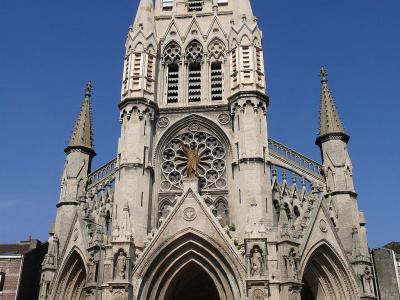
6) Église du Sacré-Cœur de Lille (Sacred Heart Church)
The Church of the Sacred Heart, one of Lille's largest churches, measures 90 meters in length, and 24 meters in width, and rises to 22 meters at its highest point. It was built in response to a promise made by the Association of the Children of Mary of the Sacred Heart on October 7, 1870, to protect Lille from the Prussian invasion during wartime.
Constructed in the Neo-Gothic style by architect Jules Batigny, the church's construction occurred in two stages. The initial phase, from 1875 to 1878, was followed by a second, from 1895 to 1898. This later phase included the addition of the apsidal chapel, known as the Chapel of the Vow, positioned behind the choir and featuring eleven stained glass windows. This expansion was inspired by another pledge by local women to build a chapel dedicated to the Sacred Heart, aimed at providing a dedicated space for reflection within the church.
The church was officially consecrated on June 20, 1902. At that time, its bell tower was still incomplete. It now contains a carillon, although the bells have not rung for several years. The tower, designed by architect Charles Sarazin and standing at 75 meters tall, was finished in 1928. It is constructed of reinforced concrete, which deteriorated due to weather conditions and required complete restoration from 2005 to 2008.
In April 2018, the church was temporarily closed for worship for six months by a city order due to dry rot. To date, only seven of its canopies have been restored, while the remaining five are still in disrepair and waiting to be fixed.
Since 1983, the building has been recognized as a National Historic Monument.
Constructed in the Neo-Gothic style by architect Jules Batigny, the church's construction occurred in two stages. The initial phase, from 1875 to 1878, was followed by a second, from 1895 to 1898. This later phase included the addition of the apsidal chapel, known as the Chapel of the Vow, positioned behind the choir and featuring eleven stained glass windows. This expansion was inspired by another pledge by local women to build a chapel dedicated to the Sacred Heart, aimed at providing a dedicated space for reflection within the church.
The church was officially consecrated on June 20, 1902. At that time, its bell tower was still incomplete. It now contains a carillon, although the bells have not rung for several years. The tower, designed by architect Charles Sarazin and standing at 75 meters tall, was finished in 1928. It is constructed of reinforced concrete, which deteriorated due to weather conditions and required complete restoration from 2005 to 2008.
In April 2018, the church was temporarily closed for worship for six months by a city order due to dry rot. To date, only seven of its canopies have been restored, while the remaining five are still in disrepair and waiting to be fixed.
Since 1983, the building has been recognized as a National Historic Monument.
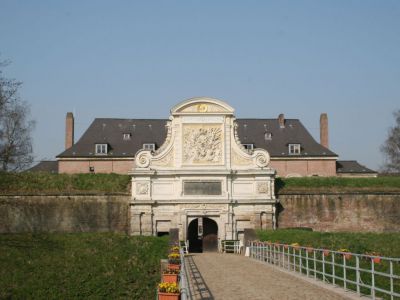
7) Citadel of Lille (must see)
King Louis XIV captured Lille from Spanish occupation in 1668. Shortly after marching in triumph through the Gate of the Sick, Louis commissioned his military engineer and architect, Paul Vauban, to fortify the city and the border between France and Flanders. The Citadel of Lille, the "Queen of Citadels" was Vauban's creation.
The citadel was the lynch pin to a complex of fortifications also designed by Vauban which firmly secured France's northern corner against invasion. Vauban established a double line of 28 fortified cities in this defense complex. The double line extended between Gravelines, Dunkirk and Maubeuge-Rocoi.
The citadel was situated on marshland between the rivers Delle and Bucquet. With a system of locks and gates the surrounding areas around the citadel could be flooded without warning. The fort is made in the form of a pentagon. The pentagon in turn is further defended by outer walls. This design was present in all Vauban's military works.
Several elements and components of the Citadel have been classified as historic monuments in 1914, 1921 and 1934.
The citadel was the lynch pin to a complex of fortifications also designed by Vauban which firmly secured France's northern corner against invasion. Vauban established a double line of 28 fortified cities in this defense complex. The double line extended between Gravelines, Dunkirk and Maubeuge-Rocoi.
The citadel was situated on marshland between the rivers Delle and Bucquet. With a system of locks and gates the surrounding areas around the citadel could be flooded without warning. The fort is made in the form of a pentagon. The pentagon in turn is further defended by outer walls. This design was present in all Vauban's military works.
Several elements and components of the Citadel have been classified as historic monuments in 1914, 1921 and 1934.
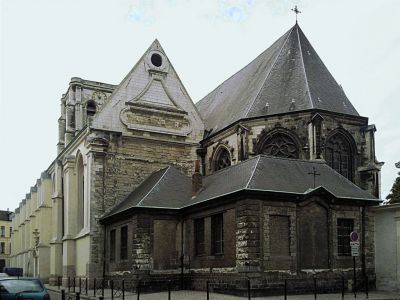
8) Église Sainte-Catherine (St. Catherine Church)
In the center of the Old Lille district is Saint Catherine Church, dedicated to Saint Catherine of Alexandria. It was built in the thirteenth century. It is constructed as a "Hallekerk", a church laid out like a hall in the old Flemish tradition. It is the oldest parish church in the city.
Although it appears in a lush Gothic style, it is all on one level with three naves and one transept. The bell tower is squat and stolid. It is a dominating figure and it holds the oldest bell in the city. The tower served as an optical telegraph station in the 18th century. On the north wall were reclusoirs, cells for pious meditation.
Inside the church there is much to admire. There is carved wooden furniture from the 1800s and paintings of Saint Mathieu, Saint John the Evangelist, and Saints Mark and Luke by artist Victor Mottez. Most admirable is the stained glass window showing the Triumph of Saint Catherine and the paneled cradles of the ceiling.
The church was classified as an Historical Monument in August 1991.
Although it appears in a lush Gothic style, it is all on one level with three naves and one transept. The bell tower is squat and stolid. It is a dominating figure and it holds the oldest bell in the city. The tower served as an optical telegraph station in the 18th century. On the north wall were reclusoirs, cells for pious meditation.
Inside the church there is much to admire. There is carved wooden furniture from the 1800s and paintings of Saint Mathieu, Saint John the Evangelist, and Saints Mark and Luke by artist Victor Mottez. Most admirable is the stained glass window showing the Triumph of Saint Catherine and the paneled cradles of the ceiling.
The church was classified as an Historical Monument in August 1991.
9) Place aux Oignons (Onions Square)
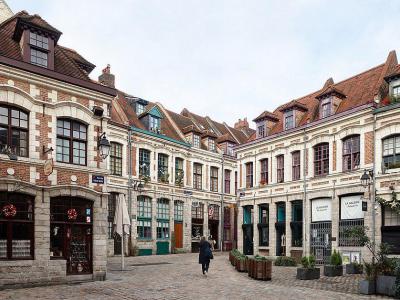
Looking for onions? You won't necessarily find a sack of onions in Onions Square. The site of the square once held the fortress of the counts of Flanders. In the fortress was a keep, a strong place, called dominium. That is all gone now, but the locals corrupted the word, dominium, into "Ognions."
The square is lined with houses dating from the 17th and 18th centuries. The houses on the square originally were homes for artisan weavers. The weavers used the attics and cellars as workshops if conditions of humidity were acceptable. In the eighteenth century the houses became living quarters for factory workers and their families.
The neighborhood was not known for its sanitation or habitability. In 1945, George d'Orgeville, a novelist, described the square as a "district of misfortune...lined with hovels which are falling apart..." Living conditions were deplorable by today's standards. Six or seven families were often sharing one water tap and a toilet.
Buildings were dilapidated. In 1976 reinforcing work was begun prior to restoration. Between 1985 and 1990 all buildings on the square were partially or completely rebuilt. Since the year 2000, the square has become a draw for tourists. The square is now a pedestrian area surrounded by restaurants and cafes.
The square is lined with houses dating from the 17th and 18th centuries. The houses on the square originally were homes for artisan weavers. The weavers used the attics and cellars as workshops if conditions of humidity were acceptable. In the eighteenth century the houses became living quarters for factory workers and their families.
The neighborhood was not known for its sanitation or habitability. In 1945, George d'Orgeville, a novelist, described the square as a "district of misfortune...lined with hovels which are falling apart..." Living conditions were deplorable by today's standards. Six or seven families were often sharing one water tap and a toilet.
Buildings were dilapidated. In 1976 reinforcing work was begun prior to restoration. Between 1985 and 1990 all buildings on the square were partially or completely rebuilt. Since the year 2000, the square has become a draw for tourists. The square is now a pedestrian area surrounded by restaurants and cafes.
10) Lille Cathedral (must see)
The miraculous statue of the Virgin Mary of the Trellis made its home in the Collegiate Church of Saint Peter from the 13th century until 1792. The gilded iron trellis wrapped around the statue was lost in the upheavals of the French Revolution. The statue was recovered and placed in the church of Saint Catherine, its iron trellis replaced with a wooden one.
In 1853 Charles-Kolb Bernard and his cousin formed a commission to build a fabulous new church in honor of Our Lady of the Treille. Land in the center of Lille was set aside for the construction. The 13th century Gothic styles shown by the cathedrals in Reims, Amiens and Chartres were pressed on the architects and builders.
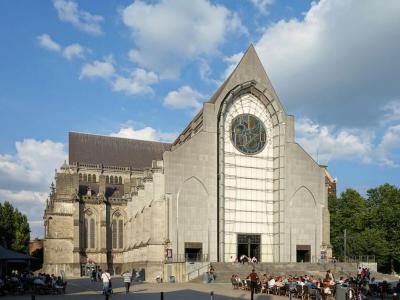
At first the task was intimidating. It called for a building 433 feet long and spires reaching to 377 feet. The proportions were too large, the budget too small. The cathedral's main facade was not completed until the 1990s. The center is made of an ogive 96 feet high faced with 110 sheets of thick white marble.
A rose window dedicated to the Resurrection is by Ladislas Kijno. The main iron doorway was created by Georges Jeanclos. It is an enormous neo-Gothic building with a bold modern facade designed by architects Pierre-Louis Carlier and Peter Rice. In addition to services, the cathedral hosts concerts and it has a Sacred Art Center in its crypt.
The Cathedral is open all year. Guided tours are available.
In 1853 Charles-Kolb Bernard and his cousin formed a commission to build a fabulous new church in honor of Our Lady of the Treille. Land in the center of Lille was set aside for the construction. The 13th century Gothic styles shown by the cathedrals in Reims, Amiens and Chartres were pressed on the architects and builders.
At first the task was intimidating. It called for a building 433 feet long and spires reaching to 377 feet. The proportions were too large, the budget too small. The cathedral's main facade was not completed until the 1990s. The center is made of an ogive 96 feet high faced with 110 sheets of thick white marble.
A rose window dedicated to the Resurrection is by Ladislas Kijno. The main iron doorway was created by Georges Jeanclos. It is an enormous neo-Gothic building with a bold modern facade designed by architects Pierre-Louis Carlier and Peter Rice. In addition to services, the cathedral hosts concerts and it has a Sacred Art Center in its crypt.
The Cathedral is open all year. Guided tours are available.
11) Chambre de Commerce (Chamber of Commerce)
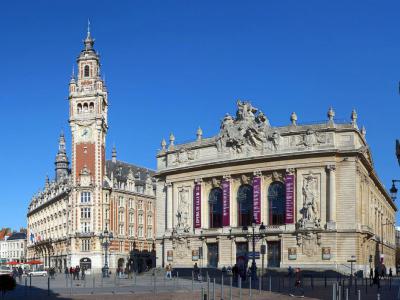
The Chamber of Commerce (Chambre de Commerce) in Lille housed within the Nouvelle Bourse building, stands as a prominent architectural and historical landmark. Constructed over 11 years from 1910 to 1921, it is situated directly across from the Old Stock Exchange (Vieille Bourse) on the Theater Square (Place du Théâtre). Designed by architect Louis Marie Cordonnier, the New Stock Exchange (Nouvelle Bourse) was intended to serve as the headquarters for the Chamber of Commerce and Industry of Greater Lille, an institution that was founded in 1715.
Architecturally, the building exemplifies Neo-Flemish style, drawing inspiration from the grand Dutch town halls of the past. This style is apparent in its rich decorative elements, including plant motifs and scrolls reminiscent of 17th-century Lille. One of the most striking features of the building is its 76-meter-high belfry, adorned with a four-dial clock and an automated carillon that includes 26 bells weighing a total of 2000 kg, cast in 1984 by Luigi Bergamo of the Cornille-Havard foundry.
The interior of the building is equally impressive, with a 25x25-meter hall of honor that boasts colonnaded galleries and a 17-meter high dome, lavishly decorated with exquisite frescoes. The building also houses several important rooms used for various functions, including a 300-seat auditorium known as the Descamps room, Reception rooms, the Sessions room, and the Committee room or the Kuhlmann office, which are also richly decorated with frescoes and woodwork.
In recognition of its architectural and historical significance, the Chamber of Commerce and Industry building was listed as a historic monument in 2015. This designation underscores its importance not only as a center of commerce and industry but also as a key part of Lille’s cultural and historical heritage.
Architecturally, the building exemplifies Neo-Flemish style, drawing inspiration from the grand Dutch town halls of the past. This style is apparent in its rich decorative elements, including plant motifs and scrolls reminiscent of 17th-century Lille. One of the most striking features of the building is its 76-meter-high belfry, adorned with a four-dial clock and an automated carillon that includes 26 bells weighing a total of 2000 kg, cast in 1984 by Luigi Bergamo of the Cornille-Havard foundry.
The interior of the building is equally impressive, with a 25x25-meter hall of honor that boasts colonnaded galleries and a 17-meter high dome, lavishly decorated with exquisite frescoes. The building also houses several important rooms used for various functions, including a 300-seat auditorium known as the Descamps room, Reception rooms, the Sessions room, and the Committee room or the Kuhlmann office, which are also richly decorated with frescoes and woodwork.
In recognition of its architectural and historical significance, the Chamber of Commerce and Industry building was listed as a historic monument in 2015. This designation underscores its importance not only as a center of commerce and industry but also as a key part of Lille’s cultural and historical heritage.
12) Grande Place (Main Square) (must see)
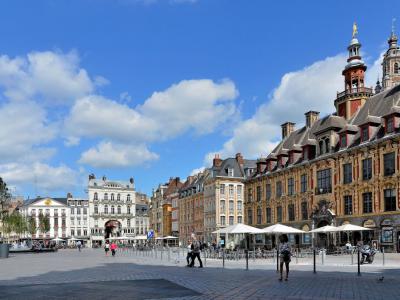
The Main Square of Lille was officially called "General de Gaulle Square" at the end of World War II. Among the good people of Lille however, it is often referred to as "The Main Square" As with New York, the Avenue of the Americas is "Sixth Avenue." Whatever it might be called, it is still the Main Square of the city.
In 1066 the area of the Main Square was referred to as the "forum." The forum was declared a market square. The ground was drained, leveled and paved and voila! A market square. In the 17th century, the Commodity Exchange divided the Square into the Main Square and the Little Square.
The Place du General-de-Gaulle assumes the role of Main Square. Oops, it is also referred to as "Place de la Decesse." Let us declare for Grand Place or Main Square. Today it is a venue for events and business exchanges. It is the traditional location for Lille book clearance sales, a major event.
The square is surrounded by a number of buildings. They include the Theatre of the North and the Old Stock Exchange (no longer the commercial exchange). In the center of the Main Square is the awesome "Column of the Goddess", memorializing the siege of Lille in 1792.
The square is paved in a checks of blue and pink granite. It is partially pedestrianized. It can be reached by metro first line Rihour station. There is also an underground car park with 342 spaces.
In 1066 the area of the Main Square was referred to as the "forum." The forum was declared a market square. The ground was drained, leveled and paved and voila! A market square. In the 17th century, the Commodity Exchange divided the Square into the Main Square and the Little Square.
The Place du General-de-Gaulle assumes the role of Main Square. Oops, it is also referred to as "Place de la Decesse." Let us declare for Grand Place or Main Square. Today it is a venue for events and business exchanges. It is the traditional location for Lille book clearance sales, a major event.
The square is surrounded by a number of buildings. They include the Theatre of the North and the Old Stock Exchange (no longer the commercial exchange). In the center of the Main Square is the awesome "Column of the Goddess", memorializing the siege of Lille in 1792.
The square is paved in a checks of blue and pink granite. It is partially pedestrianized. It can be reached by metro first line Rihour station. There is also an underground car park with 342 spaces.
13) Column of the Goddess
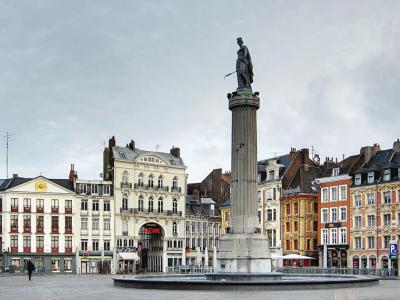
The Column of the Goddess stands as a poignant memorial in the heart of the city's Grand Place, or General de Gaulle Square (Place du Général de Gaulle). This memorial commemorates the Siege of Lille in September 1792, during the French Revolutionary Wars, a pivotal moment in local history marked by the relentless and heroic resistance of Lille's citizens against Austrian forces. Despite its limited strategic importance in the broader scope of the wars, the siege remains a significant event for Lille's residents.
For nine continuous days and nights, the Austrians bombarded Lille, resulting in substantial destruction, including the demolition of many houses and the main church, Saint-Etienne, located on the Grand Place. This church was never rebuilt, leaving the Grand Place notably devoid of a church or belfry, which is unusual compared to other central squares in similar cities like Bruges and Brussels.
The absence of a physical monument to remember the siege was felt until the mid-19th century. In response, local authorities decided to erect a memorial in time for the siege's 50th anniversary. The foundation stone was laid in September 1842, and the memorial was completed three years later in 1845.
Designed by architect Charles Benvignat, the memorial features a column topped by a statue crafted by sculptor Théophile Bra. The statue, an allegorical representation of the besieged city adorned with a mural crown, quickly earned the moniker "The Goddess" from locals. This nickname was reinforced by references in contemporary poetry. Since around 1990, the column has also been encircled by a fountain, enhancing its presence as a central and cherished landmark in Lille.
For nine continuous days and nights, the Austrians bombarded Lille, resulting in substantial destruction, including the demolition of many houses and the main church, Saint-Etienne, located on the Grand Place. This church was never rebuilt, leaving the Grand Place notably devoid of a church or belfry, which is unusual compared to other central squares in similar cities like Bruges and Brussels.
The absence of a physical monument to remember the siege was felt until the mid-19th century. In response, local authorities decided to erect a memorial in time for the siege's 50th anniversary. The foundation stone was laid in September 1842, and the memorial was completed three years later in 1845.
Designed by architect Charles Benvignat, the memorial features a column topped by a statue crafted by sculptor Théophile Bra. The statue, an allegorical representation of the besieged city adorned with a mural crown, quickly earned the moniker "The Goddess" from locals. This nickname was reinforced by references in contemporary poetry. Since around 1990, the column has also been encircled by a fountain, enhancing its presence as a central and cherished landmark in Lille.
14) Vieille Bourse (Old Stock Exchange) (must see)
Julien Destree was a master cabinet maker and architect in the city of Lille in 1651. The city had obtained from King Philip IV of Spain a license to build an exchange (bourse) for the merchants of the city. Julien Destree was the man to make it happen. He was determined to create a great monument to commerce to rival the one in Antwerp.
The King had authorized "an exchange...surrounded and encloses 24 houses." Twenty-four plots of land around the market square were sold to traders. Construction of the galleries, paving the courtyard and the four entrances were undertaken by the city. Construction took place under the direction of Julien Destree from 1652-1653.
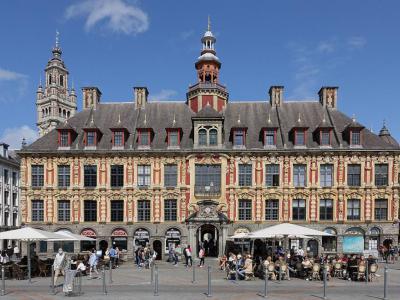
The building shows a Renaissance Flemish influence prevalent in the 17th century. Piers and columns richly adorned with garlands and horns of plenty are a paen to the commerce of Lille. At the top of the bell tower stands a golden image of the god, Mercury. Lille was in fierce competition with her sister cities, Antwerp, Ghent, and Bruges.
In 1861 the stock exchange opened for business. It was a very modest exchange, not trading much more than 3% of its capital. In 1921 the new stock exchange building, the Chamber of Commerce, was opened. The Old Stock Exchange was indeed the "old" stock exchange.
The Old Stock Exchange is situated by the Main Square and the Theatre Square. It is an important landmark of the center of the city. It consists of a quadrangle of 24 look-alike houses surrounding a large courtyard. The courtyard today is a gathering venue for book stalls, florists, chess players, tourists and visitors.
The Old Stock Exchange can be reached by the Rihour metro station.
Why You Should Visit:
The old building sells a lot of things. Old books, coins, etc. The courtyard hosts games and bookstalls. The building itself is like a voyage back in time.
The King had authorized "an exchange...surrounded and encloses 24 houses." Twenty-four plots of land around the market square were sold to traders. Construction of the galleries, paving the courtyard and the four entrances were undertaken by the city. Construction took place under the direction of Julien Destree from 1652-1653.
The building shows a Renaissance Flemish influence prevalent in the 17th century. Piers and columns richly adorned with garlands and horns of plenty are a paen to the commerce of Lille. At the top of the bell tower stands a golden image of the god, Mercury. Lille was in fierce competition with her sister cities, Antwerp, Ghent, and Bruges.
In 1861 the stock exchange opened for business. It was a very modest exchange, not trading much more than 3% of its capital. In 1921 the new stock exchange building, the Chamber of Commerce, was opened. The Old Stock Exchange was indeed the "old" stock exchange.
The Old Stock Exchange is situated by the Main Square and the Theatre Square. It is an important landmark of the center of the city. It consists of a quadrangle of 24 look-alike houses surrounding a large courtyard. The courtyard today is a gathering venue for book stalls, florists, chess players, tourists and visitors.
The Old Stock Exchange can be reached by the Rihour metro station.
Why You Should Visit:
The old building sells a lot of things. Old books, coins, etc. The courtyard hosts games and bookstalls. The building itself is like a voyage back in time.
