Custom Walk in Los Angeles, California by andreasalaz36_696f4 created on 2025-05-15
Guide Location: USA » Los Angeles
Guide Type: Custom Walk
# of Sights: 10
Tour Duration: 3 Hour(s)
Travel Distance: 5.5 Km or 3.4 Miles
Share Key: 7UCXH
Guide Type: Custom Walk
# of Sights: 10
Tour Duration: 3 Hour(s)
Travel Distance: 5.5 Km or 3.4 Miles
Share Key: 7UCXH
How It Works
Please retrieve this walk in the GPSmyCity app. Once done, the app will guide you from one tour stop to the next as if you had a personal tour guide. If you created the walk on this website or come to the page via a link, please follow the instructions below to retrieve the walk in the app.
Retrieve This Walk in App
Step 1. Download the app "GPSmyCity: Walks in 1K+ Cities" on Apple App Store or Google Play Store.



Step 2. In the GPSmyCity app, download(or launch) the guide "Los Angeles Map and Walking Tours".
Step 3. Tap the menu button located at upper right corner of the "Walks" screen and select "Retrieve custom walk". Enter the share key: 7UCXH
1) Olvera Street (must see)
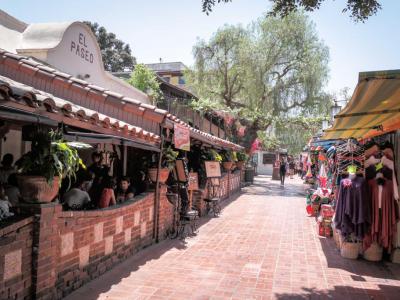
Olvera Street is a historic pedestrian street situated in El Pueblo de Los Ángeles, which is the historical center of Los Angeles. This street is located adjacent to the Plaza de Los Ángeles, which happens to be the oldest plaza in California. This plaza played a central role in the life of the city during the Spanish and Mexican periods, and even into the early American era, following the Conquest of California.
Olvera Street, also referred to as Calle Olvera or Placita Olvera, is a designated historic district in downtown Los Angeles and is a part of the El Pueblo de Los Angeles Historic Monument. Los Angeles was officially founded in 1781, and Olvera Street acquired its current name in 1877. Many of the historic buildings in the Plaza District can be found on Olvera Street, including some of the oldest monuments in Los Angeles, such as the Avila Adobe, which was constructed in 1818, the Pelanconi House from 1857, and the Sepulveda House built in 1887.
Olvera Street has even earned recognition as one of the "Top Five" streets in the "Great Streets of America" journal. The street is lined with restaurants, vendors, and public establishments, attracting nearly two million visitors each year. Additionally, there is a Visitors Center where tourists can watch a complimentary film depicting early life in Los Angeles.
Why You Should Visit:
If you want a taste of Mexico, this is the place to be.
Could be the closest thing to real Mexico one can experience!
Olvera Street, also referred to as Calle Olvera or Placita Olvera, is a designated historic district in downtown Los Angeles and is a part of the El Pueblo de Los Angeles Historic Monument. Los Angeles was officially founded in 1781, and Olvera Street acquired its current name in 1877. Many of the historic buildings in the Plaza District can be found on Olvera Street, including some of the oldest monuments in Los Angeles, such as the Avila Adobe, which was constructed in 1818, the Pelanconi House from 1857, and the Sepulveda House built in 1887.
Olvera Street has even earned recognition as one of the "Top Five" streets in the "Great Streets of America" journal. The street is lined with restaurants, vendors, and public establishments, attracting nearly two million visitors each year. Additionally, there is a Visitors Center where tourists can watch a complimentary film depicting early life in Los Angeles.
Why You Should Visit:
If you want a taste of Mexico, this is the place to be.
Could be the closest thing to real Mexico one can experience!
2) Avila Adobe
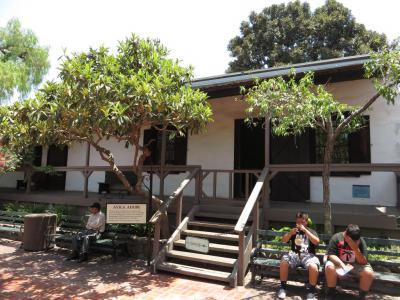
If you would like to know how the rich lived in Los Angeles in the 19th century, do visit the Ávila Adobe on Olvera Street. As the oldest residence still standing in Los Angeles, it is part of the El Pueblo de Los Angeles Historic Monuments. It was built in 1818 by Francisco Ávila, a wealthy cattle rancher, as a weekend and holiday home. He entertained friends here and traded his hides and tallow for fine furniture and the building’s wooden window and door frames.
The walls, built out of adobe bricks that had been sundried, are three feet thick. Once the floors were of hard-packed earth, but later varnished wooden planks were added. The ceilings are over 15ft high with cottonwood beams and the large rooms have many windows.
After Francisco Ávila’s death, his widow lived in the house until her death and it passed on to her children. Between 1868 and 1920 it was used as a restaurant and a bed and board. The area was a poor one and in 1926 the City Health Department decided to demolish the house. Luckily for history fans, an Englishwoman, Christine Sterling, who was interested in the city’s historical heritage, started a public campaign to save the building. Private donations flooded in from all around the city and the building was restored. The police department organized the prisoners of the county jail into work-groups and they cleaned up the surrounding plaza, turning it into a Mexican-style market-place.
Today only seven rooms remain of the original, larger house. They are open to the public as a house museum furnished as they would have been in Adobe’s time. You can see a four-poster bed, the family dining area, children’s ragdolls and, in the kitchen, an enormous washtub for bathing.
Why You Should Visit:
To see/imagine how life was back in the 19th century in this neighborhood, especially since most other houses have turned into shops/restaurants.
Tip:
The house/museum is free to the public and the public restroom is an added bonus.
You can see the whole place in 10 mins if you walk around, but take some time to also read the description on the wall.
The walls, built out of adobe bricks that had been sundried, are three feet thick. Once the floors were of hard-packed earth, but later varnished wooden planks were added. The ceilings are over 15ft high with cottonwood beams and the large rooms have many windows.
After Francisco Ávila’s death, his widow lived in the house until her death and it passed on to her children. Between 1868 and 1920 it was used as a restaurant and a bed and board. The area was a poor one and in 1926 the City Health Department decided to demolish the house. Luckily for history fans, an Englishwoman, Christine Sterling, who was interested in the city’s historical heritage, started a public campaign to save the building. Private donations flooded in from all around the city and the building was restored. The police department organized the prisoners of the county jail into work-groups and they cleaned up the surrounding plaza, turning it into a Mexican-style market-place.
Today only seven rooms remain of the original, larger house. They are open to the public as a house museum furnished as they would have been in Adobe’s time. You can see a four-poster bed, the family dining area, children’s ragdolls and, in the kitchen, an enormous washtub for bathing.
Why You Should Visit:
To see/imagine how life was back in the 19th century in this neighborhood, especially since most other houses have turned into shops/restaurants.
Tip:
The house/museum is free to the public and the public restroom is an added bonus.
You can see the whole place in 10 mins if you walk around, but take some time to also read the description on the wall.
3) Little Tokyo
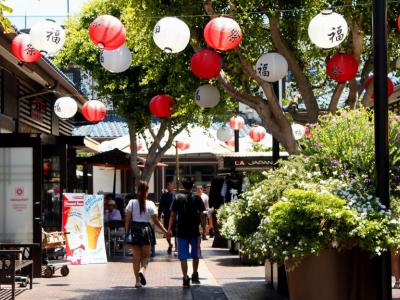
Little Tokyo is a neighborhood in Los Angeles that holds a special place as the Japanese American district. It's a unique area that captures the essence of Japanese art and traditions, and it's one of the three official Japantowns in the United States. This neighborhood boasts a variety of attractions, including over 30 restaurants, peaceful Japanese gardens, markets, live performances, bookstores, a Buddhist temple, galleries, and a wide array of gift shops. Additionally, it's home to the largest Japanese supermarket in the U.S.
Originally, Little Tokyo covered a larger area to the east and south of its present location, spanning about one square mile. It used to be a hub for Japanese immigrants until the Exclusion Act of 1924 halted further migration. First Street was lined with shops, and Central Avenue to the south hosted vegetable markets, with Japanese Americans playing a significant role in the vegetable trade due to successful Japanese American truck farms in Southern California.
During World War II, Japanese American internment forced the evacuation of Little Tokyo, temporarily renamed Bronzeville, where African Americans and Native Americans established nightclubs and restaurants. After internment, most Bronzeville residents moved elsewhere. Later, a housing shortage in Little Tokyo led returning Japanese Americans to settle in nearby areas like Boyle Heights, which once had a significant Japanese American population in the 1950s before becoming predominantly Mexican and Latino.
In the late 1970s, a redevelopment effort began as Japanese corporations expanded their overseas operations, establishing their U.S. headquarters in the Los Angeles area. This resulted in the construction of new shopping plazas, hotels, and branches of major Japanese banks. Despite these changes, some of the original buildings and restaurants in Little Tokyo, particularly along First Street, still remain.
Originally, Little Tokyo covered a larger area to the east and south of its present location, spanning about one square mile. It used to be a hub for Japanese immigrants until the Exclusion Act of 1924 halted further migration. First Street was lined with shops, and Central Avenue to the south hosted vegetable markets, with Japanese Americans playing a significant role in the vegetable trade due to successful Japanese American truck farms in Southern California.
During World War II, Japanese American internment forced the evacuation of Little Tokyo, temporarily renamed Bronzeville, where African Americans and Native Americans established nightclubs and restaurants. After internment, most Bronzeville residents moved elsewhere. Later, a housing shortage in Little Tokyo led returning Japanese Americans to settle in nearby areas like Boyle Heights, which once had a significant Japanese American population in the 1950s before becoming predominantly Mexican and Latino.
In the late 1970s, a redevelopment effort began as Japanese corporations expanded their overseas operations, establishing their U.S. headquarters in the Los Angeles area. This resulted in the construction of new shopping plazas, hotels, and branches of major Japanese banks. Despite these changes, some of the original buildings and restaurants in Little Tokyo, particularly along First Street, still remain.
4) Grand Central Market / Homer Laughlin Building (must see)
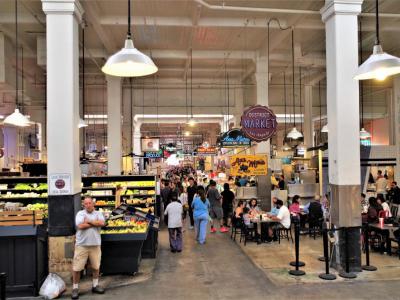
The Grand Central Market (or GCM as the regulars call it) is a rare place in Downtown LA (DTLA) which serves both as a watering hole for locals and an authentic piece of LA's architectural history for tourists. Opened in 1917, it has been continuously in operation ever since!
GCM's stated mission is lofty: "to celebrate the cuisines and cultures of Los Angeles … to preserve the legacy of a historic downtown landmark … to gather the city's many communities around a shared table" – and it does a very decent job of all that, across 30,000 square feet of space that encompasses a food emporium and a retail marketplace.
The landmark building that houses the market was commissioned by retired Ohio entrepreneur Homer Laughlin and was the city's first fireproofed, steel-reinforced structure when finished in 1898. Originally built in the Beaux Arts style, it underwent subsequent modifications that drastically changed its appearance, including the addition of a tile façade in the 1960s which hid the second-story windows. Along with the adjacent Million Dollar Theater Building, it underwent a major renovation in the 1990s in the course of which residential units were added, creating DTLA's first true mixed-use developments in decades.
GCM's original vendors were Jewish delis, fishmongers, greengrocers, and butchers, with additional stalls for coffee, cheese, baked products, dry goods, eggs, and so forth. As DTLA continued to evolve, the market kept pace, now offering a wide range of cuisines – Mexican, Thai, Peruvian, Japanese, Chinese, Italian, and Mediterranean – as well as desserts and beverages, including ice cream, coffee, pressed juices, beer, wine, and a lot more.
Among the well-known names presented at GCM, you can find McConnell's Fine Ice Cream, Belcampo, Roast-To-Go, Eggslut, Sarita's Pupusaria, Horse Thief BBQ, and Wexler's Deli.
GCM's stated mission is lofty: "to celebrate the cuisines and cultures of Los Angeles … to preserve the legacy of a historic downtown landmark … to gather the city's many communities around a shared table" – and it does a very decent job of all that, across 30,000 square feet of space that encompasses a food emporium and a retail marketplace.
The landmark building that houses the market was commissioned by retired Ohio entrepreneur Homer Laughlin and was the city's first fireproofed, steel-reinforced structure when finished in 1898. Originally built in the Beaux Arts style, it underwent subsequent modifications that drastically changed its appearance, including the addition of a tile façade in the 1960s which hid the second-story windows. Along with the adjacent Million Dollar Theater Building, it underwent a major renovation in the 1990s in the course of which residential units were added, creating DTLA's first true mixed-use developments in decades.
GCM's original vendors were Jewish delis, fishmongers, greengrocers, and butchers, with additional stalls for coffee, cheese, baked products, dry goods, eggs, and so forth. As DTLA continued to evolve, the market kept pace, now offering a wide range of cuisines – Mexican, Thai, Peruvian, Japanese, Chinese, Italian, and Mediterranean – as well as desserts and beverages, including ice cream, coffee, pressed juices, beer, wine, and a lot more.
Among the well-known names presented at GCM, you can find McConnell's Fine Ice Cream, Belcampo, Roast-To-Go, Eggslut, Sarita's Pupusaria, Horse Thief BBQ, and Wexler's Deli.
5) Angels Flight Railway
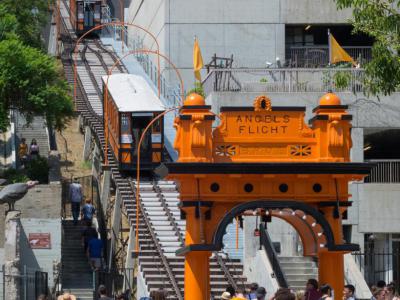
Just a short distance from the famous Grand Central Market is one of LA's most enduring (and beloved) landmarks, the Angels Flight Railway. This whimsically-named funicular bills itself as "the world's shortest railway". Indeed, it can take you up and down a steep incline between Hill Street and Olive Street, nice and easy, in just a minute or so, which is still enough to put a silly smile on your face, being much fun, albeit, admittedly, of a shorter duration.
The narrow gauge cable railway has only two carriages, endearingly named Sinai and Olivet – roughly from the same era as San Francisco's cable cars – which travel on an almost continuous loop.
The railway first opened on New Year's Eve in 1901 and quickly became a popular mode of transportation. It was originally designed to serve the Bunker Hill district. With its stately Victorian mansions, Bunker Hill was one of LA's very upmarket neighborhoods, and the area's elite residents apparently rode down on Angels Flight to shop for their groceries in Grand Central Market's open-air arcade.
In those days, the well-heeled Bunker Hill residents paid only a penny a ride. Today, the ride costs $1 each way – payable upon alighting at the terminus, which is still a true bargain for a nice piece of history.
In 1912, the"Angels Flight" name (which was originally displayed at the Hill Street entrance archway) became official, and by the 1950s the railway had carried over 100 million passengers already! The count of them to date has been lost...
The railway was closed and dismantled in 1969 due to large-scale development in the area, but was later restored and reopened in 1996. However, tragedy struck in 2001 when a derailment occurred, causing one of the cars to plummet down the track and kill a passenger. After an investigation, the railway was shut down again and remained closed for several years.
In 2010, the historic railway was once again restored and reopened, and today remains in operation.
The narrow gauge cable railway has only two carriages, endearingly named Sinai and Olivet – roughly from the same era as San Francisco's cable cars – which travel on an almost continuous loop.
The railway first opened on New Year's Eve in 1901 and quickly became a popular mode of transportation. It was originally designed to serve the Bunker Hill district. With its stately Victorian mansions, Bunker Hill was one of LA's very upmarket neighborhoods, and the area's elite residents apparently rode down on Angels Flight to shop for their groceries in Grand Central Market's open-air arcade.
In those days, the well-heeled Bunker Hill residents paid only a penny a ride. Today, the ride costs $1 each way – payable upon alighting at the terminus, which is still a true bargain for a nice piece of history.
In 1912, the"Angels Flight" name (which was originally displayed at the Hill Street entrance archway) became official, and by the 1950s the railway had carried over 100 million passengers already! The count of them to date has been lost...
The railway was closed and dismantled in 1969 due to large-scale development in the area, but was later restored and reopened in 1996. However, tragedy struck in 2001 when a derailment occurred, causing one of the cars to plummet down the track and kill a passenger. After an investigation, the railway was shut down again and remained closed for several years.
In 2010, the historic railway was once again restored and reopened, and today remains in operation.
6) Cathedral of Our Lady of the Angels
The Cathedral of Our Lady of the Angels is the Mother Church of the Archdiocese of Los Angeles and holds the seat of the Archbishop. It is a Roman Catholic Church unlike any other you will see in the city.
The church was built in 2002 to replace the Cathedral of Saint Vibiana which was damaged during an earthquake in 1994. The plans to demolish the old cathedral to build the new were stopped by conservationists, who wanted the new church incorporated into the old. This was impossible if the building was to meet with seismic laws, so a new site was found.
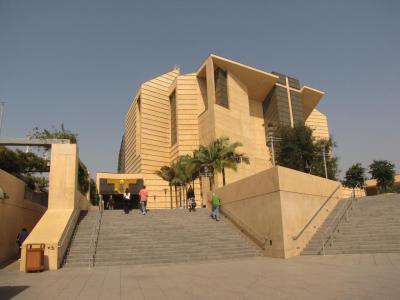
Built by the architect Rafael Moneo, the church is startlingly postmodern, with no right angles and a base isolated structure. The windows are of alabaster instead of stained glass and the doors are in sculpted bronze. The interior is softly lit and you can admire tapestries of the Communion of Saints by John Nava, a postmodern statue of the Virgin Mary by Robert Graham and a huge pipe organ, 60 feet high and set 24 feet off the ground. The 6019 pipes include many from the 1929 organ from the Cathedral of Saint Vibiana.
The church stands on a 6-acre plaza with gardens, fountains, a mausoleum with 1270 crypts, a gift shop, a cafeteria, and a conference center.
Tip:
Do go in – they have wonderful music, and you might be fortunate enough to have an organist give you a recital!
The church was built in 2002 to replace the Cathedral of Saint Vibiana which was damaged during an earthquake in 1994. The plans to demolish the old cathedral to build the new were stopped by conservationists, who wanted the new church incorporated into the old. This was impossible if the building was to meet with seismic laws, so a new site was found.
Built by the architect Rafael Moneo, the church is startlingly postmodern, with no right angles and a base isolated structure. The windows are of alabaster instead of stained glass and the doors are in sculpted bronze. The interior is softly lit and you can admire tapestries of the Communion of Saints by John Nava, a postmodern statue of the Virgin Mary by Robert Graham and a huge pipe organ, 60 feet high and set 24 feet off the ground. The 6019 pipes include many from the 1929 organ from the Cathedral of Saint Vibiana.
The church stands on a 6-acre plaza with gardens, fountains, a mausoleum with 1270 crypts, a gift shop, a cafeteria, and a conference center.
Tip:
Do go in – they have wonderful music, and you might be fortunate enough to have an organist give you a recital!
7) Central Plaza West Gate
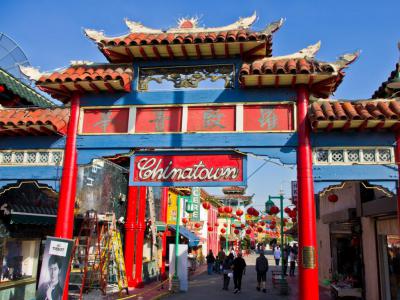
Marking one of the four entrances to New Chinatown, the West Gate on Gin Ling Way at North Hill Street was the first gate built around the Central Plaza. In 1938, L.A.’s Chinese community gathered at this site to celebrate the opening of New Chinatown after the original Chinatown, about a mile away, was uprooted to make room for Union Station. Gin Ling Way, one of Chinatown’s main pedestrian strips, is named after the “Street of Golden Treasures” in Beijing.
The four Chinese characters displayed across the top of the gate, composed by T.K. Chang, translate as “Cooperate to Achieve.” The red, blue, and yellow neon lights adorning the gate’s perimeter were added later. Color-coordinated with all the red lanterns at night, they create a most spectacular sight.
Initially, the gate was partially made of 150-year-old camphor wood imported from China. This durable lumber has been described as the “smelly cousin of cinnamon”-its odor repels insects. The original pillars later had to be replaced with concrete, though, because of weathering and dry rot. The red color of the gate symbolizes happiness and good fortune in Chinese tradition.
Among the memorial plaques displayed at the gate there is one dedicated to 19th-century Chinese builders, presented by then-California governor Frank Finley Merriam, and two others commending architects Adrian Wilson and Erle Webster. The city of Los Angeles declared the West Gate a Historic-Cultural Monument in 2005.
The four Chinese characters displayed across the top of the gate, composed by T.K. Chang, translate as “Cooperate to Achieve.” The red, blue, and yellow neon lights adorning the gate’s perimeter were added later. Color-coordinated with all the red lanterns at night, they create a most spectacular sight.
Initially, the gate was partially made of 150-year-old camphor wood imported from China. This durable lumber has been described as the “smelly cousin of cinnamon”-its odor repels insects. The original pillars later had to be replaced with concrete, though, because of weathering and dry rot. The red color of the gate symbolizes happiness and good fortune in Chinese tradition.
Among the memorial plaques displayed at the gate there is one dedicated to 19th-century Chinese builders, presented by then-California governor Frank Finley Merriam, and two others commending architects Adrian Wilson and Erle Webster. The city of Los Angeles declared the West Gate a Historic-Cultural Monument in 2005.
8) Chinatown Central Plaza
Central Plaza, situated at the heart of L.A.'s Chinatown and positioned between Broadway and Hill streets off College Street, played a pivotal role in the inception of New Chinatown when it officially opened its doors in June 1938. Due to its historical significance as the oldest part of the neighborhood, it is sometimes informally referred to as "Old Chinatown Plaza."
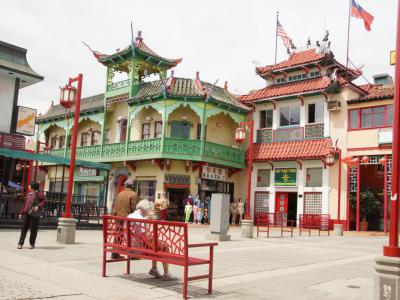
Central Plaza is not just a physical space but also a hub for various Chinatown societies and guilds, including the Hop Sing Tong Society. The architecture of the buildings within Central Plaza is noteworthy, featuring distinctive elements such as sloped roofs, intricate wood carvings, and vibrant facades. Interestingly, these structures were inspired by the Hollywood interpretation of Shanghai and were designed by architects Erle Webster and Adrian Wilson, who were not of Chinese descent.
Central Plaza, near Broadway, features statues of Dr. Sun Yat-sen, a Chinese revolutionary leader, and Bruce Lee. The Sun Yat-sen statue, erected in the 1960s, honors his contributions, while the 7-foot tall Bruce Lee statue was unveiled on June 15, 2013. Don't miss this iconic Chinatown spot where Bruce Lee once had a studio at 628 West College Street.
Central Plaza is a vibrant spot for seniors, offering games, tea, and socializing on sunny mornings. It hosts traditional events like lion dances and lantern festivals during special occasions like Chinese New Year and the Autumn Moon Festival. Notable landmarks include the 50-foot Golden Pagoda and the Seven Star Cavern Wishing Well.
For years, Central Plaza has drawn tourists with its Chinese charm. It offers diverse local crafts like porcelain, woodwork, jade, paintings, herbs, teas, and more. Nearby, there are 15 stores, seven eateries, two bakeries (Wonder Bakery and Phoenix Bakery), and two banks (Standard Savings & Loan and United Savings Bank).
Central Plaza is not just a physical space but also a hub for various Chinatown societies and guilds, including the Hop Sing Tong Society. The architecture of the buildings within Central Plaza is noteworthy, featuring distinctive elements such as sloped roofs, intricate wood carvings, and vibrant facades. Interestingly, these structures were inspired by the Hollywood interpretation of Shanghai and were designed by architects Erle Webster and Adrian Wilson, who were not of Chinese descent.
Central Plaza, near Broadway, features statues of Dr. Sun Yat-sen, a Chinese revolutionary leader, and Bruce Lee. The Sun Yat-sen statue, erected in the 1960s, honors his contributions, while the 7-foot tall Bruce Lee statue was unveiled on June 15, 2013. Don't miss this iconic Chinatown spot where Bruce Lee once had a studio at 628 West College Street.
Central Plaza is a vibrant spot for seniors, offering games, tea, and socializing on sunny mornings. It hosts traditional events like lion dances and lantern festivals during special occasions like Chinese New Year and the Autumn Moon Festival. Notable landmarks include the 50-foot Golden Pagoda and the Seven Star Cavern Wishing Well.
For years, Central Plaza has drawn tourists with its Chinese charm. It offers diverse local crafts like porcelain, woodwork, jade, paintings, herbs, teas, and more. Nearby, there are 15 stores, seven eateries, two bakeries (Wonder Bakery and Phoenix Bakery), and two banks (Standard Savings & Loan and United Savings Bank).
9) Central Plaza East Gate
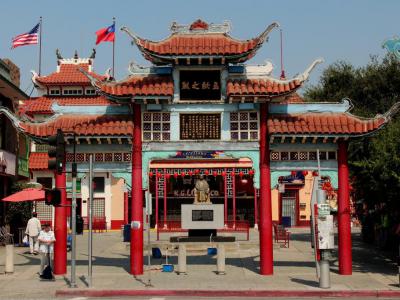
The East Gate is one of the many famous golden landmarks in Old Chinatown Plaza. This grand entrance is located on the east side of the plaza, on Broadway between West College Street and Bamboo Lane, and is particularly photogenic at night, when brightly illuminated with neon lights, giving out a romantic glow to the nearby shops, restaurants, fortune tellers, and other inhabitants of Chinatown. The very first lighting ceremony of the East Gate took place on the first anniversary of New Chinatown in 1939. This historic event reprized years later, in 1985, when the East Gate was ceremoniously refit following a major rehabilitation and beautification effort by the Chinatown Project of the Community Redevelopment Agency.
Otherwise known as the Gate of Maternal Virtues, the East Gate was erected by attorney You Chung Hong in honor of his late mother. The four character poem inscribed on the gate says, “The spirit of (Mother) Meng and (Mother) Ow.” These women were exemplary mothers in the history of China, and so were appropriately revered by their offspring, as each child in Chinese culture reveres and respects their mother.
As you walk through the gateway, you may recognize some of the settings used in many Hollywood productions, TV shows and commercials. Among these TV shows are Hunter, The Rockford Files, Hart To Hart, Beverly Hills, 90210, and Melrose Place. The motion pictures include Lethal Weapon 4, Rush Hour, 8 Millimeter and, of course, Chinatown.
To the right of the gate is a tower with the Dragon Chasing Pearl mural originally painted in 1941 by Chinese-American artist Tyrus Wong. The legendary artist, who passed away in December 2016 at the age of 106, was renowned for his work in film, particularly as the lead artist on Disney's Bambi.
Also nearby is a home decor shop Realm which, years earlier, was the site of Hong Kong Cafe, a restaurant that became a cornerstone in the city's punk rock history. You'll even find a photo of L.A. punk icon, Alice Bag, hanging on the wall.
Otherwise known as the Gate of Maternal Virtues, the East Gate was erected by attorney You Chung Hong in honor of his late mother. The four character poem inscribed on the gate says, “The spirit of (Mother) Meng and (Mother) Ow.” These women were exemplary mothers in the history of China, and so were appropriately revered by their offspring, as each child in Chinese culture reveres and respects their mother.
As you walk through the gateway, you may recognize some of the settings used in many Hollywood productions, TV shows and commercials. Among these TV shows are Hunter, The Rockford Files, Hart To Hart, Beverly Hills, 90210, and Melrose Place. The motion pictures include Lethal Weapon 4, Rush Hour, 8 Millimeter and, of course, Chinatown.
To the right of the gate is a tower with the Dragon Chasing Pearl mural originally painted in 1941 by Chinese-American artist Tyrus Wong. The legendary artist, who passed away in December 2016 at the age of 106, was renowned for his work in film, particularly as the lead artist on Disney's Bambi.
Also nearby is a home decor shop Realm which, years earlier, was the site of Hong Kong Cafe, a restaurant that became a cornerstone in the city's punk rock history. You'll even find a photo of L.A. punk icon, Alice Bag, hanging on the wall.
10) Chinatown Gateway Monument (The Dragon Gate)
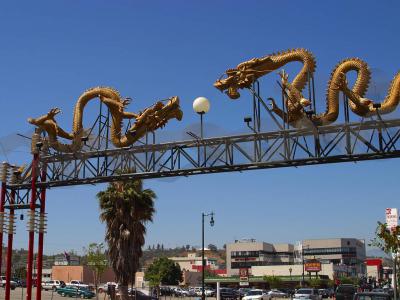
Los Angeles' historic Chinatown has long served as a gateway for countless Chinese and Asian immigrants coming to the United States. Commemorating this historic fact is the Chinatown Gateway Monument, also known as the Dragon Gate, found at the intersection of North Broadway and Cesar E. Chavez Avenue. Funded by the local Teochew-speaking population, the monument symbolizes mutual cooperation and prosperity for the local Chinese community and the city of Los Angeles, and features two dragons poised on a metal framework, ushering in good luck and harmony.
Designed by Chinese-born architect Ruppert Mok, the Gateway was dedicated in June 2001. Mok’s design was said to have come to him in a dream in which he ran across North Broadway and saw a skeleton across the street with two dragons flying on top of it, facing one another, with a pearl right in the middle; the envisioned dragons descended from a cloud.
Painted in the traditional bright gold with red flames at the elbows, the gatekeeper dragons soar 43 feet above ground, set on an 80-foot-wide steel truss welded to eight steel pipes. Aluminum mesh on both sides create the cloud-like effect along with a misting system with nozzles tucked underneath the dragons. The fine spray of water creates the illusion of majestic beasts “flying in the clouds.”
The 3,000-pound fiberglass figures have fins on their backs, scales on the sides of their bodies, and snakeskin on their bellies; the five fingers on each paw represent the highest authority. Their whiskers are 10 to 15 feet long. Each curved dragon measures 35 to 40 feet in length (or up to 70 feet, if straightened out).
The dragons face each other, one looking down with its mouth wide open, and the other looking up with its mouth only slightly ajar. An opaque-fiberglass pearl – representing longevity and prosperity – appears to float between them, held up by a steel bracket. Mok made the taller of the dragons look more aggressive, while the other is more defensive, subtle and protective. Whether they are female or male, is subject to everyone's guess.
If you walk through the Gate, make sure to turn around and look south for a perfectly-framed shot of the City Hall. Brightly illuminated at night since 2004, it offers an ideal photo spot any time of the day.
Designed by Chinese-born architect Ruppert Mok, the Gateway was dedicated in June 2001. Mok’s design was said to have come to him in a dream in which he ran across North Broadway and saw a skeleton across the street with two dragons flying on top of it, facing one another, with a pearl right in the middle; the envisioned dragons descended from a cloud.
Painted in the traditional bright gold with red flames at the elbows, the gatekeeper dragons soar 43 feet above ground, set on an 80-foot-wide steel truss welded to eight steel pipes. Aluminum mesh on both sides create the cloud-like effect along with a misting system with nozzles tucked underneath the dragons. The fine spray of water creates the illusion of majestic beasts “flying in the clouds.”
The 3,000-pound fiberglass figures have fins on their backs, scales on the sides of their bodies, and snakeskin on their bellies; the five fingers on each paw represent the highest authority. Their whiskers are 10 to 15 feet long. Each curved dragon measures 35 to 40 feet in length (or up to 70 feet, if straightened out).
The dragons face each other, one looking down with its mouth wide open, and the other looking up with its mouth only slightly ajar. An opaque-fiberglass pearl – representing longevity and prosperity – appears to float between them, held up by a steel bracket. Mok made the taller of the dragons look more aggressive, while the other is more defensive, subtle and protective. Whether they are female or male, is subject to everyone's guess.
If you walk through the Gate, make sure to turn around and look south for a perfectly-framed shot of the City Hall. Brightly illuminated at night since 2004, it offers an ideal photo spot any time of the day.
