Custom Walk in Zurich, Switzerland by vaneyepiz_48baa created on 2025-05-27
Guide Location: Switzerland » Zurich
Guide Type: Custom Walk
# of Sights: 12
Tour Duration: 2 Hour(s)
Travel Distance: 3.2 Km or 2 Miles
Share Key: MFW28
Guide Type: Custom Walk
# of Sights: 12
Tour Duration: 2 Hour(s)
Travel Distance: 3.2 Km or 2 Miles
Share Key: MFW28
How It Works
Please retrieve this walk in the GPSmyCity app. Once done, the app will guide you from one tour stop to the next as if you had a personal tour guide. If you created the walk on this website or come to the page via a link, please follow the instructions below to retrieve the walk in the app.
Retrieve This Walk in App
Step 1. Download the app "GPSmyCity: Walks in 1K+ Cities" on Apple App Store or Google Play Store.



Step 2. In the GPSmyCity app, download(or launch) the guide "Zurich Map and Walking Tours".
Step 3. Tap the menu button located at upper right corner of the "Walks" screen and select "Retrieve custom walk". Enter the share key: MFW28
1) Niederdorfstrasse (Niederdorf street) (must see)
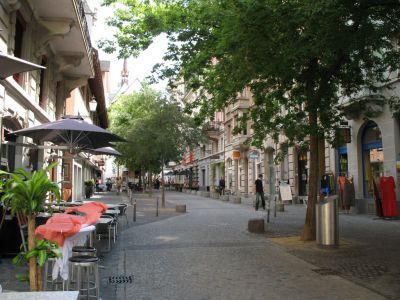
Niederdorf Street-known to locals simply as Niederdorf, or more affectionately as Dörfli (which means "little village")-is Zurich’s cobblestoned catwalk where medieval mischief meets modern-day people-watching. Tucked into the east side of the Old Town, just across the Limmat River, this pedestrian stretch is part time machine, part open-air stage, and full-time charmer.
Back in the day, this was the artisans’ turf. Imagine hammering, shouting, bargaining, and maybe the odd scandal whispered over a barrel of ale. Many of the buildings here date back to the 14th and 15th centuries, and if you squint, you might see a medieval merchant leaning out a timbered window-or maybe it’s just a tourist in vintage Instagram mode...
Fast forward to now, and Dörfli’s still buzzing, only the tools of the trade have changed. Out are the blacksmiths, and in are the chocolate-makers, bookshop keepers, and espresso artists. During the day, it’s the perfect place to grab a coffee, pick up a quirky souvenir, or get delightfully lost in a narrow alley that probably leads to a surprise fountain or a tiny wine bar. By night, the whole street slips into something more comfortable-live music, clinking glasses, laughter in at least five different languages, and bars that don’t mind if you stay a little longer.
The fun starts just opposite Zurich’s main train station and runs parallel to Limmatquai-the riverside promenade one block over, where the views are breezy and the vibes are park-like. Down at the southern end, you'll spot the Great Minster-Zurich’s twin-towered Romanesque giant, looking ever so stoic, while the rest of us have fondue.
Speaking of food: Dörfli delivers too. From bubbling Swiss cheese pots to globally inspired bites, there’s plenty to keep your fork busy. And if you're lucky, a street performer or accordionist might just soundtrack your evening.
Oh, and don’t miss the Dörfli Festival in late August-Zurich's answer to “what if a whole street threw a party?” Music, food, and good vibes guaranteed.
So, go ahead-make good use of your walking shoes, follow the sound of clinking glasses, and let Niederdorf work its old-world magic on you.
Back in the day, this was the artisans’ turf. Imagine hammering, shouting, bargaining, and maybe the odd scandal whispered over a barrel of ale. Many of the buildings here date back to the 14th and 15th centuries, and if you squint, you might see a medieval merchant leaning out a timbered window-or maybe it’s just a tourist in vintage Instagram mode...
Fast forward to now, and Dörfli’s still buzzing, only the tools of the trade have changed. Out are the blacksmiths, and in are the chocolate-makers, bookshop keepers, and espresso artists. During the day, it’s the perfect place to grab a coffee, pick up a quirky souvenir, or get delightfully lost in a narrow alley that probably leads to a surprise fountain or a tiny wine bar. By night, the whole street slips into something more comfortable-live music, clinking glasses, laughter in at least five different languages, and bars that don’t mind if you stay a little longer.
The fun starts just opposite Zurich’s main train station and runs parallel to Limmatquai-the riverside promenade one block over, where the views are breezy and the vibes are park-like. Down at the southern end, you'll spot the Great Minster-Zurich’s twin-towered Romanesque giant, looking ever so stoic, while the rest of us have fondue.
Speaking of food: Dörfli delivers too. From bubbling Swiss cheese pots to globally inspired bites, there’s plenty to keep your fork busy. And if you're lucky, a street performer or accordionist might just soundtrack your evening.
Oh, and don’t miss the Dörfli Festival in late August-Zurich's answer to “what if a whole street threw a party?” Music, food, and good vibes guaranteed.
So, go ahead-make good use of your walking shoes, follow the sound of clinking glasses, and let Niederdorf work its old-world magic on you.
2) Grossmünster (Great Minster) (must see)
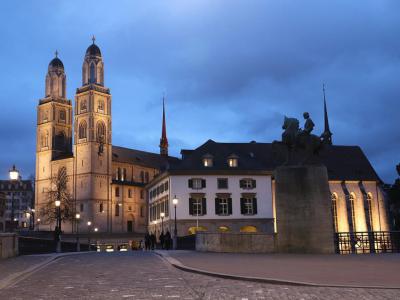
Now, if Zurich’s skyline had a king of the hill, it would probably be the Great Minster-standing tall, proud, and unmistakably Romanesque. It’s one of the city’s four major churches, rubbing historic shoulders with The Church of Our Lady, Preacher's Church, and Saint Peter's Church. But this one’s got some serious theological swagger.
Legend credits none other than Emperor Charlemagne-yes, that Charles the Great-with commissioning the place. Construction kicked off around 1100, and after about 120 years of medieval bricklaying, the Great Minster was born.
But here’s where it gets spicy: in the early 1500s, this church didn’t just host sermons-it became ground zero for the Swiss-German Reformation. Huldrych Zwingli, local priest and full-time disruptor, began preaching bold new ideas in 1520. By 1523, after winning a couple of intense theological debates, Zurich officially seceded from the Pope.
Zwingli’s influence ran deep. In 1524, the interior of the Great Minster underwent a makeover-with religious imagery, altars, and even the organ stripped away. Fasting was declared optional. Mass got rewritten. Celibacy-rethought. Church music? Well… eventually it made a comeback. What’s left is a beautifully bare, historically loaded space that tells the story of faith meeting reform head-on.
And speaking of Charles the Great, you’ll spot him again as a statue perched on the southern tower-sword in hand, crown slipping stylishly off his head like a medieval mic drop. The man unified a good chunk of Europe and even lent his name to the word “king” in many languages. Not bad for a guy in stone.
Okay, the church may seem a little plain inside-but don’t let that fool you. The stained-glass windows made from sliced agate are pure magic. The Carolus Magnus statue is iconic. And the front door alone could earn its own Instagram account.
Tip:
Feeling ambitious? Climb the tower-just 180+ steps up. No lift, no turning back. But once you’re up there, the views of Zurich are unbeatable, and best of all, you can catch your breath for as long as you like.
Legend credits none other than Emperor Charlemagne-yes, that Charles the Great-with commissioning the place. Construction kicked off around 1100, and after about 120 years of medieval bricklaying, the Great Minster was born.
But here’s where it gets spicy: in the early 1500s, this church didn’t just host sermons-it became ground zero for the Swiss-German Reformation. Huldrych Zwingli, local priest and full-time disruptor, began preaching bold new ideas in 1520. By 1523, after winning a couple of intense theological debates, Zurich officially seceded from the Pope.
Zwingli’s influence ran deep. In 1524, the interior of the Great Minster underwent a makeover-with religious imagery, altars, and even the organ stripped away. Fasting was declared optional. Mass got rewritten. Celibacy-rethought. Church music? Well… eventually it made a comeback. What’s left is a beautifully bare, historically loaded space that tells the story of faith meeting reform head-on.
And speaking of Charles the Great, you’ll spot him again as a statue perched on the southern tower-sword in hand, crown slipping stylishly off his head like a medieval mic drop. The man unified a good chunk of Europe and even lent his name to the word “king” in many languages. Not bad for a guy in stone.
Okay, the church may seem a little plain inside-but don’t let that fool you. The stained-glass windows made from sliced agate are pure magic. The Carolus Magnus statue is iconic. And the front door alone could earn its own Instagram account.
Tip:
Feeling ambitious? Climb the tower-just 180+ steps up. No lift, no turning back. But once you’re up there, the views of Zurich are unbeatable, and best of all, you can catch your breath for as long as you like.
3) Wasserkirche (Water Church)
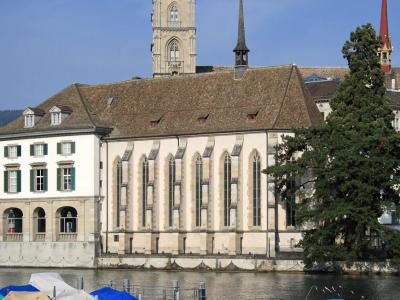
Inside the Water Church, Zurich’s history flows just as steadily as the Limmat River beneath it. First mentioned in 1250, but with roots going all the way back to the 1100s, this church wasn’t just built near the water-it was built on it. Originally perched on a little island in the river, it looked like it was doing the medieval version of island life before it was cool. By 1486, it got a full makeover-think of it as a 15th-century home renovation, but with more stained glass and fewer Instagram reels.
Then came the Reformation, and let’s just say the Water Church’s spiritual career hit a speed bump. Reformers, unimpressed by its "idolatrous" vibe, gave it a secular upgrade-making it Zurich’s very first public library in 1634. So, yes, before the Kindle, there was the Water Church...
During the 1800s, the island it sat on got connected to the mainland (bye-bye, island mystique), and by 1917, the library moved out. The church, now unemployed, found a new gig-grain storage. Holy wheat, indeed...
In the 1940s, archaeologists and restorers gave the building some long-overdue tender loving care. The crypt was dusted off, the walls were reinforced, and by the time the renovations were done, the church was back in the business of being a place of worship-this time serving the Evangelical-Reformed State Church of Zurich.
But history aside, the Water Church stands on solemn ground. Legend has it that Zurich’s patron saints, Felix and Regula, were executed right here after refusing to persecute Christians. Decapitated, yes-but apparently they stood up and walked off with their heads. As saints sometimes do...
Coming here, you'll find a serene, quiet corner of Zurich where you can catch your breath, contemplate eternity, or just admire the stunning Giacometti windows and explore the mysterious crypt below. Divine inspiration not guaranteed-but a moment of peace is highly likely.
Then came the Reformation, and let’s just say the Water Church’s spiritual career hit a speed bump. Reformers, unimpressed by its "idolatrous" vibe, gave it a secular upgrade-making it Zurich’s very first public library in 1634. So, yes, before the Kindle, there was the Water Church...
During the 1800s, the island it sat on got connected to the mainland (bye-bye, island mystique), and by 1917, the library moved out. The church, now unemployed, found a new gig-grain storage. Holy wheat, indeed...
In the 1940s, archaeologists and restorers gave the building some long-overdue tender loving care. The crypt was dusted off, the walls were reinforced, and by the time the renovations were done, the church was back in the business of being a place of worship-this time serving the Evangelical-Reformed State Church of Zurich.
But history aside, the Water Church stands on solemn ground. Legend has it that Zurich’s patron saints, Felix and Regula, were executed right here after refusing to persecute Christians. Decapitated, yes-but apparently they stood up and walked off with their heads. As saints sometimes do...
Coming here, you'll find a serene, quiet corner of Zurich where you can catch your breath, contemplate eternity, or just admire the stunning Giacometti windows and explore the mysterious crypt below. Divine inspiration not guaranteed-but a moment of peace is highly likely.
4) Rathaus (Town Hall)
Zurich’s power couple: the Town Hall and the City House-two buildings, one river, and several centuries of political drama.
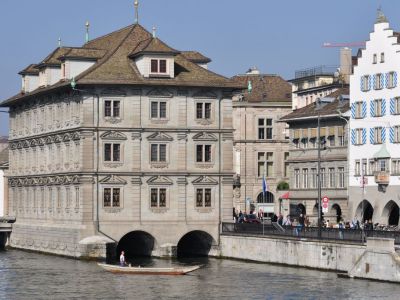
The former of the two, the Town Hall, is a stately beauty dating back to the 1690s, sitting atop a historical layer cake. It's built on the bones of a 1397 city council hall, which itself rose from a 13th-century courthouse. Basically, if these walls could talk, they’d probably be exhausted. Once the seat of the Republic of Zurich until 1798, it is now the proud property of the Canton of Zurich and hosts both the cantonal and city parliaments. Talk about multitasking...
Just across the river (because Zurich doesn’t believe in overcrowding its government buildings), you’ll find the City House, the edifice in which the executive government gets down to business. It's on the Limmat’s west side, just south of the Town Hall Bridge. If you time it right, you can watch democracy in action from a second-floor terrace. It’s like political theater, but with less shouting.
Speaking of the Town Hall Bridge, this isn’t just any river crossing. It’s a plaza, a market, a pedestrian hangout, and a time machine all rolled into one. The locals used to call it the “vegetable bridge,” because medieval farmers once hawked their carrots and cabbages here. Today, you're more likely to find bratwurst and espresso.
This bridge has been around since the Middle Ages, originally made entirely of wood. Expanded in 1375 and again in 1420, it’s always been extra-wide enough for buildings to sit on top. By the 1600s, it had grown into its current footprint, and in the 1800s, it ditched the timber look for some serious stone-and-cast-iron swagger.
The bridge and surrounding square still buzz with life-festivals, markets, street performers, and all the postcard-perfect souvenir shops your heart desires. It’s pedestrian-only, so, put on your comfy footwear and let history meet you halfway across the Limmat.
The former of the two, the Town Hall, is a stately beauty dating back to the 1690s, sitting atop a historical layer cake. It's built on the bones of a 1397 city council hall, which itself rose from a 13th-century courthouse. Basically, if these walls could talk, they’d probably be exhausted. Once the seat of the Republic of Zurich until 1798, it is now the proud property of the Canton of Zurich and hosts both the cantonal and city parliaments. Talk about multitasking...
Just across the river (because Zurich doesn’t believe in overcrowding its government buildings), you’ll find the City House, the edifice in which the executive government gets down to business. It's on the Limmat’s west side, just south of the Town Hall Bridge. If you time it right, you can watch democracy in action from a second-floor terrace. It’s like political theater, but with less shouting.
Speaking of the Town Hall Bridge, this isn’t just any river crossing. It’s a plaza, a market, a pedestrian hangout, and a time machine all rolled into one. The locals used to call it the “vegetable bridge,” because medieval farmers once hawked their carrots and cabbages here. Today, you're more likely to find bratwurst and espresso.
This bridge has been around since the Middle Ages, originally made entirely of wood. Expanded in 1375 and again in 1420, it’s always been extra-wide enough for buildings to sit on top. By the 1600s, it had grown into its current footprint, and in the 1800s, it ditched the timber look for some serious stone-and-cast-iron swagger.
The bridge and surrounding square still buzz with life-festivals, markets, street performers, and all the postcard-perfect souvenir shops your heart desires. It’s pedestrian-only, so, put on your comfy footwear and let history meet you halfway across the Limmat.
5) Lindenhofplatz (Lindenhof Square) (must see)
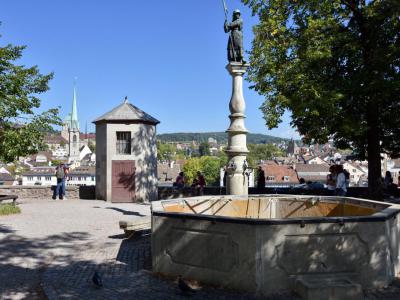
Perched above the Old Town of Zurich like a quiet, leafy crown, Lindenhof is both a park and a time machine with a view. And it's not just where the city began-it’s where the city still comes to breathe...
This peaceful hilltop was once the site of a Roman fortress, complete with ten towers and walls thick enough to make modern builders weep. The Romans got busy here in the 2nd century, but by the 9th, Louis the German decided the crumbling castle needed a royal facelift. Sadly, by the 13th century, the whole thing was abandoned, and locals did what locals do best-recycled the stones for new projects. Eco-friendly before it was cool...
And no, Zurich’s ancient swagger didn’t start with Roman togas and centurions. Long before Rome flexed its empire, Neolithic and Bronze Age folks had already claimed this hill as prime real estate. Back then, the Sihl River liked to flood the surrounding lands, and the elevated Lindenhof was the safe (and dry) bet.
Fast forward to the 1700s, and Lindenhof reinvented itself as a public park. The early crowd-pleaser, it was primarily about archery and crossbow contests that drew visitors in those days (indeed, nothing like a bit of target practice to go with your afternoon stroll...).
Nowadays, keep an eye out for the Hedwig Fountain, built in 1912 to honor one of Zurich’s boldest deceptions. During the 1292 siege by Duke Albert I, the city’s women donned full battle gear and manned the ramparts, while the men were off fighting elsewhere. The ruse worked, and Zurich lived to tell the tale. Today, Hedwig and her helmet still stand proudly in the park, thanks to sculptor Gustav Siber.
Apart from all the attractions inside, Lindenhof gives you panoramic eye-candy of Zurich’s rooftops, rivers, and lake-all in one relaxed snapshot. It’s the city’s breathing room, ideal for a pause between museum marathons and shopping sprees. Kids can run wild on the playgrounds, and for the tactically inclined, there’s an outdoor chessboard waiting to test your strategy.
Oh, and if you’re lucky, you might stumble onto a festival or event-just ask at the tourism office.
Insider tip:
Check out the replica of a Roman tombstone that first mentioned Turicum-Zurich’s name back when Latin was all the rage. The original is at the Swiss National Museum, but Lindenhof’s got its own copy for on-the-spot admiration...
This peaceful hilltop was once the site of a Roman fortress, complete with ten towers and walls thick enough to make modern builders weep. The Romans got busy here in the 2nd century, but by the 9th, Louis the German decided the crumbling castle needed a royal facelift. Sadly, by the 13th century, the whole thing was abandoned, and locals did what locals do best-recycled the stones for new projects. Eco-friendly before it was cool...
And no, Zurich’s ancient swagger didn’t start with Roman togas and centurions. Long before Rome flexed its empire, Neolithic and Bronze Age folks had already claimed this hill as prime real estate. Back then, the Sihl River liked to flood the surrounding lands, and the elevated Lindenhof was the safe (and dry) bet.
Fast forward to the 1700s, and Lindenhof reinvented itself as a public park. The early crowd-pleaser, it was primarily about archery and crossbow contests that drew visitors in those days (indeed, nothing like a bit of target practice to go with your afternoon stroll...).
Nowadays, keep an eye out for the Hedwig Fountain, built in 1912 to honor one of Zurich’s boldest deceptions. During the 1292 siege by Duke Albert I, the city’s women donned full battle gear and manned the ramparts, while the men were off fighting elsewhere. The ruse worked, and Zurich lived to tell the tale. Today, Hedwig and her helmet still stand proudly in the park, thanks to sculptor Gustav Siber.
Apart from all the attractions inside, Lindenhof gives you panoramic eye-candy of Zurich’s rooftops, rivers, and lake-all in one relaxed snapshot. It’s the city’s breathing room, ideal for a pause between museum marathons and shopping sprees. Kids can run wild on the playgrounds, and for the tactically inclined, there’s an outdoor chessboard waiting to test your strategy.
Oh, and if you’re lucky, you might stumble onto a festival or event-just ask at the tourism office.
Insider tip:
Check out the replica of a Roman tombstone that first mentioned Turicum-Zurich’s name back when Latin was all the rage. The original is at the Swiss National Museum, but Lindenhof’s got its own copy for on-the-spot admiration...
6) Augustinergasse (Augustinian Street)
Augustinian Street (Augustinergasse), located in the center of Zürich, represents the city's medieval past mixed with its modern energy. Originally named after the Augustinian Abbey, now the Augustinian Church (Augustinerkirche), this old street is a lively pedestrian area in the heart of Zürich's downtown. The church, once the hub of a convent that ended in 1525, is now used by the Christ Catholic community. Although it appears modest compared to the vibrant street, it holds historical significance.
In the past, Augustinian Street played a vital role in connecting various parts of the medieval city, like Münsterhof, Saint Peterhofstatt, and the Münzplatz, to the city gates and defenses. Its importance was further solidified when it became part of the southern extension of the Seeuferanlage promenades between 1881 and 1887. This made it not only an essential part of the city's layout but also a popular spot in Zürich's oldest neighborhood.
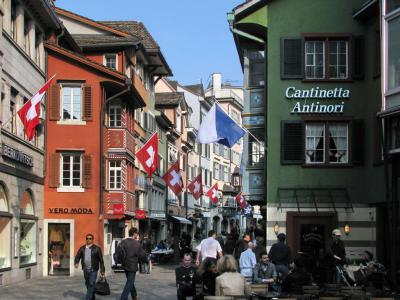
The street reflects Zürich's transition from a medieval craft center to a place of wealth and artistic expression. Starting from the 17th century, affluent factory owners moved in, leading to a competition to create the most impressive facades. This resulted in beautifully decorated wooden bay windows on the colorful houses that now line the street, making it one of the city's most charming areas. Nowadays, these buildings house shops, cafes, and restaurants catering to tourists, adding to the street's lively vibe.
The Augustinian Street illustrates Zürich's ability to retain its historical charm while embracing modern urban life. It offers visitors a glimpse into the city's past, showcasing the creativity of medieval artisans and the later inhabitants' wealth and architectural ambition. Therefore, it's not just a street but a cultural symbol, representing Zürich's spirit and evolution over time.
In the past, Augustinian Street played a vital role in connecting various parts of the medieval city, like Münsterhof, Saint Peterhofstatt, and the Münzplatz, to the city gates and defenses. Its importance was further solidified when it became part of the southern extension of the Seeuferanlage promenades between 1881 and 1887. This made it not only an essential part of the city's layout but also a popular spot in Zürich's oldest neighborhood.
The street reflects Zürich's transition from a medieval craft center to a place of wealth and artistic expression. Starting from the 17th century, affluent factory owners moved in, leading to a competition to create the most impressive facades. This resulted in beautifully decorated wooden bay windows on the colorful houses that now line the street, making it one of the city's most charming areas. Nowadays, these buildings house shops, cafes, and restaurants catering to tourists, adding to the street's lively vibe.
The Augustinian Street illustrates Zürich's ability to retain its historical charm while embracing modern urban life. It offers visitors a glimpse into the city's past, showcasing the creativity of medieval artisans and the later inhabitants' wealth and architectural ambition. Therefore, it's not just a street but a cultural symbol, representing Zürich's spirit and evolution over time.
7) St. Peterskirche (St. Peter's Church) (must see)
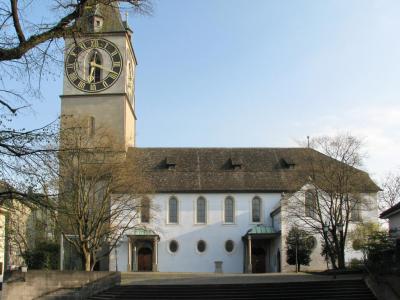
Saint Peter's Church-Zurich’s oldest temple-is also, quite possibly, the city’s most punctual landmark. Built in the 9th century, this beauty has seen more centuries than your local pub’s clock has seen beers. And speaking of clocks, St. Peter’s claims the biggest clock face in all of Europe. At a whopping 8.6 meters in diameter, its minute hand alone is longer than most compact cars. No excuse for being late around here...
The church got some facelifts over the years-first in the 13th century and again in the 1700s-because, indeed, medieval landmarks deserve a little renovation every now and then. Until 1911, a firewatcher lived in the steeple, popping his head out the window four times an hour to scan for smoke. If flames were spotted, he’d wave a flag in the direction of the danger-simple, low-tech, and surprisingly effective. Thus, unlike many of its European cousins, Zurich avoided catastrophic fires. It turns out that medieval flag signals are not just for parades...
Inside the church, you’ll find a Baroque nave paired with a Romanesque choir-like architectural speed dating through the centuries. Look closely at the faded murals, and you might spot a saint lurking in the shadows. Above the pulpit, the name of God appears in Hebrew, a nod to the Reformation’s love for the Bible’s original languages. Think of it as ancient theological street cred...
Now here’s the kicker: Saint Peter’s Church has shared custody. The City of Zurich owns the tower, while the Swiss Reformed Church parish holds the rights to the bells, the belfry, and the staircase. It is, indeed, church co-parenting at its finest...
Tip for the savvy traveler: Admire it up close, but for peak Instagram potential, cross the river-the church is even prettier from a distance.
The church got some facelifts over the years-first in the 13th century and again in the 1700s-because, indeed, medieval landmarks deserve a little renovation every now and then. Until 1911, a firewatcher lived in the steeple, popping his head out the window four times an hour to scan for smoke. If flames were spotted, he’d wave a flag in the direction of the danger-simple, low-tech, and surprisingly effective. Thus, unlike many of its European cousins, Zurich avoided catastrophic fires. It turns out that medieval flag signals are not just for parades...
Inside the church, you’ll find a Baroque nave paired with a Romanesque choir-like architectural speed dating through the centuries. Look closely at the faded murals, and you might spot a saint lurking in the shadows. Above the pulpit, the name of God appears in Hebrew, a nod to the Reformation’s love for the Bible’s original languages. Think of it as ancient theological street cred...
Now here’s the kicker: Saint Peter’s Church has shared custody. The City of Zurich owns the tower, while the Swiss Reformed Church parish holds the rights to the bells, the belfry, and the staircase. It is, indeed, church co-parenting at its finest...
Tip for the savvy traveler: Admire it up close, but for peak Instagram potential, cross the river-the church is even prettier from a distance.
8) Fraumünster (Church of Our Lady) (must see)
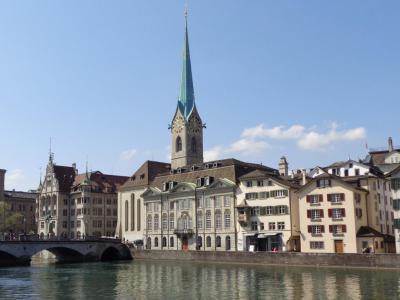
The Church of Our Lady-or Fraumünster if you're feeling Swiss about it-is easily one of Zurich’s most eye-catching landmarks, thanks to that graceful blue spire that insists on being in every skyline photo. Founded way back in 853 by Emperor Louis the German for his daughter Hildegard (talk about a royal housewarming gift), this wasn’t an average cloistered convent. No, the abbess here wasn’t just praying and gardening-she was running the show. In medieval Zurich, she held market rights, minted coins, and had a firm grip on city affairs. Basically, before Zurich was ruled by bankers in suits, it was partly governed by nuns with serious executive power.
By 874, they’d added a basilica complete with a crypt that now houses Zurich’s patron saints, Felix and Regula-because a great city can certainly benefit from a couple of martyred siblings watching over it. But the good times for the abbey came to an end in 1524 during the Reformation. The last abbess handed the keys over to the city, and most of the religious art was either taken down or..., well, aggressively removed.
Today, people come not just for the medieval intrigue, but for the stunning mashup of Gothic architecture and Baroque flair. And then-boom-the stained glass. In the 1970s, none other than Marc Chagall himself stepped in and created five towering windows for the choir. Each one tells a biblical story in bold, glowing color. The “Prophet” window is all reds and oranges and righteous fire. Across from it are “Jacob,” “Christ,” and “Zion” in cooler, gentler hues, and the “Law” window fit to impress even Moses himself.
Also remarkable is the vibrant window near the entrance by Augusto Giacometti, adding another layer of artistic prestige to the church’s interior. So now it doubles as an accidental art museum.
If you're visiting, do grab the audio guide-it’s included with the ticket and actually quite good. You’ll get the full story, minus the Latin. Entry fees vary, and remember: while photos of the interior are generally allowed, pictures of the Chagall windows are strictly prohibited. Your phone will be tempted, but resist. Oh, and be sure to bring some Swiss francs, too-they still like their cash here.
So, whether you’re into saints, stained glass, or just need a break from the Station Street, the Church of Our Lady is a peaceful detour into Zurich’s soul-with a splash of color and a whole lot of history.
By 874, they’d added a basilica complete with a crypt that now houses Zurich’s patron saints, Felix and Regula-because a great city can certainly benefit from a couple of martyred siblings watching over it. But the good times for the abbey came to an end in 1524 during the Reformation. The last abbess handed the keys over to the city, and most of the religious art was either taken down or..., well, aggressively removed.
Today, people come not just for the medieval intrigue, but for the stunning mashup of Gothic architecture and Baroque flair. And then-boom-the stained glass. In the 1970s, none other than Marc Chagall himself stepped in and created five towering windows for the choir. Each one tells a biblical story in bold, glowing color. The “Prophet” window is all reds and oranges and righteous fire. Across from it are “Jacob,” “Christ,” and “Zion” in cooler, gentler hues, and the “Law” window fit to impress even Moses himself.
Also remarkable is the vibrant window near the entrance by Augusto Giacometti, adding another layer of artistic prestige to the church’s interior. So now it doubles as an accidental art museum.
If you're visiting, do grab the audio guide-it’s included with the ticket and actually quite good. You’ll get the full story, minus the Latin. Entry fees vary, and remember: while photos of the interior are generally allowed, pictures of the Chagall windows are strictly prohibited. Your phone will be tempted, but resist. Oh, and be sure to bring some Swiss francs, too-they still like their cash here.
So, whether you’re into saints, stained glass, or just need a break from the Station Street, the Church of Our Lady is a peaceful detour into Zurich’s soul-with a splash of color and a whole lot of history.
9) Paradeplatz (Parade Square)
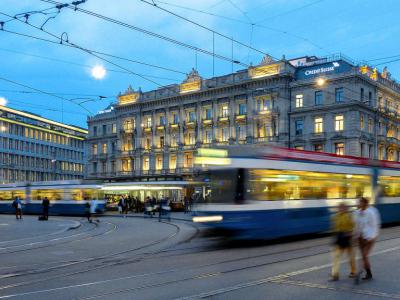
Parade Square - Zurich’s glittering crossroads of power, pastries, and jaw-dropping property prices. Nestled on Station Street and laced with tram tracks like a well-frosted cake, this square is the beating heart of Swiss finance. Here, the global giants Credit Suisse and UBS sit like heavyweight chess pieces, guarding a board where real estate is so pricey, it practically comes with its own bodyguard.
But don’t fall for this corporate shine - Parade Square wasn’t always a banker’s playground. Back in the 17th century, it was here that cows mooed and bleated at a lively livestock market just outside the city walls. All that changed in 1642, when Zurich decided to expand its waistline with extra fortifications. A couple of centuries later, in 1865, Station Street was drawn up, and Parade Square got its name - just in time to catch the next tram, which, by the way, used to be horse-drawn until they got an upgrade in 1896. Electricity turned out to be equally good for both light bulbs and public transport...
The square’s grand buildings mostly popped up during the mid-1800s. Take the Credit Suisse building, planted here in 1873 like a money tree. Or the regal Baur en Ville hotel, which first opened its polished doors in 1838. In true Swiss fashion, they demolished it entirely in the 1970s, only to rebuild it exactly the same - just with plumbing that actually works...
But the real crown jewel is Sprüngli Café. Open since 1859, and famous well before that thanks to Rudolf Sprüngli’s chocolate wizardry since 1836, this place is ground zero for anyone serious about truffles, tarts, and tingly taste buds. You haven’t really been to Zurich until you’ve dropped by Sprüngli - bonus points if you pronounce it correctly with your mouth full of Luxemburgerli.
So, go ahead, hop off the tram, stare at your bank balance, and soak in the Swiss elegance. Parade Square: here, fortunes are made, lost, and occasionally spent on chocolate...
But don’t fall for this corporate shine - Parade Square wasn’t always a banker’s playground. Back in the 17th century, it was here that cows mooed and bleated at a lively livestock market just outside the city walls. All that changed in 1642, when Zurich decided to expand its waistline with extra fortifications. A couple of centuries later, in 1865, Station Street was drawn up, and Parade Square got its name - just in time to catch the next tram, which, by the way, used to be horse-drawn until they got an upgrade in 1896. Electricity turned out to be equally good for both light bulbs and public transport...
The square’s grand buildings mostly popped up during the mid-1800s. Take the Credit Suisse building, planted here in 1873 like a money tree. Or the regal Baur en Ville hotel, which first opened its polished doors in 1838. In true Swiss fashion, they demolished it entirely in the 1970s, only to rebuild it exactly the same - just with plumbing that actually works...
But the real crown jewel is Sprüngli Café. Open since 1859, and famous well before that thanks to Rudolf Sprüngli’s chocolate wizardry since 1836, this place is ground zero for anyone serious about truffles, tarts, and tingly taste buds. You haven’t really been to Zurich until you’ve dropped by Sprüngli - bonus points if you pronounce it correctly with your mouth full of Luxemburgerli.
So, go ahead, hop off the tram, stare at your bank balance, and soak in the Swiss elegance. Parade Square: here, fortunes are made, lost, and occasionally spent on chocolate...
10) Bürkliplatz Market
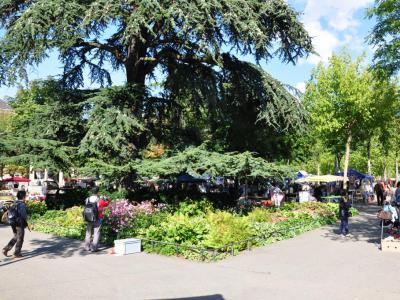
Nicknamed by the locals as “Bürklimäärt”, this cozy open-air market sits at the far end of Bahnhofstrasse, on Bürkliplatz, between the banking district and picturesque Lake Zurich. If you're keen on fresh herbs, seasonal and regional fruits and vegetables, this place is for you!
Here, under the canopy of horse chestnut trees you will find stalls laden with organic products, exotic foods from all over the globe, and many other savory delights. The market offers a large choice of fresh products, such as mushrooms and berries, different sorts of cheese, fish, fresh bread, bakery and confectionery, as well as numerous regional farm specialties.
A visit here can be easily combined with a leisurely stroll along the lake, the wonderful sight of which alone makes it well worth the while. In addition to the idyllic location, the market is also famous, not to a lesser degree, for its beautiful cut flowers and potted plants which are much popular with those eager to make a gift for their loved ones.
Here, under the canopy of horse chestnut trees you will find stalls laden with organic products, exotic foods from all over the globe, and many other savory delights. The market offers a large choice of fresh products, such as mushrooms and berries, different sorts of cheese, fish, fresh bread, bakery and confectionery, as well as numerous regional farm specialties.
A visit here can be easily combined with a leisurely stroll along the lake, the wonderful sight of which alone makes it well worth the while. In addition to the idyllic location, the market is also famous, not to a lesser degree, for its beautiful cut flowers and potted plants which are much popular with those eager to make a gift for their loved ones.
11) Bürkliplatz (Burkli Square)
Burkli-Zurich’s unofficial front porch, main square, and tram central all rolled into one. If you're looking for a place where the city gently slips off its shoes and enjoys the lake breeze, this is it. With a steady hum of trams passing through, it's where urban bustle meets lakeside leisure, and somehow, they get along quite nicely.
Just to the north, under the shade of well-behaved trees, is Stadthausanlage-a leafy square that hosts some of the city’s most delicious negotiations: veggies, cheese, flowers, and bread, all vying for your attention at the local market. In the middle, a classic music pavilion nods politely to passersby, often with a soundtrack to match.
From here, Station Street marches north like a well-dressed soldier, ready to lead you straight into Zurich’s high-end shopping world-credit cards beware...
But back to Burkli Square. It’s not just the transport hub or the snack stand heaven (though the bratwurst game is strong). It is also your launch pad for scenic lake cruises and water taxis-because, yes, Zurich knows how to do traffic with style.
To the east, the elegant Quay Bridge crosses the Limmat like a well-dressed Victorian gentleman. Nearby, the Seeuferanlage lakefront park stretches out invitingly, complete with an arboretum and aviary. Nature and relaxation? Yes, and yes.
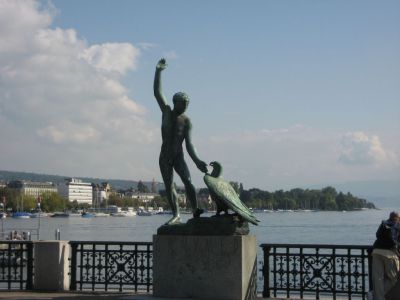
And don't miss the statue of Ganymede at the lake overlook-it’s a dramatic bronze moment of myth-meets-modernity, with the young man being whisked away by Zeus’s eagle, as you do on an average Zurich afternoon...
Just a short stroll east, you'll run into the Geiserbrunnen, a beefy 1911 sculpture by Jakob Brüllmann, where a man appears to be in intense negotiation-or maybe just wrestling-with a bull. Either way, it's got the energy of a protein bar ad.
Burkli Square is not just a place to pass through-it’s a place to pause, snack, stare at some art, and maybe catch a boat. So, linger a little. Zurich doesn’t mind...
Just to the north, under the shade of well-behaved trees, is Stadthausanlage-a leafy square that hosts some of the city’s most delicious negotiations: veggies, cheese, flowers, and bread, all vying for your attention at the local market. In the middle, a classic music pavilion nods politely to passersby, often with a soundtrack to match.
From here, Station Street marches north like a well-dressed soldier, ready to lead you straight into Zurich’s high-end shopping world-credit cards beware...
But back to Burkli Square. It’s not just the transport hub or the snack stand heaven (though the bratwurst game is strong). It is also your launch pad for scenic lake cruises and water taxis-because, yes, Zurich knows how to do traffic with style.
To the east, the elegant Quay Bridge crosses the Limmat like a well-dressed Victorian gentleman. Nearby, the Seeuferanlage lakefront park stretches out invitingly, complete with an arboretum and aviary. Nature and relaxation? Yes, and yes.
And don't miss the statue of Ganymede at the lake overlook-it’s a dramatic bronze moment of myth-meets-modernity, with the young man being whisked away by Zeus’s eagle, as you do on an average Zurich afternoon...
Just a short stroll east, you'll run into the Geiserbrunnen, a beefy 1911 sculpture by Jakob Brüllmann, where a man appears to be in intense negotiation-or maybe just wrestling-with a bull. Either way, it's got the energy of a protein bar ad.
Burkli Square is not just a place to pass through-it’s a place to pause, snack, stare at some art, and maybe catch a boat. So, linger a little. Zurich doesn’t mind...
12) FIFA World Football Museum
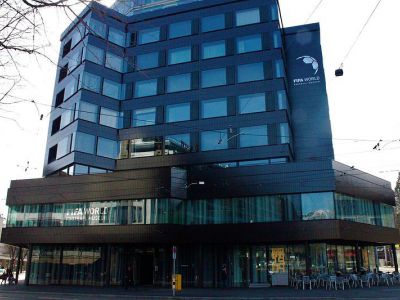
The FIFA World Football Museum in Zurich celebrates the rich history and widespread appeal of soccer. Managed by FIFA, the museum is located in Zurich's Enge neighborhood, close to FIFA's headquarters. The idea for the museum emerged in 2012 when Sepp Blatter, then FIFA president, and the FIFA Executive Committee envisioned a space dedicated to the global history of soccer. By April 2013, FIFA signed a 40-year lease agreement with Swiss Life for the Haus zur Enge, built by Werner Stücheli, which underwent significant renovations to become the museum's home.
The museum officially opened on February 28, 2016, with Gianni Infantino, FIFA's newly elected president, leading the ceremony. It occupies the lower three floors of the Haus zur Enge, covering 3,500 square meters (about 38,000 square feet) and offering a comprehensive look at soccer's worldwide journey.
The museum's collection includes over a thousand objects showcasing key moments in soccer history, such as memorabilia from FIFA World Cups and FIFA Women's World Cups. The original FIFA World Cup Trophy is a highlight. The museum provides an interactive experience, including the world's largest pinball machine and an audiovisual show called "Visions of Football," which brings soccer's memorable moments to life on 8-meter LED screens.
Aside from exhibitions, the museum features amenities like a sports bar, bistro, café, library, and shop offering exclusive soccer-related merchandise. It also includes conference rooms and hosts events, making it a versatile space. The upper floors of the building house offices and luxury apartments, integrating the museum into the city's urban landscape.
The museum's design and concept earned recognition in 2017 with a nomination for the German Design Award, highlighting its importance in cultural institutions. It actively engages with Zurich's cultural scene, participating in events like the Long Night of Museums to make soccer history accessible and engaging to all visitors.
The museum officially opened on February 28, 2016, with Gianni Infantino, FIFA's newly elected president, leading the ceremony. It occupies the lower three floors of the Haus zur Enge, covering 3,500 square meters (about 38,000 square feet) and offering a comprehensive look at soccer's worldwide journey.
The museum's collection includes over a thousand objects showcasing key moments in soccer history, such as memorabilia from FIFA World Cups and FIFA Women's World Cups. The original FIFA World Cup Trophy is a highlight. The museum provides an interactive experience, including the world's largest pinball machine and an audiovisual show called "Visions of Football," which brings soccer's memorable moments to life on 8-meter LED screens.
Aside from exhibitions, the museum features amenities like a sports bar, bistro, café, library, and shop offering exclusive soccer-related merchandise. It also includes conference rooms and hosts events, making it a versatile space. The upper floors of the building house offices and luxury apartments, integrating the museum into the city's urban landscape.
The museum's design and concept earned recognition in 2017 with a nomination for the German Design Award, highlighting its importance in cultural institutions. It actively engages with Zurich's cultural scene, participating in events like the Long Night of Museums to make soccer history accessible and engaging to all visitors.
