Custom Walk in Frankfurt, Germany by pastor_leah_4496d created on 2025-06-06
Guide Location: Germany » Frankfurt
Guide Type: Custom Walk
# of Sights: 13
Tour Duration: 3 Hour(s)
Travel Distance: 5 Km or 3.1 Miles
Share Key: EX6TA
Guide Type: Custom Walk
# of Sights: 13
Tour Duration: 3 Hour(s)
Travel Distance: 5 Km or 3.1 Miles
Share Key: EX6TA
How It Works
Please retrieve this walk in the GPSmyCity app. Once done, the app will guide you from one tour stop to the next as if you had a personal tour guide. If you created the walk on this website or come to the page via a link, please follow the instructions below to retrieve the walk in the app.
Retrieve This Walk in App
Step 1. Download the app "GPSmyCity: Walks in 1K+ Cities" on Apple App Store or Google Play Store.



Step 2. In the GPSmyCity app, download(or launch) the guide "Frankfurt Map and Walking Tours".
Step 3. Tap the menu button located at upper right corner of the "Walks" screen and select "Retrieve custom walk". Enter the share key: EX6TA
1) Place of Remembrance: Synagogue Friedberger Anlage
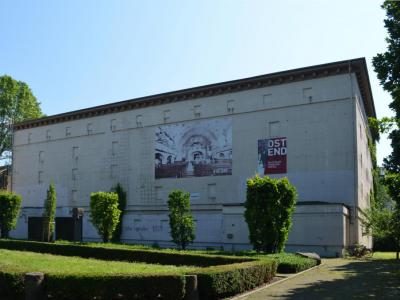
No. 6 Friedberger Anlage is the former location of a Jewish synagogue in Frankfurt that was deliberately destroyed by the Nazis.
The synagogue was built from 1905 to 1907 and was characterized by the transition style of reform architecture with elements of Romanesque and Orientalism. On November 10, 1938, it fell victim to an arson organized by the Nazis as part of the November pogroms of 1938. The police ordered the demolition of the building out of the risk of collapse. The destruction began on November 17, 1938, and was finished on June 12, 1939.
In 1942-43, a five-storey bunker was built on the site. While the surrounding Ostend district was badly damaged by air raids, the bunker remained intact. After the war, from 1947 to 1965, it served as a book storage and university library, and then as a furniture store, from 1968 to 1988.
Since the early 1950s, the Jewish Restitution Successor Organization had demanded the removal of the bunker and restitution of the property. Eventually, it came into the possession of the Federal Finance Administration, upon which the city undertook to erect a permanent memorial for the synagogue. The Friedberger Anlage Synagogue Memorial Site, designed by landscape architect Jeannette Garnhartner, was finally erected in the forecourt of the bunker in 1988. The bunker itself now houses a permanent exhibition about Jewish life in Frankfurt's Ostend.
The synagogue was built from 1905 to 1907 and was characterized by the transition style of reform architecture with elements of Romanesque and Orientalism. On November 10, 1938, it fell victim to an arson organized by the Nazis as part of the November pogroms of 1938. The police ordered the demolition of the building out of the risk of collapse. The destruction began on November 17, 1938, and was finished on June 12, 1939.
In 1942-43, a five-storey bunker was built on the site. While the surrounding Ostend district was badly damaged by air raids, the bunker remained intact. After the war, from 1947 to 1965, it served as a book storage and university library, and then as a furniture store, from 1968 to 1988.
Since the early 1950s, the Jewish Restitution Successor Organization had demanded the removal of the bunker and restitution of the property. Eventually, it came into the possession of the Federal Finance Administration, upon which the city undertook to erect a permanent memorial for the synagogue. The Friedberger Anlage Synagogue Memorial Site, designed by landscape architect Jeannette Garnhartner, was finally erected in the forecourt of the bunker in 1988. The bunker itself now houses a permanent exhibition about Jewish life in Frankfurt's Ostend.
2) Memorial Wall
The Neuer Börneplatz Memorial Site, also known as the Börneplatz Memorial Site, is located in Frankfurt am Main and serves as a tribute to the Jewish community of Frankfurt that was tragically decimated during the Holocaust. This somber memorial site was officially opened to the public on June 16, 1996.
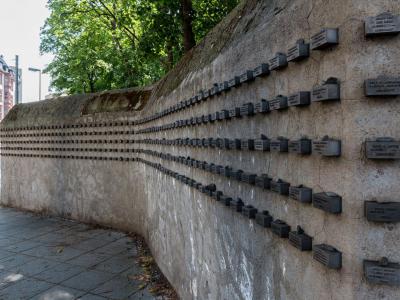
The centerpiece of this memorial is the exterior wall of the Old Jewish Cemetery on Battonnstraße, adorned with a frieze comprising 11,908 individual memorial name blocks. This frieze is a poignant tribute to those Jews who lost their lives during the Nazi era or faced persecution, many of whom had ties to Frankfurt through their birth, residency, or deportation. Notable figures such as Anne Frank are among those remembered. The inscriptions on these metal blocks provide visitors with essential biographical information about the victims, including their birth and, if known, death dates and places. It is customary for visitors to place small stones on these blocks as part of Jewish mourning rituals.
At the time of the memorial's inauguration in 1996, it represented 11,134 individuals through name blocks. In 2010, an additional 823 name blocks were added to the southern cemetery wall, bringing the total to 11,908 name blocks as of 2023.
In preparation for the unveiling of the memorial site, a new gate was installed in the cemetery wall. This gate comprises two contemporary metal door wings, with the Hebrew inscription "Beth HaChaim" (House of Life) prominently displayed.
The centerpiece of this memorial is the exterior wall of the Old Jewish Cemetery on Battonnstraße, adorned with a frieze comprising 11,908 individual memorial name blocks. This frieze is a poignant tribute to those Jews who lost their lives during the Nazi era or faced persecution, many of whom had ties to Frankfurt through their birth, residency, or deportation. Notable figures such as Anne Frank are among those remembered. The inscriptions on these metal blocks provide visitors with essential biographical information about the victims, including their birth and, if known, death dates and places. It is customary for visitors to place small stones on these blocks as part of Jewish mourning rituals.
At the time of the memorial's inauguration in 1996, it represented 11,134 individuals through name blocks. In 2010, an additional 823 name blocks were added to the southern cemetery wall, bringing the total to 11,908 name blocks as of 2023.
In preparation for the unveiling of the memorial site, a new gate was installed in the cemetery wall. This gate comprises two contemporary metal door wings, with the Hebrew inscription "Beth HaChaim" (House of Life) prominently displayed.
3) Dominican Monastery (Dominikanerkloster)
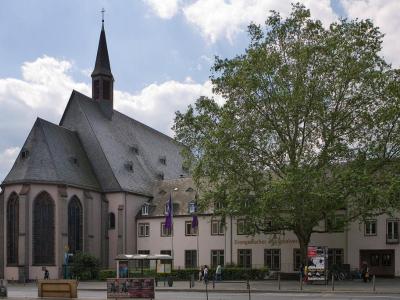
The Dominican Monastery in Frankfurt is the earliest church and Christian monastery in the city. Today, it serves as an exhibition hall and meeting place and is the seat of the Protestant Evangelical Association consisting of Evangelical Churches and Deaneries in the region. The Synod of the Evangelical Church in Hessen and Nassau is convened here, twice a year.
Established in 1233, the monastery was off to a humble beginning. The first Dominican brothers built a small house with four rooms and set about their task of providing religious instruction to the local people. The small house served as an entrance to the monastery.
By the 14th century, the sanctuary had evolved and accommodated numerous scholars, receiving generous donations from citizens in appreciation of the good work performed by the monks. With this, richly decorated monastery buildings, including a chapel, were constructed, featuring Gothic style and made of rubble stone. After the Reformation, the property was taken over by the Lutherans and then, during the secularization period, was apprehended by the municipal authorities and put to various non-religious uses.
The monastery was almost destroyed during WWII. After the war, architect Gustav Scheinpflug designed a new complex – also in Gothic style, but with modern interiors – based on the layout of the old monastery. Only the choir of the Holy Ghost Church remains from the old building.
Each summer, the monastery courtyard plays host to a folk theater show and concerts by the Frankfurt Church Music Association.
Established in 1233, the monastery was off to a humble beginning. The first Dominican brothers built a small house with four rooms and set about their task of providing religious instruction to the local people. The small house served as an entrance to the monastery.
By the 14th century, the sanctuary had evolved and accommodated numerous scholars, receiving generous donations from citizens in appreciation of the good work performed by the monks. With this, richly decorated monastery buildings, including a chapel, were constructed, featuring Gothic style and made of rubble stone. After the Reformation, the property was taken over by the Lutherans and then, during the secularization period, was apprehended by the municipal authorities and put to various non-religious uses.
The monastery was almost destroyed during WWII. After the war, architect Gustav Scheinpflug designed a new complex – also in Gothic style, but with modern interiors – based on the layout of the old monastery. Only the choir of the Holy Ghost Church remains from the old building.
Each summer, the monastery courtyard plays host to a folk theater show and concerts by the Frankfurt Church Music Association.
4) Frankfurt Cathedral (Cathedral of St. Bartholomew) (must see)
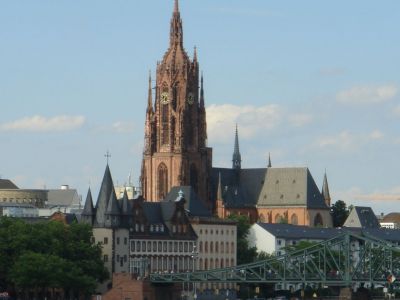
Frankfurt Cathedral is a Gothic-style Roman Catholic temple dedicated to Saint Bartholomew. This is the main and by far the largest religious site in Frankfurt – the height of its spire reaches 95 meters. Despite the name – Kaiserdom (Imperial Cathedral), or simply the Dom, – it has never been a cathedral in the true sense of the word but is only called so for its importance as a former coronation church of the Holy Roman Empire.
The present building on the site is the third one. The very first church (Merovingian chapel) was built here in the 7th century, which was then replaced, by a grander temple, in 1250. In 1356, Charles IV, Holy Roman Emperor issued the Golden Bull whereby all emperors of the Holy Roman Empire were to be elected in this collegiate church as kings of Germany; from 1562 to 1792, all emperors-elect were crowned here.
In 1867, Saint Bartholomew's was destroyed by fire and rebuilt in its present style. During WWII, between October 1943 and March 1944, the Old Town of Frankfurt was devastated by the Allied Forces' air bombardments. The cathedral also suffered severe damage; its interior burned out completely and was reconstructed only in the 1950s.
Saint Bartholomew's houses many splendid works of art, including a unique high altar and the Maria Schlaf altar found in Saint Mary’s chapel. Also, there is an Anthony Van Dyke painting, ‘The Lamentation’, and a museum with many historic pieces including objects discovered in a grave of a Merovingian girl.
Why You Should Visit:
Admission is free and, if lucky, you may enjoy some impressive organ music, too, or take in panoramic views of Frankfurt from atop the cathedral's tower (for a small fee).
Tip:
Try and go on a weekday to avoid the weekend crowd; make sure to bring a bottle of water if you decide to climb the tower.
The present building on the site is the third one. The very first church (Merovingian chapel) was built here in the 7th century, which was then replaced, by a grander temple, in 1250. In 1356, Charles IV, Holy Roman Emperor issued the Golden Bull whereby all emperors of the Holy Roman Empire were to be elected in this collegiate church as kings of Germany; from 1562 to 1792, all emperors-elect were crowned here.
In 1867, Saint Bartholomew's was destroyed by fire and rebuilt in its present style. During WWII, between October 1943 and March 1944, the Old Town of Frankfurt was devastated by the Allied Forces' air bombardments. The cathedral also suffered severe damage; its interior burned out completely and was reconstructed only in the 1950s.
Saint Bartholomew's houses many splendid works of art, including a unique high altar and the Maria Schlaf altar found in Saint Mary’s chapel. Also, there is an Anthony Van Dyke painting, ‘The Lamentation’, and a museum with many historic pieces including objects discovered in a grave of a Merovingian girl.
Why You Should Visit:
Admission is free and, if lucky, you may enjoy some impressive organ music, too, or take in panoramic views of Frankfurt from atop the cathedral's tower (for a small fee).
Tip:
Try and go on a weekday to avoid the weekend crowd; make sure to bring a bottle of water if you decide to climb the tower.
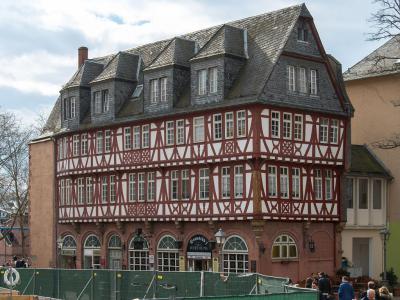
5) Haus Wertheim
The Wertheim, also known as Wertheym, is a half-timbered house built around 1600 at the Fahrtor, between Romerplatz and the Main River. This is a listed building and the only house of its kind in the Old Town that has survived almost intact World War II. In large part due to this fact, much as for its unique Renaissance appearance (typical of the Frankfurt architectural style) and favorable position, this building is now very popular among tourists.
The name Wertheim was first mentioned in 1383, referring to the then owner of the property on this site, who probably came from Wertheim. The current building dates back to around 1600 and, apparently, initially served as a warehouse with the goods stored and traded in the open basement between the arcades or in the cellar vaults, especially during fairs in spring and autumn.
From the 17th to the 19th century, the Wertheim served as a customs house and facility for the city guard. In 1926, after renovation, there was a café and a restaurant on the ground floor.
The Wertheim was the only one of nearly 1,250 half-timbered houses in the Old Town to have come out largely unscathed from the air raids in World War II. Some credit it to an exit made in 1940 onto Römerberg, next to the extinguishing water basin at the Justice Fountain.
Still, it wasn't until 1963 that the Haus Wertheim was placed under monument protection which led to its eventual restoration in the mid-1970s. Following that, between 1981 and 1983, the half-timbered houses on Saturday Mountain had been reconstructed, and from 2012 to 2017 several historic streets had been built as part of the Dom-Römer project.
The name Wertheim was first mentioned in 1383, referring to the then owner of the property on this site, who probably came from Wertheim. The current building dates back to around 1600 and, apparently, initially served as a warehouse with the goods stored and traded in the open basement between the arcades or in the cellar vaults, especially during fairs in spring and autumn.
From the 17th to the 19th century, the Wertheim served as a customs house and facility for the city guard. In 1926, after renovation, there was a café and a restaurant on the ground floor.
The Wertheim was the only one of nearly 1,250 half-timbered houses in the Old Town to have come out largely unscathed from the air raids in World War II. Some credit it to an exit made in 1940 onto Römerberg, next to the extinguishing water basin at the Justice Fountain.
Still, it wasn't until 1963 that the Haus Wertheim was placed under monument protection which led to its eventual restoration in the mid-1970s. Following that, between 1981 and 1983, the half-timbered houses on Saturday Mountain had been reconstructed, and from 2012 to 2017 several historic streets had been built as part of the Dom-Römer project.
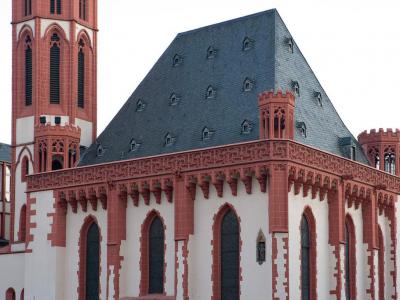
6) Old Nicholas Church (Alte Nikolaikirche)
The Old Nicholas Church (German: Alte Nikolaikirche), located near the Römer city hall in the Old Town (Altstadt) of Frankfurt, is a medieval Lutheran temple dedicated to Saint Nicholas, the patron saint of fishermen. The current building dates back to the mid-15th century, replacing the original chapel on this site that stood since the mid-12th century. The foundations of the previous Nikolaikirche found during excavations are now marked on the floor and give the impression of its dimensions.
The Reformation proved a turning point in the history of Nikolaikirche. In the 15th century, the existing structure had a tower with leveled roof and a balcony added. The latter served as a viewing gallery for aristocrats when passion plays and other events took place in the plaza below. In 1543, the church was closed and its altars were demolished.
Over the next 150 years, the building was leased and used as an archive for the municipal jury and, at times, as a warehouse during trade fairs. A trumpeter watchman, stationed in the steeple, announced the arrival of boats up and down the River Main by blowing a horn. The bugle also sounded, like the modern-day alarm, whenever fires were sighted.
In 1838, the church was completely renovated. The previously closed northern portal facing Saturday Mountain was opened, and the roof, gallery, and corner turret were renewed. In 1903, the damaged cast-iron spire was torn down and replaced a year later by the pointed copper roof that still exists.
During World War II, the Alte Nikolaikirche was one of the very few historical buildings in downtown Frankfurt to be spared from destruction by aerial warfare. Only the 19th-century organ, despite being walled in, had become unusable from the effects of the war for reasons not quite known. The reconstruction of the building, which started in the summer of 1947, was completed relatively quickly, by the end of December 1948.
The church has a double aisle hall with a high Gothic choir and 51 bells, four of which are used for peals and 47 for carillons. The church is also renowned for its acoustics. Organ concerts, hand bells, trumpets, choirs, and brass bands perform here regularly. Another attraction is the spiral stairway leading to the gallery which affords a spectacular view of Romerberg Plaza.
The Reformation proved a turning point in the history of Nikolaikirche. In the 15th century, the existing structure had a tower with leveled roof and a balcony added. The latter served as a viewing gallery for aristocrats when passion plays and other events took place in the plaza below. In 1543, the church was closed and its altars were demolished.
Over the next 150 years, the building was leased and used as an archive for the municipal jury and, at times, as a warehouse during trade fairs. A trumpeter watchman, stationed in the steeple, announced the arrival of boats up and down the River Main by blowing a horn. The bugle also sounded, like the modern-day alarm, whenever fires were sighted.
In 1838, the church was completely renovated. The previously closed northern portal facing Saturday Mountain was opened, and the roof, gallery, and corner turret were renewed. In 1903, the damaged cast-iron spire was torn down and replaced a year later by the pointed copper roof that still exists.
During World War II, the Alte Nikolaikirche was one of the very few historical buildings in downtown Frankfurt to be spared from destruction by aerial warfare. Only the 19th-century organ, despite being walled in, had become unusable from the effects of the war for reasons not quite known. The reconstruction of the building, which started in the summer of 1947, was completed relatively quickly, by the end of December 1948.
The church has a double aisle hall with a high Gothic choir and 51 bells, four of which are used for peals and 47 for carillons. The church is also renowned for its acoustics. Organ concerts, hand bells, trumpets, choirs, and brass bands perform here regularly. Another attraction is the spiral stairway leading to the gallery which affords a spectacular view of Romerberg Plaza.
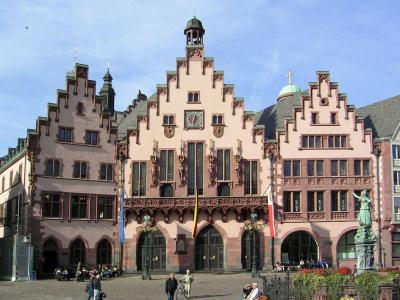
7) Römer (City Hall) (must see)
The Römer ("Roman") is the Rathaus (City Hall) of Frankfurt and one of the main local historic landmarks. This medieval building has been in service for over 600 years and still houses offices of the local government.
In 1405, the Römer family of the wealthy Frankfurt merchants sold their house, along with the adjacent Goldener Schwan (Golden Swan) building, to the city council. Since then the property has continuously accommodated different civic offices until the present. Over the years, the complex has been expanded by the addition and purchase of nearby buildings, so today it represents a labyrinth of several structures connected by streets. A bridge, jokingly referred to as the “Bridge of Sighs” (after its famous counterpart in Venice), connects the Römer to the offices across the street. Two towers were added to the complex in the early 20th century. One of them is dubbed Langer Franz (Tall Franz) in homage to the city's tall mayor, and the other, smaller one, Kleiner Cohen (Small Cohen), after a popular song of the time.
Römerhalle and Schwanenhalle are the oldest rooms within the complex and are virtually unchanged after 600 years. They are found on the ground floor of the Römer and Goldener Schwan houses and can be entered directly from the main entrance in Römerberg.
Still, the main attraction of the Römer, perhaps, is the Kaisersaal (Emperor Hall) where coronation banquets of German Kings and Emperors of the Holy Roman Empire took place. The hall contains 52 portraits by famous artists of all the German Kings and Emperors, starting from Freidrich Barbarossa in 1152 to Franz II who was forced to abdicate by Napoleon in 1806. There is also an ornate balcony from where the rulers used to greet the crowds down below. The annual Christmas fair held in the square outside the City Hall is a regular attraction in its own right, drawing thousands of visitors from all over the world.
Why You Should Visit:
Truly an eye-catcher, even more interesting in the run-up to Christmas than during the rest of the year.
German history and culture are perfectly preserved in this Gingerbread part of town.
Tip:
Make sure you walk to the river to catch the Frankfurt cityscape which is only a few hundred meters away!
In 1405, the Römer family of the wealthy Frankfurt merchants sold their house, along with the adjacent Goldener Schwan (Golden Swan) building, to the city council. Since then the property has continuously accommodated different civic offices until the present. Over the years, the complex has been expanded by the addition and purchase of nearby buildings, so today it represents a labyrinth of several structures connected by streets. A bridge, jokingly referred to as the “Bridge of Sighs” (after its famous counterpart in Venice), connects the Römer to the offices across the street. Two towers were added to the complex in the early 20th century. One of them is dubbed Langer Franz (Tall Franz) in homage to the city's tall mayor, and the other, smaller one, Kleiner Cohen (Small Cohen), after a popular song of the time.
Römerhalle and Schwanenhalle are the oldest rooms within the complex and are virtually unchanged after 600 years. They are found on the ground floor of the Römer and Goldener Schwan houses and can be entered directly from the main entrance in Römerberg.
Still, the main attraction of the Römer, perhaps, is the Kaisersaal (Emperor Hall) where coronation banquets of German Kings and Emperors of the Holy Roman Empire took place. The hall contains 52 portraits by famous artists of all the German Kings and Emperors, starting from Freidrich Barbarossa in 1152 to Franz II who was forced to abdicate by Napoleon in 1806. There is also an ornate balcony from where the rulers used to greet the crowds down below. The annual Christmas fair held in the square outside the City Hall is a regular attraction in its own right, drawing thousands of visitors from all over the world.
Why You Should Visit:
Truly an eye-catcher, even more interesting in the run-up to Christmas than during the rest of the year.
German history and culture are perfectly preserved in this Gingerbread part of town.
Tip:
Make sure you walk to the river to catch the Frankfurt cityscape which is only a few hundred meters away!
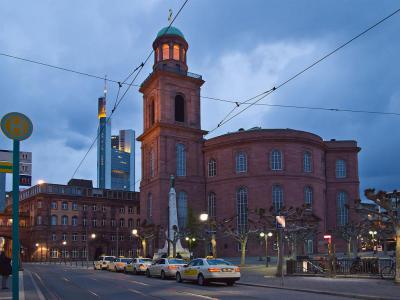
8) Paulskirche (St. Paul's Church)
The oval-shaped church of Saint Paul in the Zeil district of Frankfurt is easily spotted for its red sandstone exterior. Formerly a protestant temple, it was built between 1789 and 1833 to serve the local Evangelical Lutheran congregation. Still, more than for its religious service and architecture, this neoclassical-style edifice is renowned for its role in the shaping of German democracy.
In 1848, during the so-called German revolutions, the Frankfurt Parliament convened here, being the first publicly and freely-elected German legislative body. The parliamentarians chose the building because of its typical Protestant centralized design, allowing everybody to easily hear the speaker.
In 1848, the National Assembly met inside the church for the first time and was therefore named the Paulskirchenparlament. Representatives from Germany and Austria worked on the premises until 1849 to draft a Charter of Basic Rights and a Constitution for a united Germany on the basis of popular self-determination. The attempt subsequently failed and the building resumed service as a church.
During WWII, Paulskirsche suffered extensive damage from bombings. After the war, its exterior was painstakingly restored, while the interior was somewhat simplified. Nonetheless, the striking feature of the interior is a modern mural depicting the procession of the people’s representatives into Paulskrische which today stands as the symbol of German democracy.
Presently, the building is used as a venue for various events and exhibitions including the Peace Prize of the German Book Trade and the Goethe Prize by the city of Frankfurt. The hall on the first floor is used for municipal and other functions.
Why You Should Visit:
Free entry, with a wealth of information in English covering the German democratic process.
Tip:
Pop in for the excellent art exhibition in the basement (pieces are for sale but are on the expensive side).
Upstairs you can visit the room in which JFK gave his brief speech in 1963.
In 1848, during the so-called German revolutions, the Frankfurt Parliament convened here, being the first publicly and freely-elected German legislative body. The parliamentarians chose the building because of its typical Protestant centralized design, allowing everybody to easily hear the speaker.
In 1848, the National Assembly met inside the church for the first time and was therefore named the Paulskirchenparlament. Representatives from Germany and Austria worked on the premises until 1849 to draft a Charter of Basic Rights and a Constitution for a united Germany on the basis of popular self-determination. The attempt subsequently failed and the building resumed service as a church.
During WWII, Paulskirsche suffered extensive damage from bombings. After the war, its exterior was painstakingly restored, while the interior was somewhat simplified. Nonetheless, the striking feature of the interior is a modern mural depicting the procession of the people’s representatives into Paulskrische which today stands as the symbol of German democracy.
Presently, the building is used as a venue for various events and exhibitions including the Peace Prize of the German Book Trade and the Goethe Prize by the city of Frankfurt. The hall on the first floor is used for municipal and other functions.
Why You Should Visit:
Free entry, with a wealth of information in English covering the German democratic process.
Tip:
Pop in for the excellent art exhibition in the basement (pieces are for sale but are on the expensive side).
Upstairs you can visit the room in which JFK gave his brief speech in 1963.
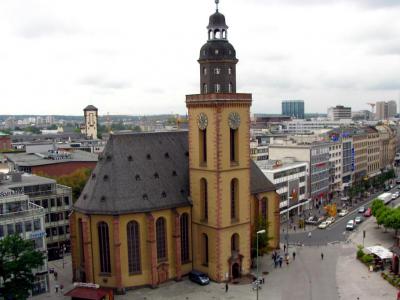
9) Saint Catherine's (Katharinenkirche)
The Saint Catherine Church (Katherinenkirche), located near the busy Hauptwache Plaza in Frankfurt, is the largest Lutheran church in the city and was constructed between 1678 and 1681.
It stands on the site of a vestal cloister and hospital once run by the Teutonic Knights order. Later, a small parish church was built on the site which gained importance in history because, in 1522, it became the setting of the first protestant sermon in Frankfurt. The church was consecrated in 1681 and dedicated to the martyred Saint Catherine of Alexandria.
The single-vessel hall church had a tower at the side and ornamental gateways; just like many other buildings in the city, it was destroyed during the bombings of 1944. The parishioners and citizens of Frankfurt rebuilt the property in 1954, carefully reconstructing the original exterior, although with a somewhat simpler interior.
Among the well-known parishioners who have worshiped at Ketherinenkirche, over the years, were the likes of the Goethe family; Johann Wolfgang von Goethe was baptized here. Also, near the church, at some point, was the Katharinenpforte prison where, in 1771, a child murderer Susanna Margaretha Brandt was incarcerated. Her beheading strongly affected 22-year-old Goethe, who witnessed it. Later, he used some of the Brandt case details in the ‘Faust’ poem.
It stands on the site of a vestal cloister and hospital once run by the Teutonic Knights order. Later, a small parish church was built on the site which gained importance in history because, in 1522, it became the setting of the first protestant sermon in Frankfurt. The church was consecrated in 1681 and dedicated to the martyred Saint Catherine of Alexandria.
The single-vessel hall church had a tower at the side and ornamental gateways; just like many other buildings in the city, it was destroyed during the bombings of 1944. The parishioners and citizens of Frankfurt rebuilt the property in 1954, carefully reconstructing the original exterior, although with a somewhat simpler interior.
Among the well-known parishioners who have worshiped at Ketherinenkirche, over the years, were the likes of the Goethe family; Johann Wolfgang von Goethe was baptized here. Also, near the church, at some point, was the Katharinenpforte prison where, in 1771, a child murderer Susanna Margaretha Brandt was incarcerated. Her beheading strongly affected 22-year-old Goethe, who witnessed it. Later, he used some of the Brandt case details in the ‘Faust’ poem.
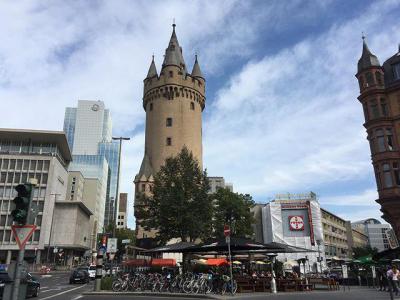
10) Eschenheimer Tower
One of the few remaining medieval towers that once protected the city of Frankfurt, the Eschenheimer Tower is a well-known city landmark. It is now located at the center of one of Frankfurt’s busiest intersections.
At the time of completion, the Eschenheimer was one of 60 towers that protected the city of Frankfurt from its enemies. Klaus Mengos, a carpenter, built the tower’s rectangular-shaped base in 1400 and the design was executed and completed by master builder Madern Gerthener. A self-portrait bust of Gerthener is placed on its archway. The tower became functional in 1428. In the 18th century, the city began to expand and many medieval towers were demolished. The timely intervention of French ambassador Count d’Hedouville helped prevent the demolition of the Eschenheimer Tower and to preserve this fine example of medieval architecture till the 21st century. The tower is 47 meters high with eight levels and two attics.
The Eschenheimer Tower is located one block north of the Hauptwache. A bistro called E.T. im Trum is located at the ground floor serving classic German food and beer. Visitors can also view the tower’s well-preserved battlements.
Why You Should Visit:
This tower is EXTREMELY German, has a friendly easy-going feel to it, and just begs to be photographed.
Inside it is comfortable, but there's a large covered outdoor patio, and if the weather is good, that's a nice option.
Tip:
Alternately, go to the top of Fleming's Hotel nearby for a drink and a nice view.
At the time of completion, the Eschenheimer was one of 60 towers that protected the city of Frankfurt from its enemies. Klaus Mengos, a carpenter, built the tower’s rectangular-shaped base in 1400 and the design was executed and completed by master builder Madern Gerthener. A self-portrait bust of Gerthener is placed on its archway. The tower became functional in 1428. In the 18th century, the city began to expand and many medieval towers were demolished. The timely intervention of French ambassador Count d’Hedouville helped prevent the demolition of the Eschenheimer Tower and to preserve this fine example of medieval architecture till the 21st century. The tower is 47 meters high with eight levels and two attics.
The Eschenheimer Tower is located one block north of the Hauptwache. A bistro called E.T. im Trum is located at the ground floor serving classic German food and beer. Visitors can also view the tower’s well-preserved battlements.
Why You Should Visit:
This tower is EXTREMELY German, has a friendly easy-going feel to it, and just begs to be photographed.
Inside it is comfortable, but there's a large covered outdoor patio, and if the weather is good, that's a nice option.
Tip:
Alternately, go to the top of Fleming's Hotel nearby for a drink and a nice view.
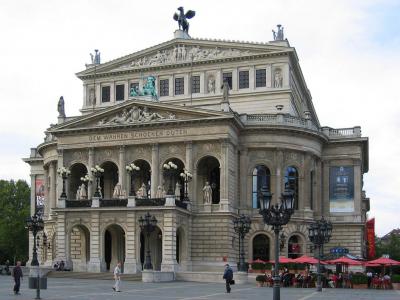
11) Old Opera House (Alte Oper) (must see)
Perched above a picturesque square adorned with a graceful fountain lies the Opera House, sporting a Renaissance-style façade. This historic edifice, known by the moniker "Alte Oper," or "the Old Opera House," stands in place of a predecessor that graced the location from 1880 to 1944.
The inaugural Frankfurt Opera House, conceived by the Berlin-based architect Richard Lucae, made its debut in 1880, with Kaiser Wilhelm I presiding over the grand opening. The architectural design exuded the opulence expected of a venue patronized by royalty, showcasing Renaissance aesthetics. Tragically, during World War II, the structure suffered complete devastation. Following extensive deliberations among Frankfurt's residents, a new building arose, echoing the design of its predecessor. While the lobby and façade maintained their Renaissance architectural charm, the remainder of the structure underwent a transformation into a versatile modern complex, housing banquet halls, concert venues, and a convention center. This Opera House now fulfills the dual role of a cultural hub and a gathering place for Frankfurt's denizens.
At the Alte Oper, visitors can relish classical and popular music concerts. The edifice takes on an enchanting allure in the evening, its exterior adorned with splendid statues of Goethe and Mozart, who preside over the square below.
Why You Should Visit:
Great location to spend time in Frankfurt – beautifully restored theatre in a beautifully designed square.
Tip:
Both the café and the restaurant are generally busy in the evening, so try and reserve a spot in advance.
During a nice warm day, try and grab a seat outside, enjoy a cup of coffee/glass of wine and people watch.
The inaugural Frankfurt Opera House, conceived by the Berlin-based architect Richard Lucae, made its debut in 1880, with Kaiser Wilhelm I presiding over the grand opening. The architectural design exuded the opulence expected of a venue patronized by royalty, showcasing Renaissance aesthetics. Tragically, during World War II, the structure suffered complete devastation. Following extensive deliberations among Frankfurt's residents, a new building arose, echoing the design of its predecessor. While the lobby and façade maintained their Renaissance architectural charm, the remainder of the structure underwent a transformation into a versatile modern complex, housing banquet halls, concert venues, and a convention center. This Opera House now fulfills the dual role of a cultural hub and a gathering place for Frankfurt's denizens.
At the Alte Oper, visitors can relish classical and popular music concerts. The edifice takes on an enchanting allure in the evening, its exterior adorned with splendid statues of Goethe and Mozart, who preside over the square below.
Why You Should Visit:
Great location to spend time in Frankfurt – beautifully restored theatre in a beautifully designed square.
Tip:
Both the café and the restaurant are generally busy in the evening, so try and reserve a spot in advance.
During a nice warm day, try and grab a seat outside, enjoy a cup of coffee/glass of wine and people watch.
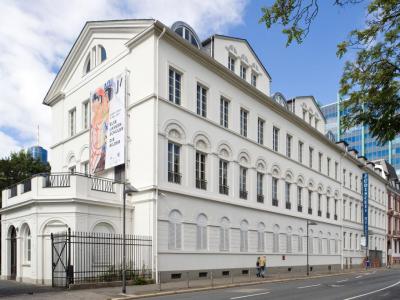
12) Jewish Museum Frankfurt
The Jewish Museum of Frankfurt is the oldest independent Jewish museum in the Federal Republic of Germany. It is aimed at preserving and recounting the 900 years of Jewish history and culture in the city. The Museum includes a permanent exhibition at two locations with site-specific references. The Judengasse Museum on Börneplatz deals with the history and culture of Jews in Frankfurt during the early modern period and includes the ruins of the former Frankfurt Judengasse and the second-oldest Jewish cemetery in Germany. The Jewish Museum in the Rothschild Palais is dedicated to Jewish history and culture since the Jewish emancipation.
At the end of the 1970s, the head of the municipal cultural department initiated the project for a museum bank. A Jewish museum in the Rothschild Palais and an adjoining building on Untermainkai were approved by the city council in 1980. In the following years, a commission of historians developed a concept for the museum that was to present the history of Frankfurt's Jews from the 12th century to 1945. Donations made it possible to create the basis for its own collection. The opening of the first Jewish Museum in the Federal Republic of Germany took place on November 9, 1988, to mark the 50th anniversary of the 1938 pogrom, and was presided by Helmut Kohl.
At the end of the 1970s, the head of the municipal cultural department initiated the project for a museum bank. A Jewish museum in the Rothschild Palais and an adjoining building on Untermainkai were approved by the city council in 1980. In the following years, a commission of historians developed a concept for the museum that was to present the history of Frankfurt's Jews from the 12th century to 1945. Donations made it possible to create the basis for its own collection. The opening of the first Jewish Museum in the Federal Republic of Germany took place on November 9, 1988, to mark the 50th anniversary of the 1938 pogrom, and was presided by Helmut Kohl.
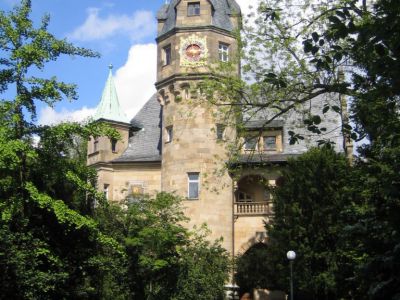
13) Liebieghaus
In 1908, the city of Frankfurt acquired a grand mansion with the intention of housing a sculpture museum. This mansion, known as Liebieghaus, was originally the residence of Baron Heinrich von Liebieg and is situated on the banks of the River Main, near other prominent museums in Frankfurt.
The renowned architect Leonhard Romies was tasked with constructing a retirement residence for Baron Liebieg, a wealthy textile magnate from Bohemia. This architectural project took place between 1892 and 1896. The resulting structure reflects a blend of various architectural styles, influenced by the builder's extensive travels across Europe. The design incorporates elements from the Bamberg Renaissance, Tyrolean architecture, and the opulent Historicist style. In a notable act, Baron Liebieg, in his will, offered to sell the villa to the city in 1908 at a reduced price, on the condition that it be preserved and maintained as a museum.
Liebieghaus now serves as a repository for sculptures, housing artifacts that date back more than 5000 years. The museum's extensive collection encompasses sculptures from the Egyptian, Medieval, Baroque, Renaissance, and Neoclassical periods. Among the notable treasures within the collection are a marble statue of Athena, Carolingian ivory reliefs, Hans Multscher's alabaster sculpture depicting the Trinity, and a bust of Barbel von Ottenheim, who was the mistress of Jakob von Lichtenberg, the last Lord of Lichtenberg.
Visitors to Liebieghaus have the opportunity to enhance their experience with an audio guide, providing informative and engaging insights into the artists and the stories behind each exhibited artwork.
Why You Should Visit:
The collection of classical sculpture is second to none in Frankfurt, and the temporary exhibitions are always exciting.
Pleasant to visit as it is often quieter than the larger museums. They also have a small cafe to sit outside and enjoy the fresh air.
Tip:
You could simply take a picnic and sit in the garden – that's free! The garden itself is a real attraction with strategically placed seating for public use.
The renowned architect Leonhard Romies was tasked with constructing a retirement residence for Baron Liebieg, a wealthy textile magnate from Bohemia. This architectural project took place between 1892 and 1896. The resulting structure reflects a blend of various architectural styles, influenced by the builder's extensive travels across Europe. The design incorporates elements from the Bamberg Renaissance, Tyrolean architecture, and the opulent Historicist style. In a notable act, Baron Liebieg, in his will, offered to sell the villa to the city in 1908 at a reduced price, on the condition that it be preserved and maintained as a museum.
Liebieghaus now serves as a repository for sculptures, housing artifacts that date back more than 5000 years. The museum's extensive collection encompasses sculptures from the Egyptian, Medieval, Baroque, Renaissance, and Neoclassical periods. Among the notable treasures within the collection are a marble statue of Athena, Carolingian ivory reliefs, Hans Multscher's alabaster sculpture depicting the Trinity, and a bust of Barbel von Ottenheim, who was the mistress of Jakob von Lichtenberg, the last Lord of Lichtenberg.
Visitors to Liebieghaus have the opportunity to enhance their experience with an audio guide, providing informative and engaging insights into the artists and the stories behind each exhibited artwork.
Why You Should Visit:
The collection of classical sculpture is second to none in Frankfurt, and the temporary exhibitions are always exciting.
Pleasant to visit as it is often quieter than the larger museums. They also have a small cafe to sit outside and enjoy the fresh air.
Tip:
You could simply take a picnic and sit in the garden – that's free! The garden itself is a real attraction with strategically placed seating for public use.
