Custom Walk in Split, Croatia by bcheltenham9465 created on 2025-06-13
Guide Location: Croatia » Split
Guide Type: Custom Walk
# of Sights: 16
Tour Duration: 3 Hour(s)
Travel Distance: 4.9 Km or 3 Miles
Share Key: 95LET
Guide Type: Custom Walk
# of Sights: 16
Tour Duration: 3 Hour(s)
Travel Distance: 4.9 Km or 3 Miles
Share Key: 95LET
How It Works
Please retrieve this walk in the GPSmyCity app. Once done, the app will guide you from one tour stop to the next as if you had a personal tour guide. If you created the walk on this website or come to the page via a link, please follow the instructions below to retrieve the walk in the app.
Retrieve This Walk in App
Step 1. Download the app "GPSmyCity: Walks in 1K+ Cities" on Apple App Store or Google Play Store.



Step 2. In the GPSmyCity app, download(or launch) the guide "Split Map and Walking Tours".
Step 3. Tap the menu button located at upper right corner of the "Walks" screen and select "Retrieve custom walk". Enter the share key: 95LET
1) Diocletian's Palace (must see)
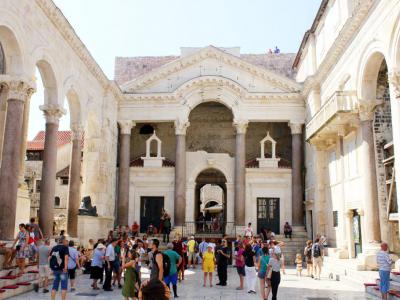
The "Palace" of Diocletian is more than a palace. It is really a fortress. It provided not only a private retirement home for the ex-emperor, but quarters for an armed garrison. It was a "key" community like no other. The palace, built at the turn of the fourth century, today forms most of the old town of Split, Croatia.
The palace complex was built on a peninsula about 18 miles from Salona, then the capital of Dalmatia and the birthplace of the retired Roman emperor. When Diocletian died in 312, the palace complex remained a property of the Roman imperium. It was used as a residence and refuge for members of imperial family who were out of favor.
In the seventh century the country was invaded by Avars and Slavs and the city of Salona was destroyed. The people found security within the formidable walls of the palace. Safe behind the walls they formed a new city community. From that time the palace has been continually occupied and today it is the heart of the city of Split.
The mausoleum of Diocletian became the cathedral of Saint Domnius. In time the remains of the fortress home of the emperor dropped out of the consciousness of Europe. Then the Scottish architect Robert Adam surveyed the ruins and published his findings. The palace formed the inspiration for Adam's style of Neoclassical architecture.
The plan of the palace has been found to be an irregular rectangle with 16 towers from the facades and corners. Only the southern facade was unfortified. It provided easy access to the sea and vessels could unload cargo directly through the Sea Gate.
There are three other gates that grant entrance and egress. The North Gate guarded the road towards Salona. The Church of Saint Martin is above the gate. The East Gate faced the town of Epetia, now Stobrec.
The West Gate, was used as the military gate. It remains in use today. The South Gate faces the sea.
Why You Should Visit:
The long history and diverse cultures of Split are distilled and contained in this remarkable Palace.
Tips: Be prepared to do a lot of walking.
The palace complex was built on a peninsula about 18 miles from Salona, then the capital of Dalmatia and the birthplace of the retired Roman emperor. When Diocletian died in 312, the palace complex remained a property of the Roman imperium. It was used as a residence and refuge for members of imperial family who were out of favor.
In the seventh century the country was invaded by Avars and Slavs and the city of Salona was destroyed. The people found security within the formidable walls of the palace. Safe behind the walls they formed a new city community. From that time the palace has been continually occupied and today it is the heart of the city of Split.
The mausoleum of Diocletian became the cathedral of Saint Domnius. In time the remains of the fortress home of the emperor dropped out of the consciousness of Europe. Then the Scottish architect Robert Adam surveyed the ruins and published his findings. The palace formed the inspiration for Adam's style of Neoclassical architecture.
The plan of the palace has been found to be an irregular rectangle with 16 towers from the facades and corners. Only the southern facade was unfortified. It provided easy access to the sea and vessels could unload cargo directly through the Sea Gate.
There are three other gates that grant entrance and egress. The North Gate guarded the road towards Salona. The Church of Saint Martin is above the gate. The East Gate faced the town of Epetia, now Stobrec.
The West Gate, was used as the military gate. It remains in use today. The South Gate faces the sea.
Why You Should Visit:
The long history and diverse cultures of Split are distilled and contained in this remarkable Palace.
Tips: Be prepared to do a lot of walking.
2) Podrum (Cellars of Diocletian's Palace)
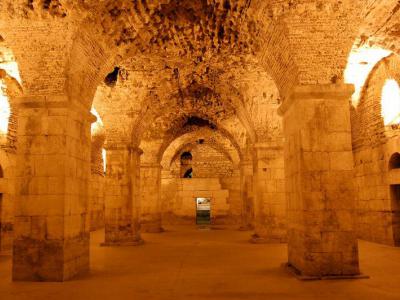
Under Diocletian's apartments were the cellars. Strong substructures which were used to support the apartments above and to store wine, foods and other items for the use of the Palace. The supports were a faithful copy of the structures above. The cellars also had a nymphaeum, a shrine dedicated to the nymphs guarding a source of fresh water.
In the middle ages the palace gradually became a safe haven for refugees. Part of the vast underground area was residential. In later times wealthier citizens who had houses above the cellars would break through the vaults and turn them into storage spaces for themselves.
Today Diocletian's cellars can be reached through the Bronze Gate, or through a stair connected to the peristyle. The western part of the cellars is preserved. It is available to sightseers and is used as a fair and exhibition space. The collapsed eastern part is being restored and will one day be accessible as well.
In the middle ages the palace gradually became a safe haven for refugees. Part of the vast underground area was residential. In later times wealthier citizens who had houses above the cellars would break through the vaults and turn them into storage spaces for themselves.
Today Diocletian's cellars can be reached through the Bronze Gate, or through a stair connected to the peristyle. The western part of the cellars is preserved. It is available to sightseers and is used as a fair and exhibition space. The collapsed eastern part is being restored and will one day be accessible as well.
3) Cathedral of St. Domnius (must see)
It was the year 305. Roman emperor Diocletian had persecuted a lot of Christians and like-minded dissidents in his Imperial tour of duty. Now it was time to retire to his native land of Dalmatia and raise vegetables. As the vegetables were growing, he built a mausoleum. His final resting place was in the center of Split. But he would not rest there forever.
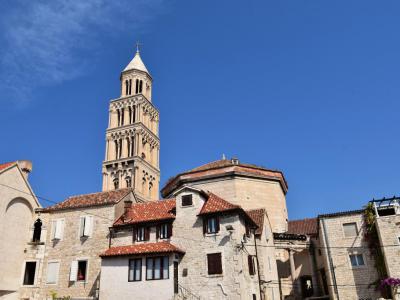
By the seventh century the Cathedral of Saint Domnius was consecrated. The Cathedral was in fact the Mausoleum of Diocletian. Those darn Christians finally got him. The Cathedral is a cluster of ad-ons that have changed little over the years. The former Mausoleum is dedicated to the Virgin Mary. The bell tower, added in 1100, is dedicated to Saint Domnius.
Saint Domnius is the patron saint of Split. He was the Bishop of Salona, a Roman city and capital of Dalmatia. He was born in Antioch and he was beheaded, along with seven other Christians, in 304. Ironically, he died one year before Diocletian retired.
Diocletian was a soldier. Naturally his retirement home was a Roman army camp. There was an East-West road (decumanus) and a North-South road (cardo maximus). Those roads remain in Split today. At the intersection of the roads is a great peristyle which grants access from the east to the Cathedral of Saint Domnius.
The Cathedral evolved through three stages. Diocletian's Mausolem, the central part of the cathedral, dates from the end of the third century. It is composed of white marble, limestone, and brick. In the seventh century a choir was added to the mausoleum. Finally the bell tower was erected in 1100. There was further rebuilding in 1908.
Within the Church there are relics and art treasures. Found here is the 13th century panel Painting, Madonna and Child. There are reliquaries, chalices and vestments from the 13th to the 19th centuries. The library includes the Book of gospels (6th century), Kartularium from Sumpetar (11th century) and the Historia Salanitana (13th century).
Why You Should Visit:
To take in the ancient, medieval and modern Split all in one place.
By the seventh century the Cathedral of Saint Domnius was consecrated. The Cathedral was in fact the Mausoleum of Diocletian. Those darn Christians finally got him. The Cathedral is a cluster of ad-ons that have changed little over the years. The former Mausoleum is dedicated to the Virgin Mary. The bell tower, added in 1100, is dedicated to Saint Domnius.
Saint Domnius is the patron saint of Split. He was the Bishop of Salona, a Roman city and capital of Dalmatia. He was born in Antioch and he was beheaded, along with seven other Christians, in 304. Ironically, he died one year before Diocletian retired.
Diocletian was a soldier. Naturally his retirement home was a Roman army camp. There was an East-West road (decumanus) and a North-South road (cardo maximus). Those roads remain in Split today. At the intersection of the roads is a great peristyle which grants access from the east to the Cathedral of Saint Domnius.
The Cathedral evolved through three stages. Diocletian's Mausolem, the central part of the cathedral, dates from the end of the third century. It is composed of white marble, limestone, and brick. In the seventh century a choir was added to the mausoleum. Finally the bell tower was erected in 1100. There was further rebuilding in 1908.
Within the Church there are relics and art treasures. Found here is the 13th century panel Painting, Madonna and Child. There are reliquaries, chalices and vestments from the 13th to the 19th centuries. The library includes the Book of gospels (6th century), Kartularium from Sumpetar (11th century) and the Historia Salanitana (13th century).
Why You Should Visit:
To take in the ancient, medieval and modern Split all in one place.
4) Silver Gate
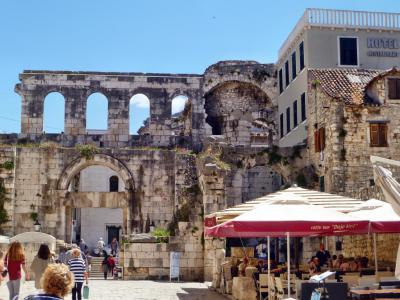
There are four gates to the stari grad ("old town"). The Silver Gate faces east, in the direction of the Roman town, Epetia. Since the gate was meant to face east, the Romans called it Porta Orientalis, the "eastern gate." The other three gates to Diocletian's retirement retreat are called, "Golden Gate", "Iron Gate", and "Bronze Gate."
Around the sixth century, above the gate in a narrow corridor a mini-church of Saint Apolinar was built. This occurred at the time of a flood of refugees from outside the walls. Similar mini-churches were established above the other gates. In the 18th century the ruling Venetians opened a "small gate" next to the Silver Gate.
Opposite the Silver Gate by a market is the monastery and church of Saint Catherine of Alexandria built by the Dominicans in the 17th century.
On his way to visit the Cathedral of Saint Dmnius in 2000, Pope John Paul II drove through the Silver Gate in his Popemobile.
Around the sixth century, above the gate in a narrow corridor a mini-church of Saint Apolinar was built. This occurred at the time of a flood of refugees from outside the walls. Similar mini-churches were established above the other gates. In the 18th century the ruling Venetians opened a "small gate" next to the Silver Gate.
Opposite the Silver Gate by a market is the monastery and church of Saint Catherine of Alexandria built by the Dominicans in the 17th century.
On his way to visit the Cathedral of Saint Dmnius in 2000, Pope John Paul II drove through the Silver Gate in his Popemobile.
5) Green Market (Pazar)
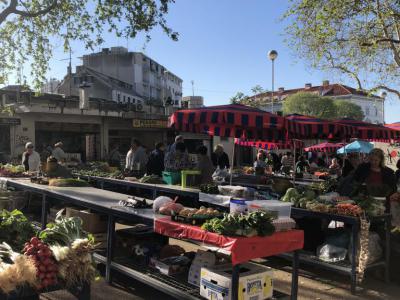
Nestled beside the east wall of the UNESCO-listed World Heritage site of Diocletian's Palace, Split's vibrant green market, affectionately known as Pazar, immerses you in the essence of everyday life in the city. Here, you can seamlessly blend in with the locals and truly embrace the authentic atmosphere of Croatia. Tourists seeking a genuine Croatian experience are increasingly drawn to this lively outdoor market.
Previously situated at Fruit Square, the market's relocation became a necessity due to the city's rapid growth and development. Now, in its new central location, it has become the beating heart and soul of Split. It serves as a gathering place for both residents and visitors, all eager to indulge in the array of colors, flavors, aromas, and sounds that encapsulate the vibrant essence of life in Split.
Previously situated at Fruit Square, the market's relocation became a necessity due to the city's rapid growth and development. Now, in its new central location, it has become the beating heart and soul of Split. It serves as a gathering place for both residents and visitors, all eager to indulge in the array of colors, flavors, aromas, and sounds that encapsulate the vibrant essence of life in Split.
6) Bronze Gate
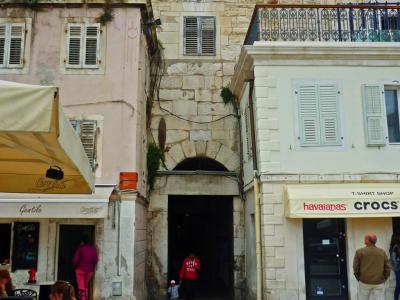
The Bronze gate (Mjedena vrata) was originally Porta Meridionalis, the "southern gate". It is unlike the other Roman gates. It is small, plain, no ornament. There are no flanking gatehouses. It gave direct access to the sea and served as an emergency exit in the event of an attack from the land. In the middle ages it was the "security gate."
In Diocletian's time there was no promenade outside the gate. The sea lapped against the south wall. The emperor was able to enter the compound directly by ship. Today it serves as the entry from the promenade to the Cathedral. Since it has access to the Riva, it is currently the most used gate of the palace. Many guided or self-guided tours start here.
The emperor could enter the Palace directly from the sea. His private apartments are in the southern half of the complex. Naturally this meant the more luxurious appointments would be in the southern half, below the decumanus road running east to west.
In Diocletian's time there was no promenade outside the gate. The sea lapped against the south wall. The emperor was able to enter the compound directly by ship. Today it serves as the entry from the promenade to the Cathedral. Since it has access to the Riva, it is currently the most used gate of the palace. Many guided or self-guided tours start here.
The emperor could enter the Palace directly from the sea. His private apartments are in the southern half of the complex. Naturally this meant the more luxurious appointments would be in the southern half, below the decumanus road running east to west.
7) Fruit's Square
Fruit's Square, one of the most popular tourist attractions in Split, is officially, Square Radic Brothers. Stjepan and Ante Radic were the founders of the Croatian Peasants Party in 1904. The party was actively opposed to the hegemony of Serbia in the local government. The brothers died in their cause but their efforts are remembered.
So why is it called Fruit's Square? It is popularly named Fruit's Square because this is where one would go to buy fruit; or to sell fruit. Today it is as aforesaid, a favorite tourist destination within the City. Its fame lies in its monuments, shops, pubs and clubs.
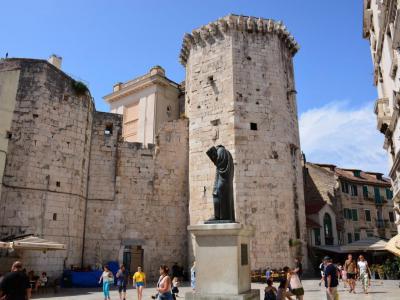
The most compelling structure of the Fruit's Square is the Venetian tower. The octagonal shaped building is a relic of the City's 15th century fortifications. Opposite the tower is a sumptuous Palace of the Milesi family from the 17th century. The Palace has a bold Baroque facade. It is probably the foremost example of Baroque style in Croatia.
In front of the Palace stands a statue of Marko Marulic, a 15th cenury philosopher called the father of Croatian literature. It is said that every stone in Fruit's Square, like the other old squares, are records of the history of the region. The elder times are preserved in the towers of Diocletian's Palace at the exit to the Square.
So why is it called Fruit's Square? It is popularly named Fruit's Square because this is where one would go to buy fruit; or to sell fruit. Today it is as aforesaid, a favorite tourist destination within the City. Its fame lies in its monuments, shops, pubs and clubs.
The most compelling structure of the Fruit's Square is the Venetian tower. The octagonal shaped building is a relic of the City's 15th century fortifications. Opposite the tower is a sumptuous Palace of the Milesi family from the 17th century. The Palace has a bold Baroque facade. It is probably the foremost example of Baroque style in Croatia.
In front of the Palace stands a statue of Marko Marulic, a 15th cenury philosopher called the father of Croatian literature. It is said that every stone in Fruit's Square, like the other old squares, are records of the history of the region. The elder times are preserved in the towers of Diocletian's Palace at the exit to the Square.
8) Marjan Hill Telegrin Peak
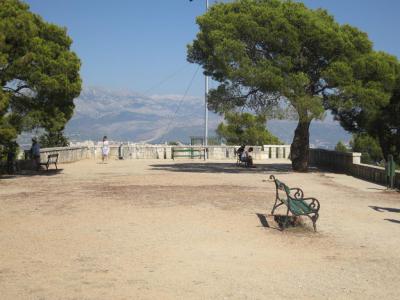
One sees signs for "Marjan Hill" and a few steps later there is a totally different world. Marjan Hill Park extends out from Split on a rugged peninsula jutting into the Adriatic. The park is densely forested, mostly with pines. The forest is a sign of recovery. Over the years the hills of what is now Marjan were stripped bare.
The peninsula reforested but it was too rugged to build on except for the ancient Jewish cemetery, and many very small churches or chapels hidden under the trees or carved into the hillsides. The highest point is a hill called Telegrin. When Napoleon's armies controlled Dalmatia. There was a telegraph signal tower atop the hill.
The hill was the perfect place for a visual telegraph. The hill can be seen for miles around, especially from the sea. The telegraph is long gone but the Croatian flag remains. Napoleon didn't stay long. He was a busy man.
Marjan Hill is 178 meters (578.8 feet) high. The peak can be reached by a staircase of 314 steps. Getting around the park can involve some serious climbing, but not to worry. There are dozens of benches conveniently placed. Be sure to bring good shoes for hiking, snacks and plenty of water.
The peninsula reforested but it was too rugged to build on except for the ancient Jewish cemetery, and many very small churches or chapels hidden under the trees or carved into the hillsides. The highest point is a hill called Telegrin. When Napoleon's armies controlled Dalmatia. There was a telegraph signal tower atop the hill.
The hill was the perfect place for a visual telegraph. The hill can be seen for miles around, especially from the sea. The telegraph is long gone but the Croatian flag remains. Napoleon didn't stay long. He was a busy man.
Marjan Hill is 178 meters (578.8 feet) high. The peak can be reached by a staircase of 314 steps. Getting around the park can involve some serious climbing, but not to worry. There are dozens of benches conveniently placed. Be sure to bring good shoes for hiking, snacks and plenty of water.
9) Gospa od Zdravlja
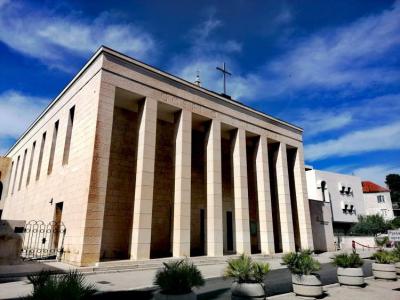
The Church of Our Lady of Good Health (Gospa od Zdravlja) is a remarkable religious site located in the vibrant city of Split. If you find yourself strolling up Marmontova Street, heading in the direction of the Croatian National Theater, you will be pleasantly surprised to stumble upon this significant place of worship and community gathering.
The centerpiece of the complex is the Church of Our Lady of Health, which was reconstructed in 1937. However, its history dates back to the 18th century, when an elegant Baroque church with the same name once stood. Unfortunately, the original structure was demolished in the early 1930s, paving the way for the construction of the modernist-style church we see today. Lavoslav Horvat, a renowned architect from Zagreb, was the mastermind behind the design of this impressive new church.
As you approach the church, your eyes will be drawn to the elegant bell tower that proudly stands tall, a preserved remnant from the old Baroque church. Its presence adds a touch of history and heritage to the modern surroundings. Step inside the church, and you will be immediately captivated by the interior beauty that lies within its walls.
The Church of Our Lady of Good Health is not just a place of worship; it also serves as a hub for religious education and a meeting place for the local community. The church also includes the Franciscan Monastery. The Franciscan monks residing within the monastery play an essential role in the spiritual guidance of the area's residents, offering religious instruction and support to those who seek it.
The centerpiece of the complex is the Church of Our Lady of Health, which was reconstructed in 1937. However, its history dates back to the 18th century, when an elegant Baroque church with the same name once stood. Unfortunately, the original structure was demolished in the early 1930s, paving the way for the construction of the modernist-style church we see today. Lavoslav Horvat, a renowned architect from Zagreb, was the mastermind behind the design of this impressive new church.
As you approach the church, your eyes will be drawn to the elegant bell tower that proudly stands tall, a preserved remnant from the old Baroque church. Its presence adds a touch of history and heritage to the modern surroundings. Step inside the church, and you will be immediately captivated by the interior beauty that lies within its walls.
The Church of Our Lady of Good Health is not just a place of worship; it also serves as a hub for religious education and a meeting place for the local community. The church also includes the Franciscan Monastery. The Franciscan monks residing within the monastery play an essential role in the spiritual guidance of the area's residents, offering religious instruction and support to those who seek it.

10) People's Square (Pjaca) (must see)
Like so many other squares in Split, People's Square is not the official name of the square. It was first called Saint Lawrence's Square in the 13th century. It has the distinction of being the first inhabited part of the City outside of Diocletian's Palace. For centuries the square has been the very center of City life.
The city clock has 24 numerals, not twelve. Life never pauses in the Square. One may rest, eat, drink, meet, see and be seen. The square is joined to the peristyle of old Diocletian's palace. As the city grew, the citizens started living outside the protection of the Roman walls and the square has been the People's Square ever since.
Renaissance, Venetian, and Gothic styles appear in the buildings around the square. The north side is occupied by the Old Town Hall, a 15th century building that sometimes hosts exhibitions of Art and history. It is said every building in Split has a story.
The attractions that might be seen in the square beside the Old Town Hall include: The ornate palaces of the nobility, the Church of Our Lady of the Bell Tower, The Old Town Clock. the Old Town Cafe, and the Morpurgo Bookstore (since 1860).
In the base of the flagpole of the Square one finds the words of the poet Tonci Petrasov:
"One doesn't need to travel anywhere,
nor does one have to search elsewhere,
what you are looking for is precisely here."
Here, in People's Square.
The city clock has 24 numerals, not twelve. Life never pauses in the Square. One may rest, eat, drink, meet, see and be seen. The square is joined to the peristyle of old Diocletian's palace. As the city grew, the citizens started living outside the protection of the Roman walls and the square has been the People's Square ever since.
Renaissance, Venetian, and Gothic styles appear in the buildings around the square. The north side is occupied by the Old Town Hall, a 15th century building that sometimes hosts exhibitions of Art and history. It is said every building in Split has a story.
The attractions that might be seen in the square beside the Old Town Hall include: The ornate palaces of the nobility, the Church of Our Lady of the Bell Tower, The Old Town Clock. the Old Town Cafe, and the Morpurgo Bookstore (since 1860).
In the base of the flagpole of the Square one finds the words of the poet Tonci Petrasov:
"One doesn't need to travel anywhere,
nor does one have to search elsewhere,
what you are looking for is precisely here."
Here, in People's Square.
11) Iron Gate and Church of Our Lady of the Bell Tower
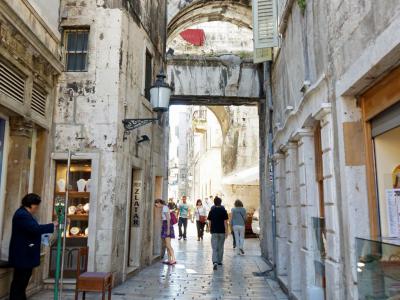
The West gate, or Iron Gate is one of four gates giving access/egress to the palace of Diocletian. It is part of an urban complex of the People's Square (Pjaca), the old City Hall, the clock tower, and the Nakic, Karepic, Cambi, and Cipriani palaces.
The arrangements around the Iron Gate include ancient developments like the defensive rampart, with its double door safety chamber and the Church of Our Lady of the Bell Tower. The church is a tiny, narrow space similar to the churches in the other gates. It was renovated when the bell tower was added in the 11th century.
On the northern wall of the rampart, behind a sealed medieval niche, a sculpture of hands holding a crown was discovered. It was restored and returned to the niche.
The arrangements around the Iron Gate include ancient developments like the defensive rampart, with its double door safety chamber and the Church of Our Lady of the Bell Tower. The church is a tiny, narrow space similar to the churches in the other gates. It was renovated when the bell tower was added in the 11th century.
On the northern wall of the rampart, behind a sealed medieval niche, a sculpture of hands holding a crown was discovered. It was restored and returned to the niche.
12) Church of Our Lady of the Bell Tower
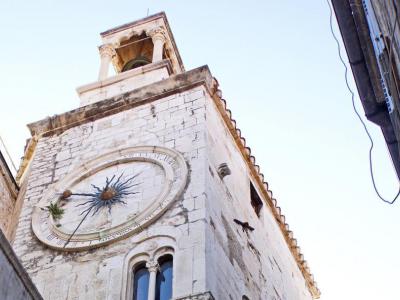
The Church of Our Lady of the Bell Tower (Gospa od Zvonika) has a long and fascinating history. Its origins can be traced back to the 6th century when it was constructed on the sentries' walkway above the Iron Gate of Diocletian's Palace. Initially, it was dedicated to Saint Theodore. Later, in the 11th century, an Early Romanesque bell tower was added, making it the oldest preserved bell tower on the Croatian side of the Adriatic.
Notable remnants from this era include fragments of a chancel screen with an inscription mentioning the city's benefactor, Firminus, along with his first and second wives, Magi and Brita, who made significant contributions to the church. The church received its current name in the 13th century after the installation of the icon of Our Lady of the Bell Tower, which is now safeguarded in the treasury of Split Cathedral.
To reach the church, a steep external staircase was constructed, which was historically climbed by the women of Split. They ascended the stairs to make vows before the church, seeking protection during childbirth.
Adjacent to the Iron Gate and facing the square (Pjaca), a Romanesque tower was built. Later, in the 16th century, a Renaissance municipal clock was installed in this tower, adding a touch of modernity to the ancient structure. The church and its surrounding elements stand as a testament to the rich historical and architectural heritage of the region.
Tip:
Rather than looking at the tower alone, you can enjoy the view from the Narodni (People's) Square side with the Iron Gate and the Clock Tower.
Go inside for the mural with Christ behind the altar, which is very interesting for its originality, different from many in the world.
Notable remnants from this era include fragments of a chancel screen with an inscription mentioning the city's benefactor, Firminus, along with his first and second wives, Magi and Brita, who made significant contributions to the church. The church received its current name in the 13th century after the installation of the icon of Our Lady of the Bell Tower, which is now safeguarded in the treasury of Split Cathedral.
To reach the church, a steep external staircase was constructed, which was historically climbed by the women of Split. They ascended the stairs to make vows before the church, seeking protection during childbirth.
Adjacent to the Iron Gate and facing the square (Pjaca), a Romanesque tower was built. Later, in the 16th century, a Renaissance municipal clock was installed in this tower, adding a touch of modernity to the ancient structure. The church and its surrounding elements stand as a testament to the rich historical and architectural heritage of the region.
Tip:
Rather than looking at the tower alone, you can enjoy the view from the Narodni (People's) Square side with the Iron Gate and the Clock Tower.
Go inside for the mural with Christ behind the altar, which is very interesting for its originality, different from many in the world.
13) Game of Thrones Museum (must see)
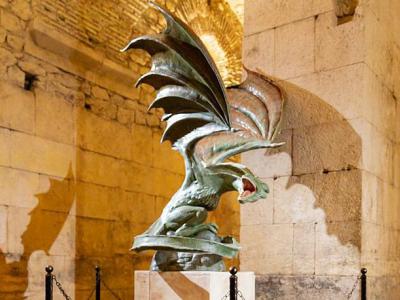
Split figured large in the filming of Game of Thrones (GOT). So it is only natural that Split should have an awesome Game of Thrones museum. The museum's address is 9 Bosanska Street. This is very close to the places where the series was actually filmed. Take Diocletian's Cellars, where a dragon's head once smashed through the ancient brick walls.
Luka Galik, the brain behind the Museum swears that everything is "just like" the series. "Split deserved the Game of Thrones Museum." He says. The museum has exhibits of photographs taken during the filming, and weapons and costumes that were worn. There are theme rooms of leading characters like, Khaleesi, Thyron, Hodor, Jack Sow, and others.
The Game of Thrones Museum has dark walls that help the grim atmosphere of the series. Aroma therapy is not neglected. The inside of the museum is filled with the aromas of cedar, Jasmine, lavender and ether oils. Smell a mystery, anyone? Yes, this is the place.
Luka Galik, the brain behind the Museum swears that everything is "just like" the series. "Split deserved the Game of Thrones Museum." He says. The museum has exhibits of photographs taken during the filming, and weapons and costumes that were worn. There are theme rooms of leading characters like, Khaleesi, Thyron, Hodor, Jack Sow, and others.
The Game of Thrones Museum has dark walls that help the grim atmosphere of the series. Aroma therapy is not neglected. The inside of the museum is filled with the aromas of cedar, Jasmine, lavender and ether oils. Smell a mystery, anyone? Yes, this is the place.
14) Grgur Ninski Statue (must see)
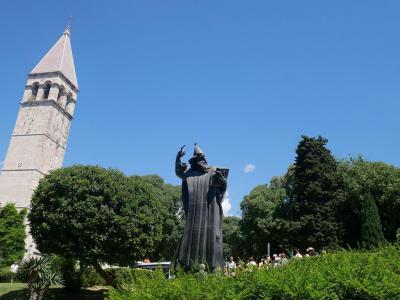
May Gregory of Nin's Big Toe bring you good fortune. That's a nice thought. But you must go to Split and rub Gregory's big toe. Grigur Ninski (Gregory of Nin), was the Bishop of Nin in 926. Rome thought him a dangerous radical. He wanted to preach in the language of the people, since almost no one understood Latin, a condition that persists to this day.
Croatians consider Gregory as the defender of Croation language and culture. The City of Split has a huge statue of him (28 feet high). The statue was sculpted in 1929 by Ivan Mestrovic. The statue was in the center of Diocletian's Palace until 1941, when it was moved by Italian occupation forces. In 1954 it was moved to the City's Golden Gate.
Gregory is bronze and dark except for his big toe. It is worn smooth and golden by constant rubbings of tourists, travelers, pilgrims and local people. Croatians are said to believe that rubbing the toe will grant their wishes. Every day, for as long as Gregory has guarded the Golden Gate, the faithful have rubbed his toe.
Croatians consider Gregory as the defender of Croation language and culture. The City of Split has a huge statue of him (28 feet high). The statue was sculpted in 1929 by Ivan Mestrovic. The statue was in the center of Diocletian's Palace until 1941, when it was moved by Italian occupation forces. In 1954 it was moved to the City's Golden Gate.
Gregory is bronze and dark except for his big toe. It is worn smooth and golden by constant rubbings of tourists, travelers, pilgrims and local people. Croatians are said to believe that rubbing the toe will grant their wishes. Every day, for as long as Gregory has guarded the Golden Gate, the faithful have rubbed his toe.
15) Golden Gate
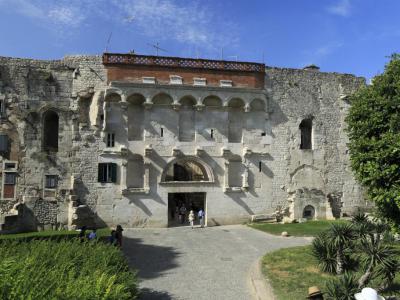
When Diocletian retired he left the empire behind him. He sailed to his sea front villa/fortress. He debarked and entered his palace through the Porta septemrionalis. Or, as some prefer to say The Golden Gate. The gate was designed with double doors for defensive tactics. Or, as some would say then, "propugnaculum."
The Golden Gate ("Zlatna vrata") is one of four gates giving access and egress to the old town ("stari grad"). The old town of course was Diocletian's Palace itself. In the Emperor's time the gate was referred to as "the northern gate". In the middle ages it was known as "Roman Gate." The name Golden Gate was first used in 1553.
On each side of the gate are niches for the statues of the four Tetrarchs, Diocletian himself, and the rulers of the divided Empire, Maximian, Galerius, and Constantius Chlorus. The sixth century church of Saint Martin's is perched above the outer part of the gate.
Most visitors arriving from the harbor side of the Palace will enter through the the South or East Gates although the North Gate, the Golden Gate, was meant to be the main entrance. Today the 28 foot statue by Ivan Mestrovic of Grgur Ninski, Saint Gregory of Nin, looms just outside the Golden Gate.
The Golden Gate ("Zlatna vrata") is one of four gates giving access and egress to the old town ("stari grad"). The old town of course was Diocletian's Palace itself. In the Emperor's time the gate was referred to as "the northern gate". In the middle ages it was known as "Roman Gate." The name Golden Gate was first used in 1553.
On each side of the gate are niches for the statues of the four Tetrarchs, Diocletian himself, and the rulers of the divided Empire, Maximian, Galerius, and Constantius Chlorus. The sixth century church of Saint Martin's is perched above the outer part of the gate.
Most visitors arriving from the harbor side of the Palace will enter through the the South or East Gates although the North Gate, the Golden Gate, was meant to be the main entrance. Today the 28 foot statue by Ivan Mestrovic of Grgur Ninski, Saint Gregory of Nin, looms just outside the Golden Gate.
16) City Museum of Split
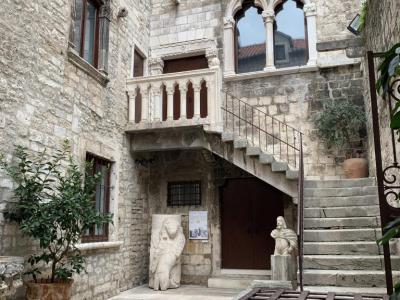
Established in 1946, the City Museum of Split is located in the northeastern part of the Diocletian Palace, within the complex of Medieval buildings centered around a remarkable Gothic-Renaissance edifice which once belonged to the noble family of Papalic. The family's coat of arms is featured on one of the portals.
The Papalic Palace (Papaliceva Palaca) was designed and built by the native master Juraj of Dalmatia (Juraj Dalmatinac) in the 15th century. The beautifully executed courtyard has richly decorated portal and loggia. The Renaissance hall with a fine window decoration and a well preserved wooden ceiling completes the courtyard ensemble.
The museum is found on the first floor. Inside, its permanent collection features artifacts and a variety of sculptures, dating from the Diocletian times, through the 12th-14th centuries, when Split was an autonomous commune, and more. Among the exhibits there are pieces of medieval weaponry, various paintings and artworks, along with fragments of sculptures, monuments and statues that were once part of the buildings in Split. The dining room, on the first floor, is furnished just as it was back in the day, when the Papalic family owned the house, giving the idea of how the nobility of that time lived.
Here you will also find the city statute, seal and coins, plus the Romanesque sculpture from the belfry of the local cathedral attributed to the period of Venetian rule (15th- 16th centuries). There are also numerous documents, photographs, maps and manuscripts relating to the more recent history of Split.
Additionally, within the museum there is a gallery of Emanuel Vidovic, a major local painter of the 20th century and one of the foremost protagonists of Croatian modern painting.
The Papalic Palace (Papaliceva Palaca) was designed and built by the native master Juraj of Dalmatia (Juraj Dalmatinac) in the 15th century. The beautifully executed courtyard has richly decorated portal and loggia. The Renaissance hall with a fine window decoration and a well preserved wooden ceiling completes the courtyard ensemble.
The museum is found on the first floor. Inside, its permanent collection features artifacts and a variety of sculptures, dating from the Diocletian times, through the 12th-14th centuries, when Split was an autonomous commune, and more. Among the exhibits there are pieces of medieval weaponry, various paintings and artworks, along with fragments of sculptures, monuments and statues that were once part of the buildings in Split. The dining room, on the first floor, is furnished just as it was back in the day, when the Papalic family owned the house, giving the idea of how the nobility of that time lived.
Here you will also find the city statute, seal and coins, plus the Romanesque sculpture from the belfry of the local cathedral attributed to the period of Venetian rule (15th- 16th centuries). There are also numerous documents, photographs, maps and manuscripts relating to the more recent history of Split.
Additionally, within the museum there is a gallery of Emanuel Vidovic, a major local painter of the 20th century and one of the foremost protagonists of Croatian modern painting.
Image Courtesy of Roger.
