Custom Walk in Savannah, Georgia by blevinsandrew_865a5 created on 2025-06-30
Guide Location: USA » Savannah
Guide Type: Custom Walk
# of Sights: 11
Tour Duration: 2 Hour(s)
Travel Distance: 4 Km or 2.5 Miles
Share Key: FQ4ZH
Guide Type: Custom Walk
# of Sights: 11
Tour Duration: 2 Hour(s)
Travel Distance: 4 Km or 2.5 Miles
Share Key: FQ4ZH
How It Works
Please retrieve this walk in the GPSmyCity app. Once done, the app will guide you from one tour stop to the next as if you had a personal tour guide. If you created the walk on this website or come to the page via a link, please follow the instructions below to retrieve the walk in the app.
Retrieve This Walk in App
Step 1. Download the app "GPSmyCity: Walks in 1K+ Cities" on Apple App Store or Google Play Store.



Step 2. In the GPSmyCity app, download(or launch) the guide "Savannah Map and Walking Tours".
Step 3. Tap the menu button located at upper right corner of the "Walks" screen and select "Retrieve custom walk". Enter the share key: FQ4ZH
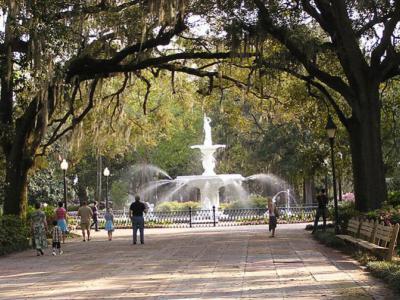
1) Forsyth Park (must see)
Forsyth Park to Savannah, Georgia is pretty much what Central Park is to New York City or Lincoln Park to Chicago. Occupying 30 acres of land in the city's Historic District, this park was laid out in 1851 and named for the then Governor of the state, John Forsyth.
The park's centerpiece is undoubtedly its most famous asset, the Forsyth Fountain. Modeled after the fountains at Place de la Concorde square in Paris, France, it was added in 1858. More recently, this fountain has made appearance in a number of movies like 'Cape Fear', 'Forrest Gump', and 'Midnight in the Garden of Good and Evil'.
Among other amenities here, visitors will find plenty of walking paths, a children's play area, a fragrant "Garden for the Blind" (where all of the plantings are chosen for their scent, rather than their appearance), tennis and basketball courts, areas for soccer and frisbee, a half-shell theater, cafe, and more. The park is also home to the Savannah Shamrocks Rugby Club, and contains several monuments to historic personalities, including the one commemorating those killed in the Civil War, the bloodiest armed conflict in American history.
From time to time, the park hosts musical events, such as Savannah Symphony and Jazz Festival, as well as a Farmers Market held every Saturday, and free movie screenings every few months. The place is very family-friendly, ideally suited for those loving to throw and kick some ball or simply relax with a picnic and blanket under the shade of an oak tree. Architecture buffs will definitely want to take the sidewalk along the park to view the homes across from it.
The park's centerpiece is undoubtedly its most famous asset, the Forsyth Fountain. Modeled after the fountains at Place de la Concorde square in Paris, France, it was added in 1858. More recently, this fountain has made appearance in a number of movies like 'Cape Fear', 'Forrest Gump', and 'Midnight in the Garden of Good and Evil'.
Among other amenities here, visitors will find plenty of walking paths, a children's play area, a fragrant "Garden for the Blind" (where all of the plantings are chosen for their scent, rather than their appearance), tennis and basketball courts, areas for soccer and frisbee, a half-shell theater, cafe, and more. The park is also home to the Savannah Shamrocks Rugby Club, and contains several monuments to historic personalities, including the one commemorating those killed in the Civil War, the bloodiest armed conflict in American history.
From time to time, the park hosts musical events, such as Savannah Symphony and Jazz Festival, as well as a Farmers Market held every Saturday, and free movie screenings every few months. The place is very family-friendly, ideally suited for those loving to throw and kick some ball or simply relax with a picnic and blanket under the shade of an oak tree. Architecture buffs will definitely want to take the sidewalk along the park to view the homes across from it.
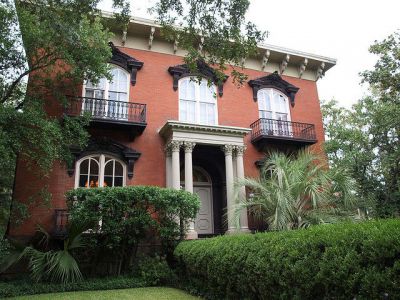
2) Mercer-Williams House (must see)
The Mercer-Williams House Museum sees a lot of visitors due to its role in the hugely popular "Midnight in the Garden of Good and Evil". While this grand John Norris building is now primarily known as a crime scene involving late antiques dealer Jim Williams and his lover, if you take a tour of the home, you might hear less about all that than you may have expected.
Now proudly owned by Jim Williams's sister, an established academic in her own right, the house deliberately concentrates on the early history of the home and Jim Williams's prodigious talent as a collector and conservator of fine art and antiques. Tours are worth it for art aficionados even though the upstairs, Dr. Kingery's residence, is off-limits.
Williams bought the elegant Italianate mansion, which has been cited as "nationally significant" for its architectural style, in 1969. With its tall arched windows and ornate ironwork balconies, it is considered one of the most beautiful in Savannah.
Why You Should Visit:
Okay, so you only get to see the garden and the first floor, but the house is so interesting and the guides are so committed to telling the stories that it's a worthwhile tour.
Tip:
Try to check the neighborhood out at night, as the garden/park in the center of the block is eerily beautiful and well-lit.
Now proudly owned by Jim Williams's sister, an established academic in her own right, the house deliberately concentrates on the early history of the home and Jim Williams's prodigious talent as a collector and conservator of fine art and antiques. Tours are worth it for art aficionados even though the upstairs, Dr. Kingery's residence, is off-limits.
Williams bought the elegant Italianate mansion, which has been cited as "nationally significant" for its architectural style, in 1969. With its tall arched windows and ornate ironwork balconies, it is considered one of the most beautiful in Savannah.
Why You Should Visit:
Okay, so you only get to see the garden and the first floor, but the house is so interesting and the guides are so committed to telling the stories that it's a worthwhile tour.
Tip:
Try to check the neighborhood out at night, as the garden/park in the center of the block is eerily beautiful and well-lit.
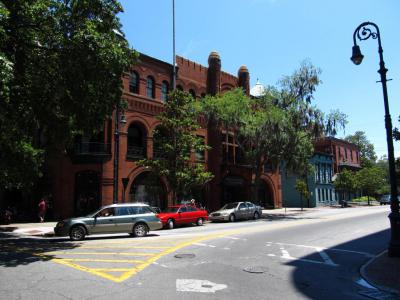
3) Bull Street (must see)
Bull Street is the main artery of Savannah’s downtown area, stretching all the way from the Starland neighborhood through Historic District. A section between Forsyth Park and the City Hall is the showroom of the city's history and beauty. Walking here you will pass via five of Savannah's iconic squares, such as Johnson Square, Wright Square, Chippewa Square, Madison Square, and Monterey Square, located precisely two blocks away from each other down the road.
This thoroughfare offers some of Savannah’s best shopping experiences, not to mention lots of other delights! The long stretch between Forsyth and the river is a home to some of the best restaurants in town.
In particular, make sure to explore the BULL STREET TACO (open Monday through Saturday, from 11am–10pm), which is a hip artsy spot with lots of contemporary artwork and vintage photos on the walls. It has a few tables inside, a bar, and a nice patio outside, where many people dine in the warmer months. Most of the drinks at the bar are tequila-based; however, their main event, undoubtedly, is the street tacos!
As you stroll down the road under the moss and oak trees past the numerous boutiques, eateries, and historic homes, keep an eye on memorial plaques here and there. The genuine feeling of presence in the Old South will come over you instantly.
This thoroughfare offers some of Savannah’s best shopping experiences, not to mention lots of other delights! The long stretch between Forsyth and the river is a home to some of the best restaurants in town.
In particular, make sure to explore the BULL STREET TACO (open Monday through Saturday, from 11am–10pm), which is a hip artsy spot with lots of contemporary artwork and vintage photos on the walls. It has a few tables inside, a bar, and a nice patio outside, where many people dine in the warmer months. Most of the drinks at the bar are tequila-based; however, their main event, undoubtedly, is the street tacos!
As you stroll down the road under the moss and oak trees past the numerous boutiques, eateries, and historic homes, keep an eye on memorial plaques here and there. The genuine feeling of presence in the Old South will come over you instantly.
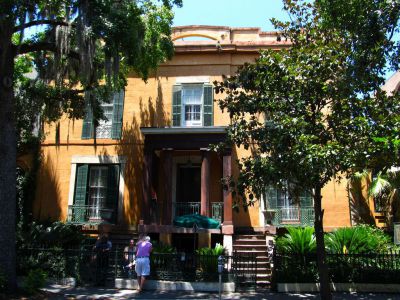
4) Sorrel-Weed House
There are many beautiful antebellum mansions in Savannah, Georgia, but the Sorrel-Weed House, which was the first house in Georgia to be designated as a state landmark in 1953, may be the most beautiful of all. Surely, it's an exceptional example of Greek Revival and Regency Style architecture.
Located in Madison Square, it was designed and built by renowned Irish architect Charles B. Cluskey in 1841 for Francis Sorrel, a commission merchant from the West Indies. The house, which is also a National Trust Historic Landmark, features a parapet with elliptical arches, a sweeping double entrance and Doric columns on the portico with balconies on the first story front windows. An oval shaped library with curved wooden doors is of particular interest.
Note the pinkish color of the house; there's an interesting story there. During the first restoration, the Historic Savannah Foundation didn't want the owner to use it because it wasn't considered as one of Savannah's original colors. However, after scraping off over 20 layers of old paint, the owner was able to prove that it was, in fact, the original color, so it stayed. Today, visitors can enjoy touring the interior – a nice combination of informative, intriguing, and only slightly creepy.
Located in Madison Square, it was designed and built by renowned Irish architect Charles B. Cluskey in 1841 for Francis Sorrel, a commission merchant from the West Indies. The house, which is also a National Trust Historic Landmark, features a parapet with elliptical arches, a sweeping double entrance and Doric columns on the portico with balconies on the first story front windows. An oval shaped library with curved wooden doors is of particular interest.
Note the pinkish color of the house; there's an interesting story there. During the first restoration, the Historic Savannah Foundation didn't want the owner to use it because it wasn't considered as one of Savannah's original colors. However, after scraping off over 20 layers of old paint, the owner was able to prove that it was, in fact, the original color, so it stayed. Today, visitors can enjoy touring the interior – a nice combination of informative, intriguing, and only slightly creepy.
5) Chippewa Square
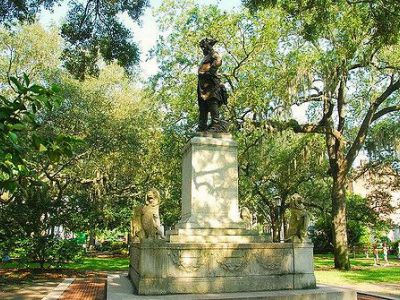
Chippewa Square is one of Savannah's 22 historic squares. Laid out in 1815, it occupies a central position in the city's layout, situated along Bull Street and McDonough Street. Chippewa Square was named in honor of American soldiers who fell in the Battle of Chippawa during the War of 1812.
The square's most historic structure is the Savannah Theatre, located at 222 Bull Street, which dates back to 1818, making it the oldest building on the square.
A prominent feature of Chippewa Square is the James Oglethorpe Monument, a tribute to the founder of Georgia. Unveiled in 1910, it was a collaborative creation by sculptor Daniel Chester French and architect Henry Bacon. The monument is significant for its depiction of Oglethorpe, facing south with a drawn sword, symbolically facing Georgia's historic adversary, Spanish Florida.
Chippewa Square gained widespread recognition through its appearance in the 1994 film "Forrest Gump." The iconic "park bench" scene was filmed on the north side of the square, using a fiberglass prop bench instead of the park's actual benches. This prop has since become a significant piece of film history, with a replica displayed at the Savannah Visitors Center and the original kept at Paramount Studios in Los Angeles.
In addition to its cinematic fame, Chippewa Square is also the site of significant religious and architectural landmarks, including the First Baptist Church (1833), the Independent Presbyterian Church, and the Philbrick–Eastman House (1847). Each of these buildings adds to the square's historical and cultural fabric, making Chippewa Square a vital component of Savannah's heritage.
The square's most historic structure is the Savannah Theatre, located at 222 Bull Street, which dates back to 1818, making it the oldest building on the square.
A prominent feature of Chippewa Square is the James Oglethorpe Monument, a tribute to the founder of Georgia. Unveiled in 1910, it was a collaborative creation by sculptor Daniel Chester French and architect Henry Bacon. The monument is significant for its depiction of Oglethorpe, facing south with a drawn sword, symbolically facing Georgia's historic adversary, Spanish Florida.
Chippewa Square gained widespread recognition through its appearance in the 1994 film "Forrest Gump." The iconic "park bench" scene was filmed on the north side of the square, using a fiberglass prop bench instead of the park's actual benches. This prop has since become a significant piece of film history, with a replica displayed at the Savannah Visitors Center and the original kept at Paramount Studios in Los Angeles.
In addition to its cinematic fame, Chippewa Square is also the site of significant religious and architectural landmarks, including the First Baptist Church (1833), the Independent Presbyterian Church, and the Philbrick–Eastman House (1847). Each of these buildings adds to the square's historical and cultural fabric, making Chippewa Square a vital component of Savannah's heritage.
6) Historic District
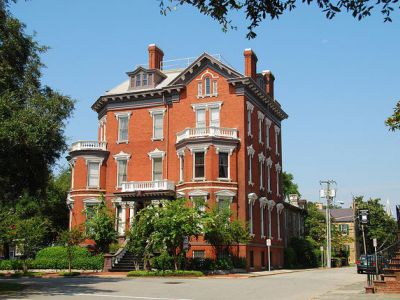
The Savannah Historic District is a sizable historic area in the United States that corresponds roughly to the boundaries of Savannah, before the American Civil War. In 1966, it earned the distinction of being declared a National Historic Landmark District, making it one of the largest of its kind in the country.
Every year, the Savannah Historic District draws millions of tourists who come to appreciate its architecture from the 18th and 19th centuries, as well as its green spaces. This district is home to various historically significant sites, such as the birthplace of Juliette Gordon Low (the founder of the Girl Scouts of the United States of America, found in the Juliette Gordon Low Historic District), the Telfair Academy of Arts and Sciences (one of the earliest public museums in the Southern United States), the First African Baptist Church (the oldest African American Baptist congregation in the U.S.), Temple Mickve Israel (the third-oldest synagogue in America), the Central of Georgia Railway roundhouse complex (the oldest surviving pre-Civil War rail facility in America), the old Colonial Cemetery, Cathedral of St. John the Baptist, and Old Harbor Light.
Among the notable buildings within the district are the Isaiah Davenport House, the Green-Meldrim House, the Owens-Thomas House, the William Scarbrough House, and the United States Customhouse. Additionally, you'll find attractive green spaces in the area, including Savannah's 22 shaded squares, the 30-acre Forsyth Park, located at the district's southern edge, and Emmet Park, situated near the city's riverfront.
Every year, the Savannah Historic District draws millions of tourists who come to appreciate its architecture from the 18th and 19th centuries, as well as its green spaces. This district is home to various historically significant sites, such as the birthplace of Juliette Gordon Low (the founder of the Girl Scouts of the United States of America, found in the Juliette Gordon Low Historic District), the Telfair Academy of Arts and Sciences (one of the earliest public museums in the Southern United States), the First African Baptist Church (the oldest African American Baptist congregation in the U.S.), Temple Mickve Israel (the third-oldest synagogue in America), the Central of Georgia Railway roundhouse complex (the oldest surviving pre-Civil War rail facility in America), the old Colonial Cemetery, Cathedral of St. John the Baptist, and Old Harbor Light.
Among the notable buildings within the district are the Isaiah Davenport House, the Green-Meldrim House, the Owens-Thomas House, the William Scarbrough House, and the United States Customhouse. Additionally, you'll find attractive green spaces in the area, including Savannah's 22 shaded squares, the 30-acre Forsyth Park, located at the district's southern edge, and Emmet Park, situated near the city's riverfront.
7) City Market (must see)
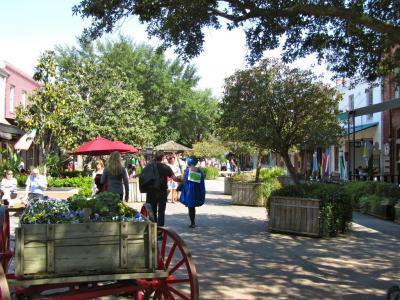
Originally centered on the site of today's Ellis Square, from 1733, Savannah's main marketplace was established as a wooden building where locals gathered for their groceries and services. By 1755, the market had turned into a center of local commerce and hub of all activity downtown; a place where fishermen and farmers would bring their goods to sell.
Over time, the building survived two fires (in 1796 and 1820) which ultimately destroyed it, and was replaced the following year with a single-storey structure. The latter was torn down also, shortly after the Civil War, and its place was taken by a brick building, erected in 1876, by architects Augustus Schwaab and Martin Phillip Muller.
Albeit praised as "roomy (the structure encompassed 33,000 square feet), and capable of being kept in the highest condition of cleanliness, with ample ventilation", the cost of construction "vastly exceeded expectations". Later excavations revealed weakened arches in the basement floor that required them to be replaced.
The market suffered severe damage from a hurricane in 1896, and was even closed at one point, in 1954. But today it thrives once again, stretching for a good two blocks between Ellis and Franklin squares.
The old 19th-century cotton warehouses, once fallen into disrepair, have been restored and renovated, and turned into bistros, art galleries, casual and upscale restaurants, antique stores, jewelry shops, bakeries, sweets and candy parlors, and other specialty outlets (there's even a daiquiri dispensary and a specialty coffee joint).
The newest attraction in the market complex is the American Prohibition Museum, which has 6,000 square feet of exhibition space, housing 13 galleries.
During the day and at night the historic place offers totally different experiences. In the evenings, visitors can enjoy jazz at local nightclubs or otherwise discover the "art and soul" of Savannah while being serenaded by local musicians.
Over time, the building survived two fires (in 1796 and 1820) which ultimately destroyed it, and was replaced the following year with a single-storey structure. The latter was torn down also, shortly after the Civil War, and its place was taken by a brick building, erected in 1876, by architects Augustus Schwaab and Martin Phillip Muller.
Albeit praised as "roomy (the structure encompassed 33,000 square feet), and capable of being kept in the highest condition of cleanliness, with ample ventilation", the cost of construction "vastly exceeded expectations". Later excavations revealed weakened arches in the basement floor that required them to be replaced.
The market suffered severe damage from a hurricane in 1896, and was even closed at one point, in 1954. But today it thrives once again, stretching for a good two blocks between Ellis and Franklin squares.
The old 19th-century cotton warehouses, once fallen into disrepair, have been restored and renovated, and turned into bistros, art galleries, casual and upscale restaurants, antique stores, jewelry shops, bakeries, sweets and candy parlors, and other specialty outlets (there's even a daiquiri dispensary and a specialty coffee joint).
The newest attraction in the market complex is the American Prohibition Museum, which has 6,000 square feet of exhibition space, housing 13 galleries.
During the day and at night the historic place offers totally different experiences. In the evenings, visitors can enjoy jazz at local nightclubs or otherwise discover the "art and soul" of Savannah while being serenaded by local musicians.
8) Owens-Thomas House and Slave Quarters (must see)
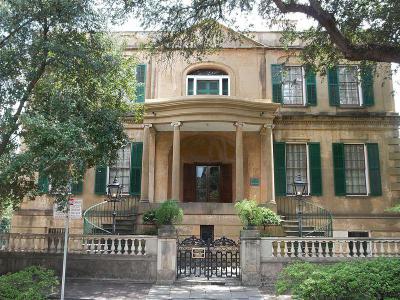
The historic Owens–Thomas House in Savannah, Georgia is one of the finest examples of English Regency architecture in the United States.
The building was completed in 1819 to a design by William Jay, an English architect. His plan was to create a house aesthetically compatible to Bath, England, which is evident in the use of the Bath stone as well as in the sophisticated architectural detail that was meant to add a gentrifying physical ornament to the then-newly emerging Southern port of Savannah. The structure is notable for its early cast-iron side veranda with elaborate acanthus scroll supports on which the Marquis de Lafayette addressed the citizens of Savannah on his visit in 1825.
The house was originally named for its first owner, Richard Richardson, whose family had earned fortune as cotton merchants and bankers. In 1830, the mansion was purchased by the local attorney and politician, George Welshman Owens, and remained in his family for several decades until Owens' granddaughter, Margaret Thomas, bequeathed it to the Telfair Academy of Arts and Sciences, in 1951.
In 1976, the house was designated a National Historic Landmark. Complete with the Slave Quarters, which were uncovered and restored during renovations in the 1990s, the property is now a museum. Its collection contains furnishings and decorative arts from the English Regency period, including possessions of the Owens family dating from 1790 to 1840. Among other exhibits here are English Georgian and American Federal period furniture, early Savannah textiles, silver, Chinese Export porcelain, and 18th- and 19th-century art.
The museum's highlight, though, is the carriage house that once functioned as slave quarters – one of the earliest in existence and best preserved in the American South. Previously inhabited by servants like the nanny, cook, butler and other enslaved workers, the place features slave artifacts of the period.
Although architecturally insignificant, the Slave Quarters is culturally and historically important as the showcase of the African slaves' attempt to maintain their ethnic heritage. The ceiling of the building is painted haint blue, which was customarily used in Gullah culture to deter ghosts or other malevolent spirits.
In the courtyard you can see a small parterre garden designed in 1820 English-American style.
The place is open Sunday through Monday from 12–5pm; and Tuesday through Saturday from 10am–5pm.
Tip:
Museum tours go off every 15 minutes – so try to go with a smaller group!
You can also get a pass to see the Jepson Art Center and the Telfair Museum of Art for a single price of $20 in the space of one week.
The building was completed in 1819 to a design by William Jay, an English architect. His plan was to create a house aesthetically compatible to Bath, England, which is evident in the use of the Bath stone as well as in the sophisticated architectural detail that was meant to add a gentrifying physical ornament to the then-newly emerging Southern port of Savannah. The structure is notable for its early cast-iron side veranda with elaborate acanthus scroll supports on which the Marquis de Lafayette addressed the citizens of Savannah on his visit in 1825.
The house was originally named for its first owner, Richard Richardson, whose family had earned fortune as cotton merchants and bankers. In 1830, the mansion was purchased by the local attorney and politician, George Welshman Owens, and remained in his family for several decades until Owens' granddaughter, Margaret Thomas, bequeathed it to the Telfair Academy of Arts and Sciences, in 1951.
In 1976, the house was designated a National Historic Landmark. Complete with the Slave Quarters, which were uncovered and restored during renovations in the 1990s, the property is now a museum. Its collection contains furnishings and decorative arts from the English Regency period, including possessions of the Owens family dating from 1790 to 1840. Among other exhibits here are English Georgian and American Federal period furniture, early Savannah textiles, silver, Chinese Export porcelain, and 18th- and 19th-century art.
The museum's highlight, though, is the carriage house that once functioned as slave quarters – one of the earliest in existence and best preserved in the American South. Previously inhabited by servants like the nanny, cook, butler and other enslaved workers, the place features slave artifacts of the period.
Although architecturally insignificant, the Slave Quarters is culturally and historically important as the showcase of the African slaves' attempt to maintain their ethnic heritage. The ceiling of the building is painted haint blue, which was customarily used in Gullah culture to deter ghosts or other malevolent spirits.
In the courtyard you can see a small parterre garden designed in 1820 English-American style.
The place is open Sunday through Monday from 12–5pm; and Tuesday through Saturday from 10am–5pm.
Tip:
Museum tours go off every 15 minutes – so try to go with a smaller group!
You can also get a pass to see the Jepson Art Center and the Telfair Museum of Art for a single price of $20 in the space of one week.
9) Davenport House
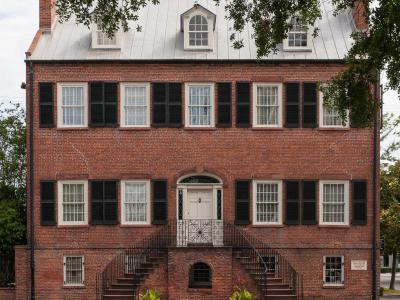
The Isaiah Davenport House, built in 1820 and threatened with demolition in 1955, is what encouraged concerned citizens of Savannah, Georgia, to recognize the architectural significance of the home and other historical buildings in the city and launch preservation efforts that eventually saved hundreds of structures.
Located on a corner of Columbia Square, the Federal-style building was built by Davenport for his wife, ten children and nine slaves. A century later, the once stately home in a fashionable neighborhood became a rundown and dilapidated rooming house in a seedy part of town. A group of community-spirited citizens gathered to purchase it – the first act of the newly organized Historic Savannah Foundation, which went on to save hundreds of buildings in the city; in fact, in 1955, Davenport House became the Foundation's headquarters. It was opened to the public as a house museum in 1963.
Since the mid-1990s, the museum began a restoration process which resulted in a more authentic experience for visitors, including period wallpaper and room furnishings reflecting the inventory taken at the time of Davenport's death in 1827.
Why You Should Visit:
Although not as opulent as some other houses one can visit in Savannah, the 40-min tour – which starts with a brief video, very well done – is quite appealing. Each room has been carefully renovated with attention given to the tiniest detail, and great pains have been taken to create even the original designs of the floor and the wallpaper.
Tip:
Enjoy the beauty of the garden after your tour but make sure to enjoy the gift shop as well, since profits go for the continual improvement of this beautiful home.
Located on a corner of Columbia Square, the Federal-style building was built by Davenport for his wife, ten children and nine slaves. A century later, the once stately home in a fashionable neighborhood became a rundown and dilapidated rooming house in a seedy part of town. A group of community-spirited citizens gathered to purchase it – the first act of the newly organized Historic Savannah Foundation, which went on to save hundreds of buildings in the city; in fact, in 1955, Davenport House became the Foundation's headquarters. It was opened to the public as a house museum in 1963.
Since the mid-1990s, the museum began a restoration process which resulted in a more authentic experience for visitors, including period wallpaper and room furnishings reflecting the inventory taken at the time of Davenport's death in 1827.
Why You Should Visit:
Although not as opulent as some other houses one can visit in Savannah, the 40-min tour – which starts with a brief video, very well done – is quite appealing. Each room has been carefully renovated with attention given to the tiniest detail, and great pains have been taken to create even the original designs of the floor and the wallpaper.
Tip:
Enjoy the beauty of the garden after your tour but make sure to enjoy the gift shop as well, since profits go for the continual improvement of this beautiful home.
10) Cathedral of St. John the Baptist (must see)
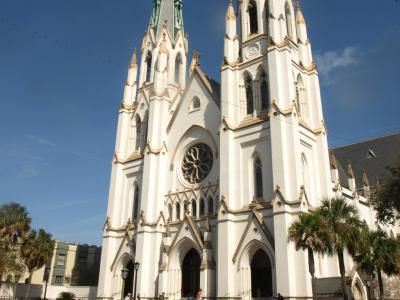
Back in the early days of America, the Roman Catholics were banned from settling in the South out of fear of their potential loyalty to the Spanish crown and possible secession of the southern colonies from the English-controlled North. As a result, Savannah had no Catholic church until 1799, when the French migrants from Haiti, fleeing the French Revolution, established it for the first time. The Cathedral of Saint John the Baptist was begun in 1873. It was commissioned in 1896 upon the completion of the majestic twin spires and addition of stucco and whitewash coating to the brick structure.
The cathedral boasts a number of notable artistic and architectural features, including the Great Rose Window, a Gothic quatrefoil with the image of Saint Cecilia in the center. The windows radiating from the center also contain figures – of players of musical instruments. The Original Window of the Blessed Virgin Mary is one of the few to have survived the great fire that ravaged the city in 1898. The Transept Windows feature the assumption of Virgin Mary into heaven, surrounded by angels and saints. In addition to this, the church houses several murals dating from 1912, depicting saints and other religious figures with the encoded symbols indicating their lives and deaths.
Locals lovingly dub the cathedral "America's Sistine Chapel", referring to its amazing stained glass work, ceiling paintings, and altar. Lovely to look at, this fine piece of French Gothic architecture is like a free 'trip' to Europe, particularly impressive to those who have not traveled extensively outside of the U.S.
Whilst inside, spare some time for a guided tour of the building – you'll be glad that you did. Also, be sure to drop a few bills in the donation box at the exit, which is quite unique, and don't forget to turn the handle.
The cathedral boasts a number of notable artistic and architectural features, including the Great Rose Window, a Gothic quatrefoil with the image of Saint Cecilia in the center. The windows radiating from the center also contain figures – of players of musical instruments. The Original Window of the Blessed Virgin Mary is one of the few to have survived the great fire that ravaged the city in 1898. The Transept Windows feature the assumption of Virgin Mary into heaven, surrounded by angels and saints. In addition to this, the church houses several murals dating from 1912, depicting saints and other religious figures with the encoded symbols indicating their lives and deaths.
Locals lovingly dub the cathedral "America's Sistine Chapel", referring to its amazing stained glass work, ceiling paintings, and altar. Lovely to look at, this fine piece of French Gothic architecture is like a free 'trip' to Europe, particularly impressive to those who have not traveled extensively outside of the U.S.
Whilst inside, spare some time for a guided tour of the building – you'll be glad that you did. Also, be sure to drop a few bills in the donation box at the exit, which is quite unique, and don't forget to turn the handle.
11) Andrew Low House
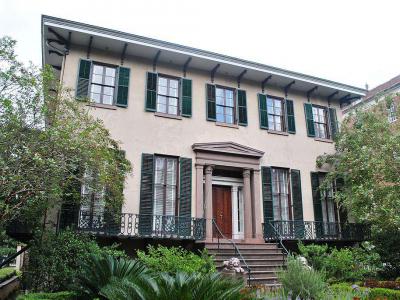
A major landmark on Lafayette Square is the lovely and stately house designed and built in 1848-49 for wealthy cotton merchant Andrew Low, which combines Grecian details with elements of the Italian Villa style and boasts one of Savannah's most stunning ironwork balconies. The shuttered piazza overlooks a beautiful brick-walled rear garden, and the front garden remains much as it did when first planted, with two hourglass-shaped flowerbeds.
Handsome inside as well as outside, the house features spacious rooms decorated with beautiful plaster cornices and carved woodwork, which were host to several important visitors over the years, including English author William Thackeray and Confederate General Robert E. Lee. In 1886, Low's son married Juliette Gordon, who later founded the Girl Scouts of America. When she died in 1927, she bequeathed her carriage house at 330 Drayton Street (in the rear) to the Girl Scouts.
The interior is decorated in the best examples of high-end furnishings from the 1850. No detail has been spared in textiles, furnishings, artwork, plate, glass and silver. Antiques junkies will go nuts over the furnishings, especially the massive secretary in the parlor, one of only four of this type in existence (a sibling is in NY's Metropolitan Museum of Art).
Why You Should Visit:
The tour guides are very informative and the period furnishings and window coverings add to the experience.
This is one of the few houses that allow taking pictures inside – if you go after hours as part of a 'ghost tour'.
Handsome inside as well as outside, the house features spacious rooms decorated with beautiful plaster cornices and carved woodwork, which were host to several important visitors over the years, including English author William Thackeray and Confederate General Robert E. Lee. In 1886, Low's son married Juliette Gordon, who later founded the Girl Scouts of America. When she died in 1927, she bequeathed her carriage house at 330 Drayton Street (in the rear) to the Girl Scouts.
The interior is decorated in the best examples of high-end furnishings from the 1850. No detail has been spared in textiles, furnishings, artwork, plate, glass and silver. Antiques junkies will go nuts over the furnishings, especially the massive secretary in the parlor, one of only four of this type in existence (a sibling is in NY's Metropolitan Museum of Art).
Why You Should Visit:
The tour guides are very informative and the period furnishings and window coverings add to the experience.
This is one of the few houses that allow taking pictures inside – if you go after hours as part of a 'ghost tour'.
