Custom Walk in Philadelphia, Pennsylvania by mechie023_77e26 created on 2025-08-19
Guide Location: USA » Philadelphia
Guide Type: Custom Walk
# of Sights: 13
Tour Duration: 2 Hour(s)
Travel Distance: 2.5 Km or 1.6 Miles
Share Key: TVRTM
Guide Type: Custom Walk
# of Sights: 13
Tour Duration: 2 Hour(s)
Travel Distance: 2.5 Km or 1.6 Miles
Share Key: TVRTM
How It Works
Please retrieve this walk in the GPSmyCity app. Once done, the app will guide you from one tour stop to the next as if you had a personal tour guide. If you created the walk on this website or come to the page via a link, please follow the instructions below to retrieve the walk in the app.
Retrieve This Walk in App
Step 1. Download the app "GPSmyCity: Walks in 1K+ Cities" on Apple App Store or Google Play Store.



Step 2. In the GPSmyCity app, download(or launch) the guide "Philadelphia Map and Walking Tours".
Step 3. Tap the menu button located at upper right corner of the "Walks" screen and select "Retrieve custom walk". Enter the share key: TVRTM
1) Independence Hall (must see)
By the late 1720s, Philadelphia was in need of a state house. The ground for its construction – on the south side of Chestnut Street, between Fifth and Sixth Streets, to a design by architect Edmund Woolley – was broken in 1732.
Upon its completion in 1753, the Colonial Government of Pennsylvania took occupancy of the State House immediately. The building served as the Capitol of the Province and Commonwealth of Pennsylvania until 1799.
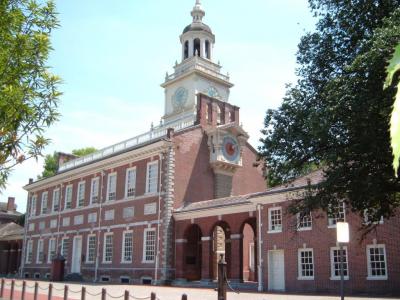
The former Pennsylvania State House, now known as Independence Hall, is a Georgian-style hall with a red brick facade. There is a central building with a bell tower and steeple. The center is attached by arcaded passageways to wings on either side. The steeple spire is 169 feet high. Old City Hall, Congress Hall, and Independence Hall together with Philosophical Hall, share Independence Square.
The Hall underwent several renovations in the 19th and 20th centuries ultimately restoring its 18th-century appearance. On the ground floor are the Assembly Room and the Supreme Court Room, separated by a vestibule. Behind the entrance is the Tower Stair Hall.
On June 14, 1775, the delegates of the Continental Congress chose George Washington to serve as the commander-in-chief of the Continental Army in the Assembly Room of the Independence Hall. Later, on July 26, the Congress named Benjamin Franklin as the first Postmaster General, a position that eventually evolved into the United States Post Office Department.
From 1775 to 1783, the Independence Hall was the main meeting house of the Second Continental Congress. The Declaration of Independence was approved within its walls on July 4, 1776. The United States Constitution was approved here in 1787.
Ever since then, Independence Hall has often served as a venue for speeches, rallies, and protests. Most events have been held on behalf of democratic and civil rights movements.
Upon its completion in 1753, the Colonial Government of Pennsylvania took occupancy of the State House immediately. The building served as the Capitol of the Province and Commonwealth of Pennsylvania until 1799.
The former Pennsylvania State House, now known as Independence Hall, is a Georgian-style hall with a red brick facade. There is a central building with a bell tower and steeple. The center is attached by arcaded passageways to wings on either side. The steeple spire is 169 feet high. Old City Hall, Congress Hall, and Independence Hall together with Philosophical Hall, share Independence Square.
The Hall underwent several renovations in the 19th and 20th centuries ultimately restoring its 18th-century appearance. On the ground floor are the Assembly Room and the Supreme Court Room, separated by a vestibule. Behind the entrance is the Tower Stair Hall.
On June 14, 1775, the delegates of the Continental Congress chose George Washington to serve as the commander-in-chief of the Continental Army in the Assembly Room of the Independence Hall. Later, on July 26, the Congress named Benjamin Franklin as the first Postmaster General, a position that eventually evolved into the United States Post Office Department.
From 1775 to 1783, the Independence Hall was the main meeting house of the Second Continental Congress. The Declaration of Independence was approved within its walls on July 4, 1776. The United States Constitution was approved here in 1787.
Ever since then, Independence Hall has often served as a venue for speeches, rallies, and protests. Most events have been held on behalf of democratic and civil rights movements.
2) Congress Hall
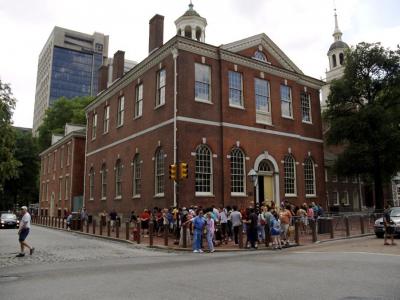
Congress Hall, a significant landmark in Philadelphia, is situated at the intersection of Chestnut and 6th Streets. Notably, it served as the seat of the United States Congress from December 6, 1790, to May 14, 1800. During this decade, Philadelphia was the temporary capital of the United States.
The building's architecture and use reflect the formative years of the U.S. government. The House of Representatives convened on the first floor, while the Senate met upstairs. This period in Congress Hall was marked by pivotal moments in American history, including the inauguration of Presidents George Washington (for his second term) and John Adams.
The first floor, home to the House chamber, features a simple design with mahogany desks and leather chairs. By 1796, it accommodated 106 representatives from 16 states, including the original 13, plus Vermont in 1791, Kentucky in 1792, and Tennessee in 1796. This room has been meticulously restored to its 1796 condition.
In contrast, the Senate chamber on the second floor is more elaborate. It was adorned with heavy red drapes and, by 1796, equipped with 32 secretary desks, 28 of which are original and akin to those in the current Senate chamber at the United States Capitol. The room also displays portraits of Louis XVI and Marie Antoinette, gifts from France post-Revolution. Noteworthy features include a ceiling fresco of an American bald eagle, symbolizing peace, and a plaster medallion depicting a sunburst with 13 stars for the original colonies.
The building's architecture and use reflect the formative years of the U.S. government. The House of Representatives convened on the first floor, while the Senate met upstairs. This period in Congress Hall was marked by pivotal moments in American history, including the inauguration of Presidents George Washington (for his second term) and John Adams.
The first floor, home to the House chamber, features a simple design with mahogany desks and leather chairs. By 1796, it accommodated 106 representatives from 16 states, including the original 13, plus Vermont in 1791, Kentucky in 1792, and Tennessee in 1796. This room has been meticulously restored to its 1796 condition.
In contrast, the Senate chamber on the second floor is more elaborate. It was adorned with heavy red drapes and, by 1796, equipped with 32 secretary desks, 28 of which are original and akin to those in the current Senate chamber at the United States Capitol. The room also displays portraits of Louis XVI and Marie Antoinette, gifts from France post-Revolution. Noteworthy features include a ceiling fresco of an American bald eagle, symbolizing peace, and a plaster medallion depicting a sunburst with 13 stars for the original colonies.
3) Declaration House (Graff House)
The Declaration House, also known as the Graff House, stands as a significant historical landmark in Philadelphia. This modest three-story structure was constructed in the 1770s by bricklayer Jacob Graff, who intended the second floor to be rented out for additional income. The house gained historical importance when it became the temporary abode of Thomas Jefferson, a slim, ginger-haired lodger, during a pivotal moment in American history. Jefferson, seeking a tranquil environment away from the bustling city noise, found refuge in this house and accomplished a remarkable feat. It was within these walls, in late spring 1776, that he drafted the Declaration of Independence in just a few weeks.
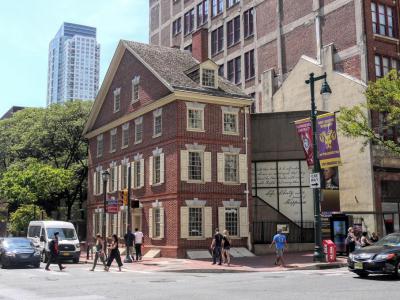
The house's architecture and design reflect the era of its construction. During its reconstruction 200 years later, many elements typical of the 1770s were meticulously incorporated to preserve its historical authenticity. This includes the Flemish Bond brick checkerboard pattern visible on its walls, windows adorned with paneled shutters, and an array of period-appropriate knickknacks. Unlike the larger, more symmetrical homes in Society Hill, the Graff House is notably small and asymmetrical, with a distinctly off-center front door. Preceding this entrance is a quaint garden, adding to the house's historical charm.
Today, the Declaration House serves not only as a reminder of Jefferson's monumental task but also as an educational site. Visitors are greeted with a short film about Jefferson's life and his drafting of the Declaration of Independence. A replica of his draft of the Declaration is also on display. The house, therefore, stands as a testament to the extraordinary circumstances and humble settings that played a backdrop to one of the most significant documents in the United States' history.
The house's architecture and design reflect the era of its construction. During its reconstruction 200 years later, many elements typical of the 1770s were meticulously incorporated to preserve its historical authenticity. This includes the Flemish Bond brick checkerboard pattern visible on its walls, windows adorned with paneled shutters, and an array of period-appropriate knickknacks. Unlike the larger, more symmetrical homes in Society Hill, the Graff House is notably small and asymmetrical, with a distinctly off-center front door. Preceding this entrance is a quaint garden, adding to the house's historical charm.
Today, the Declaration House serves not only as a reminder of Jefferson's monumental task but also as an educational site. Visitors are greeted with a short film about Jefferson's life and his drafting of the Declaration of Independence. A replica of his draft of the Declaration is also on display. The house, therefore, stands as a testament to the extraordinary circumstances and humble settings that played a backdrop to one of the most significant documents in the United States' history.
4) President's House
The President's House in Philadelphia holds a unique place in American history as the third U.S. Presidential Mansion and a pivotal site during the nation's early years. Occupied by George Washington from November 27, 1790, to March 10, 1797, and by John Adams from March 21, 1797, to May 30, 1800, this residence served as the executive mansion before the White House was completed.
Constructed around 1767 by Mary Masters, a widow, the house was situated just one block north of the Pennsylvania Statehouse, now known as Independence Hall. It briefly played a significant role during the British occupation of Philadelphia in 1777–1778, serving as headquarters for General Sir William Howe and the British Army. After the British evacuated in June 1778, the house became the headquarters for Military Governor Benedict Arnold.
Philadelphia was the national capital from 1790 to 1800, a period during which the city was the heart of American political life. The house was owned by Robert Morris, a financier of the Revolutionary War and a Founding Father, who provided it for George Washington's use. Reflecting the complexities of the era, Washington brought nine enslaved Africans from his Mount Vernon estate to work in the presidential household, a fact that underscores the entwined histories of freedom and slavery in the United States.
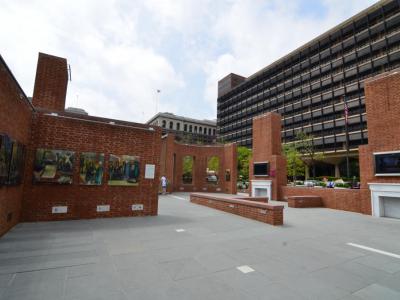
However, the exact location of The President's House was forgotten over time, leading to the unintentional demolition of its surviving walls in 1951. This loss sparked a significant historical and cultural reassessment, culminating in the 2010 commemoration of the site. This effort was driven by historians and African American groups, who advocated for the recognition of the house's complex legacy, including its role in the history of slavery in the United States.
Constructed around 1767 by Mary Masters, a widow, the house was situated just one block north of the Pennsylvania Statehouse, now known as Independence Hall. It briefly played a significant role during the British occupation of Philadelphia in 1777–1778, serving as headquarters for General Sir William Howe and the British Army. After the British evacuated in June 1778, the house became the headquarters for Military Governor Benedict Arnold.
Philadelphia was the national capital from 1790 to 1800, a period during which the city was the heart of American political life. The house was owned by Robert Morris, a financier of the Revolutionary War and a Founding Father, who provided it for George Washington's use. Reflecting the complexities of the era, Washington brought nine enslaved Africans from his Mount Vernon estate to work in the presidential household, a fact that underscores the entwined histories of freedom and slavery in the United States.
However, the exact location of The President's House was forgotten over time, leading to the unintentional demolition of its surviving walls in 1951. This loss sparked a significant historical and cultural reassessment, culminating in the 2010 commemoration of the site. This effort was driven by historians and African American groups, who advocated for the recognition of the house's complex legacy, including its role in the history of slavery in the United States.
5) Independence National Historical Park (must see)
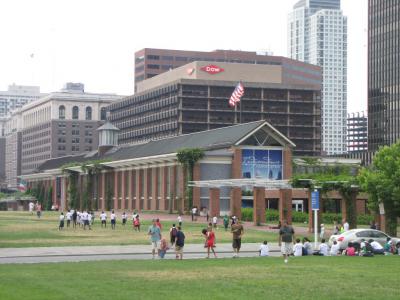
Independence National Historical Park in Philadelphia has been called "America's most historic square mile." Administered by the National Park Service, the 55 landscaped acres hold several often-visited historic sites within the Old City and Society Hill neighborhoods.
The heart of the Park is Independence Hall, the former Old State House of Philadelphia. This is where the Declaration of Independence and the Constitution of the United States were adopted. The first Continental Congress met in 1774 in Carpenters' Hall next door to Independence Hall, the home of the Second Continental Congress.
The Liberty Bell hangs in the Liberty Bell Center across from Independence Hall. The First Bank of the United States is in the Park. The Second Bank of the United States was closed down by President Andrew Jackson. Nearby is the City Tavern, a refuge of delegates and John Adams' favorite hangout.
The Park houses Franklin Court Museum dedicated to Benjamin Franklin. Another park resident is the United States Postal Service Museum. The three blocks immediately north of Independence Hall is Independence Mall. Besides the Liberty Bell Center, the Mall holds the National Constitution Center and George Washington's residence in his second term.
The first proposal for Independence National Historical Park was floated in 1915. Architects Albert Kelsey and David K. Boyd were driven to create a more sylvan locale for Independence Hall. The action was not taken until June 1948, when Congress authorized the creation of the Park. The Park is listed on the National Register of Historic Places.
The heart of the Park is Independence Hall, the former Old State House of Philadelphia. This is where the Declaration of Independence and the Constitution of the United States were adopted. The first Continental Congress met in 1774 in Carpenters' Hall next door to Independence Hall, the home of the Second Continental Congress.
The Liberty Bell hangs in the Liberty Bell Center across from Independence Hall. The First Bank of the United States is in the Park. The Second Bank of the United States was closed down by President Andrew Jackson. Nearby is the City Tavern, a refuge of delegates and John Adams' favorite hangout.
The Park houses Franklin Court Museum dedicated to Benjamin Franklin. Another park resident is the United States Postal Service Museum. The three blocks immediately north of Independence Hall is Independence Mall. Besides the Liberty Bell Center, the Mall holds the National Constitution Center and George Washington's residence in his second term.
The first proposal for Independence National Historical Park was floated in 1915. Architects Albert Kelsey and David K. Boyd were driven to create a more sylvan locale for Independence Hall. The action was not taken until June 1948, when Congress authorized the creation of the Park. The Park is listed on the National Register of Historic Places.
6) United States Mint
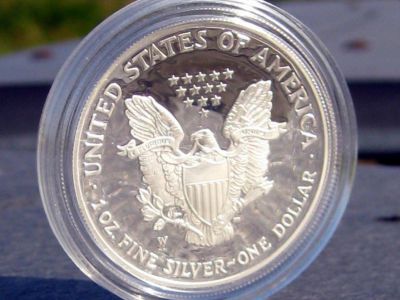
What to buy here: U.S Mint Silver Coins & Moneybag.
Collecting coins is one of the hottest hobbies around and when you’re in Philly you are at the heart of U.S coin operations. In 1792, Congress authorized construction of the first U.S. Mint in the nation's capitol, at the time, Philadelphia. For either lifelong coin hobbyists or youngsters just getting started, a coin collection gift from the United States Mint is a wonderful foundation to build on.
The new, multi-year America the Beautiful silver quarter collection is a must-have. High quality silver characterizes these uncirculated beauties, which can be purchased in a US Mint moneybag for a truly extraordinary gift. The quarters are all coded with a ‘P’ indicating their city of origin. Varies in price depending on the quantity but to give you an idea, 5 uncirculated America the Beautiful silver quarters are priced at $31.95, $49.95 for 100 identical coins in a U.S Mint moneybag.
Collecting coins is one of the hottest hobbies around and when you’re in Philly you are at the heart of U.S coin operations. In 1792, Congress authorized construction of the first U.S. Mint in the nation's capitol, at the time, Philadelphia. For either lifelong coin hobbyists or youngsters just getting started, a coin collection gift from the United States Mint is a wonderful foundation to build on.
The new, multi-year America the Beautiful silver quarter collection is a must-have. High quality silver characterizes these uncirculated beauties, which can be purchased in a US Mint moneybag for a truly extraordinary gift. The quarters are all coded with a ‘P’ indicating their city of origin. Varies in price depending on the quantity but to give you an idea, 5 uncirculated America the Beautiful silver quarters are priced at $31.95, $49.95 for 100 identical coins in a U.S Mint moneybag.
7) Christ Church Burial Ground
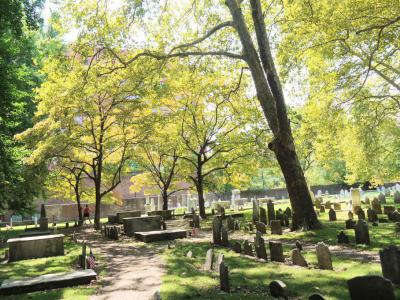
Christ Church Burial Ground in Philadelphia is an important early-American cemetery, which is still active. Despite the name, it is actually three blocks west of Christ Church. The land was acquired in 1719 when the church's property was full, and the new land was on what was back then considered the outskirts of town.
Christ Church is an Episcopal church founded in 1695, and it was the place of worship for many Revolutionary War participants, including George Washington.
Here is the final resting place of many historic national figures and prominent Philadelphians, including Benjamin Franklin and his wife Deborah, as well as four other signers of the Declaration of Independence: Benjamin Rush, Francis Hopkinson, Joseph Hewes, and George Ross. Two more signers (James Wilson and Robert Morris) are buried at Christ Church itself.
The Burial Ground is open to the public for a small fee. When the Burial Ground is closed, one can still view Benjamin Franklin's gravesite from the sidewalk at the corner of 5th and Arch Streets through a set of iron rails. The rail opening in the brick wall was added for public viewing in 1858 at the request of the Franklin Institute.
It is an old Philadelphia tradition for people to leave pennies at Franklin's resting place.
Further away from Franklin, the visitors can see a small but neatly kept space with lesser-known graves, some of which are also quite interesting.
Christ Church is an Episcopal church founded in 1695, and it was the place of worship for many Revolutionary War participants, including George Washington.
Here is the final resting place of many historic national figures and prominent Philadelphians, including Benjamin Franklin and his wife Deborah, as well as four other signers of the Declaration of Independence: Benjamin Rush, Francis Hopkinson, Joseph Hewes, and George Ross. Two more signers (James Wilson and Robert Morris) are buried at Christ Church itself.
The Burial Ground is open to the public for a small fee. When the Burial Ground is closed, one can still view Benjamin Franklin's gravesite from the sidewalk at the corner of 5th and Arch Streets through a set of iron rails. The rail opening in the brick wall was added for public viewing in 1858 at the request of the Franklin Institute.
It is an old Philadelphia tradition for people to leave pennies at Franklin's resting place.
Further away from Franklin, the visitors can see a small but neatly kept space with lesser-known graves, some of which are also quite interesting.
8) Betsy Ross House (must see)
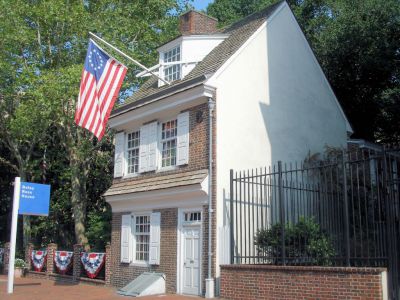
The story goes that Mrs. Eizabeth Claypoole, also known as Betsy Ross, had a visit from George Washington in 1776. She persuaded him, some say, that a five-pointed star was better than a six-pointed star. Betsy was an upholsterer, and she had been making flags for the Pennsylvania Navy. Flags were her specialty.
True or not, this captivating tale was told by her grandsons, William and George Canby, in the 1870s. People loved it, and it became a popular national legend. Number 239 Arch Street in Philadelphia is where Betsy is said to have lived with her third husband, John Claypoole. The house is a restoration done by architect Richardson Okie in 1940.
The "Betsy Ross" house that stands today may have been the house used by Betsy for her business. The residence of Betsy and her husband was adjacent to the present house. The houses next door were demolished and turned into a courtyard.
Richardson Okie used materials from the demolished houses in his restoration. A brick structure was built behind the house. Windows and a dormer were replaced. The whole property was gifted to the city of Philadelphia in 1941. In 1974 the courtyard was provided with a fountain.
As part of the American Bicentennial of 1976, city authorities moved the remains of Betsy and her husband, John Claypoole. They were reinterred in the courtyard of the Betsy Ross House. Betsy is thought to have resided in the house from 1776 until 1779.
John Ross, Betsy's first husband, a member of the militia, died in a gunpowder explosion. Her second husband, Joseph Ashburn, a mariner captured by the British, died in prison in Plymouth, England. John Claypoole was a fellow prisoner. He knew Ashburn. Betsy married Claypoole in 1783.
The Betsy Ross House is traditionally the site of Philadelphia's celebration of Flag Day. This legendary woman lived and worked here for a few short years when the Great Experiment began. Whatever else she may have done, she made flags.
True or not, this captivating tale was told by her grandsons, William and George Canby, in the 1870s. People loved it, and it became a popular national legend. Number 239 Arch Street in Philadelphia is where Betsy is said to have lived with her third husband, John Claypoole. The house is a restoration done by architect Richardson Okie in 1940.
The "Betsy Ross" house that stands today may have been the house used by Betsy for her business. The residence of Betsy and her husband was adjacent to the present house. The houses next door were demolished and turned into a courtyard.
Richardson Okie used materials from the demolished houses in his restoration. A brick structure was built behind the house. Windows and a dormer were replaced. The whole property was gifted to the city of Philadelphia in 1941. In 1974 the courtyard was provided with a fountain.
As part of the American Bicentennial of 1976, city authorities moved the remains of Betsy and her husband, John Claypoole. They were reinterred in the courtyard of the Betsy Ross House. Betsy is thought to have resided in the house from 1776 until 1779.
John Ross, Betsy's first husband, a member of the militia, died in a gunpowder explosion. Her second husband, Joseph Ashburn, a mariner captured by the British, died in prison in Plymouth, England. John Claypoole was a fellow prisoner. He knew Ashburn. Betsy married Claypoole in 1783.
The Betsy Ross House is traditionally the site of Philadelphia's celebration of Flag Day. This legendary woman lived and worked here for a few short years when the Great Experiment began. Whatever else she may have done, she made flags.
9) Elfreth's Alley (must see)
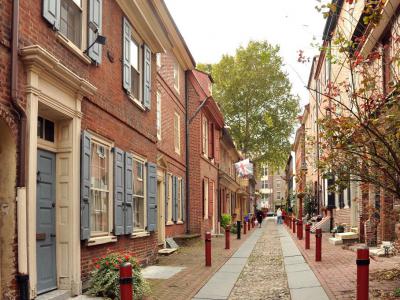
In the 18th century, Philadelphia became a bustling city, overcrowded with artisans, tradesmen, shipwrights, metalsmiths, glassblowers, and furniture makers. As a result, the landowners Arthur Wells and John Gilbert started a cart path from Front Street to Second Street in 1703. The path became Elfreth's Alley, named after Jeremiah Elfreth, an 18th-century blacksmith and a man of property in young Philadelphia.
By the 1770s Georgian and Federal-style houses lined the cobblestone Alley. Many of the structures were uniquely Philadelphian Trinity houses. These were three-story houses, exceptionally narrow, with one room on each floor. The floors were referred to as "Father, Son, and Holy Ghost." And that is how Trinity houses got their name.
In the 19th and 20th centuries, the industry started to close in on the Alley. A stove factory took its place in a row of residential houses. Immigrants, hoping for jobs, came in waves. In 1934 the Elfreth's Alley Association (EAA) was founded by Alley resident Dolly Ottey. Ottey fought to combat the deterioration of the Alley by encroaching industry in the early 20th century.
Elfreth's Alley Museum is located in houses 124 and 126. The museum preserves the home of 18th-century dressmakers. Tour guides discuss other homes and inhabitants of the Alley. On "Fete Day" in early June, which celebrates Alley's diverse ethnic heritage, the residents open their homes. There are historical reenactments with drum and fife bands. The Alley also host events for the 4th of July, Oktoberfestivities, and Halloween.
By the 1770s Georgian and Federal-style houses lined the cobblestone Alley. Many of the structures were uniquely Philadelphian Trinity houses. These were three-story houses, exceptionally narrow, with one room on each floor. The floors were referred to as "Father, Son, and Holy Ghost." And that is how Trinity houses got their name.
In the 19th and 20th centuries, the industry started to close in on the Alley. A stove factory took its place in a row of residential houses. Immigrants, hoping for jobs, came in waves. In 1934 the Elfreth's Alley Association (EAA) was founded by Alley resident Dolly Ottey. Ottey fought to combat the deterioration of the Alley by encroaching industry in the early 20th century.
Elfreth's Alley Museum is located in houses 124 and 126. The museum preserves the home of 18th-century dressmakers. Tour guides discuss other homes and inhabitants of the Alley. On "Fete Day" in early June, which celebrates Alley's diverse ethnic heritage, the residents open their homes. There are historical reenactments with drum and fife bands. The Alley also host events for the 4th of July, Oktoberfestivities, and Halloween.
10) Christ Church (must see)
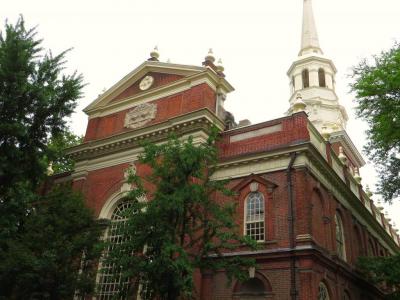
Christ Church in Philadelphia, established in 1695 by the Church of England, quickly became a pivotal religious and historical site. A year later, the congregation erected their first wooden structure, but due to rapid growth, they built a grander temple in the 1720s, the most sumptuous in the Thirteen Colonies.
Christ Church's congregation included 15 signers of the Declaration of Independence, hence it is often called the "Nation's Church". Noteworthy American Revolutionary War leaders like George Washington, Robert Morris, Benjamin Franklin, and Betsy Ross attended this church. Brass plaques mark the pews where they once sat. Washington's pew is #56, Franklin's pew is #70, and Betsy Ross's pew is #12.
Among other things, this church is also celebrated for its stunning Georgian architecture, influenced by Christopher Wren's designs in London. It features a symmetrical facade, arched windows, and a beautifully simple interior characterized by fluted columns and wooden pews. Uniquely, the church has clear windows instead of the traditional stained glass, filling the interior with natural light and views of the surroundings.
Constructed primarily between 1727 and 1744, with its steeple added in 1754, Christ Church stood the tallest building in the future United States for over fifty years. The church underwent significant modifications with a rebuild in 1777 and interior alterations in 1883.
The churchyard is the final resting place of prominent figures such as two signers of the Declaration of Independence, Robert Morris and James Wilson. Christ Church remains a vibrant Episcopal parish and a National Historic Landmark, attracting over 250,000 visitors annually. On-site docents are always there to answer questions, should you have any.
Tip:
Don't miss the collection of historical artifacts, including the 14th-century baptismal font in which William Penn (founder of the Province of Pennsylvania) was baptized, along with a rare book collection and communion elements crafted in the 1790s.
Christ Church's congregation included 15 signers of the Declaration of Independence, hence it is often called the "Nation's Church". Noteworthy American Revolutionary War leaders like George Washington, Robert Morris, Benjamin Franklin, and Betsy Ross attended this church. Brass plaques mark the pews where they once sat. Washington's pew is #56, Franklin's pew is #70, and Betsy Ross's pew is #12.
Among other things, this church is also celebrated for its stunning Georgian architecture, influenced by Christopher Wren's designs in London. It features a symmetrical facade, arched windows, and a beautifully simple interior characterized by fluted columns and wooden pews. Uniquely, the church has clear windows instead of the traditional stained glass, filling the interior with natural light and views of the surroundings.
Constructed primarily between 1727 and 1744, with its steeple added in 1754, Christ Church stood the tallest building in the future United States for over fifty years. The church underwent significant modifications with a rebuild in 1777 and interior alterations in 1883.
The churchyard is the final resting place of prominent figures such as two signers of the Declaration of Independence, Robert Morris and James Wilson. Christ Church remains a vibrant Episcopal parish and a National Historic Landmark, attracting over 250,000 visitors annually. On-site docents are always there to answer questions, should you have any.
Tip:
Don't miss the collection of historical artifacts, including the 14th-century baptismal font in which William Penn (founder of the Province of Pennsylvania) was baptized, along with a rare book collection and communion elements crafted in the 1790s.
11) Benjamin Franklin Museum and Court
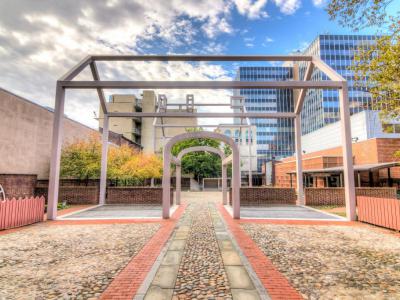
The Benjamin Franklin Museum lies in the fully-enclosed courtyard where the Founding Father's house and print shop once stood. Although these were torn down long ago, some archaeological remains were excavated and are visible beneath glass windows in the ground along with explanatory signs.
"Ghost" houses were built in the exact spots where the house and print shop once stood, so one gets a real sense of how the site would have looked when those structures were standing. There is also a working 18th-century print shop adjacent which is a neat experience.
It doesn't cost anything to walk through Franklin Court, view the "ghost" houses, or visit the working print shop. The museum costs a very reasonable fee. While the space is not huge, it provides a very thorough and interesting overview of Franklin's life and contributions to the country. There are lots of interactive objects for kids and fascinating things to see, read, and ponder for adults.
The visitors can get both an overview of Franklin's life, as well as little interesting tidbits of trivia about him. They even have entertaining videos illustrating some humorous (and informative) episodes in his life, which seem to be everyone's favorite part. All in all, there is something for everyone, regardless of age.
"Ghost" houses were built in the exact spots where the house and print shop once stood, so one gets a real sense of how the site would have looked when those structures were standing. There is also a working 18th-century print shop adjacent which is a neat experience.
It doesn't cost anything to walk through Franklin Court, view the "ghost" houses, or visit the working print shop. The museum costs a very reasonable fee. While the space is not huge, it provides a very thorough and interesting overview of Franklin's life and contributions to the country. There are lots of interactive objects for kids and fascinating things to see, read, and ponder for adults.
The visitors can get both an overview of Franklin's life, as well as little interesting tidbits of trivia about him. They even have entertaining videos illustrating some humorous (and informative) episodes in his life, which seem to be everyone's favorite part. All in all, there is something for everyone, regardless of age.
12) Franklin Court Printing Office
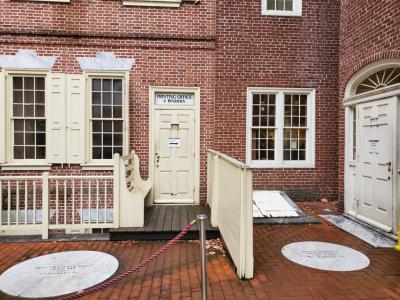
The Franklin Court Printing Office offers an immersive glimpse into the world of 18th-century publishing, showcasing Benjamin Franklin's innovative contributions to the field. Franklin, a pioneer in the publishing business, was the first to incorporate political cartoons and maps alongside his articles, enhancing the visual appeal and accessibility of printed content. He effectively utilized the power of the press to disseminate his political theories, garnering public support and influence.
Among his many publishing ventures, "Poor Richard's Almanac," begun in 1732 under the pseudonym Richard Saunders, stands out for its widespread popularity. The almanac, filled with Franklin's witty and wise sayings, preached frugality, industry, and thrift, becoming a staple in American households until its final publication in 1758.
At the re-created Franklin Court Printing Office, visitors can step back in time to experience the operation of an 18th-century printing office. The facility contains several exhibits, including a typesetting area, a bindery, and two reproduction 18th-century presses. This interactive environment allows visitors to observe firsthand the intricate process of typesetting and printing, with park rangers on hand to demonstrate these traditional techniques.
The Printing Office also houses the newspaper office of Franklin's grandson, Benjamin Franklin Bache, providing insight into the controversial newspaper culture of the 1790s. Bache, like his grandfather, played a significant role in shaping public opinion through his publication. Adjacent to the Printing Office, Benjamin Franklin Bache's house further enriches the historical narrative.
Located in Franklin Court, the Printing Office is easily accessible from Market Street, between 3rd and 4th Streets. Admission is free, and visitors can explore the site on a first-come, first-served basis.
Among his many publishing ventures, "Poor Richard's Almanac," begun in 1732 under the pseudonym Richard Saunders, stands out for its widespread popularity. The almanac, filled with Franklin's witty and wise sayings, preached frugality, industry, and thrift, becoming a staple in American households until its final publication in 1758.
At the re-created Franklin Court Printing Office, visitors can step back in time to experience the operation of an 18th-century printing office. The facility contains several exhibits, including a typesetting area, a bindery, and two reproduction 18th-century presses. This interactive environment allows visitors to observe firsthand the intricate process of typesetting and printing, with park rangers on hand to demonstrate these traditional techniques.
The Printing Office also houses the newspaper office of Franklin's grandson, Benjamin Franklin Bache, providing insight into the controversial newspaper culture of the 1790s. Bache, like his grandfather, played a significant role in shaping public opinion through his publication. Adjacent to the Printing Office, Benjamin Franklin Bache's house further enriches the historical narrative.
Located in Franklin Court, the Printing Office is easily accessible from Market Street, between 3rd and 4th Streets. Admission is free, and visitors can explore the site on a first-come, first-served basis.
13) Carpenters' Hall
Everyone knows about the Second Continental Congress, which signed the Declaration of Independence at Independence Hall. Still, hardly anyone ever talks about the First Continental Congress, which marked a pivotal moment in the lead-up to the American Revolution. It was the first time that the 13 Colonies got together in one spot in defiance of British rule.
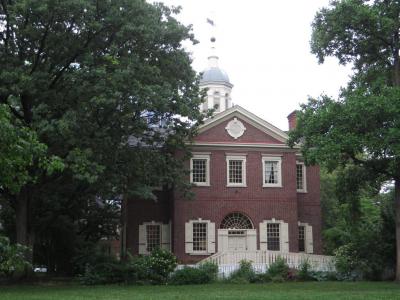
Carpenters' Hall was completed in 1773 by the Carpenters' Company of the City and County of Philadelphia, a guild or trade association established in 1724. Architect Robert Smith designed the Hall in the Georgian style, reflecting the architectural preferences of the time.
In 1774, Carpenters' Hall hosted the First Continental Congress from September 5 to October 26. Delegates from 12 of the 13 American colonies (Georgia did not send delegates) gathered to discuss grievances against British policies and to coordinate a united response. Within these walls, key decisions were made, including drafting a unified statement of rights and grievances addressed to King George III.
Notably, Carpenters' Hall was the site of clandestine meetings, such as those between Benjamin Franklin and others, who secretly met with French contacts to discuss French support for the American Revolution.
After the First Continental Congress, Carpenters' Hall was a meeting place for various organizations and events. The Second Continental Congress briefly used it in 1775 before it moved to Independence Hall. The Hall saw multiple uses throughout the 19th and early 20th centuries, including as a bank and a library.
The building was designated a National Historic Landmark on April 15, 1970. Today, Carpenters' Hall is open to the public as a historic site.
Carpenters' Hall was completed in 1773 by the Carpenters' Company of the City and County of Philadelphia, a guild or trade association established in 1724. Architect Robert Smith designed the Hall in the Georgian style, reflecting the architectural preferences of the time.
In 1774, Carpenters' Hall hosted the First Continental Congress from September 5 to October 26. Delegates from 12 of the 13 American colonies (Georgia did not send delegates) gathered to discuss grievances against British policies and to coordinate a united response. Within these walls, key decisions were made, including drafting a unified statement of rights and grievances addressed to King George III.
Notably, Carpenters' Hall was the site of clandestine meetings, such as those between Benjamin Franklin and others, who secretly met with French contacts to discuss French support for the American Revolution.
After the First Continental Congress, Carpenters' Hall was a meeting place for various organizations and events. The Second Continental Congress briefly used it in 1775 before it moved to Independence Hall. The Hall saw multiple uses throughout the 19th and early 20th centuries, including as a bank and a library.
The building was designated a National Historic Landmark on April 15, 1970. Today, Carpenters' Hall is open to the public as a historic site.
