Custom Walk in Stockholm, Sweden by ndhuffstetler_4b688 created on 2026-01-22
Guide Location: Sweden » Stockholm
Guide Type: Custom Walk
# of Sights: 13
Tour Duration: 3 Hour(s)
Travel Distance: 4.4 Km or 2.7 Miles
Share Key: 5WVHH
Guide Type: Custom Walk
# of Sights: 13
Tour Duration: 3 Hour(s)
Travel Distance: 4.4 Km or 2.7 Miles
Share Key: 5WVHH
How It Works
Please retrieve this walk in the GPSmyCity app. Once done, the app will guide you from one tour stop to the next as if you had a personal tour guide. If you created the walk on this website or come to the page via a link, please follow the instructions below to retrieve the walk in the app.
Retrieve This Walk in App
Step 1. Download the app "GPSmyCity: Walks in 1K+ Cities" on Apple App Store or Google Play Store.



Step 2. In the GPSmyCity app, download(or launch) the guide "Stockholm Map and Walking Tours".
Step 3. Tap the menu button located at upper right corner of the "Walks" screen and select "Retrieve custom walk". Enter the share key: 5WVHH
1) Järntorget (The Iron Square)
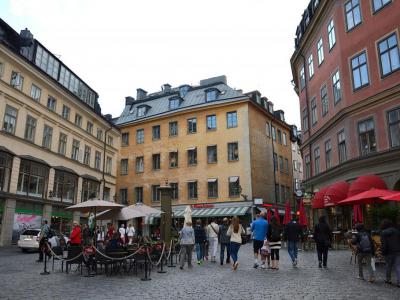
Järntorget, meaning "The Iron Square," is a historic public square located in the old town of Stockholm. This small but significant square serves as a crossroads where the main thoroughfares, Västerlånggatan and Österlånggatan, converge, with several alleys stretching out to connect it to other key areas such as Skeppsbron, Slussplan, and Kornhamnstorg.
Järntorget, dating back to around 1300, is Stockholm's second oldest square, just younger than Stortorget. Originally named Korntorget ("Grain Square"), it was renamed in 1489 as the iron trade overtook grain in importance. For centuries, the square was a hub of commerce, with merchants trading goods and official scales used to manage and tax iron, generating significant revenue for the city and monarchy.
Järntorget has undergone many changes throughout its history. In the Middle Ages, it was much larger, covering areas now occupied by additional buildings. By the 16th century, sheds were built along its eastern side, and in the 17th century, it became a hub for taverns like The Blue Eagle, The Lion, and The Griffin. Significant transformation occurred in the early 17th century when the city's scales moved to Södermalm, prompting the construction of taller, more prestigious buildings. In 1680, Södra Bankohuset, the world's oldest national bank building, was built on the square, designed by Nicodemus Tessin the Elder in the Italian Renaissance style.
The buildings around Järntorget hold rich histories. For example, Number 78, part of a former medieval alley, has elements dating back to the 17th century. Number 80 features an Art Nouveau façade shaped by renovations in the 20th century, while Number 84, home to Södra Bankohuset, stands as a testament to the square's financial legacy. Additionally, the square is adorned with a cast iron well, donated by the National Bank in 1829, modeled after a British prototype, and a statue of Swedish poet Evert Taube, created by Karl-Göte Bejemark in 1985.
Järntorget, dating back to around 1300, is Stockholm's second oldest square, just younger than Stortorget. Originally named Korntorget ("Grain Square"), it was renamed in 1489 as the iron trade overtook grain in importance. For centuries, the square was a hub of commerce, with merchants trading goods and official scales used to manage and tax iron, generating significant revenue for the city and monarchy.
Järntorget has undergone many changes throughout its history. In the Middle Ages, it was much larger, covering areas now occupied by additional buildings. By the 16th century, sheds were built along its eastern side, and in the 17th century, it became a hub for taverns like The Blue Eagle, The Lion, and The Griffin. Significant transformation occurred in the early 17th century when the city's scales moved to Södermalm, prompting the construction of taller, more prestigious buildings. In 1680, Södra Bankohuset, the world's oldest national bank building, was built on the square, designed by Nicodemus Tessin the Elder in the Italian Renaissance style.
The buildings around Järntorget hold rich histories. For example, Number 78, part of a former medieval alley, has elements dating back to the 17th century. Number 80 features an Art Nouveau façade shaped by renovations in the 20th century, while Number 84, home to Södra Bankohuset, stands as a testament to the square's financial legacy. Additionally, the square is adorned with a cast iron well, donated by the National Bank in 1829, modeled after a British prototype, and a statue of Swedish poet Evert Taube, created by Karl-Göte Bejemark in 1985.
2) Marten Trotzigs Grand (Marten Trotzig's Alley)
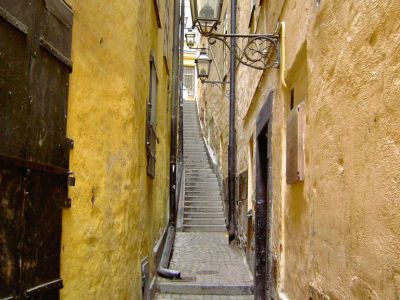
Marten Trotzig's Alley is a unique and historical street located in the heart of Stockholm's Old Town, Gamla Stan. This area is renowned for its charming, centuries-old buildings and labyrinthine streets that have stood the test of time. Mårten Trotzigs Alley is particularly notable for being the narrowest street in Stockholm, a characteristic that has made it a popular attraction for both locals and tourists.
The alleyway is so narrow that at its tightest point, it measures only 35 inches (about 90 centimeters) wide, barely allowing enough space for a person to pass through without brushing against the walls. This cramped passage is not just a walkway; it also includes a steep staircase that connects two of the main roads in Gamla Stan. The street is adorned with a few modest lamps hanging from the walls, adding to its quaint and historical atmosphere.
The name of the alley pays homage to Mårten Trotzig, a wealthy German merchant who settled in Stockholm during the 16th century. Trotzig amassed his fortune by trading in iron and copper, becoming one of the city's wealthiest citizens. He eventually purchased the land surrounding the alleyway and set up a shop there. Although the alley did not originally have a name, it quickly became associated with Trotzig, and thus it has carried his name ever since.
Mårten Trotzigs Alley remains a fascinating piece of Stockholm's history, offering a glimpse into the city's past and the daily life of its earlier inhabitants. Despite its narrowness, or perhaps because of it, the alley continues to captivate visitors who come to experience this small but significant piece of Gamla Stan.
The alleyway is so narrow that at its tightest point, it measures only 35 inches (about 90 centimeters) wide, barely allowing enough space for a person to pass through without brushing against the walls. This cramped passage is not just a walkway; it also includes a steep staircase that connects two of the main roads in Gamla Stan. The street is adorned with a few modest lamps hanging from the walls, adding to its quaint and historical atmosphere.
The name of the alley pays homage to Mårten Trotzig, a wealthy German merchant who settled in Stockholm during the 16th century. Trotzig amassed his fortune by trading in iron and copper, becoming one of the city's wealthiest citizens. He eventually purchased the land surrounding the alleyway and set up a shop there. Although the alley did not originally have a name, it quickly became associated with Trotzig, and thus it has carried his name ever since.
Mårten Trotzigs Alley remains a fascinating piece of Stockholm's history, offering a glimpse into the city's past and the daily life of its earlier inhabitants. Despite its narrowness, or perhaps because of it, the alley continues to captivate visitors who come to experience this small but significant piece of Gamla Stan.
3) Köpmanbrinken (Merchant's Slope)
Merchant's Slope (Köpmanbrinken) is a historic street located in Stockholm's Old Town (Gamla Stan). This street is unique as it consists of two distinct slopes that were unified under the current name in 1885, following the creation of Merchant's Square (Köpmantorget) which separates them.
The northern slope of Merchant's Slope has a rich history, once known as Fishing Shore Slope (Fiskestrandsbrinken), due to its proximity to the city's primary fish market during the Middle Ages, from 1413 to 1520. This market, located to the east of the slope, played a crucial role in the city's daily life, highlighting the area's importance as a bustling center of commerce.
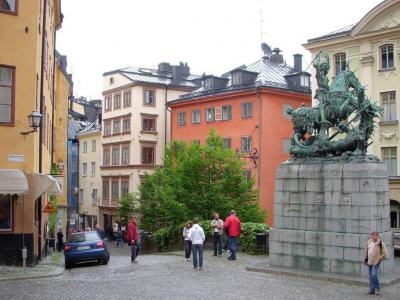
As you walk along Merchant's Slope, one of the most striking features is the statue of Saint George and the Dragon. This bronze replica, cast in 1912, is a copy of the original medieval sculpture housed in Stockholm Cathedral. The statue depicts a young Saint George, dressed in full battle armor, valiantly fighting a dragon. While the replica stays true to the spirit of the original from 1489, it introduces several alterations, such as modifications to the knight's helmet and the dragon's position. The statue is mounted on a plinth adorned with reliefs depicting the martyrdom of Saint George, adding to its historical and artistic significance.
Number 17 Köpmanbrinken stands out for its early 20th-century design, completed in 1902. The building accommodates a mix of ground-floor shops, office spaces, and residences. It also houses the restaurant "Pontus in the Green House," which adds a modern touch with its distinctive color scheme. Flanking this building are two alleys with historical significance: Nygränd (New Alley) and Brunnsgränd (Well's Alley). Although Brunnsgränd suggests the presence of a well, none exists, adding a bit of historical curiosity to the area.
The northern slope of Merchant's Slope has a rich history, once known as Fishing Shore Slope (Fiskestrandsbrinken), due to its proximity to the city's primary fish market during the Middle Ages, from 1413 to 1520. This market, located to the east of the slope, played a crucial role in the city's daily life, highlighting the area's importance as a bustling center of commerce.
As you walk along Merchant's Slope, one of the most striking features is the statue of Saint George and the Dragon. This bronze replica, cast in 1912, is a copy of the original medieval sculpture housed in Stockholm Cathedral. The statue depicts a young Saint George, dressed in full battle armor, valiantly fighting a dragon. While the replica stays true to the spirit of the original from 1489, it introduces several alterations, such as modifications to the knight's helmet and the dragon's position. The statue is mounted on a plinth adorned with reliefs depicting the martyrdom of Saint George, adding to its historical and artistic significance.
Number 17 Köpmanbrinken stands out for its early 20th-century design, completed in 1902. The building accommodates a mix of ground-floor shops, office spaces, and residences. It also houses the restaurant "Pontus in the Green House," which adds a modern touch with its distinctive color scheme. Flanking this building are two alleys with historical significance: Nygränd (New Alley) and Brunnsgränd (Well's Alley). Although Brunnsgränd suggests the presence of a well, none exists, adding a bit of historical curiosity to the area.
4) Gamla Stan (Old Town) (must see)
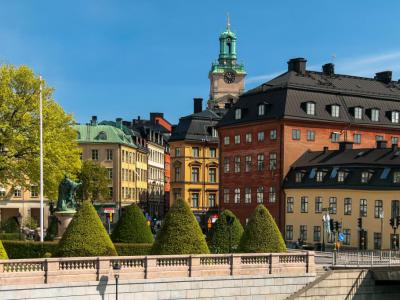
The Old Town (Gamla Stan) is the historic heart of Stockholm. Officially known until 1980 as "the Town between the Bridges," this area is situated primarily on the island of Stadsholmen. Although the name Gamla Stan is colloquially used to refer to the entire Old Town, it also officially includes the surrounding islets of Riddarholmen, Helgeandsholmen, and Strömsborg. The area is home to approximately 3,000 residents.
Dating back to the 13th century, Old Town is a well-preserved medieval district, characterized by its narrow alleyways, cobblestone streets, and historical architecture. The influence of North German architectural styles is particularly evident in many of the buildings. The area has been shaped by some of Sweden’s most notable architects, such as Nicodemus Tessin and Carl Hårleman, who played key roles in the construction of significant landmarks like the Stockholm Palace.
Old Town is rich in historical buildings, including the Stockholm Stock Exchange Building, Bonde Palace (the seat of the Swedish Supreme Court), and the House of Nobility, which once hosted the Swedish parliament. In the heart of Old Town lies Stortorget, a picturesque large square surrounded by old merchants' houses and notable buildings such as the Stockholm Stock Exchange Building. Stortorget is also infamous as the site of the Stockholm Bloodbath of 1520, where Danish King Christian II ordered the execution of Swedish noblemen, leading to a revolt that eventually dissolved the Kalmar Union and saw the rise of King Gustav I.
Key landmarks in Old Town include the Stockholm Cathedral, the Nobel Museum, and the Riddarholm Church, which is the royal burial church. Another significant site is the Royal Palace, which was constructed in the 18th century after the previous palace, Tre Kronor, was destroyed by fire. The House of Nobility (Riddarhuset), located in the north-western part of Old Town, is another historic structure of note.
Old Town is also home to one of the world's oldest continuously operating restaurants, Den Gyldene Freden, located on Österlånggatan. Established in 1722, it has maintained its original environment and is now owned by the Swedish Nobel Academy, which holds weekly luncheons there. The Stockholm Cathedral houses the famous statue of Saint George and the Dragon, sculpted by Bernt Notke, while the Riddarholm Church (Riddarholmskyrkan) serves as the royal burial church.
Tip:
Some streets can be a bit too touristy to handle, so try and stay away from the beaten tracks and explore a bit, or come in the morning for a stroll.
If you look beyond the tourist shops, there are quite a few nice little fascinating stores.
Dating back to the 13th century, Old Town is a well-preserved medieval district, characterized by its narrow alleyways, cobblestone streets, and historical architecture. The influence of North German architectural styles is particularly evident in many of the buildings. The area has been shaped by some of Sweden’s most notable architects, such as Nicodemus Tessin and Carl Hårleman, who played key roles in the construction of significant landmarks like the Stockholm Palace.
Old Town is rich in historical buildings, including the Stockholm Stock Exchange Building, Bonde Palace (the seat of the Swedish Supreme Court), and the House of Nobility, which once hosted the Swedish parliament. In the heart of Old Town lies Stortorget, a picturesque large square surrounded by old merchants' houses and notable buildings such as the Stockholm Stock Exchange Building. Stortorget is also infamous as the site of the Stockholm Bloodbath of 1520, where Danish King Christian II ordered the execution of Swedish noblemen, leading to a revolt that eventually dissolved the Kalmar Union and saw the rise of King Gustav I.
Key landmarks in Old Town include the Stockholm Cathedral, the Nobel Museum, and the Riddarholm Church, which is the royal burial church. Another significant site is the Royal Palace, which was constructed in the 18th century after the previous palace, Tre Kronor, was destroyed by fire. The House of Nobility (Riddarhuset), located in the north-western part of Old Town, is another historic structure of note.
Old Town is also home to one of the world's oldest continuously operating restaurants, Den Gyldene Freden, located on Österlånggatan. Established in 1722, it has maintained its original environment and is now owned by the Swedish Nobel Academy, which holds weekly luncheons there. The Stockholm Cathedral houses the famous statue of Saint George and the Dragon, sculpted by Bernt Notke, while the Riddarholm Church (Riddarholmskyrkan) serves as the royal burial church.
Tip:
Some streets can be a bit too touristy to handle, so try and stay away from the beaten tracks and explore a bit, or come in the morning for a stroll.
If you look beyond the tourist shops, there are quite a few nice little fascinating stores.
5) Stortorget (Grand Square) (must see)
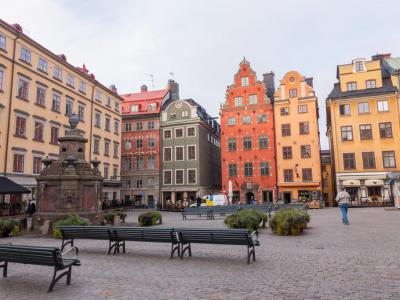
Contrary to its name, Stockholm's "Grand Square" (Stortorget) was never a stylish showpiece unlike the ones in many other European cities during the Middle Ages. It was created gradually, with the surrounding buildings added haphazardly throughout the years.
Nowadays, this is the city's oldest square and an artistic and shopping hub, particularly renowned for its annual Christmas market with fun shows, traditional handicrafts, and sumptuous culinary delights.
It is also the location of the Stock Exchange Building (Börshuset) – home to the Swedish Academy, the Nobel Museum, and the Nobel Library – built in 1773 through 1776. The nearby well dried up in 1856 due to land elevation. It was then relocated to another square (Brunkebergstorg) but eventually moved back to its original location in the 1950s, and has been connected to the city water conduit ever since.
Grand Square sits at the highest point in Stockholm and presents a carefully restored rendition of the historical buildings. Among them is house No. 3 constructed in the 1640s, commonly known as Grill House (Grillska Huset), named after its owner, Antoni Grill. The nearby building No. 5 was also Grill's property. The buildings at numbers 18 and 20 were merged into one in the 17th century and named for Johan Eberhard Schantz, the secretary of King Charles X Gustavus. House No. 22, on the left side of the square, once occupied by one of the closest friends of King Charles XI, was built in 1758 and is easily identified by its green color.
The square had a violent history, ill-famed as the location of the Stockholm Bloodbath, which took place in 1520 and resulted in the beheadings of over 80 noblemen. Their bodies were left there to bleed out, leaving pools of blood running throughout the town. Eww...(((
Indeed, the antique cobblestones of Grand Square make you feel like stepping back into the times of Old Sweden, with the pastel buildings mimicking the colors commonplace in those days.
Why You Should Visit:
The Old Town is by far the most picturesque area in Stockholm, and while this square seems unpretentious at first sight, it has a unique ambiance.
Tip:
Make sure to stand in the middle and look all around you.
Nowadays, this is the city's oldest square and an artistic and shopping hub, particularly renowned for its annual Christmas market with fun shows, traditional handicrafts, and sumptuous culinary delights.
It is also the location of the Stock Exchange Building (Börshuset) – home to the Swedish Academy, the Nobel Museum, and the Nobel Library – built in 1773 through 1776. The nearby well dried up in 1856 due to land elevation. It was then relocated to another square (Brunkebergstorg) but eventually moved back to its original location in the 1950s, and has been connected to the city water conduit ever since.
Grand Square sits at the highest point in Stockholm and presents a carefully restored rendition of the historical buildings. Among them is house No. 3 constructed in the 1640s, commonly known as Grill House (Grillska Huset), named after its owner, Antoni Grill. The nearby building No. 5 was also Grill's property. The buildings at numbers 18 and 20 were merged into one in the 17th century and named for Johan Eberhard Schantz, the secretary of King Charles X Gustavus. House No. 22, on the left side of the square, once occupied by one of the closest friends of King Charles XI, was built in 1758 and is easily identified by its green color.
The square had a violent history, ill-famed as the location of the Stockholm Bloodbath, which took place in 1520 and resulted in the beheadings of over 80 noblemen. Their bodies were left there to bleed out, leaving pools of blood running throughout the town. Eww...(((
Indeed, the antique cobblestones of Grand Square make you feel like stepping back into the times of Old Sweden, with the pastel buildings mimicking the colors commonplace in those days.
Why You Should Visit:
The Old Town is by far the most picturesque area in Stockholm, and while this square seems unpretentious at first sight, it has a unique ambiance.
Tip:
Make sure to stand in the middle and look all around you.
6) Nobel Prize Museum (must see)
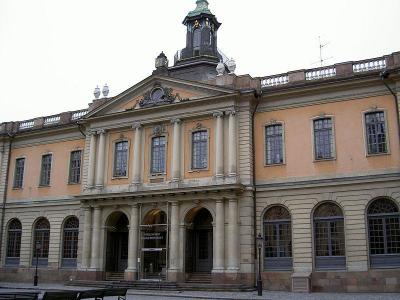
The Nobel Prize Museum in Stockholm is a must-visit destination for anyone interested in the legacy of Alfred Nobel, the Nobel Prize, and its distinguished laureates. Opened in 2001 to commemorate the centenary of the Nobel Prize, the museum offers an immersive experience into the world of this prestigious award.
The museum’s permanent exhibition showcases a fascinating collection of artifacts, personal stories, and historical accounts from Nobel Prize winners dating back to 1901. Visitors can learn about the lives and contributions of iconic figures such as Marie Curie, Nelson Mandela, and Winston Churchill.
One of the museum's highlights is the "Cultures of Creativity Exhibit," which guides visitors through the intricate process of selecting a Nobel Prize winner, culminating in the grandeur of the Nobel Banquet. An integral part of this experience is the Nobel ice cream, a treat traditionally served at the annual awards ceremony, which visitors can sample during their visit.
The museum offers daily multilingual tours, including in English, and hosts a variety of public events, conferences, and workshops. These activities are designed to engage and educate visitors, making the museum a dynamic hub of learning and inspiration.
For those wishing to take home a unique souvenir, the museum's shop offers a range of exclusive items, such as dark fair-trade chocolate versions of Alfred Nobel's gold medal and Swedish “dynamite” candy flavored with jalapeño pepper. The shop also features educational toys, books by and about Nobel laureates, and other distinctive keepsakes.
Visitors can also enjoy a meal at Bistro Nobel, which serves a selection of Swedish cakes, Nobel chocolate, and the famous Nobel ice cream and tea-both of which are featured at the Nobel Banquet. The bistro provides a perfect spot to relax and reflect on the museum's inspiring exhibits while enjoying traditional Swedish cuisine.
Tip:
Join the English tour to get the most out of your visit.
The museum’s permanent exhibition showcases a fascinating collection of artifacts, personal stories, and historical accounts from Nobel Prize winners dating back to 1901. Visitors can learn about the lives and contributions of iconic figures such as Marie Curie, Nelson Mandela, and Winston Churchill.
One of the museum's highlights is the "Cultures of Creativity Exhibit," which guides visitors through the intricate process of selecting a Nobel Prize winner, culminating in the grandeur of the Nobel Banquet. An integral part of this experience is the Nobel ice cream, a treat traditionally served at the annual awards ceremony, which visitors can sample during their visit.
The museum offers daily multilingual tours, including in English, and hosts a variety of public events, conferences, and workshops. These activities are designed to engage and educate visitors, making the museum a dynamic hub of learning and inspiration.
For those wishing to take home a unique souvenir, the museum's shop offers a range of exclusive items, such as dark fair-trade chocolate versions of Alfred Nobel's gold medal and Swedish “dynamite” candy flavored with jalapeño pepper. The shop also features educational toys, books by and about Nobel laureates, and other distinctive keepsakes.
Visitors can also enjoy a meal at Bistro Nobel, which serves a selection of Swedish cakes, Nobel chocolate, and the famous Nobel ice cream and tea-both of which are featured at the Nobel Banquet. The bistro provides a perfect spot to relax and reflect on the museum's inspiring exhibits while enjoying traditional Swedish cuisine.
Tip:
Join the English tour to get the most out of your visit.
7) Stockholm Stock Exchange Building
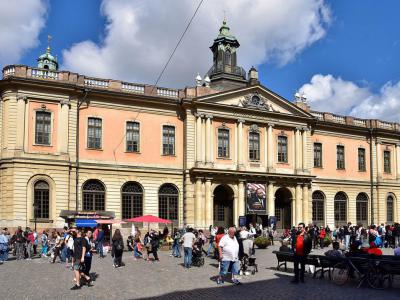
The Stockholm Stock Exchange Building, situated in the historic heart of Stockholm, is a significant landmark with a rich history. Owned by the Swedish Academy, this building has played a crucial role in the country's cultural and financial life. Originally constructed for the bourgeoisie, the building features two distinct floors: the lower floor once served as the trading floor for the Stockholm Stock Exchange, while the upper floor was designed as a grand ballroom. The ballroom, chosen by the Swedish Academy due to its generous size, has been the site where the Academy has deliberated and selected the Nobel Prize in Literature winners since the prize's inception in 1901.
Over the years, the building has been central to Sweden's business community, housing the Stockholm Stock Exchange, the primary financial securities trading agency in the country, established in 1863. However, with the recent merger of the Stockholm Stock Exchange with the Helsinki Stock Exchange, the exchange now operates from different premises.
Today, the Stockholm Stock Exchange Building is home to the Nobel Museum and the Nobel Library. The museum offers visitors a comprehensive exploration of the Nobel Prize's history, showcasing its development since 1901 and providing insights into the life of Alfred Nobel, the prize's founder. The museum features a variety of exhibitions, including films, dramas, and interactive scientific displays, making it a fascinating destination for those interested in the legacy of the Nobel Prize.
Over the years, the building has been central to Sweden's business community, housing the Stockholm Stock Exchange, the primary financial securities trading agency in the country, established in 1863. However, with the recent merger of the Stockholm Stock Exchange with the Helsinki Stock Exchange, the exchange now operates from different premises.
Today, the Stockholm Stock Exchange Building is home to the Nobel Museum and the Nobel Library. The museum offers visitors a comprehensive exploration of the Nobel Prize's history, showcasing its development since 1901 and providing insights into the life of Alfred Nobel, the prize's founder. The museum features a variety of exhibitions, including films, dramas, and interactive scientific displays, making it a fascinating destination for those interested in the legacy of the Nobel Prize.
8) Stockholm Cathedral (must see)
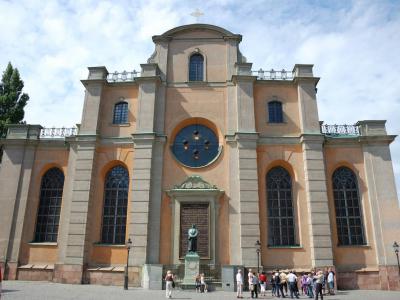
Stockholm Cathedral, also known as the Church of Saint Nicholas (Sankt Nikolai Kyrka), is the oldest and one of the most historically significant temples in Stockholm. Centrally located at the highest point of Old Town (Gamla Stan), it is flanked by the Stock Exchange Building and Stockholm Palace, forming an integral part of the city's Baroque architectural landscape.
The cathedral was consecrated in 1306, with its origins dating back to the 13th century. It features a late medieval hall interior, while the exterior showcases Baroque modifications added in the 18th century. As a crucial site during the Reformation, Stockholm Cathedral hosted the first Mass in the Swedish language. Since 1942, it has served as the seat of the Bishop of Stockholm, highlighting its ongoing religious importance.
The cathedral has a deep historical connection with the Swedish royal family, having served as the city's sole parish church for many centuries. It has been the venue for royal coronations and other significant ceremonies, including the wedding of Crown Princess Victoria in 2010. The cathedral continues to play a vital role in national events and memorials, such as the funeral of renowned Swedish author Astrid Lindgren.
Inside, the cathedral houses several significant artworks, including a medieval sculpture of Saint George and the Dragon and the Vädersolstavlan painting, one of the earliest depictions of Stockholm. The surrounding area of the cathedral is rich with historical courtyards and statues, including representations of Reason, Divine Love, Caution, and Hope. Additionally, a statue of Olaus Petri, a key figure in the Swedish Reformation, stands near the church's east facade, where the pavement also marks the former extent of a church choir demolished during the reign of King Gustav Vasa in the 16th century.
Why You Should Visit:
Architecturally interesting, culturally enriching, and very peaceful.
Tip:
Check for free organ recitals (usually at noon) and other events.
Make sure to pick up a brochure as it is very helpful in explaining several main focuses within the cathedral.
The cathedral was consecrated in 1306, with its origins dating back to the 13th century. It features a late medieval hall interior, while the exterior showcases Baroque modifications added in the 18th century. As a crucial site during the Reformation, Stockholm Cathedral hosted the first Mass in the Swedish language. Since 1942, it has served as the seat of the Bishop of Stockholm, highlighting its ongoing religious importance.
The cathedral has a deep historical connection with the Swedish royal family, having served as the city's sole parish church for many centuries. It has been the venue for royal coronations and other significant ceremonies, including the wedding of Crown Princess Victoria in 2010. The cathedral continues to play a vital role in national events and memorials, such as the funeral of renowned Swedish author Astrid Lindgren.
Inside, the cathedral houses several significant artworks, including a medieval sculpture of Saint George and the Dragon and the Vädersolstavlan painting, one of the earliest depictions of Stockholm. The surrounding area of the cathedral is rich with historical courtyards and statues, including representations of Reason, Divine Love, Caution, and Hope. Additionally, a statue of Olaus Petri, a key figure in the Swedish Reformation, stands near the church's east facade, where the pavement also marks the former extent of a church choir demolished during the reign of King Gustav Vasa in the 16th century.
Why You Should Visit:
Architecturally interesting, culturally enriching, and very peaceful.
Tip:
Check for free organ recitals (usually at noon) and other events.
Make sure to pick up a brochure as it is very helpful in explaining several main focuses within the cathedral.
9) Royal Palace (must see)
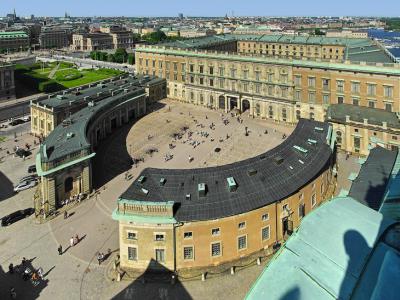
The Royal Palace in Stockholm, also known as Stockholm Palace, is the official residence of the Swedish monarch, although King Carl XVI Gustaf and Queen Silvia primarily reside at Drottningholm Palace. Situated in the Old Town of Stockholm (Gamla Stan), adjacent to the Parliament building, the Royal Palace is a significant ceremonial venue for the King in his role as head of state.
This historic site has served as a royal residence since the mid-13th century, originally home to the Three Crowns (Tre Kronor) Castle. Following a devastating fire in 1697, the current palace was constructed, with its completion delayed until 1754 due to the Great Northern War. The palace is one of the largest in the world, boasting over 1,400 rooms, including state and guest apartments, the Hall of State, the Royal Chapel, and several museums.
Visitors are welcomed by the Swedish Royal Guard, a tradition rooted in medieval Sweden, adding to the palace's majestic atmosphere. The palace’s interior is notable for its exquisite copper roof and houses significant cultural artifacts, including the Bernadotte Library, the Royal Armoury, and the Three Crowns Museum.
One of the most distinguished features is Gustav III's Museum of Antiquities, one of Europe’s oldest museums, which displays over 200 sculptures acquired by King Gustav III during his travels in Italy. The palace also offers a unique shopping experience at the Royal Gift Shop, where visitors can purchase exclusive items linked to the Royal Collections. The shop is open daily with free entry, making it a popular destination for both history enthusiasts and those seeking distinctive souvenirs.
Tip:
While the rooms are well-marked in English, it's always good to go on a guided tour for a more personalized experience.
The Treasury room, with all the regalia, would justify taking the tour as you get to learn more about what you're looking at.
This historic site has served as a royal residence since the mid-13th century, originally home to the Three Crowns (Tre Kronor) Castle. Following a devastating fire in 1697, the current palace was constructed, with its completion delayed until 1754 due to the Great Northern War. The palace is one of the largest in the world, boasting over 1,400 rooms, including state and guest apartments, the Hall of State, the Royal Chapel, and several museums.
Visitors are welcomed by the Swedish Royal Guard, a tradition rooted in medieval Sweden, adding to the palace's majestic atmosphere. The palace’s interior is notable for its exquisite copper roof and houses significant cultural artifacts, including the Bernadotte Library, the Royal Armoury, and the Three Crowns Museum.
One of the most distinguished features is Gustav III's Museum of Antiquities, one of Europe’s oldest museums, which displays over 200 sculptures acquired by King Gustav III during his travels in Italy. The palace also offers a unique shopping experience at the Royal Gift Shop, where visitors can purchase exclusive items linked to the Royal Collections. The shop is open daily with free entry, making it a popular destination for both history enthusiasts and those seeking distinctive souvenirs.
Tip:
While the rooms are well-marked in English, it's always good to go on a guided tour for a more personalized experience.
The Treasury room, with all the regalia, would justify taking the tour as you get to learn more about what you're looking at.
10) Royal Swedish Opera
Right in the cultural bloodstream of Stockholm sits the Royal Swedish Opera-a place where velvet curtains, royal boxes, and dramatic high notes have been part of the décor since the 18th century. The venue rubs elbows with serious company: the Royal Palace, the Riksdag, and the Ministry of Foreign Affairs, which lives in the old Crown Prince's Palace just across the square. Not bad neighbors, if you're into monarchy and policymaking...
The whole show began thanks to King Gustav III, who had a flair for theatrics and a passion for founding things. Alongside the Royal Swedish Academy of Music, he launched the opera company in 1773 with "Thetis and Phelée"-the first opera sung in Swedish by actual Swedes. A revolutionary concept at the time.
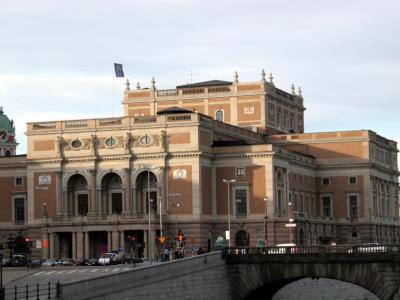
But Gustav wasn’t content with a one-night gig. He wanted a proper opera house, and by 1782, he had one. Designed by Carl Fredrik Adelcrantz, it came complete with neoclassical swagger, a four-tiered auditorium, and an entrance that looked like it belonged on Mount Olympus. Sadly, that building took its final bow in 1892, making way for a fresh production.
The new house was rolled out in 1897 under King Oscar II. Architect Axel Johan Anderberg kept the classical elegance but trimmed the size, creating a 1,200-seat venue known simply as Operan. Inside: gold-drenched foyers, a marble staircase worthy of dramatic entrances, and the Royal Box. Here, Sweden’s royal family watches the show from a throne-like perch above the orchestra pit.
Over the years, the Royal Swedish Opera has hosted some heavy hitters-both Swedish and international singers-whose vocal firepower is enough to raise the roof (if only it weren’t so historic). Performances are typically sung in their original languages with Swedish subtitles, all backed by the Royal Court Chapel, one of Europe’s oldest orchestras-still going strong after nearly 500 years.
Hot tip:
Grab your tickets online-easy and efficient. Better yet, take a guided tour. You’ll get backstage access, peek into the Royal Box, and see where the magic happens-no crown necessary...
The whole show began thanks to King Gustav III, who had a flair for theatrics and a passion for founding things. Alongside the Royal Swedish Academy of Music, he launched the opera company in 1773 with "Thetis and Phelée"-the first opera sung in Swedish by actual Swedes. A revolutionary concept at the time.
But Gustav wasn’t content with a one-night gig. He wanted a proper opera house, and by 1782, he had one. Designed by Carl Fredrik Adelcrantz, it came complete with neoclassical swagger, a four-tiered auditorium, and an entrance that looked like it belonged on Mount Olympus. Sadly, that building took its final bow in 1892, making way for a fresh production.
The new house was rolled out in 1897 under King Oscar II. Architect Axel Johan Anderberg kept the classical elegance but trimmed the size, creating a 1,200-seat venue known simply as Operan. Inside: gold-drenched foyers, a marble staircase worthy of dramatic entrances, and the Royal Box. Here, Sweden’s royal family watches the show from a throne-like perch above the orchestra pit.
Over the years, the Royal Swedish Opera has hosted some heavy hitters-both Swedish and international singers-whose vocal firepower is enough to raise the roof (if only it weren’t so historic). Performances are typically sung in their original languages with Swedish subtitles, all backed by the Royal Court Chapel, one of Europe’s oldest orchestras-still going strong after nearly 500 years.
Hot tip:
Grab your tickets online-easy and efficient. Better yet, take a guided tour. You’ll get backstage access, peek into the Royal Box, and see where the magic happens-no crown necessary...
11) Gustav Adolfs Torg (Square)
Gustav Adolfs Square-Stockholm’s ultimate power intersection, where history, politics, and perfectly aligned cobblestones meet. Nestled near the Norrbro bridge, this square isn’t just a regular place you pass through-it’s the point Stockholm measures itself from. Literally. While most cities peg distances from the train station, Stockholm prefers a bit more royal flair.
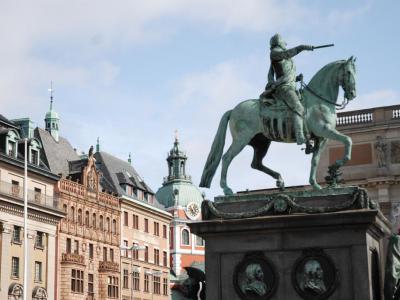
Named in 1805 after King Gustav II Adolf-Sweden’s “Lion of the North” and part-time battlefield legend, full-time national hero-the square proudly hosts an equestrian statue of the king smack in the middle. Crafted by Pierre Hubert L’Archevêque (French by birth, Swedish by sculpting ambition), this statue was cast in 1778 and planted here in 1791. It holds the national title of Sweden’s first equestrian statue (talk about setting the bar with hooves...).
Two bronze lions flank the monument-not your average public art, but replicas of fourth-century originals. The real ones live in the Vatican, probably sipping espresso and avoiding pigeons...
And the surroundings – they're equally grand. You've got the Royal Opera belting out drama to the east, the Ministry of Foreign Affairs housed in the stately Crown Prince's Palace, and the Ministry of Defence keeping a watchful eye. Head just south, and you're at the Riksdag (Parliament) Building and the Royal Palace in Gamla Stan-because nothing says "central" like being a stone’s throw from monarchy, music, and military planning...
In case you're plotting a coup, catching a matinee, or just marveling at lion-adorned monarchs, Gustav Adolfs Square is your compass point. So, stick around-the self-guided tour has plenty more stories to tell.
Named in 1805 after King Gustav II Adolf-Sweden’s “Lion of the North” and part-time battlefield legend, full-time national hero-the square proudly hosts an equestrian statue of the king smack in the middle. Crafted by Pierre Hubert L’Archevêque (French by birth, Swedish by sculpting ambition), this statue was cast in 1778 and planted here in 1791. It holds the national title of Sweden’s first equestrian statue (talk about setting the bar with hooves...).
Two bronze lions flank the monument-not your average public art, but replicas of fourth-century originals. The real ones live in the Vatican, probably sipping espresso and avoiding pigeons...
And the surroundings – they're equally grand. You've got the Royal Opera belting out drama to the east, the Ministry of Foreign Affairs housed in the stately Crown Prince's Palace, and the Ministry of Defence keeping a watchful eye. Head just south, and you're at the Riksdag (Parliament) Building and the Royal Palace in Gamla Stan-because nothing says "central" like being a stone’s throw from monarchy, music, and military planning...
In case you're plotting a coup, catching a matinee, or just marveling at lion-adorned monarchs, Gustav Adolfs Square is your compass point. So, stick around-the self-guided tour has plenty more stories to tell.
12) Stadshuset (City Hall) (must see)
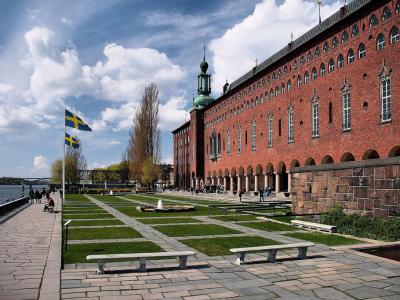
Stockholm City Hall (Stadshuset) serves as the seat of the Stockholm Municipality and stands as one of the city's most iconic landmarks. Located on the eastern tip of Kungsholmen island, it overlooks Riddarfjärden and faces the islands of Riddarholmen and Södermalm, creating a picturesque backdrop that integrates the city's architectural heritage with its natural waterways.
The building is renowned for its striking National Romantic style, characterized by a blend of robust Northern European brick construction with elements reminiscent of Venetian Gothic architecture. Designed by architect Ragnar Östberg, the City Hall was the result of an architectural competition initiated in 1907, with construction taking place between 1911 and 1923.
A prominent feature of the building is its monumental tower, rising 106 meters and crowned with the Three Crowns, a symbol of Sweden. Visitors can access the tower by elevator or by climbing a 365-step staircase. At the base of the tower is a gold-plated cenotaph dedicated to Birger Jarl, a 13th-century Swedish statesman.
The interior of Stockholm City Hall is equally impressive, with its Blue Hall and Golden Hall serving as major highlights. The Blue Hall, despite its name, lacks blue decorations; instead, it features a grand organ with 10,270 pipes, the largest in Scandinavia, and is the venue for the annual Nobel Prize banquet. The Golden Hall, located above the Blue Hall, is adorned with magnificent mosaics made of over 18 million tiles, depicting scenes from Swedish history and created by the German firm Puhl & Wagner.
Surrounding the City Hall is a small park that features several notable sculptures, including works by Carl Eldh, such as the ensemble representing artists August Strindberg, Gustaf Fröding, and Ernst Josephson. Another striking sculpture is the pillar topped with a statue of Engelbrekt Engelbrektsson, a 15th-century Swedish rebel leader, facing Riddarholmen.
Why You Should Visit:
Imposing from the outside but once inside, with the free guided tour that runs every 30 minutes, the building reveals its treasures.
The wall art is interesting and well-preserved; courtyards are attractive and the gardens provide great views across the water.
Tip:
From May to September, for a small fee, you can climb the tower (or take the lift up if needed) where you have a wonderful 360-degree view of Stockholm.
If you're short on time and want to both take the tour and climb the tower, make sure you visit the website and make note of the time slots (entry only at scheduled times).
The building is renowned for its striking National Romantic style, characterized by a blend of robust Northern European brick construction with elements reminiscent of Venetian Gothic architecture. Designed by architect Ragnar Östberg, the City Hall was the result of an architectural competition initiated in 1907, with construction taking place between 1911 and 1923.
A prominent feature of the building is its monumental tower, rising 106 meters and crowned with the Three Crowns, a symbol of Sweden. Visitors can access the tower by elevator or by climbing a 365-step staircase. At the base of the tower is a gold-plated cenotaph dedicated to Birger Jarl, a 13th-century Swedish statesman.
The interior of Stockholm City Hall is equally impressive, with its Blue Hall and Golden Hall serving as major highlights. The Blue Hall, despite its name, lacks blue decorations; instead, it features a grand organ with 10,270 pipes, the largest in Scandinavia, and is the venue for the annual Nobel Prize banquet. The Golden Hall, located above the Blue Hall, is adorned with magnificent mosaics made of over 18 million tiles, depicting scenes from Swedish history and created by the German firm Puhl & Wagner.
Surrounding the City Hall is a small park that features several notable sculptures, including works by Carl Eldh, such as the ensemble representing artists August Strindberg, Gustaf Fröding, and Ernst Josephson. Another striking sculpture is the pillar topped with a statue of Engelbrekt Engelbrektsson, a 15th-century Swedish rebel leader, facing Riddarholmen.
Why You Should Visit:
Imposing from the outside but once inside, with the free guided tour that runs every 30 minutes, the building reveals its treasures.
The wall art is interesting and well-preserved; courtyards are attractive and the gardens provide great views across the water.
Tip:
From May to September, for a small fee, you can climb the tower (or take the lift up if needed) where you have a wonderful 360-degree view of Stockholm.
If you're short on time and want to both take the tour and climb the tower, make sure you visit the website and make note of the time slots (entry only at scheduled times).
13) Riksdag (Parliament House)
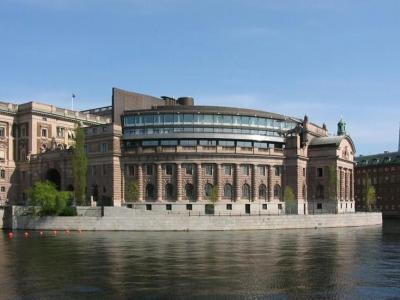
The Parliament House is the seat of the Swedish Parliament (Riksdag) and is situated on Helgeandsholmen, an islet in the heart of Stockholm's historic district, Gamla stan. This iconic building complex was designed by architect Aron Johansson in a style that combines Neoclassical architecture with a Baroque Revival facade, reflecting the grandeur and historic significance of the Swedish legislative body.
Construction of the Parliament House began in 1897 and finished in 1905 after Johansson won a design competition in 1889. The new complex replaced the Old Riksdag Building on Riddarholmen and initially included two main buildings: one for the Riksdag and one for the Swedish National Bank. The bank building, semicircular in shape, was later converted to house the new Assembly Hall when the Riksdag became unicameral in 1971. During this transition, the bank was relocated, and Parliament temporarily moved to the newly built Kulturhuset in central Stockholm.
Helgeandsholmen, the islet where the Riksdag buildings are located, has a rich history dating back to the 14th century when it was home to a sanctuary that cared for the sick and elderly. Today, the Parliament House is connected by a network of underground passages, some of which pass through areas of significant archaeological interest, including remnants of Stockholm's old city wall from the 16th century.
Despite undergoing various renovations and changes over the years, particularly in the East Wing, the Parliament House has retained much of its original architectural splendor. The building’s interiors feature Art Nouveau elements, contributing to its unique and historic atmosphere. The Parliament House stands as a symbol of Sweden's democratic traditions and serves as a central landmark in Stockholm's architectural and political landscape.
Construction of the Parliament House began in 1897 and finished in 1905 after Johansson won a design competition in 1889. The new complex replaced the Old Riksdag Building on Riddarholmen and initially included two main buildings: one for the Riksdag and one for the Swedish National Bank. The bank building, semicircular in shape, was later converted to house the new Assembly Hall when the Riksdag became unicameral in 1971. During this transition, the bank was relocated, and Parliament temporarily moved to the newly built Kulturhuset in central Stockholm.
Helgeandsholmen, the islet where the Riksdag buildings are located, has a rich history dating back to the 14th century when it was home to a sanctuary that cared for the sick and elderly. Today, the Parliament House is connected by a network of underground passages, some of which pass through areas of significant archaeological interest, including remnants of Stockholm's old city wall from the 16th century.
Despite undergoing various renovations and changes over the years, particularly in the East Wing, the Parliament House has retained much of its original architectural splendor. The building’s interiors feature Art Nouveau elements, contributing to its unique and historic atmosphere. The Parliament House stands as a symbol of Sweden's democratic traditions and serves as a central landmark in Stockholm's architectural and political landscape.
