Custom Walk in Vienna, Austria by eisenbraun13j_35f66 created on 2025-10-02
Guide Location: Austria » Vienna
Guide Type: Custom Walk
# of Sights: 15
Tour Duration: 3 Hours
Travel Distance: 6.1 Km or 3.8 Miles
Share Key: GGMKL
Guide Type: Custom Walk
# of Sights: 15
Tour Duration: 3 Hours
Travel Distance: 6.1 Km or 3.8 Miles
Share Key: GGMKL
How It Works
Please retrieve this walk in the GPSmyCity app. Once done, the app will guide you from one tour stop to the next as if you had a personal tour guide. If you created the walk on this website or come to the page via a link, please follow the instructions below to retrieve the walk in the app.
Retrieve This Walk in App
Step 1. Download the app "GPSmyCity: Walks in 1K+ Cities" on Apple App Store or Google Play Store.



Step 2. In the GPSmyCity app, download(or launch) the guide "Vienna Map and Walking Tours".
Step 3. Tap the menu button located at upper right corner of the "Walks" screen and select "Retrieve custom walk". Enter the share key: GGMKL
1) Ankeruhr (Anchor Clock)
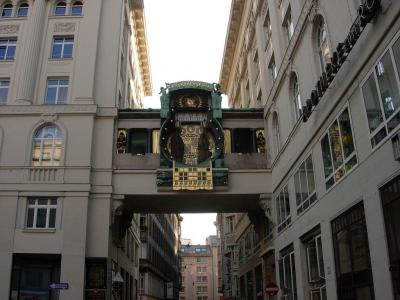
Perched above Vienna’s High Market, the Anker Clock is a delightful piece of early 20th-century theatrical engineering. It’s named after the Anker Insurance Company, which bankrolled the project-because not that many things in the world can manifest “solid investment” as vividly as an Art Nouveau timepiece straddling a bridge between two buildings... The mastermind behind it was Franz von Matsch, a close collaborator of Gustav Klimt, because apparently, Vienna couldn’t build anything back then without roping in someone from the Secessionist circle.
Now, the real fun kicks in at noon, when the clock turns into a slow-motion parade of historical celebrities. Twelve of them take a turn gliding across the clock face, each accompanied by era-appropriate music. You’ve got Marcus Aurelius (who conveniently died in Vienna), Empress Maria Theresa, Joseph Haydn, and more-if you want the full cast list, check the handy plaque at street level.
Originally, the tunes were played by an 800-tube mechanical organ-yes, 800 tubes (!!!), because subtlety wasn’t in vogue back then. Although this beast survived World War II shelling, it was badly damaged, beyond repair, so today it is replaced by a ten-minute medley of digital sound reproduction. Mozart and Wagner still show up, though now via speaker instead of steampunk sorcery.
Is it as grand as Prague’s Astronomical Clock? Not quite. But the Anker Clock has its charm nonetheless: no elbowing through selfie sticks, no jostling crowds. Just a charming, slightly surreal little moment in the middle of the day.
Bonus tip:
While you’re there, check out the Marriage Fountain nearby-a beautifully over-the-top Baroque creation from the 18th century that, let’s be honest, pairs nicely with a clock that plays Haydn at lunchtime.
Now, the real fun kicks in at noon, when the clock turns into a slow-motion parade of historical celebrities. Twelve of them take a turn gliding across the clock face, each accompanied by era-appropriate music. You’ve got Marcus Aurelius (who conveniently died in Vienna), Empress Maria Theresa, Joseph Haydn, and more-if you want the full cast list, check the handy plaque at street level.
Originally, the tunes were played by an 800-tube mechanical organ-yes, 800 tubes (!!!), because subtlety wasn’t in vogue back then. Although this beast survived World War II shelling, it was badly damaged, beyond repair, so today it is replaced by a ten-minute medley of digital sound reproduction. Mozart and Wagner still show up, though now via speaker instead of steampunk sorcery.
Is it as grand as Prague’s Astronomical Clock? Not quite. But the Anker Clock has its charm nonetheless: no elbowing through selfie sticks, no jostling crowds. Just a charming, slightly surreal little moment in the middle of the day.
Bonus tip:
While you’re there, check out the Marriage Fountain nearby-a beautifully over-the-top Baroque creation from the 18th century that, let’s be honest, pairs nicely with a clock that plays Haydn at lunchtime.
2) Stephansdom (St. Stephen's Cathedral) (must see)
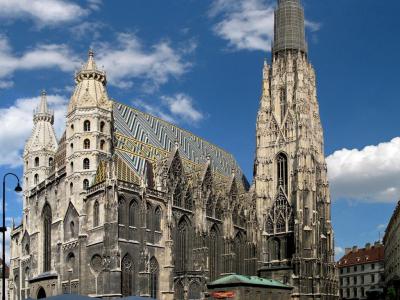
In a city where “stunning architecture” is practically the dress code, Saint Stephen’s Cathedral still manages to steal the spotlight-and possibly your neck muscles too, as you crane to admire that towering spire. Known locally as Stephansdom, this Gothic-Romanesque powerhouse has stood at the heart of Vienna’s skyline and soul since 1147, rising on the bones of two earlier churches like the overachiever it is.
In the 14th century, Duke Rudolf IV decided the cathedral needed a serious makeover. The idea worked. As a result, today we have the building stretching 107 meters long, 40 meters wide, and topped by the South Tower-or “Steffl,” if you're on nickname terms-a 136-meter-high feat of medieval determination that took 65 years to complete. It even moonlighted as a lookout post during Vienna’s sieges, complete with a live-in watchman until 1955. One heck of a long shift...
Meanwhile, the North Tower never quite hit its growth spurt. It stalled at 68 meters and got a Renaissance hat in 1578-basically the architectural equivalent of saying “this is fine” and walking away.
But the real showstopper here is the roof. A kaleidoscope of 230,000 glazed tiles arranged into imperial emblems like the double-headed eagle of the Habsburgs and the crests of Vienna and Austria. After being torched in World War II, it was rebuilt with steel instead of wood-600 metric tons of it-making the new roof not just durable, but also self-cleaning. Because even cathedrals love low-maintenance routines...
Inside, things get just as grand. There’s Pummerin, Europe’s second-largest swinging bell, forged from Turkish cannons in 1711 and recast in 1951-because nothing says peace like a bell made from wartime leftovers. Oh, and she lives in the North Tower, ringing out for special moments and daily rituals.
Musical legends haunt these hallowed halls too: Beethoven figured out he was deaf here (tragic), Haydn sang here as a kid (sweet), Strauss got married here-twice (bold), and Mozart? He got married and buried here. Yes, Saint Stephen's is basically the VIP lounge of Viennese music history.
Inside, you’ll find 18 altars, miraculous icons, bone relics-including those of Saint Valentine-and a maze of crypts holding 11,000 souls, including Habsburg royalty.
Tip:
Do a lap around the outside. Gargoyles, engravings, medieval graffiti-you never know what stories the stones will whisper...
In the 14th century, Duke Rudolf IV decided the cathedral needed a serious makeover. The idea worked. As a result, today we have the building stretching 107 meters long, 40 meters wide, and topped by the South Tower-or “Steffl,” if you're on nickname terms-a 136-meter-high feat of medieval determination that took 65 years to complete. It even moonlighted as a lookout post during Vienna’s sieges, complete with a live-in watchman until 1955. One heck of a long shift...
Meanwhile, the North Tower never quite hit its growth spurt. It stalled at 68 meters and got a Renaissance hat in 1578-basically the architectural equivalent of saying “this is fine” and walking away.
But the real showstopper here is the roof. A kaleidoscope of 230,000 glazed tiles arranged into imperial emblems like the double-headed eagle of the Habsburgs and the crests of Vienna and Austria. After being torched in World War II, it was rebuilt with steel instead of wood-600 metric tons of it-making the new roof not just durable, but also self-cleaning. Because even cathedrals love low-maintenance routines...
Inside, things get just as grand. There’s Pummerin, Europe’s second-largest swinging bell, forged from Turkish cannons in 1711 and recast in 1951-because nothing says peace like a bell made from wartime leftovers. Oh, and she lives in the North Tower, ringing out for special moments and daily rituals.
Musical legends haunt these hallowed halls too: Beethoven figured out he was deaf here (tragic), Haydn sang here as a kid (sweet), Strauss got married here-twice (bold), and Mozart? He got married and buried here. Yes, Saint Stephen's is basically the VIP lounge of Viennese music history.
Inside, you’ll find 18 altars, miraculous icons, bone relics-including those of Saint Valentine-and a maze of crypts holding 11,000 souls, including Habsburg royalty.
Tip:
Do a lap around the outside. Gargoyles, engravings, medieval graffiti-you never know what stories the stones will whisper...
3) Karlskirche (St. Karl's Church)
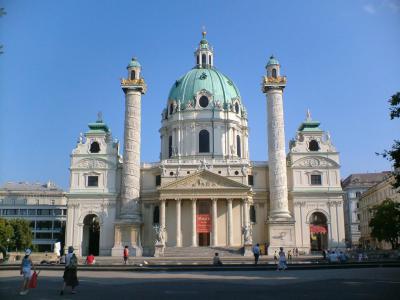
Vienna’s unapologetic showpiece of Baroque drama perched on the southern edge of Karl's Square, the dazzling Saint Karl’s Church is like a powdered wig on a powdered face. Commissioned in 1713 by Emperor Karl VI as a divine “thank you” for surviving the plague, this architectural stunner is dedicated to Karl Borromeo, a 16th-century saint famous for fighting epidemics and spiritual malaise in equal measure.
Now, if you’re sensing a bit of a style mash-up, you’re absolutely right. Completed in 1737, the church is part Roman temple, part imperial flex. It flaunts a lofty elongated dome, flanked by twin columns that look like they’ve time-traveled straight from ancient Rome-specifically modeled after Trajan’s Column, but with a Baroque Viennese twist. The columns aren’t just decorative-they’re a not-so-subtle nod to the Habsburgs’ self-image: as mighty as the mythological Pillars of Hercules.
Step inside, and you're wrapped in marble, gold, and the kind of symbolic artistry that screams “imperial ambition meets holy devotion.” Look up, and you’ll see a dramatic fresco of Saint Karl interceding on behalf of humanity-because why keep your miracles subtle? The pulpit, carved from rich walnut, is a storytelling masterpiece of its own, fully restored in the early 2000s to show off every curve and flourish in glorious detail.
Still, Saint Karl’s isn’t just about stone and symbolism-it’s got star power, too. Composer Antonio Vivaldi, who died nearby in 1741, is honored here with regular concerts that make the walls practically hum with violins. In 1878, Johann Strauss said “I do” to his second wife at this very altar… although she didn’t care much for his music, which probably explains why she said “I don’t” four years later. Oh, and Hollywood legend Hedy Lamarr got hitched here in 1933-just in case you needed one more reason to stare at the pews.
So, regardless of whether you're here for the saints, the stucco, or the scandals, Saint Karl’s Church delivers Baroque brilliance with a Viennese wink all the same...
Tip:
Yes, there’s an entry fee, but it's absolutely worth it (students, rejoice-discounts apply).
A nifty elevator takes you right up to the dome, where you can admire the ceiling frescoes face-to-face. And don’t forget to sneak a peek out the dome window-the view of Vienna alone is worth the ride...
Now, if you’re sensing a bit of a style mash-up, you’re absolutely right. Completed in 1737, the church is part Roman temple, part imperial flex. It flaunts a lofty elongated dome, flanked by twin columns that look like they’ve time-traveled straight from ancient Rome-specifically modeled after Trajan’s Column, but with a Baroque Viennese twist. The columns aren’t just decorative-they’re a not-so-subtle nod to the Habsburgs’ self-image: as mighty as the mythological Pillars of Hercules.
Step inside, and you're wrapped in marble, gold, and the kind of symbolic artistry that screams “imperial ambition meets holy devotion.” Look up, and you’ll see a dramatic fresco of Saint Karl interceding on behalf of humanity-because why keep your miracles subtle? The pulpit, carved from rich walnut, is a storytelling masterpiece of its own, fully restored in the early 2000s to show off every curve and flourish in glorious detail.
Still, Saint Karl’s isn’t just about stone and symbolism-it’s got star power, too. Composer Antonio Vivaldi, who died nearby in 1741, is honored here with regular concerts that make the walls practically hum with violins. In 1878, Johann Strauss said “I do” to his second wife at this very altar… although she didn’t care much for his music, which probably explains why she said “I don’t” four years later. Oh, and Hollywood legend Hedy Lamarr got hitched here in 1933-just in case you needed one more reason to stare at the pews.
So, regardless of whether you're here for the saints, the stucco, or the scandals, Saint Karl’s Church delivers Baroque brilliance with a Viennese wink all the same...
Tip:
Yes, there’s an entry fee, but it's absolutely worth it (students, rejoice-discounts apply).
A nifty elevator takes you right up to the dome, where you can admire the ceiling frescoes face-to-face. And don’t forget to sneak a peek out the dome window-the view of Vienna alone is worth the ride...
4) Naschmarkt (must see)
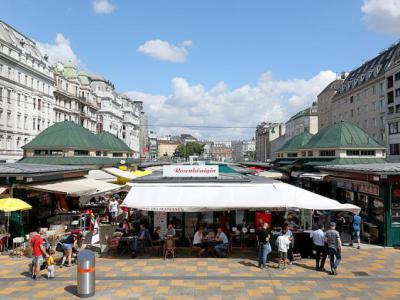
Vienna's most famous market boasts approximately 120 market stalls and restaurants, offering a diverse range of culinary delights that span from traditional Viennese dishes to Indian, Vietnamese, and Italian cuisine. The Naschmarkt has evolved into a popular gathering spot for both young and old alike. The Saturday Flea Market has even attained a cult-like status.
At the Naschmarkt, a vibrant mix of people can be seen purchasing fresh produce, vegetables, and various gourmet treats from around the world, from the early morning until sunset. In recent times, an increasing number of trendy establishments have found their place among the market's 120 or so stalls.
Do-An and Naschmarkt Deli were among the pioneering gastronomic ventures that succeeded in making the Naschmarkt an attractive destination for the young, urban crowd. On weekends, DJs provide entertainment at these locations. Consequently, numerous traditional market stalls have also garnered popularity due to their modern architectural designs.
Tewa at the Naschmarkt offers organic cuisine, while Neni serves Israeli-Oriental specialties ranging from shakshuka (eggs with vegetables) to taboulleh (a Lebanese salad). Orient & Occident, on the other hand, features Turkish home cooking prepared by the owner's wives. Umar is a haven for seafood enthusiasts and is often regarded as the best fish restaurant in Vienna.
Urbanek, initially a fine food and cheese store, doubles as a legendary wine bar-a quintessentially Viennese experience. The delicacies on offer here are simply a must-try. Kilgers am Naschmarkt also functions as a wine bar and gourmet grocery store, while the little market kitchen serves up delightful dishes. For a taste of traditional Viennese fare, Eiserne Zeit is an excellent choice; dining here is an experience in itself.
Many dining and drinking spots surround Naschmarkt. Drechsler offers all-day breakfast, Market serves Asian-inspired cuisine from morning to late night with colorful decor, and ChinaBar an der Wien serves Sichuan cuisine. Naschmarkt is vibrant, especially on Saturdays, with a diverse crowd and outdoor dining in the summer for food, drinks, and people-watching.
At the Naschmarkt, a vibrant mix of people can be seen purchasing fresh produce, vegetables, and various gourmet treats from around the world, from the early morning until sunset. In recent times, an increasing number of trendy establishments have found their place among the market's 120 or so stalls.
Do-An and Naschmarkt Deli were among the pioneering gastronomic ventures that succeeded in making the Naschmarkt an attractive destination for the young, urban crowd. On weekends, DJs provide entertainment at these locations. Consequently, numerous traditional market stalls have also garnered popularity due to their modern architectural designs.
Tewa at the Naschmarkt offers organic cuisine, while Neni serves Israeli-Oriental specialties ranging from shakshuka (eggs with vegetables) to taboulleh (a Lebanese salad). Orient & Occident, on the other hand, features Turkish home cooking prepared by the owner's wives. Umar is a haven for seafood enthusiasts and is often regarded as the best fish restaurant in Vienna.
Urbanek, initially a fine food and cheese store, doubles as a legendary wine bar-a quintessentially Viennese experience. The delicacies on offer here are simply a must-try. Kilgers am Naschmarkt also functions as a wine bar and gourmet grocery store, while the little market kitchen serves up delightful dishes. For a taste of traditional Viennese fare, Eiserne Zeit is an excellent choice; dining here is an experience in itself.
Many dining and drinking spots surround Naschmarkt. Drechsler offers all-day breakfast, Market serves Asian-inspired cuisine from morning to late night with colorful decor, and ChinaBar an der Wien serves Sichuan cuisine. Naschmarkt is vibrant, especially on Saturdays, with a diverse crowd and outdoor dining in the summer for food, drinks, and people-watching.
5) State Opera House (must see)
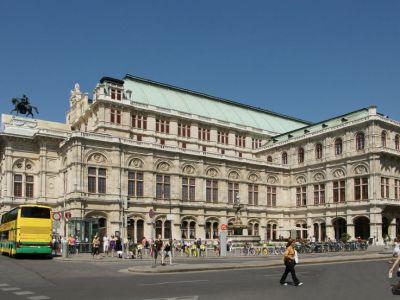
The State Opera House stands as an impressive architectural marvel, complemented by an equally remarkable ensemble of performing artists. Its historical roots trace back to approximately the 1860s when it was initially known as the Vienna Court Opera. However, the name underwent a transformation in 1920, orchestrated by the Habsburgs, during the early stages of the formation of the first Austrian Republic.
Numerous members of the Opera company eventually find themselves on stage with the renowned Vienna Philharmonic, showcasing a vast repertoire of celebrated compositions, including but not limited to, La Traviata, La Clemenza di Tito, and Verdi's Don Carlo. This venue frequently hosts performances by world-famous vocalists, and it has served as the launching pad for the careers of illustrious directors, ranging from Gustav Mahler to Herbert von Karajan and Claudio Abbado.
Beyond the captivating performances of singers and orchestra, the Opera House itself boasts architectural splendor that merits exploration. The State Opera offers guided tours of this remarkable edifice, conducted in 12 different languages. These tours are available daily and typically span approximately 40 minutes, providing visitors with a deeper understanding of this cultural gem.
Tip:
Do not buy opera tickets from the dressed up people outside on the street - they don't sell real tickets!
Numerous members of the Opera company eventually find themselves on stage with the renowned Vienna Philharmonic, showcasing a vast repertoire of celebrated compositions, including but not limited to, La Traviata, La Clemenza di Tito, and Verdi's Don Carlo. This venue frequently hosts performances by world-famous vocalists, and it has served as the launching pad for the careers of illustrious directors, ranging from Gustav Mahler to Herbert von Karajan and Claudio Abbado.
Beyond the captivating performances of singers and orchestra, the Opera House itself boasts architectural splendor that merits exploration. The State Opera offers guided tours of this remarkable edifice, conducted in 12 different languages. These tours are available daily and typically span approximately 40 minutes, providing visitors with a deeper understanding of this cultural gem.
Tip:
Do not buy opera tickets from the dressed up people outside on the street - they don't sell real tickets!
6) Sacher Cafe
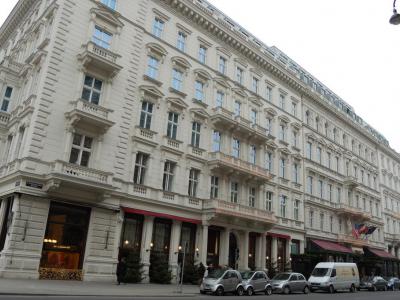
If you're on a mission to track down the best chocolate cake in Vienna-if not on Earth-then point your sweet tooth straight toward Café Sacher. Now, this isn’t just any cake shop-it’s the birthplace of the legendary Original Sacher-Torte, first whipped up in 1832 by young Franz Sacher for a Habsburg royal party. Apparently, the emperor needed dessert, the head chef was sick, and history was made with a spatula.
Decades later, in 1876, Franz’s son Ed Sacher opened the now-iconic Sacher Hotel and its equally iconic café. Ed didn’t stick around long, passing away just 16 years later, but his wife Anna took the reins like a true empress of pastry. Under her watch, the hotel and cake brand rose to international fame-think of her as the Beyoncé of Viennese hospitality...
Since 1934, the whole operation has been in the hands of the Gürtler family, and the place's guestbook reads like a who’s who of global royalty and icons: Gandhi, Queen Elizabeth II, John F. Kennedy… all graced the café with their presence, presumably seduced by that rich chocolate glaze and discreet charm.
Now, here’s the best part: even if you're pinching euros, a fairly modest sum will land you a genuinely good coffee and a slice of chocolate royalty on a plate. No need to break the bank to live deliciously.
Insider tip: Beyond the main café, the Sacher Hotel houses three rather swanky salons-each in its own chic color scheme-plus the two-story Eck, which gives you a side of Opera House views with your whipped cream. And if the main café’s packed (which it often is), just slip next door to Sacher Stube, run by the same family and serving the same glorious torte.
Oh, and about the coffee-if you’re not sure what to order, play it classic. Go for a "Einspänner"-Vienna’s beloved black coffee topped with foamed milk and a dollop of whipped cream. It’s the perfect companion for that slice of legend.
Trust us-this is one cake worth crossing a continent for...
Decades later, in 1876, Franz’s son Ed Sacher opened the now-iconic Sacher Hotel and its equally iconic café. Ed didn’t stick around long, passing away just 16 years later, but his wife Anna took the reins like a true empress of pastry. Under her watch, the hotel and cake brand rose to international fame-think of her as the Beyoncé of Viennese hospitality...
Since 1934, the whole operation has been in the hands of the Gürtler family, and the place's guestbook reads like a who’s who of global royalty and icons: Gandhi, Queen Elizabeth II, John F. Kennedy… all graced the café with their presence, presumably seduced by that rich chocolate glaze and discreet charm.
Now, here’s the best part: even if you're pinching euros, a fairly modest sum will land you a genuinely good coffee and a slice of chocolate royalty on a plate. No need to break the bank to live deliciously.
Insider tip: Beyond the main café, the Sacher Hotel houses three rather swanky salons-each in its own chic color scheme-plus the two-story Eck, which gives you a side of Opera House views with your whipped cream. And if the main café’s packed (which it often is), just slip next door to Sacher Stube, run by the same family and serving the same glorious torte.
Oh, and about the coffee-if you’re not sure what to order, play it classic. Go for a "Einspänner"-Vienna’s beloved black coffee topped with foamed milk and a dollop of whipped cream. It’s the perfect companion for that slice of legend.
Trust us-this is one cake worth crossing a continent for...
7) Austrian National Library
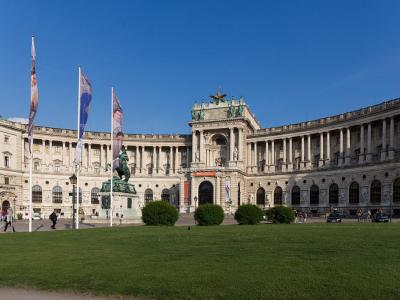
The Austrian National Library stands as the largest library in Austria, housing an extensive collection of over 12 million items across various categories. This remarkable institution is situated in the Neue Burg Wing of the Hofburg, right in the heart of Vienna. Since 2005, some portions of its collections have been relocated to the splendid Baroque setting of the Palais Mollard-Clary.
Originally named the "Imperial Court Library" by the Habsburg dynasty, it became the "Austrian National Library" in 1920 after the Habsburg Monarchy dissolved and the Austrian Republic was established. Today, it houses extensive collections, four museums, and various special collections and archives.
This institution's roots go back to the medieval imperial library, founded by Albert III, Duke of Austria (1349-1395). He moved books from Vienna's vaults into a dedicated library and supported translating Latin works into German. The library was located in the Hofburg, safeguarding Archduke Albert III's treasures in the south tower of the imperial chapel. The oldest book in the library is the 1368 golden Holy Gospels, transcribed by Johannes of Troppau with intricate Burgundian-style illustrations.
One of the key responsibilities of the Austrian National Library involves the collection and preservation of all publications originating in Austria, including those in electronic format. According to relevant laws, periodic publications in Austria must deliver four copies to the National Library, and other print materials must provide two obligation copies each.
The library collects Austrian works published abroad and foreign publications, especially in the humanities. It offers services for borrowing, searching, information, and reproductions to ensure material accessibility and availability.
Originally named the "Imperial Court Library" by the Habsburg dynasty, it became the "Austrian National Library" in 1920 after the Habsburg Monarchy dissolved and the Austrian Republic was established. Today, it houses extensive collections, four museums, and various special collections and archives.
This institution's roots go back to the medieval imperial library, founded by Albert III, Duke of Austria (1349-1395). He moved books from Vienna's vaults into a dedicated library and supported translating Latin works into German. The library was located in the Hofburg, safeguarding Archduke Albert III's treasures in the south tower of the imperial chapel. The oldest book in the library is the 1368 golden Holy Gospels, transcribed by Johannes of Troppau with intricate Burgundian-style illustrations.
One of the key responsibilities of the Austrian National Library involves the collection and preservation of all publications originating in Austria, including those in electronic format. According to relevant laws, periodic publications in Austria must deliver four copies to the National Library, and other print materials must provide two obligation copies each.
The library collects Austrian works published abroad and foreign publications, especially in the humanities. It offers services for borrowing, searching, information, and reproductions to ensure material accessibility and availability.
8) Michaelerkirche (St. Michael's Church)
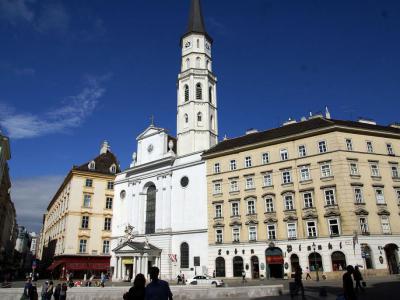
The oldest building on Michaelerplatz, and the source of its name, Michaelerkirche was first built in the 13th century, though the Neoclassical facade, added in 1792, somewhat obscures this fact. The high polygonal Gothic bell tower from the 16th century may be seen from far away, having become one of the Inner City's symbols. Above the entrance, on top of the pediment, resting on Doric columns, stands a group with winged angels and Saint Michael slaying Lucifer (1725). These sculptural figures were executed by the Italian sculptor Lorenzo Mattielli, who also sculpted the Hercules figures at the Hofburg entrance, just opposite the church.
Inside, the church retains its plain Gothic origins, but sculptor sculptor Karl Georg Merville's "Fall of Angels" steals the show: a monumental stucco alabaster Rococo sculpture, tumbling from the ceiling above the high altar. The gilded pipe organ (1714) - Vienna's largest Baroque organ - is very fine; it was once played by the 17-year-old Joseph Haydn, who lived next door in a small attic room. The very first playing of Mozart's unfinished "Requiem" first took place here on December 10, 1791, in a requiem service for the composer. Just to the right of the church's entrance, you will find two dark reliefs commemorating said performance.
Off the north choir is the entrance to a huge crypt, discovered by U.S. soldiers in 1945, when they forced open its doors, which had been sealed for 150 years. Found lying undisturbed for centuries were hundreds of mummified former wealthy parishioners, clothed in their burial finery that was perfectly preserved by the rarefied air within.
Inside, the church retains its plain Gothic origins, but sculptor sculptor Karl Georg Merville's "Fall of Angels" steals the show: a monumental stucco alabaster Rococo sculpture, tumbling from the ceiling above the high altar. The gilded pipe organ (1714) - Vienna's largest Baroque organ - is very fine; it was once played by the 17-year-old Joseph Haydn, who lived next door in a small attic room. The very first playing of Mozart's unfinished "Requiem" first took place here on December 10, 1791, in a requiem service for the composer. Just to the right of the church's entrance, you will find two dark reliefs commemorating said performance.
Off the north choir is the entrance to a huge crypt, discovered by U.S. soldiers in 1945, when they forced open its doors, which had been sealed for 150 years. Found lying undisturbed for centuries were hundreds of mummified former wealthy parishioners, clothed in their burial finery that was perfectly preserved by the rarefied air within.
9) Michaelerplatz (Saint Michael's Square)
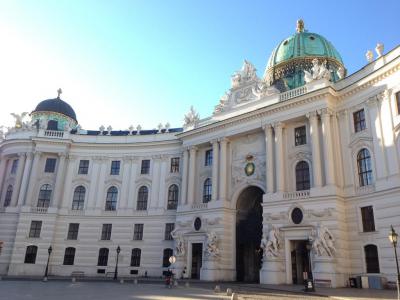
Saint Michael’s Square-or Michaelerplatz if you're feeling extra Austrian-is by far more than just a pretty roundabout. This baroque, star-shaped showstopper is the northeastern gateway to the Hofburg Palace-the kind of place where Roman legions, imperial drama, and architectural snobbery all collide in delightful chaos...
Let’s rewind a couple millennia: underneath your feet once stood Vindobona, a Roman military camp. You can still peek at the excavated remains in the center of the square-because Vienna doesn’t just bury its history, it displays it like a badge of honor.
Marching into view is the grand Michael’s Gate, a triumph of Neo-Baroque drama. It’s flanked by two dramatic 19th-century fountains sculpted by Rudolf Weyer-imagine “Roman gods doing acrobatics in water.” This is your official entrance into the imperial Hofburg, via Saint Michael’s Wing, which sounds like a fancy dessert but is actually just as rich in stone.
Across from all this pageantry stands the Church of Saint Michael, namesake of the square. Parts of it go back to 1221, though what you see now mostly dates from a sprucing-up in 1792. The church’s porch features a wild Baroque sculpture of the Fall of the Angels-very metal. Step inside and you’ll find 14th-century frescoes, Vienna’s largest gilded organ (once played by Haydn, no less), and a crypt that’s equal parts eerie and fascinating. Yes, they still have open coffins with mummified parishioners in full funeral chic. Welcome to Vienna...
Now turn your gaze to the Looshaus, a stark modernist rebel built in 1912 by architect Adolf Loos. At the time, it scandalized polite society-and Emperor Franz Joseph so hated its minimalist vibe, he refused to walk through Michael’s Gate ever again. Today, it's a working bank with a lavish interior clad in marble and mirrors. Moral of the story? Never judge a building by its cover.
Other star attractions ring the square like jewels, including the Spanish Riding School, the Sisi Museum, the Herberstein Palace, and a pair of 18th-century homes-one of which once belonged to Haydn himself.
Insider tip: spring for a horse-drawn carriage tour from here. This ride is a true slow-motion glide through centuries of imperial flair...
Let’s rewind a couple millennia: underneath your feet once stood Vindobona, a Roman military camp. You can still peek at the excavated remains in the center of the square-because Vienna doesn’t just bury its history, it displays it like a badge of honor.
Marching into view is the grand Michael’s Gate, a triumph of Neo-Baroque drama. It’s flanked by two dramatic 19th-century fountains sculpted by Rudolf Weyer-imagine “Roman gods doing acrobatics in water.” This is your official entrance into the imperial Hofburg, via Saint Michael’s Wing, which sounds like a fancy dessert but is actually just as rich in stone.
Across from all this pageantry stands the Church of Saint Michael, namesake of the square. Parts of it go back to 1221, though what you see now mostly dates from a sprucing-up in 1792. The church’s porch features a wild Baroque sculpture of the Fall of the Angels-very metal. Step inside and you’ll find 14th-century frescoes, Vienna’s largest gilded organ (once played by Haydn, no less), and a crypt that’s equal parts eerie and fascinating. Yes, they still have open coffins with mummified parishioners in full funeral chic. Welcome to Vienna...
Now turn your gaze to the Looshaus, a stark modernist rebel built in 1912 by architect Adolf Loos. At the time, it scandalized polite society-and Emperor Franz Joseph so hated its minimalist vibe, he refused to walk through Michael’s Gate ever again. Today, it's a working bank with a lavish interior clad in marble and mirrors. Moral of the story? Never judge a building by its cover.
Other star attractions ring the square like jewels, including the Spanish Riding School, the Sisi Museum, the Herberstein Palace, and a pair of 18th-century homes-one of which once belonged to Haydn himself.
Insider tip: spring for a horse-drawn carriage tour from here. This ride is a true slow-motion glide through centuries of imperial flair...
10) Hofburg Imperial Palace (must see)
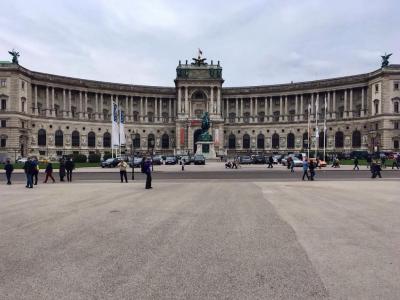
The Hofburg-or as it’s known in more regal circles, the “Castle of the Court”-is a sprawling architectural beast of a palace, a centuries-old flex of Habsburg power, pageantry, and perfectly symmetrical courtyards.
It all began back in 1279, when the Dukes of Austria needed a nice little place to call home. Fast forward a few empires and renovations later, and you've got the winter playground of the Holy Roman Emperors (until 1806) and the Emperors of Austria (until 1918). Today, the palace has swapped imperial intrigue for political paperwork-it’s now the official residence of the Austrian President and hosts the headquarters of the OSCE. Less crown, more conference...
Now, brace yourself: the Hofburg covers more than 240,000 square meters of space, comprising 18 wings, 19 courtyards, and a whopping 2,600 rooms. That’s not really a palace-it’s a small city. It houses everything from the elegant Amalienburg and Albertina museum, to the Imperial Chapel, the Court Library, the Treasure Chamber, and even the Spanish Riding School, where horses have more training than most people’s resumes.
The Swiss Wing is one of the oldest parts of the palace, dating back to the 13th century-yes, it’s older than your great-great-anything. Emperor Ferdinand I added the Swiss Gate in the 1550s, with his personal insignia on full display, just in case anyone forgot who was in charge.
The 17th-century Leopoldine Wing, built and later re-styled in Late Renaissance flair, adds even more imperial swagger, while the Court Library is basically a Baroque fever dream-with its majestic Prunksaal hall, frescoed ceilings, and emperors carved in stone, looking as dramatic as ever.
And it doesn’t stop there: the Winter Riding School, the Imperial Chancellery Wing (once home to Napoleon himself), and the elegant Redoute Wing-a former opera house-round out the complex. Even the Imperial Mews got a glow-up and now host those classy Lipizzaner horses.
Tip:
On Sundays, pop into the Imperial Chapel for Mass and catch the Vienna Boys Choir-angelic voices echoing through centuries of history. Because when in Vienna, you don’t just visit a palace… you enter a whole imperial universe.
It all began back in 1279, when the Dukes of Austria needed a nice little place to call home. Fast forward a few empires and renovations later, and you've got the winter playground of the Holy Roman Emperors (until 1806) and the Emperors of Austria (until 1918). Today, the palace has swapped imperial intrigue for political paperwork-it’s now the official residence of the Austrian President and hosts the headquarters of the OSCE. Less crown, more conference...
Now, brace yourself: the Hofburg covers more than 240,000 square meters of space, comprising 18 wings, 19 courtyards, and a whopping 2,600 rooms. That’s not really a palace-it’s a small city. It houses everything from the elegant Amalienburg and Albertina museum, to the Imperial Chapel, the Court Library, the Treasure Chamber, and even the Spanish Riding School, where horses have more training than most people’s resumes.
The Swiss Wing is one of the oldest parts of the palace, dating back to the 13th century-yes, it’s older than your great-great-anything. Emperor Ferdinand I added the Swiss Gate in the 1550s, with his personal insignia on full display, just in case anyone forgot who was in charge.
The 17th-century Leopoldine Wing, built and later re-styled in Late Renaissance flair, adds even more imperial swagger, while the Court Library is basically a Baroque fever dream-with its majestic Prunksaal hall, frescoed ceilings, and emperors carved in stone, looking as dramatic as ever.
And it doesn’t stop there: the Winter Riding School, the Imperial Chancellery Wing (once home to Napoleon himself), and the elegant Redoute Wing-a former opera house-round out the complex. Even the Imperial Mews got a glow-up and now host those classy Lipizzaner horses.
Tip:
On Sundays, pop into the Imperial Chapel for Mass and catch the Vienna Boys Choir-angelic voices echoing through centuries of history. Because when in Vienna, you don’t just visit a palace… you enter a whole imperial universe.
11) Hofburgkapelle
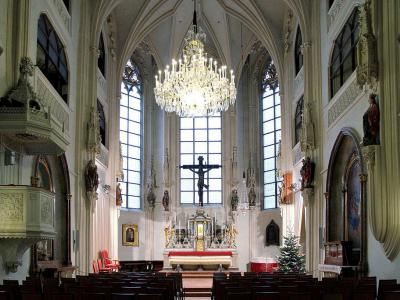
The Hofburgkapelle is a chapel that was essentially swallowed up by the Imperial castle. In fact at one point only the apse was visible externally. The chapel has been a part of church life in Vienna since at least 1424. While the castle around the chapel has been added to and ownership divided amongst various royalty, the chapel remained open for the use of all the peoples of Vienna.
Today, from September to April, the Vienna Boys Choir and members of the Vienna State Opera orchestra perform here at Sunday Mass. The music is absolutely phenomenal so be sure to book tickets as soon as travel dates are known. One can also stand outside the chapel in the narthex and here the choir if tickets were unavailable. The choir was originally 1492 to provide music for the liturgy. Although the choir has changed immensely over the centuries, it is enchanting to hear the boys sing with the incredible musicians as they were originally designed.
Inside the chapel are pillars that represent the Saints from around the time of Fredrick III who ruled throughout most of the 1800s. These pillars were refurbished in the 1970s to their original state. The chapel has been added to and redone so many times; it is nice to see parts of it being reverted back to its original splendor.
Today, from September to April, the Vienna Boys Choir and members of the Vienna State Opera orchestra perform here at Sunday Mass. The music is absolutely phenomenal so be sure to book tickets as soon as travel dates are known. One can also stand outside the chapel in the narthex and here the choir if tickets were unavailable. The choir was originally 1492 to provide music for the liturgy. Although the choir has changed immensely over the centuries, it is enchanting to hear the boys sing with the incredible musicians as they were originally designed.
Inside the chapel are pillars that represent the Saints from around the time of Fredrick III who ruled throughout most of the 1800s. These pillars were refurbished in the 1970s to their original state. The chapel has been added to and redone so many times; it is nice to see parts of it being reverted back to its original splendor.
12) Rathausplatz (City Hall Square and Park)
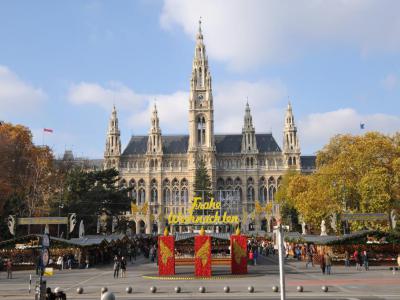
City Hall Square-or as the locals say, Rat-haus-platz-is Vienna’s grande outdoor living room, with a flair for drama, history, and seasonal costume changes.
Back in the day, this spot was basically the city’s backyard-well outside the medieval walls and mostly used for marching, saluting, and other military routines. It wasn’t until the late 19th century, when the new City Hall rose in neo-Gothic glory, that someone thought, “How about building a proper square?” And so they did-big, grand, and perfect for future festivals.
Now, here’s where the plot thickens. Over the years, the square got a few name changes... thanks to politics! In 1938, it even bore the name “Adolf Hitler Square”-yikes-but Vienna, being true to herself, gave history a firm correction and restored the name Rathausplatz in 1945.
Today, this square is a year-round stage for some of the city's best-loved events. In winter, it transforms into the Vienna Ice Dream, complete with twinkling lights and a dreamy skating rink. Come December, it’s all mulled wine and gingerbread with the Christmas Market. Spring sees the Vienna Festival kick off here, and summer-open-air film nights with classical scores floating on warm breezes.
And let’s not forget the Life Ball, where glam, glitter, and good causes collide under the neo-Gothic arches of the City Hall. Oh, and since 1959, one of Austria’s federal states has gifted Vienna a giant Christmas tree each year, right here in the square-because nothing keeps holiday spirit up like interregional diplomacy in fir form...
Just behind the square is City Hall Park, one of Vienna’s favorite green lungs. Built in 1873 on a former military parade ground, it’s now home to cozy benches, shady paths, and statues of Austria’s cultural VIPs, like composers Johann Strauss Sr. and Josef Lanner.
And if you’re into trees with gravitas, look out for the London plane tree. Planted way back in 1783-before the park even existed-it now stands 30 meters tall with a trunk circumference that would make a sumo wrestler blush.
So, whether you're skating, sipping, strolling, or simply star-gazing, City Hall Square is the place where Vienna does its best impression of a civic fairy tale.
Back in the day, this spot was basically the city’s backyard-well outside the medieval walls and mostly used for marching, saluting, and other military routines. It wasn’t until the late 19th century, when the new City Hall rose in neo-Gothic glory, that someone thought, “How about building a proper square?” And so they did-big, grand, and perfect for future festivals.
Now, here’s where the plot thickens. Over the years, the square got a few name changes... thanks to politics! In 1938, it even bore the name “Adolf Hitler Square”-yikes-but Vienna, being true to herself, gave history a firm correction and restored the name Rathausplatz in 1945.
Today, this square is a year-round stage for some of the city's best-loved events. In winter, it transforms into the Vienna Ice Dream, complete with twinkling lights and a dreamy skating rink. Come December, it’s all mulled wine and gingerbread with the Christmas Market. Spring sees the Vienna Festival kick off here, and summer-open-air film nights with classical scores floating on warm breezes.
And let’s not forget the Life Ball, where glam, glitter, and good causes collide under the neo-Gothic arches of the City Hall. Oh, and since 1959, one of Austria’s federal states has gifted Vienna a giant Christmas tree each year, right here in the square-because nothing keeps holiday spirit up like interregional diplomacy in fir form...
Just behind the square is City Hall Park, one of Vienna’s favorite green lungs. Built in 1873 on a former military parade ground, it’s now home to cozy benches, shady paths, and statues of Austria’s cultural VIPs, like composers Johann Strauss Sr. and Josef Lanner.
And if you’re into trees with gravitas, look out for the London plane tree. Planted way back in 1783-before the park even existed-it now stands 30 meters tall with a trunk circumference that would make a sumo wrestler blush.
So, whether you're skating, sipping, strolling, or simply star-gazing, City Hall Square is the place where Vienna does its best impression of a civic fairy tale.
13) Rathaus (City Hall) (must see)
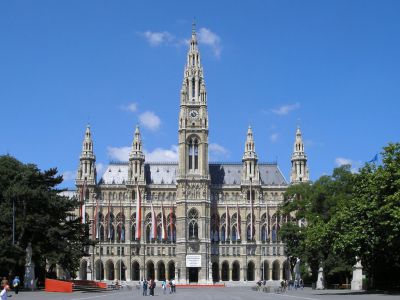
Vienna City Hall-a place where both the municipal government and the legislative assembly get down to business. By no means a dull office block, this neo-Gothic showstopper was built between 1872 and 1883 by architect Friedrich von Schmidt, who, rather humbly, now stands in a statue form just behind the building, keeping an eye on things from his very own square.
Drawing inspiration from the medieval architecture of Flanders and Brabant, the City Hall flaunts five towers like a crown. The tallest of them pierces the skyline at 98 meters, topped with the "City Hall Man"-not a superhero, but close... Clad in armor inspired by Emperor Maximilian I, this statue has been watching over Vienna since 1882 and has become something of a local mascot.
Inside, the building doesn’t just rest on its aesthetic laurels. There's the "City Hall Cellar"-a grand baroque dining hall where you can dig into proper Viennese culinary classics without a hint of modern guilt. “Schnitzel under chandeliers? Yes, please...”
The façade is a sculptural buffet in its own right, brimming with emperors, virtues like Power and Justice, and even good ol’ Vindobona, the Roman forebear of Vienna, lounging surrounded by heraldic flair. Think of it as Vienna’s resume carved in stone.
And on the flanks is a lineup of statues dedicated to trades and professions-because in this city, bakers, builders, and bookbinders all get a standing ovation in stone!
Now, if you're feeling adventurous (and are in good shape), brave the 331 steps up to the central tower that’s worth every groan from your knees. Your reward will be the sweeping views of Vienna in all its baroque-meets-modern glory-plus bragging rights for conquering the city one stair at a time. Trust us-Vienna looks even better from above.
Tip:
For the inside scoop, join the free German-language guided tour on Mondays, Wednesdays, and Fridays at 1 pm. Not fluent in German? No problem-audio guides are available in multiple languages. Just be ready to temporarily part ways with your passport. The view-and the tales-are absolutely worth it.
Drawing inspiration from the medieval architecture of Flanders and Brabant, the City Hall flaunts five towers like a crown. The tallest of them pierces the skyline at 98 meters, topped with the "City Hall Man"-not a superhero, but close... Clad in armor inspired by Emperor Maximilian I, this statue has been watching over Vienna since 1882 and has become something of a local mascot.
Inside, the building doesn’t just rest on its aesthetic laurels. There's the "City Hall Cellar"-a grand baroque dining hall where you can dig into proper Viennese culinary classics without a hint of modern guilt. “Schnitzel under chandeliers? Yes, please...”
The façade is a sculptural buffet in its own right, brimming with emperors, virtues like Power and Justice, and even good ol’ Vindobona, the Roman forebear of Vienna, lounging surrounded by heraldic flair. Think of it as Vienna’s resume carved in stone.
And on the flanks is a lineup of statues dedicated to trades and professions-because in this city, bakers, builders, and bookbinders all get a standing ovation in stone!
Now, if you're feeling adventurous (and are in good shape), brave the 331 steps up to the central tower that’s worth every groan from your knees. Your reward will be the sweeping views of Vienna in all its baroque-meets-modern glory-plus bragging rights for conquering the city one stair at a time. Trust us-Vienna looks even better from above.
Tip:
For the inside scoop, join the free German-language guided tour on Mondays, Wednesdays, and Fridays at 1 pm. Not fluent in German? No problem-audio guides are available in multiple languages. Just be ready to temporarily part ways with your passport. The view-and the tales-are absolutely worth it.
14) Cafe Central (must see)
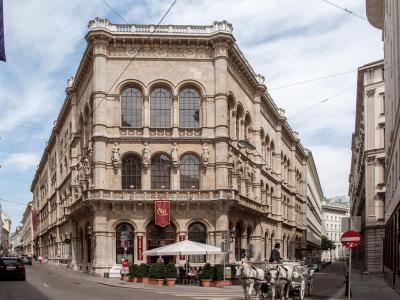
Café Central stands as a quintessential Viennese coffeehouse, nestled on the ground floor of the Palais Ferstel, formerly known as the Bank and Stockmarket Building, designed by architect Heinrich von Ferstel.
Established back in 1876, this café gained significant prominence during the late 19th century, evolving into a pivotal hub for Vienna's intellectual elite. Distinguished regulars included luminaries such as Peter Altenberg, Theodor Herzl, Alfred Adler, Egon Friedell, Hugo von Hofmannsthal, Anton Kuh, Adolf Loos, Leo Perutz, Robert Musil, Stefan Zweig, Alfred Polgar, Adolf Hitler, and Leon Trotsky. Remarkably, in January 1913 alone, notable figures like Josip Broz Tito, Sigmund Freud, and the ever-present Trotsky frequented this establishment.
It was often colloquially referred to as the "Chess school" (Die Schachhochschule), owing to the prevalence of chess enthusiasts who gathered on the first floor to engage in their games. The Vienna Circle, a group of logical positivists, convened numerous meetings here both before and after World War I.
One intriguing anecdote recalls a conversation between Victor Adler and Count Berchtold, the foreign minister of Austria-Hungary, where Adler warned that war might incite revolution in Russia, if not within the Habsburg monarchy itself. In response, Berchtold facetiously queried, "And who will lead this revolution? Perhaps Mr. Bronstein (Leon Trotsky) sitting over there at the Cafe Central?"
Following the conclusion of World War II, the café ceased its operations. However, in 1975, the Palais Ferstel underwent a renovation, and Café Central was resurrected in a different part of the building. Subsequently, in 1986, it underwent another comprehensive renovation.
Today, Café Central remains a cherished tourist attraction and a popular coffeehouse, revered for its enduring place in literary history.
Established back in 1876, this café gained significant prominence during the late 19th century, evolving into a pivotal hub for Vienna's intellectual elite. Distinguished regulars included luminaries such as Peter Altenberg, Theodor Herzl, Alfred Adler, Egon Friedell, Hugo von Hofmannsthal, Anton Kuh, Adolf Loos, Leo Perutz, Robert Musil, Stefan Zweig, Alfred Polgar, Adolf Hitler, and Leon Trotsky. Remarkably, in January 1913 alone, notable figures like Josip Broz Tito, Sigmund Freud, and the ever-present Trotsky frequented this establishment.
It was often colloquially referred to as the "Chess school" (Die Schachhochschule), owing to the prevalence of chess enthusiasts who gathered on the first floor to engage in their games. The Vienna Circle, a group of logical positivists, convened numerous meetings here both before and after World War I.
One intriguing anecdote recalls a conversation between Victor Adler and Count Berchtold, the foreign minister of Austria-Hungary, where Adler warned that war might incite revolution in Russia, if not within the Habsburg monarchy itself. In response, Berchtold facetiously queried, "And who will lead this revolution? Perhaps Mr. Bronstein (Leon Trotsky) sitting over there at the Cafe Central?"
Following the conclusion of World War II, the café ceased its operations. However, in 1975, the Palais Ferstel underwent a renovation, and Café Central was resurrected in a different part of the building. Subsequently, in 1986, it underwent another comprehensive renovation.
Today, Café Central remains a cherished tourist attraction and a popular coffeehouse, revered for its enduring place in literary history.
15) Peterskirche (St. Peter's Church) (must see)
Tucked snugly among Vienna’s Baroque showpieces like a pearl in a pastry, Saint Peter’s Church has a front-row seat to history, and not much else, thanks to the buildings crowding around it. You’ll mostly catch it head-on, which, honestly, is its best angle.
This spot has seen churches come and go like emperors with changing tastes. Some say the very first church here dates back to the early 4th century AD, making it one of the oldest in Vienna-yes, back when sandals were in and Rome was still a big deal. In 792, none other than King Charlemagne is said to have popped by and said, “Let’s build.” There’s even a plaque on the façade bragging about it. Historical records, ever the skeptics, first mention the church in 1137, but who’s counting?
By the late 1100s, the church cozied up to the newly founded Schottenstift monastery. Then came fire, plague, and drama. After the 1661 fire, it got a bit of a patch job… until the plague of 1679 cleared the streets and cleared the way for Emperor Leopold I, who swore a divine vow to rebuild. And he did...
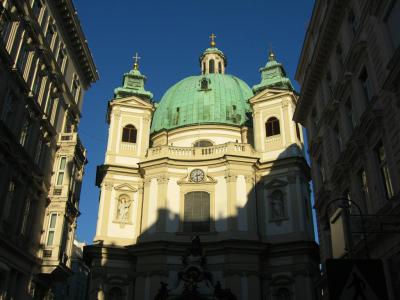
Construction began around 1701, drawing heavy inspiration from Saint Peter’s Basilica in Rome-because if you’re going to imitate, imitate the best. By 1733, Vienna had its first domed Baroque beauty, cleverly built with a compact, oval layout to fit the tight space.
Outside, it sports a neat combo of white and barely-there yellow, flanked by two towers that curve ever so slightly inward-apparently a cheeky nod to Turkish tent poles from the 1683 siege.
Step inside, and there you have it: gold stucco, opulent frescoes, and Johann Michael Rottmayr’s artistic fireworks overhead, including the Coronation of Our Lady. The high altar gets dramatic with a healing scene, starring Saint Peter and Saint John, and around the edges, you'll spot relics of Roman martyrs, reclining in crystal coffins like glittering saints on display.
The church was polished up in a major 1998-2004 renovation, and today it’s still a Baroque gem in Vienna’s crown.
Hot tip:
Drop in any day from 3 to 3:30 pm for a free organ concert-divine music, no ticket required (but donations are saintly). And if you're lucky, catch a choir in the crypts. Now that’s a holy experience...
This spot has seen churches come and go like emperors with changing tastes. Some say the very first church here dates back to the early 4th century AD, making it one of the oldest in Vienna-yes, back when sandals were in and Rome was still a big deal. In 792, none other than King Charlemagne is said to have popped by and said, “Let’s build.” There’s even a plaque on the façade bragging about it. Historical records, ever the skeptics, first mention the church in 1137, but who’s counting?
By the late 1100s, the church cozied up to the newly founded Schottenstift monastery. Then came fire, plague, and drama. After the 1661 fire, it got a bit of a patch job… until the plague of 1679 cleared the streets and cleared the way for Emperor Leopold I, who swore a divine vow to rebuild. And he did...
Construction began around 1701, drawing heavy inspiration from Saint Peter’s Basilica in Rome-because if you’re going to imitate, imitate the best. By 1733, Vienna had its first domed Baroque beauty, cleverly built with a compact, oval layout to fit the tight space.
Outside, it sports a neat combo of white and barely-there yellow, flanked by two towers that curve ever so slightly inward-apparently a cheeky nod to Turkish tent poles from the 1683 siege.
Step inside, and there you have it: gold stucco, opulent frescoes, and Johann Michael Rottmayr’s artistic fireworks overhead, including the Coronation of Our Lady. The high altar gets dramatic with a healing scene, starring Saint Peter and Saint John, and around the edges, you'll spot relics of Roman martyrs, reclining in crystal coffins like glittering saints on display.
The church was polished up in a major 1998-2004 renovation, and today it’s still a Baroque gem in Vienna’s crown.
Hot tip:
Drop in any day from 3 to 3:30 pm for a free organ concert-divine music, no ticket required (but donations are saintly). And if you're lucky, catch a choir in the crypts. Now that’s a holy experience...
