Custom Walk in Krakow, Poland by lorry500_8699f8 created on 2026-02-07
Guide Location: Poland » Krakow
Guide Type: Custom Walk
# of Sights: 9
Tour Duration: 2 Hour(s)
Travel Distance: 4.1 Km or 2.5 Miles
Share Key: 7EYJC
Guide Type: Custom Walk
# of Sights: 9
Tour Duration: 2 Hour(s)
Travel Distance: 4.1 Km or 2.5 Miles
Share Key: 7EYJC
How It Works
Please retrieve this walk in the GPSmyCity app. Once done, the app will guide you from one tour stop to the next as if you had a personal tour guide. If you created the walk on this website or come to the page via a link, please follow the instructions below to retrieve the walk in the app.
Retrieve This Walk in App
Step 1. Download the app "GPSmyCity: Walks in 1K+ Cities" on Apple App Store or Google Play Store.



Step 2. In the GPSmyCity app, download(or launch) the guide "Krakow Map and Walking Tours".
Step 3. Tap the menu button located at upper right corner of the "Walks" screen and select "Retrieve custom walk". Enter the share key: 7EYJC
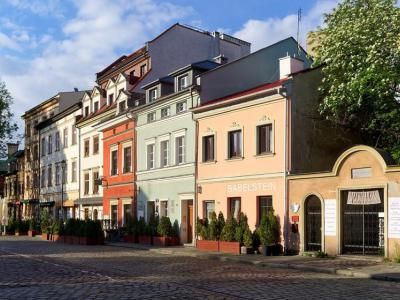
1) Szeroka Street
Szeroka Street has long been considered the heart of the Jewish quarter. Unlike most streets, Szeroka is unusually wide—its name literally means “Broad Street”—and for centuries it functioned more like a communal square than a typical roadway. Its origins date to the Middle Ages, when Kazimierz was a separate town. By the 15th and 16th centuries, as the Jewish community settled here after being relocated from Kraków proper, Szeroka Street became the focal point of Jewish religious, social, and economic life.
Several of Kraków’s most important synagogues stand directly on Szeroka Street. These include the Old Synagogue—the oldest surviving Jewish prayer house in Poland—and the Remuh Synagogue, founded in the 1550s and still an active place of worship. Adjacent to the Remuh Synagogue lies the historic Remuh Cemetery, one of the oldest Jewish burial grounds in the country, where notable rabbis, scholars, and community leaders from the 16th and 17th centuries are buried. Walking down Szeroka Street, visitors also encounter former prayer houses, historic townhouses, and the preserved façades of old Jewish institutions that once shaped everyday life in Kazimierz.
In the 19th century, as restrictions on movement eased and Jews reintegrated with the rest of Kraków, Szeroka Street remained a symbolic center and later became a place of memory after the devastation of World War II. In the postwar years, the area saw a gradual revival, and today it blends heritage with contemporary culture. Cafés, restaurants serving traditional Jewish dishes, museums, and small shops line the street, while plaques and markers recall the people and events that once defined the neighborhood.
Several of Kraków’s most important synagogues stand directly on Szeroka Street. These include the Old Synagogue—the oldest surviving Jewish prayer house in Poland—and the Remuh Synagogue, founded in the 1550s and still an active place of worship. Adjacent to the Remuh Synagogue lies the historic Remuh Cemetery, one of the oldest Jewish burial grounds in the country, where notable rabbis, scholars, and community leaders from the 16th and 17th centuries are buried. Walking down Szeroka Street, visitors also encounter former prayer houses, historic townhouses, and the preserved façades of old Jewish institutions that once shaped everyday life in Kazimierz.
In the 19th century, as restrictions on movement eased and Jews reintegrated with the rest of Kraków, Szeroka Street remained a symbolic center and later became a place of memory after the devastation of World War II. In the postwar years, the area saw a gradual revival, and today it blends heritage with contemporary culture. Cafés, restaurants serving traditional Jewish dishes, museums, and small shops line the street, while plaques and markers recall the people and events that once defined the neighborhood.
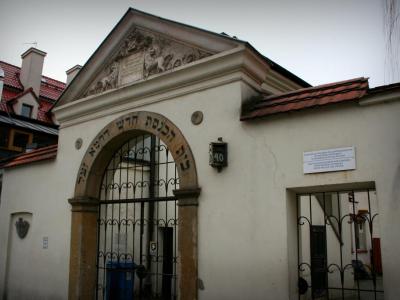
2) Remah Synagogue and Cemetery
The Remah Synagogue was founded in the mid-16th century on the initiative of a Jewish merchant who dedicated the prayer house in memory of his wife and in honour of his son, Moses Isserles (better known by the acronym “ReMA”). Isserles became one of the most important scholars in Ashkenazi Judaism, and his commentaries on Jewish law remain influential to this day. Although the first wooden building was destroyed by fire, a masonry synagogue rose in its place around 1557, and the structure standing today largely reflects that period.
The synagogue is modest in size — among the smallest historic synagogues in Kraków — yet its authenticity compensates for its scale. Inside, original elements survive: the stone Torah ark from the 16th century, a donation box near the doorway once collected alms, and, after recent conservation, colourful wall and ceiling paintings have been revealed, including biblical motifs and zodiac symbols.
Beside the synagogue lies the Old Jewish Cemetery, whose gate can be found behind and to the right of the building, along a wall filled with memorial plaques. The cemetery was founded between 1535 and 1551, making it one of the oldest surviving Jewish cemeteries in Poland. Over the centuries, it served as the burial ground for many of Kraków’s most prominent rabbis, scholars, and community members — among them Moses Isserles himself.
During World War II, many tombstones were removed or destroyed, and the site was extensively damaged. After the war, renewed efforts led to the restoration of numerous gravestones — today roughly 700 are visible, richly carved with Hebrew inscriptions and traditional Jewish symbols. Walking slowly among these weathered monuments, visitors may notice ornamental motifs such as crowns (symbolising virtuous lives), grapevine leaves (signifying wisdom and maturity), or carved vessels marking graves of members of the Levite community.
Because Remah remains a functioning religious site, visitors are encouraged to treat it with respect: modest dress, a quiet demeanour, and appreciation for its dual role as a place of prayer and a site of memory. For anyone interested in Jewish heritage or simply quiet spaces that invite reflection, Remah offers a deeply human experience — modest in scale, profound in meaning.
The synagogue is modest in size — among the smallest historic synagogues in Kraków — yet its authenticity compensates for its scale. Inside, original elements survive: the stone Torah ark from the 16th century, a donation box near the doorway once collected alms, and, after recent conservation, colourful wall and ceiling paintings have been revealed, including biblical motifs and zodiac symbols.
Beside the synagogue lies the Old Jewish Cemetery, whose gate can be found behind and to the right of the building, along a wall filled with memorial plaques. The cemetery was founded between 1535 and 1551, making it one of the oldest surviving Jewish cemeteries in Poland. Over the centuries, it served as the burial ground for many of Kraków’s most prominent rabbis, scholars, and community members — among them Moses Isserles himself.
During World War II, many tombstones were removed or destroyed, and the site was extensively damaged. After the war, renewed efforts led to the restoration of numerous gravestones — today roughly 700 are visible, richly carved with Hebrew inscriptions and traditional Jewish symbols. Walking slowly among these weathered monuments, visitors may notice ornamental motifs such as crowns (symbolising virtuous lives), grapevine leaves (signifying wisdom and maturity), or carved vessels marking graves of members of the Levite community.
Because Remah remains a functioning religious site, visitors are encouraged to treat it with respect: modest dress, a quiet demeanour, and appreciation for its dual role as a place of prayer and a site of memory. For anyone interested in Jewish heritage or simply quiet spaces that invite reflection, Remah offers a deeply human experience — modest in scale, profound in meaning.
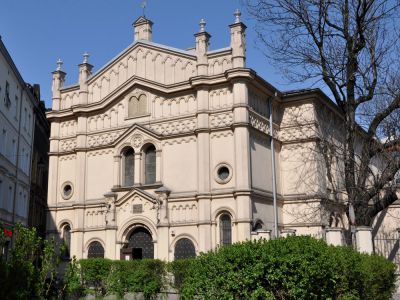
3) Tempel Synagogue (Synagoga Tempel)
The Tempel Synagogue stands out as a vivid chapter in the city’s Jewish-life story, blending faith, architectural ambition, and cultural renewal under one roof. Built between 1860 and 1862 on Miodowa Street in the historic district of Kazimierz, it was designed in a style that mixes Moorish Revival and Renaissance Revival influences.
At the time, the synagogue served a Reform (or Progressive) Jewish congregation — a community open to cultural adaptation and liturgical innovation. Services included sermons in Polish and German, choirs (sometimes with women singing), and other elements that more conservative Orthodox communities rejected.
The building itself is distinctive: a central hall rises between lower side aisles, and the interior is richly decorated with polychrome paintings, gold leaf, and unusually colourful stained-glass windows. The windows — 36 in total — are among the best preserved of their kind in Poland.
As the synagogue is quite compact, its highlights can be easily observed. A white marble Torah ark sits in the eastern apse, visible as the furthest point from the entrance when you step inside. The ark’s marble structure and golden dome make it conspicuous, yet it blends seamlessly with the surrounding intricate ceiling and balcony designs. Speaking of the latter, two balconies frame the main hall, known collectively as the Women’s Gallery. As the name suggests, these balconies were designated for women and are embellished with floral motifs and decorative ironwork. Overall, the synagogue exudes a sense of regal grandeur, reminiscent of those in other European centres such as Budapest or Vienna.
During the Second World War, the synagogue suffered under German occupation: the building was repurposed as storage for ammunition and animals, and its religious function was suppressed. After the war, it gradually returned to use — a ritual bath was added in 1947, and although regular services continued for a time, they largely ceased after the 1980s.
Between 1995 and 2000, the synagogue underwent a thorough renovation, restoring both its exterior and interior. Today it remains a protected historical monument and an active venue for cultural events — concerts, gatherings, and especially programmes linked to the annual Jewish Culture Festival in Kraków.
At the time, the synagogue served a Reform (or Progressive) Jewish congregation — a community open to cultural adaptation and liturgical innovation. Services included sermons in Polish and German, choirs (sometimes with women singing), and other elements that more conservative Orthodox communities rejected.
The building itself is distinctive: a central hall rises between lower side aisles, and the interior is richly decorated with polychrome paintings, gold leaf, and unusually colourful stained-glass windows. The windows — 36 in total — are among the best preserved of their kind in Poland.
As the synagogue is quite compact, its highlights can be easily observed. A white marble Torah ark sits in the eastern apse, visible as the furthest point from the entrance when you step inside. The ark’s marble structure and golden dome make it conspicuous, yet it blends seamlessly with the surrounding intricate ceiling and balcony designs. Speaking of the latter, two balconies frame the main hall, known collectively as the Women’s Gallery. As the name suggests, these balconies were designated for women and are embellished with floral motifs and decorative ironwork. Overall, the synagogue exudes a sense of regal grandeur, reminiscent of those in other European centres such as Budapest or Vienna.
During the Second World War, the synagogue suffered under German occupation: the building was repurposed as storage for ammunition and animals, and its religious function was suppressed. After the war, it gradually returned to use — a ritual bath was added in 1947, and although regular services continued for a time, they largely ceased after the 1980s.
Between 1995 and 2000, the synagogue underwent a thorough renovation, restoring both its exterior and interior. Today it remains a protected historical monument and an active venue for cultural events — concerts, gatherings, and especially programmes linked to the annual Jewish Culture Festival in Kraków.
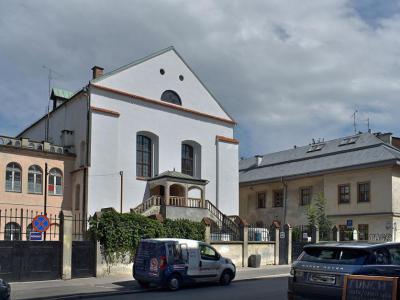
4) Izaak Synagogue
The Izaak Synagogue stands as one of the grandest monuments to the city’s Jewish heritage: built between 1638 and 1644 in the historic Jewish quarter of Kazimierz, it was commissioned by a wealthy Jewish financier, Izaak Jakubowicz — also known as “Isaac the Rich,” banker to the king — and remains a striking example of 17th-century Baroque synagogue architecture.
From the outside the building appears restrained, but inside lies a richly decorated hall: a high vaulted ceiling, Renaissance-style stucco frames, painted Hebrew liturgical texts on the walls, ornate decorative motifs, and a women’s gallery supported by elegant Tuscan columns. When it was first built, this synagogue was the largest and most lavishly furnished in Kazimierz with a majestic wooden Torah ark and richly appointed interiors.
Over the centuries the synagogue saw many trials. In the mid-17th century, during the Swedish Deluge, the furnishings were looted, and the building was even pawned to settle debts. The most destructive blow came during World War II, when occupying forces plundered and destroyed the interior: the bimah, the ark and other ritual furnishings were lost, and the synagogue was repurposed — first as storage, later as a workshop. In the post-war decades it served various secular functions and fell into disrepair, even suffering a damaging fire around 1981.
The revival began in the 1980s and 1990s: after renovation efforts uncovered long-hidden murals and decorative schemes, the building was restored to its former grandeur. Today Izaak Synagogue functions again as a place of worship for the Orthodox community, but also as a cultural and historical site: it hosts exhibitions, film screenings and educational projects about the Jewish past of Kraków’s Kazimierz district, as well as occasional concerts and meetings.
From the outside the building appears restrained, but inside lies a richly decorated hall: a high vaulted ceiling, Renaissance-style stucco frames, painted Hebrew liturgical texts on the walls, ornate decorative motifs, and a women’s gallery supported by elegant Tuscan columns. When it was first built, this synagogue was the largest and most lavishly furnished in Kazimierz with a majestic wooden Torah ark and richly appointed interiors.
Over the centuries the synagogue saw many trials. In the mid-17th century, during the Swedish Deluge, the furnishings were looted, and the building was even pawned to settle debts. The most destructive blow came during World War II, when occupying forces plundered and destroyed the interior: the bimah, the ark and other ritual furnishings were lost, and the synagogue was repurposed — first as storage, later as a workshop. In the post-war decades it served various secular functions and fell into disrepair, even suffering a damaging fire around 1981.
The revival began in the 1980s and 1990s: after renovation efforts uncovered long-hidden murals and decorative schemes, the building was restored to its former grandeur. Today Izaak Synagogue functions again as a place of worship for the Orthodox community, but also as a cultural and historical site: it hosts exhibitions, film screenings and educational projects about the Jewish past of Kraków’s Kazimierz district, as well as occasional concerts and meetings.
5) Old Synagogue
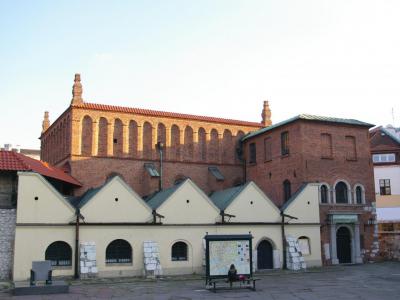
The Old Synagogue in Kraków is the oldest surviving Jewish prayer house in Poland and one of the most important monuments of Jewish heritage in Europe. Located on Szeroka Street in Kazimierz, it dates back to the late 15th or early 16th century, when the Jewish community was first relocated to the district. Its earliest known form was built in the Gothic style, but after a major fire in 1557, it was rebuilt in a Renaissance style that gave the structure its distinctive fortress-like appearance. For centuries, the Old Synagogue served as the religious, cultural, and administrative heart of Kraków’s Jewish community, hosting prayers, community meetings, and sessions of the kahal (the self-governing Jewish council).
Inside, visitors can explore the main prayer hall with its vaulted ceiling supported by two thick pillars. It features exhibits on Jewish religious practices, holidays, and daily life. The women’s section is a 17th-century addition and can be found by turning right from the Holy Ark in the main hall. It reflects traditional synagogue design and, along with various side rooms, displays artifacts such as Torah ornaments, ceremonial objects, and historic manuscripts that illustrate how deeply rooted Jewish tradition was in Kazimierz. The podium—positioned in the center of the hall—remains one of the most visually compelling features, enclosed by a beautifully wrought-iron balustrade.
The Old Synagogue also carries the memory of darker chapters. During World War II, the Nazis devastated its interior and used the building as a warehouse. After the war, it underwent careful restoration and eventually became a branch of the Historical Museum of the City of Kraków. Today, its exhibitions are thematically organized to explore aspects such as birth, prayer rituals, dietary practices, divorce, and death.
The Old Synagogue offers an essential introduction to Jewish life in Kraków. It is one of the key stops along the route through Kazimierz and provides valuable historical context for the other synagogues, cemeteries, and cultural sites nearby.
Inside, visitors can explore the main prayer hall with its vaulted ceiling supported by two thick pillars. It features exhibits on Jewish religious practices, holidays, and daily life. The women’s section is a 17th-century addition and can be found by turning right from the Holy Ark in the main hall. It reflects traditional synagogue design and, along with various side rooms, displays artifacts such as Torah ornaments, ceremonial objects, and historic manuscripts that illustrate how deeply rooted Jewish tradition was in Kazimierz. The podium—positioned in the center of the hall—remains one of the most visually compelling features, enclosed by a beautifully wrought-iron balustrade.
The Old Synagogue also carries the memory of darker chapters. During World War II, the Nazis devastated its interior and used the building as a warehouse. After the war, it underwent careful restoration and eventually became a branch of the Historical Museum of the City of Kraków. Today, its exhibitions are thematically organized to explore aspects such as birth, prayer rituals, dietary practices, divorce, and death.
The Old Synagogue offers an essential introduction to Jewish life in Kraków. It is one of the key stops along the route through Kazimierz and provides valuable historical context for the other synagogues, cemeteries, and cultural sites nearby.
6) Ghetto Heroes Square
Ghetto Heroes Square is one of the city’s most powerful memorial spaces, located in the Podgórze district, where the Nazi-established Kraków Ghetto existed during World War II. Before the war, this area was an ordinary urban square, but in March 1941 it became the central gathering point for the more than 15,000 Jews forcibly relocated into the ghetto. The square served as a place of daily passage, trade, and movement under oppression—but it was also the site where families were assembled during mass deportations to the Bełżec extermination camp and later to the Płaszów labor and concentration camp. For many, it was the last place they stood in Kraków.
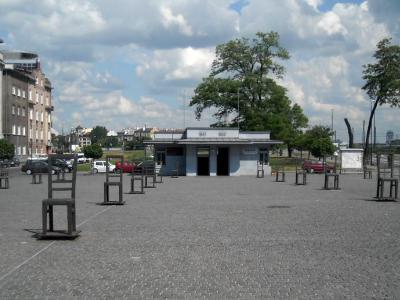
After the war, the square remained an open urban space, but its historical weight was not officially acknowledged until the early 2000s. In 2005, a memorial installation titled Ghetto Heroes Square transformed the area into a place of reflection. The memorial consists of dozens of large bronze chairs arranged across the square in varying sizes and groupings, each placed on slightly raised platforms that create the impression of floating above the pavement. The simple, empty chairs symbolize the belongings left behind during deportations and the overwhelming absence created by the destruction of the ghetto’s population.
On the north side of the square, a small police box still stands. During the deportations, the Nazis used it to identify and count the Jewish victims.
Today, Ghetto Heroes Square is a key site for those seeking to understand Kraków’s wartime history. It lies close to surviving fragments of the ghetto wall, which can still be viewed a short walk away.
After the war, the square remained an open urban space, but its historical weight was not officially acknowledged until the early 2000s. In 2005, a memorial installation titled Ghetto Heroes Square transformed the area into a place of reflection. The memorial consists of dozens of large bronze chairs arranged across the square in varying sizes and groupings, each placed on slightly raised platforms that create the impression of floating above the pavement. The simple, empty chairs symbolize the belongings left behind during deportations and the overwhelming absence created by the destruction of the ghetto’s population.
On the north side of the square, a small police box still stands. During the deportations, the Nazis used it to identify and count the Jewish victims.
Today, Ghetto Heroes Square is a key site for those seeking to understand Kraków’s wartime history. It lies close to surviving fragments of the ghetto wall, which can still be viewed a short walk away.
7) Eagle Pharmacy
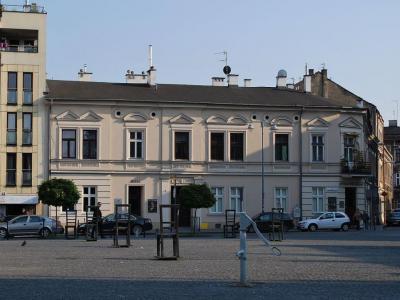
The Eagle Pharmacy is located on Ghetto Heroes Square in the former Jewish ghetto of Podgórze. It gained historical importance during World War II as the only pharmacy allowed to operate within the ghetto’s boundaries. During the Nazi occupation, the only Polish sign permitted throughout the ghetto was the inscription "Pod Orłem” (meaning “Under the Eagle”) above its entrance. Its owner, Tadeusz Pankiewicz, a Polish Catholic pharmacist, chose to remain in the ghetto even after all non-Jewish residents were ordered to leave in 1941. His decision turned the pharmacy into a crucial centre of aid, resistance, and humanitarian support for the imprisoned Jewish population.
Throughout the ghetto’s existence, the Eagle Pharmacy became much more than a place to obtain medicine. Pankiewicz and his staff provided free pharmaceuticals, passed messages in and out of the ghetto, hid individuals during Nazi roundups, and supplied hair dye and other materials to help people avoid deportation by altering their appearance. The pharmacy also functioned as an informal meeting point for community members, intellectuals, and leaders of the Jewish Council. During the liquidation of the ghetto in 1942–1943, its rooms sheltered terrified residents, offering brief refuge amid chaos and violence. For these acts of courage, Pankiewicz was later recognised as Righteous Among the Nations by Yad Vashem.
Today, the Eagle Pharmacy is a branch of the Historical Museum of the City of Kraków. As soon as you enter the pharmacy, the counter stands on your right. Behind it, large wooden shelves display glass bottles containing botanical powders and extracts. Above the shelves, a wooden clock is topped by an eagle — a nod to the pharmacy’s name. To the left of the shelves, a doorway leads to the storage rooms, Pankiewicz’s office, and other restored interiors. The carefully organised rooms recreate the pharmacy’s wartime appearance, while multimedia exhibits present photographs, personal testimonies, documents, and objects related to daily life in the ghetto.
Standing at the southwestern edge of Ghetto Heroes Square, the museum forms a powerful triad with the square’s chair memorial and the nearby remnants of the ghetto wall. For those seeking to understand Kraków’s Jewish history and the human stories of resistance amid persecution, the Eagle Pharmacy offers one of the city’s most poignant and enlightening experiences.
Throughout the ghetto’s existence, the Eagle Pharmacy became much more than a place to obtain medicine. Pankiewicz and his staff provided free pharmaceuticals, passed messages in and out of the ghetto, hid individuals during Nazi roundups, and supplied hair dye and other materials to help people avoid deportation by altering their appearance. The pharmacy also functioned as an informal meeting point for community members, intellectuals, and leaders of the Jewish Council. During the liquidation of the ghetto in 1942–1943, its rooms sheltered terrified residents, offering brief refuge amid chaos and violence. For these acts of courage, Pankiewicz was later recognised as Righteous Among the Nations by Yad Vashem.
Today, the Eagle Pharmacy is a branch of the Historical Museum of the City of Kraków. As soon as you enter the pharmacy, the counter stands on your right. Behind it, large wooden shelves display glass bottles containing botanical powders and extracts. Above the shelves, a wooden clock is topped by an eagle — a nod to the pharmacy’s name. To the left of the shelves, a doorway leads to the storage rooms, Pankiewicz’s office, and other restored interiors. The carefully organised rooms recreate the pharmacy’s wartime appearance, while multimedia exhibits present photographs, personal testimonies, documents, and objects related to daily life in the ghetto.
Standing at the southwestern edge of Ghetto Heroes Square, the museum forms a powerful triad with the square’s chair memorial and the nearby remnants of the ghetto wall. For those seeking to understand Kraków’s Jewish history and the human stories of resistance amid persecution, the Eagle Pharmacy offers one of the city’s most poignant and enlightening experiences.
8) Jewish Ghetto Wall Fragment
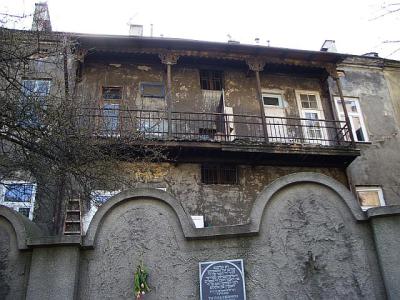
The Jewish Ghetto Wall Fragment was built by the occupying German authorities in 1941. It once enclosed the Podgórze Ghetto, where more than 15,000 Jewish residents were forcibly relocated. Its distinctive shape, often compared to tombstones, was not accidental; it reflected the oppressive symbolism imposed on the community and has since become one of the most recognisable visual markers of Kraków’s Holocaust-era landscape.
One of the most significant surviving sections stands on Lwowska Street. It features a memorial plaque that reads, “Here they lived, suffered and perished at the hands of Hitler’s executioners. From here they began their final journey to the death camps.” Although unassuming at first glance, the fragment offers a stark and powerful reminder of the atrocities endured by Kraków’s Jewish population, helping visitors form a clearer understanding of the ghetto’s tragic history.
One of the most significant surviving sections stands on Lwowska Street. It features a memorial plaque that reads, “Here they lived, suffered and perished at the hands of Hitler’s executioners. From here they began their final journey to the death camps.” Although unassuming at first glance, the fragment offers a stark and powerful reminder of the atrocities endured by Kraków’s Jewish population, helping visitors form a clearer understanding of the ghetto’s tragic history.
9) Plaszow Concentration Camp
The Płaszów Concentration Camp (Kraków-Płaszów Camp) emerged as a Nazi German labor and concentration facility in 1942. Situated in Płaszów, a southern enclave of Kraków that is now part of the Podgórze district, the camp was erected by the SS shortly after the German incursion into Poland and the subsequent establishment of the semi-colonial General Government district in the occupied region of south-central Poland.
Its primary objective was to exploit Jewish individuals as a captive workforce, subjecting them to enslavement. The camp held a staggering population of 25,000 men, women, and children concurrently, although the total count of individuals who endured its horrors exceeded 150,000 over time. Notoriously infamous for its appalling acts of terror, the camp was under the command of Amon Göth, an SS commandant hailing from Vienna. His treatment of prisoners was marked by sadistic cruelty and frequent killings.
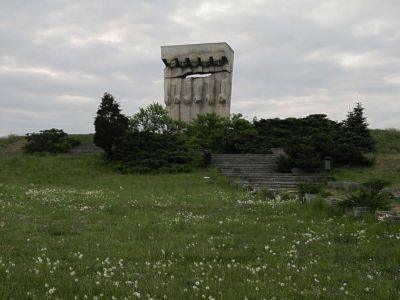
Today, the site once occupied by the camp is characterized by sparsely wooded hills and fields. It houses a substantial memorial dedicated to all the victims, accompanied by two smaller monuments. One of these monuments is a tribute to the Jewish victims, while the other commemorates the Hungarian Jewish victims, both situated along the camp's former perimeter. Amon Göth's villa still stands as a grim reminder of the past. An additional modest monument positioned at the opposite end of the site serves as a memorial for the first execution of Polish (non-Jewish) prisoners in 1939.
The Płaszów camp garnered attention through its portrayal in the film "Schindler's List" (1993), which chronicles the life of Oskar Schindler. This somber chapter of history has earned the camp a place on the UNESCO World Heritage list.
Its primary objective was to exploit Jewish individuals as a captive workforce, subjecting them to enslavement. The camp held a staggering population of 25,000 men, women, and children concurrently, although the total count of individuals who endured its horrors exceeded 150,000 over time. Notoriously infamous for its appalling acts of terror, the camp was under the command of Amon Göth, an SS commandant hailing from Vienna. His treatment of prisoners was marked by sadistic cruelty and frequent killings.
Today, the site once occupied by the camp is characterized by sparsely wooded hills and fields. It houses a substantial memorial dedicated to all the victims, accompanied by two smaller monuments. One of these monuments is a tribute to the Jewish victims, while the other commemorates the Hungarian Jewish victims, both situated along the camp's former perimeter. Amon Göth's villa still stands as a grim reminder of the past. An additional modest monument positioned at the opposite end of the site serves as a memorial for the first execution of Polish (non-Jewish) prisoners in 1939.
The Płaszów camp garnered attention through its portrayal in the film "Schindler's List" (1993), which chronicles the life of Oskar Schindler. This somber chapter of history has earned the camp a place on the UNESCO World Heritage list.
