Custom Walk in Pompei, Italy by ronmolson17_d965e created on 2026-02-16
Guide Location: Italy » Pompei
Guide Type: Custom Walk
# of Sights: 12
Tour Duration: 2 Hour(s)
Travel Distance: 2.7 Km or 1.7 Miles
Share Key: PRDDD
Guide Type: Custom Walk
# of Sights: 12
Tour Duration: 2 Hour(s)
Travel Distance: 2.7 Km or 1.7 Miles
Share Key: PRDDD
How It Works
Please retrieve this walk in the GPSmyCity app. Once done, the app will guide you from one tour stop to the next as if you had a personal tour guide. If you created the walk on this website or come to the page via a link, please follow the instructions below to retrieve the walk in the app.
Retrieve This Walk in App
Step 1. Download the app "GPSmyCity: Walks in 1K+ Cities" on Apple App Store or Google Play Store.



Step 2. In the GPSmyCity app, download(or launch) the guide "Pompei Map and Walking Tours".
Step 3. Tap the menu button located at upper right corner of the "Walks" screen and select "Retrieve custom walk". Enter the share key: PRDDD
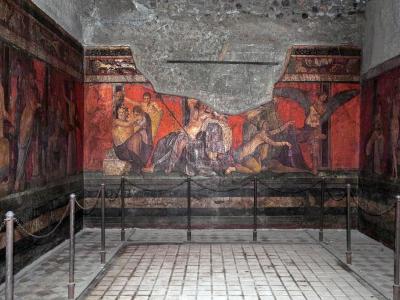
1) Villa of the Mysteries (must see)
The Villa of the Mysteries is one of the most well known buildings in the historic area around Mount Vesuvius. It is not situated within Pompei itself, lying around 500 metres northwest of the main city. Believed to be a suburban villa, which were commonplace in Roman times, it can easily be reached on foot from the centre of Pompei. Admission into the city centre will usually allow access to the villa, as well as the nearby settlement of Herculaneum.
The villa is one of the best preserved buildings in the Pompei area, as it suffered little damage during either the 62 AD earthquake or the tremors prior to the eruption of Vesuvius seventeen years later. The walls of the building are lined with some of the best kept and most detailed frescoes surviving from the Roman era. The Villa of the Mysteries earned its name from the unusual paintings on the walls of the triclinium, a formal dining hall found in most Roman villas.
The frescoes in the dining hall appear to show some form of ritual, although nobody is certain of its purpose. One theory suggests the woman pictured in the frescoes is being inducted into the cult of Dionysus. An alternative idea put forward is that the paintings show an ancient marriage ritual. The dining hall also features well preserved serving areas, which may have been used to make wine and olive oil.
The villa is one of the best preserved buildings in the Pompei area, as it suffered little damage during either the 62 AD earthquake or the tremors prior to the eruption of Vesuvius seventeen years later. The walls of the building are lined with some of the best kept and most detailed frescoes surviving from the Roman era. The Villa of the Mysteries earned its name from the unusual paintings on the walls of the triclinium, a formal dining hall found in most Roman villas.
The frescoes in the dining hall appear to show some form of ritual, although nobody is certain of its purpose. One theory suggests the woman pictured in the frescoes is being inducted into the cult of Dionysus. An alternative idea put forward is that the paintings show an ancient marriage ritual. The dining hall also features well preserved serving areas, which may have been used to make wine and olive oil.
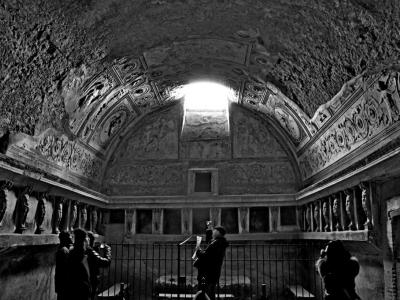
2) Forum Baths
The Forum Baths are one of four bath houses discovered in the ruined city of Pompei. Along with the Central, Stabian and Suburban Baths, they have given a fascinating insight into the importance of public baths in Roman life. With little in the way of bathing facilities found inside private dwellings, it appears that bathing in these buildings would have been a daily ritual for many citizens. The Forum Baths were not the largest or most decorated in the city, but survived the 62 AD earthquake relatively unscathed, and as a result were the only baths still in use when the city was destroyed.
The Forum Baths are located opposite the Temple of Fortuna Augusta in the centre of Pompei. Divided into men’s and women’s sections, this compact bath house contained all of the features found in larger public baths, including a frigidarium, where customers could take a cold bath. The apodyterium, or changing room, is notable for its high barrel vaulted roof, complete with a skylight. The caldarium, which contained hot baths, was heated by warm air circulated within cavities in the walls. The room also features a marble labrum bath which allows bathers to cool off after bathing.
The Forum Baths are located opposite the Temple of Fortuna Augusta in the centre of Pompei. Divided into men’s and women’s sections, this compact bath house contained all of the features found in larger public baths, including a frigidarium, where customers could take a cold bath. The apodyterium, or changing room, is notable for its high barrel vaulted roof, complete with a skylight. The caldarium, which contained hot baths, was heated by warm air circulated within cavities in the walls. The room also features a marble labrum bath which allows bathers to cool off after bathing.

3) Forum Granary (storage of artifacts)
The Forum Granary in Pompeii stands as a pivotal archaeological repository, adjacent to the Forum and the Temple of Jupiter. Originally serving as a marketplace for grain and various products, this site has transitioned into a crucial storage facility for artifacts unearthed from the ruins of Pompeii. Its proximity to significant landmarks underscores its historical and cultural significance within the ancient city.
Dating back to a period after the earthquake of 62 AD, the Forum Granary's construction hints at an ambitious project possibly halted by the devastating eruption that buried Pompeii. The building's architectural features, including eight entrances flanked by brick pillars, indicate its original use for commerce, specifically the fruit and vegetable trade known as the Forum Holitorium. However, the eruption's catastrophic impact left the building's completion in doubt, adding a layer of mystery to its historical narrative.
Today, the Forum Granary encapsulates over 9,000 artifacts, making it the largest archaeological collection related to Pompeii and its environs since excavation efforts commenced in the late 19th century. The collection extends to everyday items used by the citizens of Pompeii, such as terracotta crockery, pots, pans, jugs, and bottles, which illustrate the culinary practices of the time. Amphorae, essential for transporting staples like oil, wine, and fish sauce across the Mediterranean, highlight Pompeii's role in ancient trade networks. Additionally, marble tables and baths intended for fountains that once graced the entrances of homes are displayed, alongside casts of victims and natural elements like a tree, capturing the last moments of life in the city.
Dating back to a period after the earthquake of 62 AD, the Forum Granary's construction hints at an ambitious project possibly halted by the devastating eruption that buried Pompeii. The building's architectural features, including eight entrances flanked by brick pillars, indicate its original use for commerce, specifically the fruit and vegetable trade known as the Forum Holitorium. However, the eruption's catastrophic impact left the building's completion in doubt, adding a layer of mystery to its historical narrative.
Today, the Forum Granary encapsulates over 9,000 artifacts, making it the largest archaeological collection related to Pompeii and its environs since excavation efforts commenced in the late 19th century. The collection extends to everyday items used by the citizens of Pompeii, such as terracotta crockery, pots, pans, jugs, and bottles, which illustrate the culinary practices of the time. Amphorae, essential for transporting staples like oil, wine, and fish sauce across the Mediterranean, highlight Pompeii's role in ancient trade networks. Additionally, marble tables and baths intended for fountains that once graced the entrances of homes are displayed, alongside casts of victims and natural elements like a tree, capturing the last moments of life in the city.
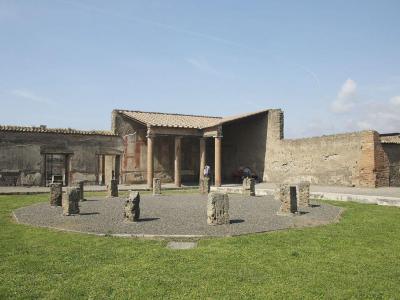
4) Macellum (Provision Market)
The Macellum of Pompei was built alongside the Forum, in order to provide further space for the city’s growing central market. The existing building was constructed in approximately 130 BC, replacing the original macellum building. Built around a central courtyard, the north and south sides both hold twelve separate units for the sale of foodstuffs.
Upon discovering the large, columned building, archaeologists at first believed it to be a pantheon – a central temple for the worship of many gods. It was only after the discovery of fish bones and jarred fruits underneath the ash that it became clear this building was used as a market. It is believed that permanent stalls were set up on the north side, hidden for much of the day from the sun. These stores sold fruit, nuts and bread, amongst other things. The stalls on the south side were used by local traders to sell meat and fish. There is a well in the centre of the courtyard, which was used by vendors to clean and gut fish.
The Macellum had three entrances – the southern entrance is notable for the checkerboard patterned wall adjacent to it. It is considered to be the finest quality wall constructed during the Roman era of Pompei. At the back of the market, there is a mysterious room, which was used as a shrine. There has been much debate over the paintings and statues found there. The latest and most widely accepted theory is that they depict Emperor Augustus Caesar, as well as local figures that commanded respect within the town.
Upon discovering the large, columned building, archaeologists at first believed it to be a pantheon – a central temple for the worship of many gods. It was only after the discovery of fish bones and jarred fruits underneath the ash that it became clear this building was used as a market. It is believed that permanent stalls were set up on the north side, hidden for much of the day from the sun. These stores sold fruit, nuts and bread, amongst other things. The stalls on the south side were used by local traders to sell meat and fish. There is a well in the centre of the courtyard, which was used by vendors to clean and gut fish.
The Macellum had three entrances – the southern entrance is notable for the checkerboard patterned wall adjacent to it. It is considered to be the finest quality wall constructed during the Roman era of Pompei. At the back of the market, there is a mysterious room, which was used as a shrine. There has been much debate over the paintings and statues found there. The latest and most widely accepted theory is that they depict Emperor Augustus Caesar, as well as local figures that commanded respect within the town.
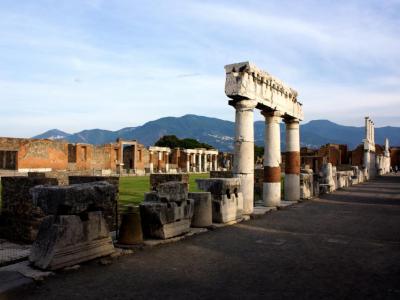
5) Forum (must see)
The Forum, a feature present in many Roman settlements, was a public space found at the centre of Pompei. It stands in the middle of a square, which contains several of the town’s most significant buildings. From the southern end of the forum, moving clockwise, there are the Basilica, the Temple of Apollo, the grain and food markets, the sanctuary, the temple of Vespasian, the building of Eumachia, and the Comitium.
It is safe to assume that the Forum was at one time the centre of Pompei. It stands on the junction of two Roman roads, linking Pompei with Naples and the nearby settlement of Stabiae. However, within the preserved ruins of the city, the Forum is found towards the outskirts. This is believed to be due to large scale development in the 2nd century BC, which moved the city centre away from the Forum.
Now a square of grass, the Forum area appears to have undergone many changes during the history of Pompei. Prior to the earthquake in 62 AD, the floor was receiving an upgrade – it is still partially paved with travertine. It is thought that a market was held in the middle of the open space. There are also a number of marble bases missing the statues that should sit upon them, and a half finished suggestum – the Roman equivalent of a soapbox for public speaking.
It is safe to assume that the Forum was at one time the centre of Pompei. It stands on the junction of two Roman roads, linking Pompei with Naples and the nearby settlement of Stabiae. However, within the preserved ruins of the city, the Forum is found towards the outskirts. This is believed to be due to large scale development in the 2nd century BC, which moved the city centre away from the Forum.
Now a square of grass, the Forum area appears to have undergone many changes during the history of Pompei. Prior to the earthquake in 62 AD, the floor was receiving an upgrade – it is still partially paved with travertine. It is thought that a market was held in the middle of the open space. There are also a number of marble bases missing the statues that should sit upon them, and a half finished suggestum – the Roman equivalent of a soapbox for public speaking.
6) Lupanar (Brothel) (must see)
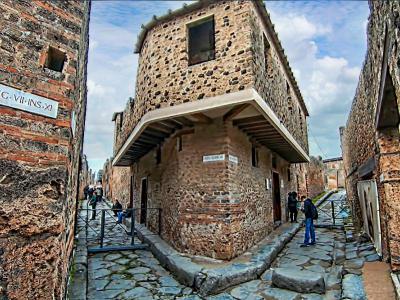
The Lupanar is the largest brothel within Pompei. It is located close to the Forum, on via del Lupanare, a street which bears its name. Whilst it has been established that prostitution was in existence during the Roman era, there has been some debate over the prevalence of brothels in a settlement like Pompei. A number of homes and bath houses in the city featured erotic artworks on their walls. Early excavators initially believed any building with erotic frescoes to have been a brothel.
When thirty five buildings with erotic artworks were discovered, it became apparent this couldn’t be the case. Further investigation has led experts to suggest that the Lupanar was the largest of ten brothels in the city, with many of the others single room establishments. The Lupanar has ten rooms, all plainly decorated, with brick platforms serving as beds. It is thought that brothels were mainly frequented by ordinary townspeople, rather than rich or well known figures. Graffiti found on the walls gives an insight into the activities that went on here. The term ‘lupanar’ is derogatory towards prostitutes – it means ‘house of the she-wolves’, a nickname given to prostitutes, who were considered predatory in Roman times.
When thirty five buildings with erotic artworks were discovered, it became apparent this couldn’t be the case. Further investigation has led experts to suggest that the Lupanar was the largest of ten brothels in the city, with many of the others single room establishments. The Lupanar has ten rooms, all plainly decorated, with brick platforms serving as beds. It is thought that brothels were mainly frequented by ordinary townspeople, rather than rich or well known figures. Graffiti found on the walls gives an insight into the activities that went on here. The term ‘lupanar’ is derogatory towards prostitutes – it means ‘house of the she-wolves’, a nickname given to prostitutes, who were considered predatory in Roman times.
7) Odeon - Teatro Piccolo (Small Theater)
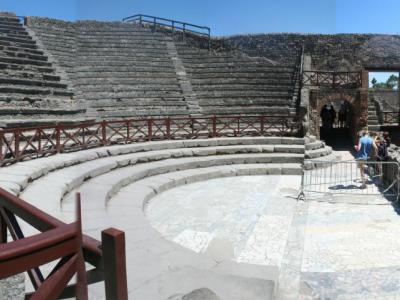
The Odeon theater in Pompeii is also known as Teatro Piccolo. Back in the Roman times, it was colloquially referred to by locals as theatrum tectum (“roofed theater”), for its four-pitched tiled roof.
The theater was built during the early years of the Roman colony, around 80-75 BC, and had a seating capacity of about 1,500. The construction was commissioned by the two local magistrates (duumvirs), Marcus Porcius and Caius Quinctius Valgus, who also facilitated the construction of the Amphitheater.
The venue was well designed for poetry recitals, operas and other musical performances, allowing every sound uttered on the stage to be heard in each part of the building. Largely adding to the acoustics was the roof. The Odeon is also said to have been used for mime shows, the most popular theatrical genre of the time.
This perfectly-balanced, Greek-style structure used to have four lower rows separated from the upper 17 rows by a high parapet, of which now only the left part (relative to the stage) has remained. It was richly decorated with multicolored marbles, whereas large male tuff figures (telamones) supported the steps. Remarkably, the plaster of the external masonry retains many graffiti left by the ancient spectators. Some of the people are believed to have traveled many miles from distant parts of the country to see the shows here.
The site was excavated in two phases, starting from 1769 and then in 1792-1795.
The theater was built during the early years of the Roman colony, around 80-75 BC, and had a seating capacity of about 1,500. The construction was commissioned by the two local magistrates (duumvirs), Marcus Porcius and Caius Quinctius Valgus, who also facilitated the construction of the Amphitheater.
The venue was well designed for poetry recitals, operas and other musical performances, allowing every sound uttered on the stage to be heard in each part of the building. Largely adding to the acoustics was the roof. The Odeon is also said to have been used for mime shows, the most popular theatrical genre of the time.
This perfectly-balanced, Greek-style structure used to have four lower rows separated from the upper 17 rows by a high parapet, of which now only the left part (relative to the stage) has remained. It was richly decorated with multicolored marbles, whereas large male tuff figures (telamones) supported the steps. Remarkably, the plaster of the external masonry retains many graffiti left by the ancient spectators. Some of the people are believed to have traveled many miles from distant parts of the country to see the shows here.
The site was excavated in two phases, starting from 1769 and then in 1792-1795.
8) Great Theater and Quadroporticus (must see)
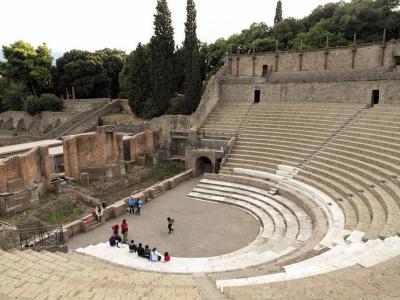
In contrast to the nearby Odeon, this venue was known as the Large Theater. It was built in the 2nd century BC, in the style of ancient Greek amphitheaters. Set in a natural indentation of the land, it features tiered stone seating on sloping sides, leading to a central horseshoe-shaped performance area.
The theater reached its peak under the reign of Augustus Caesar, being refurbished and extended by the Holconius brothers, rich wine growers from the region, who fitted the rows of seating with marble tops. Following the earthquake of 62 AD, however, the theater was damaged and the marble was removed. Simultaneously, the stage was rebuilt and a grand façade added, complete with columns and statues.
The Holconius brothers also added an upper circle and two side boxes for guests of honor. The Large Theater could hold up to 5,000 spectators within segregated seating areas. The eldest Holconius brother had his own reserved seat here, inscribed with bronze lettering. Back then, the theater was covered by a large canopy, protecting the audience from the sun. The opposite side of the amphitheater housed dressing rooms and access to the outer courtyard.
The Quadriporticus, a large four-sided courtyard, is flanked by colonnaded buildings, typical for most Roman dwellings. While there is some uncertainty over its function, it is known that portions of the complex were used as barracks for the town’s gladiators. The courtyard itself was used for their exercises, being ideally located next to the theater where gladiatorial games were held regularly. It is depicted in the ancient painting, now housed in Naples’ National Archaeological Museum, featuring a swimming pool in the center. The pool might have been covered after the site was damaged in the earthquake of 62 AD.
Graffiti carved by the gladiators in the columns of the Quadriporticus hint at public opposition to, and even condemnation of the violent games. A large quantity of gladiatorial armor found at the site, including helmets, belts and shoulder protectors, all marked with the letters NER, suggest that the gladiators came from the Neroniam, Nero’s imperial school, in nearby Capua.
The theater reached its peak under the reign of Augustus Caesar, being refurbished and extended by the Holconius brothers, rich wine growers from the region, who fitted the rows of seating with marble tops. Following the earthquake of 62 AD, however, the theater was damaged and the marble was removed. Simultaneously, the stage was rebuilt and a grand façade added, complete with columns and statues.
The Holconius brothers also added an upper circle and two side boxes for guests of honor. The Large Theater could hold up to 5,000 spectators within segregated seating areas. The eldest Holconius brother had his own reserved seat here, inscribed with bronze lettering. Back then, the theater was covered by a large canopy, protecting the audience from the sun. The opposite side of the amphitheater housed dressing rooms and access to the outer courtyard.
The Quadriporticus, a large four-sided courtyard, is flanked by colonnaded buildings, typical for most Roman dwellings. While there is some uncertainty over its function, it is known that portions of the complex were used as barracks for the town’s gladiators. The courtyard itself was used for their exercises, being ideally located next to the theater where gladiatorial games were held regularly. It is depicted in the ancient painting, now housed in Naples’ National Archaeological Museum, featuring a swimming pool in the center. The pool might have been covered after the site was damaged in the earthquake of 62 AD.
Graffiti carved by the gladiators in the columns of the Quadriporticus hint at public opposition to, and even condemnation of the violent games. A large quantity of gladiatorial armor found at the site, including helmets, belts and shoulder protectors, all marked with the letters NER, suggest that the gladiators came from the Neroniam, Nero’s imperial school, in nearby Capua.
9) House of the Ship Europa
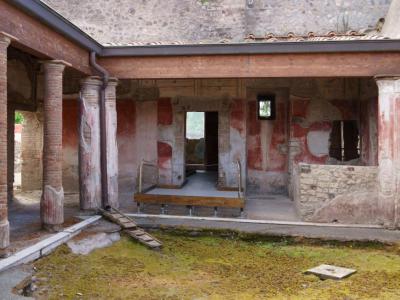
The House of the Ship Europa is found in the south east of the city. It is named after a large drawing on the north wall of the peristyle, which depicts a ship bearing the name Europa. It is not thought to be a real ship, but instead an allegory of the goddess Europa, who was kidnapped at sea by Jupiter, disguised as a bull. Beyond the peristyle lies the feature for which the house is renowned; a long, narrow garden, several times larger than the buildings at the front of the house.
This garden was used to grow an impressive array of fruits and vegetables, including beans, onions and cabbage, as well as grapes, used to produce wine. In the Roman era the production of wine was largely home based, with many houses having the facilities to press grapes. Trees bearing exotic fruits such as cherries and apricots are believed to have been planted here, having arrived from the Far East from the first century BC. Lemons were also grown here; the Romans continued the Hebrew tradition of using lemons to kill bacteria and thus fight infection. The stalls at the back of the garden were used to rear animals.
This garden was used to grow an impressive array of fruits and vegetables, including beans, onions and cabbage, as well as grapes, used to produce wine. In the Roman era the production of wine was largely home based, with many houses having the facilities to press grapes. Trees bearing exotic fruits such as cherries and apricots are believed to have been planted here, having arrived from the Far East from the first century BC. Lemons were also grown here; the Romans continued the Hebrew tradition of using lemons to kill bacteria and thus fight infection. The stalls at the back of the garden were used to rear animals.
10) Garden of Fugitives
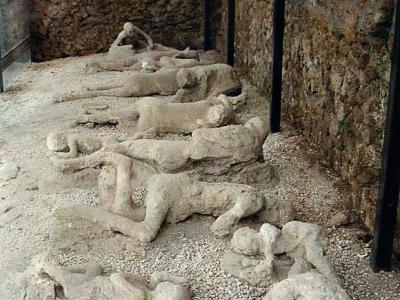
The many historical wonders of Pompei tell us much about how people lived in this ancient city. One quiet corner amongst its maze of buildings gives a poignant insight into the disaster that destroyed this city overnight. The eruption of Mount Vesuvius in 79 AD is believed to have been one of the most catastrophic volcanic events of all time. It threw a deadly cloud of ash and stone up to 20 miles into the air, and ultimately released enough thermal energy to make a hundred thousand atomic bombs. Those unable to flee Pompei, just a few miles from the volcano, were killed by lava flows that swept through the city. When the ash cloud fell to earth, it buried Pompei, and an estimated 16,000 victims of the deadly eruption.
When they began excavating Pompei in the 19th century, archaeologists began finding decomposed bodies of people and animals. By pouring plaster into air pockets left in the rubble, they were able to create casts of many victims. At the Garden of the Fugitives, an area thought to have been a small orchard, thirteen bodies were found, and their casts have been laid out as they were discovered. It is a poignant memorial to those that perished in the eruption that preserved the city for modern visitors. A woman can be seen holding her child, whilst others were clearly trying to protect themselves, in vain, from the deadly lava flow.
When they began excavating Pompei in the 19th century, archaeologists began finding decomposed bodies of people and animals. By pouring plaster into air pockets left in the rubble, they were able to create casts of many victims. At the Garden of the Fugitives, an area thought to have been a small orchard, thirteen bodies were found, and their casts have been laid out as they were discovered. It is a poignant memorial to those that perished in the eruption that preserved the city for modern visitors. A woman can be seen holding her child, whilst others were clearly trying to protect themselves, in vain, from the deadly lava flow.
11) Great Palaestra
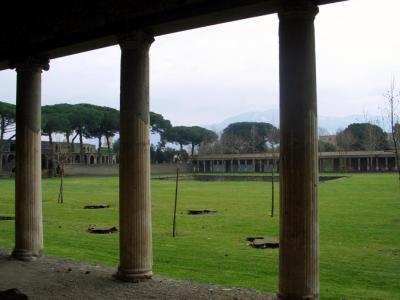
The Great Palaestra is a large rectangular building, flanked by porticoes on three sides, with a pool at its centre. Like many buildings in the city, it was commissioned under the empire of Augustus Caesar. It was used as an exercise complex by the youth associations which he set up, a Roman version of the youth branches of political parties we still see today. There was even a room, in the centre of the western portico, set aside for worship of the emperor. Behind the portico, a double row of sycamore trees provided a shaded area for attendees to relax and unwind.
The tree roots have been recreated with plaster casts. Like many natural organisms, from plant life to human beings, the roots were buried under the ash layers left by the deadly volcanic eruption, and decomposed. This left behind air pockets which were filled with plaster, creating exact replicas of the tree roots. At the time of the eruption in 79 AD the eastern portals and north wall were being restored, having been damaged in the earthquake of 62 AD. The complex even had toilet facilities – a latrine, served by water carried from the pool, can be seen on the south side of the building.
The tree roots have been recreated with plaster casts. Like many natural organisms, from plant life to human beings, the roots were buried under the ash layers left by the deadly volcanic eruption, and decomposed. This left behind air pockets which were filled with plaster, creating exact replicas of the tree roots. At the time of the eruption in 79 AD the eastern portals and north wall were being restored, having been damaged in the earthquake of 62 AD. The complex even had toilet facilities – a latrine, served by water carried from the pool, can be seen on the south side of the building.
12) Amphitheater
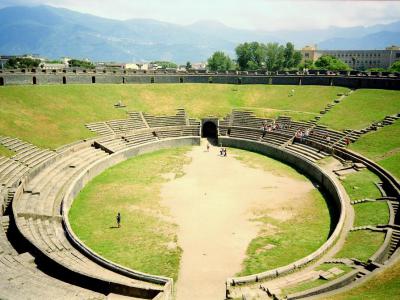
The Pompei Amphitheatre is the oldest building of its kind to have survived from the Roman era. Pompei houses many of the best preserved examples of Roman architecture, after the city was buried under volcanic ash for almost 2000 years. The Amphitheatre, one of Pompei’s most well known attractions, predates the Coliseum in Rome by over a century. It is believed that the success of the Pompei Amphitheatre, the first stone arena built within the Roman Empire, was the inspiration for a larger stone-built arena in Rome itself.
A circular structure with arches and stairways creating several entrance points, the Amphitheatre is still considered by crowd control analysts to be a near perfectly designed venue. Built around 70 BC, it was initially known as the Spectacula. Paid for by wealthy local statesmen Quinctius Valgus and Marcius Porcius, it was primarily used to host gladiatorial games and ceremonies. Twenty years before the eruption that destroyed Pompei, games were banned at the Amphitheatre, following a brawl between locals and residents of nearby Nuceria. In recent years, UK progressive rock band Pink Floyd became the first people for almost two thousand years to perform at the arena, filming a live concert here.
A circular structure with arches and stairways creating several entrance points, the Amphitheatre is still considered by crowd control analysts to be a near perfectly designed venue. Built around 70 BC, it was initially known as the Spectacula. Paid for by wealthy local statesmen Quinctius Valgus and Marcius Porcius, it was primarily used to host gladiatorial games and ceremonies. Twenty years before the eruption that destroyed Pompei, games were banned at the Amphitheatre, following a brawl between locals and residents of nearby Nuceria. In recent years, UK progressive rock band Pink Floyd became the first people for almost two thousand years to perform at the arena, filming a live concert here.
