Custom Walk in New York, New York by laurencezage_8fedfe created on 2026-03-30
Guide Location: USA » New York
Guide Type: Custom Walk
# of Sights: 12
Tour Duration: 2 Hour(s)
Travel Distance: 3.5 Km or 2.2 Miles
Share Key: UY5JT
Guide Type: Custom Walk
# of Sights: 12
Tour Duration: 2 Hour(s)
Travel Distance: 3.5 Km or 2.2 Miles
Share Key: UY5JT
How It Works
Please retrieve this walk in the GPSmyCity app. Once done, the app will guide you from one tour stop to the next as if you had a personal tour guide. If you created the walk on this website or come to the page via a link, please follow the instructions below to retrieve the walk in the app.
Retrieve This Walk in App
Step 1. Download the app "GPSmyCity: Walks in 1K+ Cities" on Apple App Store or Google Play Store.



Step 2. In the GPSmyCity app, download(or launch) the guide "New York Map and Walking Tours".
Step 3. Tap the menu button located at upper right corner of the "Walks" screen and select "Retrieve custom walk". Enter the share key: UY5JT
1) Castle Clinton & Battery Park
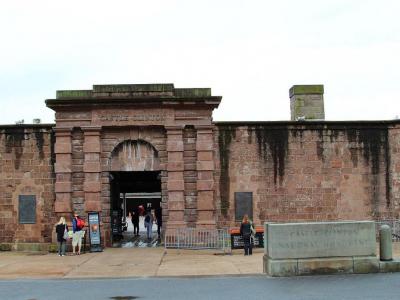
Fort Amsterdam was the first fort in Manhattan. It was built in 1626 when New York City was known by the Dutch name New Amsterdam. Fort Amsterdam was demolished in 1790, and a new fort called "West Battery" was installed at the tip of Manhattan Island in 1811.
Designed by architect John McComb Jr. with Army Colonel Jonathan Williams as a consulting engineer, West Battery was roughly circular with a radius of approximately 92 feet. It had a battery of 28 "thirty-two pounder" cannons, complementing triple-tiered Castle Williams on nearby Governors Island. A wood bridge connected the fort to the tip of lower Manhattan.
In 1815, West Battery was named Fort Clinton in honor of New York City Mayor DeWitt Clinton. The fort was garrisoned in 1812 but never used for combat. It became a popular promenade and beer garden. Later, it was an immigration center. Between 1896 and 1941, it was converted into an aquarium. Now it's a tourist center and terminal for the Statue of Liberty ferry.
The recently renovated 25-acre Battery Park has more than a few monuments and memorials, mostly located on "Monument Walk." Hope Garden is a memorial dedicated to AIDS victims. The Sphere, the world's largest bronze sculpture by German artist Fritz Koenig, was exhibited there. The Netherland Monument recalls the purchase of Manhattan Island.
Other memorials are The Memorial of the Battle of the Atlantic; The American Merchant Marine Memorial; The Immigrants; The Korean War; John Ericsson and the USS Monitor; and the Explorer Giovanni da Verrazzano statue. Battery Park is part of the Manhattan Waterfront Greenway that surrounds the entire island of Manhattan.
Designed by architect John McComb Jr. with Army Colonel Jonathan Williams as a consulting engineer, West Battery was roughly circular with a radius of approximately 92 feet. It had a battery of 28 "thirty-two pounder" cannons, complementing triple-tiered Castle Williams on nearby Governors Island. A wood bridge connected the fort to the tip of lower Manhattan.
In 1815, West Battery was named Fort Clinton in honor of New York City Mayor DeWitt Clinton. The fort was garrisoned in 1812 but never used for combat. It became a popular promenade and beer garden. Later, it was an immigration center. Between 1896 and 1941, it was converted into an aquarium. Now it's a tourist center and terminal for the Statue of Liberty ferry.
The recently renovated 25-acre Battery Park has more than a few monuments and memorials, mostly located on "Monument Walk." Hope Garden is a memorial dedicated to AIDS victims. The Sphere, the world's largest bronze sculpture by German artist Fritz Koenig, was exhibited there. The Netherland Monument recalls the purchase of Manhattan Island.
Other memorials are The Memorial of the Battle of the Atlantic; The American Merchant Marine Memorial; The Immigrants; The Korean War; John Ericsson and the USS Monitor; and the Explorer Giovanni da Verrazzano statue. Battery Park is part of the Manhattan Waterfront Greenway that surrounds the entire island of Manhattan.
2) Bowling Green Park
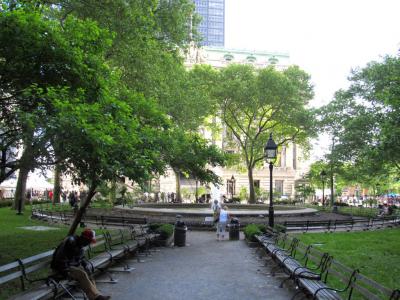
Bowling Green is a small public park in the Financial District of Lower Manhattan. It was an area of public use since Dutch colonial days when it was also home of Fort New Amsterdam. The place was officially designated as a park in 1733.
Enclosed in its 18th-century iron fence, Bowling Green is the oldest park in New York City. The park actually was a bowling green early on and it had a statue of King George III on horseback. George came down with the American Revolution.
Bowling Green was a notable historical site. There was a settlement of the indigenous Lenape people at the end of the Wickquasgeck Trail, which later became Broadway. It was at the site of Bowling Green where the Dutch colonial governor of New Amsterdam, Peter Minuit, bought Manhattan Island from the Lenape in 1626. Minuit paid a grand total of $24 worth of trinkets for the purchase.
In the early years, elegant federal-style townhouses were built around the park. President George Washington resided at the Alexander Macomb House, on the north of the park at 39-41 Broadway. Washington lived in the house from February 23 to August 30, 1790, when the U.S. capital was moved to Philadelphia.
The park is an elliptical plaza. There is a large fountain in the center of the fenced-in lawn. A bronze sculpture of a "Charging Bull," designed by artist Arturo Di Modica, weighs 7,000 pounds. "Fearless Girl," by sculptor Kristen Visbal, faced off against the bull until she was moved in 2017 to face off against the New York Stock Exchange.
Enclosed in its 18th-century iron fence, Bowling Green is the oldest park in New York City. The park actually was a bowling green early on and it had a statue of King George III on horseback. George came down with the American Revolution.
Bowling Green was a notable historical site. There was a settlement of the indigenous Lenape people at the end of the Wickquasgeck Trail, which later became Broadway. It was at the site of Bowling Green where the Dutch colonial governor of New Amsterdam, Peter Minuit, bought Manhattan Island from the Lenape in 1626. Minuit paid a grand total of $24 worth of trinkets for the purchase.
In the early years, elegant federal-style townhouses were built around the park. President George Washington resided at the Alexander Macomb House, on the north of the park at 39-41 Broadway. Washington lived in the house from February 23 to August 30, 1790, when the U.S. capital was moved to Philadelphia.
The park is an elliptical plaza. There is a large fountain in the center of the fenced-in lawn. A bronze sculpture of a "Charging Bull," designed by artist Arturo Di Modica, weighs 7,000 pounds. "Fearless Girl," by sculptor Kristen Visbal, faced off against the bull until she was moved in 2017 to face off against the New York Stock Exchange.
3) Alexander Hamilton U.S. Customs House
In 1899, Supervising Architect of the Treasury James Knox Taylor invited twenty firms to compete for the commission of the new U.S. Customs House in New York City. Architect Cass Gilbert won the project.
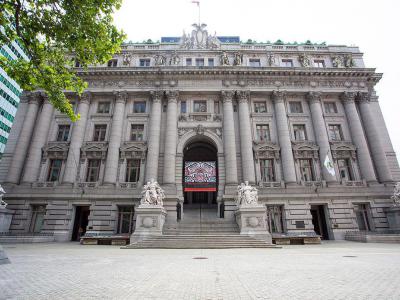
Gilbert's design reflected the aesthetic ideas of the "City Beautiful Movement," themes of patriotism and urbanity. Constructed in 1907, the seven-story building has three-story Corinthian columns. The fifth story is wrapped with an enormous entablature frieze. The seventh story is covered by the mansard roof. Enclosed pediments mark the second-floor windows.
The main entrance consists of a grand staircase flanked by four female statues representing America, Asia, Europe, and Africa, by sculptor Daniel Chester French. Above the columns on the facade are twelve marble figures of maritime nations. Over the windows are heads showing the "eight races" of humanity.
The interior is based on a square plan with a central rotunda surrounded by corridors. The ceremonial Great Hall on the second floor is finished in marble colors and textures. There are curved staircases at both ends with bronze railings, marble treads, and risers. Rooms are decorated with nautical motifs and items.
Ceiling murals by American painter Reginald Marsh show ships entering the harbor. The three-story rotunda is the masterpiece of Spanish engineer Raphael Guastavino.
The Custom House was renamed in 1990 to commemorate Alexander Hamilton, one of the Founding Fathers of the United States and its first Secretary of the Treasure. The building was designated a National Historic Landmark in 1976.
Gilbert's design reflected the aesthetic ideas of the "City Beautiful Movement," themes of patriotism and urbanity. Constructed in 1907, the seven-story building has three-story Corinthian columns. The fifth story is wrapped with an enormous entablature frieze. The seventh story is covered by the mansard roof. Enclosed pediments mark the second-floor windows.
The main entrance consists of a grand staircase flanked by four female statues representing America, Asia, Europe, and Africa, by sculptor Daniel Chester French. Above the columns on the facade are twelve marble figures of maritime nations. Over the windows are heads showing the "eight races" of humanity.
The interior is based on a square plan with a central rotunda surrounded by corridors. The ceremonial Great Hall on the second floor is finished in marble colors and textures. There are curved staircases at both ends with bronze railings, marble treads, and risers. Rooms are decorated with nautical motifs and items.
Ceiling murals by American painter Reginald Marsh show ships entering the harbor. The three-story rotunda is the masterpiece of Spanish engineer Raphael Guastavino.
The Custom House was renamed in 1990 to commemorate Alexander Hamilton, one of the Founding Fathers of the United States and its first Secretary of the Treasure. The building was designated a National Historic Landmark in 1976.
4) Fraunces Tavern
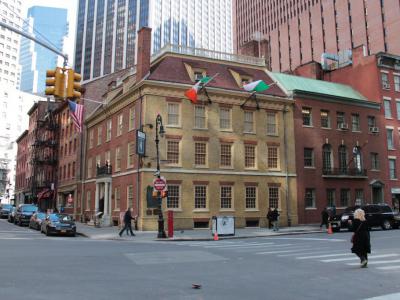
Fraunces Tavern is a landmark museum and a restaurant in the Financial District of Lower Manhattan, sitting on the corner of Broad Street and Pearl Street. Opened in 1762 by restauranteur Samuel Fraunces, this location features much of the revolutionary history of New York before, during, and after the American Revolution. It was once the headquarters for George Washington, a venue for peace negotiations with the British, and a federal office in the Early Republic.
On the inside, Fraunces happens to be bigger than it looks on the outside. Whilst here, you may wish to see the lobby frequented by the likes of George Washington during the American Revolution or the Long Room, where Washington and his officers gathered for a “turtle feast” dinner on December 4, 1783, to celebrate British withdrawal from New York.
George Washington himself was a big fan of Fraunces’ cooking and even made the innkeeper his presidential steward. He generally liked taverns and booze and even named his three dogs Tipsy, Tippler, and Drunkard. As part of the American Whiskey Trail and the New York Freedom Trail, Fraunces is a must-go tourist site for history, whiskey, and beer lovers.
The whiskey bar has the best selection in the city, and the tavern’s beer selection is well-stocked. The restaurant serves a traditional American menu, offering meatloaf, steak, various sandwiches, and salads, plus desserts. The steak, Fillet Mignon on a Stone, is highly recommended!
The museum tells the story of the building, along with varied exhibitions of art and artifacts.
On the inside, Fraunces happens to be bigger than it looks on the outside. Whilst here, you may wish to see the lobby frequented by the likes of George Washington during the American Revolution or the Long Room, where Washington and his officers gathered for a “turtle feast” dinner on December 4, 1783, to celebrate British withdrawal from New York.
George Washington himself was a big fan of Fraunces’ cooking and even made the innkeeper his presidential steward. He generally liked taverns and booze and even named his three dogs Tipsy, Tippler, and Drunkard. As part of the American Whiskey Trail and the New York Freedom Trail, Fraunces is a must-go tourist site for history, whiskey, and beer lovers.
The whiskey bar has the best selection in the city, and the tavern’s beer selection is well-stocked. The restaurant serves a traditional American menu, offering meatloaf, steak, various sandwiches, and salads, plus desserts. The steak, Fillet Mignon on a Stone, is highly recommended!
The museum tells the story of the building, along with varied exhibitions of art and artifacts.
5) Wall Street
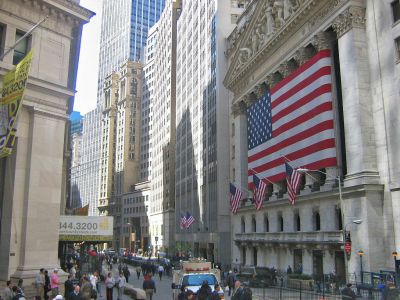
In the days of New Amsterdam, Wall Street was known in Dutch as "de Waalstraat." The origin of the name varies. It might refer to the Walloon people from the Netherlands who settled around there. Or, the name connects with Peter Minuit, the Governor of the colony, who was a Walloon. Another theory holds that there was a wall or rampart of wood on the northern end of New Amsterdam. It was removed in 1699.
Wall Street covers an eight-block stretch of lower Manhattan. Broadway crosses at the west end and South Street at the East River end. Whether the name was for a wall or a Walloon, Wall Street today stands for the financial markets of the United States. In these short eight blocks is a major financial center of the world.
In the late 1700s, there was a buttonwood tree growing on Wall Street where traders would meet regularly under the buttonwood tree to trade shares. In 1792 they created the Buttonwood Agreement, forming the association that became known as the New York Stock Exchange.
The Brutalist and Bauhaus Post-Modern Craze architectural styles largely bypassed the Wall Street area. The buildings here are more venerable, products of the Gilded Age architecture. Facades, even on the tallest buildings, are more elaborate.
Wall Street landmarks include The Federal Hall National Memorial; 55 Wall Street, the former National City Bank Building; the former Customs House; 14 Wall Street, a 32-story Skyscraper with a stepped pyramid; the New York Stock Exchange Building on Broad Street; the Irving Trust Company Building, a 50-story Skyscraper; and the famous "House of Morgan" on 60 Wall Street.
Beginning in the vaunted Gilded Age, Wall Street has become an icon of a country developed by a system of capitalism, trade, and innovative ventures in business.
Wall Street covers an eight-block stretch of lower Manhattan. Broadway crosses at the west end and South Street at the East River end. Whether the name was for a wall or a Walloon, Wall Street today stands for the financial markets of the United States. In these short eight blocks is a major financial center of the world.
In the late 1700s, there was a buttonwood tree growing on Wall Street where traders would meet regularly under the buttonwood tree to trade shares. In 1792 they created the Buttonwood Agreement, forming the association that became known as the New York Stock Exchange.
The Brutalist and Bauhaus Post-Modern Craze architectural styles largely bypassed the Wall Street area. The buildings here are more venerable, products of the Gilded Age architecture. Facades, even on the tallest buildings, are more elaborate.
Wall Street landmarks include The Federal Hall National Memorial; 55 Wall Street, the former National City Bank Building; the former Customs House; 14 Wall Street, a 32-story Skyscraper with a stepped pyramid; the New York Stock Exchange Building on Broad Street; the Irving Trust Company Building, a 50-story Skyscraper; and the famous "House of Morgan" on 60 Wall Street.
Beginning in the vaunted Gilded Age, Wall Street has become an icon of a country developed by a system of capitalism, trade, and innovative ventures in business.
6) Federal Hall
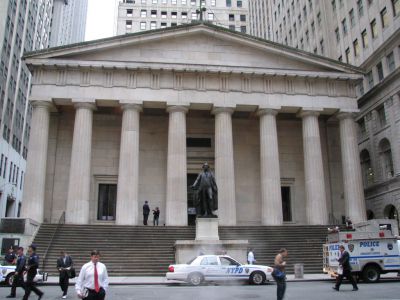
The original Federal Hall at 28 Wall Street in Lower Manhattan was built in 1703. It replaced the old Stadt Huys, the first city hall in New York City, built in the 17th century during Dutch colonial times. The new structure was used as a city hall, a library, a firehouse, and a debtors prison. The Stamp Act Congress and the Continental Congress met there. The inauguration of George Washington as the first President of the United States was held on April 30, 1789, on the balcony of Federal Hall.
The Federal Hall, demolished in 1812, was replaced by the Greek Revival-style Federal Hall. The new building, designed by architects Ithiel Town and Alexander J. Davis, was completed in 1842. The neoclassical edifice served as the U.S. Customs House and eventually the U.S. Sub-Treasury. It is today the Federal Hall National Memorial.
The building has a rotunda dome by sculptor John Frazee. The Greek Revival structure is built with Tuckahoe marble. The 18 steps of the main entrance are five-foot granite blocks. A large bronze sculpture of George Washington by sculptor John Quincy Adams Ward is installed on the front steps. The statue was unveiled in 1883 to commemorate the first inauguration of George Washington.
Doric colonnades hold up a triangular pediment. There are flat pilasters on the Nassau Street facade. The rotunda is 60 feet in diameter. It is an amphiprostyle with balconies. The wall of the rotunda has four sections, each containing four columns. A saucer dome tops the rotunda, covered with a circular skylight. The floor has marble blocks in a circular pattern. A stone in the center marks the spot where Washington once stood.
Federal Hall operates as a national memorial. It has tourist information about the monuments and parks in the New York Harbor area and a New York City tourism information center. The memorial has several exhibits open to the public. The gift shop has colonial and early American items for sale.
The Federal Hall, demolished in 1812, was replaced by the Greek Revival-style Federal Hall. The new building, designed by architects Ithiel Town and Alexander J. Davis, was completed in 1842. The neoclassical edifice served as the U.S. Customs House and eventually the U.S. Sub-Treasury. It is today the Federal Hall National Memorial.
The building has a rotunda dome by sculptor John Frazee. The Greek Revival structure is built with Tuckahoe marble. The 18 steps of the main entrance are five-foot granite blocks. A large bronze sculpture of George Washington by sculptor John Quincy Adams Ward is installed on the front steps. The statue was unveiled in 1883 to commemorate the first inauguration of George Washington.
Doric colonnades hold up a triangular pediment. There are flat pilasters on the Nassau Street facade. The rotunda is 60 feet in diameter. It is an amphiprostyle with balconies. The wall of the rotunda has four sections, each containing four columns. A saucer dome tops the rotunda, covered with a circular skylight. The floor has marble blocks in a circular pattern. A stone in the center marks the spot where Washington once stood.
Federal Hall operates as a national memorial. It has tourist information about the monuments and parks in the New York Harbor area and a New York City tourism information center. The memorial has several exhibits open to the public. The gift shop has colonial and early American items for sale.
7) Trinity Church
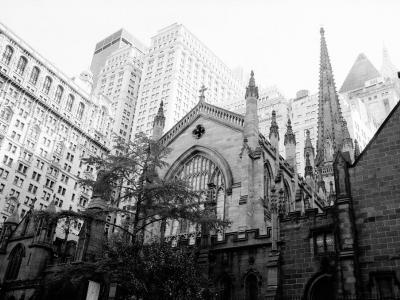
Trinity Church is a traditional high church located not far from the intersection of Wall Street and Broadway in Lower Manhattan. Renowned for its storied past and endowment, this historic temple has been around since the late 17th century.
Originally built in 1698, the church had been remodeled three times until the current edifice came in 1846. Over the centuries, the Manhattan Trinity Church has held an important place in American history. During the American Revolution, it served as the British headquarters before being destroyed by the Great Fire of New York in 1776. The replacement building was completed in 1790 and saw many of the Nation's Founding Fathers, including Alexander Hamilton and John Jay, attending services. President Washington and members of his government often worshiped there.
The burial grounds outside the church are a who's who of the early days of the Nation. Alexander Hamilton is buried here alongside his wife and son. Hamilton was the Nation's first Secretary of the Treasury after George Washington was elected president in 1789. Following Washington's death in December 1799, for a brief period, he was also the most senior-ranking officer in the U.S. Army until his retirement a year later.
Among other notable figures buried at Trinity are William Bradford (English printer, often referred to as "the pioneer printer of the Middle colonies"), Robert Fulton (American engineer and inventor of commercial steamboat), William Alexander (also known as Lord Stirling, a Scottish-American major general during the American Revolutionary War), Francis Lewis (a signer of the United States Declaration of Independence as a representative of New York), Hercules Mulligan (Irish-American tailor and spy during the American Revolutionary War), Edward Irving Koch (the mayor of New York City from 1978 to 1989), and others. Remarkably, the Trinity Church graveyard is also the only cemetery in Manhattan still in service.
Originally built in 1698, the church had been remodeled three times until the current edifice came in 1846. Over the centuries, the Manhattan Trinity Church has held an important place in American history. During the American Revolution, it served as the British headquarters before being destroyed by the Great Fire of New York in 1776. The replacement building was completed in 1790 and saw many of the Nation's Founding Fathers, including Alexander Hamilton and John Jay, attending services. President Washington and members of his government often worshiped there.
The burial grounds outside the church are a who's who of the early days of the Nation. Alexander Hamilton is buried here alongside his wife and son. Hamilton was the Nation's first Secretary of the Treasury after George Washington was elected president in 1789. Following Washington's death in December 1799, for a brief period, he was also the most senior-ranking officer in the U.S. Army until his retirement a year later.
Among other notable figures buried at Trinity are William Bradford (English printer, often referred to as "the pioneer printer of the Middle colonies"), Robert Fulton (American engineer and inventor of commercial steamboat), William Alexander (also known as Lord Stirling, a Scottish-American major general during the American Revolutionary War), Francis Lewis (a signer of the United States Declaration of Independence as a representative of New York), Hercules Mulligan (Irish-American tailor and spy during the American Revolutionary War), Edward Irving Koch (the mayor of New York City from 1978 to 1989), and others. Remarkably, the Trinity Church graveyard is also the only cemetery in Manhattan still in service.
8) National September 11 Memorial & Museum (must see)
September 11, 2001, Tuesday morning, 7 am. Flights were bound from New York to points west. By 8:45 am an American Airlines Boeing 767 slammed into the north tower of the World Trade Center. Less than 20 minutes later, another 767 hit the south tower. The Twin Towers collapsed in flames and 2,977 people died. This day would never be forgotten.
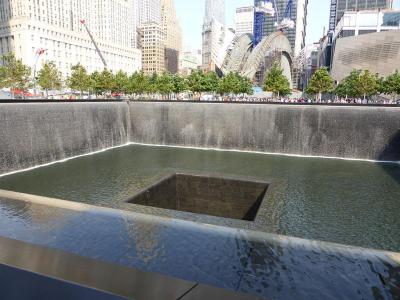
The National September 11 Memorial & Museum is a memorial and museum in New York City commemorating the September 11, 2001, and the 1993 World Trade Center bombing attacks. By November 2003, the memorial design project had been awarded to architect Michael Arad and landscape architect Peter Walker. Their memorial is called "Reflecting Absence." It is a forest of white oak trees surrounding two recessed pools formed by the footprints of the Twin Towers.
The park is level with the street. The names of victims who died from the attacks, including the 1993 bombing, are inscribed on parapets around the waterfalls. The waterfalls are intended to mute outside noises and create a meditative atmosphere at the site.
A callery pear tree that survived, called the "Survivor Tree," was replanted at the World Trade Center. It is thriving. Six other "survivor" pear trees and linden trees have been planted at other sites.
The "Memorial Glade" is a path that follows a temporary ramp used by first responders. It has six enormous stones that jut up through the ground as if violently pushed. The stones simply "strength and resistance."
The September 11 Museum at the site opened in May 2014. It has a collection of over 40,000 images, 14,000 artifacts, and about 3,500 recordings, including 500 hours of videos. There are steel items from the towers, such as the "Last Column." The museum is designed by the architectural firm Davis Brody Bond. It is 70 feet underground, accessible through a pavilion.
The pavilion follows a deconstructivist design, resembling collapsed buildings. Two "tridents" from the towers are inside. One of the museum walls is the old "slurry" wall holding back the Hudson River. The bodies of 1,115 victims were moved to a bedrock crypt space as part of the museum.
The National September 11 Memorial & Museum is a memorial and museum in New York City commemorating the September 11, 2001, and the 1993 World Trade Center bombing attacks. By November 2003, the memorial design project had been awarded to architect Michael Arad and landscape architect Peter Walker. Their memorial is called "Reflecting Absence." It is a forest of white oak trees surrounding two recessed pools formed by the footprints of the Twin Towers.
The park is level with the street. The names of victims who died from the attacks, including the 1993 bombing, are inscribed on parapets around the waterfalls. The waterfalls are intended to mute outside noises and create a meditative atmosphere at the site.
A callery pear tree that survived, called the "Survivor Tree," was replanted at the World Trade Center. It is thriving. Six other "survivor" pear trees and linden trees have been planted at other sites.
The "Memorial Glade" is a path that follows a temporary ramp used by first responders. It has six enormous stones that jut up through the ground as if violently pushed. The stones simply "strength and resistance."
The September 11 Museum at the site opened in May 2014. It has a collection of over 40,000 images, 14,000 artifacts, and about 3,500 recordings, including 500 hours of videos. There are steel items from the towers, such as the "Last Column." The museum is designed by the architectural firm Davis Brody Bond. It is 70 feet underground, accessible through a pavilion.
The pavilion follows a deconstructivist design, resembling collapsed buildings. Two "tridents" from the towers are inside. One of the museum walls is the old "slurry" wall holding back the Hudson River. The bodies of 1,115 victims were moved to a bedrock crypt space as part of the museum.
9) One World Observatory (must see)
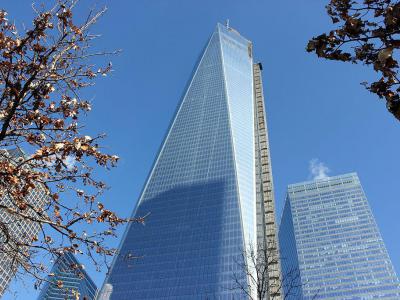
One World Trade Center in lower Manhattan is a highly reflective, elegant steel and glass wedge tapering skyward for 1,776 feet which is a reminder of the year of U.S. Independence. Designed by architect David Childs, One World Trade Center replaces the Towers lost in the attack of September 9, 2001. It is presently the tallest tower in North America.
The Observatory is located on the 100th, 101st, and 102nd floors of One World Trade Center. It is a three-story observation deck perched 1,268 feet above street level, offering views of New York City's iconic sights, surrounding waters, and skyline. Visitors and tenants each have their entrances to the building. The viewing deck of the center is on the 100th floor. The 101st floor houses a food court. The 102nd floor is an events venue.
Visitors can explore the various levels of the observatory, filled with interactive and inspirational displays. City Pulse, an interactive tool provided by Tour Ambassadors, gives visitors information about New York, its facts, and its legends. There is an admission charge with discounts for children and seniors. Admission is free for 9/11 responders and victims' families.
One World Observatory features a restaurant, a cafe, and a bar with sprawling views of the New York City skyline. The cafe is called "One Cafe," the bar and "small plates" grill are called "One Mix," and for more ambitious diners is a restaurant "One Dining." One is the name for all three places. To enter the restaurant, purchase a full Observatory ticket is required.
The Observatory is located on the 100th, 101st, and 102nd floors of One World Trade Center. It is a three-story observation deck perched 1,268 feet above street level, offering views of New York City's iconic sights, surrounding waters, and skyline. Visitors and tenants each have their entrances to the building. The viewing deck of the center is on the 100th floor. The 101st floor houses a food court. The 102nd floor is an events venue.
Visitors can explore the various levels of the observatory, filled with interactive and inspirational displays. City Pulse, an interactive tool provided by Tour Ambassadors, gives visitors information about New York, its facts, and its legends. There is an admission charge with discounts for children and seniors. Admission is free for 9/11 responders and victims' families.
One World Observatory features a restaurant, a cafe, and a bar with sprawling views of the New York City skyline. The cafe is called "One Cafe," the bar and "small plates" grill are called "One Mix," and for more ambitious diners is a restaurant "One Dining." One is the name for all three places. To enter the restaurant, purchase a full Observatory ticket is required.
10) St. Paul's Chapel
Saint Paul's Chapel is an Episcopal church on the Columbia University campus. It was a gift to the campus from sisters Caroline Phelps Stokes and Olivia Egleston Phelps Stokes.
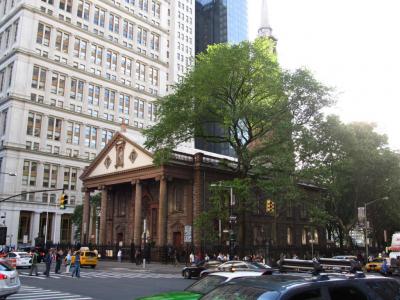
Construction of the church began in 1903 and was completed in 1907. It was designed by I.N. Phelps Stokes, nephew of the sisters who gifted the building to the campus. The church is influenced by a myriad of architectural styles, including Northern Italian Renaissance Revival, Byzantine and Gothic.
Saint Paul's Chapel has a number of unique features in its interior. The 91-foot tall dome has 16 stained-glass windows that display coats of arms belonging to distinguished graduates.
Memorial tablets are also installed throughout the chapel. They are placed in honor of teachers and administrators, including Seth Low, the former college president, who was instrumental in moving Columbia University to Morningside Heights.
Saint Paul's Chapel has often been recognized in popular culture. The Simon & Garfunkel classic "The Boxer" was partially recorded here. It was also featured in the Barbra Streisand film "The Mirror Has Two Faces."
Construction of the church began in 1903 and was completed in 1907. It was designed by I.N. Phelps Stokes, nephew of the sisters who gifted the building to the campus. The church is influenced by a myriad of architectural styles, including Northern Italian Renaissance Revival, Byzantine and Gothic.
Saint Paul's Chapel has a number of unique features in its interior. The 91-foot tall dome has 16 stained-glass windows that display coats of arms belonging to distinguished graduates.
Memorial tablets are also installed throughout the chapel. They are placed in honor of teachers and administrators, including Seth Low, the former college president, who was instrumental in moving Columbia University to Morningside Heights.
Saint Paul's Chapel has often been recognized in popular culture. The Simon & Garfunkel classic "The Boxer" was partially recorded here. It was also featured in the Barbra Streisand film "The Mirror Has Two Faces."
11) City Hall Park
While Boston and Philadelphia are thoroughly steeped in revolutionary history, New York’s contribution to the American independence is little noted despite the greatest price it had paid in terms of death and human suffering. Part of New York’s revolutionary heritage is closely associated with City Hall Park, a public park surrounding New York City Hall in the Civic Center of Lower Manhattan. During the Revolutionary era this part of the city was the site of many rallies and movements.
The Declaration of Independence may well have been enacted in Philadelphia, but the first soldiers rising bravely to the defense of American liberty were in New York. On July 9, 1776, the word of the newly signed Declaration reached George Washington, upon which he gathered his men on the New York Common, now City Hall Park, and had the Declaration read out to them, exhorting the troops to be worthy of the newly independent nation whose uniform they wore.
The very first blood of struggle for the cause was shed on the New York Common. On August 11, 1766, the Sons of Liberty, a secret revolutionary organization advancing the rights of European colonists in American Colonies, erected the first Liberty Pole featuring the word “Liberty” outside the barracks of the British occupation force. Although the British soldiers had it chopped down, the post was repeatedly replaced – five times in total. A replica dating to 1921 now stands near its original location between City Hall and Broadway. On November 9, 1783, after the American troops recaptured the Civic Center, George Washington raised the American flag in the park for the first time.
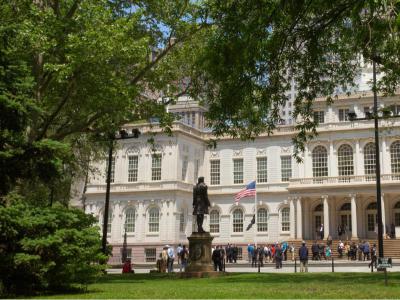
Also, the park houses a monument honoring America's most famous Revolutionary-era martyr, Nathan Hale, a 21-year-old American spy. A graceful, 13-foot bronze statue set upon a granite base, facing the City Hall directly, illustrates the last moments of the hero shackled and bound. The statue is inscribed with the last words he had uttered prior to being hung by the British, "I only regret that I have but one life to lose for my country."
The Declaration of Independence may well have been enacted in Philadelphia, but the first soldiers rising bravely to the defense of American liberty were in New York. On July 9, 1776, the word of the newly signed Declaration reached George Washington, upon which he gathered his men on the New York Common, now City Hall Park, and had the Declaration read out to them, exhorting the troops to be worthy of the newly independent nation whose uniform they wore.
The very first blood of struggle for the cause was shed on the New York Common. On August 11, 1766, the Sons of Liberty, a secret revolutionary organization advancing the rights of European colonists in American Colonies, erected the first Liberty Pole featuring the word “Liberty” outside the barracks of the British occupation force. Although the British soldiers had it chopped down, the post was repeatedly replaced – five times in total. A replica dating to 1921 now stands near its original location between City Hall and Broadway. On November 9, 1783, after the American troops recaptured the Civic Center, George Washington raised the American flag in the park for the first time.
Also, the park houses a monument honoring America's most famous Revolutionary-era martyr, Nathan Hale, a 21-year-old American spy. A graceful, 13-foot bronze statue set upon a granite base, facing the City Hall directly, illustrates the last moments of the hero shackled and bound. The statue is inscribed with the last words he had uttered prior to being hung by the British, "I only regret that I have but one life to lose for my country."
12) South Street Seaport
In the relentless pursuit of bigger and better, New York has followed a pattern of construction, demolition, and grander reconstruction, striving to become the largest, most exceptional entity in the Western Hemisphere. Amidst this trend, the South Street Seaport stands as a peculiar and endearing anomaly in Lower Manhattan. Its collection of historic ships and well-preserved nineteenth-century buildings transports visitors back to the city's mercantile and shipping past, with a distinct charm to it all.
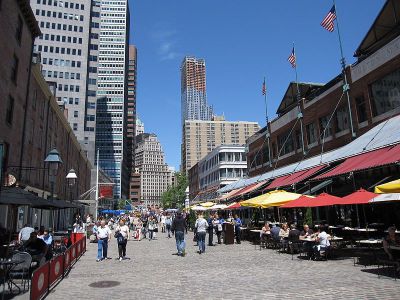
Initially, one might mistake the South Street Seaport for a mere shopping mall, with its cobblestone pedestrian areas lined by chain stores. However, following the transformative impact of Superstorm Sandy, the area has undergone significant physical and spiritual changes. Today, the Seaport has been rebranded as a hub for temporary container ship installations, artisanal vendors from Brooklyn, and a venue for live events.
Driving this revitalization is the Howard Hughes Corporation, aiming to shake up what was once a sleepy and, frankly, stagnant part of Lower Manhattan. For now, the South Street Seaport deserves all the support it can garner. Enjoy delectable sushi rolls at SUteiShi, conveniently located across the street, while recognizing the resilience of Barbalu's owners in the face of adversity.
Initially, one might mistake the South Street Seaport for a mere shopping mall, with its cobblestone pedestrian areas lined by chain stores. However, following the transformative impact of Superstorm Sandy, the area has undergone significant physical and spiritual changes. Today, the Seaport has been rebranded as a hub for temporary container ship installations, artisanal vendors from Brooklyn, and a venue for live events.
Driving this revitalization is the Howard Hughes Corporation, aiming to shake up what was once a sleepy and, frankly, stagnant part of Lower Manhattan. For now, the South Street Seaport deserves all the support it can garner. Enjoy delectable sushi rolls at SUteiShi, conveniently located across the street, while recognizing the resilience of Barbalu's owners in the face of adversity.
