Custom Walk in Athens, Greece by rehana_stover_7ec782 created on 2026-03-30
Guide Location: Greece » Athens
Guide Type: Custom Walk
# of Sights: 10
Tour Duration: 3 Hour(s)
Travel Distance: 6 Km or 3.7 Miles
Share Key: M4D7Q
Guide Type: Custom Walk
# of Sights: 10
Tour Duration: 3 Hour(s)
Travel Distance: 6 Km or 3.7 Miles
Share Key: M4D7Q
How It Works
Please retrieve this walk in the GPSmyCity app. Once done, the app will guide you from one tour stop to the next as if you had a personal tour guide. If you created the walk on this website or come to the page via a link, please follow the instructions below to retrieve the walk in the app.
Retrieve This Walk in App
Step 1. Download the app "GPSmyCity: Walks in 1K+ Cities" on Apple App Store or Google Play Store.



Step 2. In the GPSmyCity app, download(or launch) the guide "Athens Map and Walking Tours".
Step 3. Tap the menu button located at upper right corner of the "Walks" screen and select "Retrieve custom walk". Enter the share key: M4D7Q
1) Ancient Agora of Athens (must see)
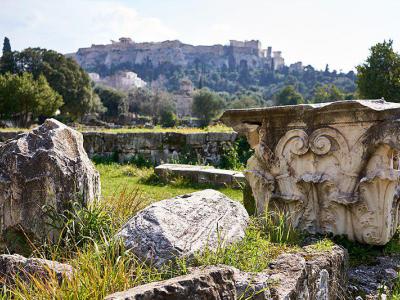
The ancient Agora of Athens sits beneath the revered hill of the Acropolis. This sprawling site contains the remnants of what was once a vast and intricate marketplace complex. In ancient times, the Agora served as the beating heart of public life in the city-state of Athens. Numerous administrative buildings, temples, altars, and roofed shopping arcades known as 'stoas', as well as fountains were constructed around the open square, which took its final shape in the 2nd century AD. Common citizens would gather here to engage in political discussions and participate in the voting process for proposed laws. It was within the Agora council buildings, law courts, and streets that democracy took root and thrived.
In 507 BC, Athenian leader Cleisthenes introduced a system of political reforms which he termed "demokratia", or the "rule of the people". This consisted of three distinct institutions, such as the "ekklesia", a sovereign governing body responsible for drafting laws and shaping foreign policy; the "boule", a council of representatives from the ten Athenian tribes; and the "dikasteria" – popular courts where citizens presented cases to a panel of randomly selected jurors. Although Athenian democracy lasted only two centuries, it stands as one of ancient Greece's most enduring legacies to the modern world.
Beyond its role as the city's political center, the Agora also served as a venue for religious ceremonies, commercial transactions, theatrical and musical shows, and even athletic competitions. The city mint producing Athens' silver currency was here, just as the state prison in which philosopher Socrates was executed in 399 BC.
Tips:
Admission to the on-site museum is included in the Agora ticket. Water fountains and restrooms are conveniently located nearby.
The site also features a well-marked ancient temple complete with the remains of the ancient drainage system.
In 507 BC, Athenian leader Cleisthenes introduced a system of political reforms which he termed "demokratia", or the "rule of the people". This consisted of three distinct institutions, such as the "ekklesia", a sovereign governing body responsible for drafting laws and shaping foreign policy; the "boule", a council of representatives from the ten Athenian tribes; and the "dikasteria" – popular courts where citizens presented cases to a panel of randomly selected jurors. Although Athenian democracy lasted only two centuries, it stands as one of ancient Greece's most enduring legacies to the modern world.
Beyond its role as the city's political center, the Agora also served as a venue for religious ceremonies, commercial transactions, theatrical and musical shows, and even athletic competitions. The city mint producing Athens' silver currency was here, just as the state prison in which philosopher Socrates was executed in 399 BC.
Tips:
Admission to the on-site museum is included in the Agora ticket. Water fountains and restrooms are conveniently located nearby.
The site also features a well-marked ancient temple complete with the remains of the ancient drainage system.
2) Kerameikos Ancient Cemetery
If ancient Athens had a VIP section for the dearly departed, Kerameikos would be it. Now, before you start picturing some dusty ruins with a few sad stones, let’s set the record straight-this place is an oasis. Really. Thanks to the lush Iridhanós stream decorated with water lilies, which lazily meanders through the site, it makes it feel more like a secret garden than a burial ground.
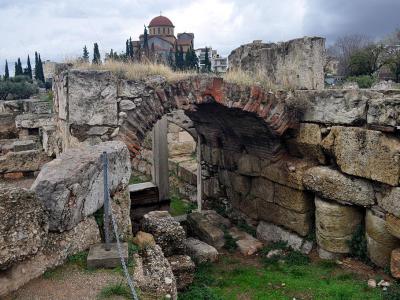
As you enter, glance to your right. There’s the impressive double line of the city wall. Ancient Athens wasn’t an open-door policy kind of town-two major roads once sliced through these defenses, each with its own grand gate-now unearthed through excavations.
First up, the Dipylon Gate, the city’s busiest entrance in its heyday. If ancient Athenians had morning traffic, this is where it all happened-the hustle and bustle of traders, travelers, and festival-goers pouring in from Piraeus, Eleusis, and the north. Then, there’s the Sacred Gate, which wasn’t just a fancy name-it had a VIP role, welcoming the famous Eleusinian and Panathenaic processions into the city, which were basically parades of the gods.
Wander left from the Sacred Way, and you’ll find the Street of the Tombs, where Classical Athens put its best funerary art on display. Expect a mix of solemn ancient headstones and sarcophagi from later Hellenistic and Roman times. Among the highlights is The Memorial of Dexileos, honoring a 20-year-old warrior who fell in battle in 394 BC, and the Monument of Dionysios of Kollytos, topped with a striking, exquisitely sculpted Pentelic marble bull-why settle for a regular tombstone when you can have a full-on animal guardian?
Now, if you love artifacts, the Kerameikos Museum is a must. A chic, marble-floored gallery showcasing stunning ceramics, intricate grave markers, and even children’s burial toys (poignant, yet fascinating). The pottery collection is particularly dazzling, with everything from horse-adorned dishes from the 8th century BC to those famous black-and-red figure vases of the 5th century BC.
Tip:
Your ticket to Kerameikos is part of the Acropolis multi-site pass, so don’t let it go to waste! And before you leave, climb the hill near the entrance-there’s a charming little church and a sweeping panorama of the entire site, perfect for a quiet moment of contemplation… or a dramatic selfie.
As you enter, glance to your right. There’s the impressive double line of the city wall. Ancient Athens wasn’t an open-door policy kind of town-two major roads once sliced through these defenses, each with its own grand gate-now unearthed through excavations.
First up, the Dipylon Gate, the city’s busiest entrance in its heyday. If ancient Athenians had morning traffic, this is where it all happened-the hustle and bustle of traders, travelers, and festival-goers pouring in from Piraeus, Eleusis, and the north. Then, there’s the Sacred Gate, which wasn’t just a fancy name-it had a VIP role, welcoming the famous Eleusinian and Panathenaic processions into the city, which were basically parades of the gods.
Wander left from the Sacred Way, and you’ll find the Street of the Tombs, where Classical Athens put its best funerary art on display. Expect a mix of solemn ancient headstones and sarcophagi from later Hellenistic and Roman times. Among the highlights is The Memorial of Dexileos, honoring a 20-year-old warrior who fell in battle in 394 BC, and the Monument of Dionysios of Kollytos, topped with a striking, exquisitely sculpted Pentelic marble bull-why settle for a regular tombstone when you can have a full-on animal guardian?
Now, if you love artifacts, the Kerameikos Museum is a must. A chic, marble-floored gallery showcasing stunning ceramics, intricate grave markers, and even children’s burial toys (poignant, yet fascinating). The pottery collection is particularly dazzling, with everything from horse-adorned dishes from the 8th century BC to those famous black-and-red figure vases of the 5th century BC.
Tip:
Your ticket to Kerameikos is part of the Acropolis multi-site pass, so don’t let it go to waste! And before you leave, climb the hill near the entrance-there’s a charming little church and a sweeping panorama of the entire site, perfect for a quiet moment of contemplation… or a dramatic selfie.
3) Hadrian's Library
While not much remains of this Roman-era library today, back in the 2nd century AD, it was the place to be. Imagine a massive cloistered courtyard, a hundred grand columns, and enough space to make even the most extravagant book hoarder jealous. And who do we have to thank for this intellectual paradise?-Emperor Hadrian, the ultimate fanboy of Greek culture. In fact, he was so enamored with it, that they nicknamed him “Graecula” (which means “Little Greek”).
He decked out this sprawling complex with art galleries, lecture halls, and a magnificent public space-because why stop at books when you can have everything? His reign ushered in a golden age of peace and prosperity, giving arts and culture a serious upgrade across the empire.
In its prime, the library housed precious papyrus scrolls and exquisite artworks-until the barbaric Herules (from modern-day Germany) came knocking (not for a book club meeting, unfortunately). After their invasion, a Roman official named Herculius took on restoration duties, but history had more plans for the ruins. Over time, they became the foundations for not one, not two, but three different churches-a Byzantine one in the 5th century, another in the 7th, and a cathedral in the 12th. That's what they call re-purposing real estate!
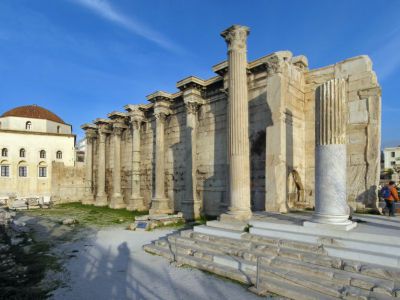
These days, the site is finally open to the public, though excavation is still ongoing. A few original Corinthian columns have survived the centuries, hinting at the library’s former grandeur. And here’s a fun twist: the remains of the Tetraconch Church, smack in the middle of the ruins, were built entirely inside the library’s old courtyard.
Tip:
Your Acropolis ticket covers entry, so if you’re in the area, it’s a no-brainer to check it out. Or, if you’re feeling more mysterious, just walk along the perimeter fence and steal a few glances through the gaps-because who doesn’t love a little architectural intrigue?
He decked out this sprawling complex with art galleries, lecture halls, and a magnificent public space-because why stop at books when you can have everything? His reign ushered in a golden age of peace and prosperity, giving arts and culture a serious upgrade across the empire.
In its prime, the library housed precious papyrus scrolls and exquisite artworks-until the barbaric Herules (from modern-day Germany) came knocking (not for a book club meeting, unfortunately). After their invasion, a Roman official named Herculius took on restoration duties, but history had more plans for the ruins. Over time, they became the foundations for not one, not two, but three different churches-a Byzantine one in the 5th century, another in the 7th, and a cathedral in the 12th. That's what they call re-purposing real estate!
These days, the site is finally open to the public, though excavation is still ongoing. A few original Corinthian columns have survived the centuries, hinting at the library’s former grandeur. And here’s a fun twist: the remains of the Tetraconch Church, smack in the middle of the ruins, were built entirely inside the library’s old courtyard.
Tip:
Your Acropolis ticket covers entry, so if you’re in the area, it’s a no-brainer to check it out. Or, if you’re feeling more mysterious, just walk along the perimeter fence and steal a few glances through the gaps-because who doesn’t love a little architectural intrigue?
4) Tower of the Winds
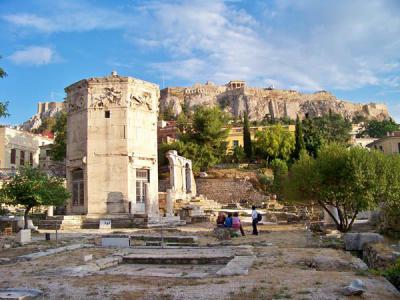
At the Tower of the Winds, you have science, mythology, and a touch of irony collide in an exquisite octagonal package. Standing proudly at 12 meters tall, this marble masterpiece was ancient Athens' answer to the weather app, a multi-functional timepiece that not only told the time but also predicted the wind’s next move. Think of it as a 2,000-year-old smart gadget, featuring sundials, a water clock, and a wind vane-all meticulously designed by a Syrian Greek astronomer around 50 BC (or perhaps even earlier, if some historians are to be believed).
Its frieze is a who’s who of the wind gods, with eight deities sculpted into the marble: from Boreas, blowing in the chill from the north, to Zephyrus, the west wind who, according to mythology, had a rather dramatic love life. Beneath them?-Eight sundials, because one just wasn’t enough. Inside?-A once-impressive water clock, powered by water piped directly from the Acropolis. And its height? Not just for show-it was designed so that Athenians could check the time and weather without craning their necks too much.
But history, as always, had its way with this tower. Early Christians turned it into a belfry, because why not? Then, during the Ottoman era, it became a tekke for whirling dervishes, where spiritual dancers twirled in meditation while the ancient sundials probably sighed in retirement. Over time, parts of the tower were buried, and today, faint Turkish inscriptions still linger on its interior walls-a nod to its many past lives.
Want to see it for yourself? Your ticket to the Roman Agora (or the Acropolis combo pass) will get you in. A small price to pay for a glimpse into one of history’s most sophisticated and repurposed buildings!
Its frieze is a who’s who of the wind gods, with eight deities sculpted into the marble: from Boreas, blowing in the chill from the north, to Zephyrus, the west wind who, according to mythology, had a rather dramatic love life. Beneath them?-Eight sundials, because one just wasn’t enough. Inside?-A once-impressive water clock, powered by water piped directly from the Acropolis. And its height? Not just for show-it was designed so that Athenians could check the time and weather without craning their necks too much.
But history, as always, had its way with this tower. Early Christians turned it into a belfry, because why not? Then, during the Ottoman era, it became a tekke for whirling dervishes, where spiritual dancers twirled in meditation while the ancient sundials probably sighed in retirement. Over time, parts of the tower were buried, and today, faint Turkish inscriptions still linger on its interior walls-a nod to its many past lives.
Want to see it for yourself? Your ticket to the Roman Agora (or the Acropolis combo pass) will get you in. A small price to pay for a glimpse into one of history’s most sophisticated and repurposed buildings!
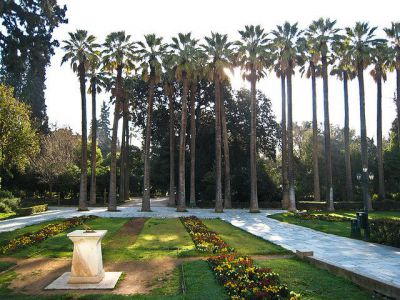
5) National Garden
Just behind the Voulí parliament building, this expansive 16-hectare (40-acre) park, held dear by all Athenians and formerly referred to as the "Royal Gardens", was officially renamed the National Gardens in 1923 by decree. The park's origins date back to the 1840s when Queen Amalía spearheaded its creation, even using the fledgling Greek navy to transport 15,000 seedlings from various corners of the world. Landscaping was entrusted to Prussian horticulturalist Friedrich Schmidt, an avid traveler who scoured the globe in search of rare plant specimens. Notably, Queen Amalía herself planted the avenue of Washingtonia fan palms, native to the southwestern United States.
While the gardens have undergone changes over the years, they remain a serene oasis in the heart of the city. Winding paths lead visitors past charming squares, park benches, and ponds inhabited by koi fish. Adding to the ambiance, visitors can explore remnants of Roman mosaics unearthed within the park and an ancient aqueduct. Throughout the gardens, you'll also encounter modern sculptures paying tribute to renowned writers such as Dionýsios Solomós (author of the Greek National Hymn), Aristotélis Valaorítis, and Jean Moreas. Towards the eastern end stands the neoclassical Zappeion Hall, constructed in 1888 as an Olympic facility. You will also find a duck pond, a small zoo, a small cafe, and a Children's Library and playground. The place is quite clean, suitable and safe for everyone in daytime.
Tip:
The pine-covered Ardittos Hill nearby offers one of the city's most serene and tranquil public spaces, along with stunning viewpoints.
While the gardens have undergone changes over the years, they remain a serene oasis in the heart of the city. Winding paths lead visitors past charming squares, park benches, and ponds inhabited by koi fish. Adding to the ambiance, visitors can explore remnants of Roman mosaics unearthed within the park and an ancient aqueduct. Throughout the gardens, you'll also encounter modern sculptures paying tribute to renowned writers such as Dionýsios Solomós (author of the Greek National Hymn), Aristotélis Valaorítis, and Jean Moreas. Towards the eastern end stands the neoclassical Zappeion Hall, constructed in 1888 as an Olympic facility. You will also find a duck pond, a small zoo, a small cafe, and a Children's Library and playground. The place is quite clean, suitable and safe for everyone in daytime.
Tip:
The pine-covered Ardittos Hill nearby offers one of the city's most serene and tranquil public spaces, along with stunning viewpoints.
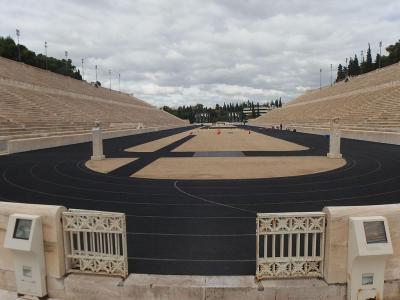
6) Panathenaic Stadium (must see)
The Panathenaic is truly a remarkable historical site, being the only major stadium in the world constructed entirely of white marble. Its origins trace back to ancient times when it served as the venue for the athletic competitions of the Panathenaic Games, dedicated to the Goddess Athena and held every four years. The stadium underwent significant transformations, with a marble reconstruction in 329 BC and later expansion and renovation in 140 AD, accommodating up to 50,000 spectators.
Having fallen into disuse and disrepair after the 4th century AD, it was rediscovered and revitalized for the modern era, playing a pivotal role in the revival of the Olympic Games in the late 19th century. Despite its smaller scale compared to contemporary Olympic venues, the Panathenaic's elegant simplicity and iconic five Olympic rings continue to inspire awe. At the entrance, you'll encounter four stones engraved with the interesting history of the Olympics from the late 19th century to the present day.
The inaugural international Olympic Games in modern history were held here in 1896, with King George I of Greece opening the ceremony. Among participants were 241 male athletes from 14 countries, competing in 9 sports and 43 events. These early modern Olympic sports included athletics, cycling, fencing, gymnastics, tennis, shooting, swimming, weightlifting, and wrestling. Since then, athletes from across the globe have convened every four years, with the tradition enduring through the tumultuous 20th century wars.
Why You Should Visit:
A captivating place to explore, and you can enhance your visit with the free audio guide provided.
The on-site museum provides an engaging exhibition on the fascinating history of the Olympics.
Tip:
Don't miss the opportunity to climb to the upper tier for stunning views of the stadium.
Having fallen into disuse and disrepair after the 4th century AD, it was rediscovered and revitalized for the modern era, playing a pivotal role in the revival of the Olympic Games in the late 19th century. Despite its smaller scale compared to contemporary Olympic venues, the Panathenaic's elegant simplicity and iconic five Olympic rings continue to inspire awe. At the entrance, you'll encounter four stones engraved with the interesting history of the Olympics from the late 19th century to the present day.
The inaugural international Olympic Games in modern history were held here in 1896, with King George I of Greece opening the ceremony. Among participants were 241 male athletes from 14 countries, competing in 9 sports and 43 events. These early modern Olympic sports included athletics, cycling, fencing, gymnastics, tennis, shooting, swimming, weightlifting, and wrestling. Since then, athletes from across the globe have convened every four years, with the tradition enduring through the tumultuous 20th century wars.
Why You Should Visit:
A captivating place to explore, and you can enhance your visit with the free audio guide provided.
The on-site museum provides an engaging exhibition on the fascinating history of the Olympics.
Tip:
Don't miss the opportunity to climb to the upper tier for stunning views of the stadium.
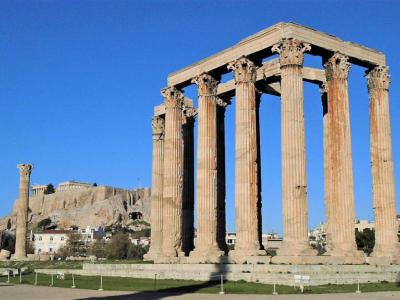
7) Temple of Olympian Zeus (must see)
Even in its ruined state, the Athenian temple of Olympian Zeus remains a monument of awe-inspiring proportions, surpassing even the Parthenon in size. This colossal edifice saw its construction commence in the 6th century BC during the rule of the tyrant Peisistratos, who allegedly initiated the ambitious project to garner public favor. However, despite numerous attempts spanning many years to complete what would have been the greatest temple in the ancient world, it remained unfinished for over six and a half centuries.
In AD 132, the Roman emperor Hadrian, renowned for his admiration of classical Greek culture, dedicated the temple to Zeus Olympios during the Panhellenic festival, a competition of music and poetry held the year before the Olympics. This act took place during his second visit to Athens, and Hadrian also placed a gold and ivory inlaid statue of the god Zeus inside the temple. Regrettably, both the statue of Zeus and a colossal statue of the emperor himself have since been lost to history.
Today, only 15 of the original 104 Corinthian columns remain standing, each at a height of 17 meters (56 feet) – but enough to provide a sense of the temple's immense scale, which would have spanned about 96 meters (315 feet) in length and 40 meters (130 feet) in width. Nearby, there lies a 16th column that toppled during a storm in 1852, bearing witness to the passage of time. The temple's ruins extend beyond the towering columns, although entry into the temple may be restricted at times due to ongoing archaeological excavations.
Adjacent stands Hadrian's Arch, constructed in AD 131 and intentionally positioned to demarcate the boundary between the ancient city and the new Athens envisioned by Emperor Hadrian.
Tip:
For visitors who have acquired the Acropolis multi-site ticket, access to this historical site is automatically granted.
In AD 132, the Roman emperor Hadrian, renowned for his admiration of classical Greek culture, dedicated the temple to Zeus Olympios during the Panhellenic festival, a competition of music and poetry held the year before the Olympics. This act took place during his second visit to Athens, and Hadrian also placed a gold and ivory inlaid statue of the god Zeus inside the temple. Regrettably, both the statue of Zeus and a colossal statue of the emperor himself have since been lost to history.
Today, only 15 of the original 104 Corinthian columns remain standing, each at a height of 17 meters (56 feet) – but enough to provide a sense of the temple's immense scale, which would have spanned about 96 meters (315 feet) in length and 40 meters (130 feet) in width. Nearby, there lies a 16th column that toppled during a storm in 1852, bearing witness to the passage of time. The temple's ruins extend beyond the towering columns, although entry into the temple may be restricted at times due to ongoing archaeological excavations.
Adjacent stands Hadrian's Arch, constructed in AD 131 and intentionally positioned to demarcate the boundary between the ancient city and the new Athens envisioned by Emperor Hadrian.
Tip:
For visitors who have acquired the Acropolis multi-site ticket, access to this historical site is automatically granted.
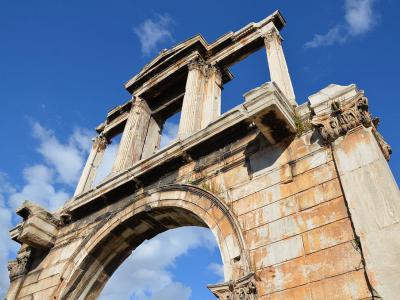
8) Hadrian's Arch
Resembling a triumphal arch, this monumental gateway was built to celebrate the arrival of Roman Emperor Hadrian and pay tribute to his many benefactions to the city. It serves as a symbolic passage between the ancient part of Athens and the newly developed district, largely conceived during Hadrian's rule, which extended until the year 138 A.D. Hadrian was a great admirer of classical Greek literature, philosophy, and arts. During his reign, he generously sponsored several significant projects in Athens, including Hadrian's Library, the Hadrianic Aqueduct, and the completion of the Temple of Olympian Zeus, among others.
The entire structure dedicated to honoring Hadrian is constructed from marble quarried from Mount Pentelicus, located 18 kilometers away. In terms of design, it is fully symmetrical, both from the front and the sides; however, while the lower section draws inspiration from similar Roman arches, the upper part is typical of Greek ones. Inscriptions etched into the monument's surfaces celebrate the new Roman era: the northwest frieze bears the inscription, 'This is Athens, the Ancient city of Theseus,' whereas the southeast frieze declares, 'This is the city of Hadrian, and not of Theseus.'
Why You Should Visit:
One of the most important Roman monuments surviving in Athens, providing an opportunity to gain insights into the relationship between the Roman Empire and its province of Achaea, conquered by the Romans in the year 146 BC.
Tip:
While the monument can be admired from a distance during a stroll through Athens, for a closer view, you may opt to purchase a ticket for the Temple of Olympian Zeus or a combination ticket providing access to the city's major archaeological sites.
The entire structure dedicated to honoring Hadrian is constructed from marble quarried from Mount Pentelicus, located 18 kilometers away. In terms of design, it is fully symmetrical, both from the front and the sides; however, while the lower section draws inspiration from similar Roman arches, the upper part is typical of Greek ones. Inscriptions etched into the monument's surfaces celebrate the new Roman era: the northwest frieze bears the inscription, 'This is Athens, the Ancient city of Theseus,' whereas the southeast frieze declares, 'This is the city of Hadrian, and not of Theseus.'
Why You Should Visit:
One of the most important Roman monuments surviving in Athens, providing an opportunity to gain insights into the relationship between the Roman Empire and its province of Achaea, conquered by the Romans in the year 146 BC.
Tip:
While the monument can be admired from a distance during a stroll through Athens, for a closer view, you may opt to purchase a ticket for the Temple of Olympian Zeus or a combination ticket providing access to the city's major archaeological sites.
9) Odeon of Herodes Atticus
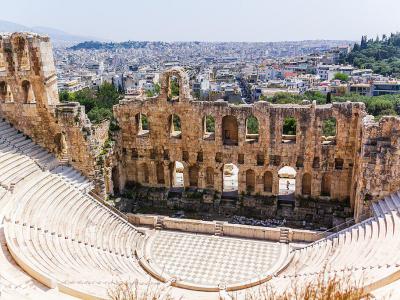
The Odeon of Herodes Atticus-or, as locals call it, the Herodeion. This name sounds like it belongs to an ancient superhero, but in reality, it’s a grand stone amphitheater sitting snug at the foot of the Acropolis. Built in 161 AD by a Greek aristocrat with a Roman title, Herodes Atticus, this wasn’t just any vanity project-it was a love letter to his late wife. And what better way to say “I miss you” than with a massive, acoustically perfect concert hall?
Originally, the Herodeion played host to the finest musical and theatrical performances of the ancient world-think tragic dramas, soaring choral arrangements, and instrumental masterpieces. The kind of cultural flex that made Athens the place to be. With no remnants of a roof (aside from the cedar one that once covered the orchestra area), this was an open-air spectacle from the very start.
A couple of millennia on, the Herodeion is still in business. By day, it’s a stunning ruin that whispers tales of the past. By night, it transforms into one of the dreamiest venues on Earth, hosting classical concerts, modern theater, and international acts beneath the Athenian moon.
Tip:
If you're planning a trip to Athens, check the event schedule ahead of time-nothing ruins a perfect ancient Greek night out like realizing all the tickets are gone. And since this is an open-air gig, always keep an eye on the weather. Rain or shine, though, this place remains one of the most breathtaking remnants of an era when entertainment was truly larger than life.
Originally, the Herodeion played host to the finest musical and theatrical performances of the ancient world-think tragic dramas, soaring choral arrangements, and instrumental masterpieces. The kind of cultural flex that made Athens the place to be. With no remnants of a roof (aside from the cedar one that once covered the orchestra area), this was an open-air spectacle from the very start.
A couple of millennia on, the Herodeion is still in business. By day, it’s a stunning ruin that whispers tales of the past. By night, it transforms into one of the dreamiest venues on Earth, hosting classical concerts, modern theater, and international acts beneath the Athenian moon.
Tip:
If you're planning a trip to Athens, check the event schedule ahead of time-nothing ruins a perfect ancient Greek night out like realizing all the tickets are gone. And since this is an open-air gig, always keep an eye on the weather. Rain or shine, though, this place remains one of the most breathtaking remnants of an era when entertainment was truly larger than life.
10) Temple of Hephaestus (must see)
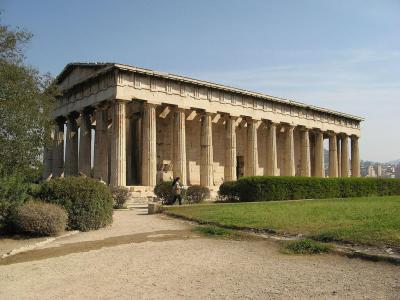
The Temple of Hephaestus is arguably the best-kept piece of real estate in ancient Athens. While other temples crumbled under time, earthquakes, and general neglect, this one decided to stick around, much like a friend who refuses to leave a party.
Dedicated to Hephaestus, the god of fire, metalworking, and crafting all things indestructible (including the Olympian gods’ celestial mansions), this temple sits proudly on Agoraios Kolonos hill, as if keeping an eye on the Agora below. Thanks to its side hustle as a Greek Orthodox church from the 7th century until 1834, it avoided the fate of so many ancient ruins-namely, becoming an oversized jigsaw puzzle.
Its construction started in 449 BC during the Golden Days of Athens, but progress was a bit delayed. Why? Because Athens was busy throwing money at the Parthenon. Eventually, circa 421–415 BC, the builders got back to it, completing this Doric peripteral beauty-a 13+ by 31+ meter marble masterpiece, with six columns at the front, thirteen on the sides, and all the classical elegance you’d expect. Inside, it once housed bronze statues of Hephaestus and Athena, as noted by the Greek travel influencer of antiquity, Pausanias.
The decoration?-A delightful mix of Doric and Ionic flair. The east pediment showed Athena being born (classic), while the west pediment depicted Hephaestus returning to Olympus (presumably after being thrown off it as a baby-tough childhood). The pronaos frieze captured Theseus vs. the Pallantides, while the opisthodomos frieze threw in a good old-fashioned Centaurs vs. Lapiths battle. Meanwhile, 18 sculpted metopes (out of 68) focused on the heroic labors of Heracles and Theseus.
Like all good historical sites, the temple went through a few career changes. By the late Roman Empire, it stopped serving as a pagan sanctuary, and by 700 AD, it was reborn as the Church of Saint George Akamates (why "Akamates"? No one quite knows). Then, in 1833, it hosted one last Divine Liturgy to welcome Greece’s first modern king, Otto, before transforming into a museum. By 1934, the temple officially retired, designated as an ancient monument.
Tips:
The surrounding garden offers shaded spots-perfect for a scenic break.
It’s included in the Acropolis multi-site ticket, so bundle up for the full Athenian experience.
An audio guide is a smart move for deeper insight.
While you can’t waltz inside, the exterior friezes are well worth the admiration.
In short, whether you're a history buff, an architecture lover, or just here for the views, the Temple of Hephaestus is a must-see survivor of ancient Athens-no time machine required.
Dedicated to Hephaestus, the god of fire, metalworking, and crafting all things indestructible (including the Olympian gods’ celestial mansions), this temple sits proudly on Agoraios Kolonos hill, as if keeping an eye on the Agora below. Thanks to its side hustle as a Greek Orthodox church from the 7th century until 1834, it avoided the fate of so many ancient ruins-namely, becoming an oversized jigsaw puzzle.
Its construction started in 449 BC during the Golden Days of Athens, but progress was a bit delayed. Why? Because Athens was busy throwing money at the Parthenon. Eventually, circa 421–415 BC, the builders got back to it, completing this Doric peripteral beauty-a 13+ by 31+ meter marble masterpiece, with six columns at the front, thirteen on the sides, and all the classical elegance you’d expect. Inside, it once housed bronze statues of Hephaestus and Athena, as noted by the Greek travel influencer of antiquity, Pausanias.
The decoration?-A delightful mix of Doric and Ionic flair. The east pediment showed Athena being born (classic), while the west pediment depicted Hephaestus returning to Olympus (presumably after being thrown off it as a baby-tough childhood). The pronaos frieze captured Theseus vs. the Pallantides, while the opisthodomos frieze threw in a good old-fashioned Centaurs vs. Lapiths battle. Meanwhile, 18 sculpted metopes (out of 68) focused on the heroic labors of Heracles and Theseus.
Like all good historical sites, the temple went through a few career changes. By the late Roman Empire, it stopped serving as a pagan sanctuary, and by 700 AD, it was reborn as the Church of Saint George Akamates (why "Akamates"? No one quite knows). Then, in 1833, it hosted one last Divine Liturgy to welcome Greece’s first modern king, Otto, before transforming into a museum. By 1934, the temple officially retired, designated as an ancient monument.
Tips:
The surrounding garden offers shaded spots-perfect for a scenic break.
It’s included in the Acropolis multi-site ticket, so bundle up for the full Athenian experience.
An audio guide is a smart move for deeper insight.
While you can’t waltz inside, the exterior friezes are well worth the admiration.
In short, whether you're a history buff, an architecture lover, or just here for the views, the Temple of Hephaestus is a must-see survivor of ancient Athens-no time machine required.
