Custom Walk in Bangkok, Thailand by barbintn_3ff42 created on 2026-05-28
Guide Location: Thailand » Bangkok
Guide Type: Custom Walk
# of Sights: 14
Tour Duration: 9 Hour(s)
Travel Distance: 23.3 Km or 14.5 Miles
Share Key: SHT9L
Guide Type: Custom Walk
# of Sights: 14
Tour Duration: 9 Hour(s)
Travel Distance: 23.3 Km or 14.5 Miles
Share Key: SHT9L
How It Works
Please retrieve this walk in the GPSmyCity app. Once done, the app will guide you from one tour stop to the next as if you had a personal tour guide. If you created the walk on this website or come to the page via a link, please follow the instructions below to retrieve the walk in the app.
Retrieve This Walk in App
Step 1. Download the app "GPSmyCity: Walks in 1K+ Cities" on Apple App Store or Google Play Store.



Step 2. In the GPSmyCity app, download(or launch) the guide "Bangkok Map and Walking Tours".
Step 3. Tap the menu button located at upper right corner of the "Walks" screen and select "Retrieve custom walk". Enter the share key: SHT9L
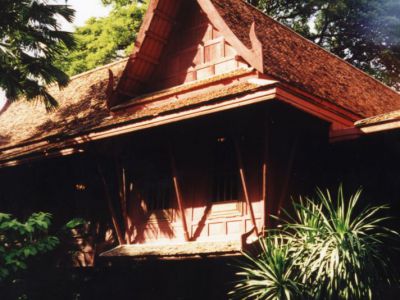
1) Jim Thompson House & Museum (must see)
James H.W. Thompson, founder of the world renowned Jim Thompson Thai Silk Company, was a self-made American entrepreneur. During his 25 year stay in Thailand, he contributed to the development of the Thai Silk industry. His achievements have won him fame as the "Legendary American of Thailand". He was awarded the Order of the White Elephant – an award given to foreigners for rendering exceptional services to Thailand.
Jim Thompson was born in Greenville in 1906 and was a practiced architect prior to World War II. He volunteered for service in the U.S. Army and reached Thailand on a mission to liberate Thailand. However, the war ended before the operation. He decided to reside in Thailand permanently and devoted himself to reviving the craft of hand-weaving silk. A superb designer and a talented textile colorist, he contributed greatly to the industry's growth and to the worldwide recognition of Thai silk. His dwelling showed his great love for Thai culture. His house has the honor of the 'city's most celebrated social center' along with becoming the 'talk of the town'. Even today, the charming Thai-style house is a key stop for visitors to Bangkok. Supporting columns and the walls lean slightly inward adding to the illusion of height and grace; and the curved roof ends, characteristic of traditional Thai houses, increases the beauty. The collection of antique items on display is also really beautiful and worth seeing.
Why You Should Visit:
Jim Thompson had a great eye for an artifact and his house is the envy of anyone who has even a passing interest in Buddhist or Southeast Asian culture.
Tip:
English tours are frequent but get a time as soon as you enter.
Go into the shop: it is expensive but the products are excellent.
Jim Thompson was born in Greenville in 1906 and was a practiced architect prior to World War II. He volunteered for service in the U.S. Army and reached Thailand on a mission to liberate Thailand. However, the war ended before the operation. He decided to reside in Thailand permanently and devoted himself to reviving the craft of hand-weaving silk. A superb designer and a talented textile colorist, he contributed greatly to the industry's growth and to the worldwide recognition of Thai silk. His dwelling showed his great love for Thai culture. His house has the honor of the 'city's most celebrated social center' along with becoming the 'talk of the town'. Even today, the charming Thai-style house is a key stop for visitors to Bangkok. Supporting columns and the walls lean slightly inward adding to the illusion of height and grace; and the curved roof ends, characteristic of traditional Thai houses, increases the beauty. The collection of antique items on display is also really beautiful and worth seeing.
Why You Should Visit:
Jim Thompson had a great eye for an artifact and his house is the envy of anyone who has even a passing interest in Buddhist or Southeast Asian culture.
Tip:
English tours are frequent but get a time as soon as you enter.
Go into the shop: it is expensive but the products are excellent.
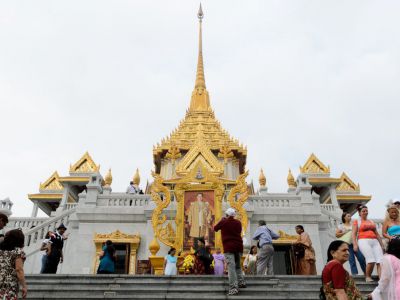
2) Wat Traimit (Temple of the Golden Buddha) (must see)
On the eastern edge of Chinatown, the Wat Traimit Witthayaram is home to the world's largest solid gold Buddha – 3 meters (9.8 feet) tall and weighing 5.5 tonnes – and is consequently known also as the Temple of the Golden Buddha.
Worth millions of dollars at today's gold price, the Golden Buddha was cast sometime in the 13th century and is an excellent example of the gracious Sukhothai style. This statue has such a bright, reflective surface that its edges seem to disappear, and it shines with such richness and purity that everyone is inspired by it. At one point, it was covered in plaster and colored glass – presumably to disguise it from Burmese invaders – and remained like this for nearly two centuries. Only in 1955, when an accident while moving it caused the surface to crack off, was its true nature revealed.
The Golden Buddha is now installed at the highest level of Wat Traimit, with the plaster pieces that once hid it from looters being displayed in a case to the left. The gold, the gems, the mosaic patterns all combine to make a spectacular sight.
Few of the Thai temples also have two quite interesting museums incorporated – this one does! The 2nd-floor exhibits cover the history of Bangkok's Chinese community and the 3rd-floor exhibits allow you to learn more about the story of the Golden Buddha itself.
Tip:
It will cost you 40 THB to get into the temple and another 100 THB to get into the museums.
This is a sacred place, so your arms and legs must be covered. Be prepared to remove your shoes.
Worth millions of dollars at today's gold price, the Golden Buddha was cast sometime in the 13th century and is an excellent example of the gracious Sukhothai style. This statue has such a bright, reflective surface that its edges seem to disappear, and it shines with such richness and purity that everyone is inspired by it. At one point, it was covered in plaster and colored glass – presumably to disguise it from Burmese invaders – and remained like this for nearly two centuries. Only in 1955, when an accident while moving it caused the surface to crack off, was its true nature revealed.
The Golden Buddha is now installed at the highest level of Wat Traimit, with the plaster pieces that once hid it from looters being displayed in a case to the left. The gold, the gems, the mosaic patterns all combine to make a spectacular sight.
Few of the Thai temples also have two quite interesting museums incorporated – this one does! The 2nd-floor exhibits cover the history of Bangkok's Chinese community and the 3rd-floor exhibits allow you to learn more about the story of the Golden Buddha itself.
Tip:
It will cost you 40 THB to get into the temple and another 100 THB to get into the museums.
This is a sacred place, so your arms and legs must be covered. Be prepared to remove your shoes.
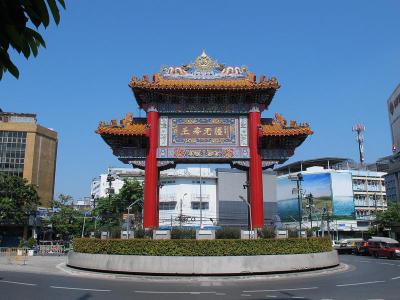
3) Chinatown Gate (must see)
Built in 1999 as part of the celebrations of King Bhumibol Adulyadej's 72's birthday, the Chinatown Gate is sometimes called "Odean Gate" after the Odean cinema that once stood nearby. The words on the gate say "Sheng Shou Wu Jiang", translated as "Long Live the King". During Chinese New Year celebrations, the gate becomes the center of activities where people make their offerings.
Chinatown Gate is the entrance to many sites, a brief description of which is given below:
- Wat Traimit, a small temple, home to the world's largest five-ton-plus solid gold Buddha image;
- Li Thi Miew Temple, one of the more open and accessible of many Chinese temples in Chinatown;
- Wat Kanikaphon, a small temple with some interesting details, founded by a former Madame who owned a brothel;
- Tien Fa Charity, a small clinic run by a charitable foundation, with a large chapel to the goddess Ming in its courtyard;
- Sampaeng Lane, Chinatown's original main street, now a small narrow alley crowded with shops selling mostly inexpensive household items and a very old Chinese pharmacy – definitely worth a look;
- Wat Mangkon Kamalawat, the Chinese-Buddhist temple – a center of festivities during important festivals such as the Chinese New Year and the vegetarian festival;
- Phahurat Market, a small community center for Sikhs and other immigrants from the subcontinent, home to a large number of fabric and wedding stalls;
- Wat Chakrawat, one of Bangkok's three biggest monasteries, housing some very unusual buildings and a few crocodiles!;
- The Old Siam, a shopping center where you will find tourist-friendly western and Thai restaurants and fast food outlets.
In short, Chinatown Gate gives you the visa to enter into a whole new world to explore and enjoy!
Tip:
Plan ahead so you can visit the top spots and leave room in your stomach for the unexpected – but be sure to eat where the locals are queueing.
Chinatown Gate is the entrance to many sites, a brief description of which is given below:
- Wat Traimit, a small temple, home to the world's largest five-ton-plus solid gold Buddha image;
- Li Thi Miew Temple, one of the more open and accessible of many Chinese temples in Chinatown;
- Wat Kanikaphon, a small temple with some interesting details, founded by a former Madame who owned a brothel;
- Tien Fa Charity, a small clinic run by a charitable foundation, with a large chapel to the goddess Ming in its courtyard;
- Sampaeng Lane, Chinatown's original main street, now a small narrow alley crowded with shops selling mostly inexpensive household items and a very old Chinese pharmacy – definitely worth a look;
- Wat Mangkon Kamalawat, the Chinese-Buddhist temple – a center of festivities during important festivals such as the Chinese New Year and the vegetarian festival;
- Phahurat Market, a small community center for Sikhs and other immigrants from the subcontinent, home to a large number of fabric and wedding stalls;
- Wat Chakrawat, one of Bangkok's three biggest monasteries, housing some very unusual buildings and a few crocodiles!;
- The Old Siam, a shopping center where you will find tourist-friendly western and Thai restaurants and fast food outlets.
In short, Chinatown Gate gives you the visa to enter into a whole new world to explore and enjoy!
Tip:
Plan ahead so you can visit the top spots and leave room in your stomach for the unexpected – but be sure to eat where the locals are queueing.
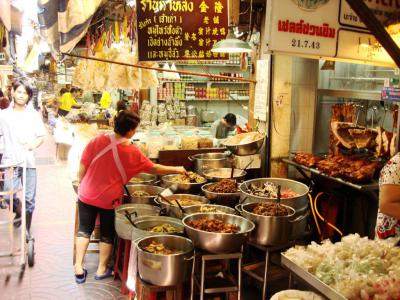
4) Talat Kao Market
If you want to see Bangkok before air-conditioning and shopping malls took over, this is your time machine. This Thai-Chinese trading community is the city’s oldest market, running nonstop since the reign of King Rama V in the late 1800s—so yes, it has seen more history than some museums, and with better snacks too. The wooden houses along the alley still hold onto that old-world feel, as if they’ve quietly agreed not to change too much, no matter what century it is.
The name comes from a man named Hong, who arrived here after selling his rafting business and decided to reinvent himself as a riverside trader. He built a nine-room house and, with admirable branding instincts, named the place after it: Talat Kao Hong. Not stopping there, he added a five-story watchtower—compact, four by four meters, but apparently enough to keep an eye on thieves and troublemakers, both of which were in no short supply at the time. During World War II, the same tower took on a new job, scanning the skies for enemy bombers and sounding air-raid alarms. These days, it just stands there, quietly reminding everyone it has seen things...
Now, about the alley itself. It’s short—barely two blocks—and narrow enough that passing someone requires either cooperation or a bit of choreography. Add a motorbike squeezing through with deliveries, plus a few people pausing mid-path to inspect snacks, and suddenly you’re part of a slow-moving, mildly chaotic dance. On holidays, expect a little elbow-to-elbow bonding with strangers, too.
But the reward is worth it. The market is packed with fresh seafood—fish, shrimp, prawns, and the occasional mystery creature that may or may not look back at you. Then come the dried goods: red dates, persimmons, fish, and even fish stomach—because nothing goes to waste here...
And, of course, the ready-to-eat lineup: kanom krok sizzling away in their little pans, soft dim sum, rich curries, noodles coated in sauce, and sweets like chan ub or pia. Since this is very much a Chinese market, roast ducks hang proudly in shop windows, duck noodles are always on standby, and on festive days, whole roast pigs make a rather unforgettable appearance.
The name comes from a man named Hong, who arrived here after selling his rafting business and decided to reinvent himself as a riverside trader. He built a nine-room house and, with admirable branding instincts, named the place after it: Talat Kao Hong. Not stopping there, he added a five-story watchtower—compact, four by four meters, but apparently enough to keep an eye on thieves and troublemakers, both of which were in no short supply at the time. During World War II, the same tower took on a new job, scanning the skies for enemy bombers and sounding air-raid alarms. These days, it just stands there, quietly reminding everyone it has seen things...
Now, about the alley itself. It’s short—barely two blocks—and narrow enough that passing someone requires either cooperation or a bit of choreography. Add a motorbike squeezing through with deliveries, plus a few people pausing mid-path to inspect snacks, and suddenly you’re part of a slow-moving, mildly chaotic dance. On holidays, expect a little elbow-to-elbow bonding with strangers, too.
But the reward is worth it. The market is packed with fresh seafood—fish, shrimp, prawns, and the occasional mystery creature that may or may not look back at you. Then come the dried goods: red dates, persimmons, fish, and even fish stomach—because nothing goes to waste here...
And, of course, the ready-to-eat lineup: kanom krok sizzling away in their little pans, soft dim sum, rich curries, noodles coated in sauce, and sweets like chan ub or pia. Since this is very much a Chinese market, roast ducks hang proudly in shop windows, duck noodles are always on standby, and on festive days, whole roast pigs make a rather unforgettable appearance.
5) Wat Arun (Temple of Dawn) (must see)
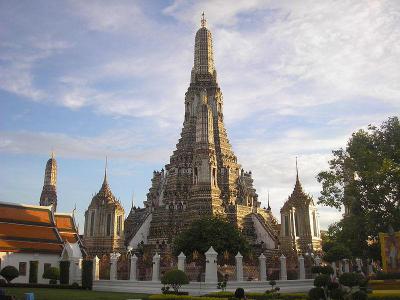
Wat Arun, located in the Bangkok Yai district of Bangkok, is a prominent Buddhist temple. It rests on the western bank of the Chao Phraya River in the Thonburi area. This temple takes its name from Aruṇa, a Hindu deity symbolizing the radiant energies of the rising sun. Wat Arun is one of Thailand's most renowned landmarks. Although the temple has a history dating back to at least the 17th century, its distinctive prang (tower-like spire) was constructed in the early 19th century under the reigns of Rama II and Rama III.
The central feature of Wat Arun is its central prang, adorned with vibrant porcelain. It resembles a stupa-like pagoda embellished with colorful faience. Its height is reported differently in various sources, ranging from 66.8 meters (219 feet) to 86 meters (282 feet). Four smaller satellite prang surround its corners, adorned with shells from Mauritia mauritiana and fragments of porcelain.
At the pinnacle of the central prang is a seven-pronged trident often referred to as the "Trident of Shiva." Surrounding the prang's base, you'll find various depictions of ancient Chinese soldiers and animals. Above the second terrace, there are four statues of the Hindu god Indra mounted on Erawan, his celestial mount.
The central prang is believed to have three significant levels: the base represents Traiphum, signifying all realms of existence; the middle stands for Tavatimsa, the Tusita Heaven where all desires find fulfillment; and the top denotes Devaphum, indicating the six heavens within the seven realms of happiness. Along the riverside, there are six pavilions constructed in the Chinese architectural style. These pavilions are crafted from green granite and feature landing bridges.
Adjacent to the prang stands the Ordination Hall, housing a Niramitr Buddha image, purportedly designed by Rama II. The front entrance of the Ordination Hall boasts a roof adorned with a central spire, decorated with colored ceramics and stuccowork covered in colored china. Inside, you'll find a grand altar adorned with red, grey, and white marble decorations. Two temple guardian figures, representing demons, stand at the entrance. The murals inside were commissioned during the reign of Rama V.
Why You Should Visit:
Lovely, colorful, and less crowded than the other major temples in the area.
Not many Buddhist temples are this white and bright with pieces of different types of ceramic tiles and fragments of multi-colored porcelain decorated on almost every inch.
Tip:
Make sure you are properly dressed so that you won't be required to rent a sarong or be turned away.
Some people will suggest renting a boat to visit the temple. It will cost you a lot, so pass on that! Just cross with the ferry for a mere 4 THB.
The best time to visit would be evening since you can get a glimpse of the temple's structure & details in daylight as well as when lit up artificially after sunset.
The central feature of Wat Arun is its central prang, adorned with vibrant porcelain. It resembles a stupa-like pagoda embellished with colorful faience. Its height is reported differently in various sources, ranging from 66.8 meters (219 feet) to 86 meters (282 feet). Four smaller satellite prang surround its corners, adorned with shells from Mauritia mauritiana and fragments of porcelain.
At the pinnacle of the central prang is a seven-pronged trident often referred to as the "Trident of Shiva." Surrounding the prang's base, you'll find various depictions of ancient Chinese soldiers and animals. Above the second terrace, there are four statues of the Hindu god Indra mounted on Erawan, his celestial mount.
The central prang is believed to have three significant levels: the base represents Traiphum, signifying all realms of existence; the middle stands for Tavatimsa, the Tusita Heaven where all desires find fulfillment; and the top denotes Devaphum, indicating the six heavens within the seven realms of happiness. Along the riverside, there are six pavilions constructed in the Chinese architectural style. These pavilions are crafted from green granite and feature landing bridges.
Adjacent to the prang stands the Ordination Hall, housing a Niramitr Buddha image, purportedly designed by Rama II. The front entrance of the Ordination Hall boasts a roof adorned with a central spire, decorated with colored ceramics and stuccowork covered in colored china. Inside, you'll find a grand altar adorned with red, grey, and white marble decorations. Two temple guardian figures, representing demons, stand at the entrance. The murals inside were commissioned during the reign of Rama V.
Why You Should Visit:
Lovely, colorful, and less crowded than the other major temples in the area.
Not many Buddhist temples are this white and bright with pieces of different types of ceramic tiles and fragments of multi-colored porcelain decorated on almost every inch.
Tip:
Make sure you are properly dressed so that you won't be required to rent a sarong or be turned away.
Some people will suggest renting a boat to visit the temple. It will cost you a lot, so pass on that! Just cross with the ferry for a mere 4 THB.
The best time to visit would be evening since you can get a glimpse of the temple's structure & details in daylight as well as when lit up artificially after sunset.
6) The Royal Grand Palace (must see)
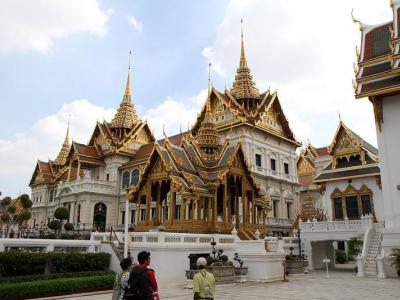
If Bangkok had a crown, it would look suspiciously like the Grand Palace—ornate, dazzling, and absolutely not trying to keep a low profile. Commissioned in 1782 by King Rama I, this sprawling complex marked the moment the capital officially moved from Thonburi to Bangkok. The chosen site already had Chinese merchants in place, who, when asked politely to relocate, did so without delay—because when a king needs a palace, negotiations tend to be short...
At the beginning, the palace was a fortified cluster of wooden buildings wrapped in a defensive wall stretching nearly two kilometers. Over time, it grew into something far more elaborate, with layers of halls, courtyards, and ceremonial spaces unfolding like a carefully staged performance. On the eastern side, you’ll find the revered Wat Phra Kaew, built as the king’s personal place of worship and still considered the most sacred temple in Thailand. The layout follows a strict order: river to the west, temple to the east, and everything aligned with purpose.
Inside, the palace is divided into three zones. The Outer Court handled administration, treasury, and military affairs—the kingdom’s working machinery. The Central Court housed the king’s residence and state halls. Beyond that lay the Inner Court, a secluded world occupied only by royal consorts, daughters, and young boys, functioning as a self-contained community.
By the early 20th century, Thai kings had moved out, but the palace didn’t retire and stayed very much in use. Today, it hosts royal ceremonies, state events, and occasions that call for maximum grandeur. And grandeur is something this place delivers effortlessly. Gold surfaces shimmer in the sun, intricate details reward every glance, and the entire complex feels like a masterclass in craftsmanship.
A quick note before entering: this is Thailand’s most sacred site, so dress accordingly—covered shoulders, no bare feet, nothing see-through.
And, of course, timing matters. Arrive early to avoid midday crowds. Free English tours run at 10 and 10:30 am, as well as at 1 and 1:30 pm, and audio guides are available if you prefer to explore at your own pace. The entry ticket also includes access to a traditional theater performance, adding a final touch of spectacle.
Skip this, and you’ve essentially missed Bangkok’s main act.
At the beginning, the palace was a fortified cluster of wooden buildings wrapped in a defensive wall stretching nearly two kilometers. Over time, it grew into something far more elaborate, with layers of halls, courtyards, and ceremonial spaces unfolding like a carefully staged performance. On the eastern side, you’ll find the revered Wat Phra Kaew, built as the king’s personal place of worship and still considered the most sacred temple in Thailand. The layout follows a strict order: river to the west, temple to the east, and everything aligned with purpose.
Inside, the palace is divided into three zones. The Outer Court handled administration, treasury, and military affairs—the kingdom’s working machinery. The Central Court housed the king’s residence and state halls. Beyond that lay the Inner Court, a secluded world occupied only by royal consorts, daughters, and young boys, functioning as a self-contained community.
By the early 20th century, Thai kings had moved out, but the palace didn’t retire and stayed very much in use. Today, it hosts royal ceremonies, state events, and occasions that call for maximum grandeur. And grandeur is something this place delivers effortlessly. Gold surfaces shimmer in the sun, intricate details reward every glance, and the entire complex feels like a masterclass in craftsmanship.
A quick note before entering: this is Thailand’s most sacred site, so dress accordingly—covered shoulders, no bare feet, nothing see-through.
And, of course, timing matters. Arrive early to avoid midday crowds. Free English tours run at 10 and 10:30 am, as well as at 1 and 1:30 pm, and audio guides are available if you prefer to explore at your own pace. The entry ticket also includes access to a traditional theater performance, adding a final touch of spectacle.
Skip this, and you’ve essentially missed Bangkok’s main act.
7) Wat Phra Kaew (Temple of the Emerald Buddha) (must see)
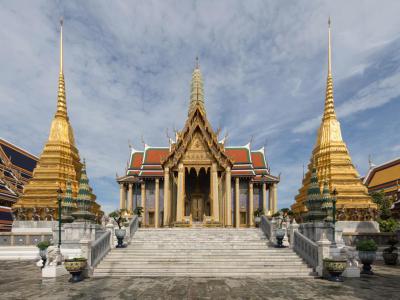
Set within the grounds of the Grand Palace, Wat Phra Kaew—or the Temple of the Emerald Buddha—is a place where reverence meets spectacle. It’s the most sacred Buddhist site in the country, and all that prestige revolves around a statue that stands just about two feet tall. Small in size, enormous in significance—the Emerald Buddha, carved from dark green stone, commands the kind of attention most monuments can only dream of.
Now, where did this statue actually come from? That depends on who you ask. Some historians point toward Sri Lanka, others insist it was crafted locally in the 14th century. But the more cinematic version involves a lightning strike in Chiang Rai in 1434, cracking open a plaster-covered monument to reveal the green figure hidden inside. Not exactly subtle, but then again, subtlety wasn’t really the point.
Over the centuries, this statue has sparked rivalries, relocations, and more than a few military campaigns. Eventually, it arrived in Bangkok in 1782, where it has remained ever since, regarded as a powerful symbol of protection and legitimacy for the Thai kingdom. Paired with the Grand Palace next door, Wat Phra Kaew forms one of the most compelling sights in the city—less a single attraction, more a full cultural statement.
So, yes, the Grand Palace already delivers the grandeur. But Wat Phra Kaew adds that final, almost theatrical flourish—the detail that pulls everything together. Call it the finishing touch, the quiet center of gravity, or simply the reason everyone ends up here sooner or later.
If you want to experience it without the shoulder-to-shoulder shuffle, aim to arrive right when the gates open, around 8 a.m. Dress with a bit of respect—covered shoulders, no bare knees—and give yourself time to wander. This isn’t a place you rush; it’s one you take in, piece by piece, until the scale of it all starts to make sense.
Now, where did this statue actually come from? That depends on who you ask. Some historians point toward Sri Lanka, others insist it was crafted locally in the 14th century. But the more cinematic version involves a lightning strike in Chiang Rai in 1434, cracking open a plaster-covered monument to reveal the green figure hidden inside. Not exactly subtle, but then again, subtlety wasn’t really the point.
Over the centuries, this statue has sparked rivalries, relocations, and more than a few military campaigns. Eventually, it arrived in Bangkok in 1782, where it has remained ever since, regarded as a powerful symbol of protection and legitimacy for the Thai kingdom. Paired with the Grand Palace next door, Wat Phra Kaew forms one of the most compelling sights in the city—less a single attraction, more a full cultural statement.
So, yes, the Grand Palace already delivers the grandeur. But Wat Phra Kaew adds that final, almost theatrical flourish—the detail that pulls everything together. Call it the finishing touch, the quiet center of gravity, or simply the reason everyone ends up here sooner or later.
If you want to experience it without the shoulder-to-shoulder shuffle, aim to arrive right when the gates open, around 8 a.m. Dress with a bit of respect—covered shoulders, no bare knees—and give yourself time to wander. This isn’t a place you rush; it’s one you take in, piece by piece, until the scale of it all starts to make sense.
8) Wat Pho (Temple of the Reclining Buddha) (must see)
If there's one place in Bangkok that does “relaxed grandeur” properly, this is Wat Pho. Officially known as the Temple of the Reclining Buddha, it’s the city’s oldest Buddhist temple, whose origins reach back well before Bangkok became the capital. Sitting just behind Wat Phra Kaew, it might sound secondary—but once inside, that idea disappears quickly.
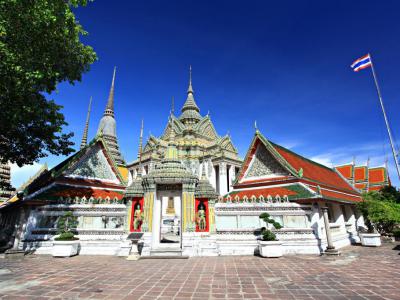
The temple's main attraction is impossible to miss. The Reclining Buddha stretches 46 meters long and 15 meters high, covered in gold and representing the Buddha’s passage into nirvana. In essence, this statue feels more like an experience in scale. As you move along its length, the details begin to stand out—especially the feet, inlaid with mother-of-pearl and decorated with 108 auspicious symbols drawn from both Chinese and Indian traditions. It’s the kind of detail that rewards slowing down.
The complex expands gradually as you walk through it. Divided into two walled sections, most visitors focus on the northern compound, where the Reclining Buddha sits inside a large hall surrounded by nearly 400 bronze Buddha images.
Step outside, and the grounds open up to rows of Buddhist structures called “chedis”—91 in total—each adding color and variation to the skyline. Nearby, a richly decorated library stands out with porcelain ornamentation, while across the complex, you’ll find over a thousand Buddha images, many brought here from the ruins of earlier capitals like Ayutthaya and Sukhothai.
Apart from being a place to pray and look at, Wat Pho is also a teaching institution. Recognized as Thailand’s first public university, it remains closely tied to the traditional Thai massage. This isn’t the gentle spa version, no; it’s more structured, involving stretching and pressure techniques designed to improve circulation and flexibility. If you’re curious, this is one of the most authentic places to try it.
Practicalities are straightforward but worth noting. Bring exact change for your ticket, as change is rarely given. Plan at least two hours, though it’s easy to stay longer. The ticket includes a bottle of water, and refill stations are available inside. Dress modestly—covering knees and shoulders—and be prepared to remove your shoes before entering the main hall. It’s a small adjustment that fits the rhythm of the place: slow down, take your time, and let the details do the work.
The temple's main attraction is impossible to miss. The Reclining Buddha stretches 46 meters long and 15 meters high, covered in gold and representing the Buddha’s passage into nirvana. In essence, this statue feels more like an experience in scale. As you move along its length, the details begin to stand out—especially the feet, inlaid with mother-of-pearl and decorated with 108 auspicious symbols drawn from both Chinese and Indian traditions. It’s the kind of detail that rewards slowing down.
The complex expands gradually as you walk through it. Divided into two walled sections, most visitors focus on the northern compound, where the Reclining Buddha sits inside a large hall surrounded by nearly 400 bronze Buddha images.
Step outside, and the grounds open up to rows of Buddhist structures called “chedis”—91 in total—each adding color and variation to the skyline. Nearby, a richly decorated library stands out with porcelain ornamentation, while across the complex, you’ll find over a thousand Buddha images, many brought here from the ruins of earlier capitals like Ayutthaya and Sukhothai.
Apart from being a place to pray and look at, Wat Pho is also a teaching institution. Recognized as Thailand’s first public university, it remains closely tied to the traditional Thai massage. This isn’t the gentle spa version, no; it’s more structured, involving stretching and pressure techniques designed to improve circulation and flexibility. If you’re curious, this is one of the most authentic places to try it.
Practicalities are straightforward but worth noting. Bring exact change for your ticket, as change is rarely given. Plan at least two hours, though it’s easy to stay longer. The ticket includes a bottle of water, and refill stations are available inside. Dress modestly—covering knees and shoulders—and be prepared to remove your shoes before entering the main hall. It’s a small adjustment that fits the rhythm of the place: slow down, take your time, and let the details do the work.
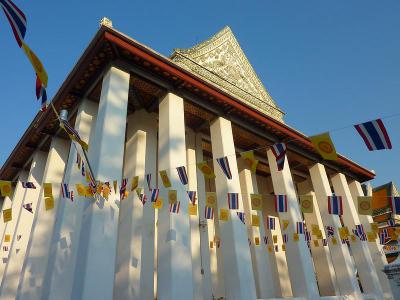
9) Wat Thepthidaram
Built in 1836 by King Rama III as a royal tribute to one of his wives, Wat Thepthidaram arrived with a bit of cultural flair. At the time, Bangkok had a serious fascination with all things Chinese, and the temple was clearly in on the trend. Keep an eye out for gables decorated with Chinese porcelain and a scattering of statues that look like they’ve quietly traveled a long way to be here—and decided to stay.
Inside the main compound, the layout keeps things neatly symmetrical: the ordination hall, or ubosot, takes center stage, flanked by two wiharns, or prayer halls. Around them, a walled courtyard anchors the scene, with corn cob-shaped prangs standing guard at each corner. Right in the middle sits a rather unusual Buddha image, carved from snow-white stone and placed on a golden, boat-shaped altar. The northern hall tends to stay closed, keeping its gilded window frames a bit of a mystery, while the southern hall opens up to a cluster of small chedis and another well-revered Buddha image.
But architecture isn’t the only reason people remember this place. The temple is closely tied to Sunthorn Phu, widely regarded as Thailand’s literary giant—often compared to Shakespeare. He spent three years here as a monk, trading ink for introspection. UNESCO later recognized his cultural impact in 1986, naming him a “Great Personality of the World.” Not all of his legacy survived intact, though; some manuscripts left behind in the temple fell victim to humidity and time—a quiet reminder that preservation isn’t always guaranteed...
In 2006, the poet's former living quarters at the rear of the complex were turned into a small museum, aptly called the “House of the Great Poet,” with the help from Silpakorn University. It’s a modest space, but one that keeps his story alive. And yes, the temple itself shows signs of wear these days—but if anything, that only adds to its character. Indeed, this isn’t a polished postcard version of Bangkok, but something a bit more real, a bit more lived-in—and well worth your time.
Inside the main compound, the layout keeps things neatly symmetrical: the ordination hall, or ubosot, takes center stage, flanked by two wiharns, or prayer halls. Around them, a walled courtyard anchors the scene, with corn cob-shaped prangs standing guard at each corner. Right in the middle sits a rather unusual Buddha image, carved from snow-white stone and placed on a golden, boat-shaped altar. The northern hall tends to stay closed, keeping its gilded window frames a bit of a mystery, while the southern hall opens up to a cluster of small chedis and another well-revered Buddha image.
But architecture isn’t the only reason people remember this place. The temple is closely tied to Sunthorn Phu, widely regarded as Thailand’s literary giant—often compared to Shakespeare. He spent three years here as a monk, trading ink for introspection. UNESCO later recognized his cultural impact in 1986, naming him a “Great Personality of the World.” Not all of his legacy survived intact, though; some manuscripts left behind in the temple fell victim to humidity and time—a quiet reminder that preservation isn’t always guaranteed...
In 2006, the poet's former living quarters at the rear of the complex were turned into a small museum, aptly called the “House of the Great Poet,” with the help from Silpakorn University. It’s a modest space, but one that keeps his story alive. And yes, the temple itself shows signs of wear these days—but if anything, that only adds to its character. Indeed, this isn’t a polished postcard version of Bangkok, but something a bit more real, a bit more lived-in—and well worth your time.
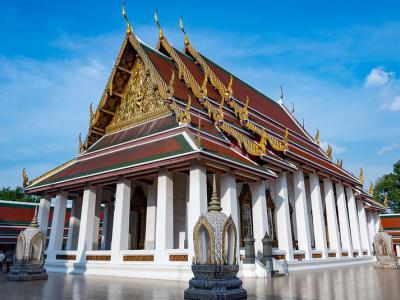
10) Wat Saket (Temple of the Golden Mount) (must see)
If Bangkok ever decided to grow a hill, it would probably look like Wat Saket—and yes, that’s more or less what happened. Dating back to the Ayutthaya era (which lasted from 1351 to 1767), this temple is best known for its gleaming golden chedi, once the highest point in a city that otherwise prefers to stay impressively flat. It is equal parts a landmark, a lookout, and a seasonal party host, especially during the Loy Krathong festival.
Now, about that “mountain.” The Golden Mount isn’t natural—it’s Bangkok’s most ambitious DIY project. King Rama III tried to build a massive chedi here, only to have it dramatically sink into the soft ground. Plan B was to build a hill first and then try again. So, up went a mound of mud and bricks, which sat around long enough to sprout greenery and earn itself the name “Phu Khao,” or “mountain.” Later, King Rama IV added a smaller chedi and reinforced the base with nearly a thousand teak logs. Finally, King Rama V completed the golden structure you see today, enshrining a Buddha relic from India. A few concrete reinforcements during World War II ensured the whole thing would stay put.
From late October to mid-November, this quiet hill turns festive. For nine days around the full moon, the Golden Mount is wrapped in red cloth, and the temple fair takes over with food stalls, performances, and just enough chaos to keep things interesting. At night, candlelight processions wind their way up the hill, with worshippers carrying flowers and flickering lights toward the summit. A kind of spiritual ritual mixed with a lively fairground...
Getting to the Golden Mount's peak means tackling 318 steps—not exactly Everest, but enough to make you feel like you’ve earned the view. And once you’re up there, Bangkok stretches out in every direction—a rare chance to see the city from above without boarding a skyscraper.
Bangkok doesn’t do hills. Which is precisely why this one feels special. A temple on top is just a bonus.
If you can, go early—before the heat kicks in and the crowds follow. And if the sun is in a generous mood, bring a hat. This climb comes with very little shade and a lot of enthusiasm from the tropical sky.
Now, about that “mountain.” The Golden Mount isn’t natural—it’s Bangkok’s most ambitious DIY project. King Rama III tried to build a massive chedi here, only to have it dramatically sink into the soft ground. Plan B was to build a hill first and then try again. So, up went a mound of mud and bricks, which sat around long enough to sprout greenery and earn itself the name “Phu Khao,” or “mountain.” Later, King Rama IV added a smaller chedi and reinforced the base with nearly a thousand teak logs. Finally, King Rama V completed the golden structure you see today, enshrining a Buddha relic from India. A few concrete reinforcements during World War II ensured the whole thing would stay put.
From late October to mid-November, this quiet hill turns festive. For nine days around the full moon, the Golden Mount is wrapped in red cloth, and the temple fair takes over with food stalls, performances, and just enough chaos to keep things interesting. At night, candlelight processions wind their way up the hill, with worshippers carrying flowers and flickering lights toward the summit. A kind of spiritual ritual mixed with a lively fairground...
Getting to the Golden Mount's peak means tackling 318 steps—not exactly Everest, but enough to make you feel like you’ve earned the view. And once you’re up there, Bangkok stretches out in every direction—a rare chance to see the city from above without boarding a skyscraper.
Bangkok doesn’t do hills. Which is precisely why this one feels special. A temple on top is just a bonus.
If you can, go early—before the heat kicks in and the crowds follow. And if the sun is in a generous mood, bring a hat. This climb comes with very little shade and a lot of enthusiasm from the tropical sky.
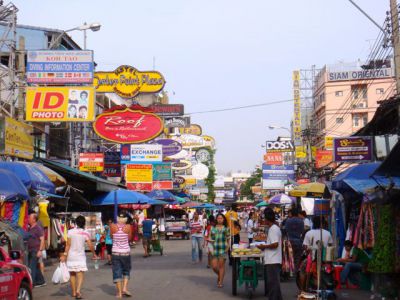
11) Khaosan Road
Clocking in at just 410 meters, Khaosan Road somehow manages to feel like a whole universe squeezed into a single stretch of asphalt. Built in 1892 during the reign of King Rama V, it started life as a rice market—khaosan literally means “milled rice.” Not exactly the kind of origin story that hints at neon lights, bass drops, and bucket cocktails… but here we are.
Over the past four decades, this short street has turned into a global rite of passage. Budget travelers arrive in waves—40,000 to 50,000 a day in peak season—hunting for cheap beds, cheaper food, and stories they may or may not remember later. Accommodation ranges from “just enough to sleep” to surprisingly decent mid-range hotels, depending on how adventurous—or sleep-deprived—you’re willing to be.
As for the crowd, it's a rotating cast of characters. Gap-year explorers, post-exam escapees, backpackers mapping out Southeast Asia one hostel at a time, and travelers who came for a few days and somehow never quite left. Indeed, this street feels like a temporary society, held together by shared curiosity, jet lag, and the occasional questionable life decision...
By day, stalls line the road, selling everything from handmade crafts and loose, elephant-print trousers to second-hand books and items that definitely didn’t come with a warranty. But once the sun goes down, the whole place shifts gears. Music spills out from bars, street vendors fire up grills—yes, including insects—and the air fills with equal parts excitement and chaos. If you happen to be here during Songkran festival (which is the Thai New Year), expect the entire street to turn into one giant water fight, where staying dry is simply not an option.
Just across the way, the calm presence of Wat Chana Songkram offers a quiet counterpoint, while nearby lanes reveal small mosques and a longstanding Muslim community—reminders that even here, amid the noise, Bangkok’s layered identity never really disappears...
Over the past four decades, this short street has turned into a global rite of passage. Budget travelers arrive in waves—40,000 to 50,000 a day in peak season—hunting for cheap beds, cheaper food, and stories they may or may not remember later. Accommodation ranges from “just enough to sleep” to surprisingly decent mid-range hotels, depending on how adventurous—or sleep-deprived—you’re willing to be.
As for the crowd, it's a rotating cast of characters. Gap-year explorers, post-exam escapees, backpackers mapping out Southeast Asia one hostel at a time, and travelers who came for a few days and somehow never quite left. Indeed, this street feels like a temporary society, held together by shared curiosity, jet lag, and the occasional questionable life decision...
By day, stalls line the road, selling everything from handmade crafts and loose, elephant-print trousers to second-hand books and items that definitely didn’t come with a warranty. But once the sun goes down, the whole place shifts gears. Music spills out from bars, street vendors fire up grills—yes, including insects—and the air fills with equal parts excitement and chaos. If you happen to be here during Songkran festival (which is the Thai New Year), expect the entire street to turn into one giant water fight, where staying dry is simply not an option.
Just across the way, the calm presence of Wat Chana Songkram offers a quiet counterpoint, while nearby lanes reveal small mosques and a longstanding Muslim community—reminders that even here, amid the noise, Bangkok’s layered identity never really disappears...
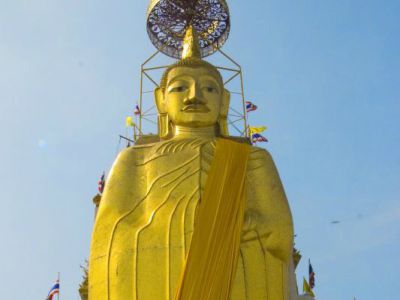
12) Wat Intharawihan (Temple of the Standing Buddha)
Wat Intharawihan is one of Thailand's most frequently visited temples. Built during the later Ayutthaya period, it is located in the Nakhon District of Bangkok. The main feature of the temple is a 32 meter high, 10 meters wide standing Buddha known as Luang Pho To or Phrasiariyametri. The topknot of the Buddha image contains a relic of Lord Buddha brought from Sri Lanka and took over 60 years to complete.
The statue faces east, holds alms-bowls in hands and remains sheathed with 24K golden mosaics brought from Italy. The peculiarity of the image is that it is very thin with prominently flat facial features. However, as a whole, it displays a very modernistic architectural style.
A closer look at the gigantic image reveals that even the gilded toenails of the statue are quite large. Smaller Buddha images are also placed near the feet of the statue. Next to the entrance of the temple, many caged birds are available for sale. People believe that purchasing and releasing the birds while standing on the base of the statue brings good luck, prosperity and success. Many Thais, as well as tourists, visit the temple every day and make various offerings at the feet of the statue in order to mark their devotion.
Why You Should Visit:
To see the impressively large outdoor Buddha statue as well as the museum underneath and several smaller structures.
The statue faces east, holds alms-bowls in hands and remains sheathed with 24K golden mosaics brought from Italy. The peculiarity of the image is that it is very thin with prominently flat facial features. However, as a whole, it displays a very modernistic architectural style.
A closer look at the gigantic image reveals that even the gilded toenails of the statue are quite large. Smaller Buddha images are also placed near the feet of the statue. Next to the entrance of the temple, many caged birds are available for sale. People believe that purchasing and releasing the birds while standing on the base of the statue brings good luck, prosperity and success. Many Thais, as well as tourists, visit the temple every day and make various offerings at the feet of the statue in order to mark their devotion.
Why You Should Visit:
To see the impressively large outdoor Buddha statue as well as the museum underneath and several smaller structures.
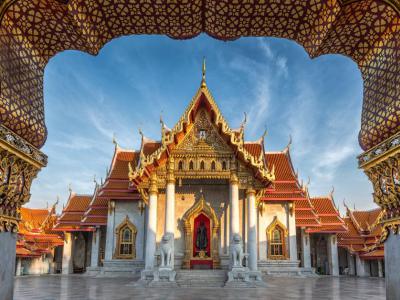
13) Wat Benchamabophit, The Marble temple”
Wat Benchamabophit Dusitvanaram, often referred to as the Marble Temple, is a prominent Buddhist temple located in the Dusit District of Bangkok. This temple is renowned as one of Bangkok's most famous religious sites and a significant attraction for tourists. It is a prime example of the elaborate architectural style found in Bangkok, characterized by its intricate gables, distinctive stepped-out roofs, and ornate finials.
Construction of this temple commenced in 1899, at the behest of King Chulalongkorn, who had constructed his palace nearby. The name of the temple translates to "the Temple of the fifth King located near Dusit Palace." It was meticulously designed by Prince Naris, who was the king's half-brother, and constructed using Italian marble. The temple boasts Carrara marble pillars, a marble courtyard, and two imposing singhas (lion statues) guarding the entrance to the bot, or the main hall. The cloister surrounding the assembly hall is home to 52 Buddha statues.
Within the ordination hall, visitors can find a Sukhothai-style Buddha statue named Phra Buddhajinaraja. The primary Buddha image in the temple is a replica of Phra Buddha Chinarat, which is situated in Phitsanulok in northern Thailand. Interestingly, the ashes of King Chulalongkorn rest beneath this statue. Notably, the temple's facade is depicted on the reverse side of the Five-Baht coin in the Thai currency. Additionally, the temple grounds house the Benchamabophit National Museum.
Devotees and merit-makers visit the temple daily to provide alms to the resident monks. This charitable practice occurs each morning from 6:00 to 7:30 AM, with the monks lining up on Nakhon Pathom with their alms bowls to receive donations that include curry, rice, lotus buds, incense, toiletries, and other essential items.
Construction of this temple commenced in 1899, at the behest of King Chulalongkorn, who had constructed his palace nearby. The name of the temple translates to "the Temple of the fifth King located near Dusit Palace." It was meticulously designed by Prince Naris, who was the king's half-brother, and constructed using Italian marble. The temple boasts Carrara marble pillars, a marble courtyard, and two imposing singhas (lion statues) guarding the entrance to the bot, or the main hall. The cloister surrounding the assembly hall is home to 52 Buddha statues.
Within the ordination hall, visitors can find a Sukhothai-style Buddha statue named Phra Buddhajinaraja. The primary Buddha image in the temple is a replica of Phra Buddha Chinarat, which is situated in Phitsanulok in northern Thailand. Interestingly, the ashes of King Chulalongkorn rest beneath this statue. Notably, the temple's facade is depicted on the reverse side of the Five-Baht coin in the Thai currency. Additionally, the temple grounds house the Benchamabophit National Museum.
Devotees and merit-makers visit the temple daily to provide alms to the resident monks. This charitable practice occurs each morning from 6:00 to 7:30 AM, with the monks lining up on Nakhon Pathom with their alms bowls to receive donations that include curry, rice, lotus buds, incense, toiletries, and other essential items.

14) Chatuchak Weekend Market (must see)
The Chatuchak Weekend Market is a great spot for those who enjoy searching for antiques, although it's worth noting that these days, you might not find the best deals in Bangkok here. Nevertheless, the market is a haven for shoppers, with over 8,000 stalls offering a wide array of ancient items. You can find nearly everything here, from designer clothing and fashion accessories to antiques, silks, and ceramics, all spread out across a vast 112,000 square meter area.
With more than 15,000 shops and stalls on the premises, this weekend market attracts over 200,000 visitors daily who are enticed by the extensive selection of antiques and household items available. The variety of goods is impressive and includes items like Moroccan lamps, wooden chests, colorful gemstones, exquisite handicrafts, religious artifacts, remarkable works of art, unique ceramics, porcelain, dolls, Chinese merchandise, vintage books and clothing, as well as various Asian collectibles, some dating back to the 19th century.
With more than 15,000 shops and stalls on the premises, this weekend market attracts over 200,000 visitors daily who are enticed by the extensive selection of antiques and household items available. The variety of goods is impressive and includes items like Moroccan lamps, wooden chests, colorful gemstones, exquisite handicrafts, religious artifacts, remarkable works of art, unique ceramics, porcelain, dolls, Chinese merchandise, vintage books and clothing, as well as various Asian collectibles, some dating back to the 19th century.
