

Belize City Introduction Walking Tour (Self Guided), Belize City
Belize City stands between two forces of nature—a river behind it and the Caribbean Sea in front. Over time it was shaped by logwood traders, coral explorers, and powerful hurricanes. Yet one of its greatest benefactors, Baron Bliss, never even stepped ashore. Confined by illness to his yacht, he still chose Belize as the place where he would leave his fortune—and his legacy.
Belize City, the largest city in Belize and the country’s historic commercial center, developed as a port settlement during the period when the territory was known as British Honduras. Long before European arrival, Maya communities lived along the rivers and coast of the region. In the 17th century, British settlers known as Baymen established logging camps here, exporting valuable hardwoods such as logwood and later mahogany. These early camps gradually grew into a trading settlement along the Belize River near the Caribbean coast.
The name “Belize” is generally believed to derive from the Belize River. One explanation traces it to the Maya words belix or beliz, meaning “muddy water,” describing the river during the rainy season. Another theory links the name to Peter Wallace, a Scottish buccaneer active in the area during the 17th century, whose surname may have evolved into “Belize” through Spanish pronunciation.
During the 18th and 19th centuries, Belize City became the administrative and commercial center of the British colony. Warehouses and merchants’ offices lined the waterfront, supporting the timber trade and regional shipping. Despite repeated damage from fires and hurricanes, the city remained the country’s main urban center until Hurricane Hattie in 1961 led to the creation of the new inland capital, Belmopan. Belize City nevertheless continues to function as the nation’s principal port and economic hub.
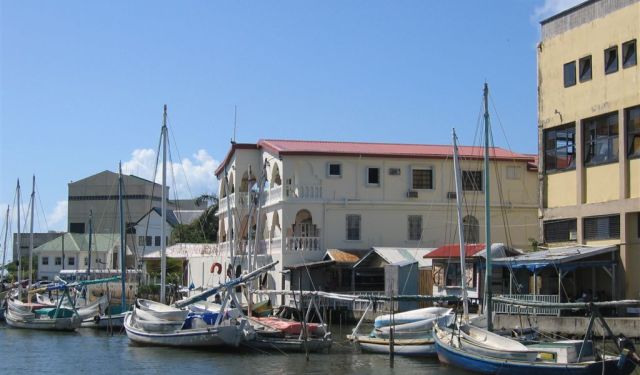
Walking through the city center of Belize City, visitors encounter colonial-era buildings, lively commercial streets, and views of the Caribbean Sea. Landmarks such as St. John’s Cathedral, the Swing Bridge, and the Baron Bliss Lighthouse reflect the city’s layered past. Along Albert Street, shops, banks, and street vendors create a busy local atmosphere, while nearby parks and waterfront promenades offer places to pause and watch boats move through the harbor.
As you walk, you are following paths shaped by traders, sailors, and settlers—and moving through the city that ultimately received the final gift of Baron Bliss, the unlikely benefactor who chose Belize as the place to bless.
Belize City, the largest city in Belize and the country’s historic commercial center, developed as a port settlement during the period when the territory was known as British Honduras. Long before European arrival, Maya communities lived along the rivers and coast of the region. In the 17th century, British settlers known as Baymen established logging camps here, exporting valuable hardwoods such as logwood and later mahogany. These early camps gradually grew into a trading settlement along the Belize River near the Caribbean coast.
The name “Belize” is generally believed to derive from the Belize River. One explanation traces it to the Maya words belix or beliz, meaning “muddy water,” describing the river during the rainy season. Another theory links the name to Peter Wallace, a Scottish buccaneer active in the area during the 17th century, whose surname may have evolved into “Belize” through Spanish pronunciation.
During the 18th and 19th centuries, Belize City became the administrative and commercial center of the British colony. Warehouses and merchants’ offices lined the waterfront, supporting the timber trade and regional shipping. Despite repeated damage from fires and hurricanes, the city remained the country’s main urban center until Hurricane Hattie in 1961 led to the creation of the new inland capital, Belmopan. Belize City nevertheless continues to function as the nation’s principal port and economic hub.
Walking through the city center of Belize City, visitors encounter colonial-era buildings, lively commercial streets, and views of the Caribbean Sea. Landmarks such as St. John’s Cathedral, the Swing Bridge, and the Baron Bliss Lighthouse reflect the city’s layered past. Along Albert Street, shops, banks, and street vendors create a busy local atmosphere, while nearby parks and waterfront promenades offer places to pause and watch boats move through the harbor.
As you walk, you are following paths shaped by traders, sailors, and settlers—and moving through the city that ultimately received the final gift of Baron Bliss, the unlikely benefactor who chose Belize as the place to bless.
How it works: Download the app "GPSmyCity: Walks in 1K+ Cities" from Apple App Store or Google Play Store to your mobile phone or tablet. The app turns your mobile device into a personal tour guide and its built-in GPS navigation functions guide you from one tour stop to next. The app works offline, so no data plan is needed when traveling abroad.
Belize City Introduction Walking Tour Map
Guide Name: Belize City Introduction Walking Tour
Guide Location: Belize » Belize City (See other walking tours in Belize City)
Guide Type: Self-guided Walking Tour (Sightseeing)
# of Attractions: 12
Tour Duration: 2 Hour(s)
Travel Distance: 3.6 Km or 2.2 Miles
Author: DanaOffice
Sight(s) Featured in This Guide:
Guide Location: Belize » Belize City (See other walking tours in Belize City)
Guide Type: Self-guided Walking Tour (Sightseeing)
# of Attractions: 12
Tour Duration: 2 Hour(s)
Travel Distance: 3.6 Km or 2.2 Miles
Author: DanaOffice
Sight(s) Featured in This Guide:
- Belize City Cruise Terminal
- Fort Street Tourism Village
- The Belize Sign Monument
- Baron Bliss Lighthouse
- Memorial Park
- Museum of Belize
- Swing Bridge
- Supreme Court of Belize
- Bliss Institute
- Museum of Belizean Art
- St. John's Cathedral
- Albert Street
1) Belize City Cruise Terminal
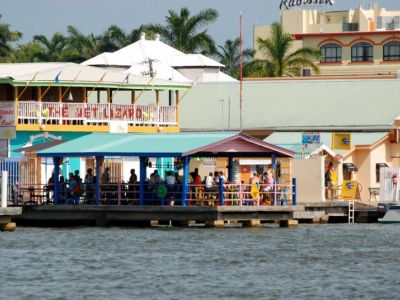
Belize City Cruise Terminal serves as the main gateway for cruise visitors arriving in Belize City and is one of the busiest entry points for travelers exploring the country. Located along the waterfront near the historic center, the terminal connects passengers from anchored cruise ships with the city by tender boats that shuttle visitors directly to the port. Because Belize City’s harbor is relatively shallow, most large cruise vessels anchor offshore, making the tender ride across the harbor a distinctive part of the arrival experience.
The terminal area is designed to welcome visitors with a lively mix of local shops, restaurants, and tour services. Colorful market stalls sell Belizean handicrafts, souvenirs, jewelry, and locally produced goods, giving travelers a first introduction to the country’s culture and craftsmanship. Small cafés and bars offer refreshments and Caribbean-inspired dishes, allowing visitors to relax before beginning their excursions.
Beyond shopping, the cruise terminal also functions as an orientation point for exploring Belize and the surrounding region. Tour operators located at the terminal arrange excursions to some of the country’s most famous attractions, including the Belize Barrier Reef, nearby caves, jungle adventures, and Mayan archaeological sites such as Altun Ha. Transportation services and guides are readily available to help visitors plan their day.
The terminal area is designed to welcome visitors with a lively mix of local shops, restaurants, and tour services. Colorful market stalls sell Belizean handicrafts, souvenirs, jewelry, and locally produced goods, giving travelers a first introduction to the country’s culture and craftsmanship. Small cafés and bars offer refreshments and Caribbean-inspired dishes, allowing visitors to relax before beginning their excursions.
Beyond shopping, the cruise terminal also functions as an orientation point for exploring Belize and the surrounding region. Tour operators located at the terminal arrange excursions to some of the country’s most famous attractions, including the Belize Barrier Reef, nearby caves, jungle adventures, and Mayan archaeological sites such as Altun Ha. Transportation services and guides are readily available to help visitors plan their day.
2) Fort Street Tourism Village
Fort Street Tourism Village is Belize City’s main cruise arrival hub, welcoming passengers who reach shore by tender boats from ships anchored offshore. Located along the harbor near the historic center, the complex features colorful buildings, open-air courtyards, shops selling Belizean crafts and souvenirs, and cafés and restaurants overlooking the Caribbean Sea.
When you head north-east from the cruise terminal toward Fort Street, you will enter the main pedestrian section of the Fort Street Tourism Village. From the tender dock, follow the clearly marked walkway leading inland through the security checkpoint. Immediately beyond the entrance, the path opens into the village’s open-air shopping courtyard, where rows of small, colorful storefronts line both sides of the pedestrian walkway. Here you will find shops selling Belizean handicrafts, jewelry, textiles, wood carvings, and locally produced souvenirs arranged around shaded courtyards.
Continuing along the main walkway toward Fort Street, you will begin to see several restaurants and bars positioned around the central plaza areas of the village. Many of these establishments are easy to spot thanks to their outdoor seating areas and shaded terraces, where visitors can sit with views of the harbor while enjoying Caribbean dishes, fresh seafood, tropical drinks, or Belizean snacks.
As you move through the central open plaza of the Tourism Village, you may encounter street entertainment and cultural performances, especially on busy cruise days. Musicians, drummers, or small dance groups often perform in the open spaces between the shop buildings and near the central gathering areas where visitors naturally stop to rest or browse.
Before exiting the village onto Fort Street, take a moment to look around the larger courtyard spaces near the entrance and along the waterfront side of the complex. These areas are the most common locations for temporary craft stalls, music performances, and informal street entertainment.
When you head north-east from the cruise terminal toward Fort Street, you will enter the main pedestrian section of the Fort Street Tourism Village. From the tender dock, follow the clearly marked walkway leading inland through the security checkpoint. Immediately beyond the entrance, the path opens into the village’s open-air shopping courtyard, where rows of small, colorful storefronts line both sides of the pedestrian walkway. Here you will find shops selling Belizean handicrafts, jewelry, textiles, wood carvings, and locally produced souvenirs arranged around shaded courtyards.
Continuing along the main walkway toward Fort Street, you will begin to see several restaurants and bars positioned around the central plaza areas of the village. Many of these establishments are easy to spot thanks to their outdoor seating areas and shaded terraces, where visitors can sit with views of the harbor while enjoying Caribbean dishes, fresh seafood, tropical drinks, or Belizean snacks.
As you move through the central open plaza of the Tourism Village, you may encounter street entertainment and cultural performances, especially on busy cruise days. Musicians, drummers, or small dance groups often perform in the open spaces between the shop buildings and near the central gathering areas where visitors naturally stop to rest or browse.
Before exiting the village onto Fort Street, take a moment to look around the larger courtyard spaces near the entrance and along the waterfront side of the complex. These areas are the most common locations for temporary craft stalls, music performances, and informal street entertainment.
3) The Belize Sign Monument (must see)
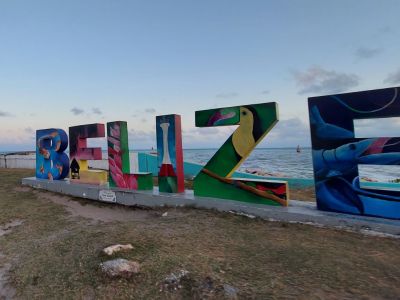
The Belize Sign Monument is one of the most recognizable photo spots along the Belize City waterfront. Located on the seaside promenade, the monument features large, colorful letters spelling “BELIZE,” creating a bright and welcoming landmark that celebrates national pride. Set against views of the Caribbean Sea, the sign has become a popular place where visitors stop to take photographs and mark their arrival in the country.
Each letter of the monument is decorated with vivid patterns and imagery inspired by Belizean culture, nature, and history. The designs reflect elements of the country’s identity, including tropical wildlife, marine life from the nearby barrier reef, traditional motifs, and references to the diverse cultures that shape Belize. The colorful artwork makes the monument both a public art installation and a visual introduction to the spirit of the country.
The location of the sign along the waterfront adds to its appeal. From here, visitors can enjoy sea breezes and wide views across the harbor while watching boats move through the bay. The promenade around the monument is a pleasant place for a short stroll, especially in the early morning or late afternoon when the Caribbean light enhances the bright colors of the sign.
Each letter of the monument is decorated with vivid patterns and imagery inspired by Belizean culture, nature, and history. The designs reflect elements of the country’s identity, including tropical wildlife, marine life from the nearby barrier reef, traditional motifs, and references to the diverse cultures that shape Belize. The colorful artwork makes the monument both a public art installation and a visual introduction to the spirit of the country.
The location of the sign along the waterfront adds to its appeal. From here, visitors can enjoy sea breezes and wide views across the harbor while watching boats move through the bay. The promenade around the monument is a pleasant place for a short stroll, especially in the early morning or late afternoon when the Caribbean light enhances the bright colors of the sign.
4) Baron Bliss Lighthouse
Baron Bliss Lighthouse is one of the most recognizable landmarks on the Belize City waterfront and a place closely connected with the country’s modern history. The lighthouse stands at the entrance to the harbor along the seaside promenade and marks the location of the tomb of Baron Henry Edward Ernest Victor Bliss, commonly known as Barron Bliss, an English philanthropist who left a significant legacy to Belize. Although he never set foot on the mainland, Bliss became deeply attached to the country during a visit to its waters in the 1920s.
Baron Bliss died aboard his yacht in 1926, but before his death he left a generous portion of his fortune to the people of what was then British Honduras. His will established the Baron Bliss Trust, which funded schools, libraries, parks, and public projects across the country. In accordance with his wishes, he was buried near the sea he loved, and the lighthouse was later built beside his tomb as a memorial.
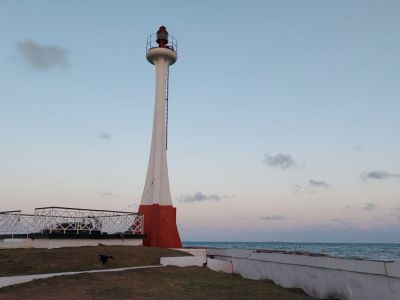
The lighthouse itself is a white structure topped with a red lantern, standing beside the marble tomb monument of Baron Bliss. The area around the lighthouse forms part of a small waterfront park where visitors can walk along the seawall and enjoy open views of the Caribbean Sea and the harbor.
Baron Bliss died aboard his yacht in 1926, but before his death he left a generous portion of his fortune to the people of what was then British Honduras. His will established the Baron Bliss Trust, which funded schools, libraries, parks, and public projects across the country. In accordance with his wishes, he was buried near the sea he loved, and the lighthouse was later built beside his tomb as a memorial.
The lighthouse itself is a white structure topped with a red lantern, standing beside the marble tomb monument of Baron Bliss. The area around the lighthouse forms part of a small waterfront park where visitors can walk along the seawall and enjoy open views of the Caribbean Sea and the harbor.
5) Memorial Park
Memorial Park is located along the Marine Parade waterfront overlooking the Caribbean Sea. Created in the early 20th century, the park was established to honor the men from British Honduras—today’s Belize—who lost their lives while serving in the First and Second World Wars. Set within the historic heart of the city, the park stands as a place of remembrance and reflection amid the movement of daily life along the waterfront.
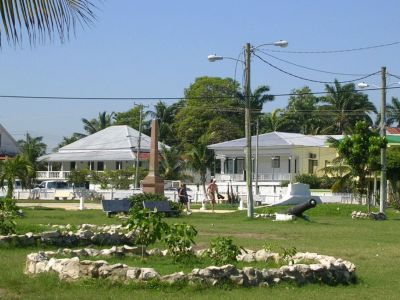
At the center of the park stands a war memorial monument dedicated to Belizean soldiers who served in the British armed forces during the global conflicts of the 20th century. Their service reflected the colony’s connection to the wider British Empire at the time, when volunteers from across the Caribbean traveled overseas to support the war effort. The monument bears the names of those who died, ensuring their sacrifice remains part of the country’s historical memory.
During the daytime, Memorial Park offers a quiet green space shaded by trees, where visitors can pause and enjoy views of the sea while exploring the surrounding historic district. Benches and open lawns create a calm atmosphere that contrasts with the busy streets nearby, making the park a natural place for reflection.
Yet the park also plays an important role in Belize’s contemporary cultural life. During national holidays, festivals, and public celebrations, Memorial Park transforms from a place of quiet remembrance into a vibrant community stage, hosting concerts, cultural performances, and public gatherings.
At the center of the park stands a war memorial monument dedicated to Belizean soldiers who served in the British armed forces during the global conflicts of the 20th century. Their service reflected the colony’s connection to the wider British Empire at the time, when volunteers from across the Caribbean traveled overseas to support the war effort. The monument bears the names of those who died, ensuring their sacrifice remains part of the country’s historical memory.
During the daytime, Memorial Park offers a quiet green space shaded by trees, where visitors can pause and enjoy views of the sea while exploring the surrounding historic district. Benches and open lawns create a calm atmosphere that contrasts with the busy streets nearby, making the park a natural place for reflection.
Yet the park also plays an important role in Belize’s contemporary cultural life. During national holidays, festivals, and public celebrations, Memorial Park transforms from a place of quiet remembrance into a vibrant community stage, hosting concerts, cultural performances, and public gatherings.
6) Museum of Belize
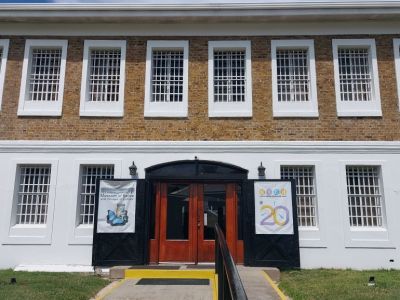
Museum of Belize is one of the country’s most important cultural institutions, offering visitors a clear introduction to the history and heritage of Belize. Located in the historic center of Belize City, the museum occupies a colonial-era building that once served as Her Majesty’s Prison during the British Honduras period. Constructed in 1857 using bricks brought from England as ship ballast, the structure itself is a reminder of the city’s colonial past and its connections to maritime trade.
The museum’s exhibits trace Belize’s history across many centuries, beginning with the ancient Maya civilization, whose cities once flourished throughout the region. Displays include artifacts, pottery, and models that explain Maya culture, trade, and daily life. The galleries then move through the colonial period, highlighting the development of logging settlements, the rise of the mahogany trade, and Belize’s evolution from British Honduras to an independent nation.
Visitors will also find exhibits dedicated to Belize’s diverse cultural traditions. Displays explore the heritage of the Creole, Garifuna, Mestizo, Maya, and other communities that contribute to the country’s cultural identity. Historic photographs, documents, and everyday objects help illustrate how these different traditions shaped Belizean society.
Today, the Museum of Belize serves not only as a place to view historical artifacts but also as a center for education and cultural programs.
The museum’s exhibits trace Belize’s history across many centuries, beginning with the ancient Maya civilization, whose cities once flourished throughout the region. Displays include artifacts, pottery, and models that explain Maya culture, trade, and daily life. The galleries then move through the colonial period, highlighting the development of logging settlements, the rise of the mahogany trade, and Belize’s evolution from British Honduras to an independent nation.
Visitors will also find exhibits dedicated to Belize’s diverse cultural traditions. Displays explore the heritage of the Creole, Garifuna, Mestizo, Maya, and other communities that contribute to the country’s cultural identity. Historic photographs, documents, and everyday objects help illustrate how these different traditions shaped Belizean society.
Today, the Museum of Belize serves not only as a place to view historical artifacts but also as a center for education and cultural programs.
7) Swing Bridge
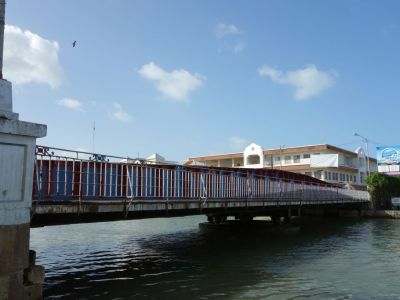
Spanning Haulover Creek, the Swing Bridge connects the north and south sides of the city and has served for decades as an important crossing between the commercial center and nearby neighborhoods. Completed in 1923, the structure became famous as one of the few manually operated swing bridges in the world, reflecting early 20th-century engineering adapted to the needs of a busy harbor town.
The bridge was designed with a rotating central span that could pivot open to allow boats traveling along Haulover Creek to pass. This movement was traditionally controlled by operators turning large hand wheels that slowly rotated the bridge on its central pivot. For many years the opening of the bridge was a familiar daily sight in Belize City, illustrating the city’s close connection to the waterways that shaped its development.
In recent years, however, the bridge’s role has changed. With a decline in heavy boat traffic along Haulover Creek, the span is no longer opened regularly and is typically swung only for special ceremonies or by special request. Despite this reduced operation, the bridge remains a powerful symbol of Belize City’s maritime heritage and continues to attract visitors interested in its unusual mechanical design.
A major transition is now planned for the historic crossing. In late 2025, the Government of Belize signed a grant agreement with the Government of Japan to construct a modern replacement bridge designed to better withstand traffic demands and environmental conditions. Preparations are underway for a temporary bridge at Hyde’s Lane, which will maintain traffic flow during reconstruction scheduled to begin in January 2027, with completion expected by 2029.
Importantly, elements of the original 1923 structure, including the historic manual swing mechanism, will be preserved and displayed so future generations can continue to appreciate this iconic piece of Belize City’s engineering history.
The bridge was designed with a rotating central span that could pivot open to allow boats traveling along Haulover Creek to pass. This movement was traditionally controlled by operators turning large hand wheels that slowly rotated the bridge on its central pivot. For many years the opening of the bridge was a familiar daily sight in Belize City, illustrating the city’s close connection to the waterways that shaped its development.
In recent years, however, the bridge’s role has changed. With a decline in heavy boat traffic along Haulover Creek, the span is no longer opened regularly and is typically swung only for special ceremonies or by special request. Despite this reduced operation, the bridge remains a powerful symbol of Belize City’s maritime heritage and continues to attract visitors interested in its unusual mechanical design.
A major transition is now planned for the historic crossing. In late 2025, the Government of Belize signed a grant agreement with the Government of Japan to construct a modern replacement bridge designed to better withstand traffic demands and environmental conditions. Preparations are underway for a temporary bridge at Hyde’s Lane, which will maintain traffic flow during reconstruction scheduled to begin in January 2027, with completion expected by 2029.
Importantly, elements of the original 1923 structure, including the historic manual swing mechanism, will be preserved and displayed so future generations can continue to appreciate this iconic piece of Belize City’s engineering history.
8) Supreme Court of Belize
High Court of Belize—formerly known as the Supreme Court of Belize—is one of the most important civic landmarks in Belize City and the central headquarters of the country’s High Court. Located within the historic government district near St. John's Cathedral and the Museum of Belizean Art (formerly Government House), the building reflects Belize’s long legal tradition, which grew from the British colonial system of law and continues to influence the nation’s judiciary today.
The present structure dates to 1926 and represents the third courthouse built on this site. Earlier wooden courthouses were destroyed by fires in 1820 and again in 1918, prompting the construction of a more durable replacement. Unlike its predecessors, the current building was designed with reinforced concrete, ensuring greater fire resistance while maintaining the appearance of an elegant civic building.
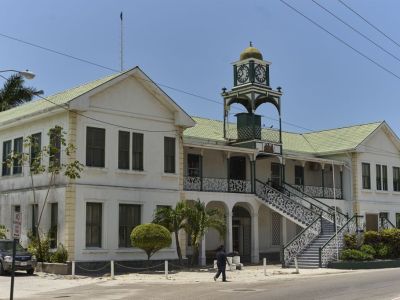
Architecturally, the courthouse stands out for its distinctive New Orleans–influenced style, an uncommon feature in Belize City. Decorative filigreed iron staircases and balcony railings add visual detail to the façade, while a prominent four-sided clock tower rises above the structure, making the building easy to recognize from nearby streets. These elements combine Caribbean colonial practicality with ornamental touches typical of Gulf Coast architecture.
In recent years, the building underwent careful modernization while preserving its historic character. Roughly 60 percent of the original exterior structure was retained, while major upgrades included a new roof, modern electrical systems, and redesigned interior spaces.
The present structure dates to 1926 and represents the third courthouse built on this site. Earlier wooden courthouses were destroyed by fires in 1820 and again in 1918, prompting the construction of a more durable replacement. Unlike its predecessors, the current building was designed with reinforced concrete, ensuring greater fire resistance while maintaining the appearance of an elegant civic building.
Architecturally, the courthouse stands out for its distinctive New Orleans–influenced style, an uncommon feature in Belize City. Decorative filigreed iron staircases and balcony railings add visual detail to the façade, while a prominent four-sided clock tower rises above the structure, making the building easy to recognize from nearby streets. These elements combine Caribbean colonial practicality with ornamental touches typical of Gulf Coast architecture.
In recent years, the building underwent careful modernization while preserving its historic character. Roughly 60 percent of the original exterior structure was retained, while major upgrades included a new roof, modern electrical systems, and redesigned interior spaces.
9) Bliss Institute
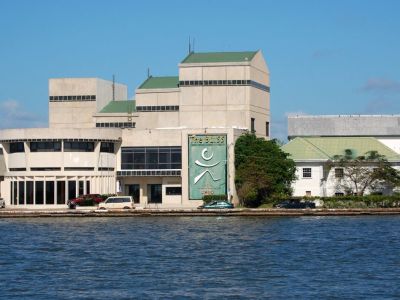
Bliss Institute is one of the most important cultural landmarks in Belize City and a long-standing center for the performing arts. Located along the Southern Foreshore overlooking the Caribbean Sea, the institute has played a central role in the country’s artistic and intellectual life for decades. It serves as a venue where Belizeans gather to celebrate music, theater, dance, and community events.
The institute was established through the legacy of Henry Edward Ernest Victor Bliss, commonly known as Baron Bliss, a British traveler and philanthropist who left a significant portion of his fortune to Belize upon his death in 1926. His bequest funded several public institutions and cultural projects, including this center dedicated to promoting education and the arts within the country.
Beyond its auditorium and performance spaces, the Bliss Institute complex also houses the National Library and an Art Gallery, creating a broader cultural and intellectual hub. The Art Gallery features a dynamic schedule of rotating exhibitions by Belizean artists, complementing the national collection found at the nearby Museum of Belizean Art.
Together these institutions support exhibitions, research, and public programs that celebrate Belizean heritage and creativity.
The institute was established through the legacy of Henry Edward Ernest Victor Bliss, commonly known as Baron Bliss, a British traveler and philanthropist who left a significant portion of his fortune to Belize upon his death in 1926. His bequest funded several public institutions and cultural projects, including this center dedicated to promoting education and the arts within the country.
Beyond its auditorium and performance spaces, the Bliss Institute complex also houses the National Library and an Art Gallery, creating a broader cultural and intellectual hub. The Art Gallery features a dynamic schedule of rotating exhibitions by Belizean artists, complementing the national collection found at the nearby Museum of Belizean Art.
Together these institutions support exhibitions, research, and public programs that celebrate Belizean heritage and creativity.
10) Museum of Belizean Art
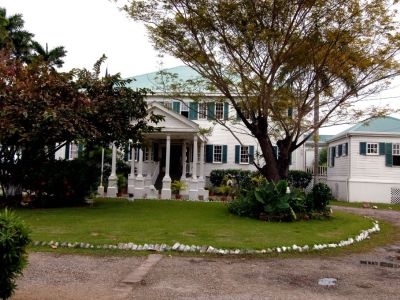
Museum of Belizean Art (former Government House) occupies one of the most distinguished colonial-era buildings in Belize City. Constructed in 1812, the building originally served as Government House, the official residence of the British colonial governors when Belize was known as British Honduras. For more than a century it functioned as a center of colonial administration where governors received dignitaries and conducted official affairs. The site later gained major national significance when the Belizean flag was first raised here at midnight on September 21, 1981, marking Belize’s independence from Great Britain.
Architecturally, the structure reflects a refined British colonial style adapted to the tropical climate. The building combines brick construction with extensive use of Belizean mahogany, the valuable timber that once formed the backbone of the colony’s economy. Wide verandas, tall windows, and elevated floors were designed to improve airflow and provide shade from the Caribbean heat. The balanced Georgian proportions and elegant wooden galleries give the residence a graceful yet practical character suited to its coastal setting.
Today the building houses the Museum of Belizean Art, where visitors can explore works by local artists that reflect the country’s culture, history, and contemporary identity. The galleries present paintings, sculptures, and mixed-media pieces that highlight both traditional themes and modern artistic expression. Walking through the museum also offers insight into the building itself, as several rooms retain the atmosphere of the former governor’s residence.
The museum stands at the southern end of Regent Street, overlooking the Caribbean Sea. Its surrounding gardens, originally designed by a botanist from Kew Gardens in London, were intended to showcase tropical plants and create a dignified setting for the residence.
Architecturally, the structure reflects a refined British colonial style adapted to the tropical climate. The building combines brick construction with extensive use of Belizean mahogany, the valuable timber that once formed the backbone of the colony’s economy. Wide verandas, tall windows, and elevated floors were designed to improve airflow and provide shade from the Caribbean heat. The balanced Georgian proportions and elegant wooden galleries give the residence a graceful yet practical character suited to its coastal setting.
Today the building houses the Museum of Belizean Art, where visitors can explore works by local artists that reflect the country’s culture, history, and contemporary identity. The galleries present paintings, sculptures, and mixed-media pieces that highlight both traditional themes and modern artistic expression. Walking through the museum also offers insight into the building itself, as several rooms retain the atmosphere of the former governor’s residence.
The museum stands at the southern end of Regent Street, overlooking the Caribbean Sea. Its surrounding gardens, originally designed by a botanist from Kew Gardens in London, were intended to showcase tropical plants and create a dignified setting for the residence.
11) St. John's Cathedral (must see)
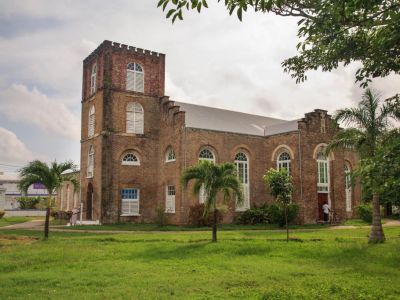
St. John's Cathedral is one of the most important historic landmarks in Belize City and the oldest Anglican church in Central America. Built between 1812 and 1820, the cathedral reflects the period when Belize—then known as British Honduras—was under British colonial influence. Its construction is particularly notable because many of the bricks used in the building were brought to Belize as ballast in British ships crossing the Atlantic. Set on slightly elevated ground in the historic heart of the city, the cathedral has long served as a focal point for religious and civic life.
Architecturally, St. John’s Cathedral stands out for its Georgian-style design, a rare feature in the Caribbean and Central America. The structure combines solid brick walls with tall windows and a modest tower, creating an appearance that feels distinctly British despite its tropical surroundings.
Inside St. John's Cathedral, most of the historic features are easy to locate because the church follows a simple single-nave layout. After entering through the main western doorway, walk straight into the central aisle of the nave. On both sides of this aisle you will see the original wooden pews, arranged in long rows facing the altar. These benches date from the early years of the cathedral and remain one of the most visible historic furnishings inside the building.
As you continue forward along the aisle, look toward the side walls of the nave. Mounted along these walls are several memorial plaques dedicated to early settlers, colonial officials, and members of the Anglican community connected with Belize’s early history.
At the far eastern end of the cathedral, the space opens into the chancel and altar area. Here visitors can see additional historic furnishings, including the altar table, wooden railings, and other liturgical elements used during Anglican services.
The cathedral also holds a unique place in Belize’s political history. During the 19th century, it served as the site where several British colonial superintendents were crowned as “Kings of the Mosquito Coast.” These ceremonies, held between 1816 and 1845, symbolized British influence over the neighboring region of present-day Nicaragua and gave the church an unusual ceremonial importance in colonial administration.
Today, St. John’s Cathedral remains an active place of worship and a key historical attraction for visitors exploring Belize City. Surrounded by mature trees and nearby historic buildings, it forms part of a small heritage area that includes Government House and the House of Culture.
Architecturally, St. John’s Cathedral stands out for its Georgian-style design, a rare feature in the Caribbean and Central America. The structure combines solid brick walls with tall windows and a modest tower, creating an appearance that feels distinctly British despite its tropical surroundings.
Inside St. John's Cathedral, most of the historic features are easy to locate because the church follows a simple single-nave layout. After entering through the main western doorway, walk straight into the central aisle of the nave. On both sides of this aisle you will see the original wooden pews, arranged in long rows facing the altar. These benches date from the early years of the cathedral and remain one of the most visible historic furnishings inside the building.
As you continue forward along the aisle, look toward the side walls of the nave. Mounted along these walls are several memorial plaques dedicated to early settlers, colonial officials, and members of the Anglican community connected with Belize’s early history.
At the far eastern end of the cathedral, the space opens into the chancel and altar area. Here visitors can see additional historic furnishings, including the altar table, wooden railings, and other liturgical elements used during Anglican services.
The cathedral also holds a unique place in Belize’s political history. During the 19th century, it served as the site where several British colonial superintendents were crowned as “Kings of the Mosquito Coast.” These ceremonies, held between 1816 and 1845, symbolized British influence over the neighboring region of present-day Nicaragua and gave the church an unusual ceremonial importance in colonial administration.
Today, St. John’s Cathedral remains an active place of worship and a key historical attraction for visitors exploring Belize City. Surrounded by mature trees and nearby historic buildings, it forms part of a small heritage area that includes Government House and the House of Culture.
12) Albert Street
Albert Street is one of the main commercial streets in Belize City and a lively corridor that captures the everyday rhythm of the historic downtown. Running through the heart of the old city near Haulover Creek, the street has long served as a hub of trade, shopping, and local activity. For visitors exploring Belize City on foot, Albert Street offers a glimpse into the city’s daily life beyond its historic landmarks.
At the northern end of the street near the Swing Bridge, a small triangular space known as Mule Park marks an important piece of the city’s commercial past. In earlier decades, mule carts gathered here to transport goods arriving by boat along Haulover Creek into the town’s warehouses and shops. Today, Mule Park remains a lively meeting spot where locals pause, street vendors set up their stalls, and the flow of pedestrians reflects the continuing energy of downtown Belize City.
Albert Street is also considered the financial center of the country, home to several historic banking institutions. Buildings such as those associated with Heritage Bank and Belize Bank stand along the street. Around them, a mix of small shops, restaurants, and service businesses continues the long tradition of local trade that has defined the street for generations.
Walking along Albert Street can be a vivid sensory experience. The road itself is narrow and often busy with taxis and the colorful local minibuses known as “safari” buses. Music spills from shop entrances, vendors sell snacks such as Belizean meat pies, and the scent of street food drifts through the air. The atmosphere becomes especially lively on Saturday mornings, when shoppers from across the city gather here, filling the street with conversation, music, and the unmistakable energy of Belize City’s commercial heart.
At the northern end of the street near the Swing Bridge, a small triangular space known as Mule Park marks an important piece of the city’s commercial past. In earlier decades, mule carts gathered here to transport goods arriving by boat along Haulover Creek into the town’s warehouses and shops. Today, Mule Park remains a lively meeting spot where locals pause, street vendors set up their stalls, and the flow of pedestrians reflects the continuing energy of downtown Belize City.
Albert Street is also considered the financial center of the country, home to several historic banking institutions. Buildings such as those associated with Heritage Bank and Belize Bank stand along the street. Around them, a mix of small shops, restaurants, and service businesses continues the long tradition of local trade that has defined the street for generations.
Walking along Albert Street can be a vivid sensory experience. The road itself is narrow and often busy with taxis and the colorful local minibuses known as “safari” buses. Music spills from shop entrances, vendors sell snacks such as Belizean meat pies, and the scent of street food drifts through the air. The atmosphere becomes especially lively on Saturday mornings, when shoppers from across the city gather here, filling the street with conversation, music, and the unmistakable energy of Belize City’s commercial heart.
The Most Popular Cities
/ view all