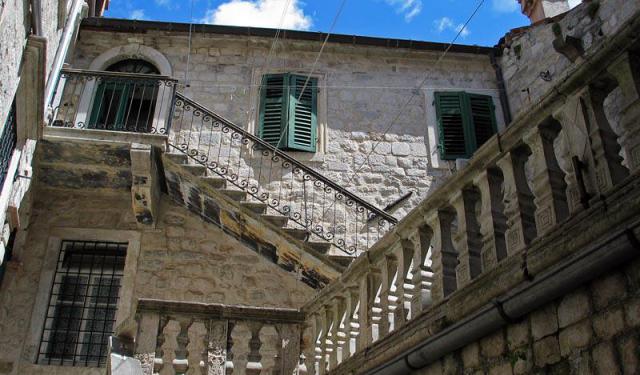


Kotor Palaces Walking Tour, Kotor

Kotor Palaces Walking Tour (Self Guided), Kotor

This magnificent historic city is home to a number of wonderful palaces. Many of these beautifully ornamented mansions belonged to wealthy and influential families. Visitors can trace the history of each building by looking at the coats of arms of noble families and the paintings on the walls. Take this self-guided tour to see these beautiful historical palaces in Kotor.
How it works: Download the app "GPSmyCity: Walks in 1K+ Cities" from Apple App Store or Google Play Store to your mobile phone or tablet. The app turns your mobile device into a personal tour guide and its built-in GPS navigation functions guide you from one tour stop to next. The app works offline, so no data plan is needed when traveling abroad.

Download The GPSmyCity App

Kotor Palaces Walking Tour Map

Guide Name: Kotor Palaces Walking Tour
Guide Location: Montenegro » Kotor (See other walking tours in Kotor)
Guide Type: Self-guided Walking Tour (Sightseeing)
# of Attractions: 7
Tour Duration: 1 Hour(s)
Travel Distance: 0.4 Km or 0.2 Miles
Author: emily
Sight(s) Featured in This Guide:
  • Palata Bizanti (Bizanti Palace)
  • Palata Beskuca (Beskuca Palace)
  • Palata Pima (Pima Palace)
  • Palata Drago (Drago Palace)
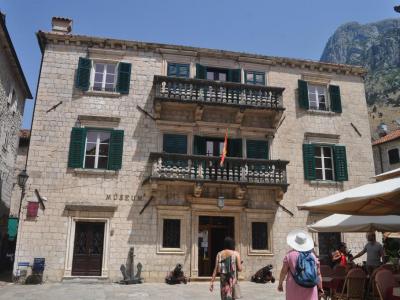
  • Museum Maritimum (Grgurin Palace and Maritime Museum)
  • Palata Lombardic (Lombardic Palace)
  • Palata Grubonja (Grubonja Palace)
1
Palata Bizanti (Bizanti Palace)

1) Palata Bizanti (Bizanti Palace)

Situated in the busy Arms Square, the Bizanti Palace traces its roots back to the 14th century. Today, it stands as a fine example of Renaissance architecture infused with Baroque elements, still bearing the initials and coat of arms of the esteemed Bizanti family. The ground floor accomodates a post office, along with several souvenir shops.

The Bizanti family, whose lineage dates back to the 11th century, has produced a host of notable individuals including captains, professors, and priests. Among them, Nikola Bizanti, a distinguished city judge, stands out. Following the earthquake of 1667, he spearheaded the reconstruction efforts of both the palace and the family residence, leaving a lasting legacy.

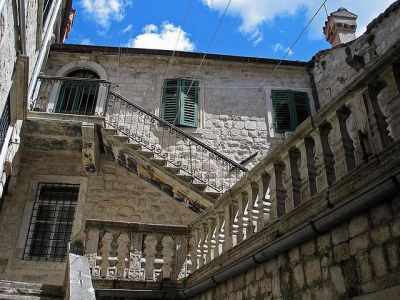
Along the street lies the entrance to the courtyard of the family home, open to visitors at no charge. Here, guests can marvel at the remnants of a bygone era: a quaint stone staircase, elegant balconies, and a weathered water well, evoking a sense of pure romance.
2
Palata Beskuca (Beskuca Palace)

2) Palata Beskuca (Beskuca Palace)

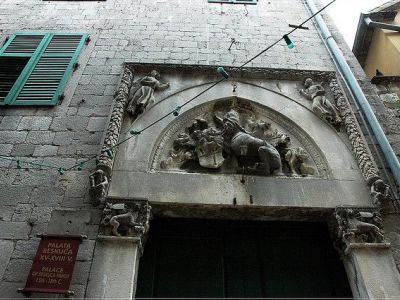
The Beskuća Palace stands on the street leading from the Arms Square to the Flour Square, opposite the Bizanti Palace, and was constructed in 1776, replacing older structures that occupied the site. It is believed that one of these structures was the residence of the prominent Bizanti family, from which the palace inherited its portal.

Featuring a simple architectural design with clean lines and minimal decorative elements, the palace is distinguished primarily by its aforementioned Gothic portal, widely regarded as a masterpiece of floral Gothic architecture along the entire eastern Adriatic coast. At its center is the family's coat of arms, depicting a winged lion, while below it, a Latin inscription reads: "Si deus com nobis, quis contra nos" ("If God is with us, who can be against us").

Originally belonging to the Beskuća family from Prčanj, the palace signifies the family's ascent to prominence in the late 18th century, fueled by their success in maritime trade. Bestowed with nobility, the family amassed considerable wealth and possessed numerous estates and residences across the Bay of Kotor, as well as in Venice and Constantinople.
3
Palata Pima (Pima Palace)

3) Palata Pima (Pima Palace)

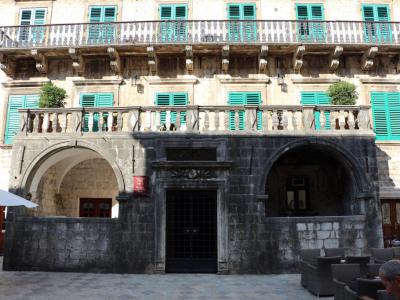
Once hailed as Kotor’s most exquisite palace of the 17th century, this grand abode was once the stately home of the esteemed Pima family, whose members included renowned poets Jerome and Bernard. Despite enduring the ravages of countless earthquakes over the years, the structure rose from the ashes following the catastrophic tremor of 1667 and again after the one in 1979. Today, its main portal proudly showcases the Pima family coat of arms, upheld by two angelic figures.

With a touch of imagination and a squint of the eyes, one can conjure a glimpse of the palace's former splendor. A harmonious blend of Renaissance and Baroque styles, adorned with intricate balconies, the façade's green shutters serve to divert attention from the now weathered exterior. On the ground floor, the Galerija Solidarnosti takes center stage – a museum showcasing artworks by artists and sculptors from former Yugoslavian countries, as well as the United States, Poland, Romania, and beyond.
4
Palata Drago (Drago Palace)

4) Palata Drago (Drago Palace)

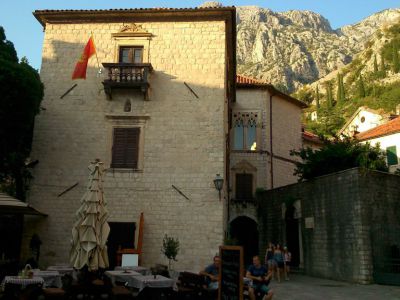
Nestled within Saint Tryphon's Square, this palace maintains a distinctive dual character across its two sections. The northern part, crafted in the Gothic style prevalent during the 14th to 16th centuries, exudes an aura of medieval charm, with its windows and portals nicely chiseled out. In contrast, the southern portion, constructed in the 17th century, showcases a blend of Baroque and Renaissance influences.

Adding to its allure, the palace often features a dragon motif, symbolizing the Drago family, who wielded significant influence in Kotor from the 13th to the 18th century. Renowned for their contributions to culture, art, economics, and politics, the Dragos owned the edifice from the 14th century until the early 19th century, when it passed into the city's hands.

Following the seismic upheaval of the 1979 earthquake, the Drago Palace found new purpose as the home of the Regional Institute of Cultural Preservation, safeguarding and celebrating the rich heritage of the region.
5
Museum Maritimum (Grgurin Palace and Maritime Museum)

5) Museum Maritimum (Grgurin Palace and Maritime Museum)

Kotor’s maritime heritage is presented in an early-18th-century Baroque palace, the Grgurina Palace, which today houses the Maritime Museum of Montenegro. Spread across three exhibition floors, the museum explores the city’s long relationship with the sea through photographs, paintings, uniforms, finely crafted weapons, navigational instruments, and detailed ship models. An audio guide helps place these objects within their historical and cultural context.

Kotor’s seafaring tradition reaches back to the Middle Ages and is closely linked to the Boka Navy, a maritime brotherhood traditionally dated to 809. The museum preserves the memory of generations of sailors and captains, alongside shipbuilders, craftsmen, artists, politicians, and diplomats whose activities connected the Adriatic with both the eastern Mediterranean and Western Europe.

Among the highlights are six bronze relief panels illustrating key historical events and figures from Kotor’s often turbulent past. The collection also includes nautical charts, geographic maps, engravings, and watercolors depicting coastal towns of the bay, as well as an ethnographic section that offers insight into maritime life between the 16th and 18th centuries, a period when Kotor reached the height of its seafaring influence.

At the entrance to the palace, look for two small historic cannons, a reminder of the constant threat of piracy in Adriatic waters and the defensive role seafarers were forced to assume. Together, the building and its collections provide a compact but detailed overview of how deeply maritime life shaped Kotor’s identity.
6
Palata Lombardic (Lombardic Palace)

6) Palata Lombardic (Lombardic Palace)

Stretching across an entire city block in the northern reaches of Kotor's urban core, the Lombardić Palace commands attention with its presence. Its northern facade overlooks the square adjacent to the Church of Saint Luke, while its southern aspect overlooks another quaint square housing the Karampana fountain.

Erected in the mid-18th century, this is a typical Baroque residential block, with finely crafted elements characteristic of the era: a rustic stone portal, elegantly profiled window frames, and balconies with stone balustrades on both the northern and southern facades. Atop the main facade sits a small turret, featuring characteristic Baroque volutes at the juncture with the roofline.

During the years 1804 to 1806, the palace served as the abode of the Russian consulate.
7
Palata Grubonja (Grubonja Palace)

7) Palata Grubonja (Grubonja Palace)

Next to the northern city gates, just at the threshold of Saint John's Castle and behind the Church of Saint Mary Collegiate, stands this venerable 17th-century palace. While the history of the Grubonja family, who settled in Kotor from Zadar in the 15th century, remains somewhat shrouded in mystery, their legacy endures through the remarkably resilient structure, which emerged unscathed from the tremors of both the 1979 and 1667 earthquakes.

On its main facade is a striking coat of arms, featuring an intriguing array of symbols: skeletal bones, a skull, a snake, a turtle, and a lizard. This emblem is widely regarded as the symbol of Kotor's first pharmacy, established in 1326 and ranking among Europe's oldest. Adjacent stands a red-gray portal, serving as the gateway to the city walls, featuring the likeness of a winged lion – the iconic symbol of the Republic of Venice – and bearing a Latin inscription, "Regia munitae rupis via", meaning "The main road to the fortress in the mountain".

Walking Tours in Kotor, Montenegro

Create Your Own Walk in Kotor

Create Your Own Walk in Kotor

Creating your own self-guided walk in Kotor is easy and fun. Choose the city attractions that you want to see and a walk route map will be created just for you. You can even set your hotel as the start point of the walk.
Kotor's Historical Churches Walking Tour

Kotor's Historical Churches Walking Tour

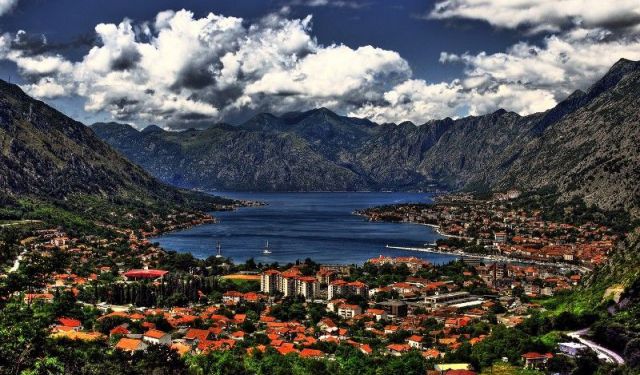
Kotor, a picturesque coastal town in Montenegro, albeit small, nonetheless, boasts a surprising number of historical churches that beautifully reflect its centuries-old heritage. Many of these temples are richly decorated with frescoes, some dating as far back as the 1300s.

At the heart of the town lies Saint Tryphon Square dominated by the eponymous cathedral, an iconic landmark from the 12th...  view more

Tour Duration: 1 Hour(s)
Travel Distance: 0.5 Km or 0.3 Miles
Kotor Old City Walking Tour

Kotor Old City Walking Tour

English poet Lord Byron once said: “The most beautiful contact between the earth and sea took place at the Montenegrin littoral”.

Kotor is one of the oldest urban centers on the eastern Adriatic, with a history shaped by its sheltered position at the end of the Bay of Kotor and by centuries of shifting political control. The town’s origins go back to antiquity. In Roman times it was...  view more

Tour Duration: 2 Hour(s)
Travel Distance: 2.2 Km or 1.4 Miles