

West Lake Tour (Self Guided), Hangzhou
The city of Hangzhou, sitting on the southern end of the Grand Canal waterway in China, opposite Beijing on the northern end, is an agglomeration of cultural and historic sights. Western Hangzhou is a home to the West Lake which has inspired poets and artists since the 9th century. It also hosts a number of other attractions, such as Yue Fei Temple, Hangzhou Botanical Garden, Zhejiang gallery, China Seal Museum and more, each unique in their own way and telling a fascinating story of Hangzhou and Chinese civilization. Take this self-guided tour and enjoy!
How it works: Download the app "GPSmyCity: Walks in 1K+ Cities" from Apple App Store or Google Play Store to your mobile phone or tablet. The app turns your mobile device into a personal tour guide and its built-in GPS navigation functions guide you from one tour stop to next. The app works offline, so no data plan is needed when traveling abroad.
West Lake Tour Map
Guide Name: West Lake Tour
Guide Location: China » Hangzhou (See other walking tours in Hangzhou)
Guide Type: Self-guided Walking Tour (Sightseeing)
# of Attractions: 6
Tour Duration: 2 Hour(s)
Travel Distance: 4.2 Km or 2.6 Miles
Author: jenny
Sight(s) Featured in This Guide:
Guide Location: China » Hangzhou (See other walking tours in Hangzhou)
Guide Type: Self-guided Walking Tour (Sightseeing)
# of Attractions: 6
Tour Duration: 2 Hour(s)
Travel Distance: 4.2 Km or 2.6 Miles
Author: jenny
Sight(s) Featured in This Guide:
- Hangzhou Public Garden
- Hangzhou Botanical Garden
- Yue Fei Temple
- Xiling Bridge
- Qiu Jin Statue
- Baochu Pagoda
1) Hangzhou Public Garden
Hangzhou Public Garden is best understood as a general public park rather than a single famous historical garden. In Hangzhou, many green spaces were created or reshaped in the mid-20th century as part of wider urban planning, with the goal of giving residents access to open areas for rest and daily activity. These parks differ from classical private gardens, which were built for elite families and focused on enclosed layouts and symbolic design.
Such public gardens have a practical and open layout. Paths are clear and easy to follow, with trees providing shade and small planted areas adding greenery. Benches and simple pavilions are placed along walkways so people can sit, talk, or rest. The design is functional rather than decorative, meant to serve large numbers of visitors instead of highlighting detailed garden art or historic structures.
Daily use shapes the park’s atmosphere. Mornings are often active, with people walking, stretching, or practicing tai chi, while afternoons are quieter and used for resting or reading. Families and older residents visit regularly, giving the space a local, everyday feel. Visitors can use the park for a short break and are expected to keep noise low and behave respectfully.
Such public gardens have a practical and open layout. Paths are clear and easy to follow, with trees providing shade and small planted areas adding greenery. Benches and simple pavilions are placed along walkways so people can sit, talk, or rest. The design is functional rather than decorative, meant to serve large numbers of visitors instead of highlighting detailed garden art or historic structures.
Daily use shapes the park’s atmosphere. Mornings are often active, with people walking, stretching, or practicing tai chi, while afternoons are quieter and used for resting or reading. Families and older residents visit regularly, giving the space a local, everyday feel. Visitors can use the park for a short break and are expected to keep noise low and behave respectfully.
2) Hangzhou Botanical Garden (must see)
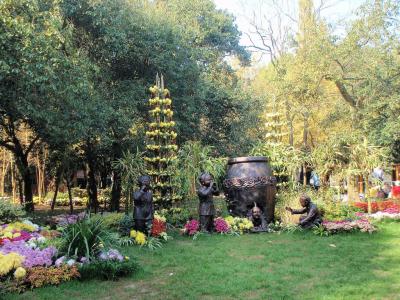
Hangzhou Botanical Garden is a large public garden focused on plants, nature study, and outdoor learning. It was set up in the mid-20th century and has been linked to botanical research in eastern China since then. The area is divided into clear sections, which makes walking around easy and not confusing. Paths are well marked and mostly flat, with shaded areas and open spaces that allow visitors to move at a relaxed pace. Many people come here for quiet walks or to spend time outdoors away from busy streets.
Different parts of the garden focus on different types of plants. There are bamboo areas, sections with medicinal plants, ornamental trees, and ponds with aquatic plants. What you see depends a lot on the season. In spring, many trees and shrubs flower. Summer is known for lotus ponds and thick greenery. In autumn, leaf color becomes more noticeable, especially in tree-filled areas. Most plants have labels that explain their names and uses, which helps visitors understand their role in medicine, gardening, or environmental studies.
The layout also follows ideas from traditional Chinese landscape design. Water, stones, and plants are arranged to feel balanced rather than decorative. Some areas feel like natural woodland, while others are more carefully planned. The garden is used by students, families, and local residents for walking, reading, photography, or light exercise. Facilities are simple but useful, and most paths are suitable for visitors of different ages.
Different parts of the garden focus on different types of plants. There are bamboo areas, sections with medicinal plants, ornamental trees, and ponds with aquatic plants. What you see depends a lot on the season. In spring, many trees and shrubs flower. Summer is known for lotus ponds and thick greenery. In autumn, leaf color becomes more noticeable, especially in tree-filled areas. Most plants have labels that explain their names and uses, which helps visitors understand their role in medicine, gardening, or environmental studies.
The layout also follows ideas from traditional Chinese landscape design. Water, stones, and plants are arranged to feel balanced rather than decorative. Some areas feel like natural woodland, while others are more carefully planned. The garden is used by students, families, and local residents for walking, reading, photography, or light exercise. Facilities are simple but useful, and most paths are suitable for visitors of different ages.
3) Yue Fei Temple (must see)
Yue Fei Temple is a memorial site honoring Yue Fei, a famous general from the Southern Song dynasty. He lived from 1103 to 1142 and is known for leading battles to defend the Song state from invading forces. He was later wrongly executed, which made his story even more powerful in Chinese history. The temple was first built not long after his death and was rebuilt several times by later dynasties. Today, it is both a historical site and a place for quiet reflection.
The temple follows a clear and simple layout. Visitors enter through a main gate and walk straight through open courtyards toward the main hall. Inside, a statue shows Yue Fei wearing armor, standing tall and calm. Plaques and stone tablets around the hall describe his military work and praise his loyalty. The buildings use traditional materials like wood, stone, and dark roof tiles, keeping the design plain and easy to understand.
Behind the main hall is Yue Fei’s tomb area. A stone path leads to the burial site, lined with carved figures of guards and animals, which was common for respected officials. Nearby are iron statues of officials blamed for his death, shown kneeling as a sign of later judgment. Signs explain this part clearly, helping visitors understand why this event became so important in history.
The temple grounds are quiet, with trees providing shade along the paths. The space is easy to walk through, and the information panels are written in simple language. Visitors can learn about Yue Fei’s life and why he became a lasting symbol of loyalty, fairness, and personal integrity.
The temple follows a clear and simple layout. Visitors enter through a main gate and walk straight through open courtyards toward the main hall. Inside, a statue shows Yue Fei wearing armor, standing tall and calm. Plaques and stone tablets around the hall describe his military work and praise his loyalty. The buildings use traditional materials like wood, stone, and dark roof tiles, keeping the design plain and easy to understand.
Behind the main hall is Yue Fei’s tomb area. A stone path leads to the burial site, lined with carved figures of guards and animals, which was common for respected officials. Nearby are iron statues of officials blamed for his death, shown kneeling as a sign of later judgment. Signs explain this part clearly, helping visitors understand why this event became so important in history.
The temple grounds are quiet, with trees providing shade along the paths. The space is easy to walk through, and the information panels are written in simple language. Visitors can learn about Yue Fei’s life and why he became a lasting symbol of loyalty, fairness, and personal integrity.
4) Xiling Bridge
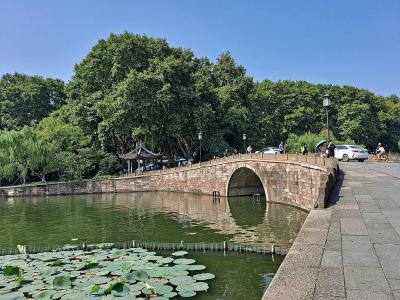
Xiling Bridge is a small stone bridge crossing a calm part of the lake. It links the shore with a nearby island and has existed for many centuries. First built in imperial times, it was repaired and rebuilt as materials aged. Its name comes from the surrounding area, once known for scholars, officials, and private gardens.
The bridge is low and gently curved, built with plain stone and simple railings. Its open design allows clear views of boats on the water, nearby trees, and distant hills. Because it sits close to the lake surface, reflections are easy to see on calm days, especially in the early morning or late afternoon when the area is quieter.
The area around the bridge has long been linked with writing and study. During the Song and Qing periods, poets and scholars lived nearby, and the setting became associated with a slower, thoughtful way of life. Today, the bridge is part of a popular walking route around the lake. Most people cross it at an easy pace, stopping briefly to look at the water or take photos before continuing their walk.
The bridge is low and gently curved, built with plain stone and simple railings. Its open design allows clear views of boats on the water, nearby trees, and distant hills. Because it sits close to the lake surface, reflections are easy to see on calm days, especially in the early morning or late afternoon when the area is quieter.
The area around the bridge has long been linked with writing and study. During the Song and Qing periods, poets and scholars lived nearby, and the setting became associated with a slower, thoughtful way of life. Today, the bridge is part of a popular walking route around the lake. Most people cross it at an easy pace, stopping briefly to look at the water or take photos before continuing their walk.
5) Qiu Jin Statue
The Qiu Jin Statue remembers Qiu Jin, a writer and political activist from the late Qing dynasty. She was born in 1875 and became known for speaking out against the old imperial system and for supporting women’s education and independence. At a time when women had very limited rights, she called for social change through her writing. She later traveled to Japan, where she was influenced by modern political ideas.
After returning to China, Qiu Jin became involved in secret revolutionary activities aimed at ending Qing rule. In 1907, after a planned uprising failed, she was arrested and executed at the age of 31. Her death made her a symbol of courage and resistance. Today, she is remembered not only for her political work but also for her poems and essays, which expressed strong emotions about freedom, justice, and national change.
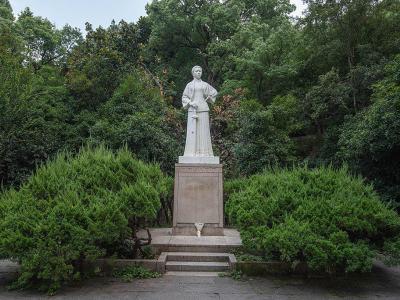
The statue shows Qiu Jin standing in traditional clothing, with a calm and serious expression. Its simple, realistic style focuses on her as a real historical figure. Nearby panels briefly explain her life and importance, and the open space around the statue makes it easy to stop, read, and reflect.
After returning to China, Qiu Jin became involved in secret revolutionary activities aimed at ending Qing rule. In 1907, after a planned uprising failed, she was arrested and executed at the age of 31. Her death made her a symbol of courage and resistance. Today, she is remembered not only for her political work but also for her poems and essays, which expressed strong emotions about freedom, justice, and national change.
The statue shows Qiu Jin standing in traditional clothing, with a calm and serious expression. Its simple, realistic style focuses on her as a real historical figure. Nearby panels briefly explain her life and importance, and the open space around the statue makes it easy to stop, read, and reflect.
6) Baochu Pagoda
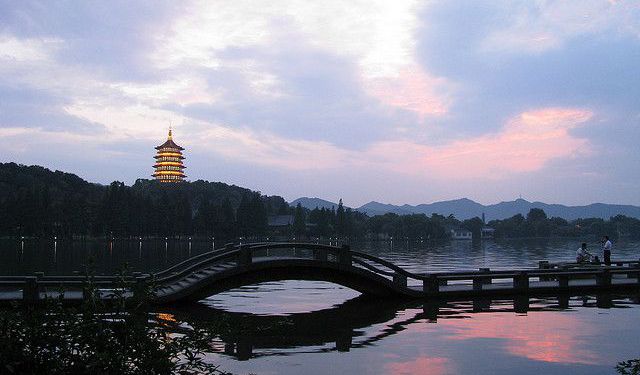
Baochu Pagoda stands on a tree-covered hill above a large freshwater lake and is one of the oldest stone pagodas in the area. It was built in the 10th century, most likely between 963 and 976 AD. Historical sources link its construction to Wu Yanshuang of the Wuyue Kingdom, and its name, meaning “Protect Chu,” refers to a wish for King Qian Chu’s safe return from the Northern Song court in Kaifeng.
The pagoda is about 45.3 meters tall and is built from brick and stone. It was not designed to be entered and has no rooms or stairs, as the structure is completely solid. The original wooden eaves were lost over time, leaving a tall stone core with blind windows and small niches. Its narrow shape and slight lean are easy to recognize from a distance.
Paths circle the hill through shaded, tree-lined areas. From lower points, visitors can see broad views of the lake and nearby hills. The pagoda’s tall, clear outline often appears in traditional paintings and poems, and its slim shape is sometimes compared in local tradition to a young woman standing above the landscape.
The pagoda is about 45.3 meters tall and is built from brick and stone. It was not designed to be entered and has no rooms or stairs, as the structure is completely solid. The original wooden eaves were lost over time, leaving a tall stone core with blind windows and small niches. Its narrow shape and slight lean are easy to recognize from a distance.
Paths circle the hill through shaded, tree-lined areas. From lower points, visitors can see broad views of the lake and nearby hills. The pagoda’s tall, clear outline often appears in traditional paintings and poems, and its slim shape is sometimes compared in local tradition to a young woman standing above the landscape.
Walking Tours in Hangzhou, China
Create Your Own Walk in Hangzhou
Creating your own self-guided walk in Hangzhou is easy and fun. Choose the city attractions that you want to see and a walk route map will be created just for you. You can even set your hotel as the start point of the walk.
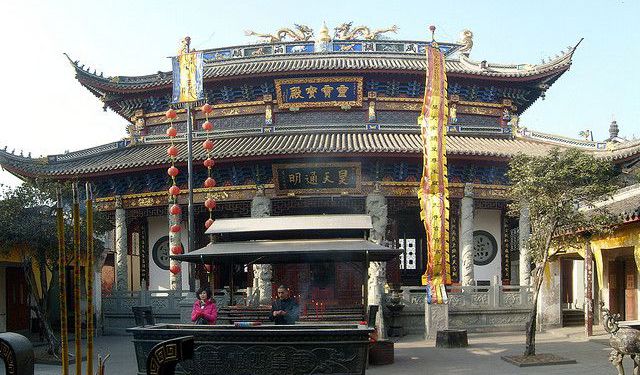
Religious Buildings Tour
Buddhism remains one of China’s main religions. Hangzhou is home to numerous temples. Each of them has a powerful, centuries-long tradition and are still attended by many. The following tour gives visitors the unique opportunity to see some magnificent temples and pagodas.
Tour Duration: 3 Hour(s)
Travel Distance: 6.8 Km or 4.2 Miles
Tour Duration: 3 Hour(s)
Travel Distance: 6.8 Km or 4.2 Miles
The Most Popular Cities
/ view all