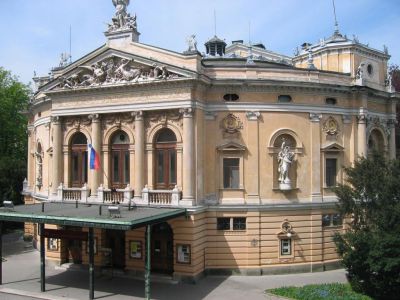


Ljubljanska Operna Hisa (Ljubljana Opera House), Ljubljana
Ljubljanska operna hiša is home to the Slovenian National Opera and Ballet. The Neo-Renaissance building opened in 1892 and was designed by Czech architects Jan Vladimír Hráský and Anton Hruby. Its façade has Ionic columns and statues of Comedy and Tragedy by Alojzij Gangl. Before the opera house was built, Gustav Mahler conducted the theatrical society during the 1881–1882 season at the former Provincial Theatre, which was destroyed by fire in 1887 and later replaced by the present opera house.
The theatre originally accommodated both Slovenian and German companies. Because the Slovenian ensemble could not initially afford a permanent orchestra, some early operas and operettas were accompanied by a hired military band. During the First World War, the building became the Central Cinema. Its 530-seat auditorium now hosts opera, ballet, concerts, and Slovenian works.
A major restoration and expansion, completed in 2011, preserved the historic auditorium while adding a modern black-clad extension with rehearsal rooms, workshops, and advanced stage technology. Its hydraulic stage descends two levels underground, while the Third Stage hosts experimental works. In 2005, the company premiered the restored complete version of Offenbach’s long-lost Die Rheinnixen.
The theatre originally accommodated both Slovenian and German companies. Because the Slovenian ensemble could not initially afford a permanent orchestra, some early operas and operettas were accompanied by a hired military band. During the First World War, the building became the Central Cinema. Its 530-seat auditorium now hosts opera, ballet, concerts, and Slovenian works.
A major restoration and expansion, completed in 2011, preserved the historic auditorium while adding a modern black-clad extension with rehearsal rooms, workshops, and advanced stage technology. Its hydraulic stage descends two levels underground, while the Third Stage hosts experimental works. In 2005, the company premiered the restored complete version of Offenbach’s long-lost Die Rheinnixen.
Want to visit this sight? Check out these Self-Guided Walking Tours in Ljubljana. Alternatively, you can download the mobile app "GPSmyCity: Walks in 1K+ Cities" from Apple App Store or Google Play Store. The app turns your mobile device to a personal tour guide and it works offline, so no data plan is needed when traveling abroad.
Download The GPSmyCity App



Ljubljanska Operna Hisa (Ljubljana Opera House) on Map
Sight Name: Ljubljanska Operna Hisa (Ljubljana Opera House)
Sight Location: Ljubljana, Slovenia (See walking tours in Ljubljana)
Sight Type: Attraction/Landmark
Guide(s) Containing This Sight:
Sight Location: Ljubljana, Slovenia (See walking tours in Ljubljana)
Sight Type: Attraction/Landmark
Guide(s) Containing This Sight:
Nearby Sights

Walking Tours in Ljubljana, Slovenia

Create Your Own Walk in Ljubljana
Creating your own self-guided walk in Ljubljana is easy and fun. Choose the city attractions that you want to see and a walk route map will be created just for you. You can even set your hotel as the start point of the walk.
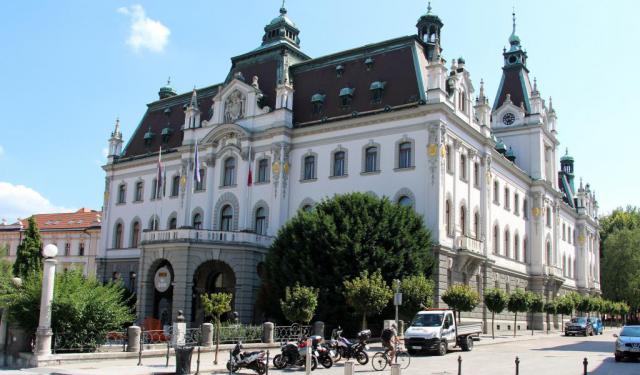
Historic Buildings Walking Tour
The Slovenian capital has no shortage of historical buildings. The architectural wealth of Ljubljana accumulated over the years received a significant boost in the early 20th century thanks to the famous Slovenian architect, Joze Plecnik, a classicist, who tried to model the city on ancient Athens.
Among the notable local landmarks is the Ljubljana Central Pharmacy, a testament to the... view more
Tour Duration: 2 Hour(s)
Travel Distance: 2.8 Km or 1.7 Miles
Among the notable local landmarks is the Ljubljana Central Pharmacy, a testament to the... view more
Tour Duration: 2 Hour(s)
Travel Distance: 2.8 Km or 1.7 Miles
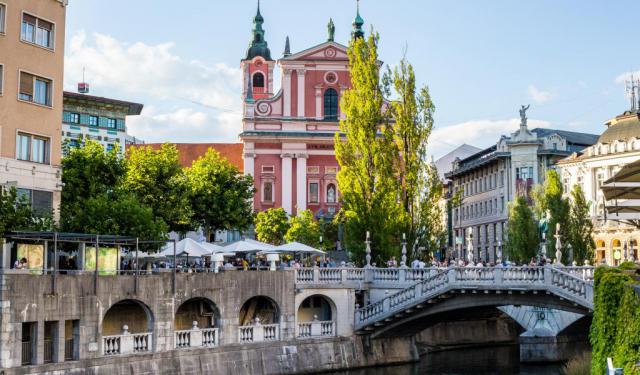
Explore Ljubljana Old Town on Foot
Ljubljana, Slovenia’s capital and largest city, developed at a natural crossroads between Central Europe, the Adriatic, and the Balkans, beside the navigable Ljubljanica River. People lived in the surrounding marshes in prehistoric times, leaving behind pile-dwelling settlements and a wooden wheel with an axle dating back about 5,200 years. By the early first century AD, the Romans had... view more
Tour Duration: 2 Hour(s)
Travel Distance: 2.0 Km or 1.2 Miles
Tour Duration: 2 Hour(s)
Travel Distance: 2.0 Km or 1.2 Miles