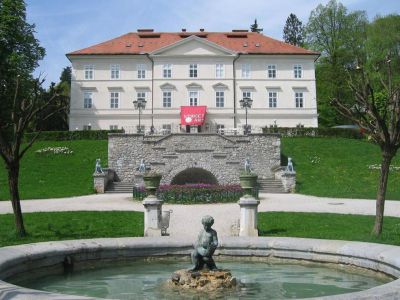


Mednarodni graficni likovni center (International Centre of Graphic Arts), Ljubljana
The International Centre of Graphic Arts (Mednarodni grafični likovni center, MGLC) is a museum devoted to printmaking, artist books, and contemporary visual art. Established in 1986, it organises the Ljubljana Biennale of Graphic Arts, founded in 1955 and considered the world’s oldest continuously operating biennial dedicated to contemporary graphic art. During the Cold War, the exhibition provided a rare meeting place for artists from the Eastern and Western blocs, while also presenting work from non-aligned countries in Africa, Asia, and Latin America.
The centre occupies Tivoli Mansion, a historic residence once used by Field Marshal Joseph Radetzky, the military commander associated with Johann Strauss I’s Radetzky March. Four cast-iron dogs attributed to sculptor Anton Dominik Fernkorn guard the entrance steps. The animals have no tongues, inspiring a false local legend that Fernkorn took his own life after discovering the mistake.
Exhibitions include prints, drawings, posters, photographs, and artist publications by Slovenian and international creators. The Biennale also helped establish the Ljubljana Graphic School, known for precise printing techniques, colour linocuts, and experimental etching. MGLC remains an active production centre, with workshops and studios where visiting artists work with screen printing, lithography, intaglio techniques, traditional presses, and other graphic processes.
The centre occupies Tivoli Mansion, a historic residence once used by Field Marshal Joseph Radetzky, the military commander associated with Johann Strauss I’s Radetzky March. Four cast-iron dogs attributed to sculptor Anton Dominik Fernkorn guard the entrance steps. The animals have no tongues, inspiring a false local legend that Fernkorn took his own life after discovering the mistake.
Exhibitions include prints, drawings, posters, photographs, and artist publications by Slovenian and international creators. The Biennale also helped establish the Ljubljana Graphic School, known for precise printing techniques, colour linocuts, and experimental etching. MGLC remains an active production centre, with workshops and studios where visiting artists work with screen printing, lithography, intaglio techniques, traditional presses, and other graphic processes.
Want to visit this sight? Check out these Self-Guided Walking Tours in Ljubljana. Alternatively, you can download the mobile app "GPSmyCity: Walks in 1K+ Cities" from Apple App Store or Google Play Store. The app turns your mobile device to a personal tour guide and it works offline, so no data plan is needed when traveling abroad.
Download The GPSmyCity App



Mednarodni graficni likovni center (International Centre of Graphic Arts) on Map
Sight Name: Mednarodni graficni likovni center (International Centre of Graphic Arts)
Sight Location: Ljubljana, Slovenia (See walking tours in Ljubljana)
Sight Type: Museum/Gallery
Sight Location: Ljubljana, Slovenia (See walking tours in Ljubljana)
Sight Type: Museum/Gallery
Nearby Sights
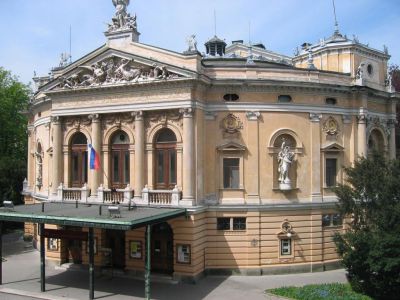
Walking Tours in Ljubljana, Slovenia

Create Your Own Walk in Ljubljana
Creating your own self-guided walk in Ljubljana is easy and fun. Choose the city attractions that you want to see and a walk route map will be created just for you. You can even set your hotel as the start point of the walk.
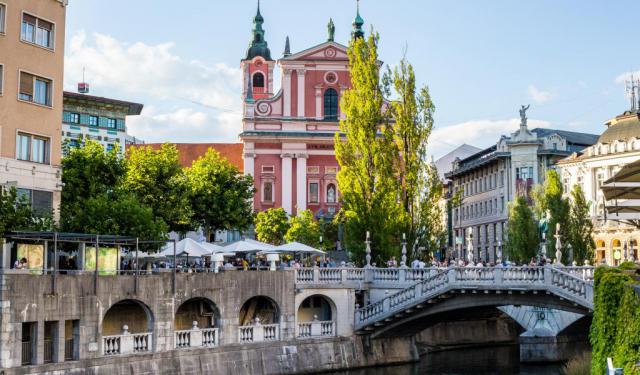
Explore Ljubljana Old Town on Foot
Ljubljana, Slovenia’s capital and largest city, developed at a natural crossroads between Central Europe, the Adriatic, and the Balkans, beside the navigable Ljubljanica River. People lived in the surrounding marshes in prehistoric times, leaving behind pile-dwelling settlements and a wooden wheel with an axle dating back about 5,200 years. By the early first century AD, the Romans had... view more
Tour Duration: 2 Hour(s)
Travel Distance: 2.0 Km or 1.2 Miles
Tour Duration: 2 Hour(s)
Travel Distance: 2.0 Km or 1.2 Miles
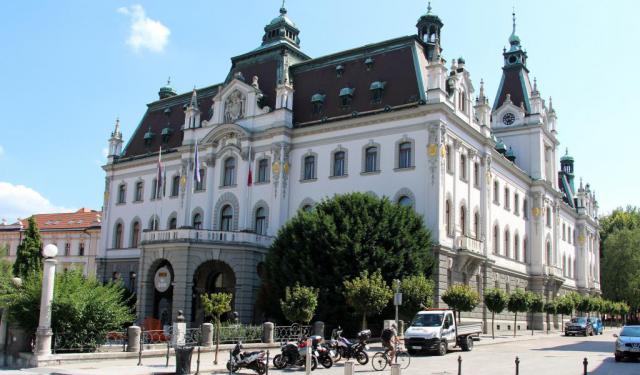
Historic Buildings Walking Tour
The Slovenian capital has no shortage of historical buildings. The architectural wealth of Ljubljana accumulated over the years received a significant boost in the early 20th century thanks to the famous Slovenian architect, Joze Plecnik, a classicist, who tried to model the city on ancient Athens.
Among the notable local landmarks is the Ljubljana Central Pharmacy, a testament to the... view more
Tour Duration: 2 Hour(s)
Travel Distance: 2.8 Km or 1.7 Miles
Among the notable local landmarks is the Ljubljana Central Pharmacy, a testament to the... view more
Tour Duration: 2 Hour(s)
Travel Distance: 2.8 Km or 1.7 Miles