

Park Tivoli (Tivoli City Park), Ljubljana (must see)
Park Tivoli (Tivoli City Park) is the largest public park in Ljubljana, covering about 50 hectares of lawns, flower beds, tree-lined avenues, and woodland. It was created in the early 19th century by combining the landscaped grounds surrounding Tivoli Castle and Cekin Mansion. Engineer Jean Blanchard helped shape its early layout, while architect Jože Plečnik substantially redesigned its central section between 1921 and 1939.
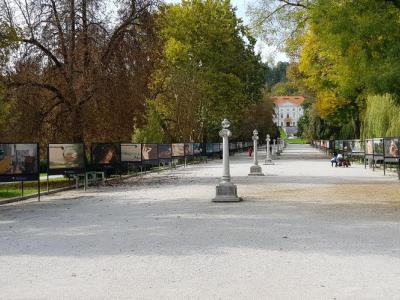
Plečnik’s main contribution was the broad Jakopič Promenade, named after Slovenian Impressionist painter Rihard Jakopič. The white gravel walkway forms part of a visual route linking the park with the historic centre and leads directly towards Tivoli Castle. Its concrete lamp bases and carefully arranged trees create a formal approach to the mansion. Today, the promenade functions as an outdoor gallery, displaying large photographs and other visual works throughout the year.
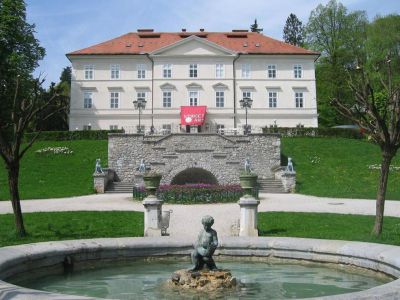
Tivoli Castle now houses the International Centre of Graphic Arts. Its entrance staircase is guarded by four cast-iron dogs made by sculptor Anton Dominik Fernkorn. All four appear tongueless, inspiring a local legend that Fernkorn forgot this detail. The sculptures were instead based on ancient models in which tongues were not shown. Nearby, Švicarija developed from a popular 19th-century recreational venue with dining, dancing, and social gatherings. The restored building now contains artists’ studios and cultural spaces.
Other features include a greenhouse, rose garden, ornamental pond, playgrounds, cafés, and sports grounds. Walking routes continue beyond the formal gardens into the wooded slopes of Rožnik Hill. Visitors may also see squirrels and numerous woodland birds where the maintained park gradually merges with the forest.
Plečnik’s main contribution was the broad Jakopič Promenade, named after Slovenian Impressionist painter Rihard Jakopič. The white gravel walkway forms part of a visual route linking the park with the historic centre and leads directly towards Tivoli Castle. Its concrete lamp bases and carefully arranged trees create a formal approach to the mansion. Today, the promenade functions as an outdoor gallery, displaying large photographs and other visual works throughout the year.
Tivoli Castle now houses the International Centre of Graphic Arts. Its entrance staircase is guarded by four cast-iron dogs made by sculptor Anton Dominik Fernkorn. All four appear tongueless, inspiring a local legend that Fernkorn forgot this detail. The sculptures were instead based on ancient models in which tongues were not shown. Nearby, Švicarija developed from a popular 19th-century recreational venue with dining, dancing, and social gatherings. The restored building now contains artists’ studios and cultural spaces.
Other features include a greenhouse, rose garden, ornamental pond, playgrounds, cafés, and sports grounds. Walking routes continue beyond the formal gardens into the wooded slopes of Rožnik Hill. Visitors may also see squirrels and numerous woodland birds where the maintained park gradually merges with the forest.
Want to visit this sight? Check out these Self-Guided Walking Tours in Ljubljana. Alternatively, you can download the mobile app "GPSmyCity: Walks in 1K+ Cities" from Apple App Store or Google Play Store. The app turns your mobile device to a personal tour guide and it works offline, so no data plan is needed when traveling abroad.
Download The GPSmyCity App



Park Tivoli (Tivoli City Park) on Map
Sight Name: Park Tivoli (Tivoli City Park)
Sight Location: Ljubljana, Slovenia (See walking tours in Ljubljana)
Sight Type: Park/Outdoor
Sight Location: Ljubljana, Slovenia (See walking tours in Ljubljana)
Sight Type: Park/Outdoor
Nearby Sights
Walking Tours in Ljubljana, Slovenia

Create Your Own Walk in Ljubljana
Creating your own self-guided walk in Ljubljana is easy and fun. Choose the city attractions that you want to see and a walk route map will be created just for you. You can even set your hotel as the start point of the walk.
Historic Buildings Walking Tour
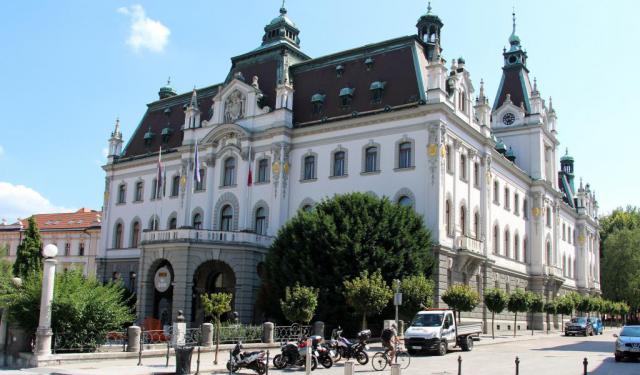
The Slovenian capital has no shortage of historical buildings. The architectural wealth of Ljubljana accumulated over the years received a significant boost in the early 20th century thanks to the famous Slovenian architect, Joze Plecnik, a classicist, who tried to model the city on ancient Athens.
Among the notable local landmarks is the Ljubljana Central Pharmacy, a testament to the... view more
Tour Duration: 2 Hour(s)
Travel Distance: 2.8 Km or 1.7 Miles
Among the notable local landmarks is the Ljubljana Central Pharmacy, a testament to the... view more
Tour Duration: 2 Hour(s)
Travel Distance: 2.8 Km or 1.7 Miles
Explore Ljubljana Old Town on Foot
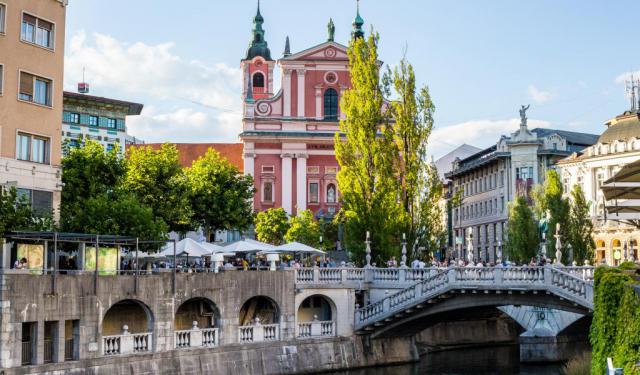
Ljubljana, Slovenia’s capital and largest city, developed at a natural crossroads between Central Europe, the Adriatic, and the Balkans, beside the navigable Ljubljanica River. People lived in the surrounding marshes in prehistoric times, leaving behind pile-dwelling settlements and a wooden wheel with an axle dating back about 5,200 years. By the early first century AD, the Romans had... view more
Tour Duration: 2 Hour(s)
Travel Distance: 2.0 Km or 1.2 Miles
Tour Duration: 2 Hour(s)
Travel Distance: 2.0 Km or 1.2 Miles