Custom Walk in Frankfurt, Germany by newtowningermany_fea82 created on 2025-05-20
Guide Location: Germany » Frankfurt
Guide Type: Custom Walk
# of Sights: 13
Tour Duration: 2 Hour(s)
Travel Distance: 4.2 Km or 2.6 Miles
Share Key: HVLZZ
Guide Type: Custom Walk
# of Sights: 13
Tour Duration: 2 Hour(s)
Travel Distance: 4.2 Km or 2.6 Miles
Share Key: HVLZZ
How It Works
Please retrieve this walk in the GPSmyCity app. Once done, the app will guide you from one tour stop to the next as if you had a personal tour guide. If you created the walk on this website or come to the page via a link, please follow the instructions below to retrieve the walk in the app.
Retrieve This Walk in App
Step 1. Download the app "GPSmyCity: Walks in 1K+ Cities" on Apple App Store or Google Play Store.



Step 2. In the GPSmyCity app, download(or launch) the guide "Frankfurt Map and Walking Tours".
Step 3. Tap the menu button located at upper right corner of the "Walks" screen and select "Retrieve custom walk". Enter the share key: HVLZZ
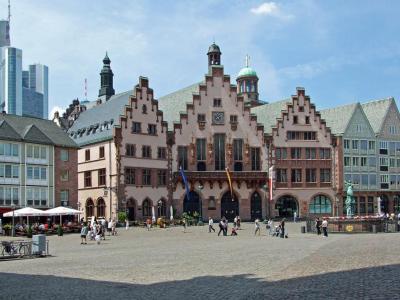
1) Römerberg (Square) (must see)
Römerberg Square is the historic heart of Frankfurt’s Old Town and one of the most recognizable places in the city. For centuries this square served as Frankfurt’s main marketplace and the stage for major public events, including imperial ceremonies, medieval trade fairs, and civic celebrations. Today it remains one of the most visited parts of the city, surrounded by historic buildings that reflect Frankfurt’s long past. At the western side of the square stands the Römer, Frankfurt’s historic city hall, whose distinctive stepped gables have become one of the city’s most iconic architectural images.
As you stand in the square, look toward the row of colorful half-timbered houses on the eastern side. This line of buildings, known as the Eastern Row, was reconstructed in the 1980s to recreate the historic appearance of Römerberg before the destruction of the Second World War. Each house features steep roofs, wooden beams, and decorative façades typical of traditional German architecture. Today these buildings house cafés, restaurants, and small shops, making this side of the square one of the most photographed spots in Frankfurt.
Walk toward the center of the square and you’ll find the Justice Fountain, a Renaissance fountain dating from the 16th century. At the top stands a statue of Lady Justice holding a sword and scales. During the coronation celebrations of Holy Roman Emperors, the fountain famously flowed with wine instead of water so that the crowds gathered here could join the festivities. Nearby, on the southern side, stands Old Saint Nicholas Church, a Gothic church that has watched over the square since the 13th century and once served merchants and travelers who came to the city’s markets.
Today Römerberg remains one of the liveliest places in Frankfurt. The square regularly hosts festivals, public gatherings, and seasonal markets, including the famous Frankfurt Christmas Market, which attracts visitors from around the world each winter. Surrounded by reconstructed historic buildings and anchored by the city hall, the square offers one of the clearest glimpses into Frankfurt’s medieval past while remaining an active gathering place for the city today.
As you stand in the square, look toward the row of colorful half-timbered houses on the eastern side. This line of buildings, known as the Eastern Row, was reconstructed in the 1980s to recreate the historic appearance of Römerberg before the destruction of the Second World War. Each house features steep roofs, wooden beams, and decorative façades typical of traditional German architecture. Today these buildings house cafés, restaurants, and small shops, making this side of the square one of the most photographed spots in Frankfurt.
Walk toward the center of the square and you’ll find the Justice Fountain, a Renaissance fountain dating from the 16th century. At the top stands a statue of Lady Justice holding a sword and scales. During the coronation celebrations of Holy Roman Emperors, the fountain famously flowed with wine instead of water so that the crowds gathered here could join the festivities. Nearby, on the southern side, stands Old Saint Nicholas Church, a Gothic church that has watched over the square since the 13th century and once served merchants and travelers who came to the city’s markets.
Today Römerberg remains one of the liveliest places in Frankfurt. The square regularly hosts festivals, public gatherings, and seasonal markets, including the famous Frankfurt Christmas Market, which attracts visitors from around the world each winter. Surrounded by reconstructed historic buildings and anchored by the city hall, the square offers one of the clearest glimpses into Frankfurt’s medieval past while remaining an active gathering place for the city today.
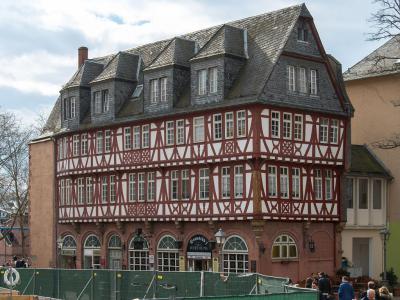
2) Haus Wertheim
House Wertheim is one of the most distinctive historic buildings in Frankfurt’s Old Town and one of the few traditional half-timbered houses that survived the destruction of the Second World War. While much of the surrounding area had to be rebuilt after the bombing of 1944, this building remained standing. Because of that, it offers a rare glimpse of what Frankfurt’s streets once looked like before the war.
The house is a classic example of traditional German timber construction. Its dark wooden beams and white plaster panels create the familiar pattern seen in many historic towns across central Europe. If you look closely at the façade, you may notice that the structure leans slightly and the beams are not perfectly straight. These irregularities reflect historic building techniques from the 15th and 16th centuries, when houses were constructed by hand using timber frames.
House Wertheim stands at a corner near the History Museum and just a short walk from Römerberg Square, the historic center of Frankfurt. This area once connected the busy medieval marketplace with the trade routes leading down to the River Main, which explains why merchants and travelers frequently passed through these streets.
Today the building houses a traditional German restaurant. Visitors often stop here to enjoy regional dishes such as sausages, schnitzel, or Frankfurt’s well-known apple wine while sitting inside one of the city’s oldest surviving houses. Because it survived when much of the Old Town did not, House Wertheim remains one of the most authentic historic structures in this part of Frankfurt.
The house is a classic example of traditional German timber construction. Its dark wooden beams and white plaster panels create the familiar pattern seen in many historic towns across central Europe. If you look closely at the façade, you may notice that the structure leans slightly and the beams are not perfectly straight. These irregularities reflect historic building techniques from the 15th and 16th centuries, when houses were constructed by hand using timber frames.
House Wertheim stands at a corner near the History Museum and just a short walk from Römerberg Square, the historic center of Frankfurt. This area once connected the busy medieval marketplace with the trade routes leading down to the River Main, which explains why merchants and travelers frequently passed through these streets.
Today the building houses a traditional German restaurant. Visitors often stop here to enjoy regional dishes such as sausages, schnitzel, or Frankfurt’s well-known apple wine while sitting inside one of the city’s oldest surviving houses. Because it survived when much of the Old Town did not, House Wertheim remains one of the most authentic historic structures in this part of Frankfurt.
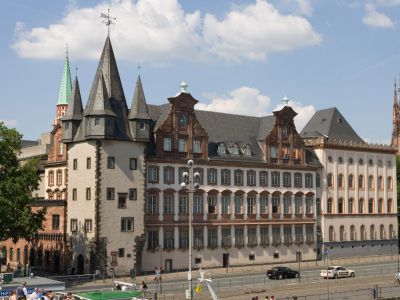
3) Customs Tower (Rententurm)
The Customs Tower, also known as Rententurm, located in Frankfurt, stands as a testament to the city's rich history and architectural heritage. When you turn towards Römerberg, you'll notice this four-story building elegantly situated on your right corner. Built in 1456, the Customs Tower is a rare surviving example of late Gothic gate towers from Frankfurt's old city fortifications.
Today, the Customs Tower has been integrated into the Historische Museum Frankfurt, where it preserves and displays its historical significance. Its roots, however, trace back to a much earlier period, as it sits atop the foundation walls of the Kaiserpfalz, initially constructed by Emperor Friedrich Barbarossa in 1150.
The tower itself is an architectural masterpiece, built by the skilled hands of Eberhard Friedberger. It takes the form of a four-story gate tower on a square floorplan, complete with a pointed spire and four turrets, combining both strength and elegance.
The Customs Tower is closely connected to the Saalhof ensemble, once the Staufer imperial palace dating back to the 12th century. However, by the time the Rententurm was constructed, it had passed into private ownership. This multifaceted structure had a dual role, serving as a protective military outpost guarding the city gate (Fahrtor) and as the place for collecting tolls and port charges. Interestingly, the tower's basement even served as the city prison, occasionally facing flooding when the Main River surged.
Today, the Customs Tower has been integrated into the Historische Museum Frankfurt, where it preserves and displays its historical significance. Its roots, however, trace back to a much earlier period, as it sits atop the foundation walls of the Kaiserpfalz, initially constructed by Emperor Friedrich Barbarossa in 1150.
The tower itself is an architectural masterpiece, built by the skilled hands of Eberhard Friedberger. It takes the form of a four-story gate tower on a square floorplan, complete with a pointed spire and four turrets, combining both strength and elegance.
The Customs Tower is closely connected to the Saalhof ensemble, once the Staufer imperial palace dating back to the 12th century. However, by the time the Rententurm was constructed, it had passed into private ownership. This multifaceted structure had a dual role, serving as a protective military outpost guarding the city gate (Fahrtor) and as the place for collecting tolls and port charges. Interestingly, the tower's basement even served as the city prison, occasionally facing flooding when the Main River surged.
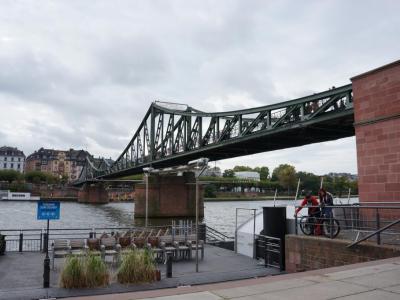
4) Eiserner Steg (Iron Footbridge) (must see)
The Iron Footbridge is one of Frankfurt’s best-known pedestrian bridges and an important crossing over the River Main. It connects the historic Old Town with the Sachsenhausen district on the southern bank. The first version of the bridge was built in 1868 after local citizens financed a pedestrian crossing between the two sides of the city. The structure was destroyed during the Second World War but rebuilt in 1946 and later renovated, preserving the recognizable iron design that gives the bridge its name.
The bridge has become one of the most photographed viewpoints in Frankfurt because of its clear view of the city skyline. From its central span, the historic buildings of the Old Town appear in the foreground while the towers of the financial district rise behind them. This contrast between medieval streets and modern skyscrapers has become one of the defining images of Frankfurt.
A distinctive feature of the bridge is the large number of padlocks attached to its railings. These “love locks” have been placed by couples as a symbol of their relationship, with the key traditionally thrown into the river below. Another interesting detail is the inscription running along the side of the bridge, written in ancient Greek. The line comes from Greek poet Homer’s Odyssey and translates roughly as “Sailing across the wine-dark sea to people of another language,” a poetic reference to journeys and encounters with new cultures.
Beyond its scenic qualities, the Iron Footbridge also serves an important practical role. It is one of the busiest pedestrian crossings in the city and provides a direct route between the historic center and Sachsenhausen, a district known for its traditional taverns serving Frankfurt’s well-known apple wine.
The bridge has become one of the most photographed viewpoints in Frankfurt because of its clear view of the city skyline. From its central span, the historic buildings of the Old Town appear in the foreground while the towers of the financial district rise behind them. This contrast between medieval streets and modern skyscrapers has become one of the defining images of Frankfurt.
A distinctive feature of the bridge is the large number of padlocks attached to its railings. These “love locks” have been placed by couples as a symbol of their relationship, with the key traditionally thrown into the river below. Another interesting detail is the inscription running along the side of the bridge, written in ancient Greek. The line comes from Greek poet Homer’s Odyssey and translates roughly as “Sailing across the wine-dark sea to people of another language,” a poetic reference to journeys and encounters with new cultures.
Beyond its scenic qualities, the Iron Footbridge also serves an important practical role. It is one of the busiest pedestrian crossings in the city and provides a direct route between the historic center and Sachsenhausen, a district known for its traditional taverns serving Frankfurt’s well-known apple wine.
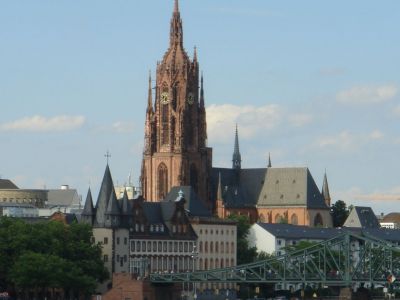
5) Frankfurt Cathedral (Cathedral of St. Bartholomew) (must see)
Frankfurt Cathedral, officially the Cathedral of Saint Bartholomew, is one of the most important historic landmarks in Frankfurt. Built mainly between the 14th and 15th centuries from deep red Main sandstone, the church rises prominently above the surrounding Old Town. Its Gothic tower reaches about 95 meters and remains one of the city’s most recognizable landmarks.
Although it was never a bishop’s seat, the cathedral played a major political role in the Holy Roman Empire. Between 1562 and 1792, ten Holy Roman Emperors were crowned here, giving the church its long-standing nickname, the “Imperial Cathedral.”
Enter through the vestibule, the modern entrance added in 1879 or 1880. From here you can access the cloister, which today houses the Frankfurt Cathedral Museum, as well as the tower hall. Inside the church, the central nave is flanked by two aisles separated by six great Gothic pillars, three on each side, and along the wall of the left aisle you’ll notice several tombs dating from the 16th to the 18th centuries.
Continue toward the High Choir just ahead, built between 1315 and 1349 and one of the best-preserved parts of the cathedral. It survived both the major fire of 1867 and much of the destruction caused by Allied bombing in 1944. At its center stands the high altar, on the left of it you’ll see the Apostles’ Farewell Altar from 1523, while on the right stands the Altar of Our Lady, made in southern Germany in the 15th century. Wooden choir stalls line the walls and are decorated with carved scenes of the Resurrection, reflecting the central Christian theme of redemption and eternal life.
Here you’ll also find one of the cathedral’s most important monuments: the tomb of King Günther von Schwarzburg, the only German king buried in Frankfurt. The tomb shows the king in full armor with a sword and shield, with two lions at his feet. The cathedral also preserves a relic of Saint Bartholomew—part of the apostle’s skull kept here since the 13th century, which helped establish the church as an important religious center in medieval Frankfurt.
Make sure to climb the cathedral tower during your visit. After 328 steps you reach a viewing platform about 66 meters above the ground. From here, you’ll enjoy a beautiful panoramic view over the narrow streets of the reconstructed Old Town, the River Main, and Frankfurt’s modern skyline.
Although it was never a bishop’s seat, the cathedral played a major political role in the Holy Roman Empire. Between 1562 and 1792, ten Holy Roman Emperors were crowned here, giving the church its long-standing nickname, the “Imperial Cathedral.”
Enter through the vestibule, the modern entrance added in 1879 or 1880. From here you can access the cloister, which today houses the Frankfurt Cathedral Museum, as well as the tower hall. Inside the church, the central nave is flanked by two aisles separated by six great Gothic pillars, three on each side, and along the wall of the left aisle you’ll notice several tombs dating from the 16th to the 18th centuries.
Continue toward the High Choir just ahead, built between 1315 and 1349 and one of the best-preserved parts of the cathedral. It survived both the major fire of 1867 and much of the destruction caused by Allied bombing in 1944. At its center stands the high altar, on the left of it you’ll see the Apostles’ Farewell Altar from 1523, while on the right stands the Altar of Our Lady, made in southern Germany in the 15th century. Wooden choir stalls line the walls and are decorated with carved scenes of the Resurrection, reflecting the central Christian theme of redemption and eternal life.
Here you’ll also find one of the cathedral’s most important monuments: the tomb of King Günther von Schwarzburg, the only German king buried in Frankfurt. The tomb shows the king in full armor with a sword and shield, with two lions at his feet. The cathedral also preserves a relic of Saint Bartholomew—part of the apostle’s skull kept here since the 13th century, which helped establish the church as an important religious center in medieval Frankfurt.
Make sure to climb the cathedral tower during your visit. After 328 steps you reach a viewing platform about 66 meters above the ground. From here, you’ll enjoy a beautiful panoramic view over the narrow streets of the reconstructed Old Town, the River Main, and Frankfurt’s modern skyline.
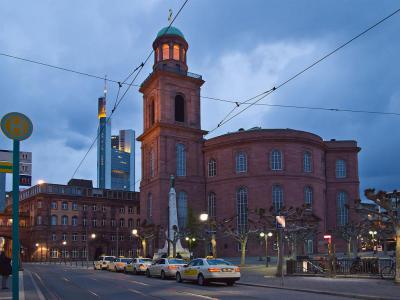
6) Paulskirche (St. Paul's Church)
The oval-shaped church of Saint Paul in the Zeil district of Frankfurt is easily spotted for its red sandstone exterior. Formerly a protestant temple, it was built between 1789 and 1833 to serve the local Evangelical Lutheran congregation. Still, more than for its religious service and architecture, this neoclassical-style edifice is renowned for its role in the shaping of German democracy.
In 1848, during the so-called German revolutions, the Frankfurt Parliament convened here, being the first publicly and freely-elected German legislative body. The parliamentarians chose the building because of its typical Protestant centralized design, allowing everybody to easily hear the speaker.
In 1848, the National Assembly met inside the church for the first time and was therefore named the Paulskirchenparlament. Representatives from Germany and Austria worked on the premises until 1849 to draft a Charter of Basic Rights and a Constitution for a united Germany on the basis of popular self-determination. The attempt subsequently failed and the building resumed service as a church.
During WWII, Paulskirsche suffered extensive damage from bombings. After the war, its exterior was painstakingly restored, while the interior was somewhat simplified. Nonetheless, the striking feature of the interior is a modern mural depicting the procession of the people’s representatives into Paulskrische which today stands as the symbol of German democracy.
Presently, the building is used as a venue for various events and exhibitions including the Peace Prize of the German Book Trade and the Goethe Prize by the city of Frankfurt. The hall on the first floor is used for municipal and other functions.
Why You Should Visit:
Free entry, with a wealth of information in English covering the German democratic process.
Tip:
Pop in for the excellent art exhibition in the basement (pieces are for sale but are on the expensive side).
Upstairs you can visit the room in which JFK gave his brief speech in 1963.
In 1848, during the so-called German revolutions, the Frankfurt Parliament convened here, being the first publicly and freely-elected German legislative body. The parliamentarians chose the building because of its typical Protestant centralized design, allowing everybody to easily hear the speaker.
In 1848, the National Assembly met inside the church for the first time and was therefore named the Paulskirchenparlament. Representatives from Germany and Austria worked on the premises until 1849 to draft a Charter of Basic Rights and a Constitution for a united Germany on the basis of popular self-determination. The attempt subsequently failed and the building resumed service as a church.
During WWII, Paulskirsche suffered extensive damage from bombings. After the war, its exterior was painstakingly restored, while the interior was somewhat simplified. Nonetheless, the striking feature of the interior is a modern mural depicting the procession of the people’s representatives into Paulskrische which today stands as the symbol of German democracy.
Presently, the building is used as a venue for various events and exhibitions including the Peace Prize of the German Book Trade and the Goethe Prize by the city of Frankfurt. The hall on the first floor is used for municipal and other functions.
Why You Should Visit:
Free entry, with a wealth of information in English covering the German democratic process.
Tip:
Pop in for the excellent art exhibition in the basement (pieces are for sale but are on the expensive side).
Upstairs you can visit the room in which JFK gave his brief speech in 1963.
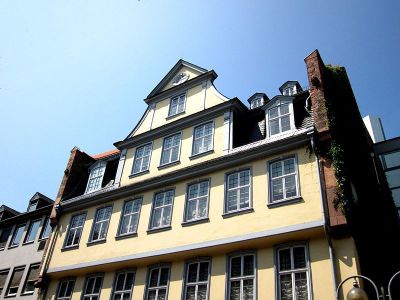
7) Goethe-Haus (must see)
Goethe House is one of Frankfurt’s most important cultural landmarks and the birthplace of Johann Wolfgang von Goethe, born in 1749 and died in 1832, Germany’s most celebrated writer. The house stands on Grosser Hirschgraben Street in the historic center of the city. Goethe spent his childhood and youth here, and many of his early experiences in Frankfurt later appeared in his literary works. His novel The Sorrows of Young Werther and parts of his autobiography Poetry and Truth contain vivid descriptions of life in the house and in the city during the 18th century.
The building visitors see today is a careful reconstruction of the original family home. The historic house was destroyed during the bombing of Frankfurt in 1944, but it was rebuilt in the 1950s using historical drawings, photographs, and documents to recreate the interiors as accurately as possible. The result is a four-story townhouse furnished with period objects that illustrate how a prosperous middle-class family lived in Frankfurt during Goethe’s lifetime.
Inside the house, visitors move through a sequence of historically furnished rooms that reflect the daily life of the Goethe family. Among the most interesting spaces is Goethe’s study, where the young writer worked and developed his early literary ideas. The house also contains a dining room, music room, and several reception rooms used by the family. A wide staircase runs through the center of the building and connects the different floors, providing a clear sense of how large 18th-century townhouses were arranged.
Behind the house is a small garden courtyard, which recreates the type of private outdoor space common in Frankfurt homes of the period. Next door is the Goethe Museum, where visitors can see paintings and artworks from Goethe’s time, including pieces from the Baroque and Romantic periods. Together, the house and museum offer a deeper understanding of Goethe’s life, his family background, and the cultural environment in which one of Germany’s greatest writers grew up.
The building visitors see today is a careful reconstruction of the original family home. The historic house was destroyed during the bombing of Frankfurt in 1944, but it was rebuilt in the 1950s using historical drawings, photographs, and documents to recreate the interiors as accurately as possible. The result is a four-story townhouse furnished with period objects that illustrate how a prosperous middle-class family lived in Frankfurt during Goethe’s lifetime.
Inside the house, visitors move through a sequence of historically furnished rooms that reflect the daily life of the Goethe family. Among the most interesting spaces is Goethe’s study, where the young writer worked and developed his early literary ideas. The house also contains a dining room, music room, and several reception rooms used by the family. A wide staircase runs through the center of the building and connects the different floors, providing a clear sense of how large 18th-century townhouses were arranged.
Behind the house is a small garden courtyard, which recreates the type of private outdoor space common in Frankfurt homes of the period. Next door is the Goethe Museum, where visitors can see paintings and artworks from Goethe’s time, including pieces from the Baroque and Romantic periods. Together, the house and museum offer a deeper understanding of Goethe’s life, his family background, and the cultural environment in which one of Germany’s greatest writers grew up.
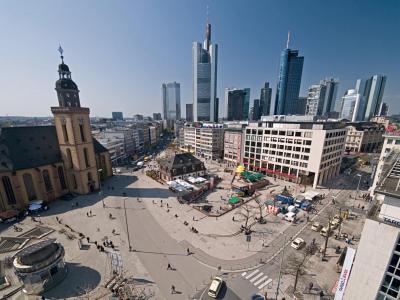
8) Hauptwache (Main Guardroom Square) (must see)
Hauptwache Square is one of the busiest and most recognizable places in the heart of the city. Located at the western end of Zeil, the city’s main shopping boulevard, it has long served as an important crossroads for trade, transportation, and daily city life. The square takes its name from the historic Hauptwache building at its center, which was constructed in 1730 when Frankfurt was still a Free Imperial City within the Holy Roman Empire.
The baroque guardhouse originally served as the headquarters of the city militia, where soldiers were stationed to protect the city and maintain order. Later it functioned as a police station and even housed a small prison. The building’s distinctive yellow façade, red sandstone details, and triangular roof make it easy to recognize among the surrounding modern architecture. Today the structure has been converted into a café and restaurant, allowing visitors to sit inside a historic building that once played a central role in the city’s security.
Beneath the square lies one of Frankfurt’s most important transportation interchanges. Hauptwache Station connects several subway and suburban railway lines, making it one of the busiest transit points in the region. The entrances to the underground network are marked by stairways and glass skylights that bring natural light into the large concourse below. Because of these connections, thousands of commuters pass through the square every day.
The buildings surrounding Hauptwache reflect different periods of Frankfurt’s development. One of the most notable nearby landmarks is Saint Catherine’s Church, the largest Protestant church in the city center, whose tower rises above the shopping district. Modern commercial buildings and department stores line the square and lead directly into the lively Zeil shopping street.
Throughout the day the square fills with commuters changing trains, shoppers heading along Zeil, and visitors stopping beside the old guardhouse before continuing into Frankfurt’s busy city center.
The baroque guardhouse originally served as the headquarters of the city militia, where soldiers were stationed to protect the city and maintain order. Later it functioned as a police station and even housed a small prison. The building’s distinctive yellow façade, red sandstone details, and triangular roof make it easy to recognize among the surrounding modern architecture. Today the structure has been converted into a café and restaurant, allowing visitors to sit inside a historic building that once played a central role in the city’s security.
Beneath the square lies one of Frankfurt’s most important transportation interchanges. Hauptwache Station connects several subway and suburban railway lines, making it one of the busiest transit points in the region. The entrances to the underground network are marked by stairways and glass skylights that bring natural light into the large concourse below. Because of these connections, thousands of commuters pass through the square every day.
The buildings surrounding Hauptwache reflect different periods of Frankfurt’s development. One of the most notable nearby landmarks is Saint Catherine’s Church, the largest Protestant church in the city center, whose tower rises above the shopping district. Modern commercial buildings and department stores line the square and lead directly into the lively Zeil shopping street.
Throughout the day the square fills with commuters changing trains, shoppers heading along Zeil, and visitors stopping beside the old guardhouse before continuing into Frankfurt’s busy city center.
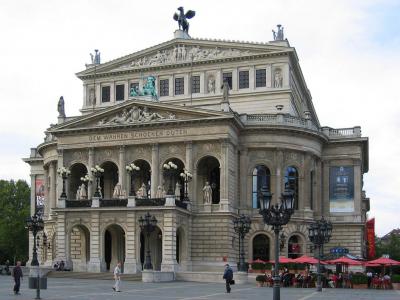
9) Old Opera House (Alte Oper) (must see)
Perched above a picturesque square adorned with a graceful fountain lies the Opera House, sporting a Renaissance-style façade. This historic edifice, known by the moniker "Alte Oper," or "the Old Opera House," stands in place of a predecessor that graced the location from 1880 to 1944.
The inaugural Frankfurt Opera House, conceived by the Berlin-based architect Richard Lucae, made its debut in 1880, with Kaiser Wilhelm I presiding over the grand opening. The architectural design exuded the opulence expected of a venue patronized by royalty, showcasing Renaissance aesthetics. Tragically, during World War II, the structure suffered complete devastation. Following extensive deliberations among Frankfurt's residents, a new building arose, echoing the design of its predecessor. While the lobby and façade maintained their Renaissance architectural charm, the remainder of the structure underwent a transformation into a versatile modern complex, housing banquet halls, concert venues, and a convention center. This Opera House now fulfills the dual role of a cultural hub and a gathering place for Frankfurt's denizens.
At the Alte Oper, visitors can relish classical and popular music concerts. The edifice takes on an enchanting allure in the evening, its exterior adorned with splendid statues of Goethe and Mozart, who preside over the square below.
Why You Should Visit:
Great location to spend time in Frankfurt – beautifully restored theatre in a beautifully designed square.
Tip:
Both the café and the restaurant are generally busy in the evening, so try and reserve a spot in advance.
During a nice warm day, try and grab a seat outside, enjoy a cup of coffee/glass of wine and people watch.
The inaugural Frankfurt Opera House, conceived by the Berlin-based architect Richard Lucae, made its debut in 1880, with Kaiser Wilhelm I presiding over the grand opening. The architectural design exuded the opulence expected of a venue patronized by royalty, showcasing Renaissance aesthetics. Tragically, during World War II, the structure suffered complete devastation. Following extensive deliberations among Frankfurt's residents, a new building arose, echoing the design of its predecessor. While the lobby and façade maintained their Renaissance architectural charm, the remainder of the structure underwent a transformation into a versatile modern complex, housing banquet halls, concert venues, and a convention center. This Opera House now fulfills the dual role of a cultural hub and a gathering place for Frankfurt's denizens.
At the Alte Oper, visitors can relish classical and popular music concerts. The edifice takes on an enchanting allure in the evening, its exterior adorned with splendid statues of Goethe and Mozart, who preside over the square below.
Why You Should Visit:
Great location to spend time in Frankfurt – beautifully restored theatre in a beautifully designed square.
Tip:
Both the café and the restaurant are generally busy in the evening, so try and reserve a spot in advance.
During a nice warm day, try and grab a seat outside, enjoy a cup of coffee/glass of wine and people watch.
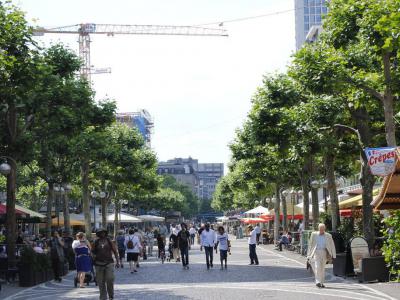
10) Fressgass (Grosse Bockenheimer Strasse)
Fressgass (literally, "Grazing Street") is an upmarket shopping street in the heart of Frankfurt, shared between the district of Innenstadt and the central business area, known as Bankenviertel. It is commonly regarded as Frankfurt's culinary main street. Fressgass has a broad pedestrian zone, located between Opernplatz (Opera Square – home to the Alte Oper) and Börsenstrasse (Stock Exchange Street) housing the Frankfurt Stock Exchange. The street is also the direct continuation (in the western direction) of the Zeil and runs parallel to Goethestrasse, one of Germany's busiest luxury shopping lanes.
Fressgass was originally an unofficial name, adopted around 1900 by the locals for the streets Kalbächer Gasse and Grosse Bockenheimer Strasse because of their many high-end food shops, bakeries, and butcheries, making it the most famous food shopping destination serving the bourgeoisie of the Westend. Today, Fressgass is famous as the area where bankers from the Bankenviertel meet for lunch. In 1977, the word Fressgass became an official name for the streets Kalbächer Gasse and Grosse Bockenheimer Strasse. Since 1977, the Rheingau Wine Festival takes place here annually during late summer, showcasing wineries from Rheingau and Rheinhessen.
Fressgass was originally an unofficial name, adopted around 1900 by the locals for the streets Kalbächer Gasse and Grosse Bockenheimer Strasse because of their many high-end food shops, bakeries, and butcheries, making it the most famous food shopping destination serving the bourgeoisie of the Westend. Today, Fressgass is famous as the area where bankers from the Bankenviertel meet for lunch. In 1977, the word Fressgass became an official name for the streets Kalbächer Gasse and Grosse Bockenheimer Strasse. Since 1977, the Rheingau Wine Festival takes place here annually during late summer, showcasing wineries from Rheingau and Rheinhessen.
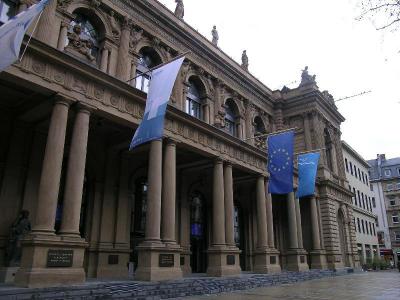
11) Frankfurt Stock Exchange
The Borse, also known as the Frankfurt Stock Exchange, ranks as the third-largest market worldwide for stocks, shares, and foreign exchange. The current building, situated in the heart of the city, was constructed during the early 19th century.
The roots of the Frankfurt stock exchange trace back to the 9th century when Emperor Louis the German issued a letter allowing the establishment of free trade fairs. This letter ignited a surge in financial activities, and by the 16th century, Frankfurt had blossomed into a thriving hub for trade and financial services. The inaugural Borse was established in 1585, and in 1874, the stock exchange relocated to its present premises. The architectural design of the new Borse building was the work of German architects Rudolf Heinrich Burnitz and Oskar Sommer. This red sandstone structure exhibited a neo-Renaissance style with an ornate Greco-Roman façade. The Borse's elegant appearance was further enriched by bronze sculptures of a bull and a bear placed in front of the building, created by sculptor Reinhard Dachlauer in 1988.
Interestingly, floor trading remains an active practice at the stock exchange, allowing visitors to reserve seats to observe the proceedings. The visitor's gallery is open for two hours on each trading day, employing interactive methods and assistance to provide viewers with a deeper understanding of the floor trading process.
The roots of the Frankfurt stock exchange trace back to the 9th century when Emperor Louis the German issued a letter allowing the establishment of free trade fairs. This letter ignited a surge in financial activities, and by the 16th century, Frankfurt had blossomed into a thriving hub for trade and financial services. The inaugural Borse was established in 1585, and in 1874, the stock exchange relocated to its present premises. The architectural design of the new Borse building was the work of German architects Rudolf Heinrich Burnitz and Oskar Sommer. This red sandstone structure exhibited a neo-Renaissance style with an ornate Greco-Roman façade. The Borse's elegant appearance was further enriched by bronze sculptures of a bull and a bear placed in front of the building, created by sculptor Reinhard Dachlauer in 1988.
Interestingly, floor trading remains an active practice at the stock exchange, allowing visitors to reserve seats to observe the proceedings. The visitor's gallery is open for two hours on each trading day, employing interactive methods and assistance to provide viewers with a deeper understanding of the floor trading process.
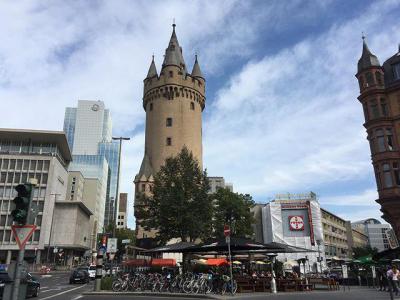
12) Eschenheimer Tower
One of the few remaining medieval towers that once protected the city of Frankfurt, the Eschenheimer Tower is a well-known city landmark. It is now located at the center of one of Frankfurt’s busiest intersections.
At the time of completion, the Eschenheimer was one of 60 towers that protected the city of Frankfurt from its enemies. Klaus Mengos, a carpenter, built the tower’s rectangular-shaped base in 1400 and the design was executed and completed by master builder Madern Gerthener. A self-portrait bust of Gerthener is placed on its archway. The tower became functional in 1428. In the 18th century, the city began to expand and many medieval towers were demolished. The timely intervention of French ambassador Count d’Hedouville helped prevent the demolition of the Eschenheimer Tower and to preserve this fine example of medieval architecture till the 21st century. The tower is 47 meters high with eight levels and two attics.
The Eschenheimer Tower is located one block north of the Hauptwache. A bistro called E.T. im Trum is located at the ground floor serving classic German food and beer. Visitors can also view the tower’s well-preserved battlements.
Why You Should Visit:
This tower is EXTREMELY German, has a friendly easy-going feel to it, and just begs to be photographed.
Inside it is comfortable, but there's a large covered outdoor patio, and if the weather is good, that's a nice option.
Tip:
Alternately, go to the top of Fleming's Hotel nearby for a drink and a nice view.
At the time of completion, the Eschenheimer was one of 60 towers that protected the city of Frankfurt from its enemies. Klaus Mengos, a carpenter, built the tower’s rectangular-shaped base in 1400 and the design was executed and completed by master builder Madern Gerthener. A self-portrait bust of Gerthener is placed on its archway. The tower became functional in 1428. In the 18th century, the city began to expand and many medieval towers were demolished. The timely intervention of French ambassador Count d’Hedouville helped prevent the demolition of the Eschenheimer Tower and to preserve this fine example of medieval architecture till the 21st century. The tower is 47 meters high with eight levels and two attics.
The Eschenheimer Tower is located one block north of the Hauptwache. A bistro called E.T. im Trum is located at the ground floor serving classic German food and beer. Visitors can also view the tower’s well-preserved battlements.
Why You Should Visit:
This tower is EXTREMELY German, has a friendly easy-going feel to it, and just begs to be photographed.
Inside it is comfortable, but there's a large covered outdoor patio, and if the weather is good, that's a nice option.
Tip:
Alternately, go to the top of Fleming's Hotel nearby for a drink and a nice view.
13) Adolph-von-Holzhausen Park
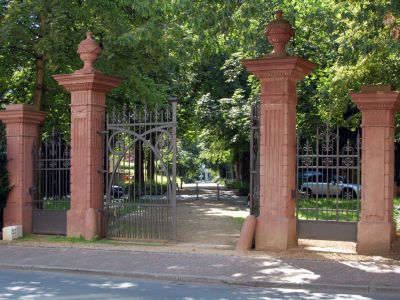
An impressive row of ancient chestnut trees lines the pathway leading to Adolph-von-Holzhausen Park, ultimately guiding visitors to the charming moated baroque Holzhausen castle. This picturesque scene is surrounded by a serene pond, enhancing the park's idyllic ambiance. It boasts well-maintained lawns, park benches strategically placed beneath magnificent old trees, and an almost enchanting glimpse of the petite castle peering through the foliage.
This site's history goes back to the 14th century when it was a farm called "Oed." In 1503, the von Holzhausen family turned it into a country estate. The castle, designed by architect Rémy de la Fosse, was built in 1722 as a summer retreat. In the late 18th century, an English-style park was added, expanding to 17 hectares in 1810. During the Wilhelminian era, Mayor Adickes developed most of the park into the Holzhausen Quarter. After protests, 3.5 hectares with valuable trees and Kastanienallee to Oeder Weg were preserved. In 1913, Frankfurt acquired the site as a public park, redesigned in 1952/53, with the castle restored in 1994.
Access to the Holzhausen castle is achieved via a stone bridge. Today, it serves as the headquarters of the Frankfurt Citizens Foundation, hosting a diverse array of events including concerts, lectures, readings, exhibitions, and activities for children. Children can enjoy singing sessions, storytelling sessions, and explore the Margot Wansleben Children's Library situated in the charming "Belvedere" under the castle's roof. Additionally, children's parties are a frequent occurrence here.
On Fridays, the elegant hall on the first floor of the castle is transformed into a branch office for the registry office, where numerous couples have exchanged their vows in a truly remarkable setting.
This site's history goes back to the 14th century when it was a farm called "Oed." In 1503, the von Holzhausen family turned it into a country estate. The castle, designed by architect Rémy de la Fosse, was built in 1722 as a summer retreat. In the late 18th century, an English-style park was added, expanding to 17 hectares in 1810. During the Wilhelminian era, Mayor Adickes developed most of the park into the Holzhausen Quarter. After protests, 3.5 hectares with valuable trees and Kastanienallee to Oeder Weg were preserved. In 1913, Frankfurt acquired the site as a public park, redesigned in 1952/53, with the castle restored in 1994.
Access to the Holzhausen castle is achieved via a stone bridge. Today, it serves as the headquarters of the Frankfurt Citizens Foundation, hosting a diverse array of events including concerts, lectures, readings, exhibitions, and activities for children. Children can enjoy singing sessions, storytelling sessions, and explore the Margot Wansleben Children's Library situated in the charming "Belvedere" under the castle's roof. Additionally, children's parties are a frequent occurrence here.
On Fridays, the elegant hall on the first floor of the castle is transformed into a branch office for the registry office, where numerous couples have exchanged their vows in a truly remarkable setting.
