Custom Walk in Granada, Spain by ersinenm9687 created on 2025-06-21
Guide Location: Spain » Granada
Guide Type: Custom Walk
# of Sights: 16
Tour Duration: 2 Hour(s)
Travel Distance: 2.7 Km or 1.7 Miles
Share Key: XKNDH
Guide Type: Custom Walk
# of Sights: 16
Tour Duration: 2 Hour(s)
Travel Distance: 2.7 Km or 1.7 Miles
Share Key: XKNDH
How It Works
Please retrieve this walk in the GPSmyCity app. Once done, the app will guide you from one tour stop to the next as if you had a personal tour guide. If you created the walk on this website or come to the page via a link, please follow the instructions below to retrieve the walk in the app.
Retrieve This Walk in App
Step 1. Download the app "GPSmyCity: Walks in 1K+ Cities" on Apple App Store or Google Play Store.



Step 2. In the GPSmyCity app, download(or launch) the guide "Granada Map and Walking Tours".
Step 3. Tap the menu button located at upper right corner of the "Walks" screen and select "Retrieve custom walk". Enter the share key: XKNDH
1) Plaza Bib-Rambla
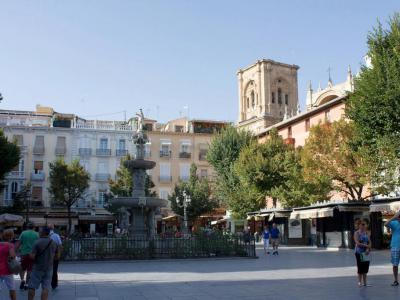
In the Plaza Bib-Rambla, when you stand before the Fountain of Giants, here's what you should do. Sit down. Sit at one of the cafes. Look at the giants, enjoy the flower market, have churros with your hot chocolate and allow your mind to go back in time.
You are in the square of Medina Garnata of the Nasrid era. The square is a Muslim bazaar, a souq. The Arabs call this place Bib-Rambla (Sand Gate) for the sandy banks of the Darro river nearby. There are three other rivers, the Genil, the Monachil, and the Beiro.
Here's a factoid. Where you are sitting was a Jewish ghetto. But that's another story. Sip your chocolate, move on. Going forward (as they say), see Bazaars, jousting knights, bull fights, burning heretics, executions, Corpus Christi processions.
In December the square is given over to Christmas markets and stalls selling hot chestnuts. In May carnival giants with swollen heads dominate in the Tarasca procession, in observance of Corpus Christi. The figure of a warrior mounted on a dragon (La Tarasca) is wafted around the square to remind people that good will triumph over evil.
Bib-Rambla today is a haven to buy flowers, enjoy the shade of the lemon trees and study the faces on the Gigantones Fountain. Still hungry? Have some tapas.
You are in the square of Medina Garnata of the Nasrid era. The square is a Muslim bazaar, a souq. The Arabs call this place Bib-Rambla (Sand Gate) for the sandy banks of the Darro river nearby. There are three other rivers, the Genil, the Monachil, and the Beiro.
Here's a factoid. Where you are sitting was a Jewish ghetto. But that's another story. Sip your chocolate, move on. Going forward (as they say), see Bazaars, jousting knights, bull fights, burning heretics, executions, Corpus Christi processions.
In December the square is given over to Christmas markets and stalls selling hot chestnuts. In May carnival giants with swollen heads dominate in the Tarasca procession, in observance of Corpus Christi. The figure of a warrior mounted on a dragon (La Tarasca) is wafted around the square to remind people that good will triumph over evil.
Bib-Rambla today is a haven to buy flowers, enjoy the shade of the lemon trees and study the faces on the Gigantones Fountain. Still hungry? Have some tapas.
2) Alcaicería (The Arab Market)
In the sixth century the Byzantine Emperor Justinian granted the Arabs the exclusive right to make and sell silk within the Empire. To show appreciation the Arabs gave their bazaars the Arabic name for Caesar, al-Kaysar-ia, "the place of Ceasar." Sounds like "Alcaiceria." And so from that time all Arab bazaars took this name.
The Alcaiceria of Granada was opened in the 15th century. It lasted well into the 19th century when it was destroyed by fire. The fire was caused by a shop for matches. The shop went up first, then all else followed. The replacement Alcaiceria is a weak imitation of the original. It is smaller, made with cheaper materials. It looks worn.
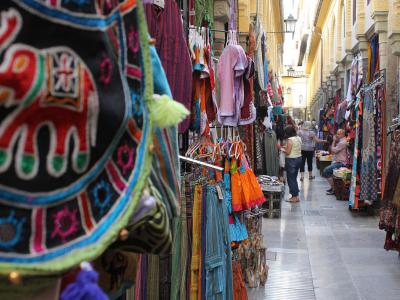
The first Alcaiceria held over 200 shops and stalls within a maze of streets and alleys. The streets were closed with iron gates to keep horsemen out. The gates were locked at night. Business was given over almost exclusively to the precious silks. Today the Aciceria is devoted to souvenir stalls, knick-knacks, and memorabilia.
The Alcaiceria of Granada was opened in the 15th century. It lasted well into the 19th century when it was destroyed by fire. The fire was caused by a shop for matches. The shop went up first, then all else followed. The replacement Alcaiceria is a weak imitation of the original. It is smaller, made with cheaper materials. It looks worn.
The first Alcaiceria held over 200 shops and stalls within a maze of streets and alleys. The streets were closed with iron gates to keep horsemen out. The gates were locked at night. Business was given over almost exclusively to the precious silks. Today the Aciceria is devoted to souvenir stalls, knick-knacks, and memorabilia.
3) Granada Cathedral (must see)
Granada Cathedral is a Roman Catholic church. It is the seat of the Archdiocese of Granada and it was built on top of the bones of the Mosque of the City. The construction took place in 1518 after the Christian Reconquest of Andalusia.
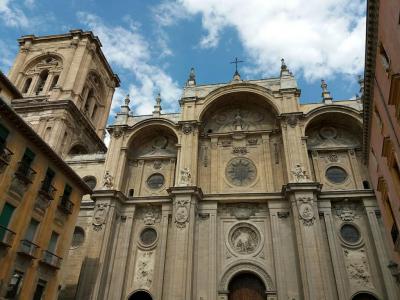
The Cathedral was started in The Spanish Renaissance style rather than the Gothic. In 1523 the first architect, Enrique Egas was replaced by Diego de Siloe. The work continued for forty years. Diego planned for a triforium of five naves rather than three. His principal chapel (capilla mayor) was circular, not a semicircular apse.
For 181 years alterations and revisions proceeded under different architects until 1667. Alonso Cano and Gaspar de la Pena introduced Baroque elements to the facade. In 1699 after 181 years, this document of stone might be considered almost complete. But two high towers were planned and never built. The ground underneath was considered unstable.
The Cathedral was meant to be the royal mausoleum but Philip II moved the royal burial site to the palace of El Escorial near Madrid.
The Cathedral was started in The Spanish Renaissance style rather than the Gothic. In 1523 the first architect, Enrique Egas was replaced by Diego de Siloe. The work continued for forty years. Diego planned for a triforium of five naves rather than three. His principal chapel (capilla mayor) was circular, not a semicircular apse.
For 181 years alterations and revisions proceeded under different architects until 1667. Alonso Cano and Gaspar de la Pena introduced Baroque elements to the facade. In 1699 after 181 years, this document of stone might be considered almost complete. But two high towers were planned and never built. The ground underneath was considered unstable.
The Cathedral was meant to be the royal mausoleum but Philip II moved the royal burial site to the palace of El Escorial near Madrid.
4) Capilla Real de Granada (Royal Chapel) (must see)
When Queen Isabella moved into Granada, she was a woman who had found her new home. She was determined to fix it up, to make it her own. Among the first things on her list was to make an addition to that new cathedral that was sitting on the old mosque. The add-on would be her very own chapel, not a little one either. It would be her Main Chapel.
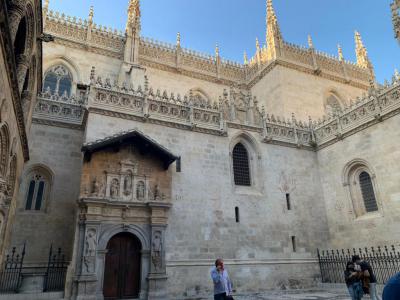
The Main Chapel was constructed at last by 1517. It was built in the new Isabelline style. It is a transition from Gothic to early Renaissance architecture. Isabella planned to stay. By royal decree the chapel was declared to be the future burial site for herself and King Ferdinand. The King did not object.
The chapel is dedicated to Saint John the Baptist and Saint John the Evangelist. The interior is reminiscent of the Monastery of San Juan de los Reyes in Toledo. It has four side chapels in the form of a cross and a Gothic vault. In the center of the transept are the tombs of Isabella and Ferdinand. The tombs are sculpted and raised.
Spoiler alert. The tombs are empty. The royal remains are actually in the crypt below. Since the church is still used for services, the crypt is not always open to visitors. The Catholic kings and queens are joined in this chapel. Their memorials mark the emergence of the coming power and glory of Spain and the brilliant renaissance of Europe.
The Main Chapel was constructed at last by 1517. It was built in the new Isabelline style. It is a transition from Gothic to early Renaissance architecture. Isabella planned to stay. By royal decree the chapel was declared to be the future burial site for herself and King Ferdinand. The King did not object.
The chapel is dedicated to Saint John the Baptist and Saint John the Evangelist. The interior is reminiscent of the Monastery of San Juan de los Reyes in Toledo. It has four side chapels in the form of a cross and a Gothic vault. In the center of the transept are the tombs of Isabella and Ferdinand. The tombs are sculpted and raised.
Spoiler alert. The tombs are empty. The royal remains are actually in the crypt below. Since the church is still used for services, the crypt is not always open to visitors. The Catholic kings and queens are joined in this chapel. Their memorials mark the emergence of the coming power and glory of Spain and the brilliant renaissance of Europe.
5) La Madrasa (The Prayer Room) (must see)
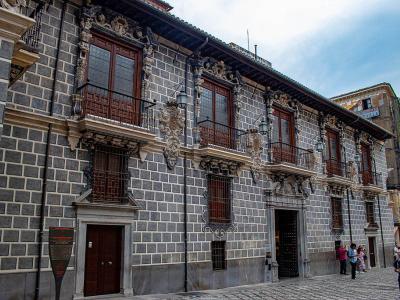
On the Oficios Street, between the Granada Cathedral and the Alcaiceria, where gold, and silk were traded long ago, sits the Madrasa of Granada. Founded in 1349 by Yusuf I, Nasrid Emir of Granada, the Madrasa was a school of Islamic law and grammar. The syllabus also included Rhetoric and Medicine.
The Madrasa survived when the city was ceded to Ferdinand and Isabella. Then in 1500, after a Muslim rebellion, Gonzalo Jimenez de Cisneros, Inquisitor-General, attacked the Madrasa. The building was sacked, the irreplaceable library books were burned in the Plaza Bib-Rambla. No one was ready for the Spanish Inquisition.
Subsequently, the building was variously standing empty, used as a city hall, or taken over to serve as a textile warehouse, its noble purpose long forgotten. In 1860 The Mihrab inscription dedicating the mosque to the month of Muharram was found. After several restorations, the Madrasa was opened to the public in 2011.
The sole part of the original Madrasa surviving today is the Prayer Room. It has a high ceiling. Halfway up the walls the shape of the room changes to an octagonal form. The upper walls are covered with stucco decorations and calligraphy. There are 16 windows and a wooden cupola overhead.
Within the entrance an inscription reads, "If in your spirit you provide a place for the desire to study...you will find within it the beautiful tree of honor..." The Inquisition tried to erase this place, and it failed.
The Madrasa survived when the city was ceded to Ferdinand and Isabella. Then in 1500, after a Muslim rebellion, Gonzalo Jimenez de Cisneros, Inquisitor-General, attacked the Madrasa. The building was sacked, the irreplaceable library books were burned in the Plaza Bib-Rambla. No one was ready for the Spanish Inquisition.
Subsequently, the building was variously standing empty, used as a city hall, or taken over to serve as a textile warehouse, its noble purpose long forgotten. In 1860 The Mihrab inscription dedicating the mosque to the month of Muharram was found. After several restorations, the Madrasa was opened to the public in 2011.
The sole part of the original Madrasa surviving today is the Prayer Room. It has a high ceiling. Halfway up the walls the shape of the room changes to an octagonal form. The upper walls are covered with stucco decorations and calligraphy. There are 16 windows and a wooden cupola overhead.
Within the entrance an inscription reads, "If in your spirit you provide a place for the desire to study...you will find within it the beautiful tree of honor..." The Inquisition tried to erase this place, and it failed.
6) Plaza Nueva (The New Square) (must see)
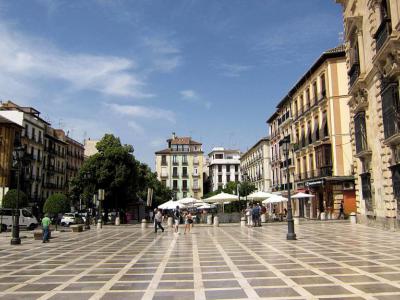
Despite its name, the Plaza Nueva (New Square) is one of the oldest squares in Granada. In former times the plaza was the scene of bull fights, tournaments and an occasional execution, definitely a spectator event. Before it was a square, however, it was a bridge. Called the Bridge of of Loggers, it spanned the River Darro.
The square is centrally located and is an ideal starting point for explorations on foot. Walk from the Puerto Granadas to the Alhambra forest to the Alhambra, a 15 or 20 minute journey. Exit by way of the cobbled street on the left of the Church of Santa Ana to the River Darro. Perhaps go up Elvira Street to the Mirador San Nicolas and the Albaicin.
The main attraction of the square itself is the High Court of Andalusia. The court building was formerly the Chancilleria Real (Royal Chancellery). Construction of the Chancellery began in 1530. In the rear of the building a prison, handy to the court. The square is also home to the Arborea Flamenco. Cafes, flamenco, ole!
The square is centrally located and is an ideal starting point for explorations on foot. Walk from the Puerto Granadas to the Alhambra forest to the Alhambra, a 15 or 20 minute journey. Exit by way of the cobbled street on the left of the Church of Santa Ana to the River Darro. Perhaps go up Elvira Street to the Mirador San Nicolas and the Albaicin.
The main attraction of the square itself is the High Court of Andalusia. The court building was formerly the Chancilleria Real (Royal Chancellery). Construction of the Chancellery began in 1530. In the rear of the building a prison, handy to the court. The square is also home to the Arborea Flamenco. Cafes, flamenco, ole!
7) Calle Calderería Nueva (New Caldereria Street)
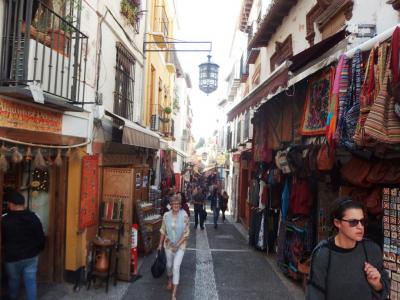
Looking for a cup of tea? Most tea rooms and tea shops in Granada can be found on New Caldereria Street, in the quarter of Albaicin. Also called La Calle de las Teterias, the street is packed with shops offering international selections of teas, juices, cakes, crepes, rugs, arrases, and, yes, hookahs. Drink, smoke, and absorb the ambiance of Albaicin.
Continuing down the narrow, cobbled street, encounter more and more teas - Arabic teas, oriental teas, and, oops, aphrodisiacs. There are smoothies, juices, and liqueurs. Feeling peckish? There is Arab cuisine, vegetarian fare, and Indian and middle eastern dishes. Last but not least, find a wide selection of Andalusian pastries and desserts.
The lasting impression of New Caldereria Street is one of aroma and color, fabrics draped over balconies, the liveliness. That's more than one impression. If we had to pick just one, it would be the exotic perfume of the many different teas, the enticing smell of the cuisines, the Andalusian sweets... Wait, that's more than one.
Continuing down the narrow, cobbled street, encounter more and more teas - Arabic teas, oriental teas, and, oops, aphrodisiacs. There are smoothies, juices, and liqueurs. Feeling peckish? There is Arab cuisine, vegetarian fare, and Indian and middle eastern dishes. Last but not least, find a wide selection of Andalusian pastries and desserts.
The lasting impression of New Caldereria Street is one of aroma and color, fabrics draped over balconies, the liveliness. That's more than one impression. If we had to pick just one, it would be the exotic perfume of the many different teas, the enticing smell of the cuisines, the Andalusian sweets... Wait, that's more than one.
8) San Jose Church
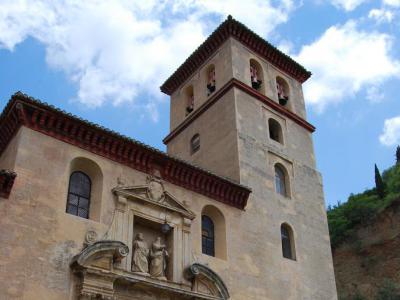
The San Jose Church is found in the district of Albayzin, one of a collection of churches in the area which were formed from the ruins of mosques and Almohad palaces. The church tower is believed to have once been the minaret for the ‘mosque of the Hermits’, which stood on this spot until 1517, when the church replaced it. At the foot of the tower you can see a Moorish era water deposit. It is in buildings like San Jose church, and the nearby San Miguel and Santa Isabella places of worship, that the crossover from Muslim to Christian domination of Granada is most visible.
The church was designed by Rodrigo Hernández in the ojival manner. Once you pass through the Elvira stone portal, you can enjoy the fine, gilded decoration typical of churches built following the return of Christianity to Andalucía. The central nave is supported by four arches, bearing the arms of the Catholic Kings. At the centre of the church, a large entablature stands on Corinthian columns. In the middle of this, you can see a sculpture of Christ Crucified in the style of Pablo de Rojas. There are examples of fine religious art and sculptures dotted throughout the many corners of this church.
The church was designed by Rodrigo Hernández in the ojival manner. Once you pass through the Elvira stone portal, you can enjoy the fine, gilded decoration typical of churches built following the return of Christianity to Andalucía. The central nave is supported by four arches, bearing the arms of the Catholic Kings. At the centre of the church, a large entablature stands on Corinthian columns. In the middle of this, you can see a sculpture of Christ Crucified in the style of Pablo de Rojas. There are examples of fine religious art and sculptures dotted throughout the many corners of this church.
9) Monastery of Santa Isabel la Real
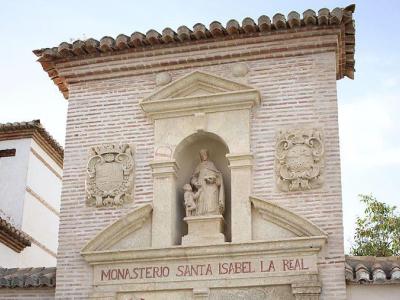
The Monastery of Santa Isabel la Real stands on the Camino Nuevo de San Nicolás, next to San Miguel Bajo church. It was built on the site of Dar al-Horra, a former Moorish palace. It was founded by Queen Isabella of Castile following the conquest of Granada. The monastery was designed in the Gothic style, known locally as ‘Isabella’s style’ due to its popularity with the Queen. It was completed in the 16th century, and bears her coat of arms on the entrance door.
The church’s interior is notable for several unusual items. These include a Mudejar ceiling above the nave, comprised of fretted woodwork in a style associated with Moorish craftsmen. The church also houses the tomb of sculptor Bernardo Francisco de Mora. The font is formed from the remnants of a fountain recovered from the remains of the palace. The statue of the Virgin Mary, along with several wooden crosses seen on the walls of the monastery, is carried by the resident nuns through Granada’s streets for the Easter parade. The nuns that live at the monastery can be heard singing next to the nave each evening at 7pm. They also sell pastries, which can be bought through a revolving window within the church.
The church’s interior is notable for several unusual items. These include a Mudejar ceiling above the nave, comprised of fretted woodwork in a style associated with Moorish craftsmen. The church also houses the tomb of sculptor Bernardo Francisco de Mora. The font is formed from the remnants of a fountain recovered from the remains of the palace. The statue of the Virgin Mary, along with several wooden crosses seen on the walls of the monastery, is carried by the resident nuns through Granada’s streets for the Easter parade. The nuns that live at the monastery can be heard singing next to the nave each evening at 7pm. They also sell pastries, which can be bought through a revolving window within the church.
10) Low San Miguel Square and Church
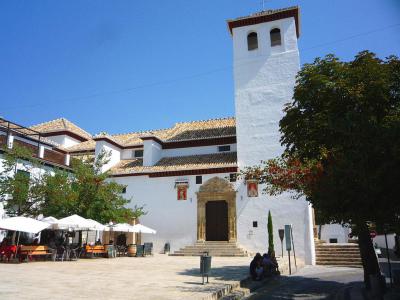
Low San Miguel is low because it is lower than the other San Miguel, High San Miguel. Low San Miguel church has a humble simple appearance, but the church and the plaza tell the story of the city.
The fountain alongside the church is of red brick, indicating the church may have been a mosque in the time of the Muslim Almohads. Two marble columns from the Roman imperial age suggest an even earlier time. A statue of Christ on the cross is bound with iron clamps, a veteran of the Spanish civil war.
The church was built in the Mudejar style but it has Renaissance accents. The entrance is flanked by two corinthian columns and pilasters bearing shields. There is an image of San Miguel above the doors, made in 1558 by Toribio de Liébana. On the sides of San Miguel's niche are two oculi with angels. On the western portal is Saint Peter, similarly arranged.
The church has one nave and side chapels, a Main Chapel and a choir. In the 16th century Tomas de Morales installed an altarpiece in two sections. In 1753 Blas Moreno replaced Morales' altar pieces with an altar with sculptures by Turcato Ruiz del Peral.
At last, visit the tower. The tower is square, with five floors accessible by stairs. On each floor there are chairs for those not used to serious climbing. From the top floor of the tower there are spectacular views of Albaicin, the convent of Santa Isabel, and the city of Granada.
The fountain alongside the church is of red brick, indicating the church may have been a mosque in the time of the Muslim Almohads. Two marble columns from the Roman imperial age suggest an even earlier time. A statue of Christ on the cross is bound with iron clamps, a veteran of the Spanish civil war.
The church was built in the Mudejar style but it has Renaissance accents. The entrance is flanked by two corinthian columns and pilasters bearing shields. There is an image of San Miguel above the doors, made in 1558 by Toribio de Liébana. On the sides of San Miguel's niche are two oculi with angels. On the western portal is Saint Peter, similarly arranged.
The church has one nave and side chapels, a Main Chapel and a choir. In the 16th century Tomas de Morales installed an altarpiece in two sections. In 1753 Blas Moreno replaced Morales' altar pieces with an altar with sculptures by Turcato Ruiz del Peral.
At last, visit the tower. The tower is square, with five floors accessible by stairs. On each floor there are chairs for those not used to serious climbing. From the top floor of the tower there are spectacular views of Albaicin, the convent of Santa Isabel, and the city of Granada.
11) Palacio de Dar-al-Horra (Dar-al-Horra Palace)
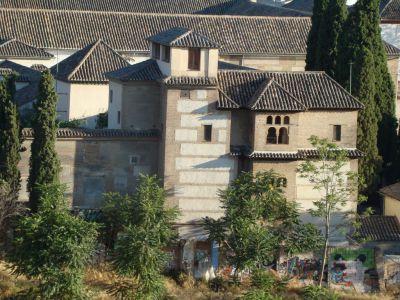
The Palacio de Dar-al-Horra was built by the Emirs of Granada in the 15th century, shortly before their rule was ended by Christian conquistadors. The palace was built upon the remains of a destroyed palace, and is the only Muslim palace in the Albayzin to have been at least partially preserved. The name ‘Dar-al-Horra’ translates from Arabic as ‘the House of the Honest Lady’. This is believed to refer to the mother of King Boabdil, the last Arab monarch of Spain, who lived in the palace until 1492, when Granada was claimed by the Catholic monarchs.
Following the Conquest of Granada, the palace was converted by Queen Isabella into the Santa Isabel la Real convent. Whilst the convent still exists within the palace compound, those parts of the original palace that remain are owned by the government, and listed as a national monument. The palace is filled with examples of Nasrid art, which combines Arabic and European artistic styles. The central courtyard is flanked by two porticoes, with a small pool and fountain in the southern portico. The northern portico is notable for its horseshoe shaped arches and ornate Medujar style ceiling, made from wood carved in a geometric pattern.
Following the Conquest of Granada, the palace was converted by Queen Isabella into the Santa Isabel la Real convent. Whilst the convent still exists within the palace compound, those parts of the original palace that remain are owned by the government, and listed as a national monument. The palace is filled with examples of Nasrid art, which combines Arabic and European artistic styles. The central courtyard is flanked by two porticoes, with a small pool and fountain in the southern portico. The northern portico is notable for its horseshoe shaped arches and ornate Medujar style ceiling, made from wood carved in a geometric pattern.
12) Mirador de San Nicolas (San Nicolas Lookout) (must see)
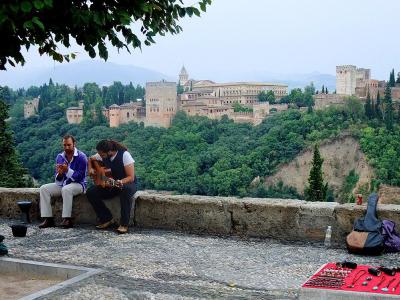
Bill Clinton is supposed to have said "the most beautiful sunset in the world" when speaking of the sunset view from San Nicolas Lookout. San Nicolas does offer the best view of the Alhambra at sunset, but there are a lot of spectacular lookouts in Granada. San Cristobal is reputed to be a fantastic viewpoint of the City.
Each clear day at sunset there is a crowd gathering in the square of San Nicolas. They are there to watch the Alhambra turn red in the setting sun. Alhambra in Arabic means "red castle." Tourists, locals, and travelers come together at the overlook. There are vendors hawking snacks, flamenco dancers, souvenir sellers and other entertainments.
The lookout is named for San Nicolas Church and Square. The church was built on the top of a mosque in 1525. There seems to have been a trend, when the Catholic Monarchs took over in 1491, to drop a church on a mosque. Location, location, the man said. The church has been destroyed several times by fires, but the original bell tower survives.
For only a few euros it is possible to climb the tower San Nicolas and get a better view.
Each clear day at sunset there is a crowd gathering in the square of San Nicolas. They are there to watch the Alhambra turn red in the setting sun. Alhambra in Arabic means "red castle." Tourists, locals, and travelers come together at the overlook. There are vendors hawking snacks, flamenco dancers, souvenir sellers and other entertainments.
The lookout is named for San Nicolas Church and Square. The church was built on the top of a mosque in 1525. There seems to have been a trend, when the Catholic Monarchs took over in 1491, to drop a church on a mosque. Location, location, the man said. The church has been destroyed several times by fires, but the original bell tower survives.
For only a few euros it is possible to climb the tower San Nicolas and get a better view.
13) Mezquita del Albaicín (Albaicín Mosque)
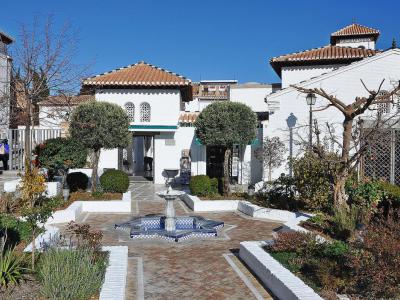
The Mezquita del Albaycín (Albaycín Mosque), also known as The Great Mosque of Granada, was opened in 2003, and is the first mosque built in the city since the Christian Reconquista in 1492.
The Mosque features traditional Arabic style with architectural accents of the Nasrid Empire. Located in Plaza San Nicolás, in the historic Albaycín neighborhood, The Great Mosque is made up of three sections: the garden, the prayer room (which is the mosque itself) and the Center for Islamic Studies.
The prayer section is decorated with sober elements borrowed from Islamic artistic traditions. The mihrab, which marks the direction of prayer towards Mecca, is a replica of the one in the Mosque of Córdoba. The cedar wood panels of the Atlas, carved by hand, contain an ayah from the Qur'an, where some of the divine attributes are named.
The marble panels of different colors are identical to those of the Al Aqsa Mosque in Jerusalem. The large windows of the qibla are copies of those of the Blue Mosque in Istanbul. The fountain and the mosaics in the courtyard, that gives access to the prayer room, have been made by artisans from Fez, Morocco, who have recreated the designs and used same techniques as in Muslim Granada 1000 years ago.
The minaret is a tower of genuinely Albaicine proportions and silhouette. The mosaic inscription with Kufic calligraphy, which can be read under its eaves, is the declaration of faith of the Muslims: “There is no god but Allah. Muhammad is the messenger of Allah." On the ground floor, in the main entrance hall there is a reception desk and a store selling books, crafts and souvenirs.
The Mosque features traditional Arabic style with architectural accents of the Nasrid Empire. Located in Plaza San Nicolás, in the historic Albaycín neighborhood, The Great Mosque is made up of three sections: the garden, the prayer room (which is the mosque itself) and the Center for Islamic Studies.
The prayer section is decorated with sober elements borrowed from Islamic artistic traditions. The mihrab, which marks the direction of prayer towards Mecca, is a replica of the one in the Mosque of Córdoba. The cedar wood panels of the Atlas, carved by hand, contain an ayah from the Qur'an, where some of the divine attributes are named.
The marble panels of different colors are identical to those of the Al Aqsa Mosque in Jerusalem. The large windows of the qibla are copies of those of the Blue Mosque in Istanbul. The fountain and the mosaics in the courtyard, that gives access to the prayer room, have been made by artisans from Fez, Morocco, who have recreated the designs and used same techniques as in Muslim Granada 1000 years ago.
The minaret is a tower of genuinely Albaicine proportions and silhouette. The mosaic inscription with Kufic calligraphy, which can be read under its eaves, is the declaration of faith of the Muslims: “There is no god but Allah. Muhammad is the messenger of Allah." On the ground floor, in the main entrance hall there is a reception desk and a store selling books, crafts and souvenirs.

14) Paseo de los Tristes (The Promenade of the Sad) (must see)
Officially, the real name of Paseo de las Tristes is Paseo del Padre Manjon. The paseo was at one time a route for funeral processions. "Tristes" in Spanish can mean "sorrows." The paseo is easy to reach with the city's hop-on hop-off train or try a bus. When the weather is mild and clear the path is often crowded, especially at sunset.
The promenade is a pleasant walk bordered by the River Darro and some finer restaurants. There are stunning views of the Alhambra against the skyline. There is a flamenco venue (of course!) and tourist shops galore. The ancient cobblestone streets recall the medieval era.
The paseo leads to the San Jose cemetery, across the river and above the Alhambra. It was a long trip on foot for mourners. They must have stopped here, in this pleasant place to say their farewells. Today there is a spacious terrace with umbrellas from which to contemplate sunset views and have a drink and let go of the "sorrows".
The promenade is a pleasant walk bordered by the River Darro and some finer restaurants. There are stunning views of the Alhambra against the skyline. There is a flamenco venue (of course!) and tourist shops galore. The ancient cobblestone streets recall the medieval era.
The paseo leads to the San Jose cemetery, across the river and above the Alhambra. It was a long trip on foot for mourners. They must have stopped here, in this pleasant place to say their farewells. Today there is a spacious terrace with umbrellas from which to contemplate sunset views and have a drink and let go of the "sorrows".
15) Carrera del Darro (Darro Street) (must see)
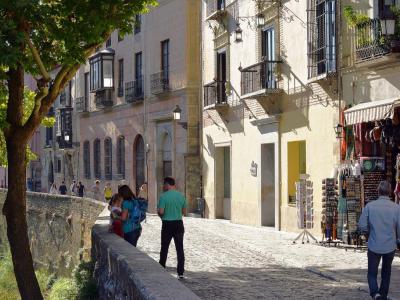
The whole left bank of the River Darro is called the Carrera del Darro. Carrera del Darro is unique in a city full of unique things. The street runs in between the river and the forest of Alhambra. At night the churches are lighted and the Alhambra at the top of its hill glows with light.
Starting in the sixteenth century the nobility of Granada made their homes in this picturesque place. Renaissance buildings, churches, and ruins beside bars and cafes line the street and the banks of the river. The Banuelo is here. Public baths came in the 11th century. Mudejar churches like Santa Ana and San Pedro date from 1567.
Then there is the tragic story of the House of Castril balcony. Today the Castril House is an archeology museum. It is a Renaissance dwelling built in 1539. It belonged to a rich nobleman named Zafra. Zafra was obsessive with keeping his daughter Elvira locked away from the local swains.
He ordered the death of a servant who was caught with a message for Elvira from a likely suitor. He believed the message of love was from the servant and ordered that he be hung from his daughter's balcony. When the servant protested his innocence, Zafra suggested he hang from the balcony and wait. Elvira took poison and killed herself.
There is an mysterious inscription that was found, "Esperando La Del Cielo" ("Waiting for Heaven") above Elvira's balcony. A melodramatic tragedy, the case was never solved.
Starting in the sixteenth century the nobility of Granada made their homes in this picturesque place. Renaissance buildings, churches, and ruins beside bars and cafes line the street and the banks of the river. The Banuelo is here. Public baths came in the 11th century. Mudejar churches like Santa Ana and San Pedro date from 1567.
Then there is the tragic story of the House of Castril balcony. Today the Castril House is an archeology museum. It is a Renaissance dwelling built in 1539. It belonged to a rich nobleman named Zafra. Zafra was obsessive with keeping his daughter Elvira locked away from the local swains.
He ordered the death of a servant who was caught with a message for Elvira from a likely suitor. He believed the message of love was from the servant and ordered that he be hung from his daughter's balcony. When the servant protested his innocence, Zafra suggested he hang from the balcony and wait. Elvira took poison and killed herself.
There is an mysterious inscription that was found, "Esperando La Del Cielo" ("Waiting for Heaven") above Elvira's balcony. A melodramatic tragedy, the case was never solved.
16) El Bañuelo (Traditional Arab Bath)
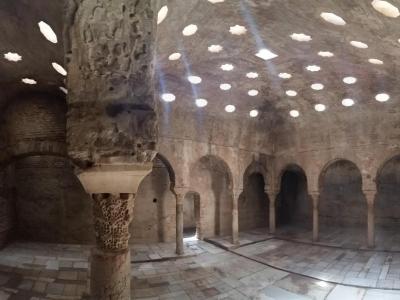
El Banuelo is a well preserved hammam, an Islamic bathhouse. It can be found on the banks of the Darro in the district of Albaicin. It saw use as a bathhouse until the 16th century. It fell into disuse until the 20th century when it underwent several restorations.
Hammams were common throughout the Muslim world. They were used for ablutions, hygiene and socializing. They functioned very much like the old Roman baths. Many Islamic bathhouses have been uncovered in Granada. Most of the bathhouses were found to be quite simple. The exception to the rule is the lush hammams of the 14th century Alhambra.
The Bañuelo dates from the 12th century, the time of Nasrid rule in Granada. the baths would have been in the old royal citadel in Abaicin before the Alhambra became the center of political power.
The baths were organized by sequential rooms. The first, open to the street, was a reception room with a small pool. A doorway in the room led to rooms with latrines and from there to a changing room. Then came a cold room, a warm room and a hot room. There was no immersion. The patrons were simply doused with warm water.
Hammams were common throughout the Muslim world. They were used for ablutions, hygiene and socializing. They functioned very much like the old Roman baths. Many Islamic bathhouses have been uncovered in Granada. Most of the bathhouses were found to be quite simple. The exception to the rule is the lush hammams of the 14th century Alhambra.
The Bañuelo dates from the 12th century, the time of Nasrid rule in Granada. the baths would have been in the old royal citadel in Abaicin before the Alhambra became the center of political power.
The baths were organized by sequential rooms. The first, open to the street, was a reception room with a small pool. A doorway in the room led to rooms with latrines and from there to a changing room. Then came a cold room, a warm room and a hot room. There was no immersion. The patrons were simply doused with warm water.
