Custom Walk in Baltimore, Maryland by elisabeth_gleis_74828 created on 2025-08-01
Guide Location: USA » Baltimore
Guide Type: Custom Walk
# of Sights: 14
Tour Duration: 3 Hour(s)
Travel Distance: 6.4 Km or 4 Miles
Share Key: WPENW
Guide Type: Custom Walk
# of Sights: 14
Tour Duration: 3 Hour(s)
Travel Distance: 6.4 Km or 4 Miles
Share Key: WPENW
How It Works
Please retrieve this walk in the GPSmyCity app. Once done, the app will guide you from one tour stop to the next as if you had a personal tour guide. If you created the walk on this website or come to the page via a link, please follow the instructions below to retrieve the walk in the app.
Retrieve This Walk in App
Step 1. Download the app "GPSmyCity: Walks in 1K+ Cities" on Apple App Store or Google Play Store.



Step 2. In the GPSmyCity app, download(or launch) the guide "Baltimore Map and Walking Tours".
Step 3. Tap the menu button located at upper right corner of the "Walks" screen and select "Retrieve custom walk". Enter the share key: WPENW
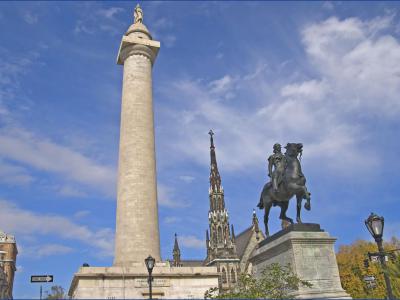
1) Washington Monument and Museum at Mount Vernon Place
The Washington Monument at Mount Vernon Place was the first significant monument built in honor of President George Washington. Construction on the memorial began in 1815 and was completed in 1829.
The monument was designed by a famed architect Robert Mills who also designed the Washington Monument in Washington, D.C. The Washington Monument in Baltimore is a marble, Doric column that is 178 feet high. There are 227 steps to climb to the top of the monument tower to look through a viewing window.
A statue of George Washington, carved by sculptor Enrico Causici, stands atop the monument. Other details include bronze inscriptions that describe Washington's life and career. These plaques were added with the advisement of John Quincy Adams.
The museum is located on the ground floor of the monument. It contains digital exhibits detailing the construction process, the history of Mount Vernon, and the life of George Washington.
The monument was designed by a famed architect Robert Mills who also designed the Washington Monument in Washington, D.C. The Washington Monument in Baltimore is a marble, Doric column that is 178 feet high. There are 227 steps to climb to the top of the monument tower to look through a viewing window.
A statue of George Washington, carved by sculptor Enrico Causici, stands atop the monument. Other details include bronze inscriptions that describe Washington's life and career. These plaques were added with the advisement of John Quincy Adams.
The museum is located on the ground floor of the monument. It contains digital exhibits detailing the construction process, the history of Mount Vernon, and the life of George Washington.
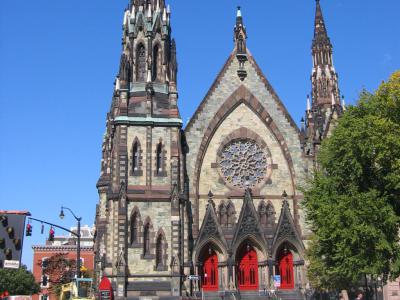
2) Mt. Vernon Place United Methodist Church
Mount Vernon Place United Methodist Church in Baltimore is a significant historical landmark with impressive architectural design and a rich congregation history. The church, completed in 1872, was designed by Thomas Dixon, a Baltimore architect, in the Norman-Gothic style.
Its striking green serpentine stone, buff, olive and red sandstone, polished granite columns, and carved designs taken from nature make it an architectural masterpiece. The many gothic details of flying buttresses, a tower, and arches are purely aesthetic in function, as the building is constructed over an iron framework. The church's interior is also notable for its iron supporting columns, carved wooden beams, and stained glass cross window over the pulpit.
The congregation of the Mount Vernon Place United Methodist Church has a rich history of providing spiritual and secular services to Baltimore. The group began in a building on Lovely Lane in 1784, and the current church on Mount Vernon Place is the congregation's fourth home.
During World War II, the church provided beds, food, and entertainment to servicemen returning from the front. In the 1970s, the church led efforts to help runaway teenagers and victims of drug abuse, and they began a service organization to engage young Baltimoreans in helping their city.
In 1971, the Mount Vernon Place United Methodist Church and Asbury House were listed on the National Register of Historic Places. The Asbury House, designed by Baltimore architects Niernsee & Neilson, was built around 1850 and became the home of George von Lingen, the German consul in Baltimore in 1893. Von Lingen renovated the second-floor library, which features a ceiling painting and intricate carvings done by German workers.
The Mount Vernon Place United Methodist Church is a remarkable historical and architectural landmark that showcases the rich history of Baltimore and the significant contributions of its citizens.
Its striking green serpentine stone, buff, olive and red sandstone, polished granite columns, and carved designs taken from nature make it an architectural masterpiece. The many gothic details of flying buttresses, a tower, and arches are purely aesthetic in function, as the building is constructed over an iron framework. The church's interior is also notable for its iron supporting columns, carved wooden beams, and stained glass cross window over the pulpit.
The congregation of the Mount Vernon Place United Methodist Church has a rich history of providing spiritual and secular services to Baltimore. The group began in a building on Lovely Lane in 1784, and the current church on Mount Vernon Place is the congregation's fourth home.
During World War II, the church provided beds, food, and entertainment to servicemen returning from the front. In the 1970s, the church led efforts to help runaway teenagers and victims of drug abuse, and they began a service organization to engage young Baltimoreans in helping their city.
In 1971, the Mount Vernon Place United Methodist Church and Asbury House were listed on the National Register of Historic Places. The Asbury House, designed by Baltimore architects Niernsee & Neilson, was built around 1850 and became the home of George von Lingen, the German consul in Baltimore in 1893. Von Lingen renovated the second-floor library, which features a ceiling painting and intricate carvings done by German workers.
The Mount Vernon Place United Methodist Church is a remarkable historical and architectural landmark that showcases the rich history of Baltimore and the significant contributions of its citizens.
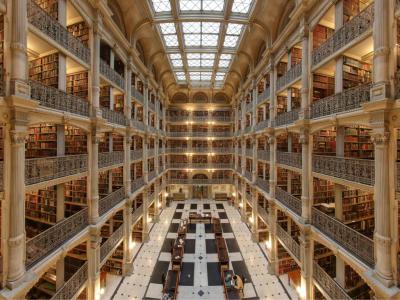
3) George Peabody Library
The George Peabody Library is a world-renowned research library recognized for its exceptional beauty and impressive collection. Originally established in 1857 as part of the Peabody Institute of the City of Baltimore, the library was funded by George Peabody, a successful Baltimore merchant and War of 1812 veteran who pledged $300,000 for its construction.
The library was designed by architect Edmund G. Lind and officially opened in the late 1870s as part of the east wing of the Peabody Institute. The structural design of the stack room is particularly noteworthy, featuring five tiers of cast-iron balconies that rise to a skylight 61 feet high.
The result is a stunning visual display of the library's 300,000 volume collection, which focuses on texts from the 19th century and covers a diverse range of topics, including religion, art, architecture, topography, science, geography, exploration, and travel.
Despite its status as a leading center for teaching and research, the George Peabody Library remains open to the public, in keeping with Peabody's original intention to create a library "for the free use of all persons who desire to consult it."
Over the years, the library has changed ownership several times, first being transferred to the City of Baltimore and then to the Enoch Pratt Free Library before ultimately becoming part of The Johns Hopkins University educational system in 1982.
Today, the George Peabody Library continues to be a source of inspiration and wonder for students, researchers, and visitors from around the world. Its stunning architecture and impressive collection of rare and unique texts make it a must-see destination for anyone with an interest in history, literature, or architecture.
The library was designed by architect Edmund G. Lind and officially opened in the late 1870s as part of the east wing of the Peabody Institute. The structural design of the stack room is particularly noteworthy, featuring five tiers of cast-iron balconies that rise to a skylight 61 feet high.
The result is a stunning visual display of the library's 300,000 volume collection, which focuses on texts from the 19th century and covers a diverse range of topics, including religion, art, architecture, topography, science, geography, exploration, and travel.
Despite its status as a leading center for teaching and research, the George Peabody Library remains open to the public, in keeping with Peabody's original intention to create a library "for the free use of all persons who desire to consult it."
Over the years, the library has changed ownership several times, first being transferred to the City of Baltimore and then to the Enoch Pratt Free Library before ultimately becoming part of The Johns Hopkins University educational system in 1982.
Today, the George Peabody Library continues to be a source of inspiration and wonder for students, researchers, and visitors from around the world. Its stunning architecture and impressive collection of rare and unique texts make it a must-see destination for anyone with an interest in history, literature, or architecture.
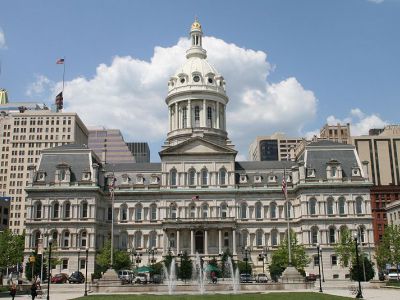
4) Baltimore City Hall
Baltimore City Hall is the seat of government for Baltimore. It houses the offices of the Mayor, the city council, and other government officials.
The building was designed by a 22-year-old architect, George A. Frederick, in the Second Empire architectural style. The engineer Wendel Bollman designed the city hall's dome and cast iron roof. Construction began in 1867 and was completed in 1875.
The six-story edifice was the first building constructed solely for the city's government. Before its construction, city leaders met in the Maryland Insurance Company building, the Baltimore Dancing Assembly, the Baltimore Exchange Company, and Peale's Baltimore Museum and Gallery of Fine Arts.
The City Hall fell under disrepair after the end of World War II. After 15 pounds of iron collapsed from the iron dome into the Board of Estimates hearing room, a decision was made to renovate the building. Two additional floors were added, which doubled the usable space in the building.
Baltimore City Hall is designated as a Baltimore City Landmark; is on the U.S. National Register of Historic Places.
The building was designed by a 22-year-old architect, George A. Frederick, in the Second Empire architectural style. The engineer Wendel Bollman designed the city hall's dome and cast iron roof. Construction began in 1867 and was completed in 1875.
The six-story edifice was the first building constructed solely for the city's government. Before its construction, city leaders met in the Maryland Insurance Company building, the Baltimore Dancing Assembly, the Baltimore Exchange Company, and Peale's Baltimore Museum and Gallery of Fine Arts.
The City Hall fell under disrepair after the end of World War II. After 15 pounds of iron collapsed from the iron dome into the Board of Estimates hearing room, a decision was made to renovate the building. Two additional floors were added, which doubled the usable space in the building.
Baltimore City Hall is designated as a Baltimore City Landmark; is on the U.S. National Register of Historic Places.
5) War Memorial Building
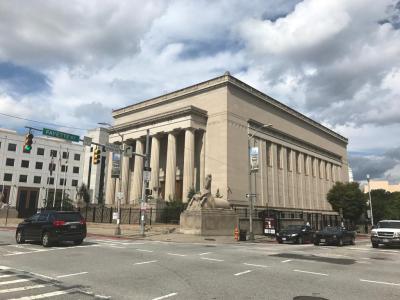
The War Memorial Building in Baltimore is a stunning memorial dedicated to the 1,752 Marylanders who lost their lives in military service during World War I. The idea for the building was initiated by the Governor of Maryland and the Mayor of Baltimore in 1919, who appointed a War Memorial Commission to launch a nationwide architectural competition to design the memorial building.
The winning design was executed by local architect Lawrence Hall Fowler, and the groundbreaking ceremony for the building was held on November 22, 1921. The cornerstone was laid on April 29, 1923, in a ceremony attended by Acting Secretary of War Colonel Dwight F. Davis, Governor Albert C. Ritchie, and Mayor William F. Broening. The War Memorial Building was officially dedicated on April 5, 1925.
The building is located across War Memorial Plaza from Baltimore City Hall and features a 1000-seat auditorium and a stunning mural by Baltimore artist R. McGill Mackall titled "A Sacrifice to Patriotism." The building's facade includes two stone sea horses representing the "Might of America crossing the seas to aid our allies," sculpted by Edmond R. Amateis. These sea horses also incorporate the coats of arms for Maryland and the City of Baltimore.
In 1977, the War Memorial Building was rededicated by Mayor William Donald Schaefer as a memorial to all Marylanders who lost their lives in wars involving American troops throughout the twentieth century.
Today, the building houses administrative offices for local veterans organizations, serving as a reminder of the sacrifices made by the brave men and women of Maryland who served their country.
The winning design was executed by local architect Lawrence Hall Fowler, and the groundbreaking ceremony for the building was held on November 22, 1921. The cornerstone was laid on April 29, 1923, in a ceremony attended by Acting Secretary of War Colonel Dwight F. Davis, Governor Albert C. Ritchie, and Mayor William F. Broening. The War Memorial Building was officially dedicated on April 5, 1925.
The building is located across War Memorial Plaza from Baltimore City Hall and features a 1000-seat auditorium and a stunning mural by Baltimore artist R. McGill Mackall titled "A Sacrifice to Patriotism." The building's facade includes two stone sea horses representing the "Might of America crossing the seas to aid our allies," sculpted by Edmond R. Amateis. These sea horses also incorporate the coats of arms for Maryland and the City of Baltimore.
In 1977, the War Memorial Building was rededicated by Mayor William Donald Schaefer as a memorial to all Marylanders who lost their lives in wars involving American troops throughout the twentieth century.
Today, the building houses administrative offices for local veterans organizations, serving as a reminder of the sacrifices made by the brave men and women of Maryland who served their country.
6) Top of the World Observation Level and Museum (must see)
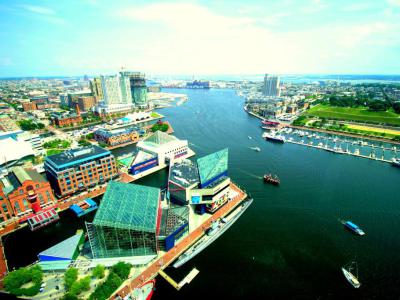
The Top of the World Observation Level is a viewing area on the 27th floor of the World Trade Center. It offers views of the Baltimore skyline and inner harbor.
The Observation Level is fully enclosed. It offers a 360-degree panoramic view, art exhibits, and an exhibit on the city's history. The Top of the World Observation Level also hosts the 9/11 Memorial of Maryland.
Baltimore World Trade Center is the world's tallest pentagonal building. The 30-floor structure 405 feet high was completed in 1977. The building was designed by the firm of the famous architect I.M. Pei (Pei Cobb Freed & Partners,) with the principal architects being Henry Cobb and Pershing Wong.
The Top of the World Observation Level is operated by the Baltimore Office of Promotion and the Arts. The non-profit organization provides support to artists and art programs across Baltimore.
The Top of the World Observation Level is open Wednesday through Sunday. Large groups can schedule private tours of the Observation Level on Mondays and Tuesdays.
The Observation Level is fully enclosed. It offers a 360-degree panoramic view, art exhibits, and an exhibit on the city's history. The Top of the World Observation Level also hosts the 9/11 Memorial of Maryland.
Baltimore World Trade Center is the world's tallest pentagonal building. The 30-floor structure 405 feet high was completed in 1977. The building was designed by the firm of the famous architect I.M. Pei (Pei Cobb Freed & Partners,) with the principal architects being Henry Cobb and Pershing Wong.
The Top of the World Observation Level is operated by the Baltimore Office of Promotion and the Arts. The non-profit organization provides support to artists and art programs across Baltimore.
The Top of the World Observation Level is open Wednesday through Sunday. Large groups can schedule private tours of the Observation Level on Mondays and Tuesdays.
7) U.S.S. Constellation
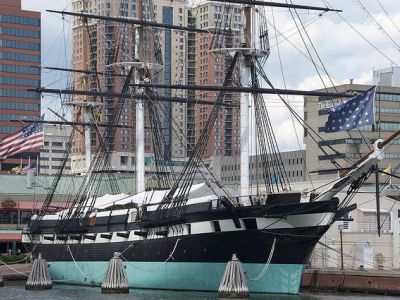
The USS Constellation is the last sail-only warship built by the United States Navy and the last intact naval ship from the U.S. Civil War. The sloop-of-war was built between 1853 and 1855. The construction used material salvaged from the disassembled frigate USS Constellation.
The ship is now a functioning museum in Baltimore's Inner Harbor, moored at Constellation Dock. The USS Constellation is part of the Historic Ships in Baltimore. Other Historic Ships in Baltimore include a Coast Guard cutter, a World War II submarine, the Seven Foot Knoll Light, and the lightship Chesapeake.
Visitors to the USS Constellation may attend the ship's museum gallery at Pier 1 in the Inner Harbor. Patrons can participate in a Parrott rifle drill, experience a tour and speak with a crew member about the ship and its history. Aboard, four decks are restored to represent the same appearance from her days serving in the Civil War.
The museum included about 50,000 artifacts, mainly documents, and photographs. Personal items have been donated by the descendants of former crew members.
The ship is now a functioning museum in Baltimore's Inner Harbor, moored at Constellation Dock. The USS Constellation is part of the Historic Ships in Baltimore. Other Historic Ships in Baltimore include a Coast Guard cutter, a World War II submarine, the Seven Foot Knoll Light, and the lightship Chesapeake.
Visitors to the USS Constellation may attend the ship's museum gallery at Pier 1 in the Inner Harbor. Patrons can participate in a Parrott rifle drill, experience a tour and speak with a crew member about the ship and its history. Aboard, four decks are restored to represent the same appearance from her days serving in the Civil War.
The museum included about 50,000 artifacts, mainly documents, and photographs. Personal items have been donated by the descendants of former crew members.
8) American Visionary Art Museum (must see)
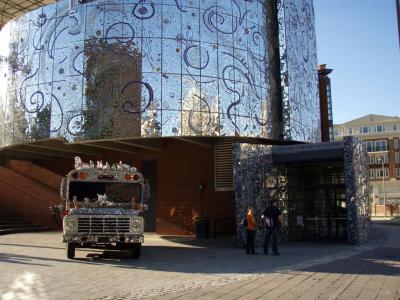
The American Visionary Art Museum, or AVAM, is an art museum that specializes in outsider art. The permanent collection has about 4,000 pieces spread over three floors of exhibition space.
The museum was established in 1995. The land was given to the museum by the city in exchange for an agreement that the museum's organizers would clear pollution from the copper factory and warehouse that had previously been on the site.
Visionary artists featured at the American Visionary Art Museum include Ho Baron, Nek Chand, Howard Finster, Vanessa German, Leo Sewell, Judith Scott, and Leonard Knight. Along with the artwork on display, the museum has a wildflower garden and a sculpture barn.
AVAM hosts an event called "Flicks from the Hill." The Hughes Family Outdoor Theater seats over 1,000 people who gather to watch movies during the summer film series. The movies vary but are always related to the museum's current exhibit.
The museum was established in 1995. The land was given to the museum by the city in exchange for an agreement that the museum's organizers would clear pollution from the copper factory and warehouse that had previously been on the site.
Visionary artists featured at the American Visionary Art Museum include Ho Baron, Nek Chand, Howard Finster, Vanessa German, Leo Sewell, Judith Scott, and Leonard Knight. Along with the artwork on display, the museum has a wildflower garden and a sculpture barn.
AVAM hosts an event called "Flicks from the Hill." The Hughes Family Outdoor Theater seats over 1,000 people who gather to watch movies during the summer film series. The movies vary but are always related to the museum's current exhibit.
9) Federal Hill Park
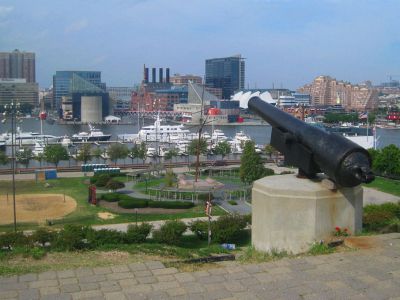
Federal Hill Park is a public park near Baltimore's Inner Harbor. The 10.3-acre park offers spectacular views of the harbor and the downtown skyline.
The park, created in 1880, was named for the hill and the nearby Federal Hill neighborhood. Before being a public park, the area was used by the Union Army during the U.S. Civil War as Fort Federal Hill.
The hill has not always been a treasured area in the city. Even after being declared a public park, it was graded for its red clay. As a result, massive erosion on the hill has caused its collapse on two occasions. The area was re-stabilized in 1995 and 2000.
Visitors to the park will see cannons used during the Civil War. They will also find recreational areas, including a basketball court, beach volleyball, and playground. The hill is often used for picnics during the day and for stargazing at night.
The park, created in 1880, was named for the hill and the nearby Federal Hill neighborhood. Before being a public park, the area was used by the Union Army during the U.S. Civil War as Fort Federal Hill.
The hill has not always been a treasured area in the city. Even after being declared a public park, it was graded for its red clay. As a result, massive erosion on the hill has caused its collapse on two occasions. The area was re-stabilized in 1995 and 2000.
Visitors to the park will see cannons used during the Civil War. They will also find recreational areas, including a basketball court, beach volleyball, and playground. The hill is often used for picnics during the day and for stargazing at night.
10) Bank of America Building
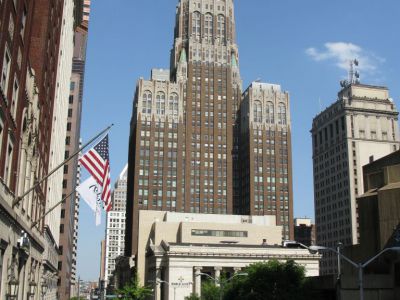
The Bank of America Building, formerly known as the Baltimore Trust Company Building, is a stunning 34-story skyscraper located in the heart of downtown Baltimore. It was designed by the architectural firm of Taylor and Fisher and completed in just eighteen months at a cost of $3 million in 1929.
When it was first built, the Bank of America Building was the tallest building in the state and the tallest office building south of New York City. The building's exterior is an impressive sight, decorated with ornate Romanesque human and animal images, stylized eagles, and intricate carvings of birds and lions. The copper and gold roof on top of the building is a sight to behold and adds to its grandeur.
The building's interior is equally impressive, featuring a two-story main banking lobby that is highly decorated with mosaic floors designed by Hildreth Meiere. The lobby also showcases historic murals by Griffith Baily Coale and McGill Mackall that depict significant events in Baltimore's history, such as the Baltimore fire of 1904 and the writing of the National Anthem during the War of 1812.
Despite its grandeur and historical significance, the building faced financial troubles shortly after its completion. The Baltimore Trust Company, which moved into the building in 1929, went bankrupt in 1933 and was placed in receivership in 1935. The building remained vacant until the Public Works Administration in Maryland took it over as part of the New Deal.
Today, the Bank of America Building remains a landmark and a testament to the city's rich history and architectural legacy. Plans to cover the historic lobby's mosaic floors with artificial turf to create an Under Armour gym have been met with controversy, but the building's stunning exterior and ornate interior continue to attract visitors from all over the world.
When it was first built, the Bank of America Building was the tallest building in the state and the tallest office building south of New York City. The building's exterior is an impressive sight, decorated with ornate Romanesque human and animal images, stylized eagles, and intricate carvings of birds and lions. The copper and gold roof on top of the building is a sight to behold and adds to its grandeur.
The building's interior is equally impressive, featuring a two-story main banking lobby that is highly decorated with mosaic floors designed by Hildreth Meiere. The lobby also showcases historic murals by Griffith Baily Coale and McGill Mackall that depict significant events in Baltimore's history, such as the Baltimore fire of 1904 and the writing of the National Anthem during the War of 1812.
Despite its grandeur and historical significance, the building faced financial troubles shortly after its completion. The Baltimore Trust Company, which moved into the building in 1929, went bankrupt in 1933 and was placed in receivership in 1935. The building remained vacant until the Public Works Administration in Maryland took it over as part of the New Deal.
Today, the Bank of America Building remains a landmark and a testament to the city's rich history and architectural legacy. Plans to cover the historic lobby's mosaic floors with artificial turf to create an Under Armour gym have been met with controversy, but the building's stunning exterior and ornate interior continue to attract visitors from all over the world.
11) St. Alphonsus Church
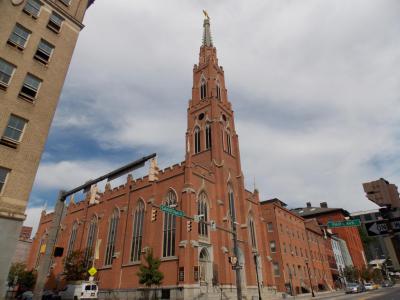
Saint Alphonsus Church is a historic Roman Catholic church complex located in the Archdiocese of Baltimore, Maryland, United States. The complex consists of the church, rectory, convent, and halle, and is also known as Saint John Neumann Shrine and "Baltimore's Powerhouse of Prayer." The church complex was constructed between 1842 and 1845 based on the design of Saint Stephen's Cathedral in Vienna and follows a basilica floorplan. The structure is constructed of red brick with limestone accents in the Gothic Revival style.
The nave of Saint Alphonsus Church reaches a height of 50 ft (15 m), and the ornate steeple rises 210 ft (64 m) above the three-level bell tower. A 12 ft (3.7 m) gold cross caps the steeple, making it a prominent landmark in the area. The church was the first major design by Baltimore architect Robert Cary Long Jr.
From its founding until 1917, the parish was overseen by the Redemptorist Fathers, who came to Baltimore to minister to the growing German immigrant community. John Neumann, who later became Bishop of Philadelphia, was one of the early pastors of Saint Alphonsus. Neumann's assistant pastor, Francis Xavier Seelos, served as pastor after his departure and later worked in areas from Connecticut to Illinois and New Orleans. Both Neumann and Seelos have been canonized and beatified, respectively.
By 1917, many of the German immigrants who lived in the area moved elsewhere, and Saint Alphonsus became a parish for the Lithuanian immigrant community. The church complex was listed on the National Register of Historic Places in 1973.
Since 1992, Saint Alphonsus has held regular Tridentine Masses. Since 2017, the parish has been administered by the Priestly Fraternity of Saint Peter (FSSP), while remaining officially part of the Archdiocese of Baltimore. Saint Alphonsus Church remains a significant landmark in the area, and its history is an important part of the city's cultural heritage.
The nave of Saint Alphonsus Church reaches a height of 50 ft (15 m), and the ornate steeple rises 210 ft (64 m) above the three-level bell tower. A 12 ft (3.7 m) gold cross caps the steeple, making it a prominent landmark in the area. The church was the first major design by Baltimore architect Robert Cary Long Jr.
From its founding until 1917, the parish was overseen by the Redemptorist Fathers, who came to Baltimore to minister to the growing German immigrant community. John Neumann, who later became Bishop of Philadelphia, was one of the early pastors of Saint Alphonsus. Neumann's assistant pastor, Francis Xavier Seelos, served as pastor after his departure and later worked in areas from Connecticut to Illinois and New Orleans. Both Neumann and Seelos have been canonized and beatified, respectively.
By 1917, many of the German immigrants who lived in the area moved elsewhere, and Saint Alphonsus became a parish for the Lithuanian immigrant community. The church complex was listed on the National Register of Historic Places in 1973.
Since 1992, Saint Alphonsus has held regular Tridentine Masses. Since 2017, the parish has been administered by the Priestly Fraternity of Saint Peter (FSSP), while remaining officially part of the Archdiocese of Baltimore. Saint Alphonsus Church remains a significant landmark in the area, and its history is an important part of the city's cultural heritage.
12) Basilica of the Assumption
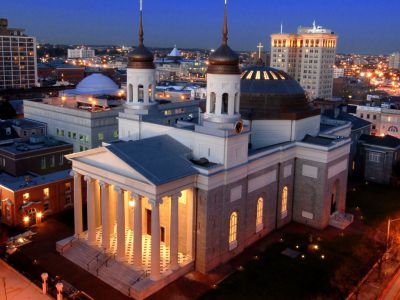
The Basilica of the Assumption, referred to as the Baltimore Basilica, is a Roman Catholic Church. It was the first Roman Catholic cathedral built in the United States and was among the first religious buildings constructed after the adoption of the U.S. Constitution. It was consecrated on May 31, 1821.
Construction on the Baltimore Basilica began in 1806. Architect Benjamin Henry Latrobe, known as "the Father of American Architecture," designed the building in the Neoclassical style with guidance from John Carroll, the first American bishop of the Roman Catholic church.
The cathedral is noted for its onion-shaped dome. The interior has many works of fine art, including two that were gifted to the basilica by King Louis XVIII of France.
The Basilica of the Assumption is on the U.S. National Register of Historic Places and is considered a U.S. National Historic Landmark.
Construction on the Baltimore Basilica began in 1806. Architect Benjamin Henry Latrobe, known as "the Father of American Architecture," designed the building in the Neoclassical style with guidance from John Carroll, the first American bishop of the Roman Catholic church.
The cathedral is noted for its onion-shaped dome. The interior has many works of fine art, including two that were gifted to the basilica by King Louis XVIII of France.
The Basilica of the Assumption is on the U.S. National Register of Historic Places and is considered a U.S. National Historic Landmark.
13) Franklin Street Presbyterian Church and Parsonage
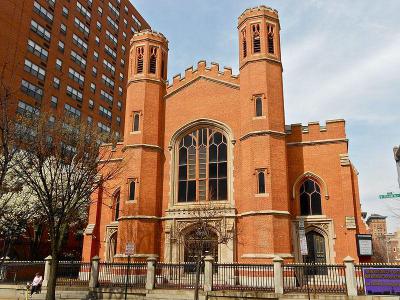
The Franklin Street Presbyterian Church and Parsonage were built in 1847 and 1857, respectively, and designed by architect Robert Cary Long, Jr in the Tudor Gothic style. The church was incorporated in 1844 by a group of men from the First Presbyterian Church, which was located in downtown Baltimore.
The front of the church features two flanking octagonal towers, each standing at 60 feet tall. The towers are also crenelated and have louvered belfry openings and stained glass Gothic-arched windows.
The manse or parsonage at the north end of the church has similar matching walls of brick, heavy Tudor-Gothic window hoods, and battlements atop the roof. The church is located on "Cathedral Hill," in the southern part of the community, bordering downtown Baltimore to the south and across the street from the old Baltimore Cathedral (Basilica of the National Shrine of the Assumption of the Blessed Virgin Mary), erected 1806-1821, and designed by Benjamin Latrobe, which was the first Catholic cathedral constructed in America.
In 1973, the First and Franklin Street Presbyterian Church was formed by two historic downtown area congregations, and the Franklin Street building was used by the merged congregation for a time.
Later, the building was sold to a fundamentalist independent Protestant congregation and was later re-sold to the present "New Unity Church Ministries." The church is no longer used by a Presbyterian congregation and is currently occupied by the New Unity Church Ministries / New Unity Baptist Church, with Pastor Johnny N. Golden, sr.
The church and manse / parsonage in the rear were listed on the National Register of Historic Places on November 5, 1971. They are included within the Cathedral Hill Historic District and the Baltimore National Heritage Area and in the Mount Vernon-Belvedere neighborhood.
The front of the church features two flanking octagonal towers, each standing at 60 feet tall. The towers are also crenelated and have louvered belfry openings and stained glass Gothic-arched windows.
The manse or parsonage at the north end of the church has similar matching walls of brick, heavy Tudor-Gothic window hoods, and battlements atop the roof. The church is located on "Cathedral Hill," in the southern part of the community, bordering downtown Baltimore to the south and across the street from the old Baltimore Cathedral (Basilica of the National Shrine of the Assumption of the Blessed Virgin Mary), erected 1806-1821, and designed by Benjamin Latrobe, which was the first Catholic cathedral constructed in America.
In 1973, the First and Franklin Street Presbyterian Church was formed by two historic downtown area congregations, and the Franklin Street building was used by the merged congregation for a time.
Later, the building was sold to a fundamentalist independent Protestant congregation and was later re-sold to the present "New Unity Church Ministries." The church is no longer used by a Presbyterian congregation and is currently occupied by the New Unity Church Ministries / New Unity Baptist Church, with Pastor Johnny N. Golden, sr.
The church and manse / parsonage in the rear were listed on the National Register of Historic Places on November 5, 1971. They are included within the Cathedral Hill Historic District and the Baltimore National Heritage Area and in the Mount Vernon-Belvedere neighborhood.
14) Walters Art Museum (must see)
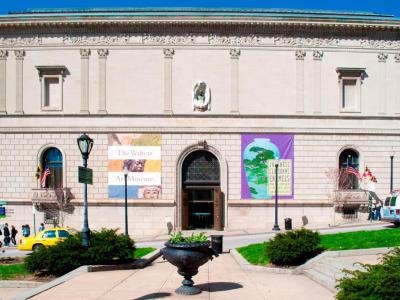
Walters Art Museum, locally known simply as "The Walters," is an art museum that focuses primarily on the works of American artists. It also contains art from ancient Egypt, Greece, and Rome. The remarkable permanent collection features ancient Asian art, textiles, furniture, jewelry, arms, and armor.
The museum was established by collectors, father and son William Thompson Walters and Henry Walters, in the late-19th century. The collection was given to the City of Baltimore in 1931 upon the death of Henry Walters.
The Egyptian collection includes two statues of the goddess Sehkmet and the Walters Mummy. The Roman collection offers portrait heads, a banquet couch, and marble sarcophagi from the tombs of the Licinian and Calpurnian families.
Artwork ranges from across the globe; the significant focus is on pottery and stone from the Americas. Fine art held in the museum varies from the late Medieval works of Italian artists Ciccarello and Lorenzetti to the Renaissance works of Greek painter El Greco. Pieces from Monet, Manet, and Rousseau are among those found in the museum. Two Faberge eggs are among the jeweled items on display.
The Walters Museum offers free admission to all visitors.
The museum was established by collectors, father and son William Thompson Walters and Henry Walters, in the late-19th century. The collection was given to the City of Baltimore in 1931 upon the death of Henry Walters.
The Egyptian collection includes two statues of the goddess Sehkmet and the Walters Mummy. The Roman collection offers portrait heads, a banquet couch, and marble sarcophagi from the tombs of the Licinian and Calpurnian families.
Artwork ranges from across the globe; the significant focus is on pottery and stone from the Americas. Fine art held in the museum varies from the late Medieval works of Italian artists Ciccarello and Lorenzetti to the Renaissance works of Greek painter El Greco. Pieces from Monet, Manet, and Rousseau are among those found in the museum. Two Faberge eggs are among the jeweled items on display.
The Walters Museum offers free admission to all visitors.
