Custom Walk in Bangkok, Thailand by jacquesvallee_a4a93 created on 2025-11-02
Guide Location: Thailand » Bangkok
Guide Type: Custom Walk
# of Sights: 13
Tour Duration: 4 Hour(s)
Travel Distance: 7.6 Km or 4.7 Miles
Share Key: PYNZR
Guide Type: Custom Walk
# of Sights: 13
Tour Duration: 4 Hour(s)
Travel Distance: 7.6 Km or 4.7 Miles
Share Key: PYNZR
How It Works
Please retrieve this walk in the GPSmyCity app. Once done, the app will guide you from one tour stop to the next as if you had a personal tour guide. If you created the walk on this website or come to the page via a link, please follow the instructions below to retrieve the walk in the app.
Retrieve This Walk in App
Step 1. Download the app "GPSmyCity: Walks in 1K+ Cities" on Apple App Store or Google Play Store.



Step 2. In the GPSmyCity app, download(or launch) the guide "Bangkok Map and Walking Tours".
Step 3. Tap the menu button located at upper right corner of the "Walks" screen and select "Retrieve custom walk". Enter the share key: PYNZR
1) The Royal Grand Palace (must see)
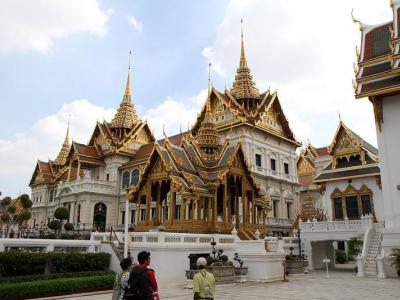
The Royal Grand Palace, a building complex in Bangkok, served as the official residence of the Kings of Thailand from the 18th century onwards. King Rama I ordered the construction of a magnificent new Palace in 1782 when he moved the capital from Thonburi to Bangkok. The chosen area was, however, occupied by Chinese merchants whom he asked to relocate. The Palace has been constantly expanded and many additional structures were added over time.
Originally the palace consisted of several wooden buildings surrounded on four sides with a high defensive wall, 1900 meters in length and enclosing an area of 218,400 square meters. The Palace is rectangular in shape with the western side next to a river, the royal temple situated to the east side and all structures facing north. The King ordered the construction of the Temple of the Emerald Buddha as a royal temple and as his personal place of worship. Around the turn of the 20th century, Thai Kings stopped living in the palace. Today, the palace is used for all kinds of other ceremonial and auspicious happenings including royal funerals, marriages and state banquets.
The palace is divided into three quarters: the outer quarters, the middle quarters and the inner quarters. The Outer Court housed the government departments in which the king was directly involved including civil administration, army, and the treasury. The Temple of the Emerald Budha takes up one corner of the complex next to the outer court. In the middle is the Central Court, where the residence of the king and the halls for conducting state business were located. Behind the central court was the inner court where the king's royal consorts and daughters lived. It was like a small city entirely populated by women and boys under the age of puberty.
The Grand Palace with its beautiful architecture and intricate details is living proof of the creativity and craftsmanship of Thai people. Today, the complex remains the spiritual heart of the Thai Kingdom. The Grand Palace with the Temple of the Emerald Buddha is Thailand's most sacred site. All visitors must be properly dressed before being allowed entry to the temple. No bare feet and no see-through clothes are allowed.
Definitely the city's most famous landmark, the dazzling and spectacular Grand Palace is one must-see sight. Your visit to Bangkok would not be complete without visiting it.
Tip:
Come early – the place gets quite crowded around 12pm.
They offer free English tours at 10am, 10:30, 1pm, 1:30pm or an audio guide for other languages (200 THB).
Entry fee is 500 THB, which includes the ticket to a theater play (like a Thai musical). Pick-up and drop to the theater from the Grand Palace are also included.
Originally the palace consisted of several wooden buildings surrounded on four sides with a high defensive wall, 1900 meters in length and enclosing an area of 218,400 square meters. The Palace is rectangular in shape with the western side next to a river, the royal temple situated to the east side and all structures facing north. The King ordered the construction of the Temple of the Emerald Buddha as a royal temple and as his personal place of worship. Around the turn of the 20th century, Thai Kings stopped living in the palace. Today, the palace is used for all kinds of other ceremonial and auspicious happenings including royal funerals, marriages and state banquets.
The palace is divided into three quarters: the outer quarters, the middle quarters and the inner quarters. The Outer Court housed the government departments in which the king was directly involved including civil administration, army, and the treasury. The Temple of the Emerald Budha takes up one corner of the complex next to the outer court. In the middle is the Central Court, where the residence of the king and the halls for conducting state business were located. Behind the central court was the inner court where the king's royal consorts and daughters lived. It was like a small city entirely populated by women and boys under the age of puberty.
The Grand Palace with its beautiful architecture and intricate details is living proof of the creativity and craftsmanship of Thai people. Today, the complex remains the spiritual heart of the Thai Kingdom. The Grand Palace with the Temple of the Emerald Buddha is Thailand's most sacred site. All visitors must be properly dressed before being allowed entry to the temple. No bare feet and no see-through clothes are allowed.
Definitely the city's most famous landmark, the dazzling and spectacular Grand Palace is one must-see sight. Your visit to Bangkok would not be complete without visiting it.
Tip:
Come early – the place gets quite crowded around 12pm.
They offer free English tours at 10am, 10:30, 1pm, 1:30pm or an audio guide for other languages (200 THB).
Entry fee is 500 THB, which includes the ticket to a theater play (like a Thai musical). Pick-up and drop to the theater from the Grand Palace are also included.
2) Wat Phra Kaew (Temple of the Emerald Buddha) (must see)
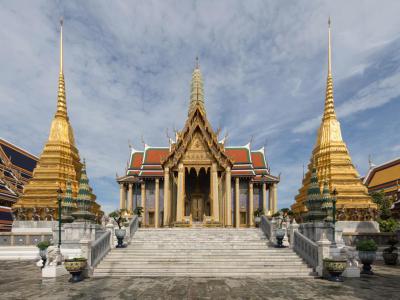
Wat Phra Kaew, commonly known as the Temple of the Emerald Buddha, is located on the ground of the Royal Palace in Bangkok. It is the most respected Buddhist shrine in Thailand, and is so primarily for the 2-feet tall dark green statue, known as Emerald Buddha, housed in the temple.
Some historians believe that the Emerald Buddha was brought from Sri Lanka, while others reckon it was crafted in Thailand in the 14th century. An associated legend suggests that the statue was once hidden, covered in plaster, inside a monument in Chiang Rai until, in 1434, a lighting storm revealed the Buddha image underneath.
In the course of history, several wars have been fought because of this Buddha image. It was brought to Bangkok in 1782 and has since been considered a talisman of tremendous significance for Thailand. Together, Wat Phra Kaew, the Temple of the Emerald Buddha, and the adjoining Grand Palace form, perhaps, the greatest attraction of Bangkok well worth looking at.
Why You Should Visit:
The Grand Palace is already something unique and amazing; the Temple of the Emerald Buddha is like a cherry on top of a beautiful cake.
Tip:
Visit when the doors open, around 8am, to avoid crowds; come dressed appropriately (no exposed knees or shoulders), and enjoy a walk around.
Some historians believe that the Emerald Buddha was brought from Sri Lanka, while others reckon it was crafted in Thailand in the 14th century. An associated legend suggests that the statue was once hidden, covered in plaster, inside a monument in Chiang Rai until, in 1434, a lighting storm revealed the Buddha image underneath.
In the course of history, several wars have been fought because of this Buddha image. It was brought to Bangkok in 1782 and has since been considered a talisman of tremendous significance for Thailand. Together, Wat Phra Kaew, the Temple of the Emerald Buddha, and the adjoining Grand Palace form, perhaps, the greatest attraction of Bangkok well worth looking at.
Why You Should Visit:
The Grand Palace is already something unique and amazing; the Temple of the Emerald Buddha is like a cherry on top of a beautiful cake.
Tip:
Visit when the doors open, around 8am, to avoid crowds; come dressed appropriately (no exposed knees or shoulders), and enjoy a walk around.
3) Lak Mueang (City Pillar Shrine)
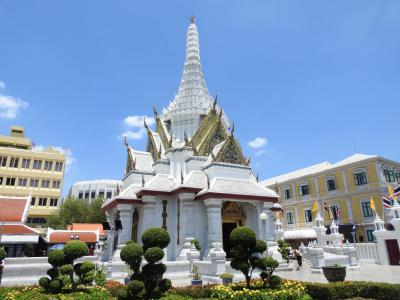
City pillars, known as Lak Mueang, are common in Thai cities. They house the city spirit deity, Chao Pho Lak Mueang, in a shrine. This tradition originates from a Brahman ritual where a single acacia pillar, Chaiyaphreuk ("tree of victory"), was erected as the city's spiritual heart before construction began. Citizens revered it for prosperity and protection.
King Rama I established Bangkok's city pillar on April 21, 1782, marking the relocation of the capital from Thonburi. This shrine, predating the royal palace, is among Thailand's oldest and most revered.
The first pillar stood 470 centimeters (190 inches) high, buried 200 centimeters (79 inches) deep, and measuring 74 centimeters (29 inches) in diameter. Inside it there was a horoscope for Bangkok. In the mid 19th century the original shrine was rebuilt and the pillar refitted with a fresh horoscope. In 1852, another pillar was added – 5.115 meters (201.4 inches) tall, 47 centimeters (18.8 inches) in diameter at the bottom, with a base of 180 centimeters (71 inches) wide. The refurbished pavilion, with a spire (prang) modeled on the shrine of Ayudhya, was inaugurated on 1 May 1853.
Legend tells of a sacrifice ritual during construction, where people responding to the call "in–chan–mun–kong" (signifying directions) were buried at the site to protect the city. This tale, however, lacks historical proof.
Worshippers at the shrine typically offer three incense sticks, a candle, gold foil, two lotuses, two flower garlands, and a three-color taffeta.
King Rama I established Bangkok's city pillar on April 21, 1782, marking the relocation of the capital from Thonburi. This shrine, predating the royal palace, is among Thailand's oldest and most revered.
The first pillar stood 470 centimeters (190 inches) high, buried 200 centimeters (79 inches) deep, and measuring 74 centimeters (29 inches) in diameter. Inside it there was a horoscope for Bangkok. In the mid 19th century the original shrine was rebuilt and the pillar refitted with a fresh horoscope. In 1852, another pillar was added – 5.115 meters (201.4 inches) tall, 47 centimeters (18.8 inches) in diameter at the bottom, with a base of 180 centimeters (71 inches) wide. The refurbished pavilion, with a spire (prang) modeled on the shrine of Ayudhya, was inaugurated on 1 May 1853.
Legend tells of a sacrifice ritual during construction, where people responding to the call "in–chan–mun–kong" (signifying directions) were buried at the site to protect the city. This tale, however, lacks historical proof.
Worshippers at the shrine typically offer three incense sticks, a candle, gold foil, two lotuses, two flower garlands, and a three-color taffeta.
4) National Museum Bangkok
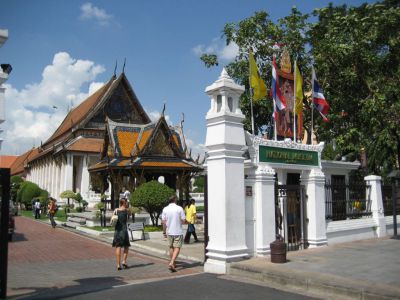
The National Museum Bangkok features exhibits of Thai art and history all the way back to Neolithic times. Opened in 1874 by His Majesty King Rama V, this is the first public venue to display the royal collection of King Rama IV and other objects of general interest. The museum occupies the 18th-century Wang Na Palace, which had previously been the residence of the Prince Successor. Originally, it was intended to exhibit the antiques and gifts bestowed to Rama V by his father.
First named the Bangkok Museum, opened by King Rama VII in 1926, the institution had subsequently been transformed, under the direction of the Department of Fine Arts, into the National Museum Bangkok by 1934. Initially a non-organized gathering of dusty relics, it now features exhibits arranged into three areas consistent with Thai history. A good English-language description is provided for all artifacts.
The Thai History Gallery, covering the periods from Sukothai to the Rattanakosin, is found at the front of the Sivamokhaphiman Hall. The Archaeological and Art History Collection features items from the prehistoric period to the modern Kingdom, including many ancient sculptures. Decorative Arts and Ethnological Collection showcases Chinese weaponry, gold treasures, precious stones, masks and many items of historical importance from all over Southeast Asia. Other exhibits include a funeral chariot hall, featuring carriages used for royal cremations, along with many excellent examples of Thai architecture.
Tip:
There are excellent free tour guides in English, French (Wed, Thu), Japanese (Wed) and German (Thu) at 9:30am.
First named the Bangkok Museum, opened by King Rama VII in 1926, the institution had subsequently been transformed, under the direction of the Department of Fine Arts, into the National Museum Bangkok by 1934. Initially a non-organized gathering of dusty relics, it now features exhibits arranged into three areas consistent with Thai history. A good English-language description is provided for all artifacts.
The Thai History Gallery, covering the periods from Sukothai to the Rattanakosin, is found at the front of the Sivamokhaphiman Hall. The Archaeological and Art History Collection features items from the prehistoric period to the modern Kingdom, including many ancient sculptures. Decorative Arts and Ethnological Collection showcases Chinese weaponry, gold treasures, precious stones, masks and many items of historical importance from all over Southeast Asia. Other exhibits include a funeral chariot hall, featuring carriages used for royal cremations, along with many excellent examples of Thai architecture.
Tip:
There are excellent free tour guides in English, French (Wed, Thu), Japanese (Wed) and German (Thu) at 9:30am.
5) Wat Chanasongkram
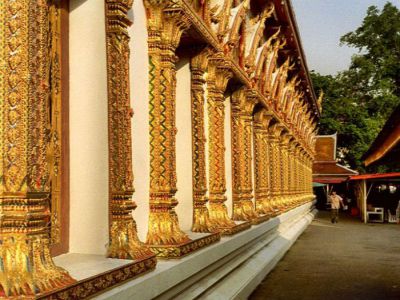
Wat Chanasongkram is one of the most important Ayuthaya period temples in the history of Thailand. The name of the temple means “Victory in the battle”. Built in the 18th century, the temple has a legend associated with it. According to the legend, King Rama I appointed a Mon group of monks to look after this temple and it became known in the Mon language as Wat Thong Pu. After winning in the battle of the Nine Armies, Thai General Somdej Chao Phraya Maha Surasinghanat moved his troops back to Bangkok. A grand ceremony of bathing and changing of robes was held in this temple before he entered the Grand Palace. King Rama I gave it the current name by which it is remembered today.
The temple was renovated and restored in 1787. One has to pass under a bell tower to reach the temple compound. The main assembly hall (ubosot) lies in a simple courtyard. The gable ends of the ubosot are beautifully decorated in carved gilded wood and mirrored tiles. The altar is quite remarkable with its gilded Buddha image in front of a large gilded fan with the ceremonial umbrella above. Of special importance are the elephant tusks, one pair of which is ebony. There is also a small enthroned statue of King Taksin in a side aisle.
A special feature of Front Palace artisans is the gable end decoration of Naga or serpent. This temple is also important because the containers of the ashes of the princes of five kings are present around the chapel and behind the principle Buddha image. In the reign of King Rama V, ashes are brought here upon the respectful invitation of Queen Si Patcharintara.
You must visit this temple as it will take you into the Ayuthaya period in the history of Thailand.
The temple was renovated and restored in 1787. One has to pass under a bell tower to reach the temple compound. The main assembly hall (ubosot) lies in a simple courtyard. The gable ends of the ubosot are beautifully decorated in carved gilded wood and mirrored tiles. The altar is quite remarkable with its gilded Buddha image in front of a large gilded fan with the ceremonial umbrella above. Of special importance are the elephant tusks, one pair of which is ebony. There is also a small enthroned statue of King Taksin in a side aisle.
A special feature of Front Palace artisans is the gable end decoration of Naga or serpent. This temple is also important because the containers of the ashes of the princes of five kings are present around the chapel and behind the principle Buddha image. In the reign of King Rama V, ashes are brought here upon the respectful invitation of Queen Si Patcharintara.
You must visit this temple as it will take you into the Ayuthaya period in the history of Thailand.
6) Wat Ratchanatdaram (Temple of the Royal Niece)
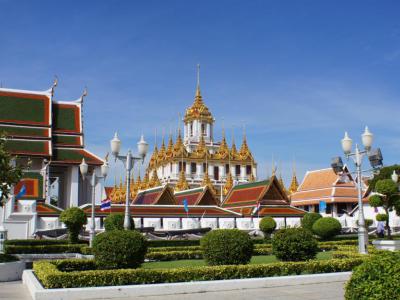
Wat Ratchanatdaram is a Buddhist temple situated in the Phra Nakhon district of Bangkok. The name "Wat Ratchanatdaram" translates to "Temple of the Royal Niece." This temple was commissioned by King Nangklao (Rama III) in 1846, specifically for his granddaughter, Princess Somanass Waddhanawathy.
Wat Ratchanatdaram's architectural centerpiece, Loha Prasat, means "iron castle" in Thai. It comprises five towers with black iron spires, including 37 golden spires symbolizing enlightenment virtues. Loha Prasat stands at 36 meters (118 feet) with three levels: 24 spires at the bottom, 12 in the middle, and 1 on top.
Two similar structures from the past, modeled after ancient ones in India and Sri Lanka's Anuradhapura, featured 1,000 rooms and golden spires. Unfortunately, these original structures no longer exist. Another Sri Lankan structure had nine floors, a thatched copper roof, and precious stone, wood, and ivory decorations.
The architectural style of Loha Prasat may initially appear Burmese, but it is, in fact, a reproduction of an ancient Buddhist design found in Sri Lanka. The construction of this remarkable edifice began in the early nineteenth century under the reign of King Rama III.
The outer building of Loha Prasat forms a pyramid-like structure, with each successive level getting smaller. The ground floor of the tower houses a labyrinthine space supported by numerous columns. Additionally, several corridors within the tower feature pictorial depictions of its history, added in late 2007.
Notably, Loha Prasat is modeled after the one in Anuradhapura, Sri Lanka, and it stands as the sole surviving example of its kind today. In 2005, it was nominated for inclusion in UNESCO's World Heritage Sites.
Wat Ratchanatdaram's architectural centerpiece, Loha Prasat, means "iron castle" in Thai. It comprises five towers with black iron spires, including 37 golden spires symbolizing enlightenment virtues. Loha Prasat stands at 36 meters (118 feet) with three levels: 24 spires at the bottom, 12 in the middle, and 1 on top.
Two similar structures from the past, modeled after ancient ones in India and Sri Lanka's Anuradhapura, featured 1,000 rooms and golden spires. Unfortunately, these original structures no longer exist. Another Sri Lankan structure had nine floors, a thatched copper roof, and precious stone, wood, and ivory decorations.
The architectural style of Loha Prasat may initially appear Burmese, but it is, in fact, a reproduction of an ancient Buddhist design found in Sri Lanka. The construction of this remarkable edifice began in the early nineteenth century under the reign of King Rama III.
The outer building of Loha Prasat forms a pyramid-like structure, with each successive level getting smaller. The ground floor of the tower houses a labyrinthine space supported by numerous columns. Additionally, several corridors within the tower feature pictorial depictions of its history, added in late 2007.
Notably, Loha Prasat is modeled after the one in Anuradhapura, Sri Lanka, and it stands as the sole surviving example of its kind today. In 2005, it was nominated for inclusion in UNESCO's World Heritage Sites.
7) Wat Thepthidaram
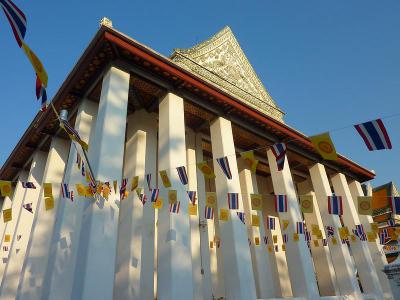
The Wat Thepthidaram temple was built in 1836, by King Rama III, to honor one of his wives. The extreme popularity of all things Chinese at that time preconditioned the distinct Chinese decor of the temple – gables with Chinese porcelain pieces, plus a number of ancient Chinese statues on the grounds.
The main compound of the temple consists of the ordination hall (ubosot) flanked by two prayer halls (wiharns). There is a walled courtyard with corn cob-shaped towers, called prangs, at each corner. The Buddha image inside this courtyard, sat upon a magnificent golden boat-shaped altar, is unusually carved from a snow-white stone. The northern wiharn, with the interesting gilded window frames, is generally closed. The southern wiharn is surrounded by several small pagodas (chedi) and houses another much-venerated Buddha image. In 1977, the Fine Arts Department declared Wat Thepthidaram a national monument.
Still, this temple is primarily famous for its association with Thailand’s greatest poet, Sunthorn Phu, commonly regarded as the “Shakespeare of Thai literature,” who spent three years here as a monk.
In 1986, 131 years after his death, UNESCO honored Sunthorn Phu for his outstanding cultural contribution to mankind and declared him a “Great Personality of the World”. Sadly, some of his unpublished manuscripts, left in the temple, have been destroyed by humidity and pests. In June 2006, the living quarters of Sunthorn Phu, at the rear of the temple's compound, were made into a museum by the initiative of the Silapakorn University of Fine Arts. Called the “House of the Great Poet,” this museum is set to preserve the legacy of Sunthorn Phu for future generations.
Although, regrettably, these days Wat Thepthidaram is not in a very good shape, you shouldn't be detracted from visiting this historic place.
The main compound of the temple consists of the ordination hall (ubosot) flanked by two prayer halls (wiharns). There is a walled courtyard with corn cob-shaped towers, called prangs, at each corner. The Buddha image inside this courtyard, sat upon a magnificent golden boat-shaped altar, is unusually carved from a snow-white stone. The northern wiharn, with the interesting gilded window frames, is generally closed. The southern wiharn is surrounded by several small pagodas (chedi) and houses another much-venerated Buddha image. In 1977, the Fine Arts Department declared Wat Thepthidaram a national monument.
Still, this temple is primarily famous for its association with Thailand’s greatest poet, Sunthorn Phu, commonly regarded as the “Shakespeare of Thai literature,” who spent three years here as a monk.
In 1986, 131 years after his death, UNESCO honored Sunthorn Phu for his outstanding cultural contribution to mankind and declared him a “Great Personality of the World”. Sadly, some of his unpublished manuscripts, left in the temple, have been destroyed by humidity and pests. In June 2006, the living quarters of Sunthorn Phu, at the rear of the temple's compound, were made into a museum by the initiative of the Silapakorn University of Fine Arts. Called the “House of the Great Poet,” this museum is set to preserve the legacy of Sunthorn Phu for future generations.
Although, regrettably, these days Wat Thepthidaram is not in a very good shape, you shouldn't be detracted from visiting this historic place.
8) Wat Saket (Temple of the Golden Mount) (must see)
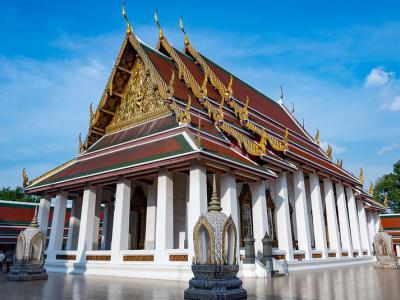
Wat Saket is a Buddhist temple and a famous landmark in Bangkok, dating back to the Ayutthaya era. The towering gold chedi of Wat Saket, once the highest point in the city, is notable for its spectacular views, much as for hosting the annual Loy Krathong festival.
A steep hill with a shiny dome inside the Wat Saket compound, covered in small golden squares reflecting the sun, is called “Golden Mount”. As such, the Golden Mount is not a natural mountain but an artificial one, and was constructed under King Rama III when the latter attempted to build a chedi which collapsed because of the soft soil beneath. The king, thus, ordered that a sturdy mound of mud and bricks be made to support the structure. For about half a century, the mound was left alone until it took the shape of a natural hill and was overgrown with weeds, and was thenceforth called "Phu Khao". King Rama IV built a small chedi on top of it and put nearly 1,000 teak logs, all along the shore, to prevent the structure from sinking into the swampy ground. Finally, Rama V completed the chedi that stands here today housing a Buddha relic brought from India. During World War II, a set of concrete walls were added to prevent the hill from eroding and the structure from collapsing.
From late October to mid-November (for 9 days around the full moon), Wat Sakhet hosts Bangkok's most important temple fair, part of the Loy Krathong festival. During this event, a red cloth is wrapped around the Golden Mount and a carnival starts with many food stalls, theatrical performances, freak shows and animal circuses. This festival also includes a candlelight procession up to the Golden Mount, during which worshipers place flowers and light candles near the temple.
To reach the Golden Mount's peak, 318 steps must be ascended, but it is well worth the effort as the panoramic view of Bangkok, opening from the top, is truly spectacular!
Why You Should Visit:
Bangkok is a pretty flat city, so to be able to scale the only hill for miles around and see a lovely temple on top, from which to admire the view... is quite great!
Tip:
Go early in the morning to avoid the heat and the crowds.
If it's hot and sunny, be sure to have a hat or some sort of parasol, as you'll be exposed to the sun most of the way up.
A steep hill with a shiny dome inside the Wat Saket compound, covered in small golden squares reflecting the sun, is called “Golden Mount”. As such, the Golden Mount is not a natural mountain but an artificial one, and was constructed under King Rama III when the latter attempted to build a chedi which collapsed because of the soft soil beneath. The king, thus, ordered that a sturdy mound of mud and bricks be made to support the structure. For about half a century, the mound was left alone until it took the shape of a natural hill and was overgrown with weeds, and was thenceforth called "Phu Khao". King Rama IV built a small chedi on top of it and put nearly 1,000 teak logs, all along the shore, to prevent the structure from sinking into the swampy ground. Finally, Rama V completed the chedi that stands here today housing a Buddha relic brought from India. During World War II, a set of concrete walls were added to prevent the hill from eroding and the structure from collapsing.
From late October to mid-November (for 9 days around the full moon), Wat Sakhet hosts Bangkok's most important temple fair, part of the Loy Krathong festival. During this event, a red cloth is wrapped around the Golden Mount and a carnival starts with many food stalls, theatrical performances, freak shows and animal circuses. This festival also includes a candlelight procession up to the Golden Mount, during which worshipers place flowers and light candles near the temple.
To reach the Golden Mount's peak, 318 steps must be ascended, but it is well worth the effort as the panoramic view of Bangkok, opening from the top, is truly spectacular!
Why You Should Visit:
Bangkok is a pretty flat city, so to be able to scale the only hill for miles around and see a lovely temple on top, from which to admire the view... is quite great!
Tip:
Go early in the morning to avoid the heat and the crowds.
If it's hot and sunny, be sure to have a hat or some sort of parasol, as you'll be exposed to the sun most of the way up.
9) Bangkok Wat Suthat (Giant Swing)
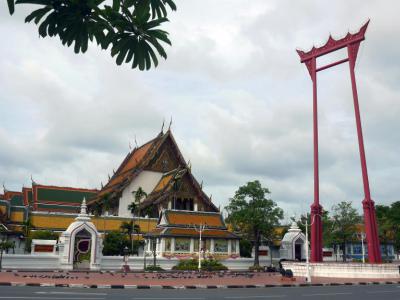
The Giant Swing is a religious structure and one of Bangkok's top tourist attractions. Set in front of the Suthat Temple, this huge Chinese-red colored frame was part of an annual ceremony whereby young men would try to swing up in the air in order to get a sack full of gold tied to a pole, some 75 feet high. After many men died during such an attempt, the ceremony was finally banned in the 1930s.
The Swing Ceremony was one of the 12 royal ceremonies held each month of the Thai Lunar calendar. At the height of 21.15 meters, from base to top, this giant swing is a great memorial to an abolished tradition in the history of Thailand and a true landmark of Bangkok. Its presence in front of the temple is an illustration of the once strong influence of Brahmanism in Thailand. The original swing was built only two years after the establishment of Bangkok as a new capital in 1782. Its story began when a Brahman, named Kratai, was granted audience with King Rama I (1782-1809) and asked for permission to uphold Brahmanism in Siam, i.e. to build a Brahmanic temple and a swing to conduct Brahmanic ceremonies. The King agreed and soon after not one but three Brahmanic temples and a swing appeared in the center of the city in 1784.
In the early 19th century, a huge 25-foot tall Phra Sri Sakyamuni Buddha statue was brought from Sukhothai by boat. To house that gigantic Buddha image, the Wat Suthat, one of Bangkok's tallest wiharns, was built in a large cloister. Its outer wall is lined with more than 150 Buddha images originally shipped from China, as a ballast, in rice boats. They are now displayed in the courtyard between the Buddha gallery and the wiharn. The walls are painted with murals depicting the last 24 lives of Buddha. The columns are also painted with murals showing the early days of Bangkok.
The original height of the swing is not confirmed to date. After over 100 years, when the old swing had decayed, it was replaced with a new one made of teak in 1920, during the reign of King Rama VI. That swing was renovated twice, in 1947 and 1970, and for 36 years had stood elegantly as one of Bangkok's major landmarks. After its condition had deteriorated again, it was replaced with another replica in 2006.
The Swing Ceremony was one of the 12 royal ceremonies held each month of the Thai Lunar calendar. At the height of 21.15 meters, from base to top, this giant swing is a great memorial to an abolished tradition in the history of Thailand and a true landmark of Bangkok. Its presence in front of the temple is an illustration of the once strong influence of Brahmanism in Thailand. The original swing was built only two years after the establishment of Bangkok as a new capital in 1782. Its story began when a Brahman, named Kratai, was granted audience with King Rama I (1782-1809) and asked for permission to uphold Brahmanism in Siam, i.e. to build a Brahmanic temple and a swing to conduct Brahmanic ceremonies. The King agreed and soon after not one but three Brahmanic temples and a swing appeared in the center of the city in 1784.
In the early 19th century, a huge 25-foot tall Phra Sri Sakyamuni Buddha statue was brought from Sukhothai by boat. To house that gigantic Buddha image, the Wat Suthat, one of Bangkok's tallest wiharns, was built in a large cloister. Its outer wall is lined with more than 150 Buddha images originally shipped from China, as a ballast, in rice boats. They are now displayed in the courtyard between the Buddha gallery and the wiharn. The walls are painted with murals depicting the last 24 lives of Buddha. The columns are also painted with murals showing the early days of Bangkok.
The original height of the swing is not confirmed to date. After over 100 years, when the old swing had decayed, it was replaced with a new one made of teak in 1920, during the reign of King Rama VI. That swing was renovated twice, in 1947 and 1970, and for 36 years had stood elegantly as one of Bangkok's major landmarks. After its condition had deteriorated again, it was replaced with another replica in 2006.
10) Wat Ratchabophit
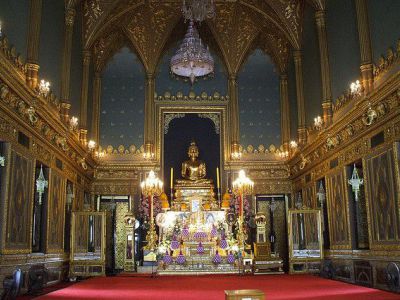
Wat Ratchabophit is a royal temple located near the Ministry of the Interior and the Grand Palace of Bangkok. The full name of the temple is Wat Raja Bopits Athitma Hasimaram, which means “Temple under the Royal Construction with the Great Sacred Boundaries”. Being the last temple erected by King Rama V in the late 19th century, it features both traditional Thai and new European elements with some distinct Gothic features, and is distinctly one of the most beautiful temples in Thailand.
The entire compound of the Wat holds a cluster of buildings – the ordination hall, Phra chedi, the wihan in front, the circumambultory gallery and small open pavilions standing in row or on sides – sheathed with marble and placed on elevated bases within the surrounding wall, one meter high, decorated with glass Chinese tiles of five colors, designed by Phra Achan Daeng, a well-known artist of King Rama's period.
The wihan is similar in architectural style to the ordination hall, except for the richly carved wooden door and window panels. It houses “Phra Prathip Warothai”, a seated image of Buddha displaying the "subduing Mara" gesture, and three cabinets holding the Tripitaka carved on palm leaves.
The living quarters of the monks and temple workers is on the south side. There is also a Chinese-style building nearby that used to accommodate kings during their stay at the temple. Also nearby is a storage area for disused Buddha images. A burial ground with small monuments and neat paths is present on the west side. Some of them were built by King Rama V, while others - by the royal members in later periods. Designed in different shapes, such as chedi, prang and wihan, these buildings are also patterned in different architectural styles – Thai, Khmer and Gothic.
Surprisingly enough, despite free public entry, this attraction is not as famous as the other temples close by.
The entire compound of the Wat holds a cluster of buildings – the ordination hall, Phra chedi, the wihan in front, the circumambultory gallery and small open pavilions standing in row or on sides – sheathed with marble and placed on elevated bases within the surrounding wall, one meter high, decorated with glass Chinese tiles of five colors, designed by Phra Achan Daeng, a well-known artist of King Rama's period.
The wihan is similar in architectural style to the ordination hall, except for the richly carved wooden door and window panels. It houses “Phra Prathip Warothai”, a seated image of Buddha displaying the "subduing Mara" gesture, and three cabinets holding the Tripitaka carved on palm leaves.
The living quarters of the monks and temple workers is on the south side. There is also a Chinese-style building nearby that used to accommodate kings during their stay at the temple. Also nearby is a storage area for disused Buddha images. A burial ground with small monuments and neat paths is present on the west side. Some of them were built by King Rama V, while others - by the royal members in later periods. Designed in different shapes, such as chedi, prang and wihan, these buildings are also patterned in different architectural styles – Thai, Khmer and Gothic.
Surprisingly enough, despite free public entry, this attraction is not as famous as the other temples close by.
11) Wat Ratchapradit
Located to the north of Suan Saranrom, not far from the Grand Palace and Wat Po, Wat Ratchapradit, also known as Wat Rajapradit, is a relatively small Buddhist temple covering a total area of approximately 2 rai. According to an old tradition, three major temples are required to be situated within the capital and, in part, this temple was built to serve this purpose during the reign of King Rama IV, in 1864, for the monks of the Dhammayutika sect.
The central building of Wat Ratchapradit is its viharn, or main chapel, called Phra Vihara Luang. Foundation of the temple had to be reinforced with garlic pots as landfill when, during the construction, it was discovered that the soft soil of the area might cause the building to sink and collapse.
Originally, back in the days of King Rama III, this plot of land was a royal coffee plantation, and was later bought by King Rama IV with his own money. The king constructed a small temple here and called it Wat Ratchapradit Sathitthammayutikaram. Later, he changed the name to Wat Ratchapradit Sathitmahasimaram.
Inside the Phra Vihara Luang are the murals showing royal ceremonies of the calendar year. One of them depicts King Rama IV using a telescope as part of his astronomical studies.
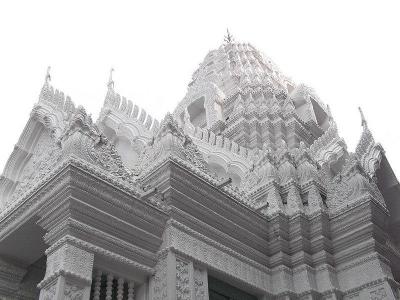
As you pass through the gate, there's a short stairway leading up to a platform supporting the ubosot surrounded by several prangs with a large chedi behind. The inside decor gives an illusion of a checkerboard pattern due to the fact that the ubosot, including its round columns, and the chedi are completely covered in small square tiles of grey and white marble.
On either side of the ubosot are the large prangs with a noticeable Khmer influence. Contrary to the heat outside, inside the ubosot is all dark and cool. The main Buddha image on the altar is backed by a shimmering blue mosaic of mirrors. The ceiling is typically finished in red and gold, with crystalline stars in gold rosettes.
A regular flow of visitors to this little temple suggests that it definitely deserves, albeit a short, visit on your way to the Grand Palace.
The central building of Wat Ratchapradit is its viharn, or main chapel, called Phra Vihara Luang. Foundation of the temple had to be reinforced with garlic pots as landfill when, during the construction, it was discovered that the soft soil of the area might cause the building to sink and collapse.
Originally, back in the days of King Rama III, this plot of land was a royal coffee plantation, and was later bought by King Rama IV with his own money. The king constructed a small temple here and called it Wat Ratchapradit Sathitthammayutikaram. Later, he changed the name to Wat Ratchapradit Sathitmahasimaram.
Inside the Phra Vihara Luang are the murals showing royal ceremonies of the calendar year. One of them depicts King Rama IV using a telescope as part of his astronomical studies.
As you pass through the gate, there's a short stairway leading up to a platform supporting the ubosot surrounded by several prangs with a large chedi behind. The inside decor gives an illusion of a checkerboard pattern due to the fact that the ubosot, including its round columns, and the chedi are completely covered in small square tiles of grey and white marble.
On either side of the ubosot are the large prangs with a noticeable Khmer influence. Contrary to the heat outside, inside the ubosot is all dark and cool. The main Buddha image on the altar is backed by a shimmering blue mosaic of mirrors. The ceiling is typically finished in red and gold, with crystalline stars in gold rosettes.
A regular flow of visitors to this little temple suggests that it definitely deserves, albeit a short, visit on your way to the Grand Palace.
12) Wat Pho (Temple of the Reclining Buddha) (must see)
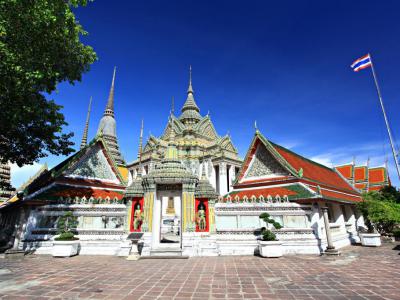
Wat Pho (the Temple of the Reclining Buddha) is the oldest Buddhist temple in Bangkok, located behind the splendid Temple of the Emerald Buddha, and is one of the city's largest. Built around 200 years before Bangkok became Thailand's capital, the temple is mainly famous for housing the huge Reclining Buddha statue along with the largest number of Buddha images within. The Wat was almost entirely rebuilt during the reign of Rama I, when the capital was moved to Bangkok.
The highly impressive gold-plated Reclining Buddha is 46 meters long and 15 meters high, and is designed to illustrate the passing of the Buddha into nirvana. The feet and the eyes are engraved with mother-of-pearl decoration. The bottoms of the Buddha's feet are intricately decorated with 108 auspicious scenes in Chinese and Indian styles.
The Wat Pho complex consists of two walled compounds, bisected north-south by Sanamchai Road running east-west. Reclining Buddha and a massage school are found in the northern walled compound. People visit mostly this section which comprises a large temple hall enclosed by 394 bronze Buddha images. There are also 91 chedis of varying sizes around the ground. The library, impressively decorated with figures and pagodas made of porcelain, is also present nearby. The large grounds of Wat Pho contain more than 1,000 Buddha images in total, most brought from the ruins of the former capitals Ayuthaya and Sukhothai.
Wat Pho is also famous as Thailand's first university, as well as the birthplace and training center of traditional Thai massage. Stimulating rather than relaxing, and incorporating yoga style postures to relieve stress and improve blood circulation, traditional Thai massage is quite different from the other forms of therapeutic massage. Wat Pho is a good place to try it – many of the rich and famous are known to have come here specifically for that. Try and see if you like it!
Traditional Thai dance and music are also taught within the temple, on Sundays. Astrologers and palm readers are likewise available for consultation. For a very small donation, that helps to maintain the temple, you can also receive a blessing from a monk.
Tip:
Make sure to bring exact THB amount for the entry tickets because, for some weird reason, they won't give any change.
It takes about 2 hours to just go round and make photos, but you can easily spend 4-5 hours in this huge complex altogether.
The admission ticket comes with a bottle of water and there are refill stations with cool clean water inside.
Women and men must wear long pants (covering knees) and shirts with long sleeves.
To enter the sanctum sanctorum, you'll have to take your shoes off.
The highly impressive gold-plated Reclining Buddha is 46 meters long and 15 meters high, and is designed to illustrate the passing of the Buddha into nirvana. The feet and the eyes are engraved with mother-of-pearl decoration. The bottoms of the Buddha's feet are intricately decorated with 108 auspicious scenes in Chinese and Indian styles.
The Wat Pho complex consists of two walled compounds, bisected north-south by Sanamchai Road running east-west. Reclining Buddha and a massage school are found in the northern walled compound. People visit mostly this section which comprises a large temple hall enclosed by 394 bronze Buddha images. There are also 91 chedis of varying sizes around the ground. The library, impressively decorated with figures and pagodas made of porcelain, is also present nearby. The large grounds of Wat Pho contain more than 1,000 Buddha images in total, most brought from the ruins of the former capitals Ayuthaya and Sukhothai.
Wat Pho is also famous as Thailand's first university, as well as the birthplace and training center of traditional Thai massage. Stimulating rather than relaxing, and incorporating yoga style postures to relieve stress and improve blood circulation, traditional Thai massage is quite different from the other forms of therapeutic massage. Wat Pho is a good place to try it – many of the rich and famous are known to have come here specifically for that. Try and see if you like it!
Traditional Thai dance and music are also taught within the temple, on Sundays. Astrologers and palm readers are likewise available for consultation. For a very small donation, that helps to maintain the temple, you can also receive a blessing from a monk.
Tip:
Make sure to bring exact THB amount for the entry tickets because, for some weird reason, they won't give any change.
It takes about 2 hours to just go round and make photos, but you can easily spend 4-5 hours in this huge complex altogether.
The admission ticket comes with a bottle of water and there are refill stations with cool clean water inside.
Women and men must wear long pants (covering knees) and shirts with long sleeves.
To enter the sanctum sanctorum, you'll have to take your shoes off.
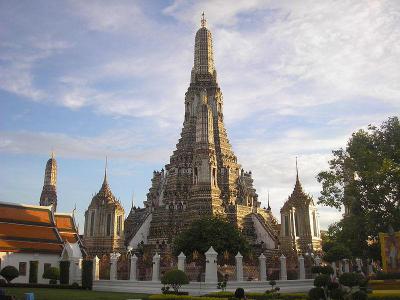
13) Wat Arun (Temple of Dawn) (must see)
Wat Arun, located in the Bangkok Yai district of Bangkok, is a prominent Buddhist temple. It rests on the western bank of the Chao Phraya River in the Thonburi area. This temple takes its name from Aruṇa, a Hindu deity symbolizing the radiant energies of the rising sun. Wat Arun is one of Thailand's most renowned landmarks. Although the temple has a history dating back to at least the 17th century, its distinctive prang (tower-like spire) was constructed in the early 19th century under the reigns of Rama II and Rama III.
The central feature of Wat Arun is its central prang, adorned with vibrant porcelain. It resembles a stupa-like pagoda embellished with colorful faience. Its height is reported differently in various sources, ranging from 66.8 meters (219 feet) to 86 meters (282 feet). Four smaller satellite prang surround its corners, adorned with shells from Mauritia mauritiana and fragments of porcelain.
At the pinnacle of the central prang is a seven-pronged trident often referred to as the "Trident of Shiva." Surrounding the prang's base, you'll find various depictions of ancient Chinese soldiers and animals. Above the second terrace, there are four statues of the Hindu god Indra mounted on Erawan, his celestial mount.
The central prang is believed to have three significant levels: the base represents Traiphum, signifying all realms of existence; the middle stands for Tavatimsa, the Tusita Heaven where all desires find fulfillment; and the top denotes Devaphum, indicating the six heavens within the seven realms of happiness. Along the riverside, there are six pavilions constructed in the Chinese architectural style. These pavilions are crafted from green granite and feature landing bridges.
Adjacent to the prang stands the Ordination Hall, housing a Niramitr Buddha image, purportedly designed by Rama II. The front entrance of the Ordination Hall boasts a roof adorned with a central spire, decorated with colored ceramics and stuccowork covered in colored china. Inside, you'll find a grand altar adorned with red, grey, and white marble decorations. Two temple guardian figures, representing demons, stand at the entrance. The murals inside were commissioned during the reign of Rama V.
Why You Should Visit:
Lovely, colorful, and less crowded than the other major temples in the area.
Not many Buddhist temples are this white and bright with pieces of different types of ceramic tiles and fragments of multi-colored porcelain decorated on almost every inch.
Tip:
Make sure you are properly dressed so that you won't be required to rent a sarong or be turned away.
Some people will suggest renting a boat to visit the temple. It will cost you a lot, so pass on that! Just cross with the ferry for a mere 4 THB.
The best time to visit would be evening since you can get a glimpse of the temple's structure & details in daylight as well as when lit up artificially after sunset.
The central feature of Wat Arun is its central prang, adorned with vibrant porcelain. It resembles a stupa-like pagoda embellished with colorful faience. Its height is reported differently in various sources, ranging from 66.8 meters (219 feet) to 86 meters (282 feet). Four smaller satellite prang surround its corners, adorned with shells from Mauritia mauritiana and fragments of porcelain.
At the pinnacle of the central prang is a seven-pronged trident often referred to as the "Trident of Shiva." Surrounding the prang's base, you'll find various depictions of ancient Chinese soldiers and animals. Above the second terrace, there are four statues of the Hindu god Indra mounted on Erawan, his celestial mount.
The central prang is believed to have three significant levels: the base represents Traiphum, signifying all realms of existence; the middle stands for Tavatimsa, the Tusita Heaven where all desires find fulfillment; and the top denotes Devaphum, indicating the six heavens within the seven realms of happiness. Along the riverside, there are six pavilions constructed in the Chinese architectural style. These pavilions are crafted from green granite and feature landing bridges.
Adjacent to the prang stands the Ordination Hall, housing a Niramitr Buddha image, purportedly designed by Rama II. The front entrance of the Ordination Hall boasts a roof adorned with a central spire, decorated with colored ceramics and stuccowork covered in colored china. Inside, you'll find a grand altar adorned with red, grey, and white marble decorations. Two temple guardian figures, representing demons, stand at the entrance. The murals inside were commissioned during the reign of Rama V.
Why You Should Visit:
Lovely, colorful, and less crowded than the other major temples in the area.
Not many Buddhist temples are this white and bright with pieces of different types of ceramic tiles and fragments of multi-colored porcelain decorated on almost every inch.
Tip:
Make sure you are properly dressed so that you won't be required to rent a sarong or be turned away.
Some people will suggest renting a boat to visit the temple. It will cost you a lot, so pass on that! Just cross with the ferry for a mere 4 THB.
The best time to visit would be evening since you can get a glimpse of the temple's structure & details in daylight as well as when lit up artificially after sunset.
