Custom Walk in Charleston, South Carolina by fgump_a5f32 created on 2026-01-01
Guide Location: USA » Charleston
Guide Type: Custom Walk
# of Sights: 14
Tour Duration: 3 Hour(s)
Travel Distance: 5.2 Km or 3.2 Miles
Share Key: KJKZ5
Guide Type: Custom Walk
# of Sights: 14
Tour Duration: 3 Hour(s)
Travel Distance: 5.2 Km or 3.2 Miles
Share Key: KJKZ5
How It Works
Please retrieve this walk in the GPSmyCity app. Once done, the app will guide you from one tour stop to the next as if you had a personal tour guide. If you created the walk on this website or come to the page via a link, please follow the instructions below to retrieve the walk in the app.
Retrieve This Walk in App
Step 1. Download the app "GPSmyCity: Walks in 1K+ Cities" on Apple App Store or Google Play Store.



Step 2. In the GPSmyCity app, download(or launch) the guide "Charleston Map and Walking Tours".
Step 3. Tap the menu button located at upper right corner of the "Walks" screen and select "Retrieve custom walk". Enter the share key: KJKZ5
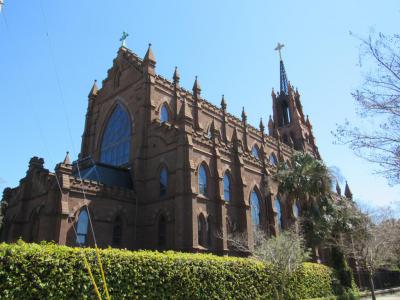
1) Cathedral of St. John the Baptist
The first Cathedral of Saint John the Baptist, completed in 1854, stood as a remarkable specimen of Gothic architecture. Crafted from Connecticut sandstone and crowned by a 200-foot spire, it tragically succumbed to the devastating fire of 1861. However, by 1890, the reconstruction of an almost exact replica of the original edifice had commenced. The design, attributed to Patrick Kelly of Brooklyn, New York, closely adhered to the plans of its predecessor, except for the substitution of a square tower due to budgetary constraints.
It wasn't until 103 years later that a new spire, along with three bells, was finally added atop the tower, culminating the restoration of the historic structure. Comprising Connecticut brownstone, the newer building was eventually completed in 2010. The spacious nave, measuring 150 by 80 feet, is adorned with exquisite stained-glass windows and has a seating capacity for 700 individuals.
Why You Should Visit:
To admire one of North America's most splendid churches, with its unique stained-glass windows, altar, and architectural grandeur.
Tip:
Try to visit on a sunny day to fully appreciate the intricate patterns and colors of the stained-glass windows.
It wasn't until 103 years later that a new spire, along with three bells, was finally added atop the tower, culminating the restoration of the historic structure. Comprising Connecticut brownstone, the newer building was eventually completed in 2010. The spacious nave, measuring 150 by 80 feet, is adorned with exquisite stained-glass windows and has a seating capacity for 700 individuals.
Why You Should Visit:
To admire one of North America's most splendid churches, with its unique stained-glass windows, altar, and architectural grandeur.
Tip:
Try to visit on a sunny day to fully appreciate the intricate patterns and colors of the stained-glass windows.

2) St. Michael's Church (must see)
While Saint Philip's church can rightfully claim the title of Charleston's oldest congregation, Saint Michael's takes pride in being the city's oldest religious structure, completed in 1761. Its architect's identity remains a mystery, though there's no doubt that this exquisite building is one of Charleston's greatest architectural treasures, reflecting the influence of London's Saint Martin-in-the-Fields temple, designed in the 1720s.
Notably, Saint Michael's features a two-story portico with Tuscan columns, a pioneering architectural feature in colonial America. Adorning the north wall is a sizable stained glass window donated in 1898, showcasing a rendition of "Easter Morning". Composed of approximately 1,800 to 2,000 individual pieces, this masterpiece was crafted by artist and designer Louis Lederlie for Tiffany Studios. Additionally, the church tower houses a clock that chimes the hours and quarters, along with eight remarkable change-ringing bells, one of only four such sets in the Charleston area. These bells were initially cast in 1764 and later recast in 1866, both times in London.
The building has, for the most part, remained remarkably intact over the centuries, aside from the addition of a sacristy in 1883; nevertheless, it has endured significant repairs due to a series of natural and man-made disasters. In the earthquake of 1886, the steeple tower sank by 8 inches, resulting in several cracks throughout the church. Further damage was inflicted by a tornado in 1935 and Hurricane Hugo in 1989. During both the American Revolution and the Civil War, the spire was painted black to reduce its visibility as a target for enemy gunners.
A historical highlight includes President George Washington's visit to Charleston in 1791 when he attended a service at Saint Michael's, occupying the Governor's Pew, which is commemorated with a small plaque. The churchyard serves as the final resting place for several distinguished members of the congregation, including General Charles Cotesworth Pinckney, a Revolutionary War hero and signer of the Constitution, as well as John Rutledge, a signer of the Constitution and member of the U.S. Supreme Court.
Notably, Saint Michael's features a two-story portico with Tuscan columns, a pioneering architectural feature in colonial America. Adorning the north wall is a sizable stained glass window donated in 1898, showcasing a rendition of "Easter Morning". Composed of approximately 1,800 to 2,000 individual pieces, this masterpiece was crafted by artist and designer Louis Lederlie for Tiffany Studios. Additionally, the church tower houses a clock that chimes the hours and quarters, along with eight remarkable change-ringing bells, one of only four such sets in the Charleston area. These bells were initially cast in 1764 and later recast in 1866, both times in London.
The building has, for the most part, remained remarkably intact over the centuries, aside from the addition of a sacristy in 1883; nevertheless, it has endured significant repairs due to a series of natural and man-made disasters. In the earthquake of 1886, the steeple tower sank by 8 inches, resulting in several cracks throughout the church. Further damage was inflicted by a tornado in 1935 and Hurricane Hugo in 1989. During both the American Revolution and the Civil War, the spire was painted black to reduce its visibility as a target for enemy gunners.
A historical highlight includes President George Washington's visit to Charleston in 1791 when he attended a service at Saint Michael's, occupying the Governor's Pew, which is commemorated with a small plaque. The churchyard serves as the final resting place for several distinguished members of the congregation, including General Charles Cotesworth Pinckney, a Revolutionary War hero and signer of the Constitution, as well as John Rutledge, a signer of the Constitution and member of the U.S. Supreme Court.
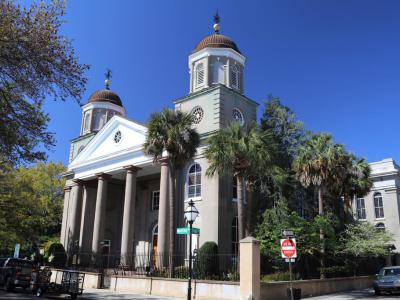
3) First (Scots) Presbyterian Church
The Scots Kirk, also known as the Scots Meeting House, was established in 1731 by a dozen Scottish families who held firm beliefs in adhering to the strict subscription to the Westminster Standards (church laws) and the Presbyterian form of church governance. Their initial modest structure on this very site was erected in 1734. Subsequently, in 1814, it was replaced by the present building, making it the fifth-oldest church edifice in Charleston. The design, inspired by the Baltimore Basilica in Baltimore, Maryland, is credited to Benjamin Latrobe, the same accomplished architect responsible for masterminding the United States Capitol in Washington D.C.
Despite suffering substantial damage from a fire in 1945, the historic building received meticulous restoration efforts. Above the main entrance, a window showcases the seal of the Church of Scotland-a depiction of the burning bush along with the Latin motto "Nec Tamen Consumbatur", which translates to "Nevertheless it was not consumed". The stained glass windows within the church feature various Scottish symbols, and the unmistakable Scottish thistle graces the wrought iron grilles, further emphasizing the deep-rooted Scottish heritage celebrated within these hallowed walls.
Despite suffering substantial damage from a fire in 1945, the historic building received meticulous restoration efforts. Above the main entrance, a window showcases the seal of the Church of Scotland-a depiction of the burning bush along with the Latin motto "Nec Tamen Consumbatur", which translates to "Nevertheless it was not consumed". The stained glass windows within the church feature various Scottish symbols, and the unmistakable Scottish thistle graces the wrought iron grilles, further emphasizing the deep-rooted Scottish heritage celebrated within these hallowed walls.
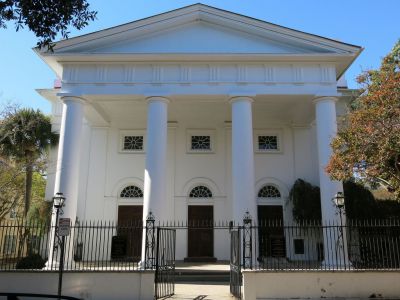
4) First Baptist Church in Charleston
This is the oldest Baptist church in the American South, originally founded by a congregation that migrated from Maine to the Carolinas in 1696. The church building itself is a remarkable work of architecture designed by Robert Mills, the first American-born architect, and it follows the popular Greek Revival style. Mills was quite straightforward in his assessment of the building, declaring it to be "the best specimen of correct taste in architecture in the city. It is purely Greek in style, simply grand in its proportions, and beautiful in its detail."
Notable features of the church include a solid mahogany pulpit, which was crafted from wood imported from the West Indies at a considerable cost of $1,000 in 1822. Additionally, the church boasts a fabulous organ dating back to 1845, which was crafted by the renowned organ builder Erben.
Notable features of the church include a solid mahogany pulpit, which was crafted from wood imported from the West Indies at a considerable cost of $1,000 in 1822. Additionally, the church boasts a fabulous organ dating back to 1845, which was crafted by the renowned organ builder Erben.

5) French Huguenot Church
One of Charleston's oldest congregations, the French Huguenot Church, founded in the 1680s, also holds the distinction of being the only remaining independent Huguenot church in the United States. The original sanctuary, constructed in 1687, was intentionally destroyed as a firebreak during the major fire of 1796. Its successor, built in 1800, was also later demolished in favor of the current picturesque stucco-coated Gothic Revival temple, which was completed in the mid-1800s and was the first of its kind in the city.
Back in the 16th and 17th centuries, Huguenots in predominantly Catholic France faced persecution for their Protestant beliefs. After the Revocation of the Nantes Edict in 1685, many had fled France, with some finding refuge in North America. Charleston's early congregation included many of these refugees, and their descendants continued to play a significant role in the church's affairs for generations.
Originally affiliated with the Calvinist Reformed Church of France, the Huguenot Church still retains elements of Calvinist doctrine in its services, which are primarily conducted in English but follow the 18th-century French liturgy. Since 1950, an annual service conducted in French has been held to celebrate the arrival of spring.
Visitors to the church can request a brief tour from the on-duty docents, who provide insights into the Huguenot influence in early America and the church's history. The famous old Tracker organ, the Gothic ceiling, and external buttresses are all worthy of a look. While there is no admission fee or mandatory tour charge, donations are welcomed and used for the preservation of the historic building.
During the Spring and Fall, tours are available from 10 am to 4 pm on Mondays through Thursdays and from 10 am to 1 pm on Fridays.
Back in the 16th and 17th centuries, Huguenots in predominantly Catholic France faced persecution for their Protestant beliefs. After the Revocation of the Nantes Edict in 1685, many had fled France, with some finding refuge in North America. Charleston's early congregation included many of these refugees, and their descendants continued to play a significant role in the church's affairs for generations.
Originally affiliated with the Calvinist Reformed Church of France, the Huguenot Church still retains elements of Calvinist doctrine in its services, which are primarily conducted in English but follow the 18th-century French liturgy. Since 1950, an annual service conducted in French has been held to celebrate the arrival of spring.
Visitors to the church can request a brief tour from the on-duty docents, who provide insights into the Huguenot influence in early America and the church's history. The famous old Tracker organ, the Gothic ceiling, and external buttresses are all worthy of a look. While there is no admission fee or mandatory tour charge, donations are welcomed and used for the preservation of the historic building.
During the Spring and Fall, tours are available from 10 am to 4 pm on Mondays through Thursdays and from 10 am to 1 pm on Fridays.
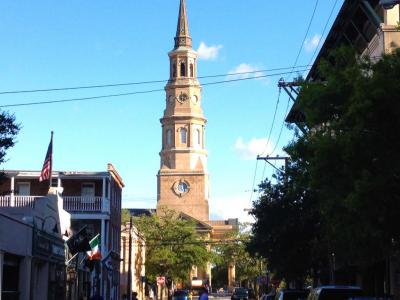
6) St. Philip's Church
The Anglican church of Saint Philip is the second (after Saint Michael's) most prominent church in Charleston, erected in the 1830s. Its congregation, however, is the oldest in town, tracing its roots back to the colony's fledgling years. Located in the heart of the French Quarter and described as "a building of the highest quality and sophistication,” this sanctuary has two historic graveyards. The imposing tower, designed in the Wren-Gibbs tradition, justifies the church's National Historic Landmark status.
Throughout the 18th century, this was the place of worship for notable figures like Charles Pinckney, a key author and signer of the U.S. Constitution; his grave is found in the church's cemetery. Also, there is the grave of Christopher Gadsden, a founding father who designed the famous flag featuring a coiled snake and the words "Don't tread on me".
Moving into the 19th century, Saint Philip's became the spiritual home of senator, vice-president, and Secretary of State, John C. Calhoun, who was instrumental in advancing the theory of states' rights. After he died in 1850, Calhoun was initially interred in the former "stranger's churchyard" behind the church; however, with the onset of the Civil War, his remains were relocated to the portion of the cemetery across the street. Eventually, the state of South Carolina erected a huge monument at his gravesite extolling his numerous achievements.
Why You Should Visit:
One of South Carolina's most photographed buildings!
The surrounding well-preserved graveyard is a fascinating historical site filled with remarkable gravestones.
Tip:
Stop across the street at the historically-affiliated French Huguenot Church; both buildings have amazing histories and architecture!
Throughout the 18th century, this was the place of worship for notable figures like Charles Pinckney, a key author and signer of the U.S. Constitution; his grave is found in the church's cemetery. Also, there is the grave of Christopher Gadsden, a founding father who designed the famous flag featuring a coiled snake and the words "Don't tread on me".
Moving into the 19th century, Saint Philip's became the spiritual home of senator, vice-president, and Secretary of State, John C. Calhoun, who was instrumental in advancing the theory of states' rights. After he died in 1850, Calhoun was initially interred in the former "stranger's churchyard" behind the church; however, with the onset of the Civil War, his remains were relocated to the portion of the cemetery across the street. Eventually, the state of South Carolina erected a huge monument at his gravesite extolling his numerous achievements.
Why You Should Visit:
One of South Carolina's most photographed buildings!
The surrounding well-preserved graveyard is a fascinating historical site filled with remarkable gravestones.
Tip:
Stop across the street at the historically-affiliated French Huguenot Church; both buildings have amazing histories and architecture!
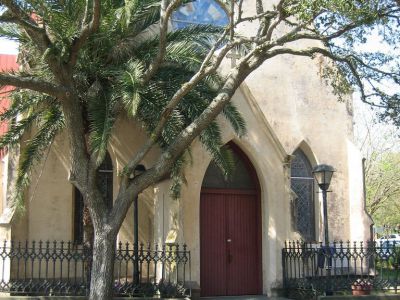
7) St. John's Reformed Episcopal Church
In 1873, the Reformed Episcopal denomination was established when it separated from the Protestant Episcopal Church due to the latter's refusal to train and ordain black ministers. The movement found its way to the Charleston area the following year when Reverend Peter Stevens, a white Confederate Army veteran, began organizing groups of black freedmen throughout the Lowcountry.
One of these groups convened in a house, and it was there that Saint John's congregation took shape in 1906. In a city still grappling with its deep-seated racism, the black parishioners sought solace and community through worship. However, it wasn't until 1971 that Saint John's found a new home in this Gothic Revival building on Anson Street, a structure of historical significance in its own right.
Constructed in 1850 by black freedmen and slaves who were part of the Presbyterian community, the church became the site of a significant revival in Charleston in 1857. At a time when the nation was on the brink of its bloodiest conflict, blacks and whites, slaves and freedmen, came together in this church to pray and sing hymns side by side.
In the 1880s, the church underwent renovations that added transepts, a Gothic frame ceiling, and 14 stained glass windows. According to records from the Historic Charleston Foundation, many of the church's interior features, including stenciled decorations and gilded Gothic elements, have been preserved by the Saint John's congregation.
On the church grounds, there is a beautifully landscaped garden dedicated to honoring church member Philip Simmons, a renowned Charleston ironworker. Simmons was the designer of the "Heart Gate" that serves as the entrance to this garden.
One of these groups convened in a house, and it was there that Saint John's congregation took shape in 1906. In a city still grappling with its deep-seated racism, the black parishioners sought solace and community through worship. However, it wasn't until 1971 that Saint John's found a new home in this Gothic Revival building on Anson Street, a structure of historical significance in its own right.
Constructed in 1850 by black freedmen and slaves who were part of the Presbyterian community, the church became the site of a significant revival in Charleston in 1857. At a time when the nation was on the brink of its bloodiest conflict, blacks and whites, slaves and freedmen, came together in this church to pray and sing hymns side by side.
In the 1880s, the church underwent renovations that added transepts, a Gothic frame ceiling, and 14 stained glass windows. According to records from the Historic Charleston Foundation, many of the church's interior features, including stenciled decorations and gilded Gothic elements, have been preserved by the Saint John's congregation.
On the church grounds, there is a beautifully landscaped garden dedicated to honoring church member Philip Simmons, a renowned Charleston ironworker. Simmons was the designer of the "Heart Gate" that serves as the entrance to this garden.
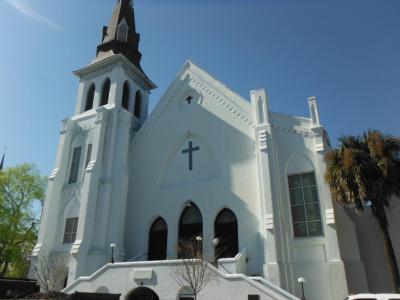
8) Mother Emanuel AME Church
The African Methodist Episcopal Church originated in 1787 in Philadelphia with the establishment of the Free African Society, which was rooted in the doctrines of Methodism and the teachings of John Wesley. A similar organization emerged in Charleston in 1791 under the leadership of Rev. Morris Brown, a free black preacher associated with another Methodist church in the city. This display of autonomy by black members led to a separation from the Methodists, giving rise to the foundation of three black churches in Charleston, collectively known as the Bethel Circuit. The congregation of Emanuel A.M.E. Church is one of the churches born from this movement.
Initially, the church was located in the Hampstead neighborhood on the city's east side and boasted a membership of 1,000 by 1818. Just four years later, in 1822, Denmark Vesey, a skilled carpenter who had purchased his freedom, devised plans for a slave insurrection within the premises. News of the planned rebellion leaked, resulting in the execution of Vesey and some of his supporters, and the burning of the Hampstead church. By 1834, the state legislature in South Carolina ordered the closure of all black churches.
Following the Denmark Vesey incident, some of the congregation returned to white churches, while others continued their African church traditions clandestinely. In 1865, after years of underground worship, the congregation resurfaced, now numbering 3,000 members. The current church building, completed in 1891, still retains the original gas lamps that line the sanctuary. With seating for 2,500 individuals, is the largest African-American congregation in Charleston today.
Initially, the church was located in the Hampstead neighborhood on the city's east side and boasted a membership of 1,000 by 1818. Just four years later, in 1822, Denmark Vesey, a skilled carpenter who had purchased his freedom, devised plans for a slave insurrection within the premises. News of the planned rebellion leaked, resulting in the execution of Vesey and some of his supporters, and the burning of the Hampstead church. By 1834, the state legislature in South Carolina ordered the closure of all black churches.
Following the Denmark Vesey incident, some of the congregation returned to white churches, while others continued their African church traditions clandestinely. In 1865, after years of underground worship, the congregation resurfaced, now numbering 3,000 members. The current church building, completed in 1891, still retains the original gas lamps that line the sanctuary. With seating for 2,500 individuals, is the largest African-American congregation in Charleston today.
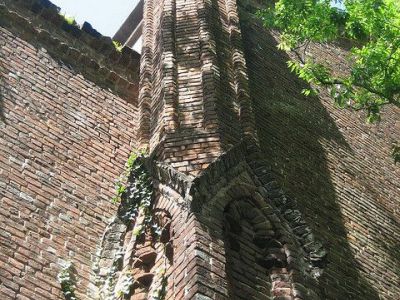
9) New Tabernacle Fourth Baptist Church
Built in 1859, the New Tabernacle Fourth Baptist Church is a splendid example of Gothic Revival architecture in Charleston, renowned for its grandeur among the city's churches. Designed by Francis D. Lee, it features a Greek cross-shaped structure with soaring 55-foot-tall ceilings, impressive 30-foot-tall stained glass windows, and elegant slate and wood flooring. Intricately adorned galleries feature Gothic-style spindle work and quatrefoil center panels.
Despite enduring damage from shelling and being stripped by Union troops during the Civil War, the building remained in continuous use by the Saint Luke's congregation until 1949 when it merged with Saint Paul's in Radcliffeborough, eventually becoming the Cathedral of Saint Luke. Fortunately, most of its intricate architectural elements have been faithfully preserved despite the transition in congregation.
Today, the New Tabernacle Fourth Baptist Church not only stands as a magnificent religious sanctuary with regular services but also serves as a community hub for various cultural activities, including concerts, festivals, and other engaging events.
Despite enduring damage from shelling and being stripped by Union troops during the Civil War, the building remained in continuous use by the Saint Luke's congregation until 1949 when it merged with Saint Paul's in Radcliffeborough, eventually becoming the Cathedral of Saint Luke. Fortunately, most of its intricate architectural elements have been faithfully preserved despite the transition in congregation.
Today, the New Tabernacle Fourth Baptist Church not only stands as a magnificent religious sanctuary with regular services but also serves as a community hub for various cultural activities, including concerts, festivals, and other engaging events.
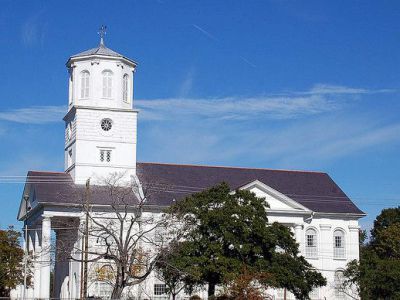
10) Second Presbyterian Church
Initially established to serve the city's growing Presbyterian community, this church, founded in 1809, has played a prominent role in Charleston's religious landscape and stands as an enduring architectural representation of the Reformed Faith. It is the fourth oldest surviving original church in the city, following Saint Michael's, the current Unitarian Church, and Old Bethel Methodist Church.
Its Classic Revival sanctuary, though more elaborate than the colonial-era meeting houses, upholds the simplicity characteristic of Presbyterian tradition. A prominent pulpit underscores the sermon's central importance in worship, while the placement of the communion table within the congregation symbolizes the belief in the priesthood of all believers. Additionally, the presence of the baptismal font among the congregation signifies their commitment to nurturing the spiritual growth of the baptized.
Remarkable for its Palladian stained glass window, the church's architecture conveys inclusivity, portraying Jesus Christ alongside individuals of diverse ages, genders, races, and professions. Inside the sanctuary, a bas-relief, meticulously restored after Hurricane Hugo, showcases various symbolic elements and references from the Bible.
Meanwhile, the surrounding graveyard narrates the stories of numerous generations of church members, including veterans, college founders, ministers, and community leaders. Notably, this burial ground is characterized by a significant number of child interments, reflecting historical challenges such as malnutrition and disease.
Its Classic Revival sanctuary, though more elaborate than the colonial-era meeting houses, upholds the simplicity characteristic of Presbyterian tradition. A prominent pulpit underscores the sermon's central importance in worship, while the placement of the communion table within the congregation symbolizes the belief in the priesthood of all believers. Additionally, the presence of the baptismal font among the congregation signifies their commitment to nurturing the spiritual growth of the baptized.
Remarkable for its Palladian stained glass window, the church's architecture conveys inclusivity, portraying Jesus Christ alongside individuals of diverse ages, genders, races, and professions. Inside the sanctuary, a bas-relief, meticulously restored after Hurricane Hugo, showcases various symbolic elements and references from the Bible.
Meanwhile, the surrounding graveyard narrates the stories of numerous generations of church members, including veterans, college founders, ministers, and community leaders. Notably, this burial ground is characterized by a significant number of child interments, reflecting historical challenges such as malnutrition and disease.
11) St. Matthew's Lutheran Church
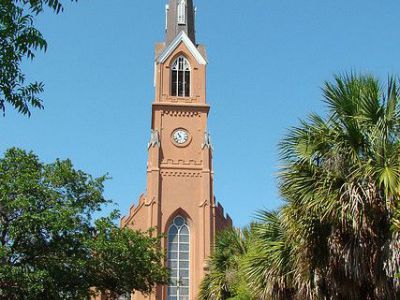
The significant influx of German immigrants to Charleston during the first half of the 19th century prompted the city's second-oldest Lutheran congregation to embark on a major expansion of their place of worship. The result was this magnificent Gothic-style church, distinguished by its lofty German-crafted stained-glass windows, which was completed in 1872. Its crowning glory was the towering 297-foot spire, surpassing any other in the state in height.
However, in a dramatic incident in 1965, a fire engulfed the church, causing the spire to collapse onto the street below. Remarkably, the steeple's point pierced the sidewalk just to the left of the church's front door. To this day, that steeple point remains encased in concrete and is commemorated by a plaque, symbolizing the congregation's resilience and determination to restore the architectural treasure.
However, in a dramatic incident in 1965, a fire engulfed the church, causing the spire to collapse onto the street below. Remarkably, the steeple's point pierced the sidewalk just to the left of the church's front door. To this day, that steeple point remains encased in concrete and is commemorated by a plaque, symbolizing the congregation's resilience and determination to restore the architectural treasure.
12) Citadel Square Baptist Church
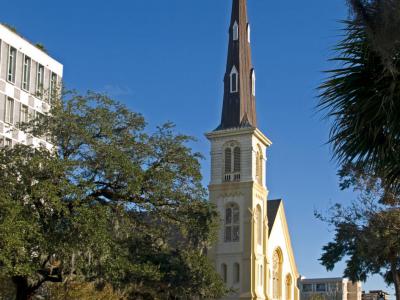
Founded in 1854 by twelve members from First Baptist Church, who were later joined by congregants from other Baptist churches in Charleston, this merged congregation wasted no time in constructing a new church building. The architects responsible for this new structure, Edward C. Jones and Francis D. Lee designed it in what was described as a "pure Norman" style, inspired by the Romanesque architecture prevalent in France. Interestingly, their design predates the more famous work in this style by Henry Hobson Richardson.
The exterior features a massive gable roof facing Meeting Street, adorned with arched entries topped by elaborate Romanesque windows, including a stunning rose window. Unfortunately, the 224-foot spire was toppled by a hurricane in 1885; its replacement, a shorter late-Victorian version of the original, had to be replaced again following damage from Hurricane Hugo. In 1990, the congregation raised funds to restore the steeple to its original height, making some concessions in design to incorporate post-1885 alterations.
Inside the church, ribbed vaulting and plaster bosses adorn the ceilings, including the pulpit area, where an alcove was originally wainscoted in oak. At one point, the interior was painted to imitate stone.
The exterior features a massive gable roof facing Meeting Street, adorned with arched entries topped by elaborate Romanesque windows, including a stunning rose window. Unfortunately, the 224-foot spire was toppled by a hurricane in 1885; its replacement, a shorter late-Victorian version of the original, had to be replaced again following damage from Hurricane Hugo. In 1990, the congregation raised funds to restore the steeple to its original height, making some concessions in design to incorporate post-1885 alterations.
Inside the church, ribbed vaulting and plaster bosses adorn the ceilings, including the pulpit area, where an alcove was originally wainscoted in oak. At one point, the interior was painted to imitate stone.

13) Circular Congregational Church
Originally known as the Independent Church of Charles Towne, this church was founded in 1681 by some of the earliest settlers, including English Congregationalists, Scots Presbyterians, and French Huguenots. In fact, it was one of the first two congregations established in the settlement, the other being Saint Philip's Church.
The initial structure, made of white bricks, was known by locals as the "White Meeting House", which gave rise to the name of Meeting Street. In 1780, during the siege of Charleston, it was struck by a British cannonball, leading to its replacement in 1806 with the first "Circular Church", an impressive Pantheon-style structure designed by Charleston's esteemed architect, Robert Mills. Described at the time as "the most extraordinary building in the U.S.", it featured seven doors, 26 windows, and could accommodate 2,000 people, including both black and white congregants.
Unfortunately, the walls of the Circular Church did not survive for long, as the devastating fire of 1861 consumed the city. The third and current church, not precisely circular but designed with a modified cloverleaf pattern, was completed in 1892, using bricks salvaged from its predecessor. Alongside its unique architectural significance and rich history, the building also serves as a splendid venue for musical events held throughout the year.
Lying adjacent, the parish house is yet another remarkable Greek Revival creation by Robert Mills, featuring twin stairways and wrought iron railings. It has survived over the years and was designated a National Historic Landmark in 1973.
The city's oldest cemetery, located at the church, is also noteworthy as it contains numerous tombstones dating back to the 1690s.
The initial structure, made of white bricks, was known by locals as the "White Meeting House", which gave rise to the name of Meeting Street. In 1780, during the siege of Charleston, it was struck by a British cannonball, leading to its replacement in 1806 with the first "Circular Church", an impressive Pantheon-style structure designed by Charleston's esteemed architect, Robert Mills. Described at the time as "the most extraordinary building in the U.S.", it featured seven doors, 26 windows, and could accommodate 2,000 people, including both black and white congregants.
Unfortunately, the walls of the Circular Church did not survive for long, as the devastating fire of 1861 consumed the city. The third and current church, not precisely circular but designed with a modified cloverleaf pattern, was completed in 1892, using bricks salvaged from its predecessor. Alongside its unique architectural significance and rich history, the building also serves as a splendid venue for musical events held throughout the year.
Lying adjacent, the parish house is yet another remarkable Greek Revival creation by Robert Mills, featuring twin stairways and wrought iron railings. It has survived over the years and was designated a National Historic Landmark in 1973.
The city's oldest cemetery, located at the church, is also noteworthy as it contains numerous tombstones dating back to the 1690s.
14) Unitarian Church in Charleston
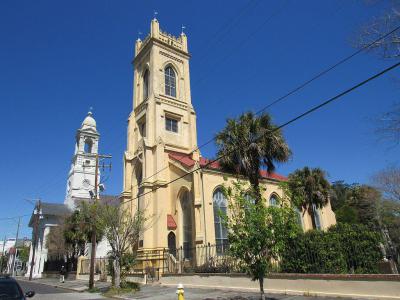
The initial construction on this site commenced just as the American Revolution was unfolding. During the British occupation of the city, the Georgian-style church served as lodging for the British militia and suffered damage, including the destruction of its newly installed pews; however, it was eventually repaired and returned to use by 1787. For the subsequent three decades, it operated as a unified entity with the Meeting Street Independent Church (now known as the Circular Church); nevertheless, in 1839, this congregation was reconstituted as the Unitarian Church.
Charleston experienced a period of considerable affluence in the 1850s, prompting the Unitarians to engage the services of the young architect Francis D. Lee, who was also a member of the church. His task was to remodel the structure in the increasingly popular Gothic Revival style, while preserving the existing walls and tower. Lee drew inspiration from the Henry VII chapel at Westminster Abbey, particularly the intricate and delicate fan tracery ceiling found there. He successfully replicated this remarkable ceiling in the church, rendering it one of the most exceptional examples of Gothic Revival architecture in the United States. The church premises also feature an intriguing garden and cemetery.
Why You Should Visit:
The sanctuary is lovely; the intentionally overgrown cemetery (free to visit when the gates are open) is a serene place to stroll or sit and reflect. The pathways are well-maintained, striking a balance between neatness and the wild beauty that draws you in.
Tip:
Consider swinging through the church when docents are available – they put on a pretty great tour and can offer further recommendations for exploring the town.
Charleston experienced a period of considerable affluence in the 1850s, prompting the Unitarians to engage the services of the young architect Francis D. Lee, who was also a member of the church. His task was to remodel the structure in the increasingly popular Gothic Revival style, while preserving the existing walls and tower. Lee drew inspiration from the Henry VII chapel at Westminster Abbey, particularly the intricate and delicate fan tracery ceiling found there. He successfully replicated this remarkable ceiling in the church, rendering it one of the most exceptional examples of Gothic Revival architecture in the United States. The church premises also feature an intriguing garden and cemetery.
Why You Should Visit:
The sanctuary is lovely; the intentionally overgrown cemetery (free to visit when the gates are open) is a serene place to stroll or sit and reflect. The pathways are well-maintained, striking a balance between neatness and the wild beauty that draws you in.
Tip:
Consider swinging through the church when docents are available – they put on a pretty great tour and can offer further recommendations for exploring the town.
