Custom Walk in Southampton, England by gpsmycity_azusfamily_223e5 created on 2026-01-03
Guide Location: England » Southampton
Guide Type: Custom Walk
# of Sights: 12
Tour Duration: 2 Hour(s)
Travel Distance: 2.4 Km or 1.5 Miles
Share Key: 4MJJU
Guide Type: Custom Walk
# of Sights: 12
Tour Duration: 2 Hour(s)
Travel Distance: 2.4 Km or 1.5 Miles
Share Key: 4MJJU
How It Works
Please retrieve this walk in the GPSmyCity app. Once done, the app will guide you from one tour stop to the next as if you had a personal tour guide. If you created the walk on this website or come to the page via a link, please follow the instructions below to retrieve the walk in the app.
Retrieve This Walk in App
Step 1. Download the app "GPSmyCity: Walks in 1K+ Cities" on Apple App Store or Google Play Store.



Step 2. In the GPSmyCity app, download(or launch) the guide "Southampton Map and Walking Tours".
Step 3. Tap the menu button located at upper right corner of the "Walks" screen and select "Retrieve custom walk". Enter the share key: 4MJJU
1) God's House Tower
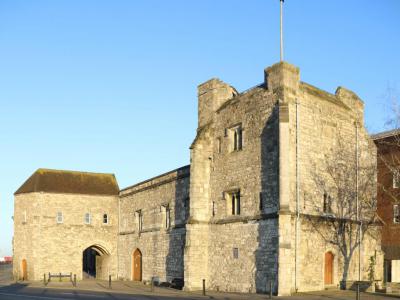
God's House Tower, located at the southeast corner of Southampton's town walls, is a historic 13th-century gatehouse that once provided access to the town from the Platform and Town Quay. Originally known as Saltmarsh Gate due to its proximity to marshlands, it later became known as God's House Gate because of its location near God's House Hospital, founded in 1168 to provide refuge for travelers.
Over the centuries, the tower evolved from a simple gatehouse to a significant fortification. Following a French raid in 1338, the town's defenses were strengthened, and in 1417, a two-story gallery and three-story tower were added, designed specifically to support cannon fire. This tower, equipped with eight gunports and rooftop firing points, helped the town gunner protect the sluices controlling seawater flow into a tidal moat that powered a nearby water mill.
In the following centuries, as Southampton's need for strong defenses diminished, God's House Tower transitioned into various roles, from a house of correction in the 1700s to the town jail by 1786. By 1855, a new prison was built elsewhere, and the tower fell into disuse until it was repurposed for storage in 1876. The building's exterior was cleaned and restored during this time, though part also served as a mortuary.
In 1961, God's House Tower became the Museum of Archaeology, showcasing Southampton's history, but closed in 2011 with exhibits moved to SeaCity Museum. Reopened in 2019 as an arts and heritage venue, it now features galleries, panoramic rooftop views, and a Hoxton Bakery branch. The Grade I listed building, known for its stone rubble construction, retains historical features like portcullis grooves, cinquefoil windows, and keyhole gunports, alongside traces of its tidal sluices and mural stairway.
Over the centuries, the tower evolved from a simple gatehouse to a significant fortification. Following a French raid in 1338, the town's defenses were strengthened, and in 1417, a two-story gallery and three-story tower were added, designed specifically to support cannon fire. This tower, equipped with eight gunports and rooftop firing points, helped the town gunner protect the sluices controlling seawater flow into a tidal moat that powered a nearby water mill.
In the following centuries, as Southampton's need for strong defenses diminished, God's House Tower transitioned into various roles, from a house of correction in the 1700s to the town jail by 1786. By 1855, a new prison was built elsewhere, and the tower fell into disuse until it was repurposed for storage in 1876. The building's exterior was cleaned and restored during this time, though part also served as a mortuary.
In 1961, God's House Tower became the Museum of Archaeology, showcasing Southampton's history, but closed in 2011 with exhibits moved to SeaCity Museum. Reopened in 2019 as an arts and heritage venue, it now features galleries, panoramic rooftop views, and a Hoxton Bakery branch. The Grade I listed building, known for its stone rubble construction, retains historical features like portcullis grooves, cinquefoil windows, and keyhole gunports, alongside traces of its tidal sluices and mural stairway.
2) Medieval Merchant's House
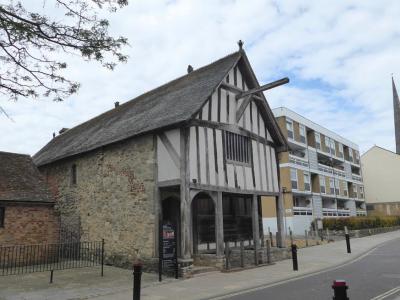
The Medieval Merchant's House in Southampton is a carefully restored late 13th-century building that stands as a testament to the city’s medieval past. Built around 1290 by John Fortin, a prosperous merchant, the house has remained largely intact despite centuries of use. It gained architectural significance after sustaining damage during the German bombing in 1940, which revealed the medieval interior, leading to its restoration in the 1980s by English Heritage.
The house is built following a traditional medieval right-angle, narrow plan design, with a functional undercroft used for wine storage, ensuring a constant temperature. The upper floor features a projecting bedchamber, a common medieval practice to increase space. Notably, historian Glyn Coppack highlights the building as "the only building of its type to survive substantially as first built," marking it as a Grade I listed building and a scheduled monument.
Facing French Street, the house showcases a mix of Bembridge and Purbeck stone walls and a timber frontage. The ground floor includes a reconstructed medieval shop front, a central hall with a 14th-century Flemish chimney, and an inner private room. The hallways, though traditional, reflect a medieval design challenge of poor lighting. The undercroft, originally designed to store barrels of wine, features an 18th-century brick floor.
The first floor houses two chambers, with the eastern one projecting into the street-similar to medieval homes found in Shrewsbury, Tewkesbury, and York. Marks from the original builders can still be seen on the timbers of this room. The western chamber retains elements of its 19th-century modifications, including a Victorian-era ceiling. The roof has been reconstructed with Cornish slate, mimicking the original medieval design.
Today, the Medieval Merchant's House serves as a fascinating glimpse into medieval life, managed by English Heritage as a tourist attraction.
The house is built following a traditional medieval right-angle, narrow plan design, with a functional undercroft used for wine storage, ensuring a constant temperature. The upper floor features a projecting bedchamber, a common medieval practice to increase space. Notably, historian Glyn Coppack highlights the building as "the only building of its type to survive substantially as first built," marking it as a Grade I listed building and a scheduled monument.
Facing French Street, the house showcases a mix of Bembridge and Purbeck stone walls and a timber frontage. The ground floor includes a reconstructed medieval shop front, a central hall with a 14th-century Flemish chimney, and an inner private room. The hallways, though traditional, reflect a medieval design challenge of poor lighting. The undercroft, originally designed to store barrels of wine, features an 18th-century brick floor.
The first floor houses two chambers, with the eastern one projecting into the street-similar to medieval homes found in Shrewsbury, Tewkesbury, and York. Marks from the original builders can still be seen on the timbers of this room. The western chamber retains elements of its 19th-century modifications, including a Victorian-era ceiling. The roof has been reconstructed with Cornish slate, mimicking the original medieval design.
Today, the Medieval Merchant's House serves as a fascinating glimpse into medieval life, managed by English Heritage as a tourist attraction.
3) Holyrood Church
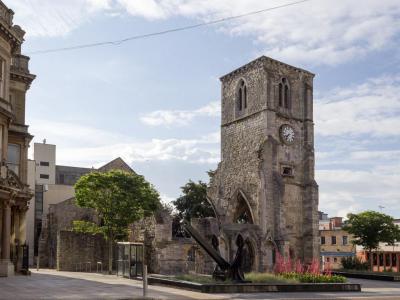
Holyrood Church, originally one of the five churches serving the old walled town of Southampton, dates back to 1320. Though heavily damaged by Nazi bombing during the Blitz in November 1940, its remnants remain a poignant memorial to the sailors of the Merchant Navy, officially dedicated in 1957.
The church's history stretches back even further, with the first documentary evidence dating from 1160 when Henry II granted it, along with other chapels, to the monks of Saint Denys. Its name, "Holy Rood," hints at Saxon origins.
Following the destruction during World War II, only the tower in the southwest corner, the eastern chancel, and significant portions of the north walls remain intact. The church's wooden spire and grand west window were lost, and much of the central structure was destroyed. On the west face of the surviving tower, a plaque honors Charles Dibdin, a Southampton-born poet, dramatist, and composer famed for his sea songs like "Tom Bowling" and "Poor Jack." Above this plaque are the clock and bells, which feature pre-1760 Quarter Jacks-small figures that strike each quarter-hour.
Inside the church, a memorial fountain, erected in 1912–1913 under the tower, pays tribute to those who perished in the sinking of the RMS Titanic. The fountain rests on four stone columns, with carvings of the Titanic adorning a curved pediment, all beneath a four-columned cupola.
Holyrood Church, though a shell of its former self, stands as a moving testament to both its ancient past and more recent history.
The church's history stretches back even further, with the first documentary evidence dating from 1160 when Henry II granted it, along with other chapels, to the monks of Saint Denys. Its name, "Holy Rood," hints at Saxon origins.
Following the destruction during World War II, only the tower in the southwest corner, the eastern chancel, and significant portions of the north walls remain intact. The church's wooden spire and grand west window were lost, and much of the central structure was destroyed. On the west face of the surviving tower, a plaque honors Charles Dibdin, a Southampton-born poet, dramatist, and composer famed for his sea songs like "Tom Bowling" and "Poor Jack." Above this plaque are the clock and bells, which feature pre-1760 Quarter Jacks-small figures that strike each quarter-hour.
Inside the church, a memorial fountain, erected in 1912–1913 under the tower, pays tribute to those who perished in the sinking of the RMS Titanic. The fountain rests on four stone columns, with carvings of the Titanic adorning a curved pediment, all beneath a four-columned cupola.
Holyrood Church, though a shell of its former self, stands as a moving testament to both its ancient past and more recent history.
4) High Street
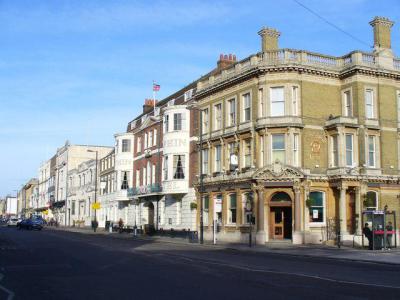
As far back as the 1500s, Southampton's High Street was recognized as one of England's cleanest and most beautiful. It was originally known as English Street in medieval times.
English Street got its name since it was the artery between three English-speaking parishes in the community. All Saints, Saint Lawrence, and Holy Rood were all connected through here. Logically, French Street linked the French-speaking sections of town, including Saint Michael and Saint John.
Unfortunately, German bombing campaigns during World War II devastated many parts of the city, including High Street. What was left after the war was a shadow of the historical glory that once stood here. Even though many buildings were destroyed, the modern buildings stand on medieval cellars and vaults.
Many bank buildings did survive the war, most of which were from the late 19th century. You can still see the National Westminster Bank, Midland Bank, and Barclay's Bank. The old Bank of England building at Nos. 31-33 is now a public house.
At No. 56, you'll find the former Oakley and Watling Fruit and Vegetable Merchants building. Its facade is ornately decorated with fruits.
English Street got its name since it was the artery between three English-speaking parishes in the community. All Saints, Saint Lawrence, and Holy Rood were all connected through here. Logically, French Street linked the French-speaking sections of town, including Saint Michael and Saint John.
Unfortunately, German bombing campaigns during World War II devastated many parts of the city, including High Street. What was left after the war was a shadow of the historical glory that once stood here. Even though many buildings were destroyed, the modern buildings stand on medieval cellars and vaults.
Many bank buildings did survive the war, most of which were from the late 19th century. You can still see the National Westminster Bank, Midland Bank, and Barclay's Bank. The old Bank of England building at Nos. 31-33 is now a public house.
At No. 56, you'll find the former Oakley and Watling Fruit and Vegetable Merchants building. Its facade is ornately decorated with fruits.
5) Bargate Markets
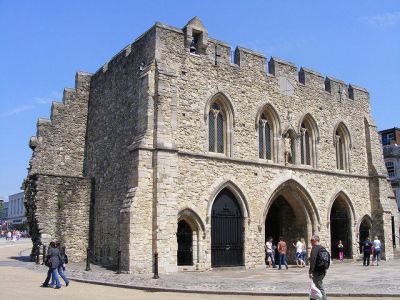
The Bargate Markets in Southampton offer a vibrant blend of history and commerce, set against the backdrop of the iconic medieval Bargate, a Grade I listed Norman gatehouse in the heart of the city. Every Friday, the market comes alive with over 50 continental-style stalls, offering an eclectic range of goods, from fresh local produce and baked goods to European cheeses, Mediterranean olives, and handmade leather items. For those seeking a bite, food stalls serve up a tempting array of treats like hog roast, noodles, and classic burgers.
On Saturdays, the market transforms with the seasons, featuring local farmers’ produce, original artwork, and craft stalls. The atmosphere is lively, with an inviting mix of traditional market vendors and independent artisans. The Bargate itself, once the main gateway to Southampton, adds to the charm of the market, blending the city’s rich medieval heritage with the modern-day bustle of commerce. Whether you’re shopping for fresh ingredients or browsing for unique gifts, the Bargate Markets provide a distinctive Southampton experience.
On Saturdays, the market transforms with the seasons, featuring local farmers’ produce, original artwork, and craft stalls. The atmosphere is lively, with an inviting mix of traditional market vendors and independent artisans. The Bargate itself, once the main gateway to Southampton, adds to the charm of the market, blending the city’s rich medieval heritage with the modern-day bustle of commerce. Whether you’re shopping for fresh ingredients or browsing for unique gifts, the Bargate Markets provide a distinctive Southampton experience.
6) Bargate
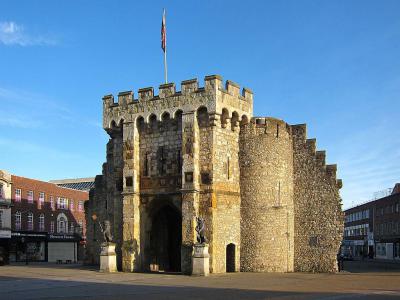
Bargate is an impressive medieval gatehouse that was built around 1180. Located in the center of High Street, Bargate was the traditional entrance and main gateway to Southampton. Bargate is praised as the finest and most complex gateway in England.
Bargate was built with flint and stone. In 1280, builders added imposing drum towers on the north side. Then, in the early 1400s, the north front was added.
At some point during the 1400s, Southampton began using Bargate as a prison. Then, during the 16th century, Southampton's court leet started meeting in the Bargate.
The Bargate was used as Southhampton's guildhall and market for centuries. Visitors can still see the vaults where merchants stored wine.
The fabled lion sculptures were added during the 16th century. The lions are thought to symbolize the legend of Sir Bevois, who founded Southhampton. Sir Bevios is the subject of many heroic legends, including a legend that tells of Sir Bevois slaying two lions to protect a princess. The lions were restored in 2020.
Visitors will find 11 heraldic shields on the Bargate's north side. Unfortunately, the original shields decayed with time, and many attempts have been made to restore them.
In 1899, 1914, and 1923, council members debated demolishing Bargate to accommodate increasing road traffic. Instead, the town council decided to separate Bargate from the town walls.
During WWII, Bargate was used as an air-raid shelter.
Bargate was built with flint and stone. In 1280, builders added imposing drum towers on the north side. Then, in the early 1400s, the north front was added.
At some point during the 1400s, Southampton began using Bargate as a prison. Then, during the 16th century, Southampton's court leet started meeting in the Bargate.
The Bargate was used as Southhampton's guildhall and market for centuries. Visitors can still see the vaults where merchants stored wine.
The fabled lion sculptures were added during the 16th century. The lions are thought to symbolize the legend of Sir Bevois, who founded Southhampton. Sir Bevios is the subject of many heroic legends, including a legend that tells of Sir Bevois slaying two lions to protect a princess. The lions were restored in 2020.
Visitors will find 11 heraldic shields on the Bargate's north side. Unfortunately, the original shields decayed with time, and many attempts have been made to restore them.
In 1899, 1914, and 1923, council members debated demolishing Bargate to accommodate increasing road traffic. Instead, the town council decided to separate Bargate from the town walls.
During WWII, Bargate was used as an air-raid shelter.
7) Southampton Town Wall (must see)
Southampton has had some defensive structures since occupied by the Romans. French forces attacked Southampton in 1338. However, the defenses were not adequate.
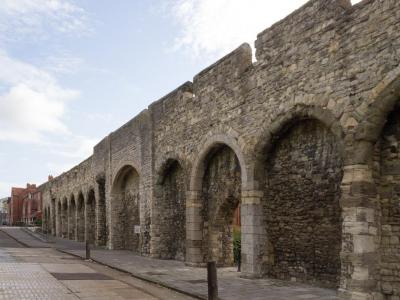
Work on the new wall began in the 1360s. Eventually, the wall was 1.25 miles long and wholly enclosed Southampton. The impressive wall housed 29 towers and eight gates. The towers were built to house cannons, which was a new technology in the 1300s.
The walls were used for defense throughout the 15th century. By the 18th century, the walls and gatehouses fell into disrepair. More recently, efforts have been made to preserve these historic walls.
Today, about half of the length of the original walls is still visible. Only 13 of the original 29 towers and six of the original gates still stand. God's House Tower still stands and is one of the first urban buildings to be purpose-built to hold gunpowder weapons. God's House Tower is three stories high and is next to God's House Gate.
Arundel tower still stands and is a popular attraction. The west walls are home to a unique feature called The Arcades. They are a series of arches built in the 14th century to reinforce the original 12th and 13th-century walls.
Work on the new wall began in the 1360s. Eventually, the wall was 1.25 miles long and wholly enclosed Southampton. The impressive wall housed 29 towers and eight gates. The towers were built to house cannons, which was a new technology in the 1300s.
The walls were used for defense throughout the 15th century. By the 18th century, the walls and gatehouses fell into disrepair. More recently, efforts have been made to preserve these historic walls.
Today, about half of the length of the original walls is still visible. Only 13 of the original 29 towers and six of the original gates still stand. God's House Tower still stands and is one of the first urban buildings to be purpose-built to hold gunpowder weapons. God's House Tower is three stories high and is next to God's House Gate.
Arundel tower still stands and is a popular attraction. The west walls are home to a unique feature called The Arcades. They are a series of arches built in the 14th century to reinforce the original 12th and 13th-century walls.
8) Arundel Tower
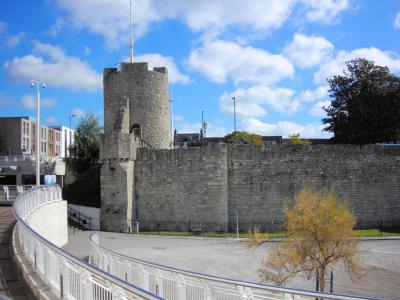
This 60-foot-tall half drum tower was initially constructed in the 13th century. It was first known as Corner Tower and offered defensive forces a commanding view out to sea. It was re-named Arundel Tower after Sir John Arundel, governor of Southampton Castle in the 1300s.
During the 16th century, shoemakers, curriers, saddlers, and cobblers were charged with the tower's defense, and the tower became known as the Shoemaker's Tower.
Before the 20th century, its location near the sea has caused saltwater damage, and the tower has needed constant repair over the centuries. In fact, early illustrations show seawater lapping at the tower's foundations. Its exposed location near sea winds earned the tower the nickname "Windwhistle".
In the 20th century, a land reclamation program increased the size of the docks, and the sea is now further away.
Visitors can climb the Arundel Tower and enjoy views of the town wall.
During the 16th century, shoemakers, curriers, saddlers, and cobblers were charged with the tower's defense, and the tower became known as the Shoemaker's Tower.
Before the 20th century, its location near the sea has caused saltwater damage, and the tower has needed constant repair over the centuries. In fact, early illustrations show seawater lapping at the tower's foundations. Its exposed location near sea winds earned the tower the nickname "Windwhistle".
In the 20th century, a land reclamation program increased the size of the docks, and the sea is now further away.
Visitors can climb the Arundel Tower and enjoy views of the town wall.
9) Tudor House Museum & Garden (must see)
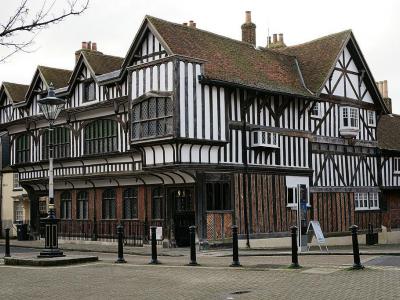
Tudor House shows visitors what life in Southampton was like during Tudor times. Tudor House is one of Southampton's most important buildings and brings 800 years of history to life.
Instead of simply viewing objects in glass cases, the museum immerses visitors in history with beautiful presentations and interactive displays.
Visitors will start with an interactive presentation. Spirits from the past tell you about Tudor House and give you glimpses into its history.
The museum has many displays of artifacts from ancient history to the present. Visitors can admire a medieval jewel casket, Victorian stuffed birds, a pair of shoes from the 1920s. One of the more intriguing displays hosts glass panes painted with bird depictions.
The Book of Hours is one of the museum's most precious items. This very small book is very fragile and dates to around 1480. The Book of Hours is a hand-illustrated prayer book written in Flemish with Latin flourishes.
The sedan chair was a popular way for wealthy people to travel around town. A mid-18th-century sedan chair for hire is on display.
The penny-farthing bicycle is another popular item. This bicycle features one very large wheel and one very small wheel and was popular in the late 19th century.
Kids and adults alike will be amazed by the Tudor dollhouses, complete with opening doors and windows and small figures. Various displays recreate daily life in Tudor times. Visitors can see a historic kitchen and learn about food prep.
The gardens are beautiful and include ancient canons. The gardens have been planned to represent a garden from the 1500s and include formal pathways and low-cut hedges. On the way out of the museum and gardens, you can visit the small attic.
Why You Should Visit:
Tudor House dates back to 1348 when a wealthy merchant owned it. Different families have owned the house throughout the centuries, and today's visitors can enjoy a complete immersion into Southampton's history.
Tips:
The Tudor House Cafe serves fabulous cream teas and gives visitors a gorgeous view of the gardens.
Instead of simply viewing objects in glass cases, the museum immerses visitors in history with beautiful presentations and interactive displays.
Visitors will start with an interactive presentation. Spirits from the past tell you about Tudor House and give you glimpses into its history.
The museum has many displays of artifacts from ancient history to the present. Visitors can admire a medieval jewel casket, Victorian stuffed birds, a pair of shoes from the 1920s. One of the more intriguing displays hosts glass panes painted with bird depictions.
The Book of Hours is one of the museum's most precious items. This very small book is very fragile and dates to around 1480. The Book of Hours is a hand-illustrated prayer book written in Flemish with Latin flourishes.
The sedan chair was a popular way for wealthy people to travel around town. A mid-18th-century sedan chair for hire is on display.
The penny-farthing bicycle is another popular item. This bicycle features one very large wheel and one very small wheel and was popular in the late 19th century.
Kids and adults alike will be amazed by the Tudor dollhouses, complete with opening doors and windows and small figures. Various displays recreate daily life in Tudor times. Visitors can see a historic kitchen and learn about food prep.
The gardens are beautiful and include ancient canons. The gardens have been planned to represent a garden from the 1500s and include formal pathways and low-cut hedges. On the way out of the museum and gardens, you can visit the small attic.
Why You Should Visit:
Tudor House dates back to 1348 when a wealthy merchant owned it. Different families have owned the house throughout the centuries, and today's visitors can enjoy a complete immersion into Southampton's history.
Tips:
The Tudor House Cafe serves fabulous cream teas and gives visitors a gorgeous view of the gardens.
10) Duke of Wellington Pub
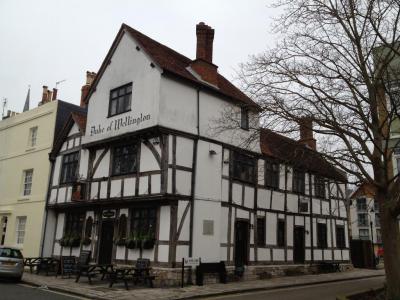
The Duke of Wellington is a classic British pub. It serves real English ales in a historic building that seeps ambiance and authenticity.
The building is located on Bugle Street, one of the oldest and most historically relevant parts of town. The building was built in 1220 on top of Normal cellars and vaults. The first resident was Benedict Ace, one of the town's first mayors.
It wasn't until 1494 that the building became a public house. It was bought by Holland-born brewer Rowland Johnson, who called it Brew House. Then, of course, he started brewing his own ales and thusly began the city's first brewery.
In the 1600s, the pilgrims would have passed this pub on their way to board the Mayflower.
The pub has changed names several times over the years. It was first the Brew House, and then it became the Shipwrights Arms in honor of the many shipbuilders who patronized it. Finally, in 1815 it was named for the Duke of Wellington in honor of his victory in the Battle of Waterloo.
The Duke of Wellington is still a pub today. They have function rooms for rent and serve locally-made ales. It's an excellent place for some pub-grub, too. The burgers are well-regarded.
The building is located on Bugle Street, one of the oldest and most historically relevant parts of town. The building was built in 1220 on top of Normal cellars and vaults. The first resident was Benedict Ace, one of the town's first mayors.
It wasn't until 1494 that the building became a public house. It was bought by Holland-born brewer Rowland Johnson, who called it Brew House. Then, of course, he started brewing his own ales and thusly began the city's first brewery.
In the 1600s, the pilgrims would have passed this pub on their way to board the Mayflower.
The pub has changed names several times over the years. It was first the Brew House, and then it became the Shipwrights Arms in honor of the many shipbuilders who patronized it. Finally, in 1815 it was named for the Duke of Wellington in honor of his victory in the Battle of Waterloo.
The Duke of Wellington is still a pub today. They have function rooms for rent and serve locally-made ales. It's an excellent place for some pub-grub, too. The burgers are well-regarded.
11) Bugle Street
Bugle Street's name comes from the Latin word "Buculus," or young bull. It is sometimes called Bull Street, but it also refers to the bugle-horn, made initially from young bulls' horns.
The street runs from Saint Michaels Square to the Town Quay. Upper Bugle Street was historically made up of Fish Street and Pepper Alley, connecting north from Saint Michaels Square to Simnel Street.
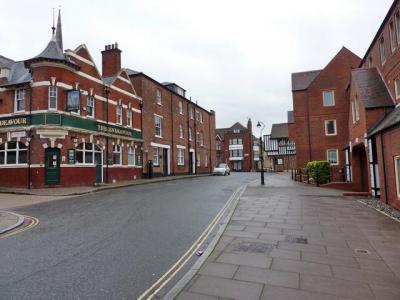
The street was one of the original laid out within the city's stone medieval walls. Today it is still lined with many historic and beautiful buildings.
Notable sights along the road include the Royal Southern Yacht Club on the south end. The building stands on the corner of Bugle and the pier. It was opened in 1846 and designed by architect Thomas Sandon Hack. The magnificent building centers around a state and ballroom. There was even an 11-gun battery for signaling the starts of races or for celebrating birthdays.
Other attractions along Bugle Street include the must-see Tudor House and the Duke of Wellington Pub.
Most of the other homes and businesses along the route were built between the 16th and 18th centuries. It has been said that Bugle Street is the best historic street in Southampton.
The street runs from Saint Michaels Square to the Town Quay. Upper Bugle Street was historically made up of Fish Street and Pepper Alley, connecting north from Saint Michaels Square to Simnel Street.
The street was one of the original laid out within the city's stone medieval walls. Today it is still lined with many historic and beautiful buildings.
Notable sights along the road include the Royal Southern Yacht Club on the south end. The building stands on the corner of Bugle and the pier. It was opened in 1846 and designed by architect Thomas Sandon Hack. The magnificent building centers around a state and ballroom. There was even an 11-gun battery for signaling the starts of races or for celebrating birthdays.
Other attractions along Bugle Street include the must-see Tudor House and the Duke of Wellington Pub.
Most of the other homes and businesses along the route were built between the 16th and 18th centuries. It has been said that Bugle Street is the best historic street in Southampton.
12) Pilgrims Fathers Memorial
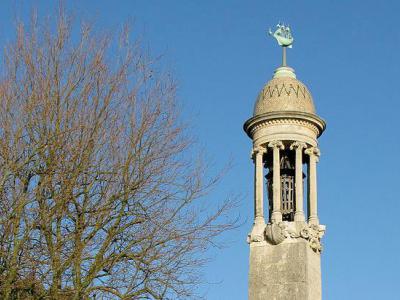
The Pilgrim Fathers Memorial in Southampton commemorates a pivotal moment in the journey of the Pilgrims who sought religious freedom. Built in 1913, this monument marks the departure of the "Mayflower" and "Speedwell" ships from Southampton Quay in 1620, carrying the Pilgrim Fathers to America. Fleeing persecution under the reign of King James I, the Pilgrims were driven by their desire to practice their Puritan faith freely.
The memorial, located on the north bank of The Haven, near the former site of Scotia Creek in Fishtoft, Lincolnshire, also recognizes earlier efforts by the Scrooby Congregation. These English Separatist Protestants first attempted to flee England in 1607, chartering a Dutch vessel to transport them to the Netherlands. However, their plan was thwarted when the captain betrayed them, leading to their arrest and imprisonment. A year later, they succeeded in their escape, first arriving in Amsterdam before settling in Leiden in 1609. By 1620, the congregation set sail for the New World, departing from Southampton and Plymouth.
Erected by the former Boston Borough Council in 1957 on the 350th anniversary of the Scrooby Congregation's journey, the memorial is a small granite obelisk mounted on a granite block. Designed to symbolize the determination and faith of the Pilgrims, the monument was crafted by Leake's Masonry and attended by members of the General Society of Mayflower Descendants. The tapering shaft represents the steadfastness and resilience of the men and women who left their homeland in pursuit of religious liberty.
The memorial, located on the north bank of The Haven, near the former site of Scotia Creek in Fishtoft, Lincolnshire, also recognizes earlier efforts by the Scrooby Congregation. These English Separatist Protestants first attempted to flee England in 1607, chartering a Dutch vessel to transport them to the Netherlands. However, their plan was thwarted when the captain betrayed them, leading to their arrest and imprisonment. A year later, they succeeded in their escape, first arriving in Amsterdam before settling in Leiden in 1609. By 1620, the congregation set sail for the New World, departing from Southampton and Plymouth.
Erected by the former Boston Borough Council in 1957 on the 350th anniversary of the Scrooby Congregation's journey, the memorial is a small granite obelisk mounted on a granite block. Designed to symbolize the determination and faith of the Pilgrims, the monument was crafted by Leake's Masonry and attended by members of the General Society of Mayflower Descendants. The tapering shaft represents the steadfastness and resilience of the men and women who left their homeland in pursuit of religious liberty.
