Custom Walk in Bergen, Norway by hannahrebeccakennedy_c42b82 created on 2026-04-02
Guide Location: Norway » Bergen
Guide Type: Custom Walk
# of Sights: 12
Tour Duration: 3 Hour(s)
Travel Distance: 6.3 Km or 3.9 Miles
Share Key: GGPQ9
Guide Type: Custom Walk
# of Sights: 12
Tour Duration: 3 Hour(s)
Travel Distance: 6.3 Km or 3.9 Miles
Share Key: GGPQ9
How It Works
Please retrieve this walk in the GPSmyCity app. Once done, the app will guide you from one tour stop to the next as if you had a personal tour guide. If you created the walk on this website or come to the page via a link, please follow the instructions below to retrieve the walk in the app.
Retrieve This Walk in App
Step 1. Download the app "GPSmyCity: Walks in 1K+ Cities" on Apple App Store or Google Play Store.



Step 2. In the GPSmyCity app, download(or launch) the guide "Bergen Map and Walking Tours".
Step 3. Tap the menu button located at upper right corner of the "Walks" screen and select "Retrieve custom walk". Enter the share key: GGPQ9
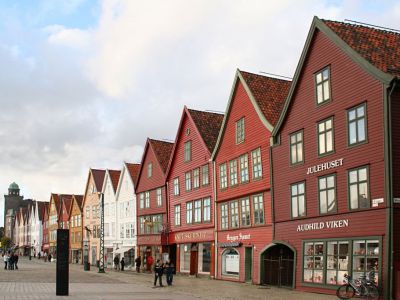
1) Bryggen (The Wharf) (must see)
The Bryggen area originally covered all buildings between the sea and the Ovregaten road. The earliest pier is dated to about 1100 AD. The city of Bergen itself dates from before 1070. The existing buildings of Bryggen date no earlier than 1702. This is not surprising in a city so well acquainted with disastrous fires.
The Hanseatic League established itself in Bergen in 1350. They traded mostly cereal grains for stockfish. The town grew into an important center for international trade, and the buildings of Bryggen near the waterfront were, piece by piece, brought under the control of the Hanseatic merchants. The stockfish and the grains had found a home.
From 1702 until 1754 the Hanseatic league buildings were on fire, rebuilt, on fire, demolished, and on fire again. Finally the Hanseatic businesses in Bergen ended and the property at Bryggen was transferred to Norwegian citizens.
Bryggen suffered a fire again in 1955. In an archeological dig that followed, 670 ancient runic inscriptions were discovered carved mostly on pine chips or sticks. For a long time runes were thought to be used only for grave pronouncements or prayers.
These runes however, were concerned with more mundane day-to-day business. Such as: "Ast min, kyss mik." "My darling, kiss me." It is not known if the wish was granted. The inscriptions are at present held in Bryggens Museum in Bergen.
Hiding behind the classic Bryggen facades is a little world of alleyways, shops, galleries and studios. Local artists and designers have taken over the storage spaces for stockfish and grain. The rooms hold art, designs, jewelry, books and, wait for it, a cafe. Artists and designers are hiding in the narrow passeges among the houses.
The local artists want people to think of Bryggen not as some kind of museum where nothing happens, but a living thriving space for art.
Buildings at Bryggen that should be mentioned are Bellgarden (300 years old), Svensgarden, Ehnjorningsgarden, Bredsgarden, Bugarden, and Engelgarden. The tallest and oldest structure is Saint Mary's Church. Museums are Bryggen's Museum and Hanseatic Museum and Hanseatic Assembly Rooms.
Why You Should Visit:
To get a feeling of the Hanseatic influence on the city.
The Hanseatic League established itself in Bergen in 1350. They traded mostly cereal grains for stockfish. The town grew into an important center for international trade, and the buildings of Bryggen near the waterfront were, piece by piece, brought under the control of the Hanseatic merchants. The stockfish and the grains had found a home.
From 1702 until 1754 the Hanseatic league buildings were on fire, rebuilt, on fire, demolished, and on fire again. Finally the Hanseatic businesses in Bergen ended and the property at Bryggen was transferred to Norwegian citizens.
Bryggen suffered a fire again in 1955. In an archeological dig that followed, 670 ancient runic inscriptions were discovered carved mostly on pine chips or sticks. For a long time runes were thought to be used only for grave pronouncements or prayers.
These runes however, were concerned with more mundane day-to-day business. Such as: "Ast min, kyss mik." "My darling, kiss me." It is not known if the wish was granted. The inscriptions are at present held in Bryggens Museum in Bergen.
Hiding behind the classic Bryggen facades is a little world of alleyways, shops, galleries and studios. Local artists and designers have taken over the storage spaces for stockfish and grain. The rooms hold art, designs, jewelry, books and, wait for it, a cafe. Artists and designers are hiding in the narrow passeges among the houses.
The local artists want people to think of Bryggen not as some kind of museum where nothing happens, but a living thriving space for art.
Buildings at Bryggen that should be mentioned are Bellgarden (300 years old), Svensgarden, Ehnjorningsgarden, Bredsgarden, Bugarden, and Engelgarden. The tallest and oldest structure is Saint Mary's Church. Museums are Bryggen's Museum and Hanseatic Museum and Hanseatic Assembly Rooms.
Why You Should Visit:
To get a feeling of the Hanseatic influence on the city.
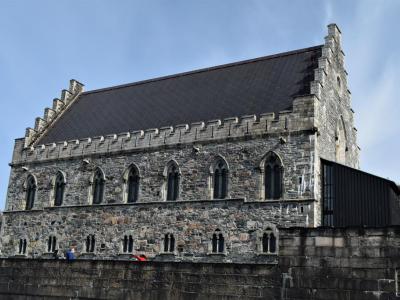
2) Haakon's Hall
Haakon's Hall, located within the Bergenhus Fortress in Bergen, is a medieval stone hall built in the mid-13th century during the reign of King Håkon Håkonsson (1217-1263). As the largest secular medieval building in Norway, it stands as a significant monument of Gothic architecture. Constructed to replace earlier wooden structures, the hall showcases the influence of English design, likely due to the friendly relations between King Håkon and King Henry III of England, and possibly designed by English architects.
The hall, built between 1247 and 1261, served as a royal residence and feasting hall. It played a central role in major national events, such as the marriage of King Håkon's son, Magnus Håkonsson Lagabøte, to the Danish princess Ingeborg in 1261, an event which hosted 2000 guests across three buildings. During medieval times, Bergen was the largest and most important city in Norway, and Haakon's Hall was the venue for significant state affairs, including the proclamation of Norway's first complete set of laws.
Haakon's Hall comprises three floors: a large festive room on the top floor, a middle floor originally used for administration and the King's council, and a cellar likely used for storage. Despite its initial prominence, the hall's role diminished after the royal family left Norway in the late Middle Ages. It then served various utilitarian purposes, including as a storeroom and an ammunition depot, and even lost its roof at one point.
In 1916, Haakon's Hall underwent its first restoration and interior decoration. However, in 1944, it was heavily damaged by an explosion from the Dutch ammunition ship Voorbode in Bergen harbor. The hall was left with only its walls standing and underwent significant restoration in the 1950s to achieve its current form.
Today, Haakon's Hall is a cultural heritage site and museum. It continues to be used for royal dinners, official occasions, and concerts, preserving its historical significance and continuing its legacy as a centerpiece of Norwegian medieval architecture and history.
The hall, built between 1247 and 1261, served as a royal residence and feasting hall. It played a central role in major national events, such as the marriage of King Håkon's son, Magnus Håkonsson Lagabøte, to the Danish princess Ingeborg in 1261, an event which hosted 2000 guests across three buildings. During medieval times, Bergen was the largest and most important city in Norway, and Haakon's Hall was the venue for significant state affairs, including the proclamation of Norway's first complete set of laws.
Haakon's Hall comprises three floors: a large festive room on the top floor, a middle floor originally used for administration and the King's council, and a cellar likely used for storage. Despite its initial prominence, the hall's role diminished after the royal family left Norway in the late Middle Ages. It then served various utilitarian purposes, including as a storeroom and an ammunition depot, and even lost its roof at one point.
In 1916, Haakon's Hall underwent its first restoration and interior decoration. However, in 1944, it was heavily damaged by an explosion from the Dutch ammunition ship Voorbode in Bergen harbor. The hall was left with only its walls standing and underwent significant restoration in the 1950s to achieve its current form.
Today, Haakon's Hall is a cultural heritage site and museum. It continues to be used for royal dinners, official occasions, and concerts, preserving its historical significance and continuing its legacy as a centerpiece of Norwegian medieval architecture and history.
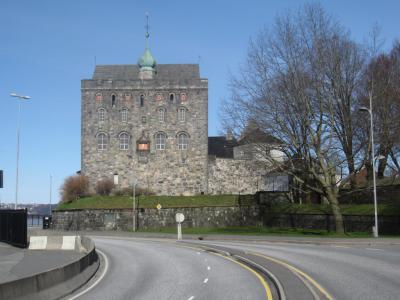
3) Bergenhus Fortress and Rosenkrantz Tower (must see)
The tower and the Fortress must be thought of as one establishment. The Fortress has been a royal seat and residence, episcopal see and a military power base. The grounds within the walls of the island fortress are Holmen, Koengen and Sverresborg. The Fortress was built in the early 1500s. It was considered complete in 1700.
The Fortress was under siege only once during the second Dutch-English War. In August, 1665, a squadron of Dutch vessels took shelter in neutral Bergen Harbor. The neutrality was not respected. The English warships fired on the Dutch ships and the Fortress. Fire was returned. The battle was a short one. It came to be known as The Battle of Vagen.
The English were attacking vessels of the Dutch East India Company. The attack failed. No ships were sunk. In the Second World War Bergenhus was once again in service. This time however it was a German occupying force that used the fort as their western headquarters.
Begenhus has been a military facility without interruption since 1628. Presently 220 military and civilian personnel are stationed at the fort.
The Rosenkrantz Tower is the dominant building of the fort complex. It was named for governor Erik Rosenkrantz. The tower got its present form during Rosenkrantz's reign, 1559-1568. There is a yet older part of the tower. It is a medieval tower called the "keep by the Sea." It was built by King Magnus the Lawmaker in 1270.
Rosenkrantz's building held dungeons on the first floor and cannons on the roof. With residential rooms in between it must have been insufferably loud in a battle. Not a good place for meditation.
The other medieval structure to remain is Haakon's Hall, built about 1270. It was incorporated in Rosenkrantz's Tower. Several Churches, including Bergen's Christ Church were included in the premises. The churches were demolished by 1531 and the isle of Holmen became strictly military.
The Fortress was under siege only once during the second Dutch-English War. In August, 1665, a squadron of Dutch vessels took shelter in neutral Bergen Harbor. The neutrality was not respected. The English warships fired on the Dutch ships and the Fortress. Fire was returned. The battle was a short one. It came to be known as The Battle of Vagen.
The English were attacking vessels of the Dutch East India Company. The attack failed. No ships were sunk. In the Second World War Bergenhus was once again in service. This time however it was a German occupying force that used the fort as their western headquarters.
Begenhus has been a military facility without interruption since 1628. Presently 220 military and civilian personnel are stationed at the fort.
The Rosenkrantz Tower is the dominant building of the fort complex. It was named for governor Erik Rosenkrantz. The tower got its present form during Rosenkrantz's reign, 1559-1568. There is a yet older part of the tower. It is a medieval tower called the "keep by the Sea." It was built by King Magnus the Lawmaker in 1270.
Rosenkrantz's building held dungeons on the first floor and cannons on the roof. With residential rooms in between it must have been insufferably loud in a battle. Not a good place for meditation.
The other medieval structure to remain is Haakon's Hall, built about 1270. It was incorporated in Rosenkrantz's Tower. Several Churches, including Bergen's Christ Church were included in the premises. The churches were demolished by 1531 and the isle of Holmen became strictly military.
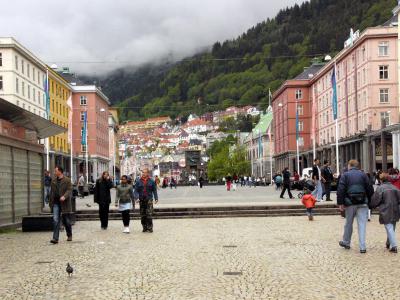
4) Torgallmenningen Square
The old days are not missed so much in Bergen, Norway. The city had a lot of wooden buildings, close together and narrow streets. Fires would break out with alarming regularity. Flames easily roared from one house to another, leaping across streets and engaging whole neighborhoods.
Something had to be done. The answer was "allmenninger", or rebuild vulnerable districts. Widen the streets and create squares between districts to stop the spread of fires. Torgallmenningen is Norway's "best designed town square."
It is near impossible to move around Bergen and not cross Torgallmenningen once or twice. Shops and malls line the square. Roofs of glass before the store facades protect shoppers from the all too frequent rains.
The Maritime Monument, with statues of Norwegian sea rovers, is at one end of the Square. These hardy sailors get no protection from the rain, but they don't mind. After all, it's only water.
"We'll meet at the blue Stone" is an expression often heard in Bergen, The Blue Stone is just that; a large blue stone that casts a spell. It is located at the intersection Of Torgallmenningen and Ole Busll Plass. It's a great place to meet.
Something had to be done. The answer was "allmenninger", or rebuild vulnerable districts. Widen the streets and create squares between districts to stop the spread of fires. Torgallmenningen is Norway's "best designed town square."
It is near impossible to move around Bergen and not cross Torgallmenningen once or twice. Shops and malls line the square. Roofs of glass before the store facades protect shoppers from the all too frequent rains.
The Maritime Monument, with statues of Norwegian sea rovers, is at one end of the Square. These hardy sailors get no protection from the rain, but they don't mind. After all, it's only water.
"We'll meet at the blue Stone" is an expression often heard in Bergen, The Blue Stone is just that; a large blue stone that casts a spell. It is located at the intersection Of Torgallmenningen and Ole Busll Plass. It's a great place to meet.
5) Vågen
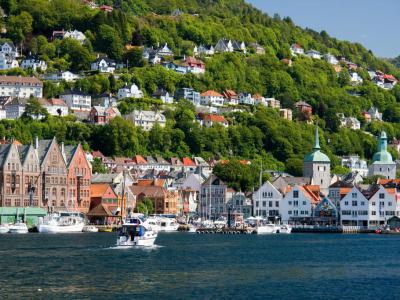
Vågen is a central bay located in the heart of Bergen. The name "Vågen" translates to "the bay" or "voe" in Norwegian. As the principal harbor of the city center, Vågen is not just a bustling maritime hub but also forms the historical core of Bergen.
The city's origins trace back to the eastern shore of Vågen. Over the centuries, Bergen expanded from this initial point, spreading out to the southern and western shores of the bay. Today, Bergen stands as the second-largest city in Norway, with Vågen remaining a pivotal element in its urban landscape.
The bay stretches approximately 1,200 meters (3,900 feet) and is a branch of the larger Byfjorden. Strategically positioned, the Nordnes peninsula flanks the southern side of the bay, while the historic Bergenhus Fortress dominates the northern shore. Adding to the historical significance of the northern shore is the Bryggen area, a UNESCO World Heritage Site. Bryggen is renowned for its ancient buildings, some of which have been standing since the 11th century, offering a glimpse into the medieval past of the city.
Vågen is not only crucial for its maritime activities but also as a keeper of Bergen’s rich historical and cultural heritage. This bay continues to be a central figure in the city's life, drawing locals and tourists alike to its scenic and historic shores.
The city's origins trace back to the eastern shore of Vågen. Over the centuries, Bergen expanded from this initial point, spreading out to the southern and western shores of the bay. Today, Bergen stands as the second-largest city in Norway, with Vågen remaining a pivotal element in its urban landscape.
The bay stretches approximately 1,200 meters (3,900 feet) and is a branch of the larger Byfjorden. Strategically positioned, the Nordnes peninsula flanks the southern side of the bay, while the historic Bergenhus Fortress dominates the northern shore. Adding to the historical significance of the northern shore is the Bryggen area, a UNESCO World Heritage Site. Bryggen is renowned for its ancient buildings, some of which have been standing since the 11th century, offering a glimpse into the medieval past of the city.
Vågen is not only crucial for its maritime activities but also as a keeper of Bergen’s rich historical and cultural heritage. This bay continues to be a central figure in the city's life, drawing locals and tourists alike to its scenic and historic shores.
6) Fredriksberg Fortress
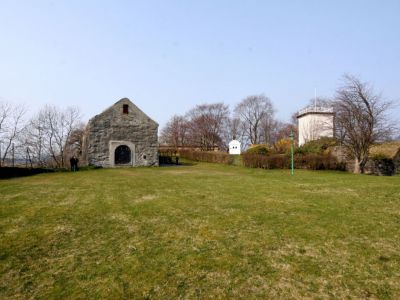
Fredriksberg Fortress is a historic military fortification located in Bergen, specifically atop the highest point of the Nordnes peninsula. This fortress holds strategic importance due to its commanding position with a sheer cliff facing the sea on the west, providing extensive views and defensive advantages. The fortress construction began in 1666 under the direction of Dutch Engineer Major General Henrik Ruse and was primarily constructed because of the insights gained after the Battle of Vågen. It was completed in its initial form in 1667 and named in honor of King Fredrik III of Norway.
The fortress featured a design that included three bastions and a half bastion on the landward side, while a sturdy wall bordered the sea-facing cliff side. However, the construction faced delays and deterioration until a significant inspection by Christian Gyldenløve, son of Christian V of Denmark, in 1695 revitalized the efforts, leading to its completion by 1706 in a simplified format.
Over the centuries, Fredriksberg Fortress served various functions including a place of execution until 1876, with the last executed being Swedish counterfeiter Jacob Wallin. Additionally, parts of the fortress, such as the Lavette houses built in 1810 and 1843, originally used for military storage, were repurposed as temporary housing after the devastating city fire in 1916.
The Nordnes Park, developed between 1888 and 1898, incorporates areas of the former fortifications, contributing to the cultural and recreational landscape of the area. The fortress also played a role in the city’s firefighting efforts, serving as a fire watch station starting in 1667 and later as a fire station from 1905 until 1926.
Today, Fredriksberg Fortress is partially leased to the Nordnæs Bataillon, a social club/buekorps, indicating its continued use and significance within the community. This historic site remains a testament to the military and civic history of Bergen, reflecting centuries of adaptation and change.
The fortress featured a design that included three bastions and a half bastion on the landward side, while a sturdy wall bordered the sea-facing cliff side. However, the construction faced delays and deterioration until a significant inspection by Christian Gyldenløve, son of Christian V of Denmark, in 1695 revitalized the efforts, leading to its completion by 1706 in a simplified format.
Over the centuries, Fredriksberg Fortress served various functions including a place of execution until 1876, with the last executed being Swedish counterfeiter Jacob Wallin. Additionally, parts of the fortress, such as the Lavette houses built in 1810 and 1843, originally used for military storage, were repurposed as temporary housing after the devastating city fire in 1916.
The Nordnes Park, developed between 1888 and 1898, incorporates areas of the former fortifications, contributing to the cultural and recreational landscape of the area. The fortress also played a role in the city’s firefighting efforts, serving as a fire watch station starting in 1667 and later as a fire station from 1905 until 1926.
Today, Fredriksberg Fortress is partially leased to the Nordnæs Bataillon, a social club/buekorps, indicating its continued use and significance within the community. This historic site remains a testament to the military and civic history of Bergen, reflecting centuries of adaptation and change.
7) Saint John's Church
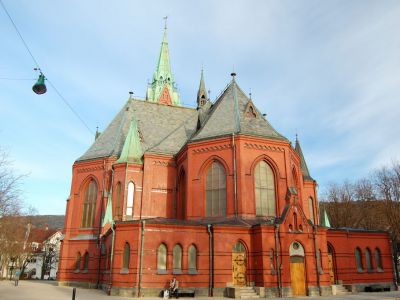
Saint John's Church, located in the Sydney area of Bergen, serves as a significant parish church within the Church of Norway. Established following the creation of the Saint John's parish on January 1, 1885, from the expansive Bergen Cathedral parish, this church is a prime example of Gothic Revival architecture, a style it embodies through its cruciform design and red brick construction.
The journey to build Saint John’s Church began with an architectural contest in 1888, which was won by Herman Major Backer (1856–1932). His designs led to the laying of the cornerstone on November 27, 1891. Initially managed by architect Adolf Fischer and later by Hans Heinrich Jess, the construction was completed, and the church was consecrated on March 15, 1894. This marked the beginning of its service to the Saint John's parish until 2002 when it became part of the merged Bergen Cathedral parish.
Saint John's Church is the largest in Bergen, seating approximately 1250 people. Its distinct features include the highest church tower in the city at 61 meters, equipped with four stair towers and a carillon, designed by Verein Bochum. The interior of the church is decorated with frescoes on its ceiling, painted in 1924 by Hugo Lous Mohr, enhancing its spiritual and artistic ambiance.
The church's musical heritage is highlighted by its organ, originally built by Schlag & Söhne of Württemberg, Germany, and later modernized in 1967 by Josef Hilmar Jørgensen. The altarpiece, created by Marcus Grønvold in 1894, portrays Christ in prayer, contributing to the church’s rich visual and spiritual experience.
Today, Saint John's Church continues to be an integral part of the Bergen Cathedral parish, which includes four other main churches, playing a pivotal role in the religious life of central Bergen.
The journey to build Saint John’s Church began with an architectural contest in 1888, which was won by Herman Major Backer (1856–1932). His designs led to the laying of the cornerstone on November 27, 1891. Initially managed by architect Adolf Fischer and later by Hans Heinrich Jess, the construction was completed, and the church was consecrated on March 15, 1894. This marked the beginning of its service to the Saint John's parish until 2002 when it became part of the merged Bergen Cathedral parish.
Saint John's Church is the largest in Bergen, seating approximately 1250 people. Its distinct features include the highest church tower in the city at 61 meters, equipped with four stair towers and a carillon, designed by Verein Bochum. The interior of the church is decorated with frescoes on its ceiling, painted in 1924 by Hugo Lous Mohr, enhancing its spiritual and artistic ambiance.
The church's musical heritage is highlighted by its organ, originally built by Schlag & Söhne of Württemberg, Germany, and later modernized in 1967 by Josef Hilmar Jørgensen. The altarpiece, created by Marcus Grønvold in 1894, portrays Christ in prayer, contributing to the church’s rich visual and spiritual experience.
Today, Saint John's Church continues to be an integral part of the Bergen Cathedral parish, which includes four other main churches, playing a pivotal role in the religious life of central Bergen.
8) Det Akademiske Kvarter (Academic Quarter)
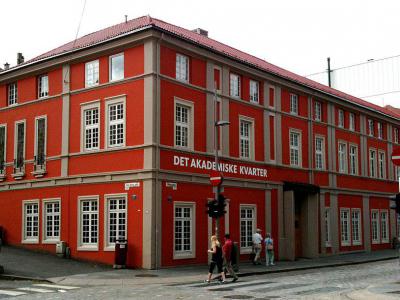
The Academic Quarter (Det Akademiske Kvarter), commonly known as Quarter (Kvarteret), is a vibrant student cultural center located in the heart of Bergen. Situated on Olav Kyrres gate, it is conveniently close to the main shopping areas and the University of Bergen, fostering a strong connection with the city's academic institutions.
The Quarter is a hub of student-led cultural activities, hosting around 2,200 events annually. These events encompass a wide range of cultural expressions from debates and lectures to concerts, drawing participants and audiences from the University of Bergen, the Norwegian School of Economics, and Bergen University College. The center, sprawling across three floors, can accommodate up to 1,500 visitors and features multiple bars, a cinema, a nightclub, a small café, an auditorium, and a concert hall.
The building itself combines historical charm with modern amenities. While the exterior retains its old character, the interior, following extensive renovations between 2007 and 2010, offers contemporary facilities. The center was originally owned by the University but was handed over to the students in 1995, becoming the nucleus of student cultural life in Bergen.
What makes the Quarter particularly special is its operation by about 400 volunteer students who gain invaluable experience in various roles, including sound technicians, bartenders, photographers, and system administrators. Despite its role as a venue, the Quarter itself does not organize events; instead, it provides a space for numerous student organizations to conduct their cultural activities. This model not only enhances the vibrancy of the cultural offerings but also embeds a strong sense of community and ownership among the students.
The Quarter is a hub of student-led cultural activities, hosting around 2,200 events annually. These events encompass a wide range of cultural expressions from debates and lectures to concerts, drawing participants and audiences from the University of Bergen, the Norwegian School of Economics, and Bergen University College. The center, sprawling across three floors, can accommodate up to 1,500 visitors and features multiple bars, a cinema, a nightclub, a small café, an auditorium, and a concert hall.
The building itself combines historical charm with modern amenities. While the exterior retains its old character, the interior, following extensive renovations between 2007 and 2010, offers contemporary facilities. The center was originally owned by the University but was handed over to the students in 1995, becoming the nucleus of student cultural life in Bergen.
What makes the Quarter particularly special is its operation by about 400 volunteer students who gain invaluable experience in various roles, including sound technicians, bartenders, photographers, and system administrators. Despite its role as a venue, the Quarter itself does not organize events; instead, it provides a space for numerous student organizations to conduct their cultural activities. This model not only enhances the vibrancy of the cultural offerings but also embeds a strong sense of community and ownership among the students.
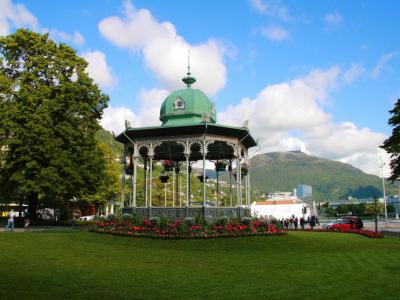
9) Byparken (City Park) (must see)
Byparken ("The City Park"), located in the very center of Bergen, is the city's first park. New municipal anti-fire regulations were put into effect in 1855. Following one more devastating fire, the city could not simply rebuild. A wide open space was needed to be a vast "fire break" in the middle of the city. Byparken was the answer.
The park is split in two. One side of the park has a light rail stop and the Music Pavilion, donated to the city. On the other side is the ever popular Festplassen ("party place"), an open-air venue for celebrations and events. Norwegian Constitution Day, on May 17, is observed here and The Festival of Light at Christmas.
Two large ponds are maintained in the park. They were once one pond but the middle part was filled in. The ponds remain connected however by an underground tunnel. Lungegardsvannet "Large lung" is the name for the larger pond. The smaller pond is Smalungeren "Small Lung." No surprise there.
The park is split in two. One side of the park has a light rail stop and the Music Pavilion, donated to the city. On the other side is the ever popular Festplassen ("party place"), an open-air venue for celebrations and events. Norwegian Constitution Day, on May 17, is observed here and The Festival of Light at Christmas.
Two large ponds are maintained in the park. They were once one pond but the middle part was filled in. The ponds remain connected however by an underground tunnel. Lungegardsvannet "Large lung" is the name for the larger pond. The smaller pond is Smalungeren "Small Lung." No surprise there.
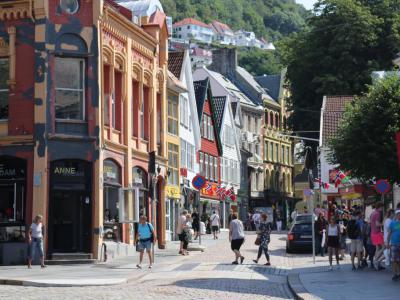
10) Kong Oscars Gate (King Oscars Street)
Named in honor of Oscar I, King of Norway and Sweden, in 1857. Prior to that date this street had a host of other names. It has been "shoemaker street", "tailor street", "hospital street", "Saint Jacobs street", "Potrgaden", and "Domkirkegaden."
The street is narrower than most others in Bergen. At the south-eastern end is the old city gate of Bergen. A number of significant buildings line the street. At No. 67 King Oscars Street is Zander Kaae's Foundation, built in the 18th century for a charity and now it rents rooms to students.
Saint Jorgen's Hospital was an 18th century leprosy hospital and now it is a leprosy museum. This is a sign that leprosy is down, an improvement, count your blessings. Next to the museum is Danekert Krohn's Foundation, another 18th century charity, this one for the elderly.
The street has its share of schools. There is Bergen katedralskole (cathedral school), one of three secondary schools on King Oscar Street. There are also Danielsen videregaende skole, and Tanks videregaende skole.
At the intersection of Lille Ovregate and Domkirkeplassen is Bergen Cathedral, a medieval church. Not far away is Holy Cross Church, also a medieval church.
A visit to King Oscars Street reveals a side of Bergen, hidden from ordinary sight. It is like a secret place, away from the chain shops and popular hang-outs. There are plenty shops and restaurants but they all have a personal style and charm that comes with the street.
The street is narrower than most others in Bergen. At the south-eastern end is the old city gate of Bergen. A number of significant buildings line the street. At No. 67 King Oscars Street is Zander Kaae's Foundation, built in the 18th century for a charity and now it rents rooms to students.
Saint Jorgen's Hospital was an 18th century leprosy hospital and now it is a leprosy museum. This is a sign that leprosy is down, an improvement, count your blessings. Next to the museum is Danekert Krohn's Foundation, another 18th century charity, this one for the elderly.
The street has its share of schools. There is Bergen katedralskole (cathedral school), one of three secondary schools on King Oscar Street. There are also Danielsen videregaende skole, and Tanks videregaende skole.
At the intersection of Lille Ovregate and Domkirkeplassen is Bergen Cathedral, a medieval church. Not far away is Holy Cross Church, also a medieval church.
A visit to King Oscars Street reveals a side of Bergen, hidden from ordinary sight. It is like a secret place, away from the chain shops and popular hang-outs. There are plenty shops and restaurants but they all have a personal style and charm that comes with the street.
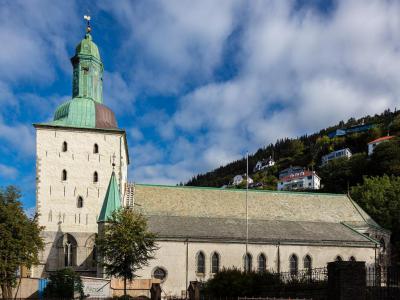
11) Bergen Cathedral
Since 12th century, Bergen Cathedral has been through the fire. Through the fire several times in fact, more than most, in a city famous for devastating fires. And to top it all off it has been hit by a cannon ball, which sticks in the wall to this day. Fires and wars, but there is peace and beauty inside.
Bergen Cathedral is episcopal seat of home parish of the Church of Norway. Word of the church appears for the first time in 1181. To this day it remains dedicated to Saint Olaf.
In 1181, Jon Kutiza, a peasant rebel and his men chased a number of King Sverre's men into the cathedral (then known as Olavskirken). Under the reign of King Haakon IV, Franciscans built a friary connecting to the church. The church had a long design in a Romanesque style. It burned down in 1248.
A new stone church was erected and that caught fire in 1270. The church wasn't fully reconstructed until 1537, when it was designated the new cathedral of the Protestant persuasion. In 1702 there was another fire and another reconstruction. By the 1880s the Cathedral's interior was restored to its original Rococo appearance.
In the second English-Dutch war, in the sea battle of Vagen in 1665, the cathedral sustained a hit from a cannon shot gone wild. The ball sits today, ensconced in the front wall.
The cathedral today is used mainly for musical events.
Bergen Cathedral is episcopal seat of home parish of the Church of Norway. Word of the church appears for the first time in 1181. To this day it remains dedicated to Saint Olaf.
In 1181, Jon Kutiza, a peasant rebel and his men chased a number of King Sverre's men into the cathedral (then known as Olavskirken). Under the reign of King Haakon IV, Franciscans built a friary connecting to the church. The church had a long design in a Romanesque style. It burned down in 1248.
A new stone church was erected and that caught fire in 1270. The church wasn't fully reconstructed until 1537, when it was designated the new cathedral of the Protestant persuasion. In 1702 there was another fire and another reconstruction. By the 1880s the Cathedral's interior was restored to its original Rococo appearance.
In the second English-Dutch war, in the sea battle of Vagen in 1665, the cathedral sustained a hit from a cannon shot gone wild. The ball sits today, ensconced in the front wall.
The cathedral today is used mainly for musical events.
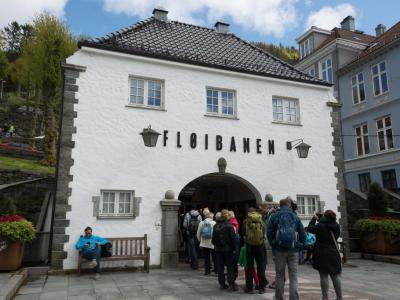
12) Floibanen Funicular (must see)
The 100-year old carriages of the Floibanen funicular will take one from Bergen center to the top of Mount Floyen. It's a six minute ride to a fabulous panoramic view over the city, mountains and fjord.
Norway is a land of hiking and climbing. A ride in the funicular allows a visit to a place of uncountable opportunities for walks and hikes. Arriving visitors on Mount Floyen discover miles of gravel roads and paths. The paths lead to stunning overlooks of the fjord, the mountains and the city spread out below.
A trail called Vidden will take a hiker from Mount Floyen to Mount Ulriken. This popular hike takes about five hours. Most people prefer to hike from Ulriken to Mount Floyen. This is a path for more serious hikers. Mount Floyen has both short and long hikes. The trails are accessible to wheelchairs, strollers, young, and old.
Hungry pioneers need not suffer on the trail. On arriving at Floyen a visitor finds the Floisten shop offering pastry, ice cream and hot and cold drinks to the fasting voyageur. A short walk to Floien Folkerestaurant can get one a fuller meal and a spectacular view of things below.
A ten minute walk from the station find Lake Skomakerdiket and the cafe Skomakerstuen. Sit by the water and have a drink with your Norwegian "Svele", a griddle cake with sour cream.
There is an obstacle course and a large playground for children. For the adventurous, take a stroll though the Mysterious Troll Forest. Rent a motorbike or a canoe, not everything must involve hiking.
Why You Should Visit:
For the excitement. And yes, the views.
Tips:
With the Bergen Card round trips are free. Ask about discounts.
Norway is a land of hiking and climbing. A ride in the funicular allows a visit to a place of uncountable opportunities for walks and hikes. Arriving visitors on Mount Floyen discover miles of gravel roads and paths. The paths lead to stunning overlooks of the fjord, the mountains and the city spread out below.
A trail called Vidden will take a hiker from Mount Floyen to Mount Ulriken. This popular hike takes about five hours. Most people prefer to hike from Ulriken to Mount Floyen. This is a path for more serious hikers. Mount Floyen has both short and long hikes. The trails are accessible to wheelchairs, strollers, young, and old.
Hungry pioneers need not suffer on the trail. On arriving at Floyen a visitor finds the Floisten shop offering pastry, ice cream and hot and cold drinks to the fasting voyageur. A short walk to Floien Folkerestaurant can get one a fuller meal and a spectacular view of things below.
A ten minute walk from the station find Lake Skomakerdiket and the cafe Skomakerstuen. Sit by the water and have a drink with your Norwegian "Svele", a griddle cake with sour cream.
There is an obstacle course and a large playground for children. For the adventurous, take a stroll though the Mysterious Troll Forest. Rent a motorbike or a canoe, not everything must involve hiking.
Why You Should Visit:
For the excitement. And yes, the views.
Tips:
With the Bergen Card round trips are free. Ask about discounts.
