Custom Walk in Naples, Italy by belindamcilwain_d5a275 created on 2026-04-13
Guide Location: Italy » Naples
Guide Type: Custom Walk
# of Sights: 15
Tour Duration: 3 Hour(s)
Travel Distance: 6.3 Km or 3.9 Miles
Share Key: W28PH
Guide Type: Custom Walk
# of Sights: 15
Tour Duration: 3 Hour(s)
Travel Distance: 6.3 Km or 3.9 Miles
Share Key: W28PH
How It Works
Please retrieve this walk in the GPSmyCity app. Once done, the app will guide you from one tour stop to the next as if you had a personal tour guide. If you created the walk on this website or come to the page via a link, please follow the instructions below to retrieve the walk in the app.
Retrieve This Walk in App
Step 1. Download the app "GPSmyCity: Walks in 1K+ Cities" on Apple App Store or Google Play Store.



Step 2. In the GPSmyCity app, download(or launch) the guide "Naples Map and Walking Tours".
Step 3. Tap the menu button located at upper right corner of the "Walks" screen and select "Retrieve custom walk". Enter the share key: W28PH
1) Castel Nuovo (New Castle) (must see)
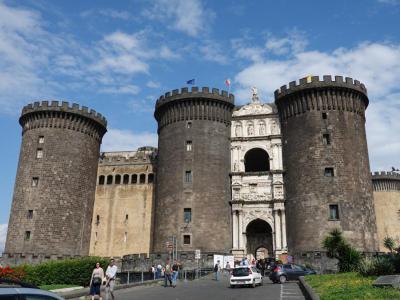
New Castle rises near the harbour as one of Naples’ most recognisable medieval landmarks. Its history begins in 1279, when Charles I of Anjou, King of Sicily, ordered the construction of a new royal fortress to serve as both a defensive stronghold and a symbol of power. At the time, Naples had recently become the capital of the Kingdom of Naples, and the castle’s location near the sea underlined its political and strategic importance.
Over the centuries, New Castle was repeatedly modified as control of the city passed from the Angevins to the Aragonese and later rulers. The most significant transformation occurred in the 15th century under Alfonso V of Aragon, who added the imposing cylindrical towers seen today and commissioned the white marble triumphal arch that marks the main entrance. This arch, celebrating Alfonso’s victorious entry into Naples in 1443, blends classical Roman imagery with Renaissance ideals and stands in deliberate contrast to the fortress’s dark volcanic stone.
Beyond its military role, New Castle also functioned as a royal residence and cultural centre. The castle hosted court ceremonies, diplomatic meetings, and intellectual gatherings. One of its most notable interior spaces is the Hall of the Barons, a vast hall once used for royal assemblies, whose ribbed vault combines Gothic tradition with early Renaissance experimentation. The imposing room can be reached via a long staircase on the northern wall of the inner courtyard. From the courtyard, the beige wall of the Hall of the Barons contrasts with the dark grey of the Palatine Chapel-the only surviving element of the 14th-century Angevin castle. The chapel can be recognised by its Renaissance portal and the rose window above it.
In addition, the castle houses interior museum spaces displaying sculptures, fresco fragments, and archaeological finds connected to Naples’ medieval and Renaissance history.
Despite later losing its status as a royal home, the castle remained central to Naples’ political life well into the modern era, serving as military and civic administrative offices until 1815.
Over the centuries, New Castle was repeatedly modified as control of the city passed from the Angevins to the Aragonese and later rulers. The most significant transformation occurred in the 15th century under Alfonso V of Aragon, who added the imposing cylindrical towers seen today and commissioned the white marble triumphal arch that marks the main entrance. This arch, celebrating Alfonso’s victorious entry into Naples in 1443, blends classical Roman imagery with Renaissance ideals and stands in deliberate contrast to the fortress’s dark volcanic stone.
Beyond its military role, New Castle also functioned as a royal residence and cultural centre. The castle hosted court ceremonies, diplomatic meetings, and intellectual gatherings. One of its most notable interior spaces is the Hall of the Barons, a vast hall once used for royal assemblies, whose ribbed vault combines Gothic tradition with early Renaissance experimentation. The imposing room can be reached via a long staircase on the northern wall of the inner courtyard. From the courtyard, the beige wall of the Hall of the Barons contrasts with the dark grey of the Palatine Chapel-the only surviving element of the 14th-century Angevin castle. The chapel can be recognised by its Renaissance portal and the rose window above it.
In addition, the castle houses interior museum spaces displaying sculptures, fresco fragments, and archaeological finds connected to Naples’ medieval and Renaissance history.
Despite later losing its status as a royal home, the castle remained central to Naples’ political life well into the modern era, serving as military and civic administrative offices until 1815.
2) Gesù Nuovo Church
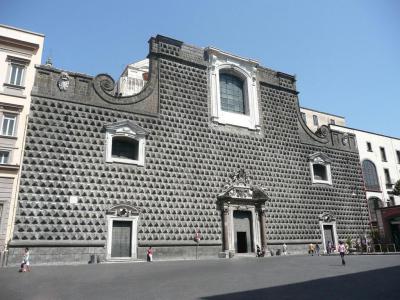
The Gesu Nuovo Church is managed by the Society of Jesus today and was initially built as a lavish residence. The unique exterior with diamond shaped stones has symbols believed to be a music score engraved upon them.
The Gesu Nuovo Church was built as the home of Roberto Sanseverino, Prince of Salerno in 1470. It was purchased by the Jesuits for 45,000 ducats in 1580 and turned into a church. Conversion of the building began in 1584 under the directions of renowned Jesuit architect, Giuseppe Valeriano and was completed in 1601. Although dedicated to Jesus and Mary of the Immaculate Conception, it has always been called the Gesu Nuovo Church.
The Gesu Nuovo Church is not only known for its unique exterior but also for its lavish interiors. It has the shape of a Greek cross with 11 chapels. The columns and altars are all covered with marble. Treasures inside the church are the fresco depicting the Expulsion of Heliodorus from the Temple by Francesco Solimena behind the façade and the frescoes depicting the life of the Virgin by Massimo Stanzione. The high altar was designed by F. Giuseppe Grossi was created by Neapolitan artists and covered with rare marbles, bronze and precious stones. Another treasure is the bas relief reproduction of Leonardo da Vinci’s Last Supper by Gennaro Calì.
The Gesu Nuovo Church was built as the home of Roberto Sanseverino, Prince of Salerno in 1470. It was purchased by the Jesuits for 45,000 ducats in 1580 and turned into a church. Conversion of the building began in 1584 under the directions of renowned Jesuit architect, Giuseppe Valeriano and was completed in 1601. Although dedicated to Jesus and Mary of the Immaculate Conception, it has always been called the Gesu Nuovo Church.
The Gesu Nuovo Church is not only known for its unique exterior but also for its lavish interiors. It has the shape of a Greek cross with 11 chapels. The columns and altars are all covered with marble. Treasures inside the church are the fresco depicting the Expulsion of Heliodorus from the Temple by Francesco Solimena behind the façade and the frescoes depicting the life of the Virgin by Massimo Stanzione. The high altar was designed by F. Giuseppe Grossi was created by Neapolitan artists and covered with rare marbles, bronze and precious stones. Another treasure is the bas relief reproduction of Leonardo da Vinci’s Last Supper by Gennaro Calì.
3) Spaccanapoli Street (must see)
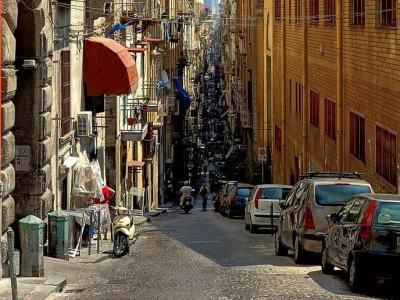
Spaccanapoli is one of the oldest and most defining streets in Naples, cutting a straight line through the historic centre and giving the impression of splitting the city in two. Its name comes from this very effect-spacca Napoli literally means “it splits Naples.” The street follows the route of one of the original decumani, the main east–west roads of the ancient Greek city of Neápolis, laid out in the 5th century BC and still forming the backbone of the historic centre today.
Because Spaccanapoli sits directly on this ancient grid, walking along it is a journey through multiple layers of history compressed into a single corridor. Roman foundations lie beneath medieval buildings, while Renaissance palaces, Baroque churches, and modest residential structures line the route. Over the centuries, the street has been known by different names along its length, but it has always functioned as a central artery for trade, religion, and daily life. Unlike larger avenues created by later urban planning, Spaccanapoli grew organically, shaped by continuous use rather than formal redesign.
Spaccanapoli offers one of the most immediate and unfiltered encounters with Naples. Churches such as Santa Chiara open directly onto the street, while small workshops, bookshops, bakeries, and family-run businesses operate at ground level. Laundry lines overhead and scooters threading through narrow gaps further reinforce the street’s lived-in character. One of the more unusual stops is the Doll Hospital, which specialises in restoring statues and antique dolls. Children are often drawn to the display of miniature hospital beds, while an adjoining museum showcases a collection of antique dolls and toys.
Because Spaccanapoli sits directly on this ancient grid, walking along it is a journey through multiple layers of history compressed into a single corridor. Roman foundations lie beneath medieval buildings, while Renaissance palaces, Baroque churches, and modest residential structures line the route. Over the centuries, the street has been known by different names along its length, but it has always functioned as a central artery for trade, religion, and daily life. Unlike larger avenues created by later urban planning, Spaccanapoli grew organically, shaped by continuous use rather than formal redesign.
Spaccanapoli offers one of the most immediate and unfiltered encounters with Naples. Churches such as Santa Chiara open directly onto the street, while small workshops, bookshops, bakeries, and family-run businesses operate at ground level. Laundry lines overhead and scooters threading through narrow gaps further reinforce the street’s lived-in character. One of the more unusual stops is the Doll Hospital, which specialises in restoring statues and antique dolls. Children are often drawn to the display of miniature hospital beds, while an adjoining museum showcases a collection of antique dolls and toys.
4) Via San Gregorio Armeno (San Gregorio Armeno Street) (must see)
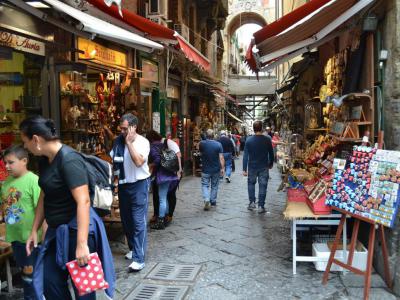
San Gregorio Armeno Street, often called “Christmas Alley,” is known worldwide for its long tradition of nativity-scene craftsmanship. The street runs through the historic centre, connecting Spaccanapoli with Tribunal Street, and follows the line of one of the ancient streets of Greek Neápolis.
The street takes its name from the nearby Church and Monastery of San Gregorio Armeno, founded in the 10th century by a community of Basilian nuns who brought relics of Saint Gregory the Illuminator, the patron saint of Armenia, to Naples. Over time, the religious complex became one of the city’s most important convents.
By the early modern period, San Gregorio Armeno Street had become the centre of Naples’ presepe tradition-the elaborate nativity scenes that go far beyond the biblical story to include everyday Neapolitan life. Artisans set up workshops along the street, producing hand-crafted figurines made from terracotta, wood, and fabric. These figures range from classic shepherds and biblical characters to bakers, musicians, market vendors, and, in more recent times, contemporary public figures.
The street offers a highly concentrated sensory experience. The atmosphere becomes especially animated in the weeks leading up to Christmas, but the street remains active year-round, making it one of the few places in Naples where a seasonal tradition never truly pauses.
The street takes its name from the nearby Church and Monastery of San Gregorio Armeno, founded in the 10th century by a community of Basilian nuns who brought relics of Saint Gregory the Illuminator, the patron saint of Armenia, to Naples. Over time, the religious complex became one of the city’s most important convents.
By the early modern period, San Gregorio Armeno Street had become the centre of Naples’ presepe tradition-the elaborate nativity scenes that go far beyond the biblical story to include everyday Neapolitan life. Artisans set up workshops along the street, producing hand-crafted figurines made from terracotta, wood, and fabric. These figures range from classic shepherds and biblical characters to bakers, musicians, market vendors, and, in more recent times, contemporary public figures.
The street offers a highly concentrated sensory experience. The atmosphere becomes especially animated in the weeks leading up to Christmas, but the street remains active year-round, making it one of the few places in Naples where a seasonal tradition never truly pauses.
5) Duomo di Napoli (Naples Cathedral) (must see)
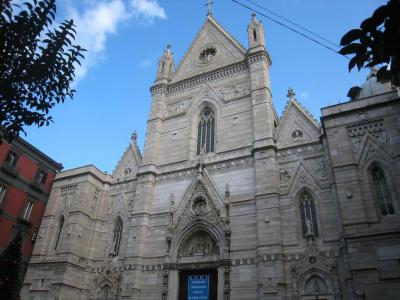
Naples Cathedral’s construction began in the late 13th century under Angevin rule, on a site already occupied by earlier Christian basilicas and Roman structures. This complex past is still visible today: beneath and beside the cathedral lie the remains of early Christian churches, including the Basilica of Santa Restituta.
The cathedral’s main structure reflects Gothic architectural principles introduced from northern Europe, particularly in its soaring interior and pointed arches. Earthquakes, fires, and restorations reshaped parts of the building, introducing new artistic influences over time. The façade seen today dates largely from a 19th-century Neo-Gothic restoration, while the interior preserves medieval elements alongside Baroque chapels and artworks.
One of the cathedral’s most important spaces is the Chapel of the Treasury of San Gennaro, built in the early 17th century and entirely separate from the cathedral’s original structure. Facing the apse, entering the right side of the cathedral brings you close to the chapel. The entrance is easily recognisable thanks to its imposing scale and black gate. This richly decorated Baroque chapel houses the relics of San Gennaro, Naples’ patron saint. Several times a year, crowds gather here to witness the so-called miracle of the liquefaction of the saint’s blood, a ritual deeply embedded in local tradition. According to legend, failure of the blood to liquefy is seen as an omen of disaster for the city.
Directly opposite the entrance to the Chapel of the Treasury of San Gennaro is the entrance to the Basilica of Santa Restituta, the original church dating to the 4th century AD. Inside, the basilica preserves several remarkable elements, including a Greek wall associated with the ancient Temple of Apollo, a stretch of Roman aqueduct, and an inclined section of ancient Greek roadway.
While you are here, you can step from the main nave into earlier basilicas, observe medieval mosaics and tombs, and contrast the cathedral’s restrained Gothic lines with the dramatic Baroque intensity of the Chapel of the Treasury of San Gennaro.
The cathedral’s main structure reflects Gothic architectural principles introduced from northern Europe, particularly in its soaring interior and pointed arches. Earthquakes, fires, and restorations reshaped parts of the building, introducing new artistic influences over time. The façade seen today dates largely from a 19th-century Neo-Gothic restoration, while the interior preserves medieval elements alongside Baroque chapels and artworks.
One of the cathedral’s most important spaces is the Chapel of the Treasury of San Gennaro, built in the early 17th century and entirely separate from the cathedral’s original structure. Facing the apse, entering the right side of the cathedral brings you close to the chapel. The entrance is easily recognisable thanks to its imposing scale and black gate. This richly decorated Baroque chapel houses the relics of San Gennaro, Naples’ patron saint. Several times a year, crowds gather here to witness the so-called miracle of the liquefaction of the saint’s blood, a ritual deeply embedded in local tradition. According to legend, failure of the blood to liquefy is seen as an omen of disaster for the city.
Directly opposite the entrance to the Chapel of the Treasury of San Gennaro is the entrance to the Basilica of Santa Restituta, the original church dating to the 4th century AD. Inside, the basilica preserves several remarkable elements, including a Greek wall associated with the ancient Temple of Apollo, a stretch of Roman aqueduct, and an inclined section of ancient Greek roadway.
While you are here, you can step from the main nave into earlier basilicas, observe medieval mosaics and tombs, and contrast the cathedral’s restrained Gothic lines with the dramatic Baroque intensity of the Chapel of the Treasury of San Gennaro.
6) Naples Underground (must see)
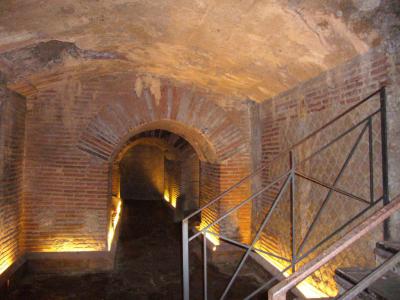
Naples Underground reveals a hidden city beneath the streets of Naples, where over two thousand years of history are preserved below ground level. This vast network of tunnels, chambers, and cavities began in ancient times, when Greek settlers excavated soft volcanic tuff to extract building stone for Neápolis. The same underground spaces were later expanded by the Romans, who transformed them into an extensive system of aqueducts and cisterns that supplied water to the growing city above.
For centuries, this subterranean infrastructure played a crucial role in daily life. Wells connected private homes and public fountains to the underground reservoirs, while maintenance corridors allowed access to the water system. When the aqueduct fell out of use in the 19th century, many of these spaces were gradually forgotten, sealed off, or repurposed for storage. Their strategic depth, however, gave them new relevance during the 20th century.
During World War II, large sections of the underground were converted into air-raid shelters. Thousands of Neapolitans took refuge here during bombing raids, leaving behind inscriptions, drawings, and everyday objects that document civilian life during the war.
Two unique sights worth seeing are the Greco-Roman Theatre and the Hypogeum Gardens. The former is notable for the presence of a private dressing room believed to have belonged to the Roman Emperor Nero. The latter’s name means “underground gardens”, and they represent an experimental project aimed at growing plants away from light and urban pollution.
Naples Underground offers a striking contrast to the city above. If you wish to encounter ancient Greek foundations, Roman water channels and improvised wartime rooms, you have to join a guided tour at the ticket office.
For centuries, this subterranean infrastructure played a crucial role in daily life. Wells connected private homes and public fountains to the underground reservoirs, while maintenance corridors allowed access to the water system. When the aqueduct fell out of use in the 19th century, many of these spaces were gradually forgotten, sealed off, or repurposed for storage. Their strategic depth, however, gave them new relevance during the 20th century.
During World War II, large sections of the underground were converted into air-raid shelters. Thousands of Neapolitans took refuge here during bombing raids, leaving behind inscriptions, drawings, and everyday objects that document civilian life during the war.
Two unique sights worth seeing are the Greco-Roman Theatre and the Hypogeum Gardens. The former is notable for the presence of a private dressing room believed to have belonged to the Roman Emperor Nero. The latter’s name means “underground gardens”, and they represent an experimental project aimed at growing plants away from light and urban pollution.
Naples Underground offers a striking contrast to the city above. If you wish to encounter ancient Greek foundations, Roman water channels and improvised wartime rooms, you have to join a guided tour at the ticket office.
7) Museo Cappella Sansevero (Sansevero Chapel Museum) (must see)
The Sansevero Chapel Museum was originally built in the late 16th century by Giovan Francesco di Sangro as a private family burial place, but it owes its present form to Raimondo di Sangro, Prince of Sansevero, who transformed it in the mid-18th century.
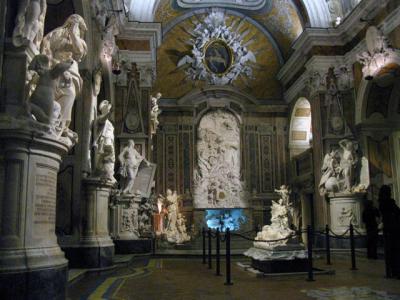
The chapel is home to nearly thirty important artworks. At the centre of the chapel lies its most famous work: the Veiled Christ, sculpted in 1753 by artist Giuseppe Sanmartino. Carved from a single block of marble, the figure is covered by a delicately rendered shroud that appears almost transparent, revealing the anatomy beneath with remarkable realism.
The chapel’s walls are lined with marble sculptures, each representing a moral virtue linked to members of the Sansevero family. Among these sculptures, two major highlights stand on either side of the Veiled Christ, toward the north-west. One of them is called Modesty, and it depicts a veiled female figure, celebrated for the delicate treatment of marble. The second is called Release from Deception, and it portrays a fisherman escaping from a fishing net with the help of an angel. The sculpture’s appeal lies in its extraordinary craftsmanship, as the intricate fishing net is carved entirely from marble.
Above, the painted ceiling, titled Glory of Paradise, gives the chapel a dynamic feel by illustrating a celestial vision of Paradise, filled with swirling clouds, angels, and radiant light, opening upward above the nave.
On the right side of the chapel, relative to the entrance, in the third archway, you will notice a narrow 19th-century spiral staircase that leads to the basement. There, you encounter the so-called Anatomical Machines: two preserved human skeletons displaying the circulatory system in extraordinary detail. While the bones are indeed human, the blood vessels are a highly intricate reconstruction made of metal wires, silk, and wax.
The chapel is home to nearly thirty important artworks. At the centre of the chapel lies its most famous work: the Veiled Christ, sculpted in 1753 by artist Giuseppe Sanmartino. Carved from a single block of marble, the figure is covered by a delicately rendered shroud that appears almost transparent, revealing the anatomy beneath with remarkable realism.
The chapel’s walls are lined with marble sculptures, each representing a moral virtue linked to members of the Sansevero family. Among these sculptures, two major highlights stand on either side of the Veiled Christ, toward the north-west. One of them is called Modesty, and it depicts a veiled female figure, celebrated for the delicate treatment of marble. The second is called Release from Deception, and it portrays a fisherman escaping from a fishing net with the help of an angel. The sculpture’s appeal lies in its extraordinary craftsmanship, as the intricate fishing net is carved entirely from marble.
Above, the painted ceiling, titled Glory of Paradise, gives the chapel a dynamic feel by illustrating a celestial vision of Paradise, filled with swirling clouds, angels, and radiant light, opening upward above the nave.
On the right side of the chapel, relative to the entrance, in the third archway, you will notice a narrow 19th-century spiral staircase that leads to the basement. There, you encounter the so-called Anatomical Machines: two preserved human skeletons displaying the circulatory system in extraordinary detail. While the bones are indeed human, the blood vessels are a highly intricate reconstruction made of metal wires, silk, and wax.
8) Santa Chiara Complex (must see)
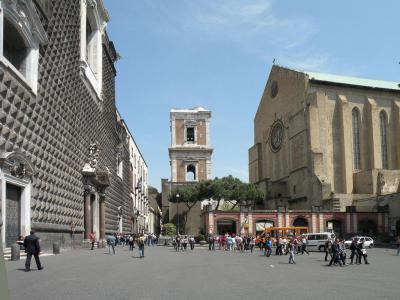
The Santa Chiara Complex was founded in the early 14th century under the Angevin rulers Robert of Anjou and Queen Sancia. At its heart stands the Basilica of Santa Chiara, originally built in a sober Gothic style that stood in contrast to the ornate churches more commonly associated with Naples.
Over the centuries, the complex evolved alongside the city. Baroque additions gradually transformed the basilica’s interior, filling it with rich decoration and colour. This version of Santa Chiara was largely destroyed during World War II, when Allied bombing in 1943 caused a devastating fire. Rather than reconstructing the Baroque interior, post-war restorations chose to return the church to its original Gothic simplicity.
After you leave the church and stroll along the basilica’s eastern façade, you encounter a gated yellow arch that leads to the complex’s most celebrated space: the cloister, redesigned in the 18th century and decorated with vibrant majolica tiles. The tiled pillars and benches depict scenes of rural life, landscapes, and everyday activities. This cloister has become one of the most photographed places in Naples, valued not only for its beauty but also for the unexpected calm it offers within the historic centre. Contributing to this sense of calm are gardens planted with citrus and lavender, as well as a fountain set within what was once the medieval friars’ refectory.
Another sight worth seeing inside the cloister is the Opera Museum of Santa Chiara. It can be found on the opposite side of the cloister’s entrance. The museum displays the remains of a 1st-century Roman bath complex, allowing visitors to trace the site’s history back to ancient Naples.
Over the centuries, the complex evolved alongside the city. Baroque additions gradually transformed the basilica’s interior, filling it with rich decoration and colour. This version of Santa Chiara was largely destroyed during World War II, when Allied bombing in 1943 caused a devastating fire. Rather than reconstructing the Baroque interior, post-war restorations chose to return the church to its original Gothic simplicity.
After you leave the church and stroll along the basilica’s eastern façade, you encounter a gated yellow arch that leads to the complex’s most celebrated space: the cloister, redesigned in the 18th century and decorated with vibrant majolica tiles. The tiled pillars and benches depict scenes of rural life, landscapes, and everyday activities. This cloister has become one of the most photographed places in Naples, valued not only for its beauty but also for the unexpected calm it offers within the historic centre. Contributing to this sense of calm are gardens planted with citrus and lavender, as well as a fountain set within what was once the medieval friars’ refectory.
Another sight worth seeing inside the cloister is the Opera Museum of Santa Chiara. It can be found on the opposite side of the cloister’s entrance. The museum displays the remains of a 1st-century Roman bath complex, allowing visitors to trace the site’s history back to ancient Naples.
9) Via Toledo (Toledo Street)
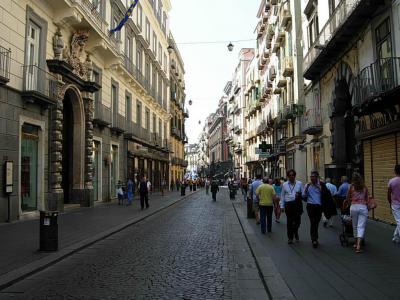
Toledo Street is one of Naples’ principal arteries and has long functioned as a dividing line between different layers of the city. It was laid out in 1536 during Spanish rule by the viceroy Pedro Álvarez de Toledo, from whom the street takes its name. The project was part of a broader effort to impose order on a rapidly growing city, creating a wide, regulated thoroughfare that contrasted with Naples’ dense medieval street network.
From the outset, Toledo Street was designed as a prestigious urban axis. Noble palaces, churches, and administrative buildings rose along its length, while the densely populated Spanish Quarter developed immediately uphill, housing soldiers and working families. Over time, Toledo Street became a showcase for architectural trends, from Renaissance and Baroque façades to later 19th-century additions linked to Naples’ modernisation after Italian unification.
In the 19th and early 20th centuries, the street evolved into a commercial hub, a role it continues to play today. Shops, cafés, cinemas, and theatres line both sides, making it one of the city’s busiest pedestrian corridors. Despite modernisation, traces of earlier centuries remain visible in courtyards, side streets, and historic storefronts, especially where Toledo Street intersects with older routes such as Spaccanapoli.
From the outset, Toledo Street was designed as a prestigious urban axis. Noble palaces, churches, and administrative buildings rose along its length, while the densely populated Spanish Quarter developed immediately uphill, housing soldiers and working families. Over time, Toledo Street became a showcase for architectural trends, from Renaissance and Baroque façades to later 19th-century additions linked to Naples’ modernisation after Italian unification.
In the 19th and early 20th centuries, the street evolved into a commercial hub, a role it continues to play today. Shops, cafés, cinemas, and theatres line both sides, making it one of the city’s busiest pedestrian corridors. Despite modernisation, traces of earlier centuries remain visible in courtyards, side streets, and historic storefronts, especially where Toledo Street intersects with older routes such as Spaccanapoli.
10) Via Chiaia (Chiaia street)
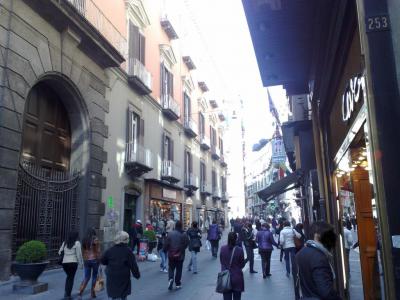
Chiaia Street is one of Naples’ oldest and most characterful streets, linking the historic centre to the waterfront districts. Its name derives from the Latin plaga, meaning slope or shore, a reminder that this area once lay close to the sea before land reclamation reshaped the coastline. By the early modern period, Chiaia Street had become a key route connecting the Spanish Quarter and Plebiscite Square with the aristocratic neighbourhoods developing toward the west. During the Bourbon era, especially in the 18th and 19th centuries, the street gained prominence as noble residences, churches, and elegant palaces lined its length, turning it into a fashionable corridor of the city.
Today, the street is a major shopping destination, with a blend of long-established local boutiques, Italian fashion brands, cafes, and pastry shops occupying historic buildings. Architectural details often reveal older layers, from Baroque façades and decorative portals to occasional courtyards glimpsed through open gateways. A short walk away, visitors can stop at the Monument to the Martyrs in the Martyrs' Square, a 19th-century monument marked by four lions commemorating anti-Bourbon uprisings in 1799, 1820, 1848, and 1860. Nearby stands the 16th-century Cellamare Palace, built for Giovan Francesco Carafa. The distinctive pink-and-white palace later hosted Bourbon royal guests and notable figures such as writers Casanova and Goethe, adding a literary and political layer to the area’s history.
At the western end of Chiaia Street, you will find the Chiaia Bridge, built in 1636 to connect the areas of Pizzofalcone and Mortella. The bridge was designed in a Neo-Renaissance style and decorated with marble elements.
Today, the street is a major shopping destination, with a blend of long-established local boutiques, Italian fashion brands, cafes, and pastry shops occupying historic buildings. Architectural details often reveal older layers, from Baroque façades and decorative portals to occasional courtyards glimpsed through open gateways. A short walk away, visitors can stop at the Monument to the Martyrs in the Martyrs' Square, a 19th-century monument marked by four lions commemorating anti-Bourbon uprisings in 1799, 1820, 1848, and 1860. Nearby stands the 16th-century Cellamare Palace, built for Giovan Francesco Carafa. The distinctive pink-and-white palace later hosted Bourbon royal guests and notable figures such as writers Casanova and Goethe, adding a literary and political layer to the area’s history.
At the western end of Chiaia Street, you will find the Chiaia Bridge, built in 1636 to connect the areas of Pizzofalcone and Mortella. The bridge was designed in a Neo-Renaissance style and decorated with marble elements.
11) Galleria Borbonica (Bourbon Tunnel) (must see)
The Bourbon Tunnel was conceived in 1853 during the reign of King Ferdinand II of Bourbon, and was originally intended as a secret military and escape route linking the Royal Palace with strategic points farther inland, such as military barracks on Morelli Street. The Bourbon monarchy of the time was wary of uprisings, and this underground corridor was meant to offer a rapid and discreet way for troops - and potentially the royal family - to move unseen or flee if the city erupted in revolt. Unfortunately, King Ferdinand II died and the tunnel was left unfinished. Despite the sudden interruption of construction works, the tunnel had already been connected to the 17th-century aqueduct system.
After the king's death, the underground space went unused until World War II. During World War II, it became a vital bomb shelter and refuge for thousands of residents, seeking safety from aerial bombardments, with makeshift facilities added to accommodate them. After the war, it was used for storage - at times housing impounded vehicles.
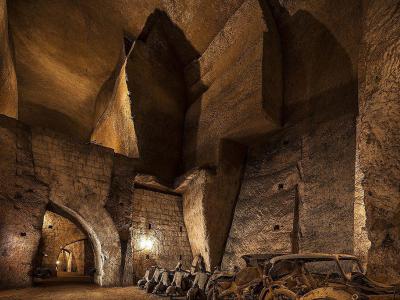
After being rediscovered and cleared in the early 21st century, the Bourbon Tunnel emerged as a popular attraction. Nowadays, guided tours take you through sections of the tunnel where you can see remnants of its varied uses: ancient water systems and aqueduct connections, wartime artefacts such as vintage cars and motorcycles left behind, and the tunnel’s narrow corridors. Some tours delve deeper into adjoining cisterns or offer more adventurous explorations of less visited branches.
After the king's death, the underground space went unused until World War II. During World War II, it became a vital bomb shelter and refuge for thousands of residents, seeking safety from aerial bombardments, with makeshift facilities added to accommodate them. After the war, it was used for storage - at times housing impounded vehicles.
After being rediscovered and cleared in the early 21st century, the Bourbon Tunnel emerged as a popular attraction. Nowadays, guided tours take you through sections of the tunnel where you can see remnants of its varied uses: ancient water systems and aqueduct connections, wartime artefacts such as vintage cars and motorcycles left behind, and the tunnel’s narrow corridors. Some tours delve deeper into adjoining cisterns or offer more adventurous explorations of less visited branches.
12) San Francesco di Paola Church
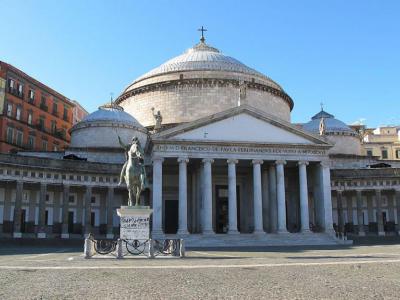
San Francesco di Paola Church is one of the city’s most visually commanding religious buildings, closely tied to Naples’ 19th-century political history. Construction began in 1816 under King Ferdinand I of Bourbon, who commissioned the church as both a votive offering and a symbol of restored monarchy after the Napoleonic period. Completed in 1824, the church deliberately echoes the Pantheon in Rome, with a vast circular plan, a portico supported by Corinthian columns, and a large central dome that dominates the square. Its restrained Neoclassical style marked a clear departure from the exuberant Baroque churches that define much of Naples’ earlier sacred architecture.
Immediately after passing through the grand external portico, you enter a rectangular atrium before reaching the main circular body. The atrium contains entrances to two side chapels. The Chapel of the Souls in Purgatory is on the left, and houses a painting of Saint Onofrio-a stark, powerful example of late Baroque art. On the right side of the atrium, you find the Chapel of the Blessed Sacrament, which features a striking 18th-century polychrome marble altar. Above it hangs a painting of Saint Francis of Paola, notable for its intense use of light and shadow.
Inside the main body of the church, the atmosphere is markedly calm and spacious, shaped by the building’s symmetry and uncluttered design. The high dome filters soft light into the interior, creating a strong sense of openness. The church’s most celebrated painting is located directly opposite the entrance, in the semi-circular space behind the altar. Titled Saint Francis of Paola Resuscitates a Dead Man, it was painted by Neoclassical Italian artist Vincenzo Camuccini and depicts the saint’s miraculous powers.
Today, the church remains an active place of worship and a popular venue for weddings.
Immediately after passing through the grand external portico, you enter a rectangular atrium before reaching the main circular body. The atrium contains entrances to two side chapels. The Chapel of the Souls in Purgatory is on the left, and houses a painting of Saint Onofrio-a stark, powerful example of late Baroque art. On the right side of the atrium, you find the Chapel of the Blessed Sacrament, which features a striking 18th-century polychrome marble altar. Above it hangs a painting of Saint Francis of Paola, notable for its intense use of light and shadow.
Inside the main body of the church, the atmosphere is markedly calm and spacious, shaped by the building’s symmetry and uncluttered design. The high dome filters soft light into the interior, creating a strong sense of openness. The church’s most celebrated painting is located directly opposite the entrance, in the semi-circular space behind the altar. Titled Saint Francis of Paola Resuscitates a Dead Man, it was painted by Neoclassical Italian artist Vincenzo Camuccini and depicts the saint’s miraculous powers.
Today, the church remains an active place of worship and a popular venue for weddings.
13) Piazza del Plebiscito (Plebiscite Square) (must see)
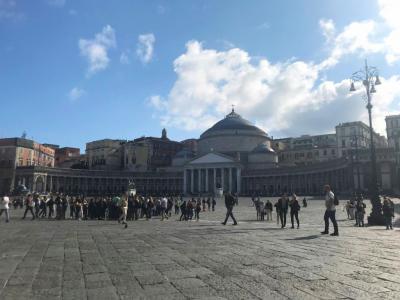
Plebiscite Square is the largest and most ceremonial public square in Naples, opening directly onto the waterfront at the edge of the historic centre. Its name refers to the plebiscite of 1860, when the Kingdom of the Two Sicilies voted to join the newly unified Kingdom of Italy-a political moment that marked the end of centuries of Bourbon rule. Long before that vote, however, the square functioned as a stage for royal power, military parades, and civic spectacle.
The square took its present form in the early 19th century under Joachim Murat, Napoleon’s brother-in-law and King of Naples, who envisioned a grand neoclassical space inspired by imperial ideals. Dominating its eastern side is the Royal Palace of Naples, begun in the early 1600s and long the residence of Spanish viceroys and later Bourbon kings.
After World War II, the square fell into neglect and was used as a large parking area until 1997, when it was restored ahead of the G7 summit held in Naples. This restoration returned the piazza to its original role as a monumental civic space.
Today, Plebiscite Square offers both scale and pause. It is one of the few places in Naples where the sky feels expansive, making it a popular meeting point and a natural threshold between the old city, the royal quarter, and the sea. Largely free of traffic, the square invites visitors to slow down, observe details, watch daily life unfold, or simply take in the symmetry and openness that set it apart from the surrounding streets.
The square took its present form in the early 19th century under Joachim Murat, Napoleon’s brother-in-law and King of Naples, who envisioned a grand neoclassical space inspired by imperial ideals. Dominating its eastern side is the Royal Palace of Naples, begun in the early 1600s and long the residence of Spanish viceroys and later Bourbon kings.
After World War II, the square fell into neglect and was used as a large parking area until 1997, when it was restored ahead of the G7 summit held in Naples. This restoration returned the piazza to its original role as a monumental civic space.
Today, Plebiscite Square offers both scale and pause. It is one of the few places in Naples where the sky feels expansive, making it a popular meeting point and a natural threshold between the old city, the royal quarter, and the sea. Largely free of traffic, the square invites visitors to slow down, observe details, watch daily life unfold, or simply take in the symmetry and openness that set it apart from the surrounding streets.
14) Royal Palace (must see)
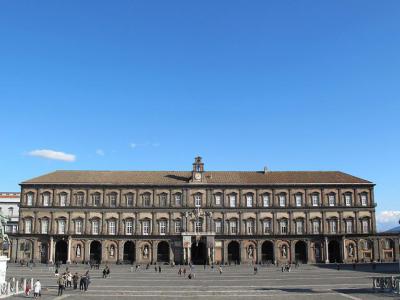
The Royal Palace of Naples stands along the eastern side of Plebiscite Square as a reminder of the centuries when Naples served as a European capital. Construction began in 1600 under Spanish rule, and the building was designed as the residence of the Spanish viceroys. From the outset, the palace was intended to project authority and stability, facing both the city and the sea. Over time, it was expanded and adapted by successive rulers, including the Bourbons, who made it one of their principal royal residences when Naples became the capital of the Kingdom of Naples and later the Kingdom of the Two Sicilies.
Niches along the palace’s orderly façade hold statues of historical rulers connected to Naples. Inside, the atmosphere shifts toward grand staircases, ceremonial halls, and richly decorated apartments. The Royal Apartments preserve original décor, including gilded ceilings, frescoes, tapestries, and period furniture, offering a glimpse into court life from the 17th to the 19th century.
As soon as you enter the palace, you have a choice. If you turn left, you reach the Court Theatre, an intimate performance space that reflects Naples’ long association with music and opera. If instead you continue straight ahead, you arrive at the square-shaped Courtyard of Honour. Continuing northeast, the Palatine Chapel, built for private worship, comes into view. While the palace’s western wing contains the Royal Apartments and the aforementioned spaces, if you turn right after entering the palace, you come to the National Library of Naples housed in the easten wing. It is one of Italy’s most important libraries, containing rare manuscripts and historic collections.
The Royal Palace offers a quieter counterpoint to Naples’ dense streets. Its broad rooms and ordered layout provide a sense of scale and formality rarely found elsewhere in the city.
Niches along the palace’s orderly façade hold statues of historical rulers connected to Naples. Inside, the atmosphere shifts toward grand staircases, ceremonial halls, and richly decorated apartments. The Royal Apartments preserve original décor, including gilded ceilings, frescoes, tapestries, and period furniture, offering a glimpse into court life from the 17th to the 19th century.
As soon as you enter the palace, you have a choice. If you turn left, you reach the Court Theatre, an intimate performance space that reflects Naples’ long association with music and opera. If instead you continue straight ahead, you arrive at the square-shaped Courtyard of Honour. Continuing northeast, the Palatine Chapel, built for private worship, comes into view. While the palace’s western wing contains the Royal Apartments and the aforementioned spaces, if you turn right after entering the palace, you come to the National Library of Naples housed in the easten wing. It is one of Italy’s most important libraries, containing rare manuscripts and historic collections.
The Royal Palace offers a quieter counterpoint to Naples’ dense streets. Its broad rooms and ordered layout provide a sense of scale and formality rarely found elsewhere in the city.
15) Galleria Umberto I (Umberto I Shopping Gallery)
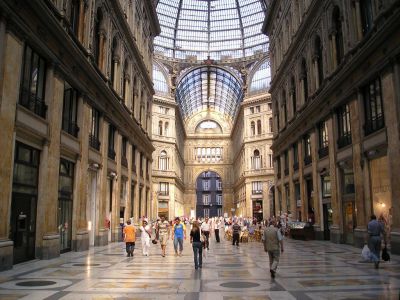
Galleria Umberto I is one of Naples’ most recognizable 19th-century landmarks, built at a time when the city was undergoing major urban transformation. Construction began in the late 1880s, shortly after Italian unification, as part of a large-scale renewal project aimed at modernising the area behind the Royal Palace and the San Carlo Theatre. The gallery was named after King Umberto I of Italy and conceived as a symbol of progress, order, and civic pride.
Completed in 1891, the gallery reflects the optimism of the era through its monumental scale and elegant use of iron and glass. Its most striking feature is the vast glass dome rising above a cruciform interior, allowing natural light to flood the space below. The floor is decorated with colourful mosaic pavements representing the signs of the zodiac, arranged beneath the intersecting arms of the arcade.
Historically, the gallery was intended as a refined social space rather than a purely commercial one. Modelled on grand European arcades such as Milan’s Galleria Vittorio Emanuele II, it was designed to host cafés, shops, and cultural venues, offering shelter from the weather and a place for leisurely strolling. Galleria Umberto I also serves as the setting for the novel The Gallery by American writer John Horne Burns, which depicts life in occupied Naples in 1944 during World War II.
Completed in 1891, the gallery reflects the optimism of the era through its monumental scale and elegant use of iron and glass. Its most striking feature is the vast glass dome rising above a cruciform interior, allowing natural light to flood the space below. The floor is decorated with colourful mosaic pavements representing the signs of the zodiac, arranged beneath the intersecting arms of the arcade.
Historically, the gallery was intended as a refined social space rather than a purely commercial one. Modelled on grand European arcades such as Milan’s Galleria Vittorio Emanuele II, it was designed to host cafés, shops, and cultural venues, offering shelter from the weather and a place for leisurely strolling. Galleria Umberto I also serves as the setting for the novel The Gallery by American writer John Horne Burns, which depicts life in occupied Naples in 1944 during World War II.
