Custom Walk in Krakow, Poland by hew_annun6567_739977 created on 2026-05-17
Guide Location: Poland » Krakow
Guide Type: Custom Walk
# of Sights: 13
Tour Duration: 2 Hour(s)
Travel Distance: 3.8 Km or 2.4 Miles
Share Key: MJE59
Guide Type: Custom Walk
# of Sights: 13
Tour Duration: 2 Hour(s)
Travel Distance: 3.8 Km or 2.4 Miles
Share Key: MJE59
How It Works
Please retrieve this walk in the GPSmyCity app. Once done, the app will guide you from one tour stop to the next as if you had a personal tour guide. If you created the walk on this website or come to the page via a link, please follow the instructions below to retrieve the walk in the app.
Retrieve This Walk in App
Step 1. Download the app "GPSmyCity: Walks in 1K+ Cities" on Apple App Store or Google Play Store.



Step 2. In the GPSmyCity app, download(or launch) the guide "Krakow Map and Walking Tours".
Step 3. Tap the menu button located at upper right corner of the "Walks" screen and select "Retrieve custom walk". Enter the share key: MJE59
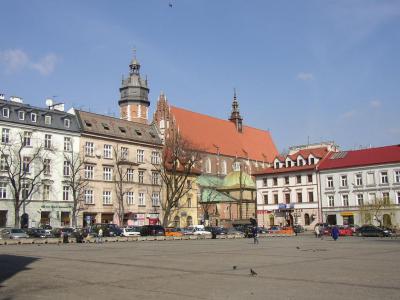
1) Kazimierz (Jewish Quarter) (must see)
For many centuries, Kazimierz thrived as a realm where Polish and Jewish cultures coexisted and blended harmoniously. The northeastern sector of the district held a rich Jewish history, with its Jewish residents being forcibly uprooted in 1941 by the occupying German forces to the Krakow ghetto just on the opposite side of the river in Podgórze. In the present day, Kazimierz stands as one of Krakow's foremost tourist destinations, playing a pivotal role in the city's cultural tapestry.
The genesis of Kazimierz owes itself to the efforts of King Casimir the Great, the namesake of the town. Yet, it was the decision of King Jan Olbracht that prompted the migration of Krakow's Jewish population to Kazimierz. Following this migration, instances of violence and clashes between these two predominant communities notably decreased. These communities coexisted relatively seamlessly until the early 19th century, when the distinct Jewish township was incorporated into Krakow. The intellectual and societal elite largely departed from Kazimierz during this period, gravitating toward other parts of Krakow. Nonetheless, within the old town, those who remained were primarily impoverished and orthodox Jews, and their presence is responsible for the enduring appreciation of the area's architecture and structures.
The upheaval of the Second World War further exacerbated the community's decline and desolation. By the conflict's conclusion, the once-vibrant Jewish enclave had been reduced to ruins, erasing a melting pot of unique and diverse Jewish heritage.
It wasn't until the year 2000, quite recently, that the most economically disadvantaged district of Krakow began to attract the attention of the burgeoning hospitality sector. Before long, the buildings became havens for some of the city's most charming cafes and restaurants. Additionally, each year at the close of June, Kazimierz hosts the Jewish Culture Festival, the largest of its kind in Europe, drawing in visitors from across the globe. The festival boasts an array of music from various regions, played by ensembles hailing from the Middle East, the USA, Africa, and beyond.
Why You Should Visit:
If you're looking for a place to wander pretty streets and dip in and out of nice places, then this is the area for you.
Tip:
If you head toward the corner of Ulica Józefa and Ulica Nowa, the walkways in that area are the perfect mix of local shops and atmospheric alleyways. You'll see lots of cute shops with fun graffiti and artwork painted on the side of them.
The genesis of Kazimierz owes itself to the efforts of King Casimir the Great, the namesake of the town. Yet, it was the decision of King Jan Olbracht that prompted the migration of Krakow's Jewish population to Kazimierz. Following this migration, instances of violence and clashes between these two predominant communities notably decreased. These communities coexisted relatively seamlessly until the early 19th century, when the distinct Jewish township was incorporated into Krakow. The intellectual and societal elite largely departed from Kazimierz during this period, gravitating toward other parts of Krakow. Nonetheless, within the old town, those who remained were primarily impoverished and orthodox Jews, and their presence is responsible for the enduring appreciation of the area's architecture and structures.
The upheaval of the Second World War further exacerbated the community's decline and desolation. By the conflict's conclusion, the once-vibrant Jewish enclave had been reduced to ruins, erasing a melting pot of unique and diverse Jewish heritage.
It wasn't until the year 2000, quite recently, that the most economically disadvantaged district of Krakow began to attract the attention of the burgeoning hospitality sector. Before long, the buildings became havens for some of the city's most charming cafes and restaurants. Additionally, each year at the close of June, Kazimierz hosts the Jewish Culture Festival, the largest of its kind in Europe, drawing in visitors from across the globe. The festival boasts an array of music from various regions, played by ensembles hailing from the Middle East, the USA, Africa, and beyond.
Why You Should Visit:
If you're looking for a place to wander pretty streets and dip in and out of nice places, then this is the area for you.
Tip:
If you head toward the corner of Ulica Józefa and Ulica Nowa, the walkways in that area are the perfect mix of local shops and atmospheric alleyways. You'll see lots of cute shops with fun graffiti and artwork painted on the side of them.
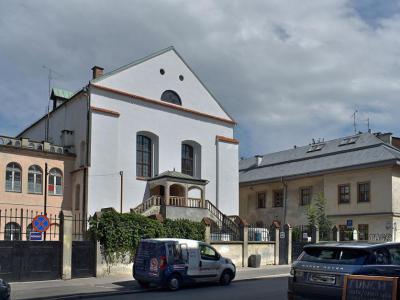
2) Izaak Synagogue
The Izaak Synagogue stands as one of the grandest monuments to the city’s Jewish heritage: built between 1638 and 1644 in the historic Jewish quarter of Kazimierz, it was commissioned by a wealthy Jewish financier, Izaak Jakubowicz - also known as “Isaac the Rich,” banker to the king - and remains a striking example of 17th-century Baroque synagogue architecture.
From the outside the building appears restrained, but inside lies a richly decorated hall: a high vaulted ceiling, Renaissance-style stucco frames, painted Hebrew liturgical texts on the walls, ornate decorative motifs, and a women’s gallery supported by elegant Tuscan columns. When it was first built, this synagogue was the largest and most lavishly furnished in Kazimierz with a majestic wooden Torah ark and richly appointed interiors.
Over the centuries the synagogue saw many trials. In the mid-17th century, during the Swedish Deluge, the furnishings were looted, and the building was even pawned to settle debts. The most destructive blow came during World War II, when occupying forces plundered and destroyed the interior: the bimah, the ark and other ritual furnishings were lost, and the synagogue was repurposed - first as storage, later as a workshop. In the post-war decades it served various secular functions and fell into disrepair, even suffering a damaging fire around 1981.
The revival began in the 1980s and 1990s: after renovation efforts uncovered long-hidden murals and decorative schemes, the building was restored to its former grandeur. Today Izaak Synagogue functions again as a place of worship for the Orthodox community, but also as a cultural and historical site: it hosts exhibitions, film screenings and educational projects about the Jewish past of Kraków’s Kazimierz district, as well as occasional concerts and meetings.
From the outside the building appears restrained, but inside lies a richly decorated hall: a high vaulted ceiling, Renaissance-style stucco frames, painted Hebrew liturgical texts on the walls, ornate decorative motifs, and a women’s gallery supported by elegant Tuscan columns. When it was first built, this synagogue was the largest and most lavishly furnished in Kazimierz with a majestic wooden Torah ark and richly appointed interiors.
Over the centuries the synagogue saw many trials. In the mid-17th century, during the Swedish Deluge, the furnishings were looted, and the building was even pawned to settle debts. The most destructive blow came during World War II, when occupying forces plundered and destroyed the interior: the bimah, the ark and other ritual furnishings were lost, and the synagogue was repurposed - first as storage, later as a workshop. In the post-war decades it served various secular functions and fell into disrepair, even suffering a damaging fire around 1981.
The revival began in the 1980s and 1990s: after renovation efforts uncovered long-hidden murals and decorative schemes, the building was restored to its former grandeur. Today Izaak Synagogue functions again as a place of worship for the Orthodox community, but also as a cultural and historical site: it hosts exhibitions, film screenings and educational projects about the Jewish past of Kraków’s Kazimierz district, as well as occasional concerts and meetings.
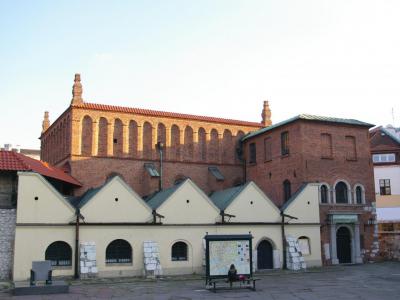
3) Old Synagogue
The Old Synagogue in Kraków is the oldest surviving Jewish prayer house in Poland and one of the most important monuments of Jewish heritage in Europe. Located on Szeroka Street in Kazimierz, it dates back to the late 15th or early 16th century, when the Jewish community was first relocated to the district. Its earliest known form was built in the Gothic style, but after a major fire in 1557, it was rebuilt in a Renaissance style that gave the structure its distinctive fortress-like appearance. For centuries, the Old Synagogue served as the religious, cultural, and administrative heart of Kraków’s Jewish community, hosting prayers, community meetings, and sessions of the kahal (the self-governing Jewish council).
Inside, visitors can explore the main prayer hall with its vaulted ceiling supported by two thick pillars. It features exhibits on Jewish religious practices, holidays, and daily life. The women’s section is a 17th-century addition and can be found by turning right from the Holy Ark in the main hall. It reflects traditional synagogue design and, along with various side rooms, displays artifacts such as Torah ornaments, ceremonial objects, and historic manuscripts that illustrate how deeply rooted Jewish tradition was in Kazimierz. The podium-positioned in the center of the hall-remains one of the most visually compelling features, enclosed by a beautifully wrought-iron balustrade.
The Old Synagogue also carries the memory of darker chapters. During World War II, the Nazis devastated its interior and used the building as a warehouse. After the war, it underwent careful restoration and eventually became a branch of the Historical Museum of the City of Kraków. Today, its exhibitions are thematically organized to explore aspects such as birth, prayer rituals, dietary practices, divorce, and death.
The Old Synagogue offers an essential introduction to Jewish life in Kraków. It is one of the key stops along the route through Kazimierz and provides valuable historical context for the other synagogues, cemeteries, and cultural sites nearby.
Inside, visitors can explore the main prayer hall with its vaulted ceiling supported by two thick pillars. It features exhibits on Jewish religious practices, holidays, and daily life. The women’s section is a 17th-century addition and can be found by turning right from the Holy Ark in the main hall. It reflects traditional synagogue design and, along with various side rooms, displays artifacts such as Torah ornaments, ceremonial objects, and historic manuscripts that illustrate how deeply rooted Jewish tradition was in Kazimierz. The podium-positioned in the center of the hall-remains one of the most visually compelling features, enclosed by a beautifully wrought-iron balustrade.
The Old Synagogue also carries the memory of darker chapters. During World War II, the Nazis devastated its interior and used the building as a warehouse. After the war, it underwent careful restoration and eventually became a branch of the Historical Museum of the City of Kraków. Today, its exhibitions are thematically organized to explore aspects such as birth, prayer rituals, dietary practices, divorce, and death.
The Old Synagogue offers an essential introduction to Jewish life in Kraków. It is one of the key stops along the route through Kazimierz and provides valuable historical context for the other synagogues, cemeteries, and cultural sites nearby.
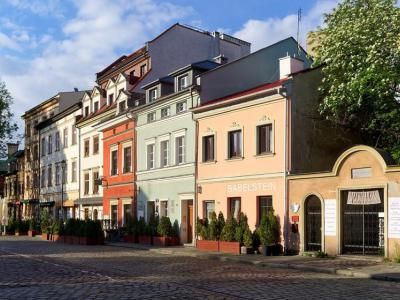
4) Szeroka Street
Szeroka Street has long been considered the heart of the Jewish quarter. Unlike most streets, Szeroka is unusually wide-its name literally means “Broad Street”-and for centuries it functioned more like a communal square than a typical roadway. Its origins date to the Middle Ages, when Kazimierz was a separate town. By the 15th and 16th centuries, as the Jewish community settled here after being relocated from Kraków proper, Szeroka Street became the focal point of Jewish religious, social, and economic life.
Several of Kraków’s most important synagogues stand directly on Szeroka Street. These include the Old Synagogue-the oldest surviving Jewish prayer house in Poland-and the Remuh Synagogue, founded in the 1550s and still an active place of worship. Adjacent to the Remuh Synagogue lies the historic Remuh Cemetery, one of the oldest Jewish burial grounds in the country, where notable rabbis, scholars, and community leaders from the 16th and 17th centuries are buried. Walking down Szeroka Street, visitors also encounter former prayer houses, historic townhouses, and the preserved façades of old Jewish institutions that once shaped everyday life in Kazimierz.
In the 19th century, as restrictions on movement eased and Jews reintegrated with the rest of Kraków, Szeroka Street remained a symbolic center and later became a place of memory after the devastation of World War II. In the postwar years, the area saw a gradual revival, and today it blends heritage with contemporary culture. Cafés, restaurants serving traditional Jewish dishes, museums, and small shops line the street, while plaques and markers recall the people and events that once defined the neighborhood.
Several of Kraków’s most important synagogues stand directly on Szeroka Street. These include the Old Synagogue-the oldest surviving Jewish prayer house in Poland-and the Remuh Synagogue, founded in the 1550s and still an active place of worship. Adjacent to the Remuh Synagogue lies the historic Remuh Cemetery, one of the oldest Jewish burial grounds in the country, where notable rabbis, scholars, and community leaders from the 16th and 17th centuries are buried. Walking down Szeroka Street, visitors also encounter former prayer houses, historic townhouses, and the preserved façades of old Jewish institutions that once shaped everyday life in Kazimierz.
In the 19th century, as restrictions on movement eased and Jews reintegrated with the rest of Kraków, Szeroka Street remained a symbolic center and later became a place of memory after the devastation of World War II. In the postwar years, the area saw a gradual revival, and today it blends heritage with contemporary culture. Cafés, restaurants serving traditional Jewish dishes, museums, and small shops line the street, while plaques and markers recall the people and events that once defined the neighborhood.
5) Remah Synagogue and Cemetery
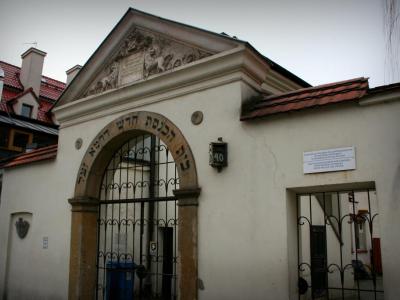
The Remah Synagogue was founded in the mid-16th century on the initiative of a Jewish merchant who dedicated the prayer house in memory of his wife and in honour of his son, Moses Isserles (better known by the acronym “ReMA”). Isserles became one of the most important scholars in Ashkenazi Judaism, and his commentaries on Jewish law remain influential to this day. Although the first wooden building was destroyed by fire, a masonry synagogue rose in its place around 1557, and the structure standing today largely reflects that period.
The synagogue is modest in size - among the smallest historic synagogues in Kraków - yet its authenticity compensates for its scale. Inside, original elements survive: the stone Torah ark from the 16th century, a donation box near the doorway once collected alms, and, after recent conservation, colourful wall and ceiling paintings have been revealed, including biblical motifs and zodiac symbols.
Beside the synagogue lies the Old Jewish Cemetery, whose gate can be found behind and to the right of the building, along a wall filled with memorial plaques. The cemetery was founded between 1535 and 1551, making it one of the oldest surviving Jewish cemeteries in Poland. Over the centuries, it served as the burial ground for many of Kraków’s most prominent rabbis, scholars, and community members - among them Moses Isserles himself.
During World War II, many tombstones were removed or destroyed, and the site was extensively damaged. After the war, renewed efforts led to the restoration of numerous gravestones - today roughly 700 are visible, richly carved with Hebrew inscriptions and traditional Jewish symbols. Walking slowly among these weathered monuments, visitors may notice ornamental motifs such as crowns (symbolising virtuous lives), grapevine leaves (signifying wisdom and maturity), or carved vessels marking graves of members of the Levite community.
Because Remah remains a functioning religious site, visitors are encouraged to treat it with respect: modest dress, a quiet demeanour, and appreciation for its dual role as a place of prayer and a site of memory. For anyone interested in Jewish heritage or simply quiet spaces that invite reflection, Remah offers a deeply human experience - modest in scale, profound in meaning.
The synagogue is modest in size - among the smallest historic synagogues in Kraków - yet its authenticity compensates for its scale. Inside, original elements survive: the stone Torah ark from the 16th century, a donation box near the doorway once collected alms, and, after recent conservation, colourful wall and ceiling paintings have been revealed, including biblical motifs and zodiac symbols.
Beside the synagogue lies the Old Jewish Cemetery, whose gate can be found behind and to the right of the building, along a wall filled with memorial plaques. The cemetery was founded between 1535 and 1551, making it one of the oldest surviving Jewish cemeteries in Poland. Over the centuries, it served as the burial ground for many of Kraków’s most prominent rabbis, scholars, and community members - among them Moses Isserles himself.
During World War II, many tombstones were removed or destroyed, and the site was extensively damaged. After the war, renewed efforts led to the restoration of numerous gravestones - today roughly 700 are visible, richly carved with Hebrew inscriptions and traditional Jewish symbols. Walking slowly among these weathered monuments, visitors may notice ornamental motifs such as crowns (symbolising virtuous lives), grapevine leaves (signifying wisdom and maturity), or carved vessels marking graves of members of the Levite community.
Because Remah remains a functioning religious site, visitors are encouraged to treat it with respect: modest dress, a quiet demeanour, and appreciation for its dual role as a place of prayer and a site of memory. For anyone interested in Jewish heritage or simply quiet spaces that invite reflection, Remah offers a deeply human experience - modest in scale, profound in meaning.
6) Tempel Synagogue (Synagoga Tempel)
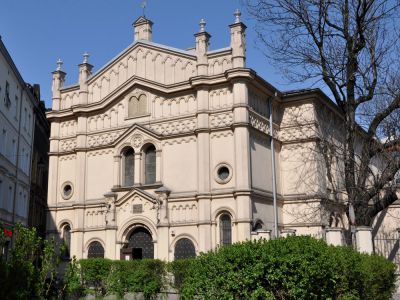
The Tempel Synagogue stands out as a vivid chapter in the city’s Jewish-life story, blending faith, architectural ambition, and cultural renewal under one roof. Built between 1860 and 1862 on Miodowa Street in the historic district of Kazimierz, it was designed in a style that mixes Moorish Revival and Renaissance Revival influences.
At the time, the synagogue served a Reform (or Progressive) Jewish congregation - a community open to cultural adaptation and liturgical innovation. Services included sermons in Polish and German, choirs (sometimes with women singing), and other elements that more conservative Orthodox communities rejected.
The building itself is distinctive: a central hall rises between lower side aisles, and the interior is richly decorated with polychrome paintings, gold leaf, and unusually colourful stained-glass windows. The windows - 36 in total - are among the best preserved of their kind in Poland.
As the synagogue is quite compact, its highlights can be easily observed. A white marble Torah ark sits in the eastern apse, visible as the furthest point from the entrance when you step inside. The ark’s marble structure and golden dome make it conspicuous, yet it blends seamlessly with the surrounding intricate ceiling and balcony designs. Speaking of the latter, two balconies frame the main hall, known collectively as the Women’s Gallery. As the name suggests, these balconies were designated for women and are embellished with floral motifs and decorative ironwork. Overall, the synagogue exudes a sense of regal grandeur, reminiscent of those in other European centres such as Budapest or Vienna.
During the Second World War, the synagogue suffered under German occupation: the building was repurposed as storage for ammunition and animals, and its religious function was suppressed. After the war, it gradually returned to use - a ritual bath was added in 1947, and although regular services continued for a time, they largely ceased after the 1980s.
Between 1995 and 2000, the synagogue underwent a thorough renovation, restoring both its exterior and interior. Today it remains a protected historical monument and an active venue for cultural events - concerts, gatherings, and especially programmes linked to the annual Jewish Culture Festival in Kraków.
At the time, the synagogue served a Reform (or Progressive) Jewish congregation - a community open to cultural adaptation and liturgical innovation. Services included sermons in Polish and German, choirs (sometimes with women singing), and other elements that more conservative Orthodox communities rejected.
The building itself is distinctive: a central hall rises between lower side aisles, and the interior is richly decorated with polychrome paintings, gold leaf, and unusually colourful stained-glass windows. The windows - 36 in total - are among the best preserved of their kind in Poland.
As the synagogue is quite compact, its highlights can be easily observed. A white marble Torah ark sits in the eastern apse, visible as the furthest point from the entrance when you step inside. The ark’s marble structure and golden dome make it conspicuous, yet it blends seamlessly with the surrounding intricate ceiling and balcony designs. Speaking of the latter, two balconies frame the main hall, known collectively as the Women’s Gallery. As the name suggests, these balconies were designated for women and are embellished with floral motifs and decorative ironwork. Overall, the synagogue exudes a sense of regal grandeur, reminiscent of those in other European centres such as Budapest or Vienna.
During the Second World War, the synagogue suffered under German occupation: the building was repurposed as storage for ammunition and animals, and its religious function was suppressed. After the war, it gradually returned to use - a ritual bath was added in 1947, and although regular services continued for a time, they largely ceased after the 1980s.
Between 1995 and 2000, the synagogue underwent a thorough renovation, restoring both its exterior and interior. Today it remains a protected historical monument and an active venue for cultural events - concerts, gatherings, and especially programmes linked to the annual Jewish Culture Festival in Kraków.
7) Wawel Royal Castle (must see)
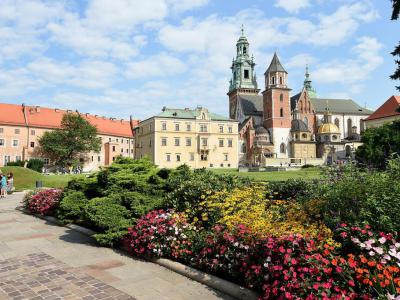
The Wawel Royal Castle stands as one of Poland’s most important historical landmarks, a castle hill complex that oversaw centuries of national, royal, and artistic history.
The hill on which Wawel sits has been inhabited since ancient times, but Wawel began taking shape as a seat of power in the early Middle Ages, with the earliest stone buildings appearing around the 11th–12th centuries. Over the following centuries, successive rulers transformed the residence. In the 14th century, under Casimir III the Great, the castle was fortified and rebuilt in a Gothic style, establishing the core structure that would survive in part to this day.
The 16th century brought a major transformation under Sigismund I the Old. He commissioned Italian architects to rebuild and expand the castle, turning it into a Renaissance-style palace - a shift that reshaped Wawel from a medieval fortress into a grand royal residence. Over time, Baroque and later architectural layers were added, so today the castle exhibits a blend of Romanesque, Gothic, Renaissance, and Baroque styles.
Wawel Royal Castle functions partly as a museum complex - the Wawel Royal Castle National Art Collection - offering access to royal apartments, state rooms, historic art, armor, furniture, tapestries, and a rich collection of paintings and decorative arts. Strolling through the arcade courtyard gives a sense of the Renaissance grandeur that reshaped the castle, while the various rooms and exhibitions reveal the lives of kings and the history of Polish statehood.
Among the standout attractions are the historic royal apartments and state chambers, furnishings, and art. For those interested in arms and military history, the museum’s collection of armor, weapons, and historic artifacts provides a vivid window into past conflicts and noble life. The castle’s collections also include fine tapestries, period furniture, ceramics, and decorative art - including items from across Europe and the Near East - showing Poland’s historical ties and international influences.
Beyond indoor treasures, the castle’s position on the hill beside the river, its layered architecture, and its atmosphere provide a strong sense of place - a fitting way to describe one of the earliest UNESCO World Heritage Sites.
The hill on which Wawel sits has been inhabited since ancient times, but Wawel began taking shape as a seat of power in the early Middle Ages, with the earliest stone buildings appearing around the 11th–12th centuries. Over the following centuries, successive rulers transformed the residence. In the 14th century, under Casimir III the Great, the castle was fortified and rebuilt in a Gothic style, establishing the core structure that would survive in part to this day.
The 16th century brought a major transformation under Sigismund I the Old. He commissioned Italian architects to rebuild and expand the castle, turning it into a Renaissance-style palace - a shift that reshaped Wawel from a medieval fortress into a grand royal residence. Over time, Baroque and later architectural layers were added, so today the castle exhibits a blend of Romanesque, Gothic, Renaissance, and Baroque styles.
Wawel Royal Castle functions partly as a museum complex - the Wawel Royal Castle National Art Collection - offering access to royal apartments, state rooms, historic art, armor, furniture, tapestries, and a rich collection of paintings and decorative arts. Strolling through the arcade courtyard gives a sense of the Renaissance grandeur that reshaped the castle, while the various rooms and exhibitions reveal the lives of kings and the history of Polish statehood.
Among the standout attractions are the historic royal apartments and state chambers, furnishings, and art. For those interested in arms and military history, the museum’s collection of armor, weapons, and historic artifacts provides a vivid window into past conflicts and noble life. The castle’s collections also include fine tapestries, period furniture, ceramics, and decorative art - including items from across Europe and the Near East - showing Poland’s historical ties and international influences.
Beyond indoor treasures, the castle’s position on the hill beside the river, its layered architecture, and its atmosphere provide a strong sense of place - a fitting way to describe one of the earliest UNESCO World Heritage Sites.
8) Wawel Cathedral (must see)
Wawel Cathedral in Kraków carries nearly a millennium of Polish history under its roof.
The earliest sacred building on the hill where the cathedral stands dates back to around the year 1000, when the local bishopric was established. That first church was replaced in the 12th century by a Romanesque basilica, consecrated in 1142. After that structure was destroyed by fire in 1305, a new cathedral was built - the building whose core survives today. Construction of the present Gothic-style nave and chancel began in the early 14th century and the church was consecrated in 1364.
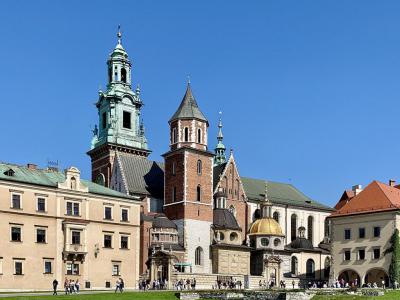
Over the centuries, successive rulers and church dignitaries added chapels, tombs, and artistic touches. This gradual layering resulted in a rich mix of architectural styles: you’ll see Gothic foundations alongside Renaissance and Baroque chapels, Renaissance-era domes and neoclassical details reflecting later modifications. As soon as the cathedral enters your view, you will notice the varied exterior. There is a golden dome, a black dome, a traditional brick tower and two other brick towers topped by jade-green helmets.
Wawel Cathedral offers many points of interest. Among the highlights is Sigismund's Chapel - a Renaissance masterpiece sometimes hailed as “the most beautiful example of Tuscan Renaissance architecture north of the Alps.” Once you step inside the cathedral, the chapel can be reached by turning right into the south aisle. After passing a series of chapels marked by plaques, you will notice a wooden-like fence with a door at its center. That is the entrance to Sigismund's Chapel. Inside, ornate sculptures and the royal tombs of Sigismund I and his son Sigismund II Augustus reflect the wealth and power of the era when Poland was a leading European kingdom. From outside, Sigismund's Chapel is located under the aforementioned golden dome.
It is recommended that you also visit the crypts and tombs beneath the cathedral as this is where many of Poland’s kings, national heroes, and cultural icons rest.
Another compelling attraction of the cathedral is the Sigismund Bell - one of Poland’s most famous bells. It can be reached by turning left from the main altar and then right. A black crucifix is placed on the left wall and to its left there is a door which is the entrance to the bell tower. The massive bell is found at the top of the tower. Cast in the 16th century, its deep toll has echoed across generations and the bell remains an important symbol of national history.
The earliest sacred building on the hill where the cathedral stands dates back to around the year 1000, when the local bishopric was established. That first church was replaced in the 12th century by a Romanesque basilica, consecrated in 1142. After that structure was destroyed by fire in 1305, a new cathedral was built - the building whose core survives today. Construction of the present Gothic-style nave and chancel began in the early 14th century and the church was consecrated in 1364.
Over the centuries, successive rulers and church dignitaries added chapels, tombs, and artistic touches. This gradual layering resulted in a rich mix of architectural styles: you’ll see Gothic foundations alongside Renaissance and Baroque chapels, Renaissance-era domes and neoclassical details reflecting later modifications. As soon as the cathedral enters your view, you will notice the varied exterior. There is a golden dome, a black dome, a traditional brick tower and two other brick towers topped by jade-green helmets.
Wawel Cathedral offers many points of interest. Among the highlights is Sigismund's Chapel - a Renaissance masterpiece sometimes hailed as “the most beautiful example of Tuscan Renaissance architecture north of the Alps.” Once you step inside the cathedral, the chapel can be reached by turning right into the south aisle. After passing a series of chapels marked by plaques, you will notice a wooden-like fence with a door at its center. That is the entrance to Sigismund's Chapel. Inside, ornate sculptures and the royal tombs of Sigismund I and his son Sigismund II Augustus reflect the wealth and power of the era when Poland was a leading European kingdom. From outside, Sigismund's Chapel is located under the aforementioned golden dome.
It is recommended that you also visit the crypts and tombs beneath the cathedral as this is where many of Poland’s kings, national heroes, and cultural icons rest.
Another compelling attraction of the cathedral is the Sigismund Bell - one of Poland’s most famous bells. It can be reached by turning left from the main altar and then right. A black crucifix is placed on the left wall and to its left there is a door which is the entrance to the bell tower. The massive bell is found at the top of the tower. Cast in the 16th century, its deep toll has echoed across generations and the bell remains an important symbol of national history.
9) Rynek Główny (Main Square) (must see)
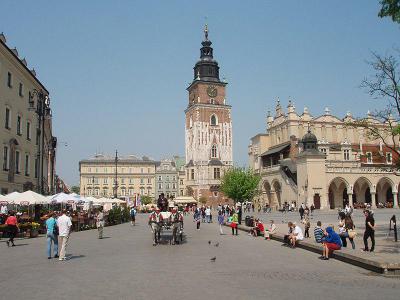
Kraków’s Main Square is the largest medieval square in Europe, serving as the vibrant heart of the city for more than 750 years. Covering nearly 40,000 square meters, it was laid out in 1257 after the Mongol invasion, when Kraków was rebuilt according to a new urban plan that emphasized order, trade, and civic life. The square quickly became the centre of commerce and public events, surrounded by merchant houses, noble residences, and key municipal buildings. Over the centuries, it has witnessed royal ceremonies, markets, festivals, uprisings-everything under the sun.
At the center of the square stands the Cloth Hall, a Renaissance trading hall that once formed part of the city’s major commercial network. Today, it houses craft stalls on the ground floor and an art gallery upstairs, continuing its tradition as a marketplace. Nearby rises the iconic St. Mary’s Basilica, distinguished by its two asymmetrical towers.
Elegant palaces line the perimeter, many now home to museums, cafés, and restaurants. Beneath the square, the Rynek Underground Museum reveals archaeological traces of medieval market stalls, roads, and merchant activity, immersing visitors in the city’s early urban history.
At the center of the square stands the Cloth Hall, a Renaissance trading hall that once formed part of the city’s major commercial network. Today, it houses craft stalls on the ground floor and an art gallery upstairs, continuing its tradition as a marketplace. Nearby rises the iconic St. Mary’s Basilica, distinguished by its two asymmetrical towers.
Elegant palaces line the perimeter, many now home to museums, cafés, and restaurants. Beneath the square, the Rynek Underground Museum reveals archaeological traces of medieval market stalls, roads, and merchant activity, immersing visitors in the city’s early urban history.
10) Sukiennice (Cloth Hall) (must see)
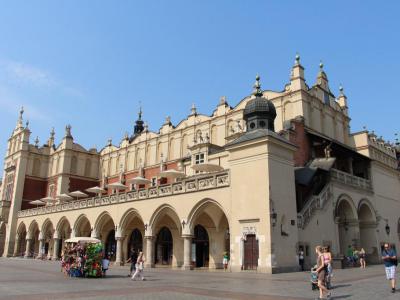
The Cloth Hall is a masterpiece of Renaissance architecture standing at the heart of the Main Square. Its origins go back to the 13th century, when a long, narrow market hall was built to house textile merchants who traded cloth, leather, and luxury fabrics from across Europe and the East. After a devastating fire in 1555, the building was rebuilt in the elegant Renaissance style that defines it today, complete with arcaded loggias, decorative attic parapets, and richly sculpted ornamentation designed by Italian architects working in Poland.
For centuries, the Cloth Hall was the commercial engine of Kraków. Merchants gathered here to exchange textiles, spices, wax, salt from the nearby mines, and exotic goods brought along the Silk Road routes. The ground floor remained a bustling trading space well into modern times, featuring the same rows of wooden merchant stalls seen centuries ago. Today, these stalls sell traditional crafts, handmade jewelry, carved wooden items, amber products, and local souvenirs. There is no shortage of things to browse.
Above the market hall, the upper floor houses a branch of the National Museum known as the Gallery of 19th-Century Polish Art. Its beautifully restored exhibition halls display works by celebrated painters such as Jan Matejko and Józef Mehoffer, giving visitors a chance to explore Poland’s Romantic and realist movements in a suitably grand setting. The gallery’s windows also offer charming views across the Main Square.
For centuries, the Cloth Hall was the commercial engine of Kraków. Merchants gathered here to exchange textiles, spices, wax, salt from the nearby mines, and exotic goods brought along the Silk Road routes. The ground floor remained a bustling trading space well into modern times, featuring the same rows of wooden merchant stalls seen centuries ago. Today, these stalls sell traditional crafts, handmade jewelry, carved wooden items, amber products, and local souvenirs. There is no shortage of things to browse.
Above the market hall, the upper floor houses a branch of the National Museum known as the Gallery of 19th-Century Polish Art. Its beautifully restored exhibition halls display works by celebrated painters such as Jan Matejko and Józef Mehoffer, giving visitors a chance to explore Poland’s Romantic and realist movements in a suitably grand setting. The gallery’s windows also offer charming views across the Main Square.
11) Underground Main Square Museum (must see)
The Underground Main Square Museum spans almost 4,000 square meters and offers a rare chance to walk beneath the city’s medieval heart and explore centuries of buried history. Opened in 2010 after an extensive archaeological excavation, the museum was created when researchers discovered remarkably well-preserved layers of Kraków’s early marketplace beneath the current Main Square. These findings included foundations of medieval buildings, merchant stalls, workshop areas, and even the remnants of an earlier square that existed before the one laid out after the Mongol invasion of 1241.
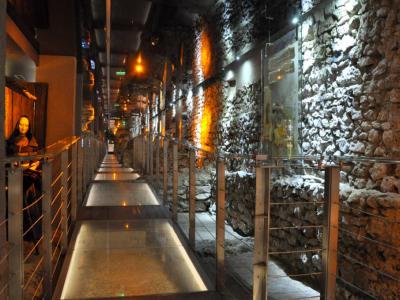
The museum is designed as an immersive archaeological park that reveals how life in Kraków unfolded between the 11th and 18th centuries. Interactive exhibits, holograms, and multimedia reconstructions help visitors visualize the medieval trading hub that once thrived above. Among the most significant discoveries are the remains of wooden roads, stone market stalls, and traces of blacksmiths’ and goldsmiths’ workshops. One of the museum’s highlights is the preserved section of ancient city walls and a defensive walkway used by guards who protected the bustling market.
As you walk around the museum, you can also see artifacts uncovered during the excavation-coins, tools, jewelry, toys, and everyday objects that illuminate the daily routines of medieval townspeople. The museum cleverly places these items within archaeological layers, giving a sense of walking through history rather than simply observing it. Glass walkways let you peer directly down onto excavated structures, creating a dynamic connection to the past.
Another notable feature is the reconstructed medieval cemetery and the remains of a merchant’s house, offering insight into how people lived, traded, and moved through the city centuries ago.
Throughout the exhibits, atmospheric lighting, soundscapes, and historical maps reinforce the feeling of descending into Kraków’s buried world.
The museum is designed as an immersive archaeological park that reveals how life in Kraków unfolded between the 11th and 18th centuries. Interactive exhibits, holograms, and multimedia reconstructions help visitors visualize the medieval trading hub that once thrived above. Among the most significant discoveries are the remains of wooden roads, stone market stalls, and traces of blacksmiths’ and goldsmiths’ workshops. One of the museum’s highlights is the preserved section of ancient city walls and a defensive walkway used by guards who protected the bustling market.
As you walk around the museum, you can also see artifacts uncovered during the excavation-coins, tools, jewelry, toys, and everyday objects that illuminate the daily routines of medieval townspeople. The museum cleverly places these items within archaeological layers, giving a sense of walking through history rather than simply observing it. Glass walkways let you peer directly down onto excavated structures, creating a dynamic connection to the past.
Another notable feature is the reconstructed medieval cemetery and the remains of a merchant’s house, offering insight into how people lived, traded, and moved through the city centuries ago.
Throughout the exhibits, atmospheric lighting, soundscapes, and historical maps reinforce the feeling of descending into Kraków’s buried world.
12) Basilica of St. Mary (must see)
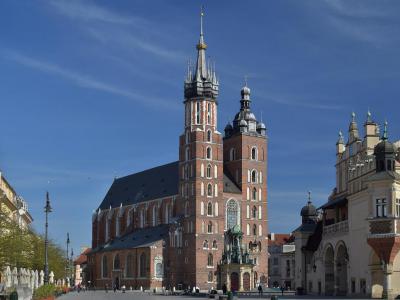
Saint Mary's Basilica is one of the city’s most iconic landmarks, rising over the Main Market Square with its distinctive pair of uneven towers. Its history stretches back to the early 13th century, when the original church was built on the foundations of an even earlier Romanesque structure. After the Mongol invasion of 1241 left much of Kraków in ruins, the church was rebuilt in Gothic style, taking on its recognizable form. Over the following centuries, it became one of the most important religious and artistic centers in the city.
Once you find yourself in front of the church, you can clearly see that the left tower is the taller one. In terms of design, it is more intricate than the right one, and its helmet has sharper spires. As you step inside, you will notice the soaring vaulted ceiling painted a deep blue and dotted with gold stars, creating a cosmic effect that draws the eye upward. However, the church’s most celebrated treasure is the monumental wooden altarpiece carved by German sculptor Veit Stoss in the late 15th century. Even though it is visible as soon as you enter the church, its beauty is best admired up close. The famous altarpiece can be found under the chancel opening, which is marked by a huge cross. Considered one of the greatest Gothic sculptures in Europe, the altarpiece depicts scenes from the life of the Virgin Mary in extraordinary detail, with dozens of figures carved from linden wood and highlighted with bold colors and gold leaf.
Another highlight is the basilica’s stained-glass windows, including some of Poland’s finest examples of medieval and 19th-century glasswork. The most impressive windows can be observed behind and beside the Veit Stoss masterpiece. Moreover, richly decorated chapels line the nave, showcasing centuries of donations by wealthy patrons, guilds, and noble families.
Outside, the basilica’s taller tower reveals its more distinct function. From this tower, every hour, a trumpeter plays a brief melody that ends abruptly, commemorating a legendary trumpeter who was shot while warning the city of a Mongol attack. The live performance of this bugle call remains one of Kraków’s most beloved traditions. Don’t miss it.
Once you find yourself in front of the church, you can clearly see that the left tower is the taller one. In terms of design, it is more intricate than the right one, and its helmet has sharper spires. As you step inside, you will notice the soaring vaulted ceiling painted a deep blue and dotted with gold stars, creating a cosmic effect that draws the eye upward. However, the church’s most celebrated treasure is the monumental wooden altarpiece carved by German sculptor Veit Stoss in the late 15th century. Even though it is visible as soon as you enter the church, its beauty is best admired up close. The famous altarpiece can be found under the chancel opening, which is marked by a huge cross. Considered one of the greatest Gothic sculptures in Europe, the altarpiece depicts scenes from the life of the Virgin Mary in extraordinary detail, with dozens of figures carved from linden wood and highlighted with bold colors and gold leaf.
Another highlight is the basilica’s stained-glass windows, including some of Poland’s finest examples of medieval and 19th-century glasswork. The most impressive windows can be observed behind and beside the Veit Stoss masterpiece. Moreover, richly decorated chapels line the nave, showcasing centuries of donations by wealthy patrons, guilds, and noble families.
Outside, the basilica’s taller tower reveals its more distinct function. From this tower, every hour, a trumpeter plays a brief melody that ends abruptly, commemorating a legendary trumpeter who was shot while warning the city of a Mongol attack. The live performance of this bugle call remains one of Kraków’s most beloved traditions. Don’t miss it.
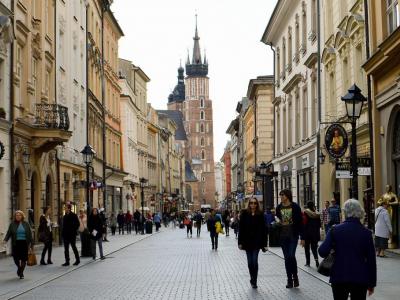
13) Florianska Street (must see)
Florianska Street is one of Kraków’s most famous thoroughfares, forming a key part of the historic Royal Route that once guided Polish kings from the city walls to Wawel Castle. Its origins go back to the city’s 13th-century reconstruction, when Kraków was rebuilt on a grid plan after the Mongol invasion of 1241. The street takes its name from St. Florian’s Church, located just outside the northern gate, and it quickly became one of the city’s busiest commercial arteries. By the late Middle Ages, the street was lined with the homes and workshops of merchants, craftsmen, and wealthy burghers whose fortunes were tied to the bustling Main Square nearby.
Over the centuries, Florianska Street developed into a showcase of Kraków’s architectural evolution. Many of the townhouses still standing today preserve Gothic foundations beneath Renaissance or Baroque façades, while several buildings feature ornate portals, painted ceilings, and preserved courtyards hidden behind unassuming entrances. Among its most notable sites is the famed Jama Michalika Cafe, a meeting place for early 20th-century artists and writers of the Young Poland movement. The street is also home to the Pharmacy Museum, displaying centuries of medical history within an authentic 14th-century building.
Florianska Street is above all an atmospheric passageway that leads straight from the medieval Barbican and St. Florian’s Gate into the Main Market Square. Shops, cafes, bookshops, amber boutiques, and bakeries line the route, making it one of the liveliest pedestrian streets in the Old Town. Street musicians often perform beneath the historic arches, and the view from the gate toward the twin towers of St. Mary’s Basilica is one of the most photographed perspectives in Kraków.
Over the centuries, Florianska Street developed into a showcase of Kraków’s architectural evolution. Many of the townhouses still standing today preserve Gothic foundations beneath Renaissance or Baroque façades, while several buildings feature ornate portals, painted ceilings, and preserved courtyards hidden behind unassuming entrances. Among its most notable sites is the famed Jama Michalika Cafe, a meeting place for early 20th-century artists and writers of the Young Poland movement. The street is also home to the Pharmacy Museum, displaying centuries of medical history within an authentic 14th-century building.
Florianska Street is above all an atmospheric passageway that leads straight from the medieval Barbican and St. Florian’s Gate into the Main Market Square. Shops, cafes, bookshops, amber boutiques, and bakeries line the route, making it one of the liveliest pedestrian streets in the Old Town. Street musicians often perform beneath the historic arches, and the view from the gate toward the twin towers of St. Mary’s Basilica is one of the most photographed perspectives in Kraków.
