Custom Walk in Rhodes, Greece by jjseres_06_a7d464 created on 2026-06-14
Guide Location: Greece » Rhodes
Guide Type: Custom Walk
# of Sights: 14
Tour Duration: 3 Hour(s)
Travel Distance: 4.8 Km or 3 Miles
Share Key: QKF4X
Guide Type: Custom Walk
# of Sights: 14
Tour Duration: 3 Hour(s)
Travel Distance: 4.8 Km or 3 Miles
Share Key: QKF4X
How It Works
Please retrieve this walk in the GPSmyCity app. Once done, the app will guide you from one tour stop to the next as if you had a personal tour guide. If you created the walk on this website or come to the page via a link, please follow the instructions below to retrieve the walk in the app.
Retrieve This Walk in App
Step 1. Download the app "GPSmyCity: Walks in 1K+ Cities" on Apple App Store or Google Play Store.



Step 2. In the GPSmyCity app, download(or launch) the guide "Rhodes Map and Walking Tours".
Step 3. Tap the menu button located at upper right corner of the "Walks" screen and select "Retrieve custom walk". Enter the share key: QKF4X
1) Street of the Knights (must see)
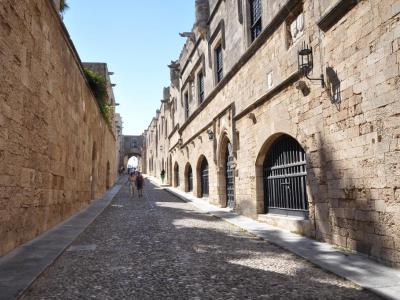
The Street of the Knights is lined with the former inns of the Knights Hospitaller, each once housing members of a specific langue of the Order. The street is widely regarded as one of the best-preserved medieval streets in Europe, notable for the coherence of its architecture and its limited later alteration. The buildings on both sides are constructed primarily of local limestone, carefully dressed to present a unified and imposing facade that remains consistent from start to finish.
At the upper end of the street, immediately after leaving the Palace of the Grand Master, the route is visually anchored by a stone archway spanning the roadway, marking the transition from the palace complex into the residential quarter of the Knights. As you proceed downhill along the center of the street, the facades are punctuated by small square windows set high in the walls and arched doorways at ground level, proportioned to admit mounted riders or carts. Along the way, carved coats of arms, inscriptions, and commemorative plaques appear on both sides, identifying individual patrons and phases of construction as you continue toward the lower town.
Roughly halfway down the street, the Inn of France comes into view on your left-hand side. Continuing toward the lower end of the street, look across to your left to see a small enclosed garden with an Ottoman fountain. This garden forms part of the courtyard of the 15th-century Villaragut Mansion, restored in 2002. The courtyard is generally closed to the public and accessible only on special occasions or through institutional arrangements. Near the lower end of the street, on the north side, the route opens toward the Archaeological Museum of Rhodes, housed in the former Knights’ Hospital.
During the day, as you walk this stretch, the street is heavily trafficked by visitors and tour groups, which can obscure its original function as a ceremonial and administrative route linking the Knights’ residences to the Palace of the Grand Master. In the evening, with fewer people moving along the route, the architectural sequence, from palace to inns to lower town, becomes easier to read, clearly revealing the street’s original role within the medieval city.
At the upper end of the street, immediately after leaving the Palace of the Grand Master, the route is visually anchored by a stone archway spanning the roadway, marking the transition from the palace complex into the residential quarter of the Knights. As you proceed downhill along the center of the street, the facades are punctuated by small square windows set high in the walls and arched doorways at ground level, proportioned to admit mounted riders or carts. Along the way, carved coats of arms, inscriptions, and commemorative plaques appear on both sides, identifying individual patrons and phases of construction as you continue toward the lower town.
Roughly halfway down the street, the Inn of France comes into view on your left-hand side. Continuing toward the lower end of the street, look across to your left to see a small enclosed garden with an Ottoman fountain. This garden forms part of the courtyard of the 15th-century Villaragut Mansion, restored in 2002. The courtyard is generally closed to the public and accessible only on special occasions or through institutional arrangements. Near the lower end of the street, on the north side, the route opens toward the Archaeological Museum of Rhodes, housed in the former Knights’ Hospital.
During the day, as you walk this stretch, the street is heavily trafficked by visitors and tour groups, which can obscure its original function as a ceremonial and administrative route linking the Knights’ residences to the Palace of the Grand Master. In the evening, with fewer people moving along the route, the architectural sequence, from palace to inns to lower town, becomes easier to read, clearly revealing the street’s original role within the medieval city.
2) Temple of Aphrodite
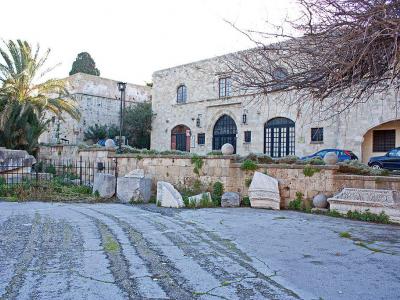
Stand on Symi Square, the remains of what is commonly identified as the Temple of Aphrodite, recall the importance of the ancient city that once occupied this area, although only fragments survive today. The sanctuary is generally dated to the Hellenistic period, around the 3rd century BC, and is associated with the cult of Aphrodite, the Greek goddess of love and beauty.
Archaeological evidence suggests that this location formed part of a broader sacred complex near the ancient harbor zone, an area closely connected to civic and religious life. A statue traditionally identified as Greek goddess Aphrodite, now housed in the Archaeological Museum of Rhodes, is often linked to the sanctuary and is believed by some scholars to have originated from this area.
Today, the remains of the former temple are enclosed by a low protective fence. While the site itself is not accessible to the public, an information board positioned outside the enclosure provides an overview of the sanctuary and its historical context. The explanatory text is presented in both Greek and English.
Visitors who linger at the temple's perimeter can still observe sections of ancient masonry, reused building blocks, and fragments of fallen columns. With careful attention, it is possible to discern traces of inscriptions on some of the surviving stone slabs, offering a tangible link to the sacred landscape of ancient Rhodes that once extended well beyond the medieval walls.
Archaeological evidence suggests that this location formed part of a broader sacred complex near the ancient harbor zone, an area closely connected to civic and religious life. A statue traditionally identified as Greek goddess Aphrodite, now housed in the Archaeological Museum of Rhodes, is often linked to the sanctuary and is believed by some scholars to have originated from this area.
Today, the remains of the former temple are enclosed by a low protective fence. While the site itself is not accessible to the public, an information board positioned outside the enclosure provides an overview of the sanctuary and its historical context. The explanatory text is presented in both Greek and English.
Visitors who linger at the temple's perimeter can still observe sections of ancient masonry, reused building blocks, and fragments of fallen columns. With careful attention, it is possible to discern traces of inscriptions on some of the surviving stone slabs, offering a tangible link to the sacred landscape of ancient Rhodes that once extended well beyond the medieval walls.
3) Eleftherias (Liberty) Gate
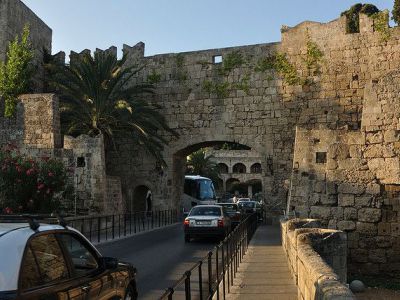
Sitting directly in front of Symi Square, Liberty Gate marks one of the main entrances into the Medieval Town of Rhodes. The original gate on this site dates to the time of Grand Master Juan Fernández de Heredia and linked the northern stretch of the seafront walls with Mandraki Harbor. In medieval sources, it was commonly associated with the nearby shipyards and arsenal of the Knights Hospitaller and was often referred to as the Shipyard Gate or the Shipyard Vaults.
Two square towers once flanked the gate on either side. One of them is believed to be depicted on the coat of arms of Grand Master Pierre d’Aubusson. The gate itself shows clear Byzantine architectural influence, and its generous dimensions indicate its intended function: allowing the passage of large ship components or heavy equipment between the harbor and the nearby shipyards.
During the Ottoman period, the gate appears to have retained a functional role connected to the adjacent waterfront. Some sources suggest that it may have incorporated a bridge-like structure spanning water linked to a small enclosed basin known in Turkish as Eğri Liman, meaning “Concealed Harbor”, though the exact configuration remains a matter of scholarly interpretation.
The ramparts visible above the gate today date from the period of Italian rule. After taking control of Rhodes during the Italo-Turkish War, the Italians undertook extensive restoration and reconstruction of the medieval fortifications. In 1924, they created the present Liberty Gate, presenting themselves as liberators from Ottoman rule and deliberately choosing a name charged with political symbolism.
Two square towers once flanked the gate on either side. One of them is believed to be depicted on the coat of arms of Grand Master Pierre d’Aubusson. The gate itself shows clear Byzantine architectural influence, and its generous dimensions indicate its intended function: allowing the passage of large ship components or heavy equipment between the harbor and the nearby shipyards.
During the Ottoman period, the gate appears to have retained a functional role connected to the adjacent waterfront. Some sources suggest that it may have incorporated a bridge-like structure spanning water linked to a small enclosed basin known in Turkish as Eğri Liman, meaning “Concealed Harbor”, though the exact configuration remains a matter of scholarly interpretation.
The ramparts visible above the gate today date from the period of Italian rule. After taking control of Rhodes during the Italo-Turkish War, the Italians undertook extensive restoration and reconstruction of the medieval fortifications. In 1924, they created the present Liberty Gate, presenting themselves as liberators from Ottoman rule and deliberately choosing a name charged with political symbolism.
4) Fort of St. Nicholas (must see)
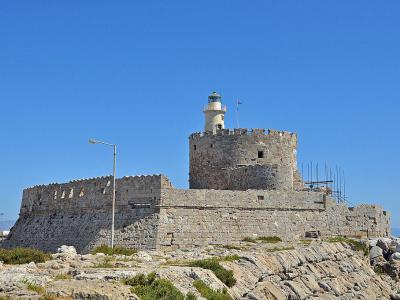
The Fort of Saint Nicholas stands at the end of the Mandráki breakwater, guarding the entrance to the harbor and marking one of the most strategically important points in Rhodes’ medieval defenses. In the early 15th century, the site was initially occupied by a guard tower built by the Knights Hospitaller to control access to the port. Following the Ottoman siege of 1480, the tower was substantially reinforced and expanded into a fortified structure designed to withstand artillery attack. The completed fort took its name from a chapel dedicated to Saint Nicholas located within its walls.
The fort played a significant defensive role during the sieges of 1480 and 1522. In 1480, the strengthened harbor defenses helped repel the Ottoman assault, allowing the Knights to retain control of Rhodes. During the second siege in 1522, however, the Ottomans eventually forced the Knights’ surrender, leading to their departure from the island in early 1523.
The fortification was designed specifically to counter the increasing use of cannon warfare, with thick masonry walls and a compact layout that reduced exposure to direct fire. Much of this structure remains intact, contributing to the fort’s strong visual presence at the harbor entrance. In later periods, the fort continued to serve military purposes and was adapted during World War II, after which a lighthouse was installed to guide vessels entering Mandráki Harbor.
Today, the Fort of Saint Nicholas is primarily appreciated from the outside. Visitors can walk along the breakwater leading to the fort, which follows the line of earlier defensive works and offers views back toward Mandráki Harbor, the medieval walls, and the windmills. This route provides a clear sense of the fort’s role within the wider harbor defense system and its enduring place in the maritime landscape of Rhodes.
The fort played a significant defensive role during the sieges of 1480 and 1522. In 1480, the strengthened harbor defenses helped repel the Ottoman assault, allowing the Knights to retain control of Rhodes. During the second siege in 1522, however, the Ottomans eventually forced the Knights’ surrender, leading to their departure from the island in early 1523.
The fortification was designed specifically to counter the increasing use of cannon warfare, with thick masonry walls and a compact layout that reduced exposure to direct fire. Much of this structure remains intact, contributing to the fort’s strong visual presence at the harbor entrance. In later periods, the fort continued to serve military purposes and was adapted during World War II, after which a lighthouse was installed to guide vessels entering Mandráki Harbor.
Today, the Fort of Saint Nicholas is primarily appreciated from the outside. Visitors can walk along the breakwater leading to the fort, which follows the line of earlier defensive works and offers views back toward Mandráki Harbor, the medieval walls, and the windmills. This route provides a clear sense of the fort’s role within the wider harbor defense system and its enduring place in the maritime landscape of Rhodes.
5) Hippocrates Square
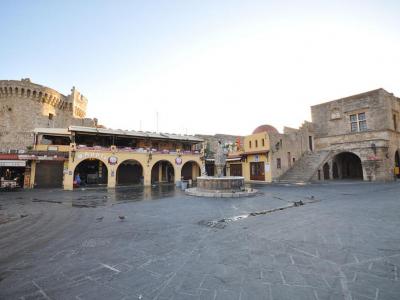
Upon entering the Old Town through the Marine Gate and its imposing towers, visitors arrive at Hippocrates Square, a natural starting point for exploring this UNESCO World Heritage Site. The square functions as one of the Old Town’s main gathering places and is centered on the Syndriváni, a fountain introduced during the Italian period, easily recognized by its decorative upper element and the pigeons that congregate around it.
Standing at the southeastern corner, the long, arcaded facade belongs to the Kastellanía, originally the commercial tribunal and courthouse of the Knights Hospitaller. Completed in 1507 and restored during the Italian administration between 1925 and 1935, the building now houses the municipal library and historical archives. On the northern side stands the small Syndriváni Mosque, a modest Ottoman-era structure dating to the late 18th century.
Turning your attention to the western side of the square, Socrates Street begins here, drawing visitors deeper into the Old Town. The surrounding buildings are a mix of medieval structures and later Ottoman- and Italian-period adaptations, many featuring arcades at street level and upper floors converted into cafes, shops, and terraces. Several of these buildings incorporate reused medieval stonework, visible in door frames and wall sections.
Standing at the southeastern corner, the long, arcaded facade belongs to the Kastellanía, originally the commercial tribunal and courthouse of the Knights Hospitaller. Completed in 1507 and restored during the Italian administration between 1925 and 1935, the building now houses the municipal library and historical archives. On the northern side stands the small Syndriváni Mosque, a modest Ottoman-era structure dating to the late 18th century.
Turning your attention to the western side of the square, Socrates Street begins here, drawing visitors deeper into the Old Town. The surrounding buildings are a mix of medieval structures and later Ottoman- and Italian-period adaptations, many featuring arcades at street level and upper floors converted into cafes, shops, and terraces. Several of these buildings incorporate reused medieval stonework, visible in door frames and wall sections.
6) Church of the Virgin of the Burgh
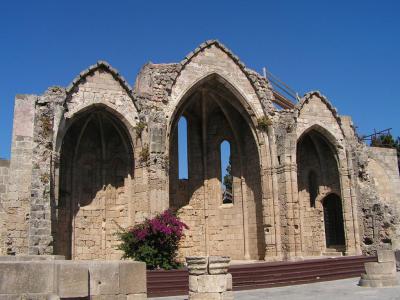
Near the Gate of the Virgin, stand the remains of the Church of the Virgin of the Burgh, a Gothic Roman Catholic church dating to the 14th century. It was constructed during the early period of Hospitaller rule and served the Latin Christian population living outside the Knights’ administrative quarter.
Following the Ottoman conquest of Rhodes in 1522, the church was converted into a mosque. The structure suffered extensive damage during World War II, particularly during bombing raids in 1944, which led to its partial collapse. Despite this destruction, the surviving remains still convey the scale and ambition of its original Gothic design.
The term “Burgh” derives from the bourgeois, or civilian population of this district, distinguishing it from the fortified Collachium of the Knights. The church’s location and history reflect its role as a focal point for the non-knightly community within the medieval city. Today, what remains visible are the three eastern apses and fragments of adjoining chapels, making the site one of the few surviving examples of a medieval Latin church in the Dodecanese.
Following the Ottoman conquest of Rhodes in 1522, the church was converted into a mosque. The structure suffered extensive damage during World War II, particularly during bombing raids in 1944, which led to its partial collapse. Despite this destruction, the surviving remains still convey the scale and ambition of its original Gothic design.
The term “Burgh” derives from the bourgeois, or civilian population of this district, distinguishing it from the fortified Collachium of the Knights. The church’s location and history reflect its role as a focal point for the non-knightly community within the medieval city. Today, what remains visible are the three eastern apses and fragments of adjoining chapels, making the site one of the few surviving examples of a medieval Latin church in the Dodecanese.
7) Jewish Museum of Rhodes
The Jewish presence on Rhodes can be traced back to at least the 2nd century BC, making it one of the oldest continuously attested Jewish communities in the eastern Mediterranean. By the 12th century, the traveler Rabbi Benjamin of Tudela recorded a Jewish population of approximately 400 to 500 people living on the island. A decisive transformation came after 1492, when Sephardic Jews expelled from Spain settled in Rhodes in large numbers. Their arrival shaped the community’s language, customs, and identity, giving rise to Ladino, a distinctive dialect blending Old Spanish with Hebrew and influences from the wider Mediterranean world.
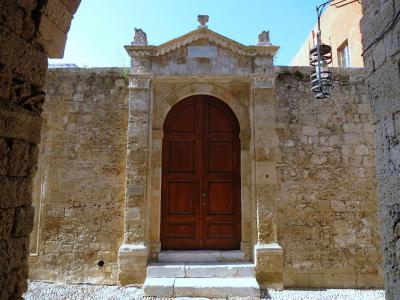
Accessible through the Kahal Shalom Synagogue, the Jewish Museum of Rhodes presents the history of this community through photographs, documents, and personal objects drawn from everyday life. The exhibition traces centuries of religious practice, family life, education, and trade, while also addressing the community’s tragic fate during World War II, when the Jews of Rhodes were deported to Auschwitz in 1944.
The museum’s collection includes historic Torah scrolls, traditional clothing, ritual objects, and textiles, complemented by clear explanatory panels that place these items in their social and historical context.
Accessible through the Kahal Shalom Synagogue, the Jewish Museum of Rhodes presents the history of this community through photographs, documents, and personal objects drawn from everyday life. The exhibition traces centuries of religious practice, family life, education, and trade, while also addressing the community’s tragic fate during World War II, when the Jews of Rhodes were deported to Auschwitz in 1944.
The museum’s collection includes historic Torah scrolls, traditional clothing, ritual objects, and textiles, complemented by clear explanatory panels that place these items in their social and historical context.
8) Kahal Shalom Synagogue (must see)
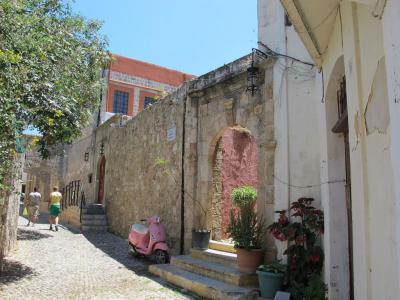
Completed in 1577, Kahal Shalom is the oldest surviving synagogue in Greece that remains in active use. Standing at the entrance to the synagogue complex, you step into a space that served a thriving Sephardic Jewish community for centuries under Ottoman rule. After the Dodecanese Islands passed to Italy in 1912, Jewish life continued, but conditions gradually changed. During the 1930s, particularly after the introduction of Fascist racial laws, many Jews of Rhodes began to emigrate, sensing growing hostility and uncertainty.
Entering the sanctuary, the central bimah stands directly ahead, positioned at the center of the prayer hall, in keeping with Sephardic tradition. Looking down, the black-and-white pebble mosaic floor, crafted from local stone, spreads across the interior and immediately distinguishes the space. Standing next to the wall opposite the entrance, there are the synagogue’s two Torah arks, set side by side, an unusual feature of Rhodes’ Jewish architecture.
Exiting the prayer hall into the courtyard, the atmosphere opens up. Here, slightly to the left side of the courtyard, stands a small fountain traditionally used for ritual handwashing, marking the transition between communal and sacred spaces. Nearby, mounted on the interior walls, a commemorative plaque honors the members of the local Jewish community who were deported and murdered during the Holocaust.
The former women’s gallery, located on the upper level of the synagogue building, now houses the Jewish Museum of Rhodes, where visitors can continue their visit by exploring photographs, documents, and artifacts that preserve the history, traditions, and daily life of the island’s once-thriving Jewish community.
Entering the sanctuary, the central bimah stands directly ahead, positioned at the center of the prayer hall, in keeping with Sephardic tradition. Looking down, the black-and-white pebble mosaic floor, crafted from local stone, spreads across the interior and immediately distinguishes the space. Standing next to the wall opposite the entrance, there are the synagogue’s two Torah arks, set side by side, an unusual feature of Rhodes’ Jewish architecture.
Exiting the prayer hall into the courtyard, the atmosphere opens up. Here, slightly to the left side of the courtyard, stands a small fountain traditionally used for ritual handwashing, marking the transition between communal and sacred spaces. Nearby, mounted on the interior walls, a commemorative plaque honors the members of the local Jewish community who were deported and murdered during the Holocaust.
The former women’s gallery, located on the upper level of the synagogue building, now houses the Jewish Museum of Rhodes, where visitors can continue their visit by exploring photographs, documents, and artifacts that preserve the history, traditions, and daily life of the island’s once-thriving Jewish community.
9) Recep Pasha Mosque
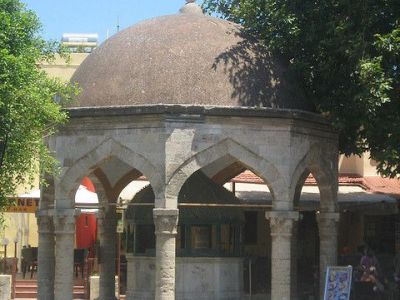
Constructed in 1588, the Reçep Pasha Mosque is one of the earliest Ottoman monuments within the walled city of Rhodes. It was commissioned by Reçep Pasha, then governor of the island, during a period when Ottoman architectural forms were firmly established across the eastern Mediterranean. As was common practice at the time, the mosque incorporates spolia, using architectural elements taken from earlier structures, including Christian buildings, without clear evidence of a single church having stood directly on the site.
The mosque complex originally included several associated elements: a courtyard, an ablution fountain, and a mausoleum containing the sarcophagus of Reçep Pasha himself. The mausoleum remains visible within the courtyard and forms an integral part of the ensemble, reflecting Ottoman funerary traditions that linked religious patronage with personal commemoration.
Over the past decades, however, the building has suffered from prolonged neglect. As a result, the mosque has remained closed and is considered structurally unsafe. Despite its deteriorated state, the Reçep Pasha Mosque is widely regarded as one of the most refined examples of Ottoman religious architecture in Rhodes, notable for its proportions, courtyard layout, and historical importance.
The mosque complex originally included several associated elements: a courtyard, an ablution fountain, and a mausoleum containing the sarcophagus of Reçep Pasha himself. The mausoleum remains visible within the courtyard and forms an integral part of the ensemble, reflecting Ottoman funerary traditions that linked religious patronage with personal commemoration.
Over the past decades, however, the building has suffered from prolonged neglect. As a result, the mosque has remained closed and is considered structurally unsafe. Despite its deteriorated state, the Reçep Pasha Mosque is widely regarded as one of the most refined examples of Ottoman religious architecture in Rhodes, notable for its proportions, courtyard layout, and historical importance.
10) Sultan Mustafa Mosque
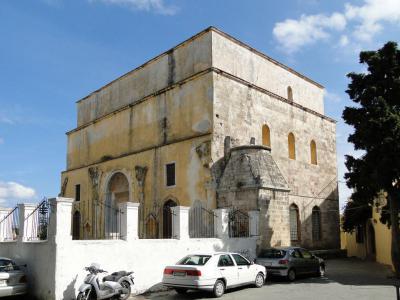
Completed in 1765, Sultan Mustafa Mosque stands as a clear expression of Rhodes’ Ottoman-era architecture. It is traditionally associated with Sultan Mustafa III, whose patronage is recorded in a marble inscription set into the entrance frame.
The mosque reflects a restrained Ottoman architectural style. Its interior is organized into three square spaces, one of which is larger and higher than the others, each covered by domes. Along the north side, two consecutive galleries overlook the prayer hall. Although the mosque originally featured a minaret, it was removed during the Italian period in the early 20th century and no longer survives.
Restoration work carried out during the Italian administration introduced the building’s distinctive yellow facade, a characteristic later maintained and refreshed during conservation campaigns in the mid-2010s. These interventions stabilized the structure while preserving its Ottoman spatial layout.
One of its most notable interior features is the marble minbar, among the largest surviving on the island. Constructed from gray marble blocks and richly decorated with carved Arabic ornament, it bears a prominent inscription of the Shahada, the Islamic declaration of faith. Today, the mosque is not in regular daily use but occasionally hosts religious events for the local Muslim community, including weddings.
The mosque reflects a restrained Ottoman architectural style. Its interior is organized into three square spaces, one of which is larger and higher than the others, each covered by domes. Along the north side, two consecutive galleries overlook the prayer hall. Although the mosque originally featured a minaret, it was removed during the Italian period in the early 20th century and no longer survives.
Restoration work carried out during the Italian administration introduced the building’s distinctive yellow facade, a characteristic later maintained and refreshed during conservation campaigns in the mid-2010s. These interventions stabilized the structure while preserving its Ottoman spatial layout.
One of its most notable interior features is the marble minbar, among the largest surviving on the island. Constructed from gray marble blocks and richly decorated with carved Arabic ornament, it bears a prominent inscription of the Shahada, the Islamic declaration of faith. Today, the mosque is not in regular daily use but occasionally hosts religious events for the local Muslim community, including weddings.
11) Palace of the Grand Master of the Knights of Rhodes (must see)
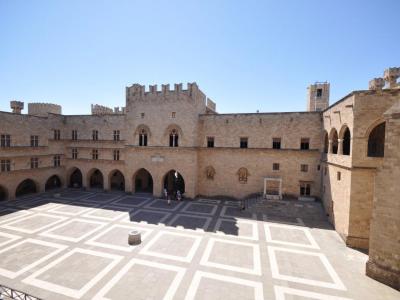
The Palace of the Grand Master was once the administrative seat of the Knights Hospitaller and the symbolic heart of the Knights’ Quarter. During the Ottoman period, the building fell into neglect and was later used as a prison. In 1856, a gunpowder explosion caused severe damage, leaving much of the structure in ruins. The palace was extensively reconstructed during the Italian administration in the 1930s. The rebuilding did not follow the original medieval layout and introduced new interior elements, including sculptures and mosaics transferred from other Dodecanese islands.
Despite these issues, the palace remains visually commanding, dominating one of the highest points of the Old Town. The interior incorporates architectural fragments such as columns and capitals reused from ancient sites. The reconstructed rooms feature coffered wooden ceilings and windows fitted with translucent stone panels that soften the interior light. Many of the grand halls are decorated with large-scale Hellenistic and Roman mosaics, primarily brought from Kos.
Visitors enter between two imposing semicircular towers and ascend a broad marble staircase to the upper level, where spacious ceremonial rooms are intentionally sparsely furnished to emphasize architectural form and mosaic decoration. Among the most notable scenes are representations of the Nine Muses, a sea nymph riding a hippocamp, and the head of Medusa, along with marine motifs featuring fish and dolphins.
The ground floor, once used for storage and logistical purposes during sieges, encloses a large courtyard populated with classical-style statues. Today, this level hosts permanent and temporary exhibitions that outline the history of Rhodes from antiquity through the medieval period and up to the Ottoman conquest, offering broader historical context alongside the palace’s own story.
Despite these issues, the palace remains visually commanding, dominating one of the highest points of the Old Town. The interior incorporates architectural fragments such as columns and capitals reused from ancient sites. The reconstructed rooms feature coffered wooden ceilings and windows fitted with translucent stone panels that soften the interior light. Many of the grand halls are decorated with large-scale Hellenistic and Roman mosaics, primarily brought from Kos.
Visitors enter between two imposing semicircular towers and ascend a broad marble staircase to the upper level, where spacious ceremonial rooms are intentionally sparsely furnished to emphasize architectural form and mosaic decoration. Among the most notable scenes are representations of the Nine Muses, a sea nymph riding a hippocamp, and the head of Medusa, along with marine motifs featuring fish and dolphins.
The ground floor, once used for storage and logistical purposes during sieges, encloses a large courtyard populated with classical-style statues. Today, this level hosts permanent and temporary exhibitions that outline the history of Rhodes from antiquity through the medieval period and up to the Ottoman conquest, offering broader historical context alongside the palace’s own story.
12) Fortifications of Rhodes (must see)
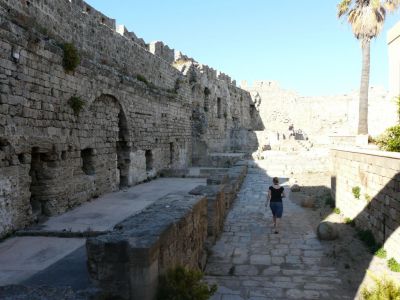
The first and most defining feature of Rhodes’ Old Town is its system of fortified walls. Extending for roughly four kilometers, these massive defenses were designed to protect the city from invading powers and corsairs who controlled the Mediterranean and Aegean sea routes during the Middle Ages. Long considered among the strongest fortifications of their time, the walls ultimately fell to the Ottoman forces in 1522 after a prolonged siege.
Much of the fortification visible today reflects the extensive strengthening carried out by the Knights Hospitaller in the late 15th century, particularly in anticipation of the siege of 1480. Building on earlier Byzantine defenses, the Knights transformed the city into a highly sophisticated fortified complex. The walls were divided into distinct sectors, each maintained by one of the Order’s langues, or national divisions, a system that shaped both construction and defense strategies.
The circuit includes an intricate combination of curtain walls, bastions, towers, gates, and a broad defensive moat. Several gates survive, each differing in form and scale according to its function and period of construction. At certain times of day: at sunrise, or after dark when the walls are illuminated, the stonework takes on a dramatic presence that emphasizes both its scale and craftsmanship.
Sections of the fortifications are accessible to visitors, including portions of the ramparts and selected towers, offering insight into medieval military engineering and daily defensive life. Access points and ticketing vary depending on the area, and some sections are reached independently rather than through a single entrance.
Much of the fortification visible today reflects the extensive strengthening carried out by the Knights Hospitaller in the late 15th century, particularly in anticipation of the siege of 1480. Building on earlier Byzantine defenses, the Knights transformed the city into a highly sophisticated fortified complex. The walls were divided into distinct sectors, each maintained by one of the Order’s langues, or national divisions, a system that shaped both construction and defense strategies.
The circuit includes an intricate combination of curtain walls, bastions, towers, gates, and a broad defensive moat. Several gates survive, each differing in form and scale according to its function and period of construction. At certain times of day: at sunrise, or after dark when the walls are illuminated, the stonework takes on a dramatic presence that emphasizes both its scale and craftsmanship.
Sections of the fortifications are accessible to visitors, including portions of the ramparts and selected towers, offering insight into medieval military engineering and daily defensive life. Access points and ticketing vary depending on the area, and some sections are reached independently rather than through a single entrance.
13) Ancient Stadium of Rhodes (must see)
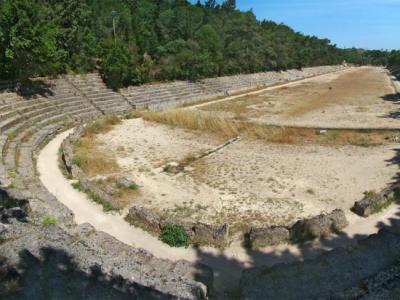
At the ancient Acropolis of Rhodes, visitors have the opportunity to explore the remains of a stadium that dates back to the 2nd century BC. Remarkably, parts of it are still standing today, including the "Sphendone" (the curved end with a turning post), the "Proedries" (the seating area for officials), and some of the lower seats in the auditorium. Built primarily from locally-sourced limestone, this robust site not only withstands the test of time but also showcases the craftsmanship of ancient builders who constructed it by hand.
The stadium was a significant venue for games similar to those of the Olympics, focusing on events connected to the Cult of Apollo; moreover, it played an integral role in the civic and religious activities of the ancient city. Influenced by Hellenistic culture, the people of Rhodes embraced the Greek gods, and remains of the temples dedicated to Zeus, Athena, Apollo, and Helios can be found nearby.
As you wander through the site, you can almost picture the ancient Rhodians gathering in this very setting. Additionally, the view of Rhodes Town from the stadium is impressive, offering a perspective on the area's landscape and cultural heritage.
The stadium was a significant venue for games similar to those of the Olympics, focusing on events connected to the Cult of Apollo; moreover, it played an integral role in the civic and religious activities of the ancient city. Influenced by Hellenistic culture, the people of Rhodes embraced the Greek gods, and remains of the temples dedicated to Zeus, Athena, Apollo, and Helios can be found nearby.
As you wander through the site, you can almost picture the ancient Rhodians gathering in this very setting. Additionally, the view of Rhodes Town from the stadium is impressive, offering a perspective on the area's landscape and cultural heritage.
14) Odeon of Rhodes
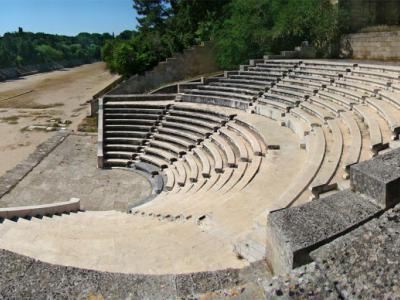
Just north of the ancient stadium, the Italian School of Archaeology uncovered the Odeon, with both monuments having been restructured during the period of Italian rule-only the orchestra and a few front-row seats here are original. Dating from the Classical Greek and Hellenistic periods, between the 3rd and 2nd centuries BC, the marble Odeon is an elegant theatrical structure nestled on the east slope of the Acropolis hill, configured within a rectangular layout. It had a seating capacity of about 800 people and was a key part of the Gymnasium complex, which was dedicated to the education of young people and apparently included a significant library.
The ancient Greeks likely attended singing events, musical performances, and poetry recitals at this venue. As you explore the site, set against a backdrop of lush greenery and naturally integrated into its surroundings, you'll feel as though you've stepped back in time, enveloped in an atmosphere that captures the essence of ancient Greek culture.
The ancient Greeks likely attended singing events, musical performances, and poetry recitals at this venue. As you explore the site, set against a backdrop of lush greenery and naturally integrated into its surroundings, you'll feel as though you've stepped back in time, enveloped in an atmosphere that captures the essence of ancient Greek culture.
