Custom Walk in Thessaloniki, Greece by nancy_cook21_b8c2ef created on 2026-07-08
Guide Location: Greece » Thessaloniki
Guide Type: Custom Walk
# of Sights: 12
Tour Duration: 3 Hour(s)
Travel Distance: 4.6 Km or 2.9 Miles
Share Key: KWQJ8
Guide Type: Custom Walk
# of Sights: 12
Tour Duration: 3 Hour(s)
Travel Distance: 4.6 Km or 2.9 Miles
Share Key: KWQJ8
How It Works
Please retrieve this walk in the GPSmyCity app. Once done, the app will guide you from one tour stop to the next as if you had a personal tour guide. If you created the walk on this website or come to the page via a link, please follow the instructions below to retrieve the walk in the app.
Retrieve This Walk in App
Step 1. Download the app "GPSmyCity: Walks in 1K+ Cities" on Apple App Store or Google Play Store.



Step 2. In the GPSmyCity app, download(or launch) the guide "Thessaloniki Map and Walking Tours".
Step 3. Tap the menu button located at upper right corner of the "Walks" screen and select "Retrieve custom walk". Enter the share key: KWQJ8
1) Statue of Alexander the Great
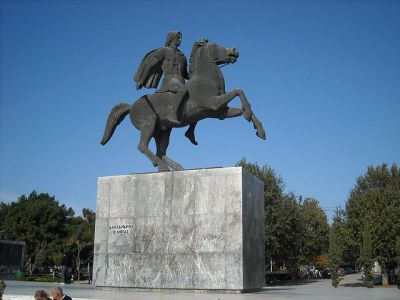
The statue of Alexander the Great shows Alexander the Great riding his horse Bucephalus. The monument is six meters (20 feet) tall. Its height, including the pedestal, is 11 meters (36 feet) tall. The bronze statue was crafted in 1973 by sculptor Evangelos Moustakas.
Alexander the Great was one of the world's most influential politicians and historical figures. Alexander the Great was one of Aristotle's students and became a Macedonian Emperor at 20. He conquered large swaths of land, including Egypt, Palestine, Syria, Pakistan, Iran, and Turkey.
Alexander the Great was undefeated in battle. But, unusually, he didn't seek to change the beliefs or customs of the territories he conquered.
The statue shows Alexander looking east while his faithful horse Bucephalus seems ready to fight. Behind the statue, a low wall depicts the Battle of Issus, which happened in 333 BC. During the battle, Alexander the Great defeated the Persian king Darius III. Other features show shields depicting Alexander's army, a snake, a lion, an ox, a falcon, and Gorgon Medusa.
Alexander the Great was incredibly influential in Macedonia and the ancient world. Thessaloniki was named after Alexander the Great's half-sister, Thessalonike.
The statue overlooks Thessaloniki's waterfront and is part of the Nea Paralia seaside park.
Alexander the Great was one of the world's most influential politicians and historical figures. Alexander the Great was one of Aristotle's students and became a Macedonian Emperor at 20. He conquered large swaths of land, including Egypt, Palestine, Syria, Pakistan, Iran, and Turkey.
Alexander the Great was undefeated in battle. But, unusually, he didn't seek to change the beliefs or customs of the territories he conquered.
The statue shows Alexander looking east while his faithful horse Bucephalus seems ready to fight. Behind the statue, a low wall depicts the Battle of Issus, which happened in 333 BC. During the battle, Alexander the Great defeated the Persian king Darius III. Other features show shields depicting Alexander's army, a snake, a lion, an ox, a falcon, and Gorgon Medusa.
Alexander the Great was incredibly influential in Macedonia and the ancient world. Thessaloniki was named after Alexander the Great's half-sister, Thessalonike.
The statue overlooks Thessaloniki's waterfront and is part of the Nea Paralia seaside park.
2) White Tower of Thessaloniki (must see)
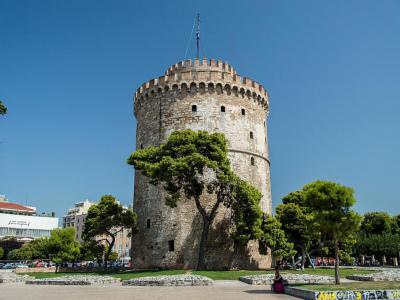
Rising to a height of approximately 112 feet, the White Tower was constructed by the Ottomans in the 15th century, shortly after their capture of the city in 1430. It formed part of the coastal fortifications and was originally integrated into a broader defensive system that included walls and artillery platforms protecting the harbor.
From the outset, the tower served a military purpose and was incorporated into the city’s defensive perimeter. Over time, it became closely associated with imprisonment and punishment. By the 17th century, it functioned as a garrison and later as a prison. During the Ottoman period, it acquired the grim name Tower of Blood or Red Tower, reflecting its role as a site of executions. In 1826, during the suppression of the Janissaries ordered by the Ottoman sultan Mahmud II, imprisoned Janissaries in Thessaloniki were executed, further cementing the tower’s fearsome reputation.
In 1890, the tower was painted white and officially renamed the White Tower. Many historians interpret this act as a symbolic attempt by the Ottoman authorities to erase-or at least soften-the memory of the tower’s violent past, though no definitive explanation survives. Regardless of intent, the new name endured and became firmly established.
The area around the tower has also witnessed pivotal moments in modern Greek history. In 1913, King George I of Greece was assassinated near the tower, marking another dramatic episode linked to the site. During World War I, the tower was used by Allied forces as a communications center, and the surrounding defensive walls were dismantled. At the same time, the tower served as a secure repository for important antiquities.
Throughout the 20th century, the White Tower continued to serve practical functions. Thessaloniki’s air defense operated from the tower between 1912 and 1983, and it also housed a meteorological laboratory. Today, the tower is home to a museum dedicated to the city’s history, presenting exhibitions that trace Thessaloniki’s development from its founding in 316 BC to the present day. Visitors who climb to the upper level are rewarded with views across the city and the Thermaic Gulf.
From the outset, the tower served a military purpose and was incorporated into the city’s defensive perimeter. Over time, it became closely associated with imprisonment and punishment. By the 17th century, it functioned as a garrison and later as a prison. During the Ottoman period, it acquired the grim name Tower of Blood or Red Tower, reflecting its role as a site of executions. In 1826, during the suppression of the Janissaries ordered by the Ottoman sultan Mahmud II, imprisoned Janissaries in Thessaloniki were executed, further cementing the tower’s fearsome reputation.
In 1890, the tower was painted white and officially renamed the White Tower. Many historians interpret this act as a symbolic attempt by the Ottoman authorities to erase-or at least soften-the memory of the tower’s violent past, though no definitive explanation survives. Regardless of intent, the new name endured and became firmly established.
The area around the tower has also witnessed pivotal moments in modern Greek history. In 1913, King George I of Greece was assassinated near the tower, marking another dramatic episode linked to the site. During World War I, the tower was used by Allied forces as a communications center, and the surrounding defensive walls were dismantled. At the same time, the tower served as a secure repository for important antiquities.
Throughout the 20th century, the White Tower continued to serve practical functions. Thessaloniki’s air defense operated from the tower between 1912 and 1983, and it also housed a meteorological laboratory. Today, the tower is home to a museum dedicated to the city’s history, presenting exhibitions that trace Thessaloniki’s development from its founding in 316 BC to the present day. Visitors who climb to the upper level are rewarded with views across the city and the Thermaic Gulf.
3) Leoforos Nikis/Nikis (Victory) Avenue
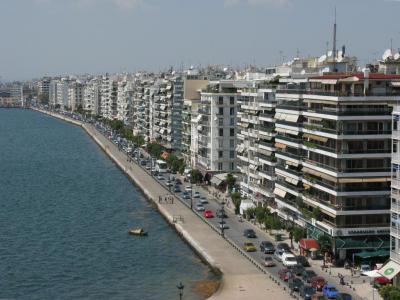
Victory Avenue runs along the historic seafront, stretching from Eleftherias Square and the port area. Often referred to as the Old Waterfront, the avenue forms a continuous coastal axis that has long defined the city’s relationship with the sea.
Rather than a conventional shopping street, Victory Avenue is best known for its prestigious seafront properties, historic apartment buildings, cafes, and restaurants overlooking the Thermaic Gulf. Property values here are among the highest in the city, reflecting its central location and uninterrupted sea views. The avenue also hosts several foreign consulates and professional offices. Over time, it has been home to landmark cafes, patisseries, historic cinemas, and notable hotels that played an important role in the city’s social and cultural life.
During the Ottoman period, the street was known as Beyaz Kule Avenue, referencing the nearby White Tower. In the early 20th century, it was renamed Vasileos Konstantinou Avenue, a name it retained until 1939. That year, it officially became Nikis Avenue, commemorating Greece’s victory in the Balkan Wars from 1912 to 1913. The name has remained ever since, closely tied to the avenue’s symbolic and historical significance.
As you walk along Victory Avenue, several landmarks stand out. Walking east along the waterfront promenade, you'll find the Alexander the Great Statue. Just beyond the statue, the promenade opens into the landscaped Alexander the Great Garden, part of Thessaloniki’s newer seafront parks. The bronze equestrian sculpture, set against the sea, is one of the most photographed landmarks along the avenue. If, instead, you turn west near the end of the seafront, close to Eleftherias Square, you'll encounter the Holocaust Memorial, a sculptural monument shaped as a menorah formed from intertwined human figures.
Today, the wide pedestrian sidewalk along the waterfront is one of Thessaloniki’s most popular promenades. Locals and visitors alike come here to stroll, meet, and enjoy open views of the sea, especially at sunset. While the city’s main retail and nightlife districts lie slightly inland, Victory Avenue continues to function as a social showcase.
Rather than a conventional shopping street, Victory Avenue is best known for its prestigious seafront properties, historic apartment buildings, cafes, and restaurants overlooking the Thermaic Gulf. Property values here are among the highest in the city, reflecting its central location and uninterrupted sea views. The avenue also hosts several foreign consulates and professional offices. Over time, it has been home to landmark cafes, patisseries, historic cinemas, and notable hotels that played an important role in the city’s social and cultural life.
During the Ottoman period, the street was known as Beyaz Kule Avenue, referencing the nearby White Tower. In the early 20th century, it was renamed Vasileos Konstantinou Avenue, a name it retained until 1939. That year, it officially became Nikis Avenue, commemorating Greece’s victory in the Balkan Wars from 1912 to 1913. The name has remained ever since, closely tied to the avenue’s symbolic and historical significance.
As you walk along Victory Avenue, several landmarks stand out. Walking east along the waterfront promenade, you'll find the Alexander the Great Statue. Just beyond the statue, the promenade opens into the landscaped Alexander the Great Garden, part of Thessaloniki’s newer seafront parks. The bronze equestrian sculpture, set against the sea, is one of the most photographed landmarks along the avenue. If, instead, you turn west near the end of the seafront, close to Eleftherias Square, you'll encounter the Holocaust Memorial, a sculptural monument shaped as a menorah formed from intertwined human figures.
Today, the wide pedestrian sidewalk along the waterfront is one of Thessaloniki’s most popular promenades. Locals and visitors alike come here to stroll, meet, and enjoy open views of the sea, especially at sunset. While the city’s main retail and nightlife districts lie slightly inland, Victory Avenue continues to function as a social showcase.

4) Church of Hagia Sophia (must see)
The church takes its name from the Greek Hagia Sophia, meaning “Holy Wisdom”. It is one of Thessaloniki’s most important Byzantine monuments and is included in the UNESCO World Heritage List as part of the Paleochristian and Byzantine Monuments of Thessaloniki.
A church has existed on this site since Late Antiquity, with earlier structures dating to the 5th century, likely replacing a Roman civic building. The present church was constructed in the late 7th century, following damage to its predecessor, and was clearly inspired by Hagia Sophia in Constantinople.
Architecturally, the church follows a domed Greek-cross basilica plan. As you step into the nave, the space immediately draws your eye upward, with strong vertical lines guiding attention toward the dome. A highlight of the church is the 9th-century mosaic of the Ascension, showing Christ rising within a mandorla, surrounded by angels, the Virgin Mary, and the Twelve Apostles. To see it clearly, stand directly beneath the dome and look straight up from the center of the nave.
After taking in the dome, move toward the eastern end of the church, near the sanctuary. Here, along the arches and upper wall surfaces, you can spot fragmentary mosaics dating to the 8th and 9th centuries. These are more subtle than the dome mosaic and require closer attention. Look for isolated tesserae patterns and partial figures, often set against gold backgrounds and embedded among later fresco layers. As you continue around the interior, notice how these mosaic remnants coexist with frescoes largely dating to the 11th century, revealing multiple phases of decoration within the same space.
During the Fourth Crusade, Thessaloniki fell to Western rule, and in 1205 the church was converted into a Catholic cathedral, remaining so until 1224. After the Ottoman capture of the city in 1430, Hagia Sophia continued to function as a church for several decades before being converted into a mosque in 1524. Architectural additions at that time included a minaret and a portico.
When Thessaloniki was incorporated into the modern Greek state in 1912, the building was returned to Christian worship. The minaret and portico were removed, though the base of the minaret remains visible outside, at the northwest corner of the building.
A church has existed on this site since Late Antiquity, with earlier structures dating to the 5th century, likely replacing a Roman civic building. The present church was constructed in the late 7th century, following damage to its predecessor, and was clearly inspired by Hagia Sophia in Constantinople.
Architecturally, the church follows a domed Greek-cross basilica plan. As you step into the nave, the space immediately draws your eye upward, with strong vertical lines guiding attention toward the dome. A highlight of the church is the 9th-century mosaic of the Ascension, showing Christ rising within a mandorla, surrounded by angels, the Virgin Mary, and the Twelve Apostles. To see it clearly, stand directly beneath the dome and look straight up from the center of the nave.
After taking in the dome, move toward the eastern end of the church, near the sanctuary. Here, along the arches and upper wall surfaces, you can spot fragmentary mosaics dating to the 8th and 9th centuries. These are more subtle than the dome mosaic and require closer attention. Look for isolated tesserae patterns and partial figures, often set against gold backgrounds and embedded among later fresco layers. As you continue around the interior, notice how these mosaic remnants coexist with frescoes largely dating to the 11th century, revealing multiple phases of decoration within the same space.
During the Fourth Crusade, Thessaloniki fell to Western rule, and in 1205 the church was converted into a Catholic cathedral, remaining so until 1224. After the Ottoman capture of the city in 1430, Hagia Sophia continued to function as a church for several decades before being converted into a mosque in 1524. Architectural additions at that time included a minaret and a portico.
When Thessaloniki was incorporated into the modern Greek state in 1912, the building was returned to Christian worship. The minaret and portico were removed, though the base of the minaret remains visible outside, at the northwest corner of the building.
5) Palace of Galerius
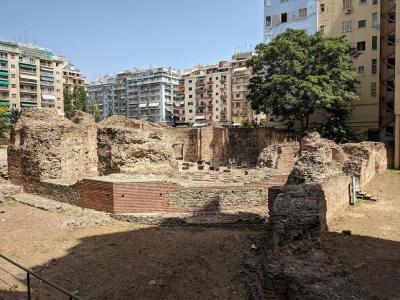
The Palace of Galerius, situated in the heart of Thessaloniki, stands as an impressive example of Roman architecture and history. Built around AD 300 during the reign of the tetrarch Galerius, it was part of a larger urban development showcasing the wealth and power of the Roman Empire.
Today, the ruins of the Palace of Galerius offer visitors a chance to step back in time in Thessaloniki's bustling center. Despite its partial state of decay, the remnants of the palace provide glimpses of its former grandeur. Particularly striking is the Octagon, believed to have been Galerius's throne room, adorned with lavish decorations.
The Palace of Galerius wasn't just a single building but a vast complex covering over 150,000 square meters. It included structures like the Rotonda, Navarino Plaza, and the temple of Agia Sofia, all essential parts of daily life in Roman Thessaloniki. These were connected by the Via Egnatia, highlighting the complex's importance in the Roman trade network.
The palace and its surroundings, including a Basilica and a Nymphaeum, showcased Roman architectural prowess and served various purposes, both religious and monumental. The northern part of the complex, near Kamara, is directly linked to the Via Egnatia. The atrium, with its grand colonnade, mosaics, and statues, exuded power and prosperity.
The Octagon, adjacent to the Basilica, was particularly impressive, likely serving as the tetrarch's throne room due to its ornate decorations and prominent location.
The Galerius Complex played a crucial role in Thessaloniki's social, political, and economic life during Roman times, its scale dwarfing typical Greek constructions.
Archaeological excavations have uncovered remarkable artifacts, many now displayed in the Archaeological Museum of Thessaloniki, offering insights into the era's artistry.
Restoration work has been ongoing, allowing the public to visit most parts of the site. Visitors can admire the preserved atrium, arcades, and Basilica, appreciating the restored marble floors and vibrant mosaics. This outdoor museum offers a unique opportunity to connect with Thessaloniki's Roman heritage, making the Palace of Galerius a must-see for history enthusiasts.
Today, the ruins of the Palace of Galerius offer visitors a chance to step back in time in Thessaloniki's bustling center. Despite its partial state of decay, the remnants of the palace provide glimpses of its former grandeur. Particularly striking is the Octagon, believed to have been Galerius's throne room, adorned with lavish decorations.
The Palace of Galerius wasn't just a single building but a vast complex covering over 150,000 square meters. It included structures like the Rotonda, Navarino Plaza, and the temple of Agia Sofia, all essential parts of daily life in Roman Thessaloniki. These were connected by the Via Egnatia, highlighting the complex's importance in the Roman trade network.
The palace and its surroundings, including a Basilica and a Nymphaeum, showcased Roman architectural prowess and served various purposes, both religious and monumental. The northern part of the complex, near Kamara, is directly linked to the Via Egnatia. The atrium, with its grand colonnade, mosaics, and statues, exuded power and prosperity.
The Octagon, adjacent to the Basilica, was particularly impressive, likely serving as the tetrarch's throne room due to its ornate decorations and prominent location.
The Galerius Complex played a crucial role in Thessaloniki's social, political, and economic life during Roman times, its scale dwarfing typical Greek constructions.
Archaeological excavations have uncovered remarkable artifacts, many now displayed in the Archaeological Museum of Thessaloniki, offering insights into the era's artistry.
Restoration work has been ongoing, allowing the public to visit most parts of the site. Visitors can admire the preserved atrium, arcades, and Basilica, appreciating the restored marble floors and vibrant mosaics. This outdoor museum offers a unique opportunity to connect with Thessaloniki's Roman heritage, making the Palace of Galerius a must-see for history enthusiasts.
6) Arch of Galerius (must see)
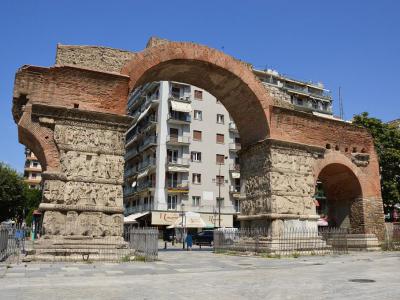
The Arch of Galerius was erected in AD 303 to commemorate the victory of the Roman co-emperor Galerius over the Persian Empire, following his successful campaign against the Sassanids. The monument originally formed part of a grand ceremonial complex and consisted of an eight-pillared structure supporting a triple arch. A processional road linked the Arch with the Rotunda of Galerius and Galerius’ palace complex, reinforcing its role as an imperial statement of power.
Today, only three of the original eight pillars remain standing. Even so, the arch remains one of Thessaloniki’s most recognizable landmarks. Locally known as Kamara, it continues to serve as a popular meeting point and reference marker in the city’s urban life.
The surviving central piers are decorated with sculpted marble relief panels that vividly depict scenes from Galerius’ Persian campaign, including battle sequences and the submission of defeated enemies. Another relief shows the imperial family participating in a ceremonial act of thanksgiving sacrifice. The faces on many figures have been deliberately chiseled away, a form of damnatio memoriae, likely carried out during later political or religious transitions rather than as a commemoration of the dead.
Additional panels emphasize the ideology of the Tetrarchy, a system of government introduced by the Roman emperor Diocletian, portraying Galerius in military attire alongside other rulers, symbolizing unity and shared authority within the late Roman imperial system. The Arch of Galerius forms part of the UNESCO World Heritage List as one of the Paleochristian and Byzantine Monuments of Thessaloniki, inscribed in 1988.
Today, only three of the original eight pillars remain standing. Even so, the arch remains one of Thessaloniki’s most recognizable landmarks. Locally known as Kamara, it continues to serve as a popular meeting point and reference marker in the city’s urban life.
The surviving central piers are decorated with sculpted marble relief panels that vividly depict scenes from Galerius’ Persian campaign, including battle sequences and the submission of defeated enemies. Another relief shows the imperial family participating in a ceremonial act of thanksgiving sacrifice. The faces on many figures have been deliberately chiseled away, a form of damnatio memoriae, likely carried out during later political or religious transitions rather than as a commemoration of the dead.
Additional panels emphasize the ideology of the Tetrarchy, a system of government introduced by the Roman emperor Diocletian, portraying Galerius in military attire alongside other rulers, symbolizing unity and shared authority within the late Roman imperial system. The Arch of Galerius forms part of the UNESCO World Heritage List as one of the Paleochristian and Byzantine Monuments of Thessaloniki, inscribed in 1988.
7) Rotunda of Galerius (must see)
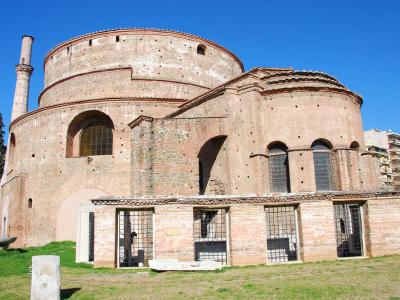
The Rotunda of Galerius is an imposing cylindrical monument and one of the best-preserved Roman structures in Thessaloniki. It was commissioned around AD 306 by the Roman co-emperor Galerius, although its original purpose remains debated. Some historians believe it was intended as Galerius’ mausoleum, while others suggest it was designed as a temple. Architecturally, the Rotunda bears strong similarities to the Pantheon in Rome, particularly in its monumental scale and domed interior.
The building’s massive walls have played a crucial role in its survival through centuries of earthquakes. The Rotunda rises to a height of approximately 95 feet and measures about 80 feet in diameter, creating a vast and commanding interior space. In antiquity, a ceremonial road connected the Rotunda to the nearby Arch of Galerius, forming part of Galerius’ imperial complex. During the Early Byzantine period, the Rotunda was converted into a Christian church, with the addition of an eastern sanctuary. It later served as Thessaloniki’s cathedral during the Byzantine era, until the Ottoman conquest. In 1590–1591, the building was converted into a mosque, and a minaret was added. After Thessaloniki’s liberation in 1912, the Rotunda was reconsecrated as a Christian church and dedicated to Saint George.
As you enter, look upward and you’ll see Early Byzantine mosaics with botanical and natural motifs: birds, fruit, flowers, and ornamental patterns. Pause at the southern niche: its vault includes a gold Latin cross set among stars, birds, floral forms, and fruit, one of the most recognizable compositions in the building. Then, return to the center and lift your eyes higher to the ring of standing saints often described as the “martyrs frieze.” Finally, look up to the very top of the dome, where a medallion scene shows angels holding a circular frame. The central figure, traditionally identified as Christ, is heavily damaged, largely because seismic activity took a toll on the highest mosaics over time.
Before leaving, step outside and spot the minaret added during the Ottoman period. It remains one of the very few historic minarets in Thessaloniki still standing at full height, offering a clear reminder of the Rotunda’s layered history across Roman, Byzantine, and Ottoman eras.
The building’s massive walls have played a crucial role in its survival through centuries of earthquakes. The Rotunda rises to a height of approximately 95 feet and measures about 80 feet in diameter, creating a vast and commanding interior space. In antiquity, a ceremonial road connected the Rotunda to the nearby Arch of Galerius, forming part of Galerius’ imperial complex. During the Early Byzantine period, the Rotunda was converted into a Christian church, with the addition of an eastern sanctuary. It later served as Thessaloniki’s cathedral during the Byzantine era, until the Ottoman conquest. In 1590–1591, the building was converted into a mosque, and a minaret was added. After Thessaloniki’s liberation in 1912, the Rotunda was reconsecrated as a Christian church and dedicated to Saint George.
As you enter, look upward and you’ll see Early Byzantine mosaics with botanical and natural motifs: birds, fruit, flowers, and ornamental patterns. Pause at the southern niche: its vault includes a gold Latin cross set among stars, birds, floral forms, and fruit, one of the most recognizable compositions in the building. Then, return to the center and lift your eyes higher to the ring of standing saints often described as the “martyrs frieze.” Finally, look up to the very top of the dome, where a medallion scene shows angels holding a circular frame. The central figure, traditionally identified as Christ, is heavily damaged, largely because seismic activity took a toll on the highest mosaics over time.
Before leaving, step outside and spot the minaret added during the Ottoman period. It remains one of the very few historic minarets in Thessaloniki still standing at full height, offering a clear reminder of the Rotunda’s layered history across Roman, Byzantine, and Ottoman eras.
8) Hagios Demetrios (Church of St. Demetrios) (must see)
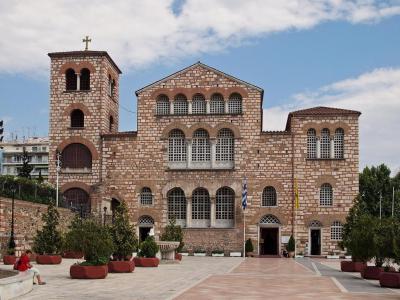
The Church of Saint Demetrios is dedicated to Saint Demetrios, the city’s patron saint and a Roman martyr of the early 4th century. According to tradition, Demetrios was a high-ranking Roman official or military commander who openly professed Christianity during the reign of Galerius. Over time, Demetrios came to be venerated as a military saint and protector of Thessaloniki, believed to have defended the city during its many sieges.
A shrine was first established over the place of his martyrdom, and in the early 5th century it was replaced by a three-aisled basilica. After a major fire in the 7th century, the church was rebuilt as a five-aisled basilica, largely defining the structure that survives today. The present building dates primarily to this reconstruction, though it has undergone repeated restoration following fires, earthquakes, and periods of conversion, including use as a mosque during the Ottoman era.
Architecturally, Hagios Demetrios is one of the largest basilicas in Greece, notable for its scale and relatively restrained exterior. As you enter the church, the interior opens into a broad forest of columns that divide the space into five parallel aisles. The church’s most celebrated artistic treasures are its Byzantine mosaics, dating from the 5th to the 9th centuries. To see them, move slowly along the central nave and into the side aisles, keeping your eyes at upper wall level, above the columns.
Several of the best-preserved mosaics are located along the north and south interior walls, especially near the transept and the area just before the sanctuary. Look for panels showing Saint Demetrios standing frontally, often flanked by clergy, civic officials, or children presenting offerings. Only nine mosaics survived the Great Fire of 1917.
After viewing the mosaics, proceed toward the sanctuary and look for the entrance leading downward. Beneath the sanctuary lies the crypt, traditionally identified as the site of Demetrios’ imprisonment and death. Today, it functions as a museum space, where you can see archaeological remains of the Roman bath complex. Each year on October 26, the feast day of Saint Demetrios, the church becomes the focal point of major religious celebrations.
A shrine was first established over the place of his martyrdom, and in the early 5th century it was replaced by a three-aisled basilica. After a major fire in the 7th century, the church was rebuilt as a five-aisled basilica, largely defining the structure that survives today. The present building dates primarily to this reconstruction, though it has undergone repeated restoration following fires, earthquakes, and periods of conversion, including use as a mosque during the Ottoman era.
Architecturally, Hagios Demetrios is one of the largest basilicas in Greece, notable for its scale and relatively restrained exterior. As you enter the church, the interior opens into a broad forest of columns that divide the space into five parallel aisles. The church’s most celebrated artistic treasures are its Byzantine mosaics, dating from the 5th to the 9th centuries. To see them, move slowly along the central nave and into the side aisles, keeping your eyes at upper wall level, above the columns.
Several of the best-preserved mosaics are located along the north and south interior walls, especially near the transept and the area just before the sanctuary. Look for panels showing Saint Demetrios standing frontally, often flanked by clergy, civic officials, or children presenting offerings. Only nine mosaics survived the Great Fire of 1917.
After viewing the mosaics, proceed toward the sanctuary and look for the entrance leading downward. Beneath the sanctuary lies the crypt, traditionally identified as the site of Demetrios’ imprisonment and death. Today, it functions as a museum space, where you can see archaeological remains of the Roman bath complex. Each year on October 26, the feast day of Saint Demetrios, the church becomes the focal point of major religious celebrations.
9) Greek Agora and Roman Forum
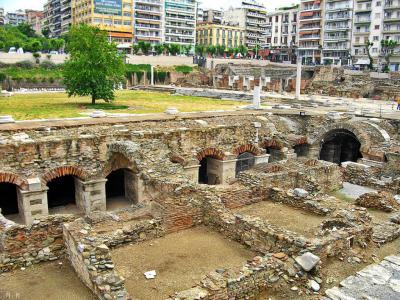
The Roman Forum is an excavated Roman-era civic complex, also commonly referred to as the Ancient Agora. It was uncovered in 1966, when construction work began on a new Thessaloniki Municipal Courthouse. Following the discovery, plans for the courthouse were abandoned, and the site was set aside for systematic archaeological excavation.
When Thessaloniki came under Roman rule, the earlier Hellenistic agora was expanded and reorganized into a large Roman forum laid out on two main levels. Construction began in the late 2nd century CE, and the complex remained in use until at least the 6th century. During this period, it functioned as the city’s primary administrative, commercial, religious, and social center, closely connected to the main streets of Roman Thessaloniki.
The forum included a central open square surrounded by two-story porticoes, along with public buildings and amenities typical of Roman urban planning. Archaeological remains indicate the presence of two bath complexes and an odeon, originally intended for musical performances, public meetings, and civic gatherings. Some interpretations suggest that the odeon itself may have been adapted to host gladiatorial contests and hunts with wild animals.
Decorative elements of the forum included arches, fountains, colonnades, and mosaic floors, fragments of which survive. Several Corinthian columns, once supporting the porticoes, remain standing or partially reconstructed. One of the most distinctive features of the site is the cryptoporticus, a network of semi-subterranean vaulted corridors that supported the upper level of the forum. These passages are exceptionally well preserved and can be followed by visitors today. They also provide access to the underground museum, which displays artifacts uncovered during excavation, including coins, inscriptions, architectural fragments, and marble sculptures found on-site.
When Thessaloniki came under Roman rule, the earlier Hellenistic agora was expanded and reorganized into a large Roman forum laid out on two main levels. Construction began in the late 2nd century CE, and the complex remained in use until at least the 6th century. During this period, it functioned as the city’s primary administrative, commercial, religious, and social center, closely connected to the main streets of Roman Thessaloniki.
The forum included a central open square surrounded by two-story porticoes, along with public buildings and amenities typical of Roman urban planning. Archaeological remains indicate the presence of two bath complexes and an odeon, originally intended for musical performances, public meetings, and civic gatherings. Some interpretations suggest that the odeon itself may have been adapted to host gladiatorial contests and hunts with wild animals.
Decorative elements of the forum included arches, fountains, colonnades, and mosaic floors, fragments of which survive. Several Corinthian columns, once supporting the porticoes, remain standing or partially reconstructed. One of the most distinctive features of the site is the cryptoporticus, a network of semi-subterranean vaulted corridors that supported the upper level of the forum. These passages are exceptionally well preserved and can be followed by visitors today. They also provide access to the underground museum, which displays artifacts uncovered during excavation, including coins, inscriptions, architectural fragments, and marble sculptures found on-site.
10) Bey Hamam
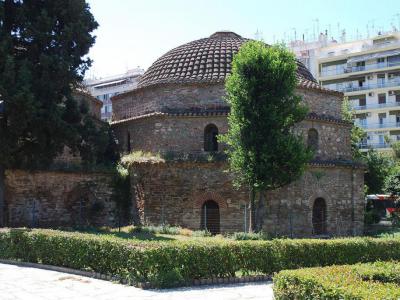
The Bey Hamam, also known as the "Baths of Paradise," is an ancient Turkish bathhouse situated on Egnatia Street in Thessaloniki, close to the Panagia Chalkeon church. It was constructed in 1444 by Sultan Murad II and stands as a significant relic of the city's Ottoman past. This bathhouse holds historical importance as the first Ottoman bath built in Thessaloniki and remains the most notable one in Greece today. Its existence underscores the influence of Ottoman culture on Thessaloniki and the broader Greek context.
In terms of architecture, the Bey Hamam is divided into sections for men and women, reflecting the societal norms of its time. The men's area, known for its spaciousness and lavish design, follows a three-part layout with cold, tepid, and hot rooms, typical of traditional Turkish baths. A large rectangular cistern on the eastern side ensures a constant water supply for the bath complex.
Inside the men's bath, there's an impressive octagonal cold room with a gallery supported by columns, arcaded windows, and a painted dome. This room leads to the octagonal tepid room to the southeast, featuring a dome with circular windows (oculi) and adorned with intricate plant designs. Moving eastward, the hot room area centers around a large cruciform room housing the massage table, surrounded by eight smaller rooms with basins and marble benches for hot and tepid baths.
Beyond its original purpose, the Bey Hamam changed over time. After operating until 1968 under the name "Baths of Paradise," it was leased to the Greek archaeological service for four years. Following the 1978 Thessaloniki earthquake, it underwent restoration. Today, the bathhouse serves as a venue for cultural events and temporary exhibitions, contributing to public engagement in a new way. Additionally, the eastern annex houses the main shop of the Foundation of Archaeological Receipts of the Hellenic Republic Ministry of Culture, further blending the bathhouse into Thessaloniki's cultural and historical scene.
In terms of architecture, the Bey Hamam is divided into sections for men and women, reflecting the societal norms of its time. The men's area, known for its spaciousness and lavish design, follows a three-part layout with cold, tepid, and hot rooms, typical of traditional Turkish baths. A large rectangular cistern on the eastern side ensures a constant water supply for the bath complex.
Inside the men's bath, there's an impressive octagonal cold room with a gallery supported by columns, arcaded windows, and a painted dome. This room leads to the octagonal tepid room to the southeast, featuring a dome with circular windows (oculi) and adorned with intricate plant designs. Moving eastward, the hot room area centers around a large cruciform room housing the massage table, surrounded by eight smaller rooms with basins and marble benches for hot and tepid baths.
Beyond its original purpose, the Bey Hamam changed over time. After operating until 1968 under the name "Baths of Paradise," it was leased to the Greek archaeological service for four years. Following the 1978 Thessaloniki earthquake, it underwent restoration. Today, the bathhouse serves as a venue for cultural events and temporary exhibitions, contributing to public engagement in a new way. Additionally, the eastern annex houses the main shop of the Foundation of Archaeological Receipts of the Hellenic Republic Ministry of Culture, further blending the bathhouse into Thessaloniki's cultural and historical scene.
11) Aristotelous Square (must see)
It was August 1917. Greece had joined the Allied side in the Great War, and Thessaloniki was crowded with British and French troops, along with refugees from the collapsing Ottoman world across the Aegean Sea. In a small refugee house at Olympiados Street, a stray ember from a kitchen fire ignited stored straw. Fanned by strong winds, the flames spread rapidly. For two days, much of the city burned.
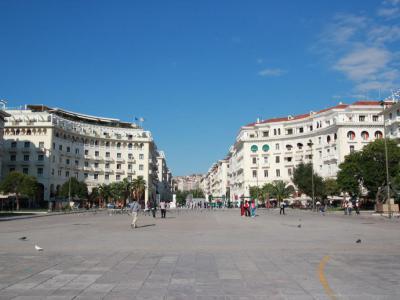
French architect Ernest Hébrard happened to be in Thessaloniki at the time. Prime Minister Eleftherios Venizelos immediately banned any ad-hoc rebuilding and ordered that reconstruction proceed only under a comprehensive modern plan. Hébrard was commissioned to redesign the devastated center. He proposed a city of broad avenues, generous public squares, and monumental facades drawing inspiration from Byzantine architecture. Among these new civic spaces was Alexander the Great Square, later renamed Aristotelous Square, designed as the city’s ceremonial heart.
A monumental axis was laid out from the sea-facing Aristotelous Square inland toward Dikastirion Square and the Roman Forum. Looking uphill from the square, toward the north, the line of the Byzantine city walls remains visible in the distance. Symbolism appears within the square itself: Aristotle sits casually in chiton and sandals near the eastern side of the square. If you stand facing inland, away from the sea, the statue will be to your right. Aristotle’s statue is a favorite local ritual; students polish the big toe of his left foot in hopes that some wisdom might rub off.
Today, Aristotelous Square functions as Thessaloniki’s principal gathering space, regularly hosting rallies, demonstrations, and major public celebrations, including Christmas and carnival events. If you stand facing inland, the western side of the square is dominated by the Electra Palace Hotel. Its symmetrical facade forms part of Hébrard’s original composition, while the Orizontes Roof Garden on the upper level opens southward toward the Thermaic Gulf.
Turn right and you'll see the Olympion Theatre on the eastern side of the square. It is a neoclassical cinema and one of the square’s key cultural landmarks. The building serves as the main venue of the Thessaloniki International Film Festival. During the festival, the square becomes an extension of the screenings themselves, filling with queues, conversations, and informal gatherings that spill directly into the surrounding streets.
French architect Ernest Hébrard happened to be in Thessaloniki at the time. Prime Minister Eleftherios Venizelos immediately banned any ad-hoc rebuilding and ordered that reconstruction proceed only under a comprehensive modern plan. Hébrard was commissioned to redesign the devastated center. He proposed a city of broad avenues, generous public squares, and monumental facades drawing inspiration from Byzantine architecture. Among these new civic spaces was Alexander the Great Square, later renamed Aristotelous Square, designed as the city’s ceremonial heart.
A monumental axis was laid out from the sea-facing Aristotelous Square inland toward Dikastirion Square and the Roman Forum. Looking uphill from the square, toward the north, the line of the Byzantine city walls remains visible in the distance. Symbolism appears within the square itself: Aristotle sits casually in chiton and sandals near the eastern side of the square. If you stand facing inland, away from the sea, the statue will be to your right. Aristotle’s statue is a favorite local ritual; students polish the big toe of his left foot in hopes that some wisdom might rub off.
Today, Aristotelous Square functions as Thessaloniki’s principal gathering space, regularly hosting rallies, demonstrations, and major public celebrations, including Christmas and carnival events. If you stand facing inland, the western side of the square is dominated by the Electra Palace Hotel. Its symmetrical facade forms part of Hébrard’s original composition, while the Orizontes Roof Garden on the upper level opens southward toward the Thermaic Gulf.
Turn right and you'll see the Olympion Theatre on the eastern side of the square. It is a neoclassical cinema and one of the square’s key cultural landmarks. The building serves as the main venue of the Thessaloniki International Film Festival. During the festival, the square becomes an extension of the screenings themselves, filling with queues, conversations, and informal gatherings that spill directly into the surrounding streets.
12) Port of Thessaloniki
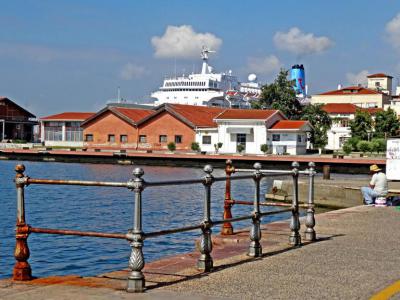
The Port of Thessaloniki, situated in Thessaloniki, Greece, stands as a significant maritime hub, deeply intertwined with the city's economic history and development. Renowned for being one of the largest ports in the Eastern Mediterranean, it plays a crucial role in bridging southeastern Europe and the Balkans with maritime routes across the globe. This bustling port specializes in handling both shipping containers and general cargo, making it a pivotal point for trade in the region.
Strategically connected to both national and international rail networks, the Port of Thessaloniki ensures seamless distribution of goods, underscoring its importance in the global logistics chain. Its historical significance is also notable; during World War I, it served as a base of operations for the Allies. In a darker chapter of history, during World War II, the port was seized by Germany, which then used it as a departure point for the deportation of Thessaloniki's Jewish population to Poland.
The port also boasts one of the Aegean Sea's largest passenger terminals, housed in a building steeped in history. Originally constructed in 1912 as a customs house, this building now welcomes thousands of tourists, as Thessaloniki has emerged as a favored cruise destination. Its passenger terminal's proximity to the city's main attractions further enhances its appeal, offering easy access to Thessaloniki's rich cultural and historical landmarks. The Port of Thessaloniki, thus, not only serves as a vital commercial gateway but also as a point of convergence for cultural exchanges, making it a cornerstone of Thessaloniki's vibrant identity.
Strategically connected to both national and international rail networks, the Port of Thessaloniki ensures seamless distribution of goods, underscoring its importance in the global logistics chain. Its historical significance is also notable; during World War I, it served as a base of operations for the Allies. In a darker chapter of history, during World War II, the port was seized by Germany, which then used it as a departure point for the deportation of Thessaloniki's Jewish population to Poland.
The port also boasts one of the Aegean Sea's largest passenger terminals, housed in a building steeped in history. Originally constructed in 1912 as a customs house, this building now welcomes thousands of tourists, as Thessaloniki has emerged as a favored cruise destination. Its passenger terminal's proximity to the city's main attractions further enhances its appeal, offering easy access to Thessaloniki's rich cultural and historical landmarks. The Port of Thessaloniki, thus, not only serves as a vital commercial gateway but also as a point of convergence for cultural exchanges, making it a cornerstone of Thessaloniki's vibrant identity.
