

Grand Canal Walking Tour, Venice

Grand Canal Walking Tour (Self Guided), Venice

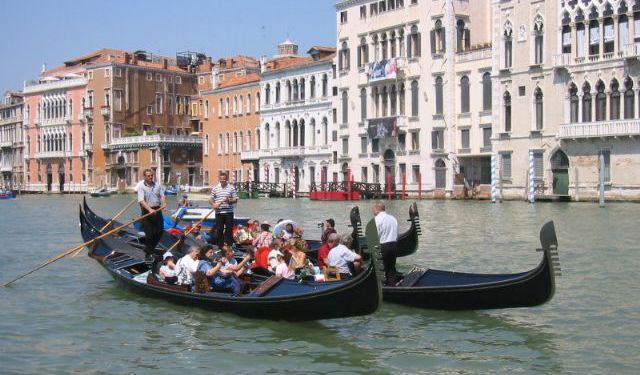
The main waterway in Venice, Grand Canal snakes in an "S" shape through the center of the city, dividing its main districts. On both sides of this thoroughfare are the most beautiful buildings dating from the 12th to the 18th centuries that tell the story of a thousand years of Venetian splendor. While one can view the architectural parade from water buses, our self-guided walking tour offers the opportunity to see some magnificent masterpieces up close and even step inside them.

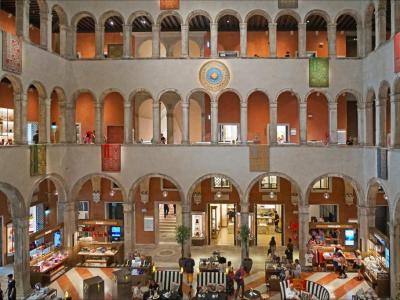
In 2016, stellar architect Rem Koolhaas converted one of the city’s elegant 16th-century palazzo – Fondaco dei Tedeschi – into a posh department store, centered on an elegant courtyard. A roof deck above has rotating art exhibitions and quite possibly the most spectacular view of Venice. Meanwhile, the other grand palazzo of the Grand Canal, Fondaco dei Turchi, is occupied by the Natural History Museum’s beautiful collection of big game taxidermy, insects, marine life, fossils, and other interesting finds collected by Venetians over the centuries, as they explored the world.

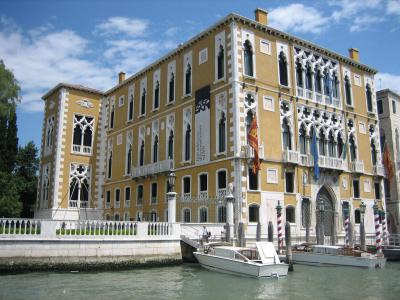
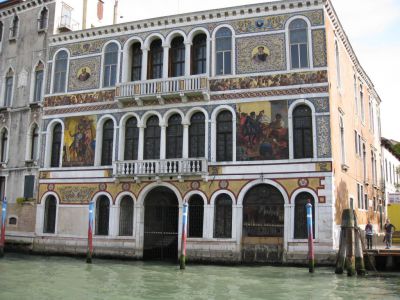
Another sight not to miss is the yellow gold Palazzo Cavalli-Franchetti – so distinctive, indeed, which is a rare attribute in this city of grandeur. Located just across the Accademia bridge, it neighbors the Palazzo Barbarigo, which has been adorned with Murano glass mosaics since the late 1800s.

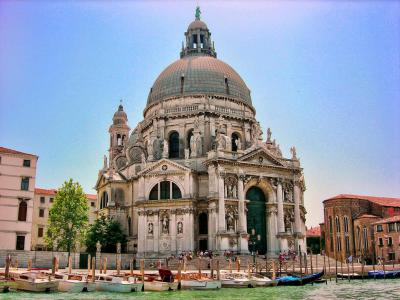
While there’s no shortage of eye-catching churches along the way, the baroque Santa Maria della Salute, supported by over 1,150,000 wooden pylons, is arguably most picturesquely situated. Dedicated to the Virgin Mary and Health/Deliverance (“salute”), it takes the form of a rotunda, or as its architect intended, “the shape of a crown”.

Time may have passed, but the Grand Canal is still, to quote a French ambassador in the 15th century, “the most beautiful street in the world”. Follow this walk along interesting narrow streets and we’re sure you’ll agree.

Getting to Sight #1. The first tour stop (Santa Lucia Train Station) can be reached by: Water Bus: 1, 1/, 3, 4.1, 5.1, 4.2, 5.2, 2, 2/, N; Tram: T1; Bus: 12L, 84, 5E, 6E, 12E, 53E, 56.
How it works: Download the app "GPSmyCity: Walks in 1K+ Cities" from Apple App Store or Google Play Store to your mobile phone or tablet. The app turns your mobile device into a personal tour guide and its built-in GPS navigation functions guide you from one tour stop to next. The app works offline, so no data plan is needed when traveling abroad.

Download The GPSmyCity App

Grand Canal Walking Tour Map

Guide Name: Grand Canal Walking Tour
Guide Location: Italy » Venice (See other walking tours in Venice)
Guide Type: Self-guided Walking Tour (Sightseeing)
# of Attractions: 10
Tour Duration: 3 Hour(s)
Travel Distance: 5.2 Km or 3.2 Miles
Author: DanaOffice
Sight(s) Featured in This Guide:
  • Chiesa di Santa Maria di Nazareth (Church of St. Mary of Nazareth)
  • Chiesa di San Simeone Piccolo (Church of St. Simeon the Lesser)
  • Fondaco dei Turchi / Museo di Storia Naturale (Turks' Inn / Natural History Museum)
  • Chiesa di Sant'Eustachio (Church of St. Eustace)
  • Fondaco dei Tedeschi (German Warehouse)
  • Palazzo Grimani di San Luca (Grimani Palace in San Luca)
  • Campo San Samuele (St. Samuel's Square)
  • Palazzo Cavalli-Franchetti (Cavalli-Franchetti Palace)
  • Palazzo Barbarigo (Barbarigo Palace)
  • Basilica di Santa Maria della Salute (Basilica of Our Lady of Good Health)
1
Chiesa di Santa Maria di Nazareth (Church of St. Mary of Nazareth)

1) Chiesa di Santa Maria di Nazareth (Church of St. Mary of Nazareth)

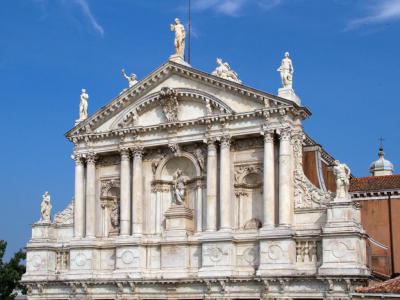
Adjacent to the modern Santa Lucia railway station, you will find the church of Santa Maria di Nazareth, commonly known as the Scalzi. The term "scalzi" refers to the barefoot Carmelite friars who arrived in Venice during the 1670s and commissioned the construction of this church along the Grand Canal.

The facade, completed by Giuseppe Sardi between 1672-80, is truly striking, adorned with numerous statues; however, it is the vast Baroque interior that will truly leave you awe-inspired. Designed by Baldassare Longhena, the interior exudes a theatrical grandeur, characterized by lavish marble, intricately gilded woodwork, and magnificent sculptures.

While exploring the interior, be sure to gaze up at the ceiling painting titled "Proclamation of the Maternity of the Virgin at the Council of Ephesus", a masterpiece by Ettore Tito dating back to 1934. This artwork replaced an earlier fresco by Tiepolo, sadly destroyed in October 1915 by an Austrian bomb intended for the nearby train station.

Before leaving the church, be sure to visit the lovely gift shop, where you may find delightful mementos or souvenirs to commemorate your visit.
2
Chiesa di San Simeone Piccolo (Church of St. Simeon the Lesser)

2) Chiesa di San Simeone Piccolo (Church of St. Simeon the Lesser)

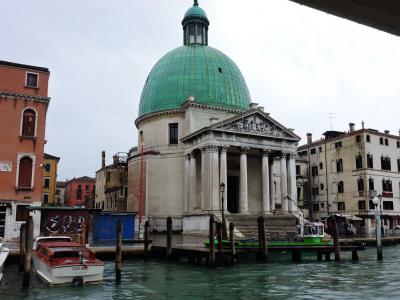
San Simeone Piccolo stands prominently in Venice, directly opposite the train station, making it impossible to miss. Designed by Giovanni Scalfarotto in 1718, it is one of the last churches built in Venice, showcasing the emerging eclecticism of Neoclassical architecture. Its architectural influence draws from both Rome's Pantheon, evident in its façade and layout, and the grandeur of Santa Maria della Salute church, reflected in the striking exaggeration of its dome.

As you approach the entrance, your attention is captured by the pediment adorned with a marble relief depicting 'The Martyrdom of the Saints', an artwork crafted by Francesco Penso. This portrayal refers to the martyrdom of Saint Simon, believed to be the cousin of Christ, who met his fate at the hands of the Romans due to his Jewish heritage. Inside the church, venture along the long corridors to discover an underground crypt housing an altar. Venturing down there may result in a dimly lit environment where a candle becomes your sole source of illumination; however, for those seeking an extraordinary and adventurous experience, it's a rather unique opportunity.
3
Fondaco dei Turchi / Museo di Storia Naturale (Turks' Inn / Natural History Museum)

3) Fondaco dei Turchi / Museo di Storia Naturale (Turks' Inn / Natural History Museum)

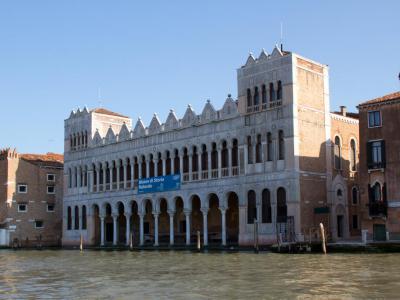
Situated majestically along the Grand Canal, the Turks' Inn ("Fondaco dei Turchi") is an architectural marvel embodying the captivating Veneto-Gothic style. Its construction traces back to the early 13th century, and in the 1800s it was heralded as "a Byzantine palace", a rare non-ecclesiastical gem in Venice. Once considered one of Europe's most unique and intriguing edifices, it stood as a significant exemplar of Italo-Byzantine architecture. However, in 1869, the government undertook extensive modernization efforts, resulting in a partial reconstruction of this historic landmark.

Having served as a residence for esteemed visitors, the building acquired its epithet "dei Turchi" when the Ottoman Turkish community repurposed it as a fondaco-a multifunctional establishment combining dwelling, warehouse, and marketplace for Turkish traders. With the decline in Oriental commerce, the fondaco fell into disrepair until Austrian authorities commenced restoration work in the 1850s.

Since 1923, the Turks' Inn has been home to the Natural History Museum ("Museo di Storia Naturale"). After years of meticulous restoration, the museum recently reopened its doors, presenting its exhibits using captivating and contemporary techniques while maintaining the intellectual rigor of its content. The initial sequence of rooms guides visitors through the fossil collection, thoughtfully arranged to trace the evolutionary process-highlighting this narrative are fossilized animal tracks ingeniously embedded in the flooring. The museum also features sections dedicated to locomotion, with separate showcases for land, water, and airborne creatures.

Noteworthy are the extraordinary artifacts amassed by Giovanni Miani during his expedition in 1859-60 to discover the source of the Nile, as well as a striking collection of African hunting trophies amassed by Giuseppe de Reali. In a long room overlooking the magnificent Grand Canal, visitors can marvel at a splendid array of cabinets illustrating the evolution of the study of natural history in Venice, including exquisitely grisly specimens of dissected animals. A meticulous reconstruction of a Wunderkammer, or Cabinet of Curiosities, awaits exploration-a treasure trove of zoological, botanical, and mineralogical wonders akin to the abodes of Renaissance scholars and erudite minds of subsequent centuries.

While the collection is vast and captivating, it is worth noting that the museum caters primarily to Italian-speaking visitors, as the captions are exclusively in Italian.

Why You Should Visit:
Fascinating fossils inside, and excellent showcase of the collection, including the traditional 19th-century presentation for some of the animal collections.
Notably, the museum offers a respite from the heat with its air-conditioned premises, an English guidebook, and an exquisite inner courtyard, all at reasonable prices.

Tip:
If you bring a picnic, the museum grounds provide an enchanting setting to savor your meal and immerse yourself in the ambiance of the surroundings.
4
Chiesa di Sant'Eustachio (Church of St. Eustace)

4) Chiesa di Sant'Eustachio (Church of St. Eustace)

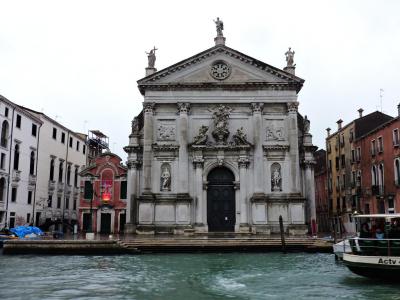
Established in the 11th century, but later rebuilt and adorned with a new facade in the 17th century, Sant'Eustachio, also known as San Stae, underwent a comprehensive restoration in 1977-78. While it may appear comparatively modest in size when compared to other churches in Venice, its prime location alongside the Grand Canal and the San Stae vaporetto stop makes it stand out.

The edifice showcases a sculpted Baroque facade adorned with numerous statues and columns, lending it an air of mystery. Inside, instead of extravagant adornments, visitors will discover a collection of paintings beautifully exhibited against the backdrop of pristine white walls. Noteworthy works include Tiepolo's "The Martyrdom of Saint Bartholomew", Pittoni's "Torture of Saint Thomas", Sebastiano Ricci's "The Liberation of Saint Peter", and many others. Ample windows allow natural light to flood the interior, illuminating the exquisite artwork.

Located near the second altar on the left, you will find a bust of Antonio Foscarini, a Venetian nobleman whose fate took a dramatic twist in 1622. Sentenced to death for high treason by the Council of Ten (a secretive council responsible for maintaining political stability), he was executed. However, just ten months later, the same council reversed its decision, posthumously exonerating Foscarini and officially notifying European courts of the annulment of his guilty verdict and death sentence. This extraordinary turn of events continues to shroud Foscarini's involvement in a perplexing tale of Venetian political intrigue.
5
Fondaco dei Tedeschi (German Warehouse)

5) Fondaco dei Tedeschi (German Warehouse) (must see)

Just beside the Rialto Bridge, there’s a massive, square-shouldered building that once ran the business side of Venice’s global trade scene: the German Warehouse. Back in the Middle Ages, this was the headquarters for German merchants, who happened to be Venice’s most powerful foreign trading group. From as early as the 13th century, traders from cities like Nuremberg, Augsburg, and Judenburg lived, stored goods, negotiated deals, and generally made money right here—under this very roof.

After a major fire, the building was reconstructed in the 16th century into the form you see now: a solid four-storey Renaissance structure arranged around a large inner courtyard. Architecturally, it looks fully Italian, but its concept tells a wider story. The word “fondaco” comes from Arabic, and the idea behind it was practical and controlled: part palace, part warehouse, part dormitory, with merchants living on-site and access carefully regulated. Venice knew how to welcome foreigners—on its own terms...

Jump ahead a few centuries, and the role has changed, though the location hasn’t. Today, the German Warehouse is one of Venice’s grandest shopping spaces, focused firmly on luxury brands. Yes, prices here reflect the address, and yes, it’s usually busy. Still, even if shopping isn’t on your agenda, this building alone has a trick worth your time.

Head up to the rooftop terrace. From the fourth-floor Event Pavilion—one that is used for exhibitions and cultural events—you get free access to one of the best viewpoints in the city. Below, you'll see the Grand Canal bend and glide past the Rialto. Nearby, the bridge forms an angle that few people ever notice. In the distance, on a clear day, you can even spot the domes of St. Mark’s Basilica, sitting quietly about a kilometer away.

A quick practical note for timing: access to the terrace requires a free ticket issued for a specific time slot, just to keep numbers manageable. Pick one up on the top floor or reserve online in advance. If you happen to be up here at sunset, you’ll understand exactly why merchants once fought for a place at this address...
6
Palazzo Grimani di San Luca (Grimani Palace in San Luca)

6) Palazzo Grimani di San Luca (Grimani Palace in San Luca)

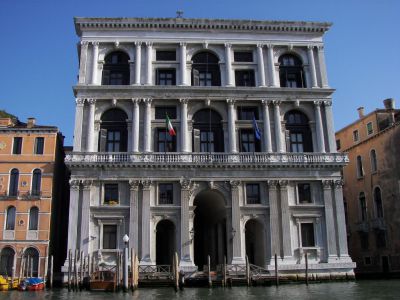
Once a renowned residence-museum, the Grimani Palace was home to a remarkable collection of antiquities amassed by the Grimani brothers, Giovanni and Vettore, who undertook the renovation of their grandfather's palace in the mid-16th century. The result is a magnificent architectural masterpiece that blends Tuscan and Roman elements with the original Venetian style, highlighted by the Roman courtyard and staircase, its most exquisite features.

While many of the Grimani brothers' treasures now reside in the Archaeological Museum, the unfurnished yet captivating rooms of Palazzo Grimani boast rich decorations, including elaborate marble and stucco work, statues, fireplaces, and remarkable frescoes. Noteworthy rooms like the Foliage Room, adorned with trees, fruits, flowers, and birds, and the Dining Room, featuring depictions of wildfowl and fish, are alone worth the visit. Additionally, the palazzo hosts temporary exhibitions, further adding to its allure as a cultural destination.
7
Campo San Samuele (St. Samuel's Square)

7) Campo San Samuele (St. Samuel's Square)

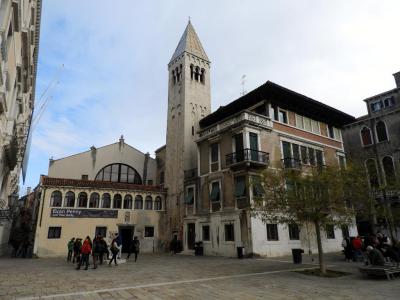
One of the few squares that open up to the Grand Canal, Saint Samuel's Square ("Campo San Samuele") boasts two remarkable palaces of immense historical, architectural, and cultural significance to Venice: the Grassi Palace ("Palazzo Grassi"), a renowned gallery showcasing contemporary masterpieces, and the Malipiero Palace ("Palazzo Malipiero"), once the residence of the legendary Venetian lover, Giacomo Casanova.

With its origins dating back to the Byzantine era, the Malipiero Palace carries a rich architectural legacy spanning nine centuries. The intricate design of the building reflects the care and passion for the arts exhibited by each successive generation of owners. Presently, the palace has been divided into multiple apartments, while the 2nd floor houses a hotel that still boasts beautifully preserved 18th-century frescoes.

Meanwhile, the historical abode of the Grassi family exudes grandeur befitting a palatial residence, complete with a central courtyard and a magnificent baroque staircase. As is customary for galleries hosting rotating exhibitions, it is advisable to inquire about the current displays.

At the heart of the square stands the Church of Saint Samuel ("Chiesa di San Samuele"), where Casanova received his baptism. Erected in the late 12th century, the church has retained much of its original form and features one of the city's oldest bell towers. Although the church was established in the preceding century, it underwent extensive reconstruction in the late 17th century.
8
Palazzo Cavalli-Franchetti (Cavalli-Franchetti Palace)

8) Palazzo Cavalli-Franchetti (Cavalli-Franchetti Palace)

Facing the Gallery of the Academy and rubbing shoulders with Barbarigo Palace, Cavalli-Franchetti Palace knows how to make an entrance. Stretching confidently along the Grand Canal, it pairs delicate Gothic tracery with a surprisingly generous garden—already a rare luxury in Venice. Built in the 16th century, the palace mixes Gothic drama with Byzantine echoes, creating a façade that feels both refined and slightly theatrical. These days, it plays host not to nobles, but to the Venetian Institute of Science, Letters, and Art—a shift from aristocratic living to intellectual life...

Its story, however, is anything but settled. Over the centuries, the palace changed owners repeatedly, each leaving a stylistic fingerprint behind. Interiors were updated, façades refined, and windows increasingly dressed up in full Venetian Gothic flair. A major moment came in 1840, when Archduke Frederick Ferdinand of Austria ordered neo-Gothic renovations to underline Habsburg prestige in the city. He lived here until 1878, after which the palace passed to Baron Raimondo Franchetti. More renovations followed—though the baron himself never actually moved in, making this one of Venice’s grandest near-misses in residential history.

Today, the palace has found a new rhythm. Instead of ballrooms and banquets, it hosts rotating exhibitions of contemporary art. That alone makes it stand out in a neighborhood dominated by Renaissance masters and centuries-old altarpieces. Inside, the contrast continues: modern works unfold beneath towering Murano glass chandeliers, some so large they feel like architectural features rather than lighting. It’s a setting where old Venice and new ideas share the same ceiling...

And there’s one more reason not to rush through. Along with the art and sweeping views of the Grand Canal, the palace also has an on-site cafeteria—a welcome pause point where you can sit down, refuel, and watch the canal traffic glide past. Art, architecture, and lunch with a view: not a bad combination for a Venetian stop...
9
Palazzo Barbarigo (Barbarigo Palace)

9) Palazzo Barbarigo (Barbarigo Palace)

Originally constructed in the 16th century and formerly owned by Venice's largest glass factory proprietors, the Barbarigo Palace stands out for its exterior adorned with Murano glass mosaics. These mosaics, added in 1886, are said to have been inspired by the similarly adorned facade of Saint Mark's Basilica.

Nonetheless, upon completion of the front mosaic, the aristocratic neighbors were less than impressed. They accused the new owners of the palace of being "nouveau riches" with a taste that they considered garish and out of touch with the elegant decay of the surrounding buildings. This criticism was unfair, as many Renaissance palaces along the Grand Canal were once adorned with vibrant polychrome and gilt decorations, showcasing elaborate plaster and stucco work that only enhanced their magnificence.

Today, the Barbarigo Palace stands as one of the most extravagant architectural gems along the Grand Canal. The central frieze mosaic portrays 35 cherubs actively engaged in various artistic endeavors, such as painting, drawing, sculpture, and architecture. Two separate murals commemorate visits by royal figures to Venice: one depicts Holy Roman Emperor Charlemagne conversing with Titian on the scaffold of Saint Mark's Basilica during a visit in the 16th century, while the other portrays French King Henry III arriving on the Doge's barge accompanied by a team of glass-makers in 1574.

Above these scenes, the portraits of two renowned Venetian painters, Titian and Tintoretto, can be found. One portrait is crowned by the lion of Saint Mark, symbolizing Venice, while the other features the rooster, symbolizing Murano.
10
Basilica di Santa Maria della Salute (Basilica of Our Lady of Good Health)

10) Basilica di Santa Maria della Salute (Basilica of Our Lady of Good Health) (must see)

San Marco may dominate postcards by reputation, but when it comes to Venice’s most recognizable outline, the real scene-stealer is the Basilica of Our Lady of Good Health. Known locally as La Salute, this sweeping white church commands the entrance to the Grand Canal with a dome that feels less like a roof and more like a statement. It stands as the clearest expression of Venetian Baroque ambition—bold, theatrical, and impossible to ignore...

Its origins are tied to crisis rather than confidence. In the early 1630s, a devastating plague swept through Venice, killing nearly a third of the city’s population. In response, the Venetian Republic made a vow: if deliverance came, a church would rise in honor of Our Lady of Good Health. The promise held, and construction followed.

Designed by Baldassare Longhena, then just in his early thirties, the project would define his career. Built on more than 100,000 wooden piles driven into the lagoon floor, La Salute took around fifty years to complete. Longhena devoted most of his life to it and lived just long enough to see the final result in 1681.

Once finished, the basilica's dome quickly became part of Venice’s visual identity. Painters took note. Canaletto and Francesco Guardi returned to it again and again, while artists visiting from abroad—Turner, Monet, and John Singer Sargent among them—used it as a focal point for light, reflection, and atmosphere. The silhouette you see today is not just architecture; it is centuries of artistic attention layered onto stone.

Inside, the basilica continues to surprise. The sacristy doubles as a compact art gallery, featuring works by Titian and Tintoretto. Ceiling paintings such as David and Goliath, Cain and Abel, and Abraham and Isaac unfold overhead, while The Marriage Feast of Cana anchors the space with dramatic intensity. At the high altar, a sculptural group by Josse de Corte delivers pure Baroque theater: the Virgin and Child banish the plague itself, imagined as a defeated old woman retreating from Venice.

Entry to the church is free during opening hours, though the sacristy requires a ticket. From the balcony, views spill back onto the square, and on certain days, a short organ recital follows the service—an unexpected reward for those who linger. Check the schedule in advance, and plan ahead.

Cafés are scarce nearby, so bringing a drink isn’t a bad idea. La Salute rewards patience, timing, and a willingness to look up...

Walking Tours in Venice, Italy

Create Your Own Walk in Venice

Create Your Own Walk in Venice

Creating your own self-guided walk in Venice is easy and fun. Choose the city attractions that you want to see and a walk route map will be created just for you. You can even set your hotel as the start point of the walk.
Titian's Paintings Walk

Titian's Paintings Walk

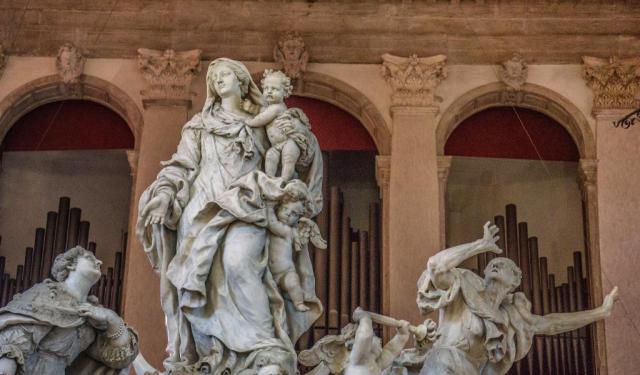
One of the greatest painters of all time, Tiziano Vecelli – better known as Titian – was a pioneering figure of the Venetian school of Italian Renaissance painting. His career was successful from the start, and he became sought after by patrons, initially from Venice and its possessions, then joined by the north Italian princes, and finally the Habsburgs and papacy.

Equally adept with...  view more

Tour Duration: 2 Hour(s)
Travel Distance: 3.6 Km or 2.2 Miles
Jewish Ghetto Tour

Jewish Ghetto Tour

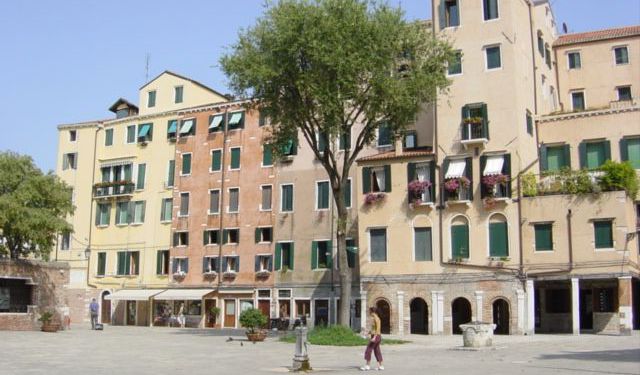
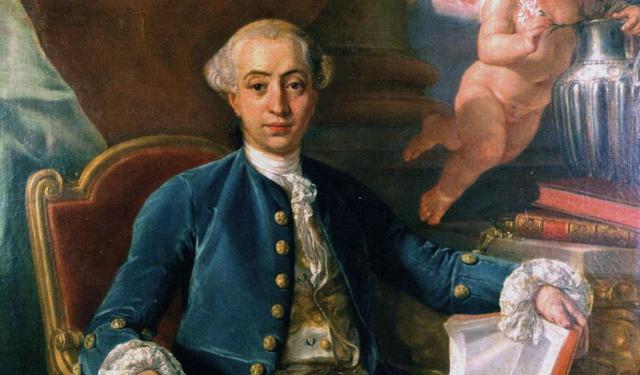
Founded in 1516, the Jewish Ghetto of Venice earns its grim little footnote in European history as the first place officially designated as a “ghetto.” It began as a Venetian compromise with sharp edges: the Papacy urged to expel the Jews, while Venice—never one to waste a useful population—chose to confine them to a small island.

The word “ghetto” comes with competing origin...  view more

Tour Duration: 1 Hour(s)
Travel Distance: 0.4 Km or 0.2 Miles
Murano Island Walking Tour

Murano Island Walking Tour

Murano Island is known around the world as the “Glass Island,” and it didn’t earn that nickname overnight. This reputation rests on more than seven centuries of uninterrupted glassmaking. Located just north of Venice, separated by a slim ribbon of lagoon water, Murano grew into a place where identity and industry became inseparable. Although inhabited since Roman times, the island truly...  view more

Tour Duration: 1 Hour(s)
Travel Distance: 2.3 Km or 1.4 Miles
Venice Introduction Walking Tour

Venice Introduction Walking Tour

Venice is a city that learned early how to live with water—and, ultimately, how to profit from it. Built across hundreds of small islands in a shallow lagoon in the northern Adriatic, it runs without roads, relying solely on canals and bridges. Although the lagoon itself formed thousands of years ago, it was inhabited mainly by fishermen up until the 5th century AD, when waves of barbarian...  view more

Tour Duration: 3 Hour(s)
Travel Distance: 4.1 Km or 2.5 Miles
Around Rialto Bridge

Around Rialto Bridge

The Rialto district represents the earliest urban and commercial core of Venice that has shaped the city’s identity for centuries. Long before grand palaces lined the canals or empires were managed from marble halls, this was the practical heart of the lagoon. Its name comes from Rivo Alto, meaning “high bank,” a rare patch of ground that stayed relatively dry and therefore attracted...  view more

Tour Duration: 1 Hour(s)
Travel Distance: 0.4 Km or 0.2 Miles
Casanova's Venice

Casanova's Venice

Giacomo Casanova is usually introduced as history’s most famous seducer—but that shorthand misses the point. Casanova didn’t simply charm his way through life, but was shaped by a very particular moment in Venetian history. He came of age in the eighteenth century, when the Republic of Venice was living on its reputation. The great maritime empire was fading, its political and commercial...  view more

Tour Duration: 2 Hour(s)
Travel Distance: 4.5 Km or 2.8 Miles
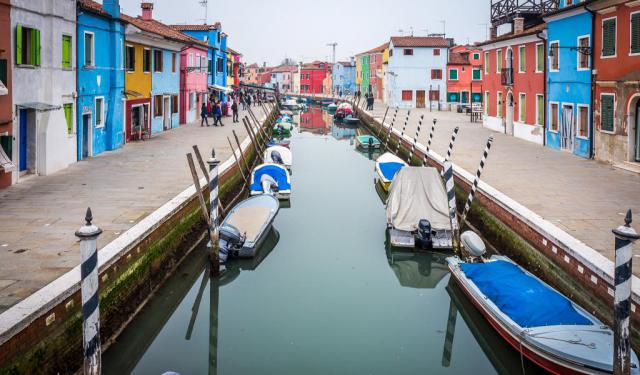
Useful Travel Guides for Planning Your Trip

15 Distinctively Italian Things to Buy in Venice

15 Distinctively Italian Things to Buy in Venice

Venice has been a tourist mecca for over a century now, with millions of visitors flocking in every year to see this unique place on the face of the Earth. Many, if not all, of these people seek to obtain something memorable as a token of their stay in this city. By far, not all of them know which...