

Kitchener Introduction Walking Tour (Self Guided), Kitchener
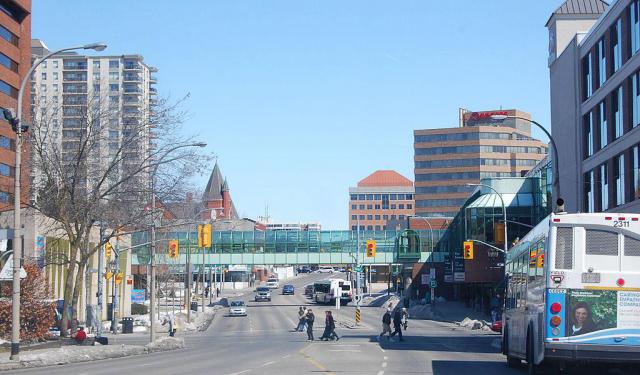
Albeit small, Kitchener makes a good tourist spot with a rich cultural scene, a number of historic attractions, parks and other places of interest. Local cultural highlights include the Kitchener-Waterloo Art Gallery, Centre In The Square, the Waterloo Region Children's Museum and the Kitchener Public Library, to mention but a few. Live music is heard regularly throughout the city, as Kitchener is a home to an independent music label featuring many locally based musicians. In the heart of downtown, Victoria Park, the oldest outdoor park in the city, plays host to a number of events and festivities during a year. To explore these and other popular sights of Kitchener, follow this orientation walk.
How it works: Download the app "GPSmyCity: Walks in 1K+ Cities" from Apple App Store or Google Play Store to your mobile phone or tablet. The app turns your mobile device into a personal tour guide and its built-in GPS navigation functions guide you from one tour stop to next. The app works offline, so no data plan is needed when traveling abroad.
Kitchener Introduction Walking Tour Map
Guide Name: Kitchener Introduction Walking Tour
Guide Location: Canada » Kitchener (See other walking tours in Kitchener)
Guide Type: Self-guided Walking Tour (Sightseeing)
# of Attractions: 10
Tour Duration: 2 Hour(s)
Travel Distance: 3.0 Km or 1.9 Miles
Author: leticia
Sight(s) Featured in This Guide:
Guide Location: Canada » Kitchener (See other walking tours in Kitchener)
Guide Type: Self-guided Walking Tour (Sightseeing)
# of Attractions: 10
Tour Duration: 2 Hour(s)
Travel Distance: 3.0 Km or 1.9 Miles
Author: leticia
Sight(s) Featured in This Guide:
- Kitchener City Hall
- Conrad Centre For The Performing Arts
- Kitchener Market Square
- Registry Theatre
- Centre in the Square
- Fallen Fire Fighters Memorial
- Kitchener Public Library
- St. Paul's Lutheran Church
- Joseph Schneider Haus Museum and Gallery
- Victoria Park
1) Kitchener City Hall
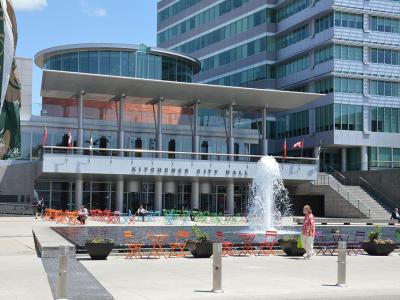
Kitchener City Hall opened in September 1993 as the city’s main government building and a public gathering space. It replaced a 1924 city hall demolished in 1973. From 1973 to 1993, city offices operated out of the Oxlea Tower at Market Square. The current building was planned as a civic centre combining public services and community events.
The complex includes the Council Chamber, the Civic Rotunda, and the Administrative Office Tower. The rotunda is used for public events and exhibits, and council meets in a circular chamber with visitor seating. The building is clad in Agra Red Sandstone from India. The 12-storey Berlin Tower has a weather beacon that changes colour to show forecasts. The 1924 clock tower was rebuilt in Victoria Park in 1995.
The open space in front of the building was known as Civic Square for its first two decades and was officially renamed Carl Zehr Square in 2014. A fountain operates in warm months and converts into a skating rink in winter. The square also hosts concerts, markets, festivals, and public gatherings throughout the year.
The complex includes the Council Chamber, the Civic Rotunda, and the Administrative Office Tower. The rotunda is used for public events and exhibits, and council meets in a circular chamber with visitor seating. The building is clad in Agra Red Sandstone from India. The 12-storey Berlin Tower has a weather beacon that changes colour to show forecasts. The 1924 clock tower was rebuilt in Victoria Park in 1995.
The open space in front of the building was known as Civic Square for its first two decades and was officially renamed Carl Zehr Square in 2014. A fountain operates in warm months and converts into a skating rink in winter. The square also hosts concerts, markets, festivals, and public gatherings throughout the year.
2) Conrad Centre For The Performing Arts
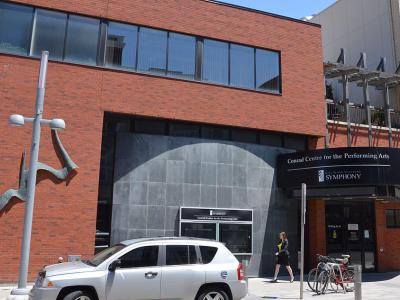
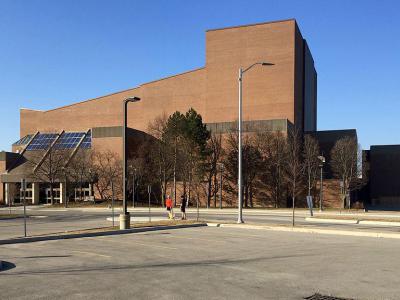
The Conrad Centre for the Performing Arts is a flexible arts venue set inside a reused industrial building. Instead of a traditional concert-hall design, it uses a “black box” layout, with exposed brick, visible structural elements, and simple finishes. The building is about 24,000 square feet and was donated to the city in 2021 by the Manfred and Penny Conrad Family Foundation to support performing arts and cultural use.
The main hall is designed to change depending on the event. It has 105 retractable tiered seats, with total seating for about 352 people. When the seating is pulled back, the space becomes a flat-floor venue for up to around 400 standing guests. A smaller Blair Rehearsal Hall follows a similar layout and can host around 100 people, or about 75 seated, making it suitable for rehearsals and smaller events.
The centre was previously used as a rehearsal and office base by the Kitchener-Waterloo Symphony, but this changed in 2023 when the city took over full operation. Today, the venue is developing into a shared cultural hub, hosting small concerts, touring performances, student events, and workshops in a setting where audiences sit close to the stage.
The main hall is designed to change depending on the event. It has 105 retractable tiered seats, with total seating for about 352 people. When the seating is pulled back, the space becomes a flat-floor venue for up to around 400 standing guests. A smaller Blair Rehearsal Hall follows a similar layout and can host around 100 people, or about 75 seated, making it suitable for rehearsals and smaller events.
The centre was previously used as a rehearsal and office base by the Kitchener-Waterloo Symphony, but this changed in 2023 when the city took over full operation. Today, the venue is developing into a shared cultural hub, hosting small concerts, touring performances, student events, and workshops in a setting where audiences sit close to the stage.
3) Kitchener Market Square (must see)
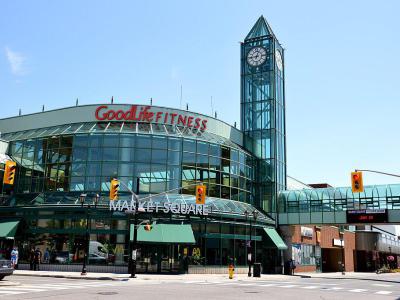
Market Square stands on the former grounds of the 1924 City Hall, demolished in 1973 during a period of downtown redevelopment. That same year, the new complex opened and became home to the Kitchener Farmers’ Market, continuing a trading tradition that began in 1869. For more than thirty years, vendors operated inside this structure before the market relocated in 2004 to a purpose-built facility nearby. The name “Market Square” remains tied to those decades when agricultural exchange shaped the daily rhythm of the site.
The building reflects late 20th-century redevelopment in both scale and materials. Concrete volumes, interior concourses, and a multi-level layout characterize the design. A glass tower element, added during a renovation in the 1980s, references the original City Hall clock tower. The historic 1924 tower itself was preserved and moved to Victoria Park, while the feature at Market Square serves as a modern architectural echo rather than an original remnant.
By early 2026, the complex faces a transitional moment. Conestoga College ceased operations at this campus in August 2025, consolidating its programs elsewhere downtown. Following the departure of its largest tenant, much of the interior has become vacant, and discussions now focus on possible redevelopment, including civic or judicial uses. Remaining service tenants occupy only limited areas of the building.
Next door, the former office tower at 22 Frederick Street has been converted into high-density residential units, now fully integrated into the downtown core. This contrast highlights the evolving character of the area, where former commercial and institutional spaces are being reconsidered for new urban purposes.
The building reflects late 20th-century redevelopment in both scale and materials. Concrete volumes, interior concourses, and a multi-level layout characterize the design. A glass tower element, added during a renovation in the 1980s, references the original City Hall clock tower. The historic 1924 tower itself was preserved and moved to Victoria Park, while the feature at Market Square serves as a modern architectural echo rather than an original remnant.
By early 2026, the complex faces a transitional moment. Conestoga College ceased operations at this campus in August 2025, consolidating its programs elsewhere downtown. Following the departure of its largest tenant, much of the interior has become vacant, and discussions now focus on possible redevelopment, including civic or judicial uses. Remaining service tenants occupy only limited areas of the building.
Next door, the former office tower at 22 Frederick Street has been converted into high-density residential units, now fully integrated into the downtown core. This contrast highlights the evolving character of the area, where former commercial and institutional spaces are being reconsidered for new urban purposes.
4) Registry Theatre
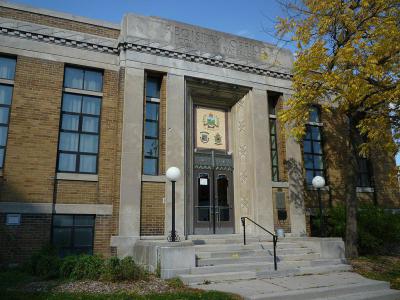
The Registry Theatre is located in a building built between 1938 and 1939 as the Waterloo County Registry Office. It managed land titles and public records until 1977. After that, it was used by the regional police until 1992 and briefly served as storage for the Curling Hall of Fame. The structure is one of the few Art Deco buildings left in the region, and visitors can still see original details such as terrazzo floors, marble walls and steps, and a limestone arch with zigzag designs.
The building was revitalized in 2000 and officially opened as a theatre in January 2001. It was redesigned as a flexible black box space, with seating for about 143 to 166 people, most often set at 150. The compact layout offers clear sightlines and good acoustics, creating a close connection between performers and audience.
Today, the theatre presents Jazz, Folk, and Classics series, along with the biennial IMPACT International Theatre Festival held in odd-numbered years. It is home to JM Drama and hosts dance groups, touring musicians, and local productions, offering an affordable stage for both new and experienced artists.
The building was revitalized in 2000 and officially opened as a theatre in January 2001. It was redesigned as a flexible black box space, with seating for about 143 to 166 people, most often set at 150. The compact layout offers clear sightlines and good acoustics, creating a close connection between performers and audience.
Today, the theatre presents Jazz, Folk, and Classics series, along with the biennial IMPACT International Theatre Festival held in odd-numbered years. It is home to JM Drama and hosts dance groups, touring musicians, and local productions, offering an affordable stage for both new and experienced artists.
5) Centre in the Square (must see)
Centre in the Square opened in September 1980 as a venue built especially for live performances. It was funded through public support and local fundraising, with the idea of creating a shared cultural space. The first event, Kitchener On Stage, was a community variety show. Over more than forty years, the centre has hosted artists such as Tony Bennett, Leonard Cohen, and The Tragically Hip, while also supporting local performers, schools, and regional arts groups.
The main performance area is the Raffi Armenian Theatre, named after the founding conductor of the local symphony. After accessibility upgrades in 2024, it seats about 1,900 people across three levels: main floor, mezzanine, and balcony. Wider aisles and wheelchair seating were added, while the hall’s design supports clear sound for different types of shows. A smaller studio theatre is used for more intimate performances.
The programme changes through the year and includes touring Broadway-style musicals, orchestra concerts, stand-up comedy, and family shows. The venue was long linked to the Kitchener-Waterloo Symphony, which stopped operating in late 2023. New groups, including the K-W Symphony Players’ Association, are now working to bring orchestral music back. Regional groups such as the Grand Philharmonic Choir also perform here, along with school concerts, talks, and community events.
For visitors, attending a show is an easy way to see local cultural life. Performances are usually held in the evening and attract both regular audiences and first-time visitors. Recent upgrades have made the building easier to access, helping visitors plan a comfortable visit.
The main performance area is the Raffi Armenian Theatre, named after the founding conductor of the local symphony. After accessibility upgrades in 2024, it seats about 1,900 people across three levels: main floor, mezzanine, and balcony. Wider aisles and wheelchair seating were added, while the hall’s design supports clear sound for different types of shows. A smaller studio theatre is used for more intimate performances.
The programme changes through the year and includes touring Broadway-style musicals, orchestra concerts, stand-up comedy, and family shows. The venue was long linked to the Kitchener-Waterloo Symphony, which stopped operating in late 2023. New groups, including the K-W Symphony Players’ Association, are now working to bring orchestral music back. Regional groups such as the Grand Philharmonic Choir also perform here, along with school concerts, talks, and community events.
For visitors, attending a show is an easy way to see local cultural life. Performances are usually held in the evening and attract both regular audiences and first-time visitors. Recent upgrades have made the building easier to access, helping visitors plan a comfortable visit.
6) Fallen Fire Fighters Memorial
The Fallen Fire Fighters Memorial, also known as Protecting the Memory, was unveiled in 2005 to honour firefighters who lost their lives while on duty. It was commissioned by the Kitchener Professional Firefighters Association and donated to the city. The memorial honours both career and volunteer firefighters and serves as a place for reflection and remembrance.
At the centre of the memorial is a 13-foot bronze sculpture by Canadian artist Timothy Schmalz. The sculpture shows firefighters beneath angel wings, symbolising protection and sacrifice. Individual bronze helmets, engraved with names, are used instead of a single wall. A steel beam from the World Trade Center was added in 2011 to remember firefighters lost on September 11.
Fire service symbols throughout the memorial connect it clearly to firefighting traditions. The open setting keeps the space calm, allowing visitors to move around at their own pace. Memorial services are held each September, with firefighters and families placing flowers. The site offers a short but meaningful visit focused on real people and shared loss.
At the centre of the memorial is a 13-foot bronze sculpture by Canadian artist Timothy Schmalz. The sculpture shows firefighters beneath angel wings, symbolising protection and sacrifice. Individual bronze helmets, engraved with names, are used instead of a single wall. A steel beam from the World Trade Center was added in 2011 to remember firefighters lost on September 11.
Fire service symbols throughout the memorial connect it clearly to firefighting traditions. The open setting keeps the space calm, allowing visitors to move around at their own pace. Memorial services are held each September, with firefighters and families placing flowers. The site offers a short but meaningful visit focused on real people and shared loss.
7) Kitchener Public Library
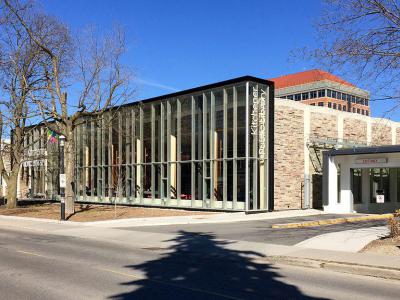
Kitchener Public Library has served the community since 1884, though its roots go back even further to the Mechanics’ Institute founded in 1854. The current Central Branch opened on May 23, 1962. In 2014, a $40 million renovation and expansion updated the original structure with modern features while keeping it open and accessible to the public.
Inside, the building is bright and open. Large 20-foot windows bring in natural light, and a “front porch” reading lounge near the entrance offers a relaxed place to sit. The library holds materials in several languages and a dedicated Local History and Genealogy collection in the Grace Schmidt Room. Visitors can also use free Wi-Fi, public computers, 3D printers, and a recording studio.
The building includes a large children’s area for story times and family programs, a 200-seat theatre for talks and performances, and meeting or study rooms that can be rented. Art is part of the experience too. One of the most noticeable pieces is Enlightenment, a 560-square-foot mural by Jack Bechtel. For travellers, the library provides a practical stop, but it also shows how the community supports learning, creativity, and shared public space.
Inside, the building is bright and open. Large 20-foot windows bring in natural light, and a “front porch” reading lounge near the entrance offers a relaxed place to sit. The library holds materials in several languages and a dedicated Local History and Genealogy collection in the Grace Schmidt Room. Visitors can also use free Wi-Fi, public computers, 3D printers, and a recording studio.
The building includes a large children’s area for story times and family programs, a 200-seat theatre for talks and performances, and meeting or study rooms that can be rented. Art is part of the experience too. One of the most noticeable pieces is Enlightenment, a 560-square-foot mural by Jack Bechtel. For travellers, the library provides a practical stop, but it also shows how the community supports learning, creativity, and shared public space.
8) St. Paul's Lutheran Church (must see)
St. Paul’s Lutheran Church was founded in 1835, making it one of the oldest Lutheran congregations in the region. In its early years, it was known as the German Protestant Evangelical Church and served a growing German-speaking population in the town then called Berlin. The congregation played an important role not only in religious life but also in education, language preservation, and social support for immigrant families building new lives in Upper Canada.
The present church building is the third constructed on this site. It was erected in 1889, after the congregation decided in March of that year to replace the earlier structure. The cornerstone was laid in June 1889, and the church was dedicated in December 1889. This rebuilding marked an important moment in the congregation’s growth, reflecting both increasing membership and greater financial stability at the end of the 19th century.
Architecturally, the church reflects Gothic Revival, often described locally as Upper Canada Vernacular Gothic. Its red-brick exterior, pointed-arch windows, and strong vertical lines follow a style commonly used for Protestant churches in the late 19th century. The prominent bell tower gives the building a clear profile and serves as a visual landmark within the surrounding neighbourhood.
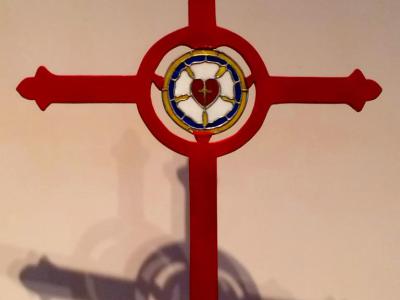
Inside, the nave is defined by wooden pews, stained glass windows, and a layout designed for both worship and music. Many of the stained glass panels were donated as memorials and record names connected to the congregation’s history. Music has long been central to church life, and the space continues to host choral performances and community concerts. Today, St. Paul’s remains an active congregation while also reflecting nearly two centuries of German-Canadian religious and cultural heritage.
The present church building is the third constructed on this site. It was erected in 1889, after the congregation decided in March of that year to replace the earlier structure. The cornerstone was laid in June 1889, and the church was dedicated in December 1889. This rebuilding marked an important moment in the congregation’s growth, reflecting both increasing membership and greater financial stability at the end of the 19th century.
Architecturally, the church reflects Gothic Revival, often described locally as Upper Canada Vernacular Gothic. Its red-brick exterior, pointed-arch windows, and strong vertical lines follow a style commonly used for Protestant churches in the late 19th century. The prominent bell tower gives the building a clear profile and serves as a visual landmark within the surrounding neighbourhood.
Inside, the nave is defined by wooden pews, stained glass windows, and a layout designed for both worship and music. Many of the stained glass panels were donated as memorials and record names connected to the congregation’s history. Music has long been central to church life, and the space continues to host choral performances and community concerts. Today, St. Paul’s remains an active congregation while also reflecting nearly two centuries of German-Canadian religious and cultural heritage.
9) Joseph Schneider Haus Museum and Gallery (must see)
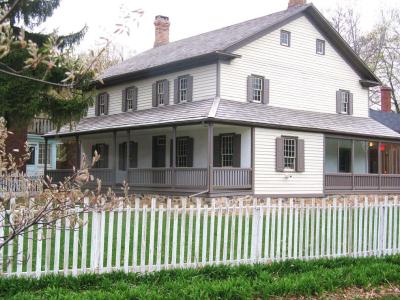
The Joseph Schneider Haus Museum and Gallery was built in 1816 by Joseph Schneider, a Pennsylvania-German Mennonite settler. It is the oldest surviving building in Kitchener. Although often called a stone house, the main structure is heavy timber-frame construction, with stone used mainly for the foundation and end chimneys. The steep roof and layout reflect Pennsylvania building traditions, with some Georgian-style influence.
Today, the museum interprets life mainly in the 1850s, especially around 1856. By this period, many families were beginning to use cast-iron cookstoves instead of relying only on an open hearth. Inside, the rooms are arranged to show daily life as it would have been in that decade. Ceilings are low, beams are exposed, and fireplaces and stoves form the centre of activity. Furniture and tools are arranged to show how work and family life shared the same spaces.
The kitchen remains an important focus. Staff sometimes demonstrate traditional cooking and craft skills, helping visitors understand how food was prepared and how textiles or tools were made. These activities show the time and physical effort required for everyday tasks before electricity and modern appliances.
Outside, the garden grows vegetables and herbs similar to those used for food and medicine in the 19th century. The site also includes an indoor gallery with rotating exhibitions on local history and regional art. In 2026, programs include events such as “Family Day Messy Makers” in February and “Bloody Berlin Walking Tours” in March, along with seasonal workshops and family activities throughout the year.
Today, the museum interprets life mainly in the 1850s, especially around 1856. By this period, many families were beginning to use cast-iron cookstoves instead of relying only on an open hearth. Inside, the rooms are arranged to show daily life as it would have been in that decade. Ceilings are low, beams are exposed, and fireplaces and stoves form the centre of activity. Furniture and tools are arranged to show how work and family life shared the same spaces.
The kitchen remains an important focus. Staff sometimes demonstrate traditional cooking and craft skills, helping visitors understand how food was prepared and how textiles or tools were made. These activities show the time and physical effort required for everyday tasks before electricity and modern appliances.
Outside, the garden grows vegetables and herbs similar to those used for food and medicine in the 19th century. The site also includes an indoor gallery with rotating exhibitions on local history and regional art. In 2026, programs include events such as “Family Day Messy Makers” in February and “Bloody Berlin Walking Tours” in March, along with seasonal workshops and family activities throughout the year.
10) Victoria Park (must see)
Victoria Park opened in 1896 and remains the oldest public park in the city. It was designed by the Olmsted Brothers, whose approach favored natural scenery over formal layouts. Curving paths, open lawns, and a central lake define the structure of the space. Created during the era of the City Beautiful movement, the park was intended as both a recreational landscape and a civic gathering ground, and it has continued to serve those dual roles for more than a century.
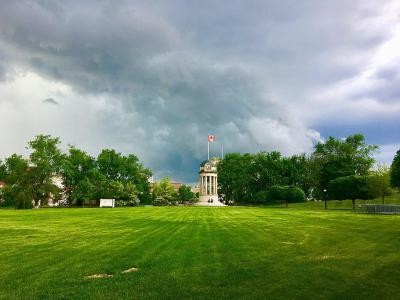
The lake forms the visual centre of the park. Footbridges connect the shore to Roos Island, named after a local family and recently restored to preserve its ironwork and pathways. Swans have long been part of the lake, and their spring return is marked by a community event known as the Parade of the Swans. Near the shore stands the restored 1899 clock tower from the former city hall, moved here in 1995 as a reminder of the city’s nineteenth-century architecture.
Close to the tower, a bronze statue commemorates Otis, a Canada Goose that became a familiar presence in the park. The pavilion nearby is a reconstruction completed in the early 1990s after the 1924 structure was lost to fire. Its design follows the earlier form and continues to host performances and seasonal events.
In winter, skating usually takes place on the outdoor artificial rink beside the pavilion rather than on the lake itself. In warmer months, flowerbeds, festivals, and open lawns shape the atmosphere. The park continues to function as a shared landscape grounded in local history and tradition.
The lake forms the visual centre of the park. Footbridges connect the shore to Roos Island, named after a local family and recently restored to preserve its ironwork and pathways. Swans have long been part of the lake, and their spring return is marked by a community event known as the Parade of the Swans. Near the shore stands the restored 1899 clock tower from the former city hall, moved here in 1995 as a reminder of the city’s nineteenth-century architecture.
Close to the tower, a bronze statue commemorates Otis, a Canada Goose that became a familiar presence in the park. The pavilion nearby is a reconstruction completed in the early 1990s after the 1924 structure was lost to fire. Its design follows the earlier form and continues to host performances and seasonal events.
In winter, skating usually takes place on the outdoor artificial rink beside the pavilion rather than on the lake itself. In warmer months, flowerbeds, festivals, and open lawns shape the atmosphere. The park continues to function as a shared landscape grounded in local history and tradition.
The Most Popular Cities
/ view all