

Medina Walking Tour, Marrakech

Medina Walking Tour (Self Guided), Marrakech

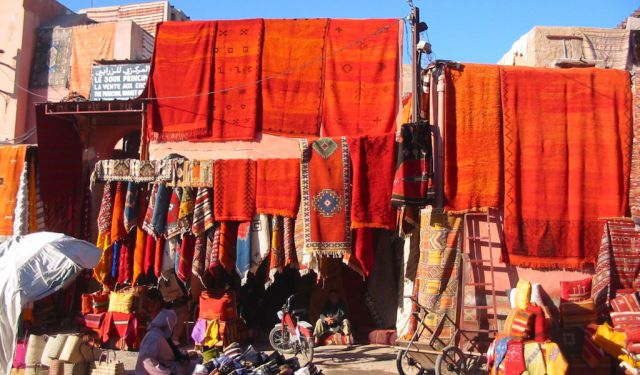
“Here everything is red — the walls, the earth, the dust that rises at every step.” French novelist and naval officer Pierre Loti was visibly impressed by the medina's choice of color. Who is there to say that Loti's visit in the 19th century did not foreshadow the French Protectorate two decades later?

The medina of Marrakech, today one of the most recognisable historic quarters in North Africa, emerged from the ambitions of the Almoravid dynasty in the late 11th century. They focused on creating a fortified seat for a rising empire, equipping the new city with mosques, aristocratic residences, and a water system fed by subterranean tunnels. This network allowed gardens, orchards, and neighbourhoods to thrive in an otherwise arid landscape, laying the groundwork for the medina’s long development.

When the Almohads overthrew the Almoravids in 1147, they did more than inherit the city. The new dynasty introduced expanded ramparts, monumental gateways, and reorganized districts that strengthened Marrakech’s role as a western capital for an empire linking North Africa to Iberia.

After the Almohad era, the medina moved through periods of uncertainty until the rise of the Saadians in the 16th century. Their reign revived Marrakech’s international prestige. The Saadian court sponsored ambitious construction, enhanced public spaces, and forged diplomatic ties across Europe and the Islamic world. Caravan networks from sub-Saharan Africa enriched the medina’s economy with new goods, artisanship, and cultural influences.

In the 17th century, the Alaouite dynasty unified Morocco and used Marrakech as a capital during key phases of its rule. Even when the seat of government moved elsewhere, the medina's neighborhoods, guilds, shrines, and markets sustained a communal structure that endured.

Remarkably, the medina contained the whole city of Marrakech and its commercial activities until early 20th century. Nevertheless, that was about to change with the arrival of the French Protectorate in 1912. While they certainly brought much-needed modernization, they made sure to leave the medina and its walls untouched.

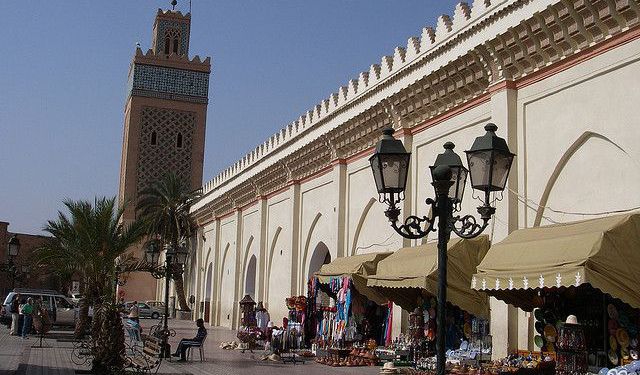
A walk through Marrakech’s medina brings you into a maze of narrow alleys filled with spice sellers, leatherworkers, lantern shops, and weaving ateliers. Souk Semmarine opens into nearby Rahba Kedima Square, where the old spice market still buzzes with life. You’ll pass red-ochre walls, carved wooden doorways, and peaceful inner courtyards before reaching the historic Ben Youssef Madrasa. Aromas of saffron, grilled bread, and mint tea drift through the streets as artisans hammer metal, dye wool, and shape pottery — a sensory introduction to the city’s centuries-old traditions.

Listed as a UNESCO Site since 1985, Marrakech's medina is a red beehive full of life. By walking its narrow alleys, you can clearly see why it has been sought after by many throughout centuries.
How it works: Download the app "GPSmyCity: Walks in 1K+ Cities" from Apple App Store or Google Play Store to your mobile phone or tablet. The app turns your mobile device into a personal tour guide and its built-in GPS navigation functions guide you from one tour stop to next. The app works offline, so no data plan is needed when traveling abroad.

Download The GPSmyCity App

Medina Walking Tour Map

Guide Name: Medina Walking Tour
Guide Location: Morocco » Marrakech (See other walking tours in Marrakech)
Guide Type: Self-guided Walking Tour (Sightseeing)
# of Attractions: 10
Tour Duration: 1 Hour(s)
Travel Distance: 1.9 Km or 1.2 Miles
Author: DanaOffice
Sight(s) Featured in This Guide:
  • Jemaa el-Fnaa Square
  • Souk Semmarine (Semmarine Market)
  • Rahba Kedima Square
  • Marrakech Souks (Marrakech Market)
  • Le Jardin Secret (The Secret Garden)
  • Almoravid Koubba
  • La Qoubba Galerie d'Art (The Qoubba Gallery of Arts)
  • Musee de Marrakech (Marrakech Museum)
  • Ben Youssef Madrasa
  • Maison de la Photographie (House of Photography)
1
Jemaa el-Fnaa Square

1) Jemaa el-Fnaa Square (must see)

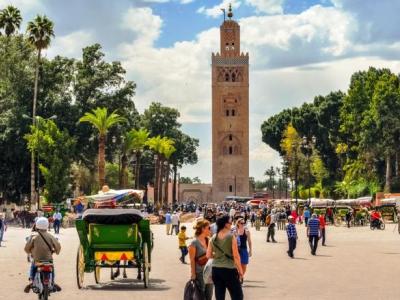
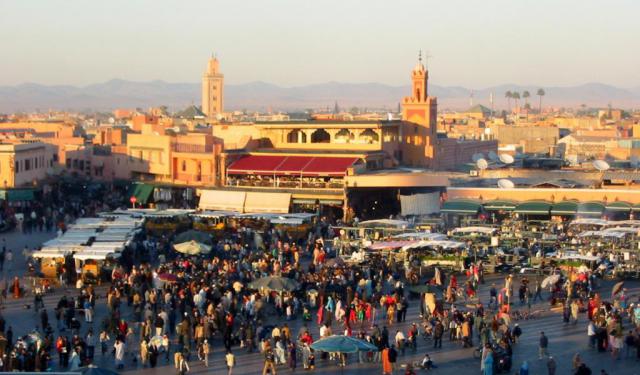
Jemaa el-Fnaa is the beating heart of Marrakech and one of the most iconic public squares in the world. It has served as a central gathering place for more than a thousand years. The name is often translated as “Assembly of the Dead” or “Place of the Vanished,” likely referring to its early use as a site for public executions during the rule of the Almoravids and Almohads in the 11th and 12th centuries. Over time, however, Jemaa el-Fnaa transformed from a grim ceremonial ground into a vibrant crossroads of trade, storytelling, and culture.

By the medieval period, the square had become a lively open market where caravans arriving from the Sahara, the Atlas Mountains, and coastal cities converged. Merchants sold spices, leather, textiles, and medicinal herbs, while musicians, poets, and snake charmers entertained crowds — traditions that have endured to this day. This unique blend led UNESCO to declare Jemaa el-Fnaa a Masterpiece of the Oral and Intangible Heritage of Humanity in 2001, recognizing its role in preserving Moroccan cultural traditions.

Visitors can watch snake charmers coax cobras to the rhythm of desert flutes, listen to traditional storytellers recount ancient folktales in Moroccan Arabic, or sip mint tea while observing the shifting rhythms of daily life. Barbary macaques may be placed on your shoulder for a souvenir photograph, and bargaining is part of the experience. The square also serves as a gateway into the surrounding maze of souks, where carpets, lanterns, spices, and silver jewelry await discovery.
2
Souk Semmarine (Semmarine Market)

2) Souk Semmarine (Semmarine Market)

Semmarine Market is one of the most famous and atmospheric markets in Marrakech’s medina, forming the main artery that leads from Jemaa el-Fnaa into the deeper network of traditional souks. Its history dates back to the Almoravid and Almohad periods, when Marrakech developed as a major trading hub linking North Africa, the Sahara, and Andalusia. By the medieval era, this route had already become a bustling commercial passage where caravans unloaded goods and merchants sold everything from textiles to metalwork.

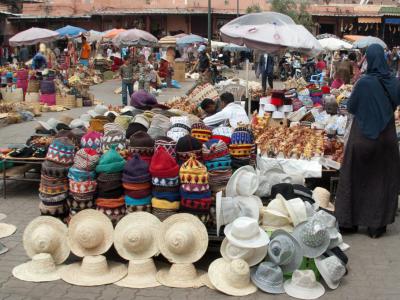
Today, Semmarine Market competes for the title of the largest market in Morocco, having hosted traders for over a thousand years. The market is partially roofed with wooden slats that cast patterned light across the stalls below, giving the street its distinctive interplay of shadow and sun. It is best known for its overflowing displays of brightly dyed fabrics, handwoven carpets, leather bags, traditional slippers, and intricately carved wooden boxes. Tailors, kaftan sellers, and textile merchants dominate the upper stretch, while the lower section transitions into jewelry, ceramics, and metalwork.

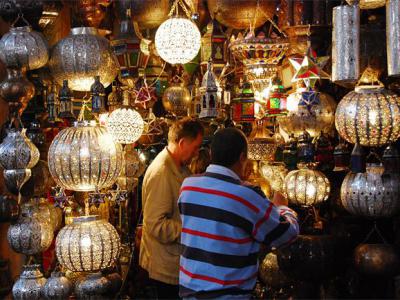
One of the most captivating traditions here is the craft of lamp-making. The intricately designed lamps lining the stalls create a magical glow in the evening hours, reflecting an art form passed down through generations in Morocco.

The souk is also one of the best places to observe the traditional organization of Marrakech’s medina, where trades cluster by specialty and workshops sit directly behind storefronts. As you walk, the aromas of saffron, cedarwood, and tanned leather drift through the air, blending with the sound of hammers shaping metal and merchants calling out their prices. Souk Semmarine is not only a lively shopping street but also a gateway: continue walking and it leads into deeper, more specialized markets dedicated to spices, blacksmithing, carpets, and beyond.
3
Rahba Kedima Square

3) Rahba Kedima Square

Rahba Kedima Square, sometimes called the “Old Square,” is one of the most atmospheric corners of Marrakech’s medina and has served as a trading space for centuries. Its origins stretch back to the early Islamic period, when Marrakech grew as a caravan crossroads linking the High Atlas, the Sahara, and markets across North Africa. Historically, the square functioned as a central grain market and an auction site where goods — and, in darker times, enslaved people — were traded.

Today, the square is best known as Marrakech’s traditional spice market. Pyramids of cumin, saffron, turmeric, and dried rosebuds spill from burlap sacks, while herbalists sell argan oil, black soap, medicinal roots, kohl eyeliner, and herbal blends used in local hammam rituals. Many stalls are run by families who have worked in the trade for generations, and it is common to see shopkeepers grinding spices, mixing remedies, or explaining the uses of their products.

The square is also lined with shops selling woven baskets, Berber carpets, vintage jewellery, and hand-carved wooden objects. Those seeking more unusual items will also find them here: some stalls offer dried scorpions, leeches, snails, and even lizards and chameleons.

Remarkably, the atmosphere is calmer than in the main souks, with enough space to pause and take in the colours, scents, and daily activity. A good rule of thumb in Marrakech’s markets is to cut the first quoted price in half — and let the bargaining begin. Once you’ve made your purchases, head to one of the rooftop cafés overlooking the square. From there, you can watch the ebb and flow of medina life from above.
4
Marrakech Souks (Marrakech Market)

4) Marrakech Souks (Marrakech Market) (must see)

The Marrakech Market — commonly referred to simply as the souks of the medina — is one of the oldest and most characteristic trading networks in North Africa. Its history stretches back to the 11th and 12th centuries, when the Almoravids and later the Almohads established Marrakech as a major imperial capital. As caravans arrived from the Sahara, the Atlas Mountains, and cities across North Africa and Andalusia, the medina developed into a dense commercial maze where every profession had its own dedicated street or quarter. Over time, these clustered craft guilds formed the interconnected market system that survives today.

For centuries, the souks functioned as Marrakech’s economic engine. Goods such as leather, wool, spices, metals, pottery, and textiles were crafted and traded in the very same alleys where artisans still work today. Many workshops are family-run and passed down through generations, preserving traditional techniques such as hand-dyeing wool for carpets, hammering brass lanterns, and carving cedarwood.

Entering the Marrakech Market brings you into a vibrant, sensory world. Narrow lanes unfold into covered passages where sunlight filters through reed roofs, illuminating stacks of rugs, rows of bright traditional slippers, woven baskets, and intricate metalwork. The smell of saffron, mint, and sandalwood fills the air as spice merchants display pyramids of colourful powders. Leather tanneries supply stalls selling bags and belts, while textile souks offer handwoven blankets and traditional garments. Artisans often work just steps from their storefronts, allowing visitors to watch pottery being shaped, wood being carved, or silver jewellery being polished.

Beyond shopping, the souks offer a rich cultural experience. Merchants engage in friendly bargaining, herbalists explain traditional remedies, and local women select ingredients for home cooking. Squares and intersections become informal meeting places where cafés spill onto the street, serving some of the best mint tea in the city. Walk with confidence, and you’ll quickly feel at home in the lively rhythm of the medina’s markets.
5
Le Jardin Secret (The Secret Garden)

5) Le Jardin Secret (The Secret Garden) (must see)

The Secret Garden, tucked within the heart of Marrakech’s medina, is a serene historic complex that traces its origins back several centuries. The site was once part of a grand Saadian-era palace from the 16th century, built for powerful local dignitaries when Marrakech flourished as an imperial capital. After the fall of the Saadian dynasty, the estate changed hands multiple times and was repeatedly rebuilt, most notably during the 19th century when it became a refined aristocratic residence. Over time, the property fell into neglect, hidden behind high walls and largely forgotten until a major restoration project in the early 21st century brought it back to life and opened it to the public.

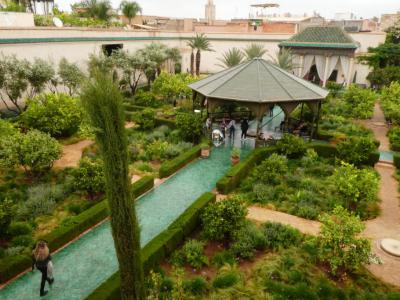
Today, The Secret Garden offers a peaceful contrast to the lively crowds of the surrounding souks. Its charm lies in its two distinct garden spaces, each reflecting traditional Islamic landscape design. As you step through the glass doors of the main entrance, you are first met by the shade of the smaller garden. This is the Exotic Garden, which features rare species from around the world—succulents, palms, and tropical plants—working together to create an intimate, almost hidden-oasis atmosphere. The larger Islamic Garden can be reached by walking along a narrow path to the right of a red pavilion, which is easily visible while exploring the Exotic Garden. The Islamic Garden follows a geometric layout inspired by Quranic descriptions of paradise, divided by pathways and fed by a historic hydraulic system that once supplied water to the palace. Shaded by olive trees, cypresses, and fruit trees, it showcases native Moroccan plants arranged with elegant symmetry.

Architectural elements also enrich the space. Restored pavilions located at both ends of the main garden display intricate zellige tilework, carved cedar, and elegant wooden balconies typical of 19th-century Moroccan mansions. Last but not least, a view from the tall tower on the western edge of the main garden brings everything into a single frame. As you enter the Islamic Garden, the tower appears to the right of the space’s far end. Second only to the Koutoubia Minaret in height, it offers one of the medina’s best panoramic viewpoints, with sweeping views of red rooftops, nearby minarets, and the distant silhouette of the Atlas Mountains.
6
Almoravid Koubba

6) Almoravid Koubba

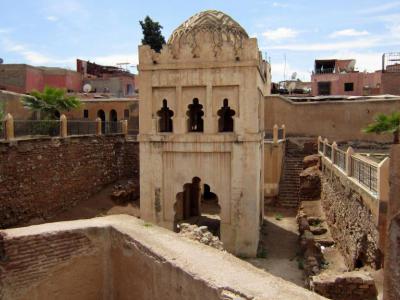
The Almoravid Koubba is the only surviving structure from the Almoravid period in Marrakech, dating back to the early 12th century. Built around 1117 under the rule of Ali ibn Yusuf, the koubba once formed part of a larger religious and ablution complex attached to the nearby Ben Youssef Mosque. Its purpose was practical rather than ceremonial: it housed the water facilities where worshippers performed ablutions before prayer, fed by an advanced hydraulic system that showcased the Almoravids’ engineering skill.

Though modest in size, the building is architecturally significant. Its design blends influences from Andalusia, North Africa, and even older Abbasid styles, making it a valuable link in the evolution of Moroccan Islamic architecture. The structure sits partially below ground today because the level of the medina has risen over the centuries. Visitors enter the site by descending a few steps into an elegant, domed pavilion decorated with carved stucco, Kufic inscriptions, and intricate geometric motifs. The interior of the dome is particularly striking, featuring star-shaped openings and ribbed patterns that reveal the sophistication of 12th-century craftsmanship.

The Almoravid Koubba offers a rare glimpse into a chapter of Marrakech’s history that is otherwise largely invisible. Nearly all Almoravid architecture was altered or demolished by the succeeding Almohad dynasty, making this building a rare survivor. Standing within its cool, quiet chamber, you can imagine the rhythms of daily life nine centuries ago, when water, worship, and community converged at this small yet pivotal Almoravid masterpiece.
7
La Qoubba Galerie d'Art (The Qoubba Gallery of Arts)

7) La Qoubba Galerie d'Art (The Qoubba Gallery of Arts)

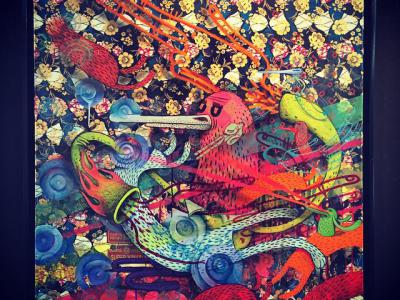
The Qoubba Gallery of Arts sits in the heart of Marrakech’s medina, offering a calm, elegant escape from the city’s bustling souks. Opened in the early 2000s, the gallery occupies a restored traditional house whose architecture blends carved cedarwood, zellige tilework, and the serene geometry of an inner courtyard with spacious, modern exhibition rooms.

Though the building once formed part of a private medina residence, its transformation into an art space mirrors the city’s growing role as a cultural hub. The founders envisioned a gallery that would highlight Moroccan artistic innovation while also creating a space for dialogue with international artists. Over the years, it has become known for showcasing a wide range of contemporary work, from painting and photography to mixed-media installations.

The Qoubba Gallery of Arts offers a different kind of medina experience. Instead of the noise of the markets or the movement of the crowds, visitors find a quiet, reflective environment where they can fully appreciate each piece on display. The rotating exhibitions often explore themes such as Moroccan identity, changing urban landscapes, craft traditions, and global artistic trends. The gallery’s staff are welcoming and knowledgeable, helping visitors understand the stories behind the works.
8
Musee de Marrakech (Marrakech Museum)

8) Musee de Marrakech (Marrakech Museum)

The Marrakech Museum, housed in the magnificent Dar Mnebhi Palace, offers one of the city’s most captivating blends of history, architecture, and art. Built at the end of the 19th century by Mehdi Mnebhi, a powerful defense minister under Sultan Moulay Abdelaziz, the palace reflects the wealth and refinement of Morocco’s elite during the final decades before the French Protectorate.

After the establishment of the French Protectorate, the palace served for a time as a girls’ school before falling into disrepair. In the 1990s, it was restored and transformed into the Marrakech Museum. Today, visitors experience not only its striking architecture but also a carefully curated exhibition space that highlights Moroccan heritage in many forms.

The museum’s collection is eclectic and engaging. It includes historical objects such as ceramics, coins, manuscripts, textiles, and jewelry from various regions of Morocco, often displayed alongside contemporary art that illustrates the country’s evolving creative expression. Temporary exhibitions rotate through the galleries, offering insight into modern Moroccan artistic movements and international collaborations.

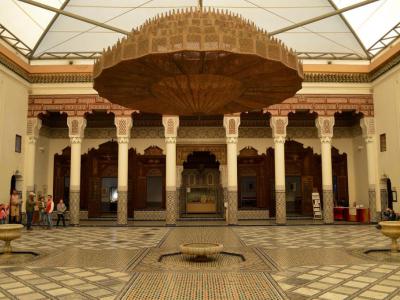
The true highlight, however, is the palace itself. The central patio—now the museum’s main attraction—can be reached by walking straight ahead from the entrance, through a short corridor. It is impossible to miss the massive wrought-iron chandelier hanging above the tiled floor, casting intricate shadows across the space. All four sides of the courtyard are framed by carved cedar-wood arches and elegant doorways, creating a harmonious visual rhythm. The central patio makes an immediate impression, drawing visitors into its world through the sheer beauty of its craftsmanship.
9
Ben Youssef Madrasa

9) Ben Youssef Madrasa (must see)
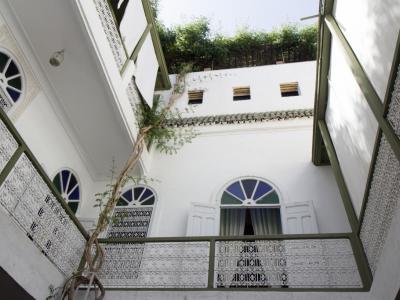
Ben Youssef Madrasa is one of Marrakech’s most celebrated historic monuments and one of the largest and finest Islamic colleges ever built in North Africa. Madrasa means “centre of learning” and can refer to a school, a college, or a university. Founded in the 14th century under the Marinid dynasty and later rebuilt in the mid-16th century by the Saadian sultans, the madrasa served for centuries as a centre of religious scholarship, attracting students from across Morocco and the wider Arab world. At its peak, it housed around 150 students, many of whom lived in tiny dormitory cells arranged around the upper floors.

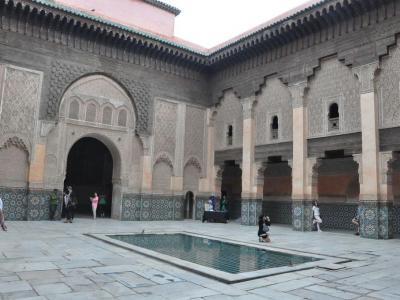
After you walk through the entrance passage, you enter the central courtyard of the madrasa. Like most of Marrakech’s architectural gems, the vast courtyard is the heart of the complex, with all other parts radiating from it. The space is paved in marble, with a large reflecting pool that mirrors the surrounding ornamentation. Every surface seems carefully considered: walls covered in carved cedarwood, stucco panels etched with flowing Arabic calligraphy, and geometric tilework forming dazzling patterns. The beauty of the space was meant to inspire contemplation, discipline, and spiritual focus—qualities essential to the life of a Quranic scholar.

Equally striking is the contrast between the madrasa’s grand public spaces and its modest student quarters. The small, bare rooms offer a poignant reminder of the austere lives led by students who devoted themselves entirely to study. The rooms are arranged on two levels: the lower dormitory cells are accessible via doorways off the courtyard, while the upper ones can be reached by staircases located in the corners of the same courtyard.

Although the madrasa ceased operating as a school in the 1960s, it remains one of Marrakech’s cultural treasures. Its meticulous restoration allows visitors to appreciate the artistry of Saadian craftsmanship and the atmosphere of learning that once animated its halls. For anyone interested in Moroccan architecture, Islamic art, or the intellectual history of the Maghreb, Ben Youssef Madrasa offers an unforgettable window into the city’s past.
10
Maison de la Photographie (House of Photography)

10) Maison de la Photographie (House of Photography) (must see)

The House of Photography is one of the medina’s most engaging cultural institutions, offering a vivid window into Morocco’s past through the lens of early photography. Opened in 2009, the museum occupies a beautifully restored 1920s inn whose traditional architecture—carved wooden balconies, tiled floors, and an airy central courtyard—creates an intimate and atmospheric setting for its collection.

The museum was founded with the purpose of preserving and showcasing Morocco’s photographic heritage. Their collection now includes over ten thousand of original photographs, postcards, glass plates, and documents dating from the 1870s to the 1950s. These rare images capture a world that has largely vanished: Berber communities in the Atlas Mountains, early portraits of Marrakech’s residents, bustling markets, desert caravans, and scenes of rural life long before modernisation reshaped the country. Many of the photographs were taken by explorers, military officers, and travelling artists who documented Morocco during pivotal historical moments.

The museum is particularly compelling because it presents Morocco from the perspective of daily life rather than grand monuments or official portraits. The black-and-white images reveal details of clothing, tools, architecture, and traditions that provide an extraordinary sense of authenticity. Remarkably, one of the exhibits is the first color movie documentary filmed in 1957 on the Berber tribes of the High Atlas. Temporary exhibitions rotate regularly, about every six months, ensuring that repeat visitors can always discover something new.

One of the highlights is the rooftop terrace, which offers stunning panoramic views over the medina, with the Atlas Mountains rising in the distance. It is an ideal spot to pause after exploring the galleries, enjoy a quiet drink, and take in the scenery that early photographers once sought to capture.

Walking Tours in Marrakech, Morocco

Create Your Own Walk in Marrakech

Create Your Own Walk in Marrakech

Creating your own self-guided walk in Marrakech is easy and fun. Choose the city attractions that you want to see and a walk route map will be created just for you. You can even set your hotel as the start point of the walk.
Marrakech Shopping Tour

Marrakech Shopping Tour

Shopping in Marrakech is an extraordinary experience that captivates the senses. Perhaps no other shopping in your life will compare to it: vivid, bright, juicy colors of carpets, clothes, and shoes; enchanting smells of local perfumes and spices; crafts, handmade jewelry, pottery; and of course, the long shopping mazes and souks.

One of the most iconic shopping destinations in Marrakech is...  view more

Tour Duration: 1 Hour(s)
Travel Distance: 1.0 Km or 0.6 Miles
Moroccan Architecture Walking Tour

Moroccan Architecture Walking Tour

No tall skyscrapers, no sophisticated giant malls, no anything else of Western architecture await you on this tour. Our self-guided walk is entirely about the genuine Moroccan style. We are going to reveal Marrakech which will amaze you with its majestic structures, traditional motifs, and mystic atmosphere.

Our first stop is a prominent example of Islamic architecture, the Koutoubia Mosque....  view more

Tour Duration: 3 Hour(s)
Travel Distance: 4.6 Km or 2.9 Miles
Moroccan Palaces Walking Tour

Moroccan Palaces Walking Tour

One of the meaningful ways to pass the time away in Marrakech is to visit the local palaces. This is particularly true given that some of them, now restored and refurbished, function as museums. Others, on the other hand, are slowly turning into ruins, which is sad. Nonetheless, they all have a long story to tell and spectacular architecture fit to amaze any beholder.

Among the most renowned...  view more

Tour Duration: 1 Hour(s)
Travel Distance: 2.7 Km or 1.7 Miles
Marrakech Top Religious Sites

Marrakech Top Religious Sites

Islam is the official religion in Morocco, which is why it is only natural that mosques are the dominant religious sites in the country, and Marrakech is no exception. Outside these places of worship, the city's religious scene is represented by unique historical monuments (koubbas), cemeteries, and mausoleums – all quite interesting to explore.

Our journey starts with the Ben Youssef...  view more

Tour Duration: 1 Hour(s)
Travel Distance: 2.7 Km or 1.7 Miles
Gueliz Walking Tour

Gueliz Walking Tour

Gueliz, also known as the New City (Nouvelle Ville), is more like the downtown of Marrakech. Here you will definitely feel the Western influence: McDonald's, KFC, brand stores, and even a supermarket. Still, Gueliz is also famous for its art galleries and parks.

We'll start our acquaintance with Gueliz in the El-Harti Gardens (Jnane El Harti), a peaceful oasis amidst the bustling...  view more

Tour Duration: 2 Hour(s)
Travel Distance: 3.1 Km or 1.9 Miles
Marrakech Introduction Walking Tour

Marrakech Introduction Walking Tour

“The sunset over Marrakech is like nothing else in the world.” Winston Churchill clearly could not hide his admiration for the city. The proof lies in the more than fifty trips he made throughout his life, many of them marked by his paintings of Marrakech—especially of that glowing, unforgettable sunset.

Marrakech was founded in 1070 by the Almoravids, a Berber dynasty that transformed a...  view more

Tour Duration: 2 Hour(s)
Travel Distance: 3.9 Km or 2.4 Miles