

Mumbai Introduction Walking Tour, Mumbai

Mumbai Introduction Walking Tour (Self Guided), Mumbai

English writer Rudyard Kipling, who was born in Bombay in 1865, famously called it “the Mother of Cities”, a place that absorbs people from everywhere and keeps giving birth to new lives, ambitions, and contradictions.

Long before it became India’s largest city, the area consisted of seven low-lying islands along the Konkan coast, inhabited by fishing communities known as the Kolis. Archaeological evidence points to human settlement as early as the Stone Age. The name Mumbai is generally traced to Mumbā Devī, a local goddess. “Mumbai” roughly translates as “Mother Mumba”. Over time, Portuguese pronunciation transformed the name, which was later anglicized as Bombay. The official return to “Mumbai” was in 1995.

From the 3rd century BCE the islands fell under the Mauryan Empire. Later they were ruled by several Hindu dynasties, including the Satavahanas and the Silaharas. Buddhist caves, most notably those on nearby Elephanta Island, date from this period. In 1534, the Portuguese took control of the islands, establishing churches, fortifications, and a colonial presence that reshaped the local landscape and economy.

A decisive turning point came in 1661, when the islands were transferred to the British Crown as part of the dowry of Catherine of Braganza upon her marriage to King Charles II of England. The British soon leased the territory to the East India Company, which recognized its natural harbor as a strategic asset. Through large-scale land reclamation projects in the 18th and 19th centuries, the seven islands were gradually fused into a single landmass, forming the physical foundation of modern Mumbai.

The city’s growth accelerated in the 19th century. The cotton boom during the American Civil War transformed the city into a global industrial hub, drawing migrants from across India. Railways, docks, and civic institutions followed, alongside public architecture that blended Gothic Revival styles with local influences. By the early 20th century, Mumbai had become a center of political activism, commerce, and culture. After Indian independence in 1947, Mumbai remained the financial engine of the country.

Walking through Mumbai’s historic center, visitors encounter layers of empire and everyday life. The Gateway of India frames the harbor, facing the domed Taj Mahal Hotel. Nearby, the former Prince of Wales Museum presents Indo-Saracenic architecture and rich collections. Further north rises Victoria Terminus, a Gothic Revival railway masterpiece, alive with motion. Tucked among busy streets, Jumma Masjid reflects the city’s enduring religious diversity and centuries of trade, migration, and memory.

And as you move between colonial landmarks, working mosques, museums, and railway platforms, Kipling’s phrase begins to make sense. Mumbai is still the “Mother of Cities”, reinventing itself, generation after generation, without ever losing its memory.
How it works: Download the app "GPSmyCity: Walks in 1K+ Cities" from Apple App Store or Google Play Store to your mobile phone or tablet. The app turns your mobile device into a personal tour guide and its built-in GPS navigation functions guide you from one tour stop to next. The app works offline, so no data plan is needed when traveling abroad.

Download The GPSmyCity App

Mumbai Introduction Walking Tour Map

Guide Name: Mumbai Introduction Walking Tour
Guide Location: India » Mumbai (See other walking tours in Mumbai)
Guide Type: Self-guided Walking Tour (Sightseeing)
# of Attractions: 9
Tour Duration: 2 Hour(s)
Travel Distance: 3.9 Km or 2.4 Miles
Author: emma
Sight(s) Featured in This Guide:
  • Gateway of India
  • Taj Mahal Palace Hotel
  • Chhatrapati Shivaji Maharaj Vastu Sangrahalaya (Prince of Wales Museum)
  • David Sassoon Library
  • Hutatma Chowk (Martyrs’ Square)
  • Fashion Street
  • Chhatrapati Shivaji Maharaj Terminus (Victoria Terminus)
  • Mahatma Jyotiba Phule Market (Crawford Market)
  • Jumma Masjid
1
Gateway of India

1) Gateway of India (must see)

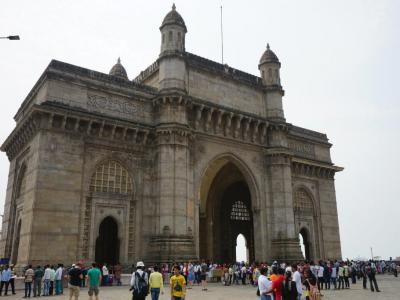
The Gateway of India rises at the edge of Mumbai’s harbor, standing as a defining symbol of the city's modern history. Conceived to commemorate the 1911 visit of King George V and Queen Mary, the first by a reigning British monarch, the monumental arch marked Mumbai’s position as the western gateway of the British Empire. Built on reclaimed land at Apollo Bunder, the site had long served as a strategic landing point for ships entering the city. Its foundations were laid in 1913, though construction began only after land reclamation was completed, and the structure was formally inaugurated in 1924.

Designed by Scottish architect George Wittet, the Gateway represents Indo-Saracenic architecture, blending Islamic and European forms with Indian decorative elements. The monument is organized around a grand pointed central arch, crowned by a domed pavilion. Built from locally sourced yellow basalt, its central arch and dome are balanced by smaller turrets, latticework, and inscriptions inspired by Hindu design traditions. The carved stone screens and ornamental details draw from Islamic jali work and Indian temple architecture.

History gave the Gateway a powerful and unexpected final role. In 1948, it became the symbolic exit point for the last British troops leaving independent India. A structure built to welcome empire thus quietly marked its end, transforming the Gateway from a ceremonial entrance into a lasting marker of political change and collective memory. Today, the Gateway of India remains a lively focal point along the waterfront, set directly opposite the historic Taj Mahal Hotel. Boats depart from nearby jetties toward Elephanta Island or for harbor cruises.
2
Taj Mahal Palace Hotel

2) Taj Mahal Palace Hotel

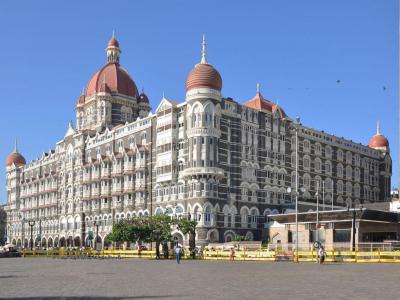
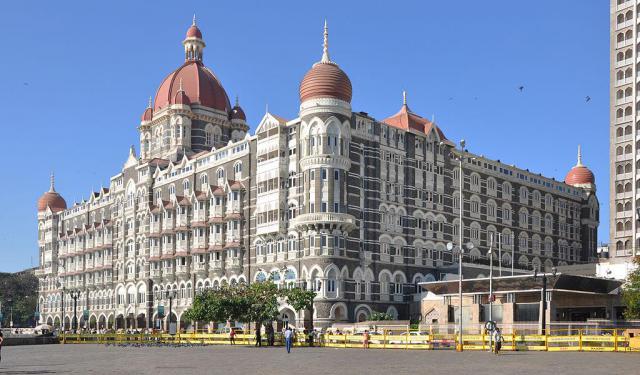
The Taj Mahal Palace Hotel, opened in 1903, was commissioned by Indian industrialist Jamsetji Tata at a time when luxury hotels in colonial Mumbai largely excluded Indian guests. Its name was inspired by the Taj Mahal in Agra. Today, it continues to function as a working luxury hotel. Visitors can admire its exterior from the promenade or step inside its public spaces.

The historic 1903 structure, often called the Taj Mahal Palace, forms the original part of the hotel complex and is easily recognized by its large red dome facing the Gateway of India. A modern high-rise addition, the Taj Tower, was built beside it in 1973. Architecturally, the red dome combines a rich blend of Indo-Saracenic, Islamic, and European design influences. The palace building features arched balconies, intricate stonework, and decorative elements inspired by Moorish traditions.

Throughout the 20th century, the Taj Mahal Palace Hotel became closely linked to Mumbai’s social, political, and cultural life. It hosted royalty, world leaders, writers, and film stars, with notable guests including Lord Mountbatten, the first Governor-General of independent India, and Bill Clinton, the 42nd President of the United States. The hotel has also appeared in international cinema, most recently as a filming location for Christopher Nolan’s “Tenet”.

Visitors can step inside the Taj Mahal Palace to experience some of its historic interiors. One of the most striking architectural highlights is the Cantilever Grand Staircase, an elegant marble staircase designed to appear as if it is floating without visible support. Afterwards stop by the famous Sea Lounge, a café overlooking the Gateway of India and Mumbai Harbor. The lounge is well known for its traditional afternoon tea service, where guests can enjoy tea, pastries, and light snacks while taking in views of the waterfront.
3
Chhatrapati Shivaji Maharaj Vastu Sangrahalaya (Prince of Wales Museum)

3) Chhatrapati Shivaji Maharaj Vastu Sangrahalaya (Prince of Wales Museum)

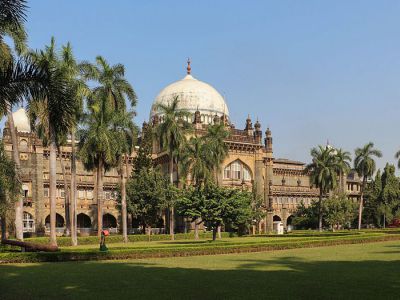
The formerly Prince of Wales Museum stands as one of Mumbai’s most important cultural institutions. Opened to the public in 1922, it was conceived during the late colonial period to house collections reflecting the art, history, and natural heritage of India and the wider region. In 1998, the museum was renamed in honor of the 17th-century Maratha ruler, and it continues to bear that name today.

The museum building itself is a landmark of Indo-Saracenic architecture, designed by Scottish architect George Wittet. Its large central dome, arched entrances, and pale stone façade draw inspiration from Mughal, Rajput, and Deccan. Construction of the building began in the early 20th century to commemorate King George V, then Prince of Wales, who laid the foundation stone in 1905. After taking several years to complete, the structure was briefly used as a military hospital before being formally established as a museum.

Inside, the museum’s collections span several millennia, ranging from artifacts of the Indus Valley Civilization to relics of major Indian empires including the Mauryas, Guptas, Rashtrakutas, Chalukyas, and the Mughal era. Galleries display sculpture, miniature paintings, decorative arts, arms and armor, textiles, and archaeological finds, alongside natural history exhibits exploring India’s biodiversity.
4
David Sassoon Library

4) David Sassoon Library

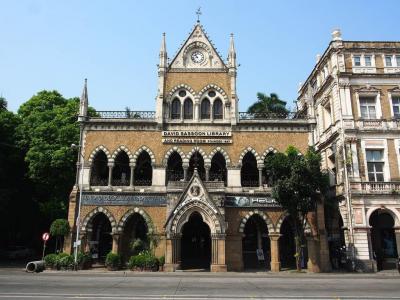
The David Sassoon Library and Reading Room was completed in 1870, protected today as a heritage structure. The library was founded with the support of Baghdadi Jewish philanthropist David Sassoon, whose family played a major role in Bombay’s commercial and civic development during the 19th century. While Sassoon’s generous financial contribution gave the institution its name, the original idea came from a group of young mechanics and foremen who envisioned an educational center dedicated to learning and technical knowledge.

Architecturally, the building represents Venetian Gothic Revival design, constructed in local stone and distinguished by pointed arches, ribbed detailing, and an ornate yet restrained facade. High ceilings and large windows were carefully planned to suit the tropical climate, allowing light and air to circulate through the interior spaces. Inside, the library preserves a timeless, almost contemplative atmosphere. Wooden shelves, long reading tables, and period furnishings frame a collection of books, journals, and historical volumes in multiple languages. In addition to the reading rooms, the building also houses a small museum.

Today, the David Sassoon Library remains an active cultural institution and a place of retreat. Behind the library lies a small, quiet garden courtyard that offers a rare pocket of calm in the middle of the city. The building itself underwent a careful restoration in recent years, and in 2023 the project received a UNESCO Asia-Pacific Award for Cultural Heritage Conservation.
5
Hutatma Chowk (Martyrs’ Square)

5) Hutatma Chowk (Martyrs’ Square)

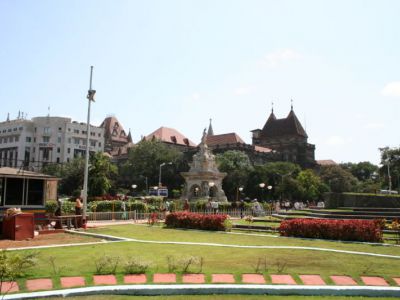
Martyrs’ Square is a historic public space known for both its monuments and its connection to the events that shaped modern Maharashtra. During the colonial period the square formed part of Mumbai’s administrative and commercial center, surrounded by grand Victorian-era buildings that reflected the city’s rise as a major port and financial hub. Originally known as Flora Fountain, the square was renamed Martyrs’ Square to honor those who died during the Samyukta Maharashtra movement, which called for the creation of a separate Marathi-speaking state.

At the center of the square stands a memorial statue of a torch-bearing martyr, commemorating the protesters who lost their lives in demonstrations in the 1950s during the struggle for statehood. The monument serves as a reminder of the political movement that eventually led to the formation of the state of Maharashtra in 1960.

Beside the memorial rises the elegant Flora Fountain, one of Mumbai’s best-known colonial monuments. Installed in 1864 and carved from Portland stone, the fountain was built in honor of Sir Bartle Frere, then Governor of Bombay. Designed by architect Norman Shaw and sculpted by James Forsythe, it depicts Flora, the Roman goddess of flowers and abundance.

Today, Martyrs’ Square functions both as a busy intersection and a place of remembrance. Looking toward the western side of the square, you will find the Central Telegraph Office, a historic communications building that once served as a key hub for telegraph and postal services during the colonial period. On the southwest side of the square stands the office of the Assistant Government Pleader, part of the government legal services that operate near the courts. From there, walking south brings you to the imposing Bombay High Court, a major landmark of Victorian Gothic architecture completed in 1878 and still functioning as one of India’s most important judicial institutions.
6
Fashion Street

6) Fashion Street

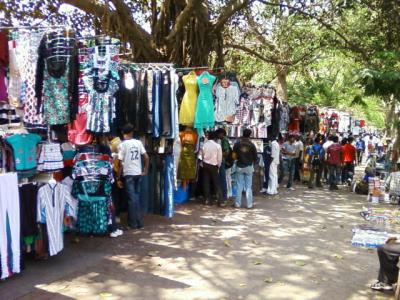
Fashion Street is one of Mumbai’s most energetic shopping areas. Known for its lively rows of street stalls, the market offers visitors a contrast to the historic colonial buildings nearby. The market developed in the late 20th century when small vendors began setting up temporary roadside stalls. Over time, it expanded into a long stretch of organized booths, now numbering in the hundreds, selling T-shirts, jeans, dresses, textiles, jewelry, bags, sunglasses, and imitation designer brands.

One of the defining features of Fashion Street is the shopping experience itself. Price tags are rarely displayed, and bargaining is expected, turning every purchase into a lively negotiation between buyer and seller. The stalls are tightly packed and constantly refreshed with new merchandise, creating a dynamic marketplace where styles change quickly and vendors adapt to shifting trends.

Visitors exploring the area will also find a variety of street food vendors and nearby restaurants offering local snacks and meals.
7
Chhatrapati Shivaji Maharaj Terminus (Victoria Terminus)

7) Chhatrapati Shivaji Maharaj Terminus (Victoria Terminus) (must see)

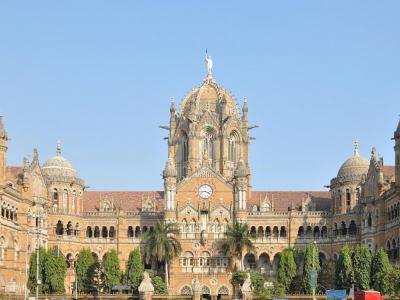
Victoria Terminus is a masterpiece of 19th-century railway architecture. The station was built between 1878 and 1887 and inaugurated during the Golden Jubilee of Queen Victoria. Originally intended to serve as the headquarters of the Great Indian Peninsula Railway, the building reflected Bombay’s growing importance as a major port and transportation hub linking the city with the rest of the Indian subcontinent. In 1996, the station was renamed in honor of the Maratha ruler Chhatrapati Shivaji.

Designed by British architect Frederick William Stevens, the station is widely regarded as one of the finest examples of Victorian Gothic Revival architecture in India. The structure blends European Gothic forms with Indian decorative elements, creating a richly detailed façade. Pointed arches, stained-glass windows, carved stonework, and ornate turrets define the exterior, while the central ribbed dome crowns the building.

Several symbolic sculptures add to the building’s character. At the entrance, stone figures of a lion at the left and a tiger at the right represent Britain and India, reflecting the colonial era in which the station was constructed. Atop the central dome stands a four-meter-high statue of a female figure holding a torch and a spoked wheel, symbolizing progress. Closer to the windows and arches, you’ll notice highly detailed stone relief panels filled with plants, animals, and ornamental patterns.

Looking closely at the façade above the ground-floor arches. It features a series of ten circular portrait medallions, representing key figures in the history of the Indian railways and the British administration. Among these prominent figures is the medallion of Jagannath Shankarsheth, a celebrated Indian philanthropist and one of the railway’s first Indian directors. Facing the building, you can find it on the far right wing of the structure, being the third medallion from the left.

Today, Victoria Terminus remains one of the busiest railway stations in India, serving more than three million passengers each day through its suburban and long-distance rail networks.
8
Mahatma Jyotiba Phule Market (Crawford Market)

8) Mahatma Jyotiba Phule Market (Crawford Market)

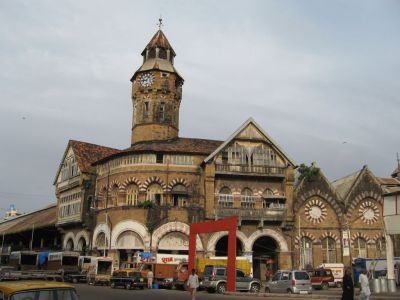
The former Crawford Market is one of Mumbai’s oldest marketplaces, completed in 1869. It was originally named after Arthur Crawford, the first municipal commissioner of Bombay, while its present name honors the social reformer Mahatma Jyotiba Phule. Even today, many residents still refer to the market by its historic name.

The building itself is an impressive example of Victorian Gothic architecture adapted to India’s tropical climate. Designed by British architect William Emerson, the structure features red stone walls, decorative arches, and high ceilings. The entrance is decorated with sculptural reliefs of animals and agricultural scenes. The building was also notable for being among the first in India to be illuminated with electricity.

Spread across more than 22,000 square meters, Crawford Market is a lively maze of stalls and shops offering everything from fresh fruits, vegetables, and spices to dried fruits, sweets, household goods, and imported products. Certain sections specialize in particular items, while other areas feature upscale shops and vendors selling unusual goods.
9
Jumma Masjid

9) Jumma Masjid (must see)

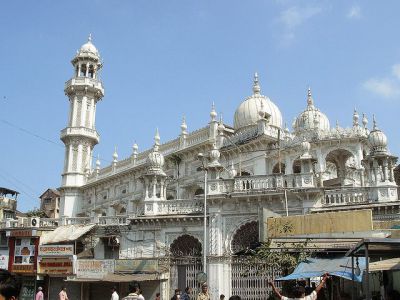
Jumma Masjid is one of the city’s oldest surviving mosques, reflecting the early development of Mumbai itself. Construction at the present site began in 1775, after earlier structures were moved or demolished during the expansion of the British colonial fortifications. The building was finally completed in 1802. The name “Jumma” comes from an Arabic word referring to the congregational prayers held every Friday.

The mosque is arranged around a spacious rectangular courtyard. At the center stands a large stone tank, where worshipers wash before prayer. It contains gold and silver fish and turtles for ritual ablutions. Pigeons frequently gather along its edges, and tall trees rising from the courtyard provide welcome shade. The quiet atmosphere inside the enclosure contrasts with the busy streets and trading activity found just outside the mosque walls.

Architecturally, Jumma Masjid reflects a simple approach. The prayer hall is built largely from dark basalt stone, giving the structure a strong and grounded appearance. Inside, rows of arched colonnades and carved stone pillars support the roof, creating a calm and balanced interior space. Rather than relying on elaborate ornamentation, the design emphasizes symmetry and proportion.

A major renovation by the businessman Mohammed Ali Roghay in 1814 added the upper floor, which significantly defined the building's current silhouette. The sacred place houses a famous digitized library containing rare Islamic manuscripts, some dating back over a century. Today, the mosque is administered by the Kokni Muslim community of Mumbai and continues to serve religious purposes.

Walking Tours in Mumbai, India

Create Your Own Walk in Mumbai

Create Your Own Walk in Mumbai

Creating your own self-guided walk in Mumbai is easy and fun. Choose the city attractions that you want to see and a walk route map will be created just for you. You can even set your hotel as the start point of the walk.
Malabar Hill Walking Tour

Malabar Hill Walking Tour

When the American writer Mark Twain arrived in Bombay during his world lecture tour, the view from Malabar Hill left a strong impression. In his travel book “Following the Equator”, he admired the city’s coastal setting, describing Mumbai as “by far the handsomest city in India”.

Malabar Hill is one of Mumbai’s most historic and prestigious neighborhoods, rising above the western...  view more

Tour Duration: 2 Hour(s)
Travel Distance: 3.4 Km or 2.1 Miles
Mumbai's Historical Churches

Mumbai's Historical Churches

The seven islands making up Mumbai were originally home to the communities of the Marathi language-speaking Koli people whose main religion is Hindu. Under the Mughal Imperial rule, Mumbai adopted Islam, so today roughly 20% of the local population are Muslims.

When the Portuguese took over the city in 1534, they actively enforced the Roman Catholic order, later followed by the British who...  view more

Tour Duration: 2 Hour(s)
Travel Distance: 3.8 Km or 2.4 Miles
Useful Travel Guides for Planning Your Trip

Places to Eat Local Food in Mumbai

Places to Eat Local Food in Mumbai

As its said, in a city like Mumbai, anybody wanting a good meal any time of the day, there’s always a rush and a stomach will always be fed. Whether its a quick bite or to indulge yourself, there is a plethora of tastes and flavours, 24/7, vying to satiate your taste buds. Multifaceted,...
Mumbai Shopping: 16 Souvenir Ideas for Travelers

Mumbai Shopping: 16 Souvenir Ideas for Travelers

In India, a foreigner can't get far without insider knowledge, whether it's for souvenir shopping or something else. Mumbai (formerly known as Bombay) is by far the most popular and the largest of Indian cities, teeming with a plethora of things representative of India's millenia-long...