

Rio's Top Religious Sites (Self Guided), Rio de Janeiro
Due to the legacy of the Portuguese in language, religion, and law, Rio de Janeiro has had a rich and influential Catholic tradition. Until the mid-20th century almost all Brazilians were – at least nominally – Catholic, and today the country’s religious sites, both classic and modern, impress with their skill, creativity and devotion.
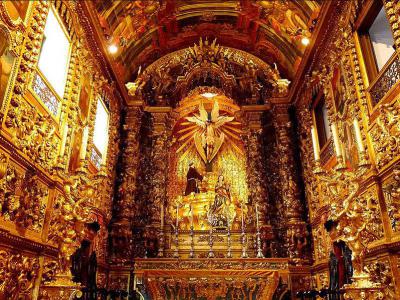
Founded in 1590 by Benedictine monks from Bahia, the Sao Bento Monastery located in the hills of Sao Bento has a simple white exterior reflecting the simplicity of the time, but gives no hint of the opulent Baroque interior. Stepping inside, and seeing the carvings, paintings, statues, and gilding will instantly take your breath away.
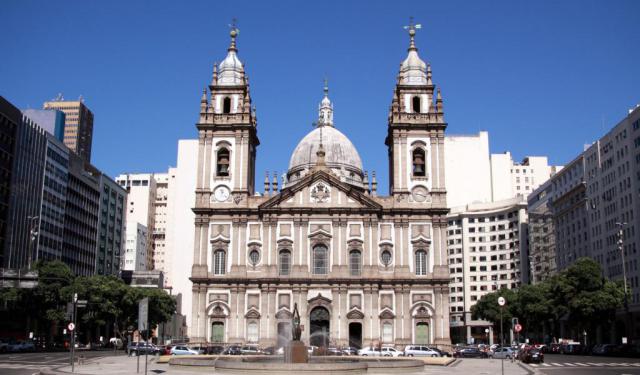
The city center houses many other religious landmarks, such as the Candelária Church, whose variety of architectural styles includes Baroque, Neoclassical and neo-Renaissance; the highly artistic Old Cathedral, decorated with statues of saints, paintings, rich stucco and mosaics; or São Francisco da Penitência – another baroque cathedral famous for its carvings, as well as for containing almost a ton of gold.
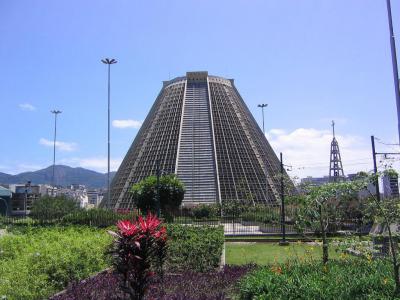
In a more contemporary architecture, the incredibly striking Metropolitan Cathedral has a conical shape, with 96 meters of internal diameter and capacity to receive up to 20 thousand faithful. Its exterior splendor, with straight and sober lines, is due to the changing stained glass windows carved on the walls up to the dome.
Take our self-guided walking tour to discover the most remarkable cathedrals, churches and monasteries in the city of Rio de Janeiro!
Founded in 1590 by Benedictine monks from Bahia, the Sao Bento Monastery located in the hills of Sao Bento has a simple white exterior reflecting the simplicity of the time, but gives no hint of the opulent Baroque interior. Stepping inside, and seeing the carvings, paintings, statues, and gilding will instantly take your breath away.
The city center houses many other religious landmarks, such as the Candelária Church, whose variety of architectural styles includes Baroque, Neoclassical and neo-Renaissance; the highly artistic Old Cathedral, decorated with statues of saints, paintings, rich stucco and mosaics; or São Francisco da Penitência – another baroque cathedral famous for its carvings, as well as for containing almost a ton of gold.
In a more contemporary architecture, the incredibly striking Metropolitan Cathedral has a conical shape, with 96 meters of internal diameter and capacity to receive up to 20 thousand faithful. Its exterior splendor, with straight and sober lines, is due to the changing stained glass windows carved on the walls up to the dome.
Take our self-guided walking tour to discover the most remarkable cathedrals, churches and monasteries in the city of Rio de Janeiro!
How it works: Download the app "GPSmyCity: Walks in 1K+ Cities" from Apple App Store or Google Play Store to your mobile phone or tablet. The app turns your mobile device into a personal tour guide and its built-in GPS navigation functions guide you from one tour stop to next. The app works offline, so no data plan is needed when traveling abroad.
Rio's Top Religious Sites Map
Guide Name: Rio's Top Religious Sites
Guide Location: Brazil » Rio de Janeiro (See other walking tours in Rio de Janeiro)
Guide Type: Self-guided Walking Tour (Sightseeing)
# of Attractions: 7
Tour Duration: 2 Hour(s)
Travel Distance: 3.0 Km or 1.9 Miles
Author: gene
Sight(s) Featured in This Guide:
Guide Location: Brazil » Rio de Janeiro (See other walking tours in Rio de Janeiro)
Guide Type: Self-guided Walking Tour (Sightseeing)
# of Attractions: 7
Tour Duration: 2 Hour(s)
Travel Distance: 3.0 Km or 1.9 Miles
Author: gene
Sight(s) Featured in This Guide:
- Saint Benedict Church and Monastery
- St. Rita Chapel
- Candelária Church
- Old Cathedral of Rio de Janeiro
- São Francisco da Penitência Church
- Santo Antônio Convent
- Catedral Metropolitana de São Sebastião
1) Saint Benedict Church and Monastery (must see)
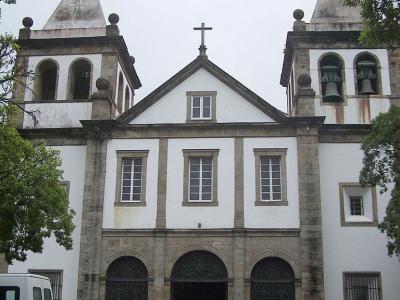
Saint Benedict Church and Monastery is one of Rio de Janeiro’s most important religious and artistic landmarks, rising above the city centre on Saint Benedict Hill. Its history began in 1590, when the land was donated to the Benedictine monks. Construction of the present complex started in 1633 and was completed in 1671, resulting in a refined example of Portuguese colonial architecture with strong Mannerist influences. The façade is marked by three entrance archways beneath a triangular gable, flanked by two towers topped with pyramidal spires. Passing through the entrance, visitors arrive at a tiled porch fitted with 19th-century iron gates.
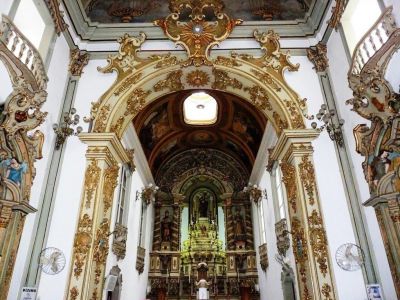
While the exterior is relatively restrained, the interior is the church’s most famous feature. Almost every square inch of the walls and ceilings is covered in intricate wood carvings coated in 22-carat gold leaf. This massive decorative program took nearly a century to complete, spanning the years from 1668 to 1743. Look up to see a series of paintings depicting the life of Saint Benedict, framed by heavy, gold-covered scrollwork.
While admiring the church’s golden ornamentation, walk down the central aisle toward the far end of the nave. There, the High Altar displays the throne for the exposition of the Blessed Sacrament, positioned at the very top of the altar structure. Flanking the throne are statues of Saint Benedict and Saint Scholastica, his sister. Facing the altar, move into the right-hand side chapel, known as the Chapel of the Blessed Sacrament. It features some of the most delicate Rococo carvings in the church, lighter and more floral in character than the heavier Baroque decoration of the main nave. The silverwork here is particularly exquisite.
Beyond its artistic value, the monastery played a major role in education and urban development and remains active today. Visitors who attend the traditional Sunday 10:00 a.m. Mass can still hear Gregorian chant accompanied by organ music.
While the exterior is relatively restrained, the interior is the church’s most famous feature. Almost every square inch of the walls and ceilings is covered in intricate wood carvings coated in 22-carat gold leaf. This massive decorative program took nearly a century to complete, spanning the years from 1668 to 1743. Look up to see a series of paintings depicting the life of Saint Benedict, framed by heavy, gold-covered scrollwork.
While admiring the church’s golden ornamentation, walk down the central aisle toward the far end of the nave. There, the High Altar displays the throne for the exposition of the Blessed Sacrament, positioned at the very top of the altar structure. Flanking the throne are statues of Saint Benedict and Saint Scholastica, his sister. Facing the altar, move into the right-hand side chapel, known as the Chapel of the Blessed Sacrament. It features some of the most delicate Rococo carvings in the church, lighter and more floral in character than the heavier Baroque decoration of the main nave. The silverwork here is particularly exquisite.
Beyond its artistic value, the monastery played a major role in education and urban development and remains active today. Visitors who attend the traditional Sunday 10:00 a.m. Mass can still hear Gregorian chant accompanied by organ music.
2) St. Rita Chapel
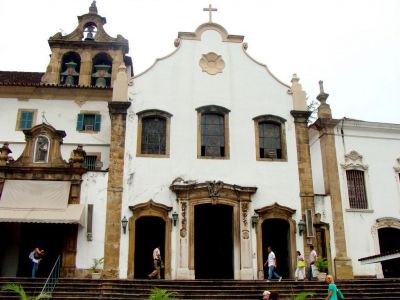
In the heart of Rio de Janeiro, in the eponymous district of Santa Rita, stands the modest temple of Santa Rita whose simple white facade and a double-arched bell tower defy the grandeur of the nearby high-rising buildings in a harmonious confrontation between the 18th century Baroque-Rococo style and the boldness of modern architecture. Built in 1722, Santa Rita is one of the oldest churches in Rio. It stands on the land donated by Manuel Nascente Pinto and his wife to the brotherhood of Santa Rita established a year earlier.
Inside the church there is a small atrium under the choir, a marble baptismal font and a small marble sink. To the left from the entrance is an oil painting featuring baptism of Lord Jesus, and to the right - the image of Santa Rita de Cássia herself. The temple houses relics of Santa Rita and Santo Lenho, and is listed by Brazil's Institute of National Historical and Artistic Heritage (IPHAN).
3) Candelária Church (must see)
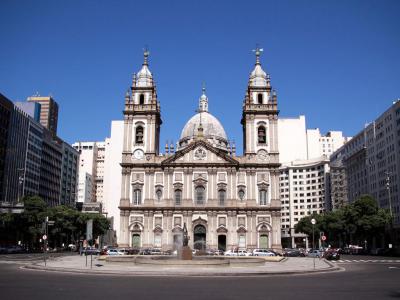
The Candelária Church is one of Rio de Janeiro’s most important and imposing Roman Catholic landmarks. Its origins lie in a quasi-legendary event from the early 17th century. According to tradition, a Portuguese couple survived a violent storm at sea aboard a ship named Candelária and vowed to build a chapel in gratitude if they reached land safely. Upon arriving in Rio de Janeiro, they fulfilled their oath by sponsoring a small chapel dedicated to Our Lady of the Candelária around 1609.
As Rio grew in size, wealth, and political importance, the modest chapel was gradually replaced by a far grander structure. Construction and decoration of the present church extended from 1775 through the late 19th century, resulting in a layered architectural composition. The façade retains a Baroque character, while the interior blends Neoclassical and Neo-Renaissance elements.
Inside, the scale is immediately impressive. Soaring columns, marble floors, and expansive spaces create a sense of solemn grandeur. The main altar was designed by Brazilian architect Archimedes Memória, while richly colored stained-glass windows produced in Germany filter light into the vast nave. The main entrance features monumental bronze doors created around 1901, and two impressive Art Nouveau bronze pulpits, added in 1931, further enrich the interior.
Beyond its architecture, Candelária has played a significant role in Brazil’s civic and social history, frequently serving as a site for public gatherings and memorials. Thanks to its excellent acoustics, the church is also renowned as a venue for concerts and organ recitals, making a visit particularly rewarding when music fills the space.
As Rio grew in size, wealth, and political importance, the modest chapel was gradually replaced by a far grander structure. Construction and decoration of the present church extended from 1775 through the late 19th century, resulting in a layered architectural composition. The façade retains a Baroque character, while the interior blends Neoclassical and Neo-Renaissance elements.
Inside, the scale is immediately impressive. Soaring columns, marble floors, and expansive spaces create a sense of solemn grandeur. The main altar was designed by Brazilian architect Archimedes Memória, while richly colored stained-glass windows produced in Germany filter light into the vast nave. The main entrance features monumental bronze doors created around 1901, and two impressive Art Nouveau bronze pulpits, added in 1931, further enrich the interior.
Beyond its architecture, Candelária has played a significant role in Brazil’s civic and social history, frequently serving as a site for public gatherings and memorials. Thanks to its excellent acoustics, the church is also renowned as a venue for concerts and organ recitals, making a visit particularly rewarding when music fills the space.
4) Old Cathedral of Rio de Janeiro
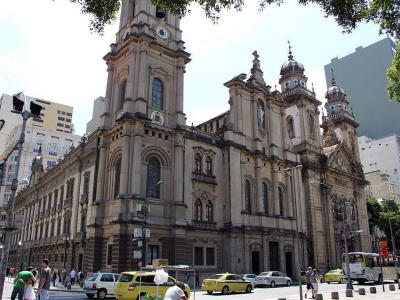
The Old Cathedral of Rio de Janeiro is one of the city’s most historically important religious buildings and a key witness to Brazil’s colonial and imperial eras. Originally founded as a Carmelite church in the 17th century, it was expanded and rebuilt in the mid-18th century as Rio de Janeiro grew in political importance. From around 1808 until 1976, it served as the city’s cathedral.
Its status changed in 1808, when the Portuguese royal court arrived in Rio while fleeing Napoleon’s invasion of Portugal. The church became the Royal Chapel and later the Imperial Chapel of independent Brazil. Kings John VI, Pedro I, and Pedro II all worshipped here, and the building hosted royal baptisms, weddings, and coronations, including the crowning of Dom Pedro I as Emperor in 1822.
While the exterior is relatively restrained, the interior ranks among the most harmonious church decorations in Rio. Executed largely after 1785, the Rococo woodwork is admired for its lightness and unity of style. Much of it was carved by Inácio Ferreira Pinto, one of Rio’s finest Rococo artists, who also created the main altarpiece. Gilded chapels, painted ceilings, oval portraits of the Apostles, and elegant balconies line the single-aisled nave, balanced by areas of plain white wall. The result is an interior of refined elegance that rewards anyone who steps inside, offering a contrast to the church’s modest exterior.
Its status changed in 1808, when the Portuguese royal court arrived in Rio while fleeing Napoleon’s invasion of Portugal. The church became the Royal Chapel and later the Imperial Chapel of independent Brazil. Kings John VI, Pedro I, and Pedro II all worshipped here, and the building hosted royal baptisms, weddings, and coronations, including the crowning of Dom Pedro I as Emperor in 1822.
While the exterior is relatively restrained, the interior ranks among the most harmonious church decorations in Rio. Executed largely after 1785, the Rococo woodwork is admired for its lightness and unity of style. Much of it was carved by Inácio Ferreira Pinto, one of Rio’s finest Rococo artists, who also created the main altarpiece. Gilded chapels, painted ceilings, oval portraits of the Apostles, and elegant balconies line the single-aisled nave, balanced by areas of plain white wall. The result is an interior of refined elegance that rewards anyone who steps inside, offering a contrast to the church’s modest exterior.
5) São Francisco da Penitência Church
The Church of the Third Order of São Francisco da Penitência is a colonial church located next to the Convent of Santo Antônio , on the hill of the same name, in the center of the city of Rio de Janeiro. For its exuberant Baroque decoration, it is considered one of the most important in the city and the country.
This Baroque style church was built back in 1726. Besides its great spiritual heritage, it has marvelous ornaments and decorations, such as the jacaranda wood carved altar or the roof panel depicting Saint Francis receiving the stigmata. With advance booking, you can take a guided tour of the underground passages under the church which were in use up until 1850.
Along with the church of São Francisco da Penitência it is the main showcase of total Baroque art in Rio de Janeiro. Currently the church functions as a Museum of Sacred Art. Don't hesitate to check out the museum for a small fee; the gold room is a spectacle to behold!
Why You Should Visit:
Overwhelming and beautiful, this church wows visitors with its elaborate architecture, magnificent statues, dazzling relics and impressive paintings.
What is more, the church exudes a rather serene feel, making it a perfect stop for anyone who needs a quick break.
This Baroque style church was built back in 1726. Besides its great spiritual heritage, it has marvelous ornaments and decorations, such as the jacaranda wood carved altar or the roof panel depicting Saint Francis receiving the stigmata. With advance booking, you can take a guided tour of the underground passages under the church which were in use up until 1850.
Along with the church of São Francisco da Penitência it is the main showcase of total Baroque art in Rio de Janeiro. Currently the church functions as a Museum of Sacred Art. Don't hesitate to check out the museum for a small fee; the gold room is a spectacle to behold!
Why You Should Visit:
Overwhelming and beautiful, this church wows visitors with its elaborate architecture, magnificent statues, dazzling relics and impressive paintings.
What is more, the church exudes a rather serene feel, making it a perfect stop for anyone who needs a quick break.
6) Santo Antônio Convent
The Convent of Santo Antonio is a Catholic monastery that belongs to the Franciscan Province of the Immaculate Conception of Brazil. It is situated on top of Santo Antônio Hill, overlooking the Largo da Carioca square in the heart of Rio de Janeiro. This convent, along with the nearby Church of the Third Order of São Francisco da Penitência, constitutes one of the oldest and most significant colonial establishments still standing in the city.
Inside the church, you'll find a simple and traditional design. It has a rectangular shape and features a single nave. The main chapel and side altars are adorned with gilded woodwork that dates back to the period between 1716 and 1719. This woodwork exhibits a late Baroque style that is more characteristic of the 17th century than the 18th century.
The history of the Convent of Saint Anthony can be traced back to 1592 when the first Franciscans arrived in Rio de Janeiro. One of its notable features is its catacombs, where the remains of several members of the Imperial Family are laid to rest.
Inside the church, you'll find a simple and traditional design. It has a rectangular shape and features a single nave. The main chapel and side altars are adorned with gilded woodwork that dates back to the period between 1716 and 1719. This woodwork exhibits a late Baroque style that is more characteristic of the 17th century than the 18th century.
The history of the Convent of Saint Anthony can be traced back to 1592 when the first Franciscans arrived in Rio de Janeiro. One of its notable features is its catacombs, where the remains of several members of the Imperial Family are laid to rest.
7) Catedral Metropolitana de São Sebastião
The Metropolitan Cathedral of Saint Sebastian, also known as the Metropolitan Cathedral of Rio de Janeiro, serves as the headquarters for the Roman Catholic Archdiocese of São Sebastião do Rio de Janeiro. It is where the Metropolitan Archbishops of Rio de Janeiro carry out their religious duties, and it is dedicated to Saint Sebastian, the patron saint of the city.
Designed by Edgar de Oliveira da Fonseca, the cathedral boasts a modern architectural style inspired by Mayan pyramids. The current cathedral was constructed between 1964 and 1979, replacing a series of churches that had previously served as cathedrals since 1676. The most recent and notable of these was the Church of Our Lady of Mount Carmel of the Ancient See, now referred to as the Old Cathedral, which was built in the 18th century and declared Rio's cathedral in the early 19th century.
The New Cathedral, as it is sometimes called, is situated in the city center. It has a distinctive conical shape with an internal diameter of 96 meters (315 feet), an external diameter of 106 meters, and an overall height of 75 meters (246 feet). The interior of the cathedral covers 8,000 square meters and provides seating for 5,000 people, with the ability to accommodate up to 20,000 individuals when standing. The cathedral's four rectangular stained glass windows reach an impressive height of 64 meters (210 feet), extending from the floor to the ceiling.
The interior design of the cathedral was created by Father Paulo Lachen Maier, while the sculptures were crafted by Humberto Cozzo. Additionally, the Chapel of the Blessed Sacrament features two candelabras created by Niccola Zanotto.
Why You Should Visit:
Majestic on the inside, free of charge, and with very minimal crowds. The massive coloured glass windows are as tall as the church itself and are beautiful beyond belief.
Tip:
Try to go during the middle of the day since the church relies on natural illumination and going earlier / later can leave it dark inside.
As the location is so close to Cinelândia and all of its attractions, you can do both on the same day.
Designed by Edgar de Oliveira da Fonseca, the cathedral boasts a modern architectural style inspired by Mayan pyramids. The current cathedral was constructed between 1964 and 1979, replacing a series of churches that had previously served as cathedrals since 1676. The most recent and notable of these was the Church of Our Lady of Mount Carmel of the Ancient See, now referred to as the Old Cathedral, which was built in the 18th century and declared Rio's cathedral in the early 19th century.
The New Cathedral, as it is sometimes called, is situated in the city center. It has a distinctive conical shape with an internal diameter of 96 meters (315 feet), an external diameter of 106 meters, and an overall height of 75 meters (246 feet). The interior of the cathedral covers 8,000 square meters and provides seating for 5,000 people, with the ability to accommodate up to 20,000 individuals when standing. The cathedral's four rectangular stained glass windows reach an impressive height of 64 meters (210 feet), extending from the floor to the ceiling.
The interior design of the cathedral was created by Father Paulo Lachen Maier, while the sculptures were crafted by Humberto Cozzo. Additionally, the Chapel of the Blessed Sacrament features two candelabras created by Niccola Zanotto.
Why You Should Visit:
Majestic on the inside, free of charge, and with very minimal crowds. The massive coloured glass windows are as tall as the church itself and are beautiful beyond belief.
Tip:
Try to go during the middle of the day since the church relies on natural illumination and going earlier / later can leave it dark inside.
As the location is so close to Cinelândia and all of its attractions, you can do both on the same day.
Walking Tours in Rio de Janeiro, Brazil

Create Your Own Walk in Rio de Janeiro
Creating your own self-guided walk in Rio de Janeiro is easy and fun. Choose the city attractions that you want to see and a walk route map will be created just for you. You can even set your hotel as the start point of the walk.
Rio de Janeiro Beach Walk
The Copacabana and Ipanema beaches are two of the main reasons Rio is so famous around the world. While Copacabana is a year-round tourist hub, famed for its incredible New Year’s Eve celebrations, the Ipanema and Leblon neighborhoods have the cleanest, safest, most beautiful beaches in the city, and are the favorite playgrounds of Rio de Janeiro’s upper-middle class.
Start your tour with a... view more
Tour Duration: 2 Hour(s)
Travel Distance: 4.9 Km or 3 Miles
Start your tour with a... view more
Tour Duration: 2 Hour(s)
Travel Distance: 4.9 Km or 3 Miles
Rio de Janeiro Introduction Walking Tour
Sixteenth-century French traveler Jean de Léry did not see merely a harbor when he visited Rio de Janeiro. In his words, it felt more like an amphitheater.
Rio de Janeiro’s history is inseparable from geography, empire, and spectacle. The city’s name dates to January 1502, when Portuguese explorers under Gaspar de Lemos arrived at Guanabara Bay. Mistaking the vast bay for the mouth of a... view more
Tour Duration: 3 Hour(s)
Travel Distance: 4.0 Km or 2.5 Miles

Rio de Janeiro’s history is inseparable from geography, empire, and spectacle. The city’s name dates to January 1502, when Portuguese explorers under Gaspar de Lemos arrived at Guanabara Bay. Mistaking the vast bay for the mouth of a... view more
Tour Duration: 3 Hour(s)
Travel Distance: 4.0 Km or 2.5 Miles
Useful Travel Guides for Planning Your Trip

16 Uniquely Brazilian Souvenirs to Bring Home from Rio de Janeiro
Other than the sun, passion and football, for which Brazil is renowned and which cannot be fitted into one's luggage, picking a memorable gift from Rio is a tough job. And this is not because of the lack of suitable things to choose from, but because of their abundance. Indeed, there're...
The Most Popular Cities
/ view all