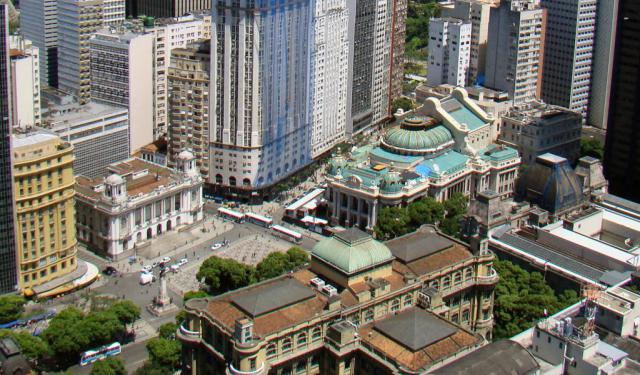


Rio de Janeiro Introduction Walking Tour, Rio de Janeiro

Rio de Janeiro Introduction Walking Tour (Self Guided), Rio de Janeiro

Sixteenth-century French traveler Jean de Léry did not see merely a harbor when he visited Rio de Janeiro. In his words, it felt more like an amphitheater.

Rio de Janeiro’s history is inseparable from geography, empire, and spectacle. The city’s name dates to January 1502, when Portuguese explorers under Gaspar de Lemos arrived at Guanabara Bay. Mistaking the vast bay for the mouth of a river, they called it “Rio de Janeiro,” meaning “River of January.” Although the error was soon understood, the name endured and became one of the most recognizable place names in the world.

For decades, the Portuguese showed limited interest in settling the area, focusing instead on trade elsewhere along the Brazilian coast. This changed in the mid-16th century, when French forces attempted to establish a colony known as Antarctic France. In response, the Portuguese founded the city of Saint Sebastian of Rio de Janeiro in 1565, naming it after the patron saint of the Portuguese crown. The French were expelled two years later, and Rio began developing as a fortified colonial outpost.

During the 17th and 18th centuries, Rio grew in importance as Brazil’s economy expanded through sugar plantations and, later, gold and diamond mining in the interior. In 1763, Rio replaced Salvador as the capital of colonial Brazil, largely due to its strategic port and proximity to mining regions.

A decisive turning point came in 1808, when the Portuguese royal court fled Napoleon’s invasion and relocated to Rio. For a time, the city became the capital of the Portuguese Empire—the only European monarchy ever based outside Europe. This elevated Rio’s status, leading to new institutions, libraries, theaters, and urban improvements.

After Brazil declared independence in 1822, Rio remained the capital of the Empire of Brazil and later of the republic until 1960, when Brasília assumed that role. Throughout the 19th and early 20th centuries, Rio underwent sweeping urban reforms, including the demolition of colonial neighborhoods, the construction of grand boulevards, and the modernization of its port.

Walking through central Rio de Janeiro today, visitors encounter colonial churches, neoclassical theaters, early 20th-century government buildings, and narrow streets that predate modern Brazil. Grand plazas open onto busy avenues, while quieter lanes reveal historic cafés such as Colombo Confectionery and cultural landmarks like the Royal Portuguese Cabinet of Reading. The Municipal Theatre and Cinelandia Square share space with modern offices, producing a city centre that feels active, layered, and distinctly lived-in.

As you move through this setting—streets rising and falling, façades opening onto sudden squares—it becomes clear why Léry reached for the image of an amphitheater. Rio has always performed best at fully living in the moment thanks to its music, Carnival, beaches, and iconic landmarks.
How it works: Download the app "GPSmyCity: Walks in 1K+ Cities" from Apple App Store or Google Play Store to your mobile phone or tablet. The app turns your mobile device into a personal tour guide and its built-in GPS navigation functions guide you from one tour stop to next. The app works offline, so no data plan is needed when traveling abroad.

Download The GPSmyCity App

Rio de Janeiro Introduction Walking Tour Map

Guide Name: Rio de Janeiro Introduction Walking Tour
Guide Location: Brazil » Rio de Janeiro (See other walking tours in Rio de Janeiro)
Guide Type: Self-guided Walking Tour (Sightseeing)
# of Attractions: 14
Tour Duration: 3 Hour(s)
Travel Distance: 4.0 Km or 2.5 Miles
Author: gene
Sight(s) Featured in This Guide:
  • Cinelandia Square
  • Pedro Ernesto Palace / City Council
  • Biblioteca Nacional (National Library)
  • Theatro Municipal (Municipal Theatre)
  • National Fine Arts Museum
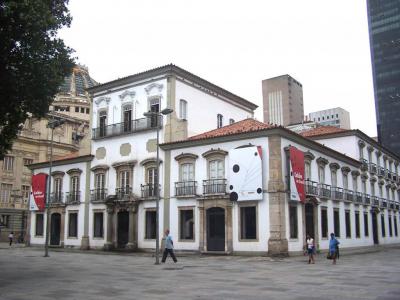
  • Paco Imperial (Imperial Palace)
  • Old Cathedral of Rio de Janeiro
  • Largo da Carioca (Carioca Square)
  • Confeitaria Colombo (Colombo Confectionery)
  • Royal Portuguese Cabinet of Reading
  • Saara Shopping District
  • Candelária Church
  • Centro Cultural Banco do Brasil (Bank of Brazil Cultural Center)
  • Saint Benedict Church and Monastery
1
Cinelandia Square

1) Cinelandia Square

Cinelandia Square is one of Rio de Janeiro’s most emblematic urban spaces, closely tied to the city’s transformation into a modern capital in the early 20th century. Officially named Floriano Peixoto Square, after Brazil’s second president, it is far better known by its popular name, Cinelandia. Originally, this site was occupied by the Ajuda Convent, built in 1750.

During the 1910s and 1920s, several grand cinemas opened here, turning the area into Rio’s main entertainment district. Although most of those cinemas have since closed or changed function, the nickname “Cinelandia,” meaning “cinema land,” has endured.

Architecturally, the square is framed by some of Rio’s most significant public buildings. The Municipal Theatre, inspired by the Paris Opera, dominates the scene, while nearby stand the National Library and the Pedro Ernesto Palace.

At the center of the square, visitors will find an impressive monument to Marshal Floriano Peixoto, incorporating sculpted scenes that represent key moments in Brazilian history. A bronze statue of Carlos Gomes, a celebrated 19th-century Brazilian composer, also stands nearby.
2
Pedro Ernesto Palace / City Council

2) Pedro Ernesto Palace / City Council

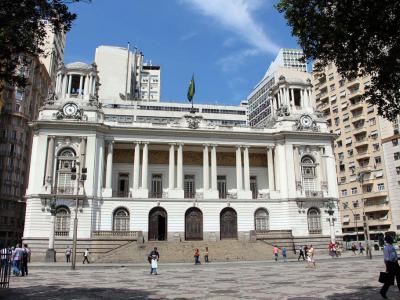
The Pedro Ernesto Palace is one of the most imposing civic buildings in downtown Rio and a defining feature of Cinelandia Square. Completed in 1923, the building serves as the seat of Rio’s City Council.

Architecturally, the palace is an excellent example of French Beaux-Arts design, reflecting the city’s ambition to present itself as a modern capital modeled on European ideals. Its grand façade is highly symmetrical: a broad staircase leads to the first level with three arched entrances, above which rise ten monumental columns on the second level. Two symmetrical towers flank the structure.

The palace quickly became one of the most photographed buildings in Rio de Janeiro, though its beauty came at a considerable cost. Historian Brasil Gérson famously referred to it as a “golden cage,” noting that its construction cost twice as much as the nearby Municipal Theatre.

Visitors are welcome to explore the interior through guided tours. Inside, the building reveals a lavish world of early 20th-century civic grandeur, featuring a sweeping staircase with ornate floral handrails, marble floors, and richly decorated lounges adorned with sculptures and paintings.

For a final impression, the Pedro Ernesto Palace is especially worth seeing illuminated at night, when its architectural details stand out against the backdrop of Cinelandia Square.
3
Biblioteca Nacional (National Library)

3) Biblioteca Nacional (National Library)

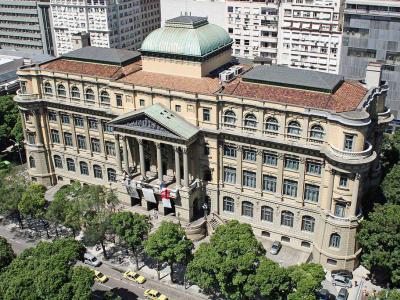
The National Library of Brazil is one of Rio de Janeiro’s most important cultural institutions. Its origins are linked to upheaval in Portugal rather than Brazil. After the devastating Lisbon earthquake of 1755 damaged the Royal Library of Portugal, parts of the collection were gradually transferred overseas. This process culminated in 1808, when the Portuguese royal court fled Napoleon’s invasion and relocated to Rio de Janeiro, bringing the Royal Library with it and laying the foundations for what is now the National Library.

Completed in 1910, the building was designed in an eclectic blend of Neoclassical and Art Nouveau styles. While the exterior is richly ornamented, the interior is particularly eye-catching. As soon as you enter, you are met by a grand bifurcated staircase of Carrara marble—an instant “wow” factor. Climb the first section of the staircase and you will find a bust of the library’s founder, King John VI of Portugal, on the landing. From here, look upward to admire the vibrant stained-glass skylight. The large stained-glass ceiling floods the marble foyer with colourful light. It features intricate geometric patterns and symbols associated with knowledge and the arts, framed by an elegant iron structure.

The National Library is the largest library in Latin America and one of the most extensive in the world, with a collection numbering in the millions, including books, manuscripts, maps, prints, photographs, and newspapers. At the heart of the institution is the Rare Works Division, often considered the soul of the library. It houses the original 60,000 volumes brought to Brazil by the Portuguese royal family in 1808 to escape Napoleon. Among its treasures are the 1459 Mainz Psalter and the Mogúncia Bible, making it one of the world’s most important bibliographic archives. Access to the Rare Works Division is possible only through an official guided tour, which usually departs from the ground-floor lobby and offers the only opportunity to step beyond the public areas.
4
Theatro Municipal (Municipal Theatre)

4) Theatro Municipal (Municipal Theatre) (must see)

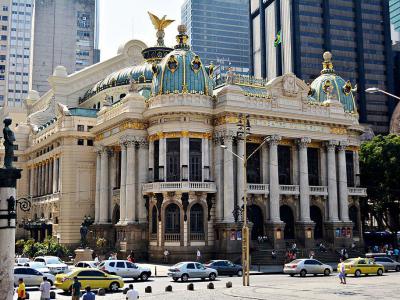
The Municipal Theatre of Rio de Janeiro is one of Brazil’s most important cultural institutions and a landmark of the city’s early 20th-century transformation. Inaugurated in 1909, its architectural design was inspired by the Garnier Palace in Paris, the home of the Paris Opera, reflecting the strong European influence on Brazil’s cultural elite at the time.

The exterior is a fine example of eclectic architecture, combining a Neoclassical structural framework with Art Nouveau ornamentation. Sculptures, columns, and decorative reliefs animate the façade, while inscriptions display the names of major Brazilian and European artists. Above it all rises an embellished dome, topped by a gilded bird that symbolically watches over both the building and the square below.

Inside, the theatre is equally impressive. Passing through the bronze and crystal doors, you enter the main reception hall. The floors are made of Italian marble, supported by columns of Carrara marble. Overhead, the ceiling is decorated with paintings by Brazilian Impressionist Eliseu Visconti. This is the most opulent part of the building, designed to impress guests upon arrival. Directly ahead from the vestibule stands the Grand Staircase, carved from coloured marble and flanked by bronze statues holding lamps. Above the staircase, look for the monumental ceiling painting by Rodolfo Amoedo. As you ascend, notice the transition from the bright, open entrance to the more intimate, velvet-lined upper tiers.

Two other highlights of the theatre—the Main Auditorium and the Noble Foyer—can only be seen by attending a performance or booking a guided tour. The Main Auditorium is a horseshoe-shaped theatre with four tiers of balconies. A massive bronze and crystal chandelier, weighing over a ton, hangs from the centre of the dome. Heavily inspired by the Palace of Versailles, the Noble Foyer features towering mirrors, Baccarat crystal chandeliers, and a grand ceiling painting by Eliseu Visconti. Doors from the foyer open onto a front balcony overlooking Cinelandia Square.

From its opening, the Municipal Theatre became the principal stage for opera, ballet, and symphonic music in Brazil, hosting international performers while also fostering national talent. Today, the theatre remains an active venue, with programming focused largely on classical music and ballet.
5
National Fine Arts Museum

5) National Fine Arts Museum

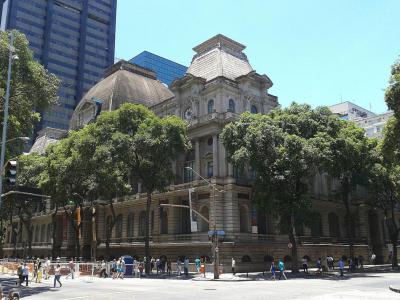
The National Fine Arts Museum is one of Brazil’s most important cultural institutions, offering a comprehensive view of the country’s artistic development from the 18th century to the early 20th century. Located in Cinelândia Square, the museum occupies a monumental building originally constructed for the 1908 National Exposition, which marked the centenary of the arrival of the Portuguese royal court in Brazil. The museum officially opened in 1937, when Brazil’s fine arts collections were separated from the former National School of Fine Arts.

The building itself is a major attraction. It presents an eclectic design inspired in part by the Louvre in Paris. The main façade draws on French Renaissance models, while the plainer side façades reference the Italian Renaissance and are decorated with Parisian mosaics depicting figures such as Vasari, Vitruvius, and Leonardo da Vinci. Inside, noble materials—including marble, mosaics, stucco, crystal, French ceramics, and statuary—create a sense of formal grandeur. The building was listed as a national heritage site in 1973.

The collection is extensive and diverse, encompassing paintings, sculptures, engravings, illustrations, and decorative arts such as furniture, medals, folk handicrafts, and select works of African art. Large historical canvases, religious works, and academic painting dominate, making it easy to spend several hours—or even a full day—exploring both the art and the architecture.
6
Paco Imperial (Imperial Palace)

6) Paco Imperial (Imperial Palace)

The Imperial Palace is a cornerstone of Brazil’s political past. Built in 1743 as the Governor’s House, it was designed in the Baroque style and distinguished by an impressive portal made of Portuguese marble. Several inner courtyards structure the building, reflecting its original administrative function within the colonial port city.

In 1763, when the Portuguese colonial capital was transferred from Salvador to Rio de Janeiro, the building became the Viceroy’s Palace. Its role expanded dramatically in 1808, when Prince Regent João—later King John VI—arrived in Brazil while fleeing Napoleon’s invasion of Portugal. From that moment, the palace served as the Royal Palace, and later as the Imperial Palace after Brazil declared independence in 1822. King John VI, Dom Pedro I, and Dom Pedro II were all crowned here. One of the most decisive moments in Brazilian history also took place within these walls in 1888, when Princess Isabel signed the Golden Law abolishing slavery.

After the proclamation of the republic in 1889, the palace lost its political role and was repurposed as Rio’s central post office. Today, it functions as a cultural centre. Visitors can explore rotating art exhibitions, the Paulo Santos Library, and architectural models showing how the surrounding area evolved over time. A small courtyard café offers a quiet pause in the heart of downtown.
7
Old Cathedral of Rio de Janeiro

7) Old Cathedral of Rio de Janeiro

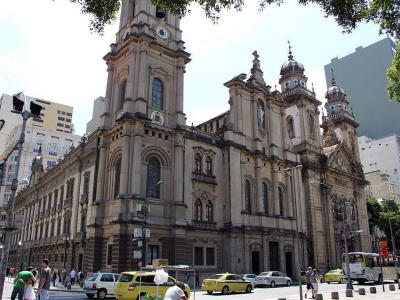
The Old Cathedral of Rio de Janeiro is one of the city’s most historically important religious buildings and a key witness to Brazil’s colonial and imperial eras. Originally founded as a Carmelite church in the 17th century, it was expanded and rebuilt in the mid-18th century as Rio de Janeiro grew in political importance. From around 1808 until 1976, it served as the city’s cathedral.

Its status changed in 1808, when the Portuguese royal court arrived in Rio while fleeing Napoleon’s invasion of Portugal. The church became the Royal Chapel and later the Imperial Chapel of independent Brazil. Kings John VI, Pedro I, and Pedro II all worshipped here, and the building hosted royal baptisms, weddings, and coronations, including the crowning of Dom Pedro I as Emperor in 1822.

While the exterior is relatively restrained, the interior ranks among the most harmonious church decorations in Rio. Executed largely after 1785, the Rococo woodwork is admired for its lightness and unity of style. Much of it was carved by Inácio Ferreira Pinto, one of Rio’s finest Rococo artists, who also created the main altarpiece. Gilded chapels, painted ceilings, oval portraits of the Apostles, and elegant balconies line the single-aisled nave, balanced by areas of plain white wall. The result is an interior of refined elegance that rewards anyone who steps inside, offering a contrast to the church’s modest exterior.
8
Largo da Carioca (Carioca Square)

8) Largo da Carioca (Carioca Square)

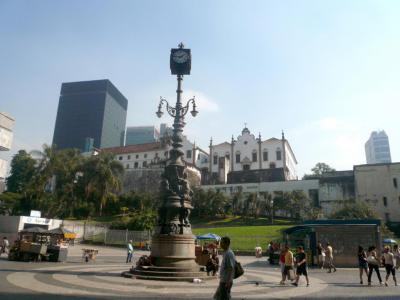
Carioca Square is one of the most animated and heavily trafficked public spaces in central Rio de Janeiro and is often described as the city’s beating heart. Its name comes from the Carioca Aqueduct, built in the 18th century to carry fresh water from the hills of Santa Teresa into the colonial city. While the aqueduct’s arches are most visible today in the Lapa neighborhood, this square marks the point where water once reached the urban core, shaping Rio’s early development.

The site itself has deeper roots. The Convent of Saint Anthony was constructed between 1608 and 1620 on a hill overlooking a lagoon. That body of water was later drained, creating the open plaza that exists today. The convent still dominates the hilltop above the square, and its interior—simple in layout with a single nave—is richly decorated with gilded Baroque carvings that reward a visit.

Over the centuries, Carioca Square evolved from an infrastructural node into a central gathering place. Today, a major metro station beneath the square channels an almost constant flow of pedestrians, making it feel as though much of Rio passes through here each day.
9
Confeitaria Colombo (Colombo Confectionery)

9) Confeitaria Colombo (Colombo Confectionery) (must see)

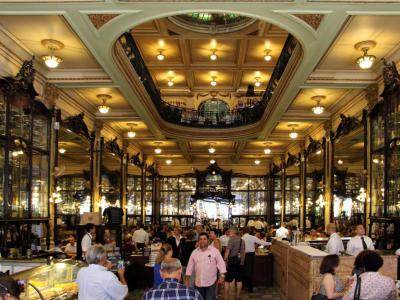
Confeitaria Colombo is one of Rio de Janeiro’s most celebrated historic cafés and a defining landmark of the city’s Belle Époque. Founded in 1894 by Portuguese immigrants, it was conceived as a refined European-style confectionery at a moment when Rio was reinventing itself as a modern capital. Today, it is frequently listed among the most beautiful cafés in the world.

The cafe’s architecture and interior design are central to its appeal. In the early 20th century, Colombo was remodeled in the fashionable Art Nouveau style, reflecting European trends of the time. Much of the wooden furniture was handcrafted by the artisan Antonio Borsoi, while towering mirrors imported from Belgium are framed in jacaranda wood. Portuguese tiles decorate the walls, and a large stained-glass skylight from France crowns the space, flooding the interior with light. An upper floor and tearoom were added in 1922, offering a quieter vantage point overlooking the main hall below.

Beyond its beauty, Colombo Confectionery has long been a place of conversation and influence. Heads of state and royalty, including Queen Elizabeth II of England, have visited, as have Brazilian presidents such as Getúlio Vargas. The café also served as a meeting place for Brazilian artists, musicians, and writers; composer Heitor Villa-Lobos and writer Lima Barreto were among those who gathered here.

Alongside coffee and traditional Portuguese pastries, Colombo offers classic Brazilian sweets. Trying a brigadeiro—made with condensed milk and chocolate—is almost obligatory.
10
Royal Portuguese Cabinet of Reading

10) Royal Portuguese Cabinet of Reading

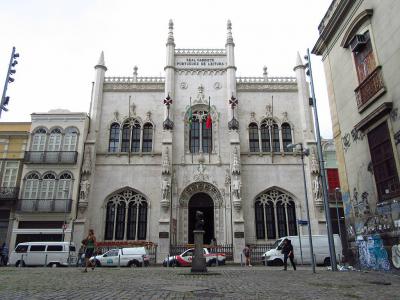
The Royal Portuguese Cabinet of Reading is one of Rio de Janeiro’s most celebrated cultural landmarks and is widely regarded as one of the most beautiful libraries in the world. Founded in 1837 by Portuguese immigrants, it was created to preserve and promote the Portuguese language, literature, and heritage in Brazil.

The current building was completed in 1887 and is a masterpiece of the Neo-Manueline style, inspired by the Gothic-Renaissance architecture of Portugal during the reign of King Manuel I, an era marked by great maritime discoveries. Emperor Pedro II laid the cornerstone in 1880, and the building was inaugurated seven years later by Imperial Princess Isabel. Its richly sculpted façade was inspired by Lisbon’s Jerónimos Monastery and constructed using stone quarried in Portugal and shipped across the Atlantic to Rio de Janeiro.

Before entering, pause on the sidewalk across the street. Look for the four statues standing in niches along the façade. From left to right, they represent major figures from Portuguese history: Pedro Álvares Cabral, the navigator credited as the European discoverer of Brazil; Luís de Camões, the greatest poet in the Portuguese language; Prince Henry the Navigator, a central figure in the early expansion of the Portuguese Empire; and Vasco da Gama, who opened the first maritime route between Europe and India. The intricate stone carvings around the windows and doors are characteristic of the Manueline style, featuring nautical motifs such as ropes and armillary spheres.

Immediately upon entering through the main doors, you pass into a small vestibule. Continue straight ahead to reach the heart of the library. The space opens into a vast, three-story-high rectangular hall, where every wall from floor to ceiling is lined with dark, intricately carved wooden shelves. This space houses the largest collection of Portuguese literature outside Portugal. While visitors cannot walk among the shelves, the central floor offers a full 360-degree view of the collection. Natural light pours in through a stained-glass skylight supported by a cast-iron frame, while an elegant silver-plated bronze chandelier hangs overhead. At the center of the room stands a statue of Pedro Álvares Cabral.
11
Saara Shopping District

11) Saara Shopping District

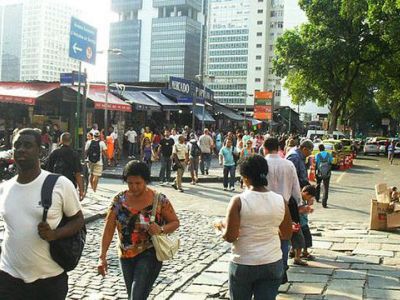
The Saara Shopping District is one of Rio de Janeiro’s most vibrant and renowned commercial areas, offering a vivid snapshot of the city’s everyday life. Located in downtown Rio, Saara is not a single market but a dense network of streets filled with small shops, stalls, and arcades, forming one of the largest retail zones in the city. With more than 600 shops, it is often cited as one of the world’s most extensive urban shopping districts.

Saara’s development is closely tied to immigration. From the late 19th century onward, Syrian and Lebanese merchants established textile and dry-goods businesses here, followed in the early 20th century by Jewish immigrants from Eastern Europe. Together, these communities shaped Saara into a major hub for affordable goods, wholesale trade, and small-scale retail.

Today, the district offers almost unlimited shopping possibilities. Stores sell everything from clothing, shoes, and accessories to candles, electronics, toys, fabrics, beachwear, and Carnival costumes. Soccer jerseys, T-shirts, hats, Brazilian bikinis, oversized beach towels, and souvenir items are everywhere, and many visitors leave with at least one pair of Havaianas, Brazil’s iconic flip-flops. Prices are generally low, and vendors are often open to bargaining, making Saara a favorite spot for bargain hunters.

The area is especially busy in the run-up to Carnival, Christmas, and other major holidays, when locals and tourists alike flood the streets. Amid the shopping bustle, a mix of cafes and casual restaurants serves traditional Brazilian food, offering a welcome pause.
12
Candelária Church

12) Candelária Church (must see)

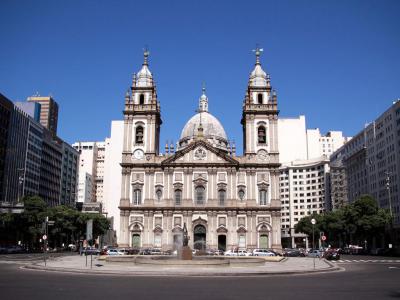
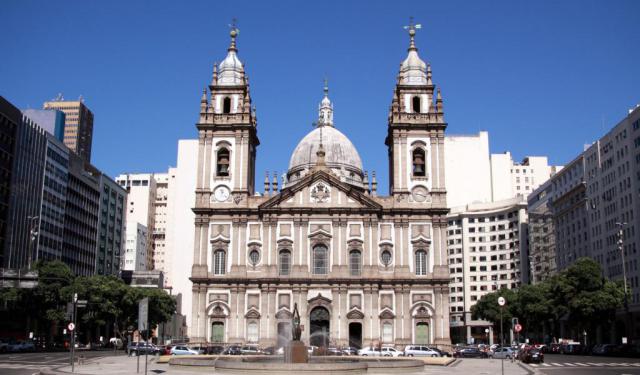
The Candelária Church is one of Rio de Janeiro’s most important and imposing Roman Catholic landmarks. Its origins lie in a quasi-legendary event from the early 17th century. According to tradition, a Portuguese couple survived a violent storm at sea aboard a ship named Candelária and vowed to build a chapel in gratitude if they reached land safely. Upon arriving in Rio de Janeiro, they fulfilled their oath by sponsoring a small chapel dedicated to Our Lady of the Candelária around 1609.

As Rio grew in size, wealth, and political importance, the modest chapel was gradually replaced by a far grander structure. Construction and decoration of the present church extended from 1775 through the late 19th century, resulting in a layered architectural composition. The façade retains a Baroque character, while the interior blends Neoclassical and Neo-Renaissance elements.

Inside, the scale is immediately impressive. Soaring columns, marble floors, and expansive spaces create a sense of solemn grandeur. The main altar was designed by Brazilian architect Archimedes Memória, while richly colored stained-glass windows produced in Germany filter light into the vast nave. The main entrance features monumental bronze doors created around 1901, and two impressive Art Nouveau bronze pulpits, added in 1931, further enrich the interior.

Beyond its architecture, Candelária has played a significant role in Brazil’s civic and social history, frequently serving as a site for public gatherings and memorials. Thanks to its excellent acoustics, the church is also renowned as a venue for concerts and organ recitals, making a visit particularly rewarding when music fills the space.
13
Centro Cultural Banco do Brasil (Bank of Brazil Cultural Center)

13) Centro Cultural Banco do Brasil (Bank of Brazil Cultural Center)

The Bank of Brazil Cultural Center in Rio de Janeiro, known as CCBB Rio, is one of the city’s most important cultural venues and a prominent landmark in the historic downtown area. The building was completed in 1906 in an elegant Art Deco–influenced style and was originally constructed to house the Commercial Association of Rio de Janeiro, serving as the city’s Public Bonds Exchange. In the 1920s, it became the headquarters of Bank of Brazil, reflecting Rio’s role as the country’s financial capital at the time.

In the 1980s, Bank of Brazil undertook a major restoration and converted the building into the cultural centre it is today. The renovation preserved key architectural features, including the marble foyer and monumental columns, while redesigning the dome above the central rotunda to suit its new public function. The result is a refined blend of historic grandeur and modern cultural use.

Since opening as a cultural centre, CCBB Rio has become one of the most visited institutions of its kind in Brazil. It hosts a wide range of activities, including major art exhibitions featuring photography, painting, and sculpture by internationally renowned and Brazilian artists. The centre also includes cinemas, theatre and music halls, a library, the Bank of Brazil Museum, and a historical archive.

CCBB offers both rich programming and an architectural experience. A cafe inside serves coffee, sandwiches, and lunch, making it easy to linger. Just behind the building, the House of France adds another cultural stop, rounding out a rewarding visit to this part of downtown Rio.
14
Saint Benedict Church and Monastery

14) Saint Benedict Church and Monastery (must see)

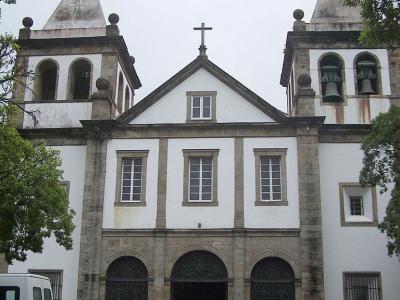
Saint Benedict Church and Monastery is one of Rio de Janeiro’s most important religious and artistic landmarks, rising above the city centre on Saint Benedict Hill. Its history began in 1590, when the land was donated to the Benedictine monks. Construction of the present complex started in 1633 and was completed in 1671, resulting in a refined example of Portuguese colonial architecture with strong Mannerist influences. The façade is marked by three entrance archways beneath a triangular gable, flanked by two towers topped with pyramidal spires. Passing through the entrance, visitors arrive at a tiled porch fitted with 19th-century iron gates.

While the exterior is relatively restrained, the interior is the church’s most famous feature. Almost every square inch of the walls and ceilings is covered in intricate wood carvings coated in 22-carat gold leaf. This massive decorative program took nearly a century to complete, spanning the years from 1668 to 1743. Look up to see a series of paintings depicting the life of Saint Benedict, framed by heavy, gold-covered scrollwork.

While admiring the church’s golden ornamentation, walk down the central aisle toward the far end of the nave. There, the High Altar displays the throne for the exposition of the Blessed Sacrament, positioned at the very top of the altar structure. Flanking the throne are statues of Saint Benedict and Saint Scholastica, his sister. Facing the altar, move into the right-hand side chapel, known as the Chapel of the Blessed Sacrament. It features some of the most delicate Rococo carvings in the church, lighter and more floral in character than the heavier Baroque decoration of the main nave. The silverwork here is particularly exquisite.

Beyond its artistic value, the monastery played a major role in education and urban development and remains active today. Visitors who attend the traditional Sunday 10:00 a.m. Mass can still hear Gregorian chant accompanied by organ music.

Walking Tours in Rio de Janeiro, Brazil

Create Your Own Walk in Rio de Janeiro

Create Your Own Walk in Rio de Janeiro

Creating your own self-guided walk in Rio de Janeiro is easy and fun. Choose the city attractions that you want to see and a walk route map will be created just for you. You can even set your hotel as the start point of the walk.
Rio de Janeiro Beach Walk

Rio de Janeiro Beach Walk

The Copacabana and Ipanema beaches are two of the main reasons Rio is so famous around the world. While Copacabana is a year-round tourist hub, famed for its incredible New Year’s Eve celebrations, the Ipanema and Leblon neighborhoods have the cleanest, safest, most beautiful beaches in the city, and are the favorite playgrounds of Rio de Janeiro’s upper-middle class.

Start your tour with a...  view more

Tour Duration: 2 Hour(s)
Travel Distance: 4.9 Km or 3 Miles
Rio's Top Religious Sites

Rio's Top Religious Sites

Due to the legacy of the Portuguese in language, religion, and law, Rio de Janeiro has had a rich and influential Catholic tradition. Until the mid-20th century almost all Brazilians were – at least nominally – Catholic, and today the country’s religious sites, both classic and modern, impress with their skill, creativity and devotion.

Founded in 1590 by Benedictine monks from Bahia, the...  view more

Tour Duration: 2 Hour(s)
Travel Distance: 3.0 Km or 1.9 Miles

Useful Travel Guides for Planning Your Trip


16 Uniquely Brazilian Souvenirs to Bring Home from Rio de Janeiro

16 Uniquely Brazilian Souvenirs to Bring Home from Rio de Janeiro

Other than the sun, passion and football, for which Brazil is renowned and which cannot be fitted into one's luggage, picking a memorable gift from Rio is a tough job. And this is not because of the lack of suitable things to choose from, but because of their abundance. Indeed, there're...