Custom Walk in Pompei, Italy by linocastagno_9bde7 created on 2025-08-11
Guide Location: Italy » Pompei
Guide Type: Custom Walk
# of Sights: 13
Tour Duration: 2 Hour(s)
Travel Distance: 4.2 Km or 2.6 Miles
Share Key: BM2XF
Guide Type: Custom Walk
# of Sights: 13
Tour Duration: 2 Hour(s)
Travel Distance: 4.2 Km or 2.6 Miles
Share Key: BM2XF
How It Works
Please retrieve this walk in the GPSmyCity app. Once done, the app will guide you from one tour stop to the next as if you had a personal tour guide. If you created the walk on this website or come to the page via a link, please follow the instructions below to retrieve the walk in the app.
Retrieve This Walk in App
Step 1. Download the app "GPSmyCity: Walks in 1K+ Cities" on Apple App Store or Google Play Store.



Step 2. In the GPSmyCity app, download(or launch) the guide "Pompei Map and Walking Tours".
Step 3. Tap the menu button located at upper right corner of the "Walks" screen and select "Retrieve custom walk". Enter the share key: BM2XF

1) Temple of Apollo
The Temple of Apollo stands next to the Forum in the historic heart of Pompei. It is thought to have been the most important religious building in the city for much of its history, and certainly during Greek and Samnite rule. The cult of Apollo, a Greek congregation who worshipped Apollo, son of Zeus and God of light, knowledge and the sun, drew a great many followers in Campania from the 6th century BC onwards.
The temple gained its present form in the 2nd century BC, and was a central part of Pompei life – so much so that the mensa ponderaria is carved into its perimeter wall. This chart forms the town’s guide to official measurements, for use by traders in the Forum. Damaged extensively by the earthquake of 62 AD, it was never fully rebuilt. Its elevated podium still allows visitors a clear view to Vesuvius, north west of the city.
The Temple of Apollo was built in the form of a peripteros – a raised platform surrounded on all sides by columns. This creates an arcade which runs around the outside of the temple. This area was redecorated under Roman rule, but the changes have almost completely disappeared over time. In the centre of the temple, you can see a white marble altar, and a set back cella, which contains statues of Apollo and Diana.
The temple gained its present form in the 2nd century BC, and was a central part of Pompei life – so much so that the mensa ponderaria is carved into its perimeter wall. This chart forms the town’s guide to official measurements, for use by traders in the Forum. Damaged extensively by the earthquake of 62 AD, it was never fully rebuilt. Its elevated podium still allows visitors a clear view to Vesuvius, north west of the city.
The Temple of Apollo was built in the form of a peripteros – a raised platform surrounded on all sides by columns. This creates an arcade which runs around the outside of the temple. This area was redecorated under Roman rule, but the changes have almost completely disappeared over time. In the centre of the temple, you can see a white marble altar, and a set back cella, which contains statues of Apollo and Diana.
2) Forum (must see)
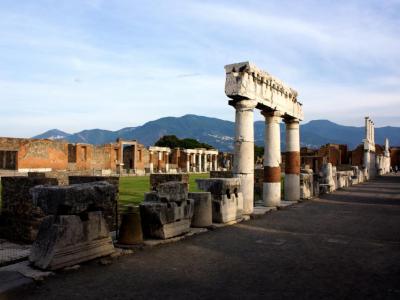
The Forum, a feature present in many Roman settlements, was a public space found at the centre of Pompei. It stands in the middle of a square, which contains several of the town’s most significant buildings. From the southern end of the forum, moving clockwise, there are the Basilica, the Temple of Apollo, the grain and food markets, the sanctuary, the temple of Vespasian, the building of Eumachia, and the Comitium.
It is safe to assume that the Forum was at one time the centre of Pompei. It stands on the junction of two Roman roads, linking Pompei with Naples and the nearby settlement of Stabiae. However, within the preserved ruins of the city, the Forum is found towards the outskirts. This is believed to be due to large scale development in the 2nd century BC, which moved the city centre away from the Forum.
Now a square of grass, the Forum area appears to have undergone many changes during the history of Pompei. Prior to the earthquake in 62 AD, the floor was receiving an upgrade – it is still partially paved with travertine. It is thought that a market was held in the middle of the open space. There are also a number of marble bases missing the statues that should sit upon them, and a half finished suggestum – the Roman equivalent of a soapbox for public speaking.
It is safe to assume that the Forum was at one time the centre of Pompei. It stands on the junction of two Roman roads, linking Pompei with Naples and the nearby settlement of Stabiae. However, within the preserved ruins of the city, the Forum is found towards the outskirts. This is believed to be due to large scale development in the 2nd century BC, which moved the city centre away from the Forum.
Now a square of grass, the Forum area appears to have undergone many changes during the history of Pompei. Prior to the earthquake in 62 AD, the floor was receiving an upgrade – it is still partially paved with travertine. It is thought that a market was held in the middle of the open space. There are also a number of marble bases missing the statues that should sit upon them, and a half finished suggestum – the Roman equivalent of a soapbox for public speaking.
3) Amphitheater
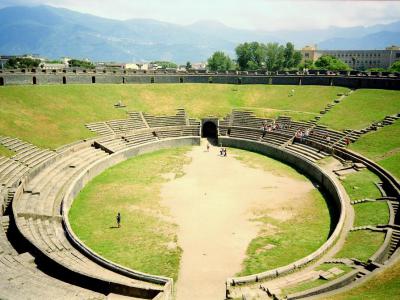
The Pompei Amphitheatre is the oldest building of its kind to have survived from the Roman era. Pompei houses many of the best preserved examples of Roman architecture, after the city was buried under volcanic ash for almost 2000 years. The Amphitheatre, one of Pompei’s most well known attractions, predates the Coliseum in Rome by over a century. It is believed that the success of the Pompei Amphitheatre, the first stone arena built within the Roman Empire, was the inspiration for a larger stone-built arena in Rome itself.
A circular structure with arches and stairways creating several entrance points, the Amphitheatre is still considered by crowd control analysts to be a near perfectly designed venue. Built around 70 BC, it was initially known as the Spectacula. Paid for by wealthy local statesmen Quinctius Valgus and Marcius Porcius, it was primarily used to host gladiatorial games and ceremonies. Twenty years before the eruption that destroyed Pompei, games were banned at the Amphitheatre, following a brawl between locals and residents of nearby Nuceria. In recent years, UK progressive rock band Pink Floyd became the first people for almost two thousand years to perform at the arena, filming a live concert here.
A circular structure with arches and stairways creating several entrance points, the Amphitheatre is still considered by crowd control analysts to be a near perfectly designed venue. Built around 70 BC, it was initially known as the Spectacula. Paid for by wealthy local statesmen Quinctius Valgus and Marcius Porcius, it was primarily used to host gladiatorial games and ceremonies. Twenty years before the eruption that destroyed Pompei, games were banned at the Amphitheatre, following a brawl between locals and residents of nearby Nuceria. In recent years, UK progressive rock band Pink Floyd became the first people for almost two thousand years to perform at the arena, filming a live concert here.
4) Great Palaestra
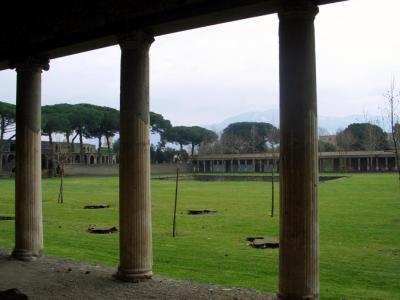
The Great Palaestra is a large rectangular building, flanked by porticoes on three sides, with a pool at its centre. Like many buildings in the city, it was commissioned under the empire of Augustus Caesar. It was used as an exercise complex by the youth associations which he set up, a Roman version of the youth branches of political parties we still see today. There was even a room, in the centre of the western portico, set aside for worship of the emperor. Behind the portico, a double row of sycamore trees provided a shaded area for attendees to relax and unwind.
The tree roots have been recreated with plaster casts. Like many natural organisms, from plant life to human beings, the roots were buried under the ash layers left by the deadly volcanic eruption, and decomposed. This left behind air pockets which were filled with plaster, creating exact replicas of the tree roots. At the time of the eruption in 79 AD the eastern portals and north wall were being restored, having been damaged in the earthquake of 62 AD. The complex even had toilet facilities – a latrine, served by water carried from the pool, can be seen on the south side of the building.
The tree roots have been recreated with plaster casts. Like many natural organisms, from plant life to human beings, the roots were buried under the ash layers left by the deadly volcanic eruption, and decomposed. This left behind air pockets which were filled with plaster, creating exact replicas of the tree roots. At the time of the eruption in 79 AD the eastern portals and north wall were being restored, having been damaged in the earthquake of 62 AD. The complex even had toilet facilities – a latrine, served by water carried from the pool, can be seen on the south side of the building.
5) Garden of Fugitives
The many historical wonders of Pompei tell us much about how people lived in this ancient city. One quiet corner amongst its maze of buildings gives a poignant insight into the disaster that destroyed this city overnight. The eruption of Mount Vesuvius in 79 AD is believed to have been one of the most catastrophic volcanic events of all time. It threw a deadly cloud of ash and stone up to 20 miles into the air, and ultimately released enough thermal energy to make a hundred thousand atomic bombs. Those unable to flee Pompei, just a few miles from the volcano, were killed by lava flows that swept through the city. When the ash cloud fell to earth, it buried Pompei, and an estimated 16,000 victims of the deadly eruption.
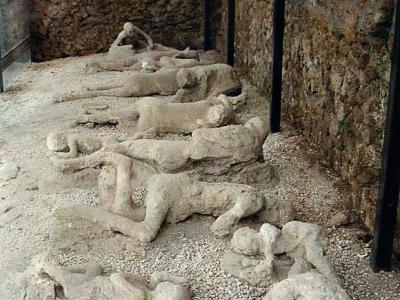
When they began excavating Pompei in the 19th century, archaeologists began finding decomposed bodies of people and animals. By pouring plaster into air pockets left in the rubble, they were able to create casts of many victims. At the Garden of the Fugitives, an area thought to have been a small orchard, thirteen bodies were found, and their casts have been laid out as they were discovered. It is a poignant memorial to those that perished in the eruption that preserved the city for modern visitors. A woman can be seen holding her child, whilst others were clearly trying to protect themselves, in vain, from the deadly lava flow.
When they began excavating Pompei in the 19th century, archaeologists began finding decomposed bodies of people and animals. By pouring plaster into air pockets left in the rubble, they were able to create casts of many victims. At the Garden of the Fugitives, an area thought to have been a small orchard, thirteen bodies were found, and their casts have been laid out as they were discovered. It is a poignant memorial to those that perished in the eruption that preserved the city for modern visitors. A woman can be seen holding her child, whilst others were clearly trying to protect themselves, in vain, from the deadly lava flow.
6) Great Theater and Quadroporticus (must see)
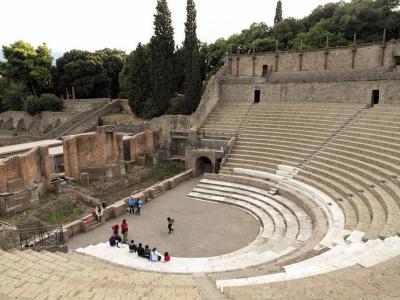
In contrast to the nearby Odeon, this venue was known as the Large Theater. It was built in the 2nd century BC, in the style of ancient Greek amphitheaters. Set in a natural indentation of the land, it features tiered stone seating on sloping sides, leading to a central horseshoe-shaped performance area.
The theater reached its peak under the reign of Augustus Caesar, being refurbished and extended by the Holconius brothers, rich wine growers from the region, who fitted the rows of seating with marble tops. Following the earthquake of 62 AD, however, the theater was damaged and the marble was removed. Simultaneously, the stage was rebuilt and a grand façade added, complete with columns and statues.
The Holconius brothers also added an upper circle and two side boxes for guests of honor. The Large Theater could hold up to 5,000 spectators within segregated seating areas. The eldest Holconius brother had his own reserved seat here, inscribed with bronze lettering. Back then, the theater was covered by a large canopy, protecting the audience from the sun. The opposite side of the amphitheater housed dressing rooms and access to the outer courtyard.
The Quadriporticus, a large four-sided courtyard, is flanked by colonnaded buildings, typical for most Roman dwellings. While there is some uncertainty over its function, it is known that portions of the complex were used as barracks for the town’s gladiators. The courtyard itself was used for their exercises, being ideally located next to the theater where gladiatorial games were held regularly. It is depicted in the ancient painting, now housed in Naples’ National Archaeological Museum, featuring a swimming pool in the center. The pool might have been covered after the site was damaged in the earthquake of 62 AD.
Graffiti carved by the gladiators in the columns of the Quadriporticus hint at public opposition to, and even condemnation of the violent games. A large quantity of gladiatorial armor found at the site, including helmets, belts and shoulder protectors, all marked with the letters NER, suggest that the gladiators came from the Neroniam, Nero’s imperial school, in nearby Capua.
The theater reached its peak under the reign of Augustus Caesar, being refurbished and extended by the Holconius brothers, rich wine growers from the region, who fitted the rows of seating with marble tops. Following the earthquake of 62 AD, however, the theater was damaged and the marble was removed. Simultaneously, the stage was rebuilt and a grand façade added, complete with columns and statues.
The Holconius brothers also added an upper circle and two side boxes for guests of honor. The Large Theater could hold up to 5,000 spectators within segregated seating areas. The eldest Holconius brother had his own reserved seat here, inscribed with bronze lettering. Back then, the theater was covered by a large canopy, protecting the audience from the sun. The opposite side of the amphitheater housed dressing rooms and access to the outer courtyard.
The Quadriporticus, a large four-sided courtyard, is flanked by colonnaded buildings, typical for most Roman dwellings. While there is some uncertainty over its function, it is known that portions of the complex were used as barracks for the town’s gladiators. The courtyard itself was used for their exercises, being ideally located next to the theater where gladiatorial games were held regularly. It is depicted in the ancient painting, now housed in Naples’ National Archaeological Museum, featuring a swimming pool in the center. The pool might have been covered after the site was damaged in the earthquake of 62 AD.
Graffiti carved by the gladiators in the columns of the Quadriporticus hint at public opposition to, and even condemnation of the violent games. A large quantity of gladiatorial armor found at the site, including helmets, belts and shoulder protectors, all marked with the letters NER, suggest that the gladiators came from the Neroniam, Nero’s imperial school, in nearby Capua.
7) Lupanar (Brothel) (must see)
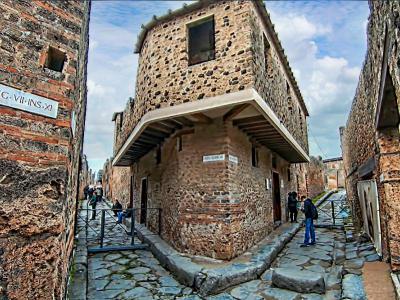
The Lupanar is the largest brothel within Pompei. It is located close to the Forum, on via del Lupanare, a street which bears its name. Whilst it has been established that prostitution was in existence during the Roman era, there has been some debate over the prevalence of brothels in a settlement like Pompei. A number of homes and bath houses in the city featured erotic artworks on their walls. Early excavators initially believed any building with erotic frescoes to have been a brothel.
When thirty five buildings with erotic artworks were discovered, it became apparent this couldn’t be the case. Further investigation has led experts to suggest that the Lupanar was the largest of ten brothels in the city, with many of the others single room establishments. The Lupanar has ten rooms, all plainly decorated, with brick platforms serving as beds. It is thought that brothels were mainly frequented by ordinary townspeople, rather than rich or well known figures. Graffiti found on the walls gives an insight into the activities that went on here. The term ‘lupanar’ is derogatory towards prostitutes – it means ‘house of the she-wolves’, a nickname given to prostitutes, who were considered predatory in Roman times.
When thirty five buildings with erotic artworks were discovered, it became apparent this couldn’t be the case. Further investigation has led experts to suggest that the Lupanar was the largest of ten brothels in the city, with many of the others single room establishments. The Lupanar has ten rooms, all plainly decorated, with brick platforms serving as beds. It is thought that brothels were mainly frequented by ordinary townspeople, rather than rich or well known figures. Graffiti found on the walls gives an insight into the activities that went on here. The term ‘lupanar’ is derogatory towards prostitutes – it means ‘house of the she-wolves’, a nickname given to prostitutes, who were considered predatory in Roman times.
8) Forum Baths
The Forum Baths are one of four bath houses discovered in the ruined city of Pompei. Along with the Central, Stabian and Suburban Baths, they have given a fascinating insight into the importance of public baths in Roman life. With little in the way of bathing facilities found inside private dwellings, it appears that bathing in these buildings would have been a daily ritual for many citizens. The Forum Baths were not the largest or most decorated in the city, but survived the 62 AD earthquake relatively unscathed, and as a result were the only baths still in use when the city was destroyed.
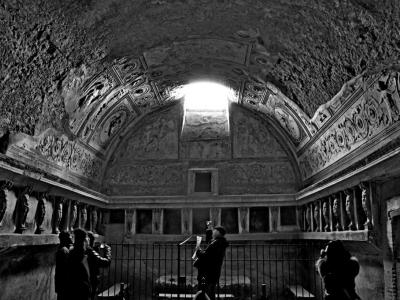
The Forum Baths are located opposite the Temple of Fortuna Augusta in the centre of Pompei. Divided into men’s and women’s sections, this compact bath house contained all of the features found in larger public baths, including a frigidarium, where customers could take a cold bath. The apodyterium, or changing room, is notable for its high barrel vaulted roof, complete with a skylight. The caldarium, which contained hot baths, was heated by warm air circulated within cavities in the walls. The room also features a marble labrum bath which allows bathers to cool off after bathing.
The Forum Baths are located opposite the Temple of Fortuna Augusta in the centre of Pompei. Divided into men’s and women’s sections, this compact bath house contained all of the features found in larger public baths, including a frigidarium, where customers could take a cold bath. The apodyterium, or changing room, is notable for its high barrel vaulted roof, complete with a skylight. The caldarium, which contained hot baths, was heated by warm air circulated within cavities in the walls. The room also features a marble labrum bath which allows bathers to cool off after bathing.
9) House of the Tragic Poet
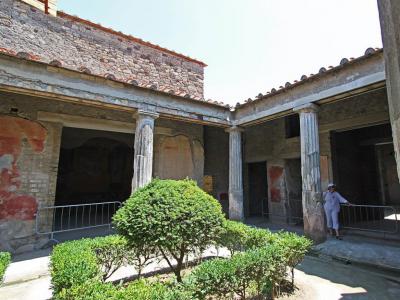
The House of the Tragic Poet is also known as the Homeric or Iliadic House. It is a fairly typical Roman era residential building, built in the 2nd century BC. It is famous for a series of elaborate mosaics and frescoes which depict scenes from Greek mythology. It has attracted interest from writers and academics ever since it was unearthed in November 1824. The artworks discovered are among the finest ever found in Pompei. This is unusual, given that the house itself is unremarkable compared to some of the city’s larger villas. Little is known of the family that owned the house, except that they were most likely killed in the 79 AD eruption of Vesuvius.
There are frescoes and mosaics throughout the House of the Tragic Poet. A mosaic found in the entrance hall shows a chained dog, with the words ‘Cave Canem’ – beware of the dog – written underneath. The house’s atrium and peristyle feature frescoes depicting several Greek Gods, including Zeus, Aphrodite, Achilles and Poseidon, amongst others. Many literary figures have been based upon this mysterious building, including Vladimir Janovic, whose epic poem House of the Tragic Poet gave the house its name. Janovic’s work is based around the myths and stories told in the house’s many frescoes and mosaics.
There are frescoes and mosaics throughout the House of the Tragic Poet. A mosaic found in the entrance hall shows a chained dog, with the words ‘Cave Canem’ – beware of the dog – written underneath. The house’s atrium and peristyle feature frescoes depicting several Greek Gods, including Zeus, Aphrodite, Achilles and Poseidon, amongst others. Many literary figures have been based upon this mysterious building, including Vladimir Janovic, whose epic poem House of the Tragic Poet gave the house its name. Janovic’s work is based around the myths and stories told in the house’s many frescoes and mosaics.
10) House of the Faun
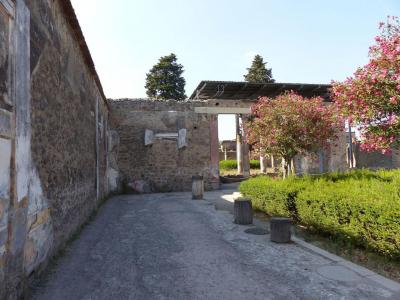
Casa del Fauno, or the House of the Faun, was built in the Samnite period, at least 100 years before the volcanic eruption which consumed Pompei. Largely ruined by the two earthquakes, which preceded the eruption, it has been preserved to represent the scale and layout of a Roman mansion.
It is known as the House of the Faun due to the discovery of a bronze statue on the edge of an impluvium – a basin used to collect rainwater for drinking and bathing. The statue depicts a dancing faun – a small, mythical creature believed to roam the wild woodlands that were once common across southern Europe. The original sculpture is housed in Naples’ National Archaeological Museum, but the exact replica of it is now found in the centre of the basin.
The house covers three thousand square metres, occupying an entire block of the ancient city. It is divided into five sections – four built around atriums and peristyles, and a network of service rooms. Look out for two other notable artworks in the complex. Firstly, the mosaic spelling out ‘HAVE’ (a popular Roman greeting) at the entrance, and, secondly, a replica of a detailed mosaic inside the house, that depicts Alexander the Great’s victory at the Battle of Issus in 333 BC.
It is known as the House of the Faun due to the discovery of a bronze statue on the edge of an impluvium – a basin used to collect rainwater for drinking and bathing. The statue depicts a dancing faun – a small, mythical creature believed to roam the wild woodlands that were once common across southern Europe. The original sculpture is housed in Naples’ National Archaeological Museum, but the exact replica of it is now found in the centre of the basin.
The house covers three thousand square metres, occupying an entire block of the ancient city. It is divided into five sections – four built around atriums and peristyles, and a network of service rooms. Look out for two other notable artworks in the complex. Firstly, the mosaic spelling out ‘HAVE’ (a popular Roman greeting) at the entrance, and, secondly, a replica of a detailed mosaic inside the house, that depicts Alexander the Great’s victory at the Battle of Issus in 333 BC.
11) House of the Vettii
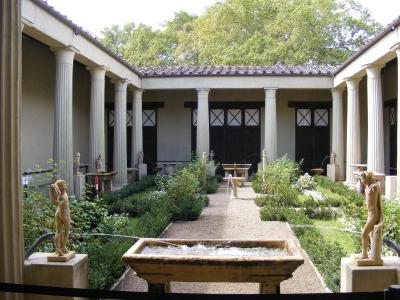
The House of the Vettii is a mansion built around a central open space, and was once one of Pompei’s most luxurious residences. It is particularly well preserved, featuring many exceptional wall frescoes. This suggests that it was constructed and decorated between the earthquake of 62 AD, which damaged many of the Roman city’s buildings, and the 79 AD volcanic eruption that buried it altogether. It is named after its owners – Aulus Vettius Conviva and Aulus Vettius Restitutus. Both are believed to have been freed slaves that subsequently amassed a large fortune.
Visitors will enter the mansion through a darkened atrium. You can see the servants’ quarters off to one side, built around a smaller atrium. In the entrance foyer, there is an almost life size image of Priapus, the Roman god of fertility. Priapus features heavily in frescoes all over Pompei – often appearing in graphic images which have led to repeated attempts to censor the original artwork. At the centre of the complex stands a peristyle, an open air garden space flanked by Doric columns. Symmetrical in design, it once contained several marble fountains and sculptures of mythological figures. The walls, as with many of the rooms, are lined with several ornate frescoes, framed in red and yellow paint, as is common throughout the buildings of Pompei.
Visitors will enter the mansion through a darkened atrium. You can see the servants’ quarters off to one side, built around a smaller atrium. In the entrance foyer, there is an almost life size image of Priapus, the Roman god of fertility. Priapus features heavily in frescoes all over Pompei – often appearing in graphic images which have led to repeated attempts to censor the original artwork. At the centre of the complex stands a peristyle, an open air garden space flanked by Doric columns. Symmetrical in design, it once contained several marble fountains and sculptures of mythological figures. The walls, as with many of the rooms, are lined with several ornate frescoes, framed in red and yellow paint, as is common throughout the buildings of Pompei.
12) House of Apollo
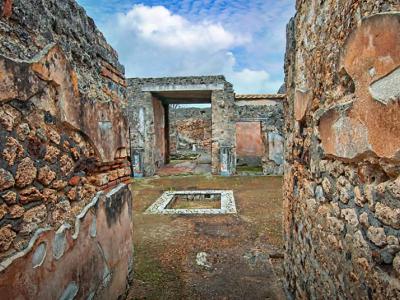
The House of Apollo is a good example of an ancient home, probably constructed during the Samnite period, which was developed in later years by the Romans. Believed to be one of Pompei’s oldest buildings, it features a number of well preserved decorations that belong to the fourth style, an artistic method popular in the years before the city was destroyed. These art works mostly depict mythical events, a popular theme during this period. Amongst these works is a depiction of Apollo, Greek god of light and knowledge, and Marsyas, which gives the house its name.
The image of Apollo decorates the walls of an unusual room housed within the garden. Thought to be a cubiculum, a small interior room normally used as a bedroom or study, it features mosaics around its entrance, and a series of mock buildings which resemble the structure of a theatre. The house also features a number of the traditional features associated with Roman villas, including a triclinium, atrium and tablinium. It is not known who owned the House of Apollo, though it is suspected that like many homes in Pompei, it belonged to a wealthy local business figure, such as a trader, rather than a member of the aristocracy.
The image of Apollo decorates the walls of an unusual room housed within the garden. Thought to be a cubiculum, a small interior room normally used as a bedroom or study, it features mosaics around its entrance, and a series of mock buildings which resemble the structure of a theatre. The house also features a number of the traditional features associated with Roman villas, including a triclinium, atrium and tablinium. It is not known who owned the House of Apollo, though it is suspected that like many homes in Pompei, it belonged to a wealthy local business figure, such as a trader, rather than a member of the aristocracy.
13) Villa of the Mysteries (must see)
The Villa of the Mysteries is one of the most well known buildings in the historic area around Mount Vesuvius. It is not situated within Pompei itself, lying around 500 metres northwest of the main city. Believed to be a suburban villa, which were commonplace in Roman times, it can easily be reached on foot from the centre of Pompei. Admission into the city centre will usually allow access to the villa, as well as the nearby settlement of Herculaneum.
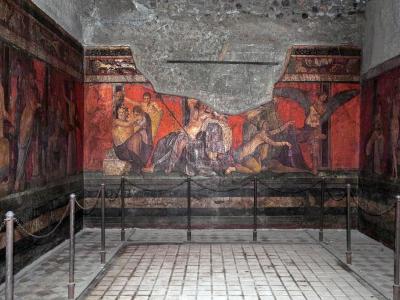
The villa is one of the best preserved buildings in the Pompei area, as it suffered little damage during either the 62 AD earthquake or the tremors prior to the eruption of Vesuvius seventeen years later. The walls of the building are lined with some of the best kept and most detailed frescoes surviving from the Roman era. The Villa of the Mysteries earned its name from the unusual paintings on the walls of the triclinium, a formal dining hall found in most Roman villas.
The frescoes in the dining hall appear to show some form of ritual, although nobody is certain of its purpose. One theory suggests the woman pictured in the frescoes is being inducted into the cult of Dionysus. An alternative idea put forward is that the paintings show an ancient marriage ritual. The dining hall also features well preserved serving areas, which may have been used to make wine and olive oil.
The villa is one of the best preserved buildings in the Pompei area, as it suffered little damage during either the 62 AD earthquake or the tremors prior to the eruption of Vesuvius seventeen years later. The walls of the building are lined with some of the best kept and most detailed frescoes surviving from the Roman era. The Villa of the Mysteries earned its name from the unusual paintings on the walls of the triclinium, a formal dining hall found in most Roman villas.
The frescoes in the dining hall appear to show some form of ritual, although nobody is certain of its purpose. One theory suggests the woman pictured in the frescoes is being inducted into the cult of Dionysus. An alternative idea put forward is that the paintings show an ancient marriage ritual. The dining hall also features well preserved serving areas, which may have been used to make wine and olive oil.
