Custom Walk in Ljubljana, Slovenia by sammynutt_7fde5 created on 2026-04-11
Guide Location: Slovenia » Ljubljana
Guide Type: Custom Walk
# of Sights: 13
Tour Duration: 2 Hour(s)
Travel Distance: 3 Km or 1.9 Miles
Share Key: LTWXQ
Guide Type: Custom Walk
# of Sights: 13
Tour Duration: 2 Hour(s)
Travel Distance: 3 Km or 1.9 Miles
Share Key: LTWXQ
How It Works
Please retrieve this walk in the GPSmyCity app. Once done, the app will guide you from one tour stop to the next as if you had a personal tour guide. If you created the walk on this website or come to the page via a link, please follow the instructions below to retrieve the walk in the app.
Retrieve This Walk in App
Step 1. Download the app "GPSmyCity: Walks in 1K+ Cities" on Apple App Store or Google Play Store.



Step 2. In the GPSmyCity app, download(or launch) the guide "Ljubljana Map and Walking Tours".
Step 3. Tap the menu button located at upper right corner of the "Walks" screen and select "Retrieve custom walk". Enter the share key: LTWXQ
1) Cevljarski most (Cobblers' Bridge)
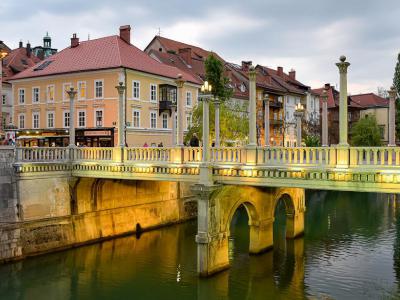
The pedestrian Cobblers' Bridge, also known as Shoemakers' Bridge, stands as one of the oldest crossings over the Ljubljanica River, linking two key areas of medieval Ljubljana. Its origins trace back to at least the 13th century when it was named the Upper Bridge. Originally constructed of wood, the bridge housed butchers' shops until the overpowering stench led to their relocation. In their place, shoemakers set up their booths, giving the bridge its present name.
Over its long history, the bridge has undergone multiple reconstructions due to floods and fires. In 1867, a cast-iron structure replaced the wooden one before being relocated later. The current stone structure, designed by esteemed architect Jože Plečnik in 1931, was recognized as part of his legacy and inscribed on the UNESCO World Heritage List in 2021.
Decorated with Corinthian pillars defining its shape and Ionic pillars serving as lamp-bearers, the bridge resembles a pillared hall over the water, although Plečnik originally intended to cover it with a pergola. In 2010, a monument honoring Ivan Hribar, Ljubljana's mayor from 1895 to 1907, known for his transformative modernization of the city's infrastructure, was unveiled nearby.
Over its long history, the bridge has undergone multiple reconstructions due to floods and fires. In 1867, a cast-iron structure replaced the wooden one before being relocated later. The current stone structure, designed by esteemed architect Jože Plečnik in 1931, was recognized as part of his legacy and inscribed on the UNESCO World Heritage List in 2021.
Decorated with Corinthian pillars defining its shape and Ionic pillars serving as lamp-bearers, the bridge resembles a pillared hall over the water, although Plečnik originally intended to cover it with a pergola. In 2010, a monument honoring Ivan Hribar, Ljubljana's mayor from 1895 to 1907, known for his transformative modernization of the city's infrastructure, was unveiled nearby.
2) Ljubljanski grad (Ljubljana Castle) (must see)
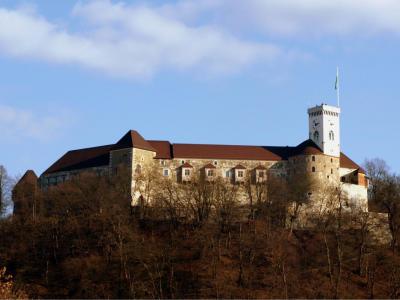
Perched atop Castle Hill, this imposing medieval fortress dominates the skyline of Ljubljana and stands as the city's most prominent landmark. Its origins trace back to the 11th and 12th centuries, undergoing numerous renovations, reconstructions, and expansions over time. The complex as we see it today took shape in the 15th century, with further additions in the 16th and 17th centuries.
The site around the castle has been inhabited since 1200 BC, believed to have been fortified by the Roman army. Throughout the 13th century, ownership changed hands multiple times, passing from the rulers of Carniola to King Ottokar II of Bohemia, and ultimately to Rudolph of Habsburg following a battle. The fortress saw occupation by the French Army in 1797 and 1809, serving as a prison during various periods, including the Austrian Empire's rule in the 19th century and World War II. Notable figures imprisoned here include Hungarian Prime Minister Lajos Batthyány, revolutionary Silvio Pellico, and author Ivan Cankar.
The iconic viewing tower, constructed in 1848, once served as a lookout point where a guard would fire cannons to signal fires or welcome important visitors. However, as the need for fortification waned and maintenance costs soared, the castle fell into disrepair during the 19th century. In 1905, the Municipality of Ljubljana eventually repurposed it to house economically disadvantaged families.
Today, visitors can ascend the Outlook Tower and stroll the ramparts for beautiful city views. The castle also hosts museum exhibitions on Slovenian history, a puppet museum, and various historical rooms including the Chapel of Saint George and the Prison. Additionally, the grounds feature a café (Grajska kavarna Lolita), a nightclub (Jazz Club Ljubljanski grad), a wine bar (Grajska vinoteka Strelec), and two restaurants (Strelec and Gostilna na Gradu). The site has also morphed into a vibrant cultural hub, hosting art exhibitions, family entertainment, dance evenings, and open-air film screenings during the summer under the banner of "Film under the Stars".
The site around the castle has been inhabited since 1200 BC, believed to have been fortified by the Roman army. Throughout the 13th century, ownership changed hands multiple times, passing from the rulers of Carniola to King Ottokar II of Bohemia, and ultimately to Rudolph of Habsburg following a battle. The fortress saw occupation by the French Army in 1797 and 1809, serving as a prison during various periods, including the Austrian Empire's rule in the 19th century and World War II. Notable figures imprisoned here include Hungarian Prime Minister Lajos Batthyány, revolutionary Silvio Pellico, and author Ivan Cankar.
The iconic viewing tower, constructed in 1848, once served as a lookout point where a guard would fire cannons to signal fires or welcome important visitors. However, as the need for fortification waned and maintenance costs soared, the castle fell into disrepair during the 19th century. In 1905, the Municipality of Ljubljana eventually repurposed it to house economically disadvantaged families.
Today, visitors can ascend the Outlook Tower and stroll the ramparts for beautiful city views. The castle also hosts museum exhibitions on Slovenian history, a puppet museum, and various historical rooms including the Chapel of Saint George and the Prison. Additionally, the grounds feature a café (Grajska kavarna Lolita), a nightclub (Jazz Club Ljubljanski grad), a wine bar (Grajska vinoteka Strelec), and two restaurants (Strelec and Gostilna na Gradu). The site has also morphed into a vibrant cultural hub, hosting art exhibitions, family entertainment, dance evenings, and open-air film screenings during the summer under the banner of "Film under the Stars".
3) Zmajski most (Dragon Bridge) (must see)
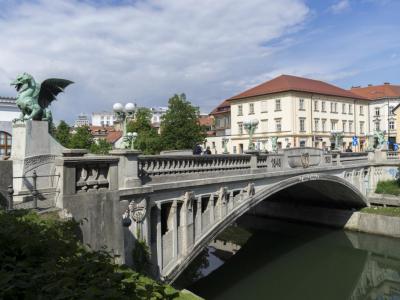
Built at the outset of the 20th century as part of a broader urban renewal initiative during Ljubljana's time under the Austro-Hungarian Empire, the Dragon Bridge is now recognized as a technical marvel, serving as one of the prime exemplars of reinforced concrete bridges. Scholars suggest that the adoption of new technologies like reinforced concrete and innovative static calculations in Ljubljana, instead of Vienna, was due to the relatively minor consequences should they have failed.
The bridge is also hailed as one of the most aesthetically pleasing creations of the Vienna Secession movement; moreover, it was the first such structure in Slovenia to be paved with asphalt and had the third-largest arch in Europe upon completion. The stylistic elements were conceived by Jurij Zaninović, who envisioned the concrete cladding, the balustrades, and the sheet-copper dragon statues, now iconic symbols of the city, standing atop pedestals at each of the bridge's four corners (alongside sixteen smaller dragon statues).
Legend has it that Jason, of Argonauts fame, founded Ljubljana, and he and his crew slew a dragon in the area. Some locals humorously refer to the structure as the "mother-in-law" due to its perceived fiery nature.
The bridge is also hailed as one of the most aesthetically pleasing creations of the Vienna Secession movement; moreover, it was the first such structure in Slovenia to be paved with asphalt and had the third-largest arch in Europe upon completion. The stylistic elements were conceived by Jurij Zaninović, who envisioned the concrete cladding, the balustrades, and the sheet-copper dragon statues, now iconic symbols of the city, standing atop pedestals at each of the bridge's four corners (alongside sixteen smaller dragon statues).
Legend has it that Jason, of Argonauts fame, founded Ljubljana, and he and his crew slew a dragon in the area. Some locals humorously refer to the structure as the "mother-in-law" due to its perceived fiery nature.
4) Osrednja ljubljanska trznica (Ljubljana Central Market)
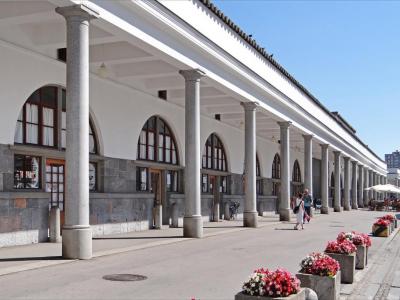
Opposite the cathedral in the Old Town lies Ljubljana's central market. Just like any other major marketplace, it boasts a traditional set of fresh fruits and vegetables, plus a spectacular range of meat and fish. It may even seem sometimes that any culinary wish can come true here. For an authentic experience of a Slovenian bazaar, come to the center of Ljubljana.
5) Stolnica svetega Nikolaja (Ljubljana Cathedral) (must see)
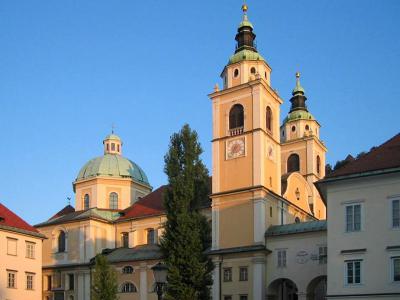
Initially constructed in the Romanesque style during the 13th century, Saint Nicholas' Cathedral saw numerous renovations before being ravaged by fire in 1469. Its rebirth commenced in the early 18th century, with a complete transformation guided by the vision of the Italian painter and architect Andrea Pozzo. Frescoes by Giulio Quaglio, sculptures by Angelo Putti, and altars by Paolo and Giuseppe Groppelli breathed new life into the edifice, with Francesco Robba contributing an altar in the left transept adorned with angels. This marked the beginning of Ljubljana's Baroque era, setting the tone for the architectural evolution of the city.
The cathedral is recognizable by its octagonal dome crowning its eastern side, while two bell towers grace the western side, adorned with gilded apples containing various relics and inscriptions. These towers, completed in 1705–06, house six bells, including the second oldest one in Slovenia, dating back to 1326. The facades are decorated with niches housing statues of bishops and saints, Baroque frescoes, and ancient Roman tombstones. Other notable features include a side entrance adorned with a Gothic pietà and a sundial dating back to 1826, bearing a poignant Latin motto: "Nescitis diem neque horam" ("You don't know the day or the hour").
In 1996, bronze sculptured doors were installed to commemorate Christianity's 1250th anniversary in Slovenia and the visit of Pope John Paul II. The Slovene Door depicts the country's history, while the Ljubljana Door is decorated with portraits of 20th-century bishops.
Inside, much of the original Baroque splendor remains, including frescoes in the cupola depicting the Holy Spirit and angels, along with depictions of the coronation of the Virgin and the glorification of Saint Nicholas on the dome walls, surrounded by celestial beings.
The cathedral is recognizable by its octagonal dome crowning its eastern side, while two bell towers grace the western side, adorned with gilded apples containing various relics and inscriptions. These towers, completed in 1705–06, house six bells, including the second oldest one in Slovenia, dating back to 1326. The facades are decorated with niches housing statues of bishops and saints, Baroque frescoes, and ancient Roman tombstones. Other notable features include a side entrance adorned with a Gothic pietà and a sundial dating back to 1826, bearing a poignant Latin motto: "Nescitis diem neque horam" ("You don't know the day or the hour").
In 1996, bronze sculptured doors were installed to commemorate Christianity's 1250th anniversary in Slovenia and the visit of Pope John Paul II. The Slovene Door depicts the country's history, while the Ljubljana Door is decorated with portraits of 20th-century bishops.
Inside, much of the original Baroque splendor remains, including frescoes in the cupola depicting the Holy Spirit and angels, along with depictions of the coronation of the Virgin and the glorification of Saint Nicholas on the dome walls, surrounded by celestial beings.

6) Mestni Trg (Town Square)
Town Square (Slovene: Mestni trg) is a major square. Ljubljana Town Hall is located at the square. In front of Town Hall stands a copy of the Robba Fountain. Near the square, at Cyril and Methodius Square, stands Ljubljana Cathedral. Opposite Town Hall is the Krisper House, where Julija Primic, the inspiration of the Slovene Romantic poet France Prešeren, was born in 1816. The composer Gustav Mahler lived in the house from 1881 to 1882, when he worked as a conductor at the Carniolan Provincial Theatre at Congress Square.
Sight description based on Wikipedia.
7) Palaca Kresija (Kresija Palace)
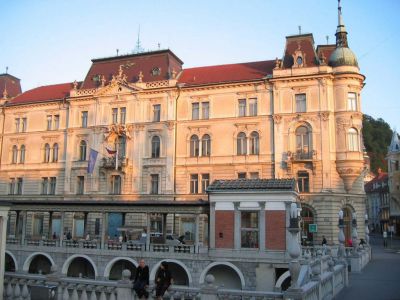
Together with the Filipov Palace, Kresija Palace marks the entrance to the Old Town center of Ljubljana with its small tower. Noted for its Neo-Renaissance facade and interior, the building emerged in the aftermath of the 1895 earthquake to house the district bureaucracy of the then Duchy of Carniola. Today, it accommodates various municipal offices, the Kresija Gallery, and the Tourist Information Center. Its name derives from the German term "Kreisamt", denoting the administrative office of the local Austro-Hungarian "Kreis" or district.
Before the great earthquake, the site housed a hospital and a school building. It served as a maternity hospital, a midwifery school-the first healthcare institution offering courses in Slovene-and a surgery repetition school founded in 1753. During the first half of the 19th century, the building housed shops and apartments; adjacent to it, until 1831, stood the Church of Saint Elizabeth, a hub of Protestantism.
Since 1999, the southwestern facade of Kresija has featured two busts: one of the Protestant grammarian Adam Bohorič and another of the 17th-century physician Marko Gerbec. Beneath a turret at the northwestern corner, a plaque commemorates the Manoeuvre Structures of National Protection, a clandestine paramilitary force that operated in the building in 1991, contributing to Slovenia's independence. In 2008, another plaque was installed, honoring the Ljubljana Coordination Group of Independence Efforts in 1991.
Before the great earthquake, the site housed a hospital and a school building. It served as a maternity hospital, a midwifery school-the first healthcare institution offering courses in Slovene-and a surgery repetition school founded in 1753. During the first half of the 19th century, the building housed shops and apartments; adjacent to it, until 1831, stood the Church of Saint Elizabeth, a hub of Protestantism.
Since 1999, the southwestern facade of Kresija has featured two busts: one of the Protestant grammarian Adam Bohorič and another of the 17th-century physician Marko Gerbec. Beneath a turret at the northwestern corner, a plaque commemorates the Manoeuvre Structures of National Protection, a clandestine paramilitary force that operated in the building in 1991, contributing to Slovenia's independence. In 2008, another plaque was installed, honoring the Ljubljana Coordination Group of Independence Efforts in 1991.
8) Tromostovje (Triple Bridge) (must see)
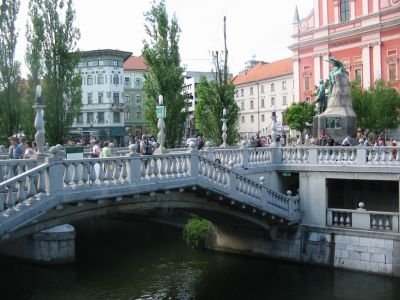
As a testament to Jože Plečnik's creativity, the Triple Bridge complex stands out as the star attraction of Ljubljana. Plečnik ingeniously added pedestrian bridges on each side of the existing Franz Bridge, but with a twist – they don't run parallel; instead, they angle sharply to it. This unique configuration gives the Triple Bridge its distinctive character, making it the most photographed and iconic symbol of the city. Last spruced up in 1992, it serves as the perfect meeting spot between Prešeren Square and the surrounding pedestrian streets.
The original Franz Bridge has been a fixture since 1842, replacing a vital medieval wooden crossing linking north-western Europe to south-eastern Europe and the Balkans. Plečnik's redesign involved removing the metal railings from the old structure and replacing them with hefty stone balustrades and lamps. Each side bridge features stairways leading to terraces above the Ljubljanica River, where poplar trees enhance the overall aesthetic. With their Venetian-inspired design, the stairways infuse a touch of Mediterranean charm into the scene.
Linking the historic city with the modern, these three bridges offer splendid river views and are surrounded by numerous bars, restaurants, and cafes. Plus, there are free restrooms tucked underneath, a handy tip for visitors.
The original Franz Bridge has been a fixture since 1842, replacing a vital medieval wooden crossing linking north-western Europe to south-eastern Europe and the Balkans. Plečnik's redesign involved removing the metal railings from the old structure and replacing them with hefty stone balustrades and lamps. Each side bridge features stairways leading to terraces above the Ljubljanica River, where poplar trees enhance the overall aesthetic. With their Venetian-inspired design, the stairways infuse a touch of Mediterranean charm into the scene.
Linking the historic city with the modern, these three bridges offer splendid river views and are surrounded by numerous bars, restaurants, and cafes. Plus, there are free restrooms tucked underneath, a handy tip for visitors.
9) Presernov spomenik (Preseren Monument)
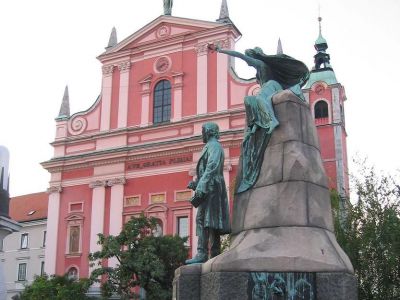
The Prešeren Monument is a centerpiece of Prešeren Square and is one of the most notable monuments in Ljubljana. Designed by Ivan Hribar and Maks Fabianithe, the statue is dedicated to the memory of France Prešeren, a Slovenian poet, and was solemnly inaugurated in 1905.
10) Presernov trg (Preseren Square) (must see)
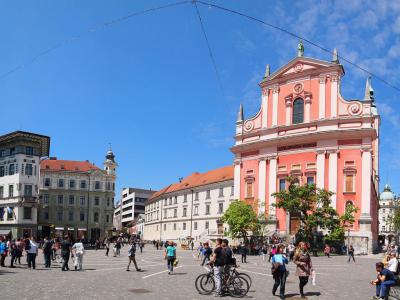
The spacious square before the Triple Bridge is like the beating heart of the city – a bustling meeting spot for both tourists and locals, perfect for snapping photos and soaking in the tunes of street musicians. But it's more than just a tourist hotspot; it holds a special significance as the spiritual nucleus of Ljubljana, named after France Prešeren, hailed as Slovenia's greatest poet. Prešeren, whose life spanned from 1800 to 1849, wrote in both German and Slovenian, but it was his Slovenian works, particularly his "Poezije" (Poems) published in 1847, that earned him the title of national poet and spiritual father of Slovenian national consciousness.
In the latter half of the 19th century, Slovenes became the majority in the city's population, gradually shifting the dominance from German to Slovenian. To celebrate this newfound or rekindled Slovenian identity, a bronze monument to Prešeren was erected here in 1905, with the muse of poetry holding a laurel branch above him. A bronze scale model of Ljubljana was installed nearby in 1991.
As you gaze across the pedestrian-friendly square, your eyes are treated to a blend of architectural marvels – from the baroque Church of the Annunciation to the grand buildings reflecting the style of the Vienna Secession. While these structures stand as the cornerstones of Ljubljana's rich history, they also hint at the city's future aspirations, as it vies for the title of European Capital of Culture in 2025.
In the latter half of the 19th century, Slovenes became the majority in the city's population, gradually shifting the dominance from German to Slovenian. To celebrate this newfound or rekindled Slovenian identity, a bronze monument to Prešeren was erected here in 1905, with the muse of poetry holding a laurel branch above him. A bronze scale model of Ljubljana was installed nearby in 1991.
As you gaze across the pedestrian-friendly square, your eyes are treated to a blend of architectural marvels – from the baroque Church of the Annunciation to the grand buildings reflecting the style of the Vienna Secession. While these structures stand as the cornerstones of Ljubljana's rich history, they also hint at the city's future aspirations, as it vies for the title of European Capital of Culture in 2025.
11) Franciskanska cerkev (Franciscan Church of the Annunciation)
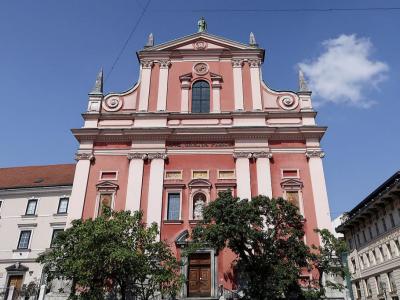
One of the standout sights in the cityscape is the Church of the Annunciation, part of the Franciscan Monastery on Prešeren Square. Built between 1646 and 1660, its facade got a facelift around 1700, showcasing Corinthian capitals on the upper part and Ionic capitals below. Crowning the front facade is a remarkable statue of Our Lady of Loretto, crafted from beaten copper, making it the largest Madonna statue in Ljubljana. Elsewhere, three niches house sculptures representing God the Father, an angel, and the Virgin Mary.
Inside, changes in the mid-18th century brought about the grand Baroque main altar, courtesy of Francesco Robba's skilled hands, while nearby, a glass coffin holds the remains of Saint Deodatus, who had been bishop of Nevers in France before retiring to solitude. The splendor of the vault frescoes, lost in the earthquake of 1895, was painstakingly restored by Slovenian painter Matej Sternen in the 1930s.
Once the Franciscans assumed ownership, the church was painted red, symbolizing the Franciscan monastic order; however, over time, the color faded to a soft salmon pink, favored by the locals. Ever since, it has retained this attractive hue, adding to its distinctiveness.
Inside, changes in the mid-18th century brought about the grand Baroque main altar, courtesy of Francesco Robba's skilled hands, while nearby, a glass coffin holds the remains of Saint Deodatus, who had been bishop of Nevers in France before retiring to solitude. The splendor of the vault frescoes, lost in the earthquake of 1895, was painstakingly restored by Slovenian painter Matej Sternen in the 1930s.
Once the Franciscans assumed ownership, the church was painted red, symbolizing the Franciscan monastic order; however, over time, the color faded to a soft salmon pink, favored by the locals. Ever since, it has retained this attractive hue, adding to its distinctiveness.
12) Kongresni trg (Congress Square)
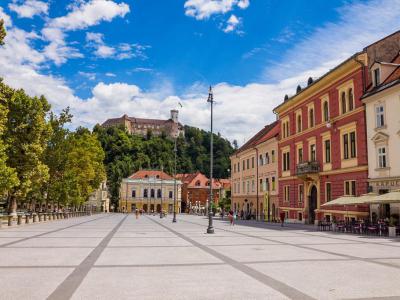
Jože Plečnik's influence on Ljubljana's cityscape is often seen as a mix of sensitivity and boldness, and he certainly embodied both traits. He took the lead in reshaping squares, fearlessly relocating monuments and reimagining facades. One of his major undertakings was the transformation of Congress Square and the nearby Star Park ("Park Zvezda"), aiming to create a grand focal point for the city. Plečnik laid a grid of light concrete slabs bordered in black, repositioned the Trinity Column to align with the Ursuline Church and the Philharmonic Building, and enhanced it with a row of lamps. This not only heightened the church's prominence but also introduced a new staircase in front of its main entrance. In Star Park, he replaced chestnut trees with plane trees, narrowed pathways, and installed a new fountain. The true impact of his changes can be fully appreciated with aerial or historical photographs.
Originally used for ceremonies during the post-Napoleonic Congress of Ljubljana, the square has been a witness to many pivotal events throughout history. It was here that independence from Austria-Hungarian rule was proclaimed on October 29, 1918, leading to the establishment of the State of Slovenes, Croats, and Serbs. Yugoslav Communist leader Josip Tito delivered a speech facing the square in 1945. A demonstration held here in June 1988 played a part in Slovenia's eventual independence three years later. Even U.S. President Bill Clinton visited Congress Square in 1999. Additionally, there is a memorial site commemorating a significant historical event – namely, an anchor atop a pedestal marking the annexation of the Slovenian coastal region to Yugoslavia in 1954.
Originally used for ceremonies during the post-Napoleonic Congress of Ljubljana, the square has been a witness to many pivotal events throughout history. It was here that independence from Austria-Hungarian rule was proclaimed on October 29, 1918, leading to the establishment of the State of Slovenes, Croats, and Serbs. Yugoslav Communist leader Josip Tito delivered a speech facing the square in 1945. A demonstration held here in June 1988 played a part in Slovenia's eventual independence three years later. Even U.S. President Bill Clinton visited Congress Square in 1999. Additionally, there is a memorial site commemorating a significant historical event – namely, an anchor atop a pedestal marking the annexation of the Slovenian coastal region to Yugoslavia in 1954.
13) Park Tivoli (Tivoli City Park) (must see)
During the era of French rule in 1813, engineer Jean Blanchard worked his magic and conjured up a park that, since 1835, has been known as Tivoli Park, named after a café and hotel bearing the same moniker. Today, it stands as the city's largest and most beloved recreational oasis. Blanchard's vision intertwined two existing mansion gardens, transforming them into a stunning parkland seamlessly integrated with the urban fabric, complete with flower beds, lush trees, elegant fountains, and elegant statues.
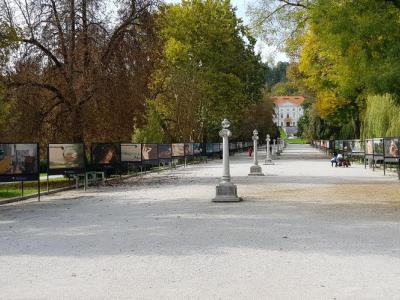
As you amble up the spacious Jakopič Promenade toward Tivoli Castle, you'll encounter the architectural finesse of Jože Plečnik, shaping an inviting space that often hosts sprawling photo exhibitions. Tivoli Castle itself, a 17th-century structure revamped in the 19th century with Neoclassical flair, commands attention. Guarding its entrance are four cast-iron dogs, standing proud beside a reconstructed Baroque fountain.
Elsewhere, the Cekin Mansion, nestled on the park's northern fringe, hosts the National Museum of Contemporary History. And don't miss out on Tivoli Pond, a serene spot perfect for contemplation. Nearby, a library springs to life outdoors during the summer and cozies up inside the greenhouse come winter. Speaking of the greenhouse, it's a delightful domain overseen by the Ljubljanica Botanical Gardens, housing an exotic array of tropical plants. Oh, and let's not forget the enchanting rose garden nearby.
Tivoli Park is peppered with sculptures, each with its own story to tell. Look out for the bronze sculpture of a boy with a whistle, and don't miss the extraordinary Coexistence sculpture, crafted by a Bosnian sculptor from a felled 300-year-old oak tree, adorned with bronze embellishments and draped in moss and lichen. And then there's the bronze statue paying homage to poet Edvard Kocbek, known for his existentialist philosophy and commitment to personalism.
As you amble up the spacious Jakopič Promenade toward Tivoli Castle, you'll encounter the architectural finesse of Jože Plečnik, shaping an inviting space that often hosts sprawling photo exhibitions. Tivoli Castle itself, a 17th-century structure revamped in the 19th century with Neoclassical flair, commands attention. Guarding its entrance are four cast-iron dogs, standing proud beside a reconstructed Baroque fountain.
Elsewhere, the Cekin Mansion, nestled on the park's northern fringe, hosts the National Museum of Contemporary History. And don't miss out on Tivoli Pond, a serene spot perfect for contemplation. Nearby, a library springs to life outdoors during the summer and cozies up inside the greenhouse come winter. Speaking of the greenhouse, it's a delightful domain overseen by the Ljubljanica Botanical Gardens, housing an exotic array of tropical plants. Oh, and let's not forget the enchanting rose garden nearby.
Tivoli Park is peppered with sculptures, each with its own story to tell. Look out for the bronze sculpture of a boy with a whistle, and don't miss the extraordinary Coexistence sculpture, crafted by a Bosnian sculptor from a felled 300-year-old oak tree, adorned with bronze embellishments and draped in moss and lichen. And then there's the bronze statue paying homage to poet Edvard Kocbek, known for his existentialist philosophy and commitment to personalism.
