Custom Walk in Bern, Switzerland by ntropper_34273e created on 2026-07-17
Guide Location: Switzerland » Bern
Guide Type: Custom Walk
# of Sights: 15
Tour Duration: 3 Hour(s)
Travel Distance: 4.2 Km or 2.6 Miles
Share Key: 33SHR
Guide Type: Custom Walk
# of Sights: 15
Tour Duration: 3 Hour(s)
Travel Distance: 4.2 Km or 2.6 Miles
Share Key: 33SHR
How It Works
Please retrieve this walk in the GPSmyCity app. Once done, the app will guide you from one tour stop to the next as if you had a personal tour guide. If you created the walk on this website or come to the page via a link, please follow the instructions below to retrieve the walk in the app.
Retrieve This Walk in App
Step 1. Download the app "GPSmyCity: Walks in 1K+ Cities" on Apple App Store or Google Play Store.



Step 2. In the GPSmyCity app, download(or launch) the guide "Bern Map and Walking Tours".
Step 3. Tap the menu button located at upper right corner of the "Walks" screen and select "Retrieve custom walk". Enter the share key: 33SHR
1) Bundesplatz (Federal Square) (must see)
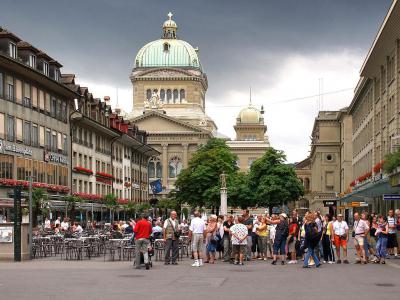
Federal Square is Bern’s principal civic plaza and the symbolic forecourt of the Federal Palace. Located in the heart of the medieval Old Town, which forms part of a UNESCO World Heritage Site, it is one of the best starting points for a walking tour of the Swiss capital. From the square, visitors have a clear view of the Federal Palace, while the Prison Tower, Dutch Tower, and Kleine Schanze Park are all within easy walking distance.
The area lies within the oldest part of Bern, first developed in the 12th century. Duke Berchtold V of Zähringen chose the site because it was naturally protected on three sides by the curve of the Aare River. The city began expanding westward in 1191 and continued to grow over the following three centuries.
Despite its historic location, the square served primarily as a parking area from 1945 until 2003. It was then completely redesigned and reopened in 2004 as a spacious pedestrian plaza paved with natural stone slabs. Its most recognizable feature is a group of twenty-six water jets rising directly from the ground, each representing one of Switzerland’s cantons. In warm weather, children often play among the fountains, while visitors gather nearby to rest and watch city life.
Federal Square remains an important setting for political demonstrations, public ceremonies, festivals, concerts, and election celebrations. Traditional markets are held here on Tuesday and Saturday mornings, with stalls selling vegetables, flowers, cheeses, baked goods, and regional products. Craft fairs and food events also regularly animate the plaza.
At dusk, a curved band of light guides the eye toward the Federal Palace, while the illuminated fountains add atmosphere to the square. At selected times of year, large-scale light displays are projected onto the palace façade several times each evening, with an additional performance on weekends.
Even outside these special events, Federal Square is worth visiting after dark. The illuminated Federal Palace, fountains, cafés, and constant flow of residents and visitors make it one of the best places to experience Bern’s public life.
The area lies within the oldest part of Bern, first developed in the 12th century. Duke Berchtold V of Zähringen chose the site because it was naturally protected on three sides by the curve of the Aare River. The city began expanding westward in 1191 and continued to grow over the following three centuries.
Despite its historic location, the square served primarily as a parking area from 1945 until 2003. It was then completely redesigned and reopened in 2004 as a spacious pedestrian plaza paved with natural stone slabs. Its most recognizable feature is a group of twenty-six water jets rising directly from the ground, each representing one of Switzerland’s cantons. In warm weather, children often play among the fountains, while visitors gather nearby to rest and watch city life.
Federal Square remains an important setting for political demonstrations, public ceremonies, festivals, concerts, and election celebrations. Traditional markets are held here on Tuesday and Saturday mornings, with stalls selling vegetables, flowers, cheeses, baked goods, and regional products. Craft fairs and food events also regularly animate the plaza.
At dusk, a curved band of light guides the eye toward the Federal Palace, while the illuminated fountains add atmosphere to the square. At selected times of year, large-scale light displays are projected onto the palace façade several times each evening, with an additional performance on weekends.
Even outside these special events, Federal Square is worth visiting after dark. The illuminated Federal Palace, fountains, cafés, and constant flow of residents and visitors make it one of the best places to experience Bern’s public life.
2) Bundeshaus (Federal Palace) (must see)
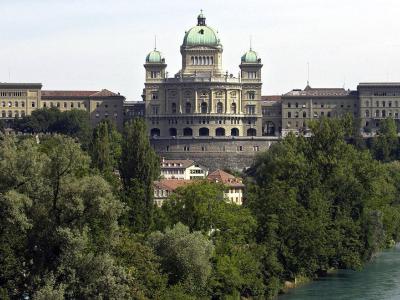
The Federal Palace is the political heart of Switzerland and one of Bern's most impressive landmarks. Standing above the Aare River at the western edge of the Old Town, it serves as the seat of both the Swiss Government and Parliament, housing the Federal Assembly, Switzerland's legislature, and the Federal Council, the country's executive. Stretching for more than 300 metres, the symmetrical complex consists of three interconnected buildings that symbolize Swiss democracy, unity, and cultural diversity.
Construction began after the creation of the modern Swiss federal state in 1848. The west wing, completed between 1852 and 1857, brought together the federal administration, government, and parliament under one roof. As the young federation expanded, the east wing got built from 1884 to 1892, before the completion of the magnificent central Parliament Building between 1894 and 1902. The restrained architecture of the two administrative wings contrasts with the richly decorated Neo-Renaissance central section, crowned by Bern's iconic copper-green dome.
Approaching from Federal Square, notice the grand portico and the façade built with stone from every region of Switzerland, emphasizing the country's federal character. Above the entrance, allegorical statues represent Political Independence, Executive Power, and Legislative Authority, while numerous cantonal coats of arms celebrate the Swiss Confederation. Inside, the entrance hall beneath the great dome features marble columns, mosaics, stained glass, sculptures, and symbolic artwork illustrating Swiss history and constitutional values. Make sure you look past the massive marble pillars to trace the 33-meter-high stained-glass dome.
Directly between the two grand staircases on the south wall of this same hall, you can find the "Three Confederates" group of statues, a white marble sculpture depicting the legendary Swiss founding fathers taking their historic oath.
Ultimately, the National Council Chamber, the Council of States Chamber and monumental staircase are also among the highlights of the guided tour. The former is the largest of these meeting halls and it is accessed by ascending the grand staircase to the first floor. Tall wooden doors on the south side bring you inside the chamber, where you can stand before the sprawling, 12-meter-wide fresco painting titled 'The Cradle of the Confederation' that spans the main wall above the speaker's desk.
The west wing houses the Federal Chancellery, the Parliamentary Library, and several federal departments, while additional government departments occupy the east wing.
Construction began after the creation of the modern Swiss federal state in 1848. The west wing, completed between 1852 and 1857, brought together the federal administration, government, and parliament under one roof. As the young federation expanded, the east wing got built from 1884 to 1892, before the completion of the magnificent central Parliament Building between 1894 and 1902. The restrained architecture of the two administrative wings contrasts with the richly decorated Neo-Renaissance central section, crowned by Bern's iconic copper-green dome.
Approaching from Federal Square, notice the grand portico and the façade built with stone from every region of Switzerland, emphasizing the country's federal character. Above the entrance, allegorical statues represent Political Independence, Executive Power, and Legislative Authority, while numerous cantonal coats of arms celebrate the Swiss Confederation. Inside, the entrance hall beneath the great dome features marble columns, mosaics, stained glass, sculptures, and symbolic artwork illustrating Swiss history and constitutional values. Make sure you look past the massive marble pillars to trace the 33-meter-high stained-glass dome.
Directly between the two grand staircases on the south wall of this same hall, you can find the "Three Confederates" group of statues, a white marble sculpture depicting the legendary Swiss founding fathers taking their historic oath.
Ultimately, the National Council Chamber, the Council of States Chamber and monumental staircase are also among the highlights of the guided tour. The former is the largest of these meeting halls and it is accessed by ascending the grand staircase to the first floor. Tall wooden doors on the south side bring you inside the chamber, where you can stand before the sprawling, 12-meter-wide fresco painting titled 'The Cradle of the Confederation' that spans the main wall above the speaker's desk.
The west wing houses the Federal Chancellery, the Parliamentary Library, and several federal departments, while additional government departments occupy the east wing.
3) Mosesbrunnen (Moses Fountain)
The Moses Fountain (Mosesbrunnen) is a historic fountain located on Münsterplatz in the Old City of Bern. Constructed in 1544 and rebuilt in 1790-1791 after storm damage, it is recognized as a Swiss Cultural Property of National Significance and forms part of the UNESCO World Heritage Site of the Old City of Bern. Its Louis XVI-style basin was designed by Niklaus Sprüngli.
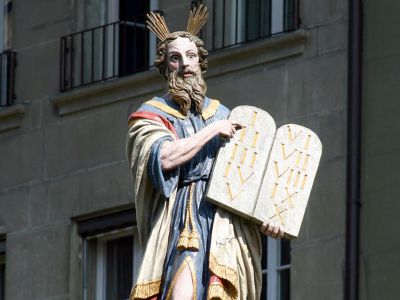
The central statue depicts Moses presenting the Ten Commandments to the Tribes of Israel. Unique to Western art traditions of the Middle Ages, Moses is depicted with two horns on his head. This feature references Exodus 34:29-35, which describes Moses' face becoming radiant after meeting with God. The horns are interpreted as a metaphorical representation of radiance, symbolizing Moses' strength, authority, and glorification of God. This imagery stems from a translation of the Hebrew term "qāran" by Jerome, who saw horns as a metaphor for divine strength.
Moses is shown pointing towards the second commandment, which prohibits the creation of graven images. He faces the nearby Bern Münster Cathedral, which saw many images destroyed during the Reformation. The Moses Fountain remains a notable testament to religious history and artistic tradition.
The central statue depicts Moses presenting the Ten Commandments to the Tribes of Israel. Unique to Western art traditions of the Middle Ages, Moses is depicted with two horns on his head. This feature references Exodus 34:29-35, which describes Moses' face becoming radiant after meeting with God. The horns are interpreted as a metaphorical representation of radiance, symbolizing Moses' strength, authority, and glorification of God. This imagery stems from a translation of the Hebrew term "qāran" by Jerome, who saw horns as a metaphor for divine strength.
Moses is shown pointing towards the second commandment, which prohibits the creation of graven images. He faces the nearby Bern Münster Cathedral, which saw many images destroyed during the Reformation. The Moses Fountain remains a notable testament to religious history and artistic tradition.
4) Berner Münster (The Cathedral of Bern) (must see)
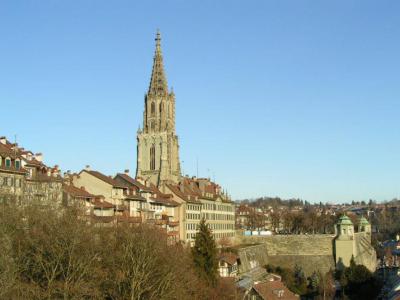
The Cathedral of Bern is the largest and most important church in the city and one of Switzerland’s finest examples of late Gothic architecture. Standing prominently in the Old Town, it was conceived as a powerful symbol of Bern’s growing wealth and political importance. Construction began in 1421 on the site of an earlier church, but the project continued for centuries. Its tower was not completed until 1893, when it reached a height of 100.6 metres, making it the tallest church tower in Switzerland.
The cathedral’s most remarkable exterior feature is its main portal, which presents the Last Judgement through 47 large statues and about 170 smaller figures. They are set into a recessed, central entryway arch on the cathedral's west portico. The composition shows the righteous being welcomed into heaven and the wicked being led toward punishment. Remarkably, much of this sculptural ensemble survived the destruction of religious images during the Protestant Reformation and is now regarded as one of Europe’s finest late medieval representations of the subject.
Inside, the tall three-aisled basilica layout—designed without a transept—features slender columns, ribbed vaulting, and large stained-glass windows create an airy and impressive Gothic interior. Visitors can also admire the side chapels, historic altars, finely carved choir stalls, and important stained glass dating from the 15th century. One particularly memorable window depicts a Dance of Death, emphasizing the medieval belief that death comes equally to people of every social rank. Finding this historical stained glass is done by walking down the right side of the nave and entering the quiet side chapels along the southern aisle.
Those able to manage the long stairway can climb the tower for panoramic views over Bern’s red-tiled roofs, the Aare River, and the Bernese Alps. The climb is especially rewarding in clear weather. Visitors should be aware that the tower contains Switzerland’s largest bell, weighing around ten tons. Climb the narrow, spiral stone staircase within the tower to the wooden belfry chamber, where you can have a meeting with the massive, ten-ton dark bronze bell cast in 1611. Standing nearby when it rings can be extremely loud, so hearing protection is advisable.
The cathedral terrace behind the building also offers peaceful gardens and elevated river views.
The cathedral’s most remarkable exterior feature is its main portal, which presents the Last Judgement through 47 large statues and about 170 smaller figures. They are set into a recessed, central entryway arch on the cathedral's west portico. The composition shows the righteous being welcomed into heaven and the wicked being led toward punishment. Remarkably, much of this sculptural ensemble survived the destruction of religious images during the Protestant Reformation and is now regarded as one of Europe’s finest late medieval representations of the subject.
Inside, the tall three-aisled basilica layout—designed without a transept—features slender columns, ribbed vaulting, and large stained-glass windows create an airy and impressive Gothic interior. Visitors can also admire the side chapels, historic altars, finely carved choir stalls, and important stained glass dating from the 15th century. One particularly memorable window depicts a Dance of Death, emphasizing the medieval belief that death comes equally to people of every social rank. Finding this historical stained glass is done by walking down the right side of the nave and entering the quiet side chapels along the southern aisle.
Those able to manage the long stairway can climb the tower for panoramic views over Bern’s red-tiled roofs, the Aare River, and the Bernese Alps. The climb is especially rewarding in clear weather. Visitors should be aware that the tower contains Switzerland’s largest bell, weighing around ten tons. Climb the narrow, spiral stone staircase within the tower to the wooden belfry chamber, where you can have a meeting with the massive, ten-ton dark bronze bell cast in 1611. Standing nearby when it rings can be extremely loud, so hearing protection is advisable.
The cathedral terrace behind the building also offers peaceful gardens and elevated river views.
5) Nydeggkirche (Nydegg Church)
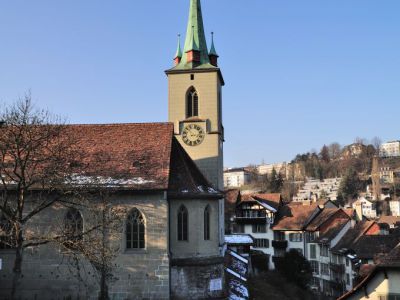
Nydegg Church stands at the eastern edge of Bern’s Old Town, on the former site of a 12th-century fortress that once guarded the river crossing below. After the castle was demolished, the first church was built between 1341 and 1346. It was later dedicated to the Mary Magdalene Brotherhood and gradually enlarged.
The church has a modest Gothic appearance, with pale sandstone walls, pointed windows, and a square bell tower with a sharp spire. Its quieter scale contrasts with the much larger Cathedral of Bern, giving the interior a more intimate atmosphere. Visitors can admire the restrained decoration, beautiful stained glass, and exceptional 20th-century bronze relief doors crafted by Marcel Perincioli, which depict vivid scenes from the life of Christ.
Nydegg Church experienced several periods of disruption. During the Protestant Reformation, it was temporarily used as a warehouse, while a later fire damaged the bell tower, roof, and clock mechanism. The building was successfully repaired and has remained in religious use for more than four centuries.
Today, it belongs to the Reformed Churches of Bern, Jura, and Solothurn. The parish is highly regarded today for its progressive community engagement, open-door cultural events, and message of modern inclusion.
For one of the best views, walk down toward the riverbank, where you can photograph Nydegg Church together with the nearby Nydegg Bridge. The church is also close to the Bear Park and makes a convenient stop while exploring the eastern end of the Old Town.
The church has a modest Gothic appearance, with pale sandstone walls, pointed windows, and a square bell tower with a sharp spire. Its quieter scale contrasts with the much larger Cathedral of Bern, giving the interior a more intimate atmosphere. Visitors can admire the restrained decoration, beautiful stained glass, and exceptional 20th-century bronze relief doors crafted by Marcel Perincioli, which depict vivid scenes from the life of Christ.
Nydegg Church experienced several periods of disruption. During the Protestant Reformation, it was temporarily used as a warehouse, while a later fire damaged the bell tower, roof, and clock mechanism. The building was successfully repaired and has remained in religious use for more than four centuries.
Today, it belongs to the Reformed Churches of Bern, Jura, and Solothurn. The parish is highly regarded today for its progressive community engagement, open-door cultural events, and message of modern inclusion.
For one of the best views, walk down toward the riverbank, where you can photograph Nydegg Church together with the nearby Nydegg Bridge. The church is also close to the Bear Park and makes a convenient stop while exploring the eastern end of the Old Town.
6) Untertorbrucke (Lower Gate Bridge)
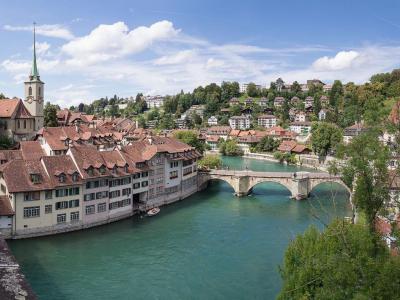
The Lower Gate Bridge is the oldest surviving bridge across the Aare River in Bern and an important reminder of the city’s medieval development. The first crossing was built in 1256, only a few decades after Bern’s foundation in 1191, and for centuries it remained the city’s only bridge to the eastern riverbank.
The original structure was made largely of oak and may have been partly covered. It included defensive features such as a fortified tower and a central guardhouse. The bridge even survived an attack during King Rudolph of Habsburg’s siege of the city in 1288.
After severe flood damage in 1460, the wooden bridge was gradually replaced with a stone structure. The reconstruction included new fortifications and a small chapel. Over time, crenelated walls, covered battlements, gates, and a drawbridge strengthened the crossing.
By the 18th century, these military features had become obstacles to growing traffic. Renovations in 1757 removed much of the medieval fortification and introduced decorative additions, including a Baroque triumphal arch. Further 19th-century changes replaced the sandstone parapets with iron railings and removed the eastern gate and drawbridge.
Today, the narrow stone bridge still carries pedestrians and local traffic. From it, visitors can admire the turquoise river, the steeply rising Old Town, and Nydegg Church above. It is particularly attractive in the morning or late afternoon and provides a scenic route between the Old Town, the Bear Park, and the riverside paths.
The original structure was made largely of oak and may have been partly covered. It included defensive features such as a fortified tower and a central guardhouse. The bridge even survived an attack during King Rudolph of Habsburg’s siege of the city in 1288.
After severe flood damage in 1460, the wooden bridge was gradually replaced with a stone structure. The reconstruction included new fortifications and a small chapel. Over time, crenelated walls, covered battlements, gates, and a drawbridge strengthened the crossing.
By the 18th century, these military features had become obstacles to growing traffic. Renovations in 1757 removed much of the medieval fortification and introduced decorative additions, including a Baroque triumphal arch. Further 19th-century changes replaced the sandstone parapets with iron railings and removed the eastern gate and drawbridge.
Today, the narrow stone bridge still carries pedestrians and local traffic. From it, visitors can admire the turquoise river, the steeply rising Old Town, and Nydegg Church above. It is particularly attractive in the morning or late afternoon and provides a scenic route between the Old Town, the Bear Park, and the riverside paths.
7) Rosengarten (Rose Garden) (must see)
The Rose Garden is one of Bern’s most beautiful public parks and one of the best viewpoints over the Old Town. It occupies a hillside east of the city center, above the Bear Park and the Aare River. Before becoming a place of recreation, the site served as a cemetery from 1765 to 1877. It was transformed into a public park in 1913 and later developed into the richly planted garden seen today.
The park contains more than 400 varieties of roses and irises, together with over 20 varieties of rhododendrons. Visitors can also admire a water-lily pond, Japanese cherry trees, and a group of 12 linden trees. The garden is especially colorful in summer, when the roses are in bloom, but every season has its own appeal. Spring brings cherry blossoms, autumn covers the park in warm foliage, and winter offers clear views across the city.
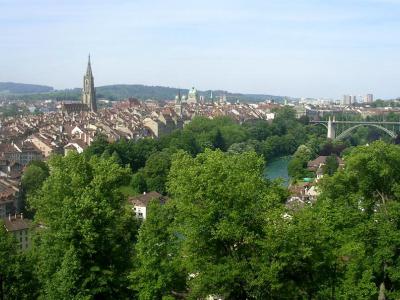
The main attraction is the panoramic terrace overlooking Bern. From here, visitors can identify the Cathedral of Bern, the Federal Palace, the Clock Tower, and the rows of red-tiled roofs enclosed by the curve of the Aare River. On clear days, the Bernese Alps rise in the distance, making the park especially popular with photographers.
The Rose Garden also offers broad lawns, shaded benches, walking paths, a playground, and a pavilion with a small reading library. Families can relax while children play in the sand, and visitors can enjoy a picnic while overlooking the river. Several sculptures decorate the grounds, including a popular seated tribute to Albert Einstein.
A restaurant with an outdoor terrace provides meals and refreshments with a view. The walk uphill from the Bear Park is fairly steep, but the panorama makes the climb worthwhile.
The park contains more than 400 varieties of roses and irises, together with over 20 varieties of rhododendrons. Visitors can also admire a water-lily pond, Japanese cherry trees, and a group of 12 linden trees. The garden is especially colorful in summer, when the roses are in bloom, but every season has its own appeal. Spring brings cherry blossoms, autumn covers the park in warm foliage, and winter offers clear views across the city.
The main attraction is the panoramic terrace overlooking Bern. From here, visitors can identify the Cathedral of Bern, the Federal Palace, the Clock Tower, and the rows of red-tiled roofs enclosed by the curve of the Aare River. On clear days, the Bernese Alps rise in the distance, making the park especially popular with photographers.
The Rose Garden also offers broad lawns, shaded benches, walking paths, a playground, and a pavilion with a small reading library. Families can relax while children play in the sand, and visitors can enjoy a picnic while overlooking the river. Several sculptures decorate the grounds, including a popular seated tribute to Albert Einstein.
A restaurant with an outdoor terrace provides meals and refreshments with a view. The walk uphill from the Bear Park is fairly steep, but the panorama makes the climb worthwhile.

8) Barengraben (and BarenPark)
The Bear Pit (Bärengraben), alongside its more recent addition, the BärenPark, is a significant tourist attraction in Bern. Situated at the eastern edge of the old city, near the Nydeggbrücke bridge and the River Aar, these facilities offer a unique glimpse into the symbol of Bern-the bear, which also adorns the city and canton's coat of arms.
The history of bears in Bern dates back to 1191 when Duke Berthold V of Zähringen supposedly named the city after the first animal encountered during a hunt-a bear. This legend underscores the bear's enduring significance to Bern. The tradition of keeping bears in the city was documented starting in 1513 when bears were brought back as spoils of war.
Originally housed in various locations throughout the city, the first official bear pit was established in what is now known as Bear Place (Bärenplatz) in 1857. In response to evolving views on animal welfare and legal changes, the Bear Pit was thoroughly renovated between 1994 and 1996. However, continuing concerns about the conditions led to the opening of the BärenPark in 2009. This newer, more expansive, and naturalistic habitat is located on the sloping banks of the River Aar, adjacent to the old pit.
Both the Bear Pit and BärenPark are managed as part of Bern's Dählhölzli Zoo. The Bear Pit itself is a Swiss heritage site of national significance, reflecting its historical and cultural importance. The facilities are interconnected by a tunnel that allows bears to move freely between the old pit and the new park. Additionally, the original smaller pit has been repurposed to support facility operations and public engagement.
In 2015, the installation of the Schräglift Bärenpark, an inclined lift, further enhanced accessibility, making it easier for visitors to explore the steeply sloped BärenPark. This development signifies Bern's ongoing commitment to improving both the welfare of its bear population and the visitor experience.
The history of bears in Bern dates back to 1191 when Duke Berthold V of Zähringen supposedly named the city after the first animal encountered during a hunt-a bear. This legend underscores the bear's enduring significance to Bern. The tradition of keeping bears in the city was documented starting in 1513 when bears were brought back as spoils of war.
Originally housed in various locations throughout the city, the first official bear pit was established in what is now known as Bear Place (Bärenplatz) in 1857. In response to evolving views on animal welfare and legal changes, the Bear Pit was thoroughly renovated between 1994 and 1996. However, continuing concerns about the conditions led to the opening of the BärenPark in 2009. This newer, more expansive, and naturalistic habitat is located on the sloping banks of the River Aar, adjacent to the old pit.
Both the Bear Pit and BärenPark are managed as part of Bern's Dählhölzli Zoo. The Bear Pit itself is a Swiss heritage site of national significance, reflecting its historical and cultural importance. The facilities are interconnected by a tunnel that allows bears to move freely between the old pit and the new park. Additionally, the original smaller pit has been repurposed to support facility operations and public engagement.
In 2015, the installation of the Schräglift Bärenpark, an inclined lift, further enhanced accessibility, making it easier for visitors to explore the steeply sloped BärenPark. This development signifies Bern's ongoing commitment to improving both the welfare of its bear population and the visitor experience.
9) Gerechtigkeitsbrunnen (Fountain of Justice) (must see)
In a city with over a hundred fountains, the Fountain of Justice in Bern's Old City is a standout attraction. It is the only fountain in Bern that has maintained all its original design features and is recognized as a national cultural heritage site.
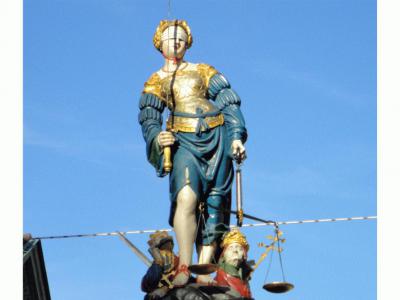
The renowned statue of Lady Justice elevates the Fountain of Justice above other Bernese fountains in artistic value. This iconic figure was replicated across Switzerland until the mid-17th century. At Justice's feet, four smaller busts encircle the base: a Pope, an Emperor, a Sultan, and a Bernese mayor. The latter’s gold chain of office is believed to have originally displayed Bern's emblem. Each figure's eyes are shut, symbolizing submission. They represent the Four Earthly Powers as outlined by Renaissance humanism: theocracy is represented by the Pope, monarchy by the Emperor, autocracy by the Sultan, and republic by the Mayor.
The statue illustrates how Justice reigns supreme over all earthly rulers-a variation of the medieval motif of virtue conquering vice. Divine Justice was a popular topic in Reformation-era Bern. Reformers believed that practicing justice according to God's word was the highest responsibility of any authority, outweighing feudal rights. They used this argument, among others, to rationalize Bern's takeover of Vaud in 1536 from the Savoy dukes.
While the sword and scales are typical symbols of Lady Justice, the Bern statue's blindfold is a unique addition. This feature later became a widely recognized representation of Justice and a universal sign of equality before the law. The blindfold implies that justice should be served impartially, with decisions made through thoughtful reflection rather than external appearances. Lady Justice embodies the principle of republican justice and served as a compelling public reminder of the Bernese Republic's legal authority.
The renowned statue of Lady Justice elevates the Fountain of Justice above other Bernese fountains in artistic value. This iconic figure was replicated across Switzerland until the mid-17th century. At Justice's feet, four smaller busts encircle the base: a Pope, an Emperor, a Sultan, and a Bernese mayor. The latter’s gold chain of office is believed to have originally displayed Bern's emblem. Each figure's eyes are shut, symbolizing submission. They represent the Four Earthly Powers as outlined by Renaissance humanism: theocracy is represented by the Pope, monarchy by the Emperor, autocracy by the Sultan, and republic by the Mayor.
The statue illustrates how Justice reigns supreme over all earthly rulers-a variation of the medieval motif of virtue conquering vice. Divine Justice was a popular topic in Reformation-era Bern. Reformers believed that practicing justice according to God's word was the highest responsibility of any authority, outweighing feudal rights. They used this argument, among others, to rationalize Bern's takeover of Vaud in 1536 from the Savoy dukes.
While the sword and scales are typical symbols of Lady Justice, the Bern statue's blindfold is a unique addition. This feature later became a widely recognized representation of Justice and a universal sign of equality before the law. The blindfold implies that justice should be served impartially, with decisions made through thoughtful reflection rather than external appearances. Lady Justice embodies the principle of republican justice and served as a compelling public reminder of the Bernese Republic's legal authority.
10) Einsteinhaus (Einstein House) (must see)
Einstein House is both a historic residence and a small museum dedicated to the life and work of Albert Einstein, one of the most influential physicists of the 20th century. It occupies a historic building in Bern’s Old Town, where Einstein lived with his wife, Mileva Marić, and their son, Hans Albert, from 1903 to 1905. During this period, he worked as a technical expert at the Federal Institute of Intellectual Property, commonly known as the Swiss Patent Office.
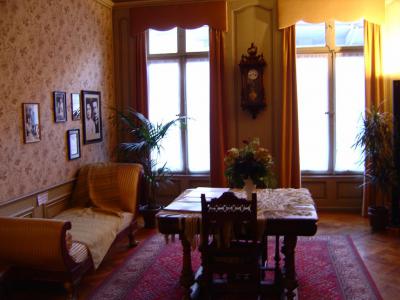
The apartment on the second floor has been carefully preserved to recreate the atmosphere of an early 20th-century home. Visitors can see period furnishings, photographs, documents, and personal memorabilia that provide insight into Einstein’s domestic life.
The year 1905 became known as Einstein’s miracle year. During it, he published four groundbreaking papers in the Annals of Physics. These works addressed special relativity, the photoelectric effect, Brownian motion, and the relationship between mass and energy, expressed in the equation E = mc². Together, they helped lay the foundations of modern physics and transformed scientific understanding of matter, light, space, and time.
The third floor contains an exhibition tracing Einstein’s biography, his years in Bern from 1902 to 1909, and the wider influence of his discoveries. A 20-minute film provides a useful introduction before visitors continue through the more detailed written displays. A separate permanent exhibition about Einstein can also be found in the Historical Museum of Bern.
Einstein House is modest in size, inexpensive, and usually less crowded than Bern’s larger attractions. A café on the ground floor offers a convenient place to pause during a walk through the Old Town.
The apartment on the second floor has been carefully preserved to recreate the atmosphere of an early 20th-century home. Visitors can see period furnishings, photographs, documents, and personal memorabilia that provide insight into Einstein’s domestic life.
The year 1905 became known as Einstein’s miracle year. During it, he published four groundbreaking papers in the Annals of Physics. These works addressed special relativity, the photoelectric effect, Brownian motion, and the relationship between mass and energy, expressed in the equation E = mc². Together, they helped lay the foundations of modern physics and transformed scientific understanding of matter, light, space, and time.
The third floor contains an exhibition tracing Einstein’s biography, his years in Bern from 1902 to 1909, and the wider influence of his discoveries. A 20-minute film provides a useful introduction before visitors continue through the more detailed written displays. A separate permanent exhibition about Einstein can also be found in the Historical Museum of Bern.
Einstein House is modest in size, inexpensive, and usually less crowded than Bern’s larger attractions. A café on the ground floor offers a convenient place to pause during a walk through the Old Town.
11) Zahringerbrunnen (Zahringen Fountain)
The Zähringen Fountain is an important cultural monument on Market Street in Bern’s Old Town, a UNESCO World Heritage Site. Erected in 1535, it commemorates Berchtold of Zähringen, the founder of Bern. According to local legend, he chose the site for the city after killing a bear while hunting on the Aare peninsula.
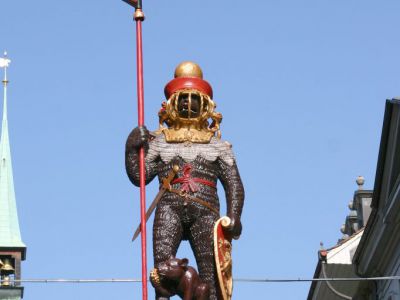
The fountain is crowned by a statue of a bear, Bern’s heraldic symbol, dressed in full armor. The bear carries a shield and a banner bearing the golden lion on a red background, the emblem of the Zähringen family. At its feet stands a smaller bear cub, which appears to be eating grapes and adds a playful detail to the monument.
The fountain’s original octagonal basin, dating from 1542, carried several inscriptions. These included “Protect us, Lord” and “Glory to God alone.” In 1889, the basin was replaced with a new one modeled on that of the Piper Fountain. At the same time, the statue and supporting column were restored.
The fountain is crowned by a statue of a bear, Bern’s heraldic symbol, dressed in full armor. The bear carries a shield and a banner bearing the golden lion on a red background, the emblem of the Zähringen family. At its feet stands a smaller bear cub, which appears to be eating grapes and adds a playful detail to the monument.
The fountain’s original octagonal basin, dating from 1542, carried several inscriptions. These included “Protect us, Lord” and “Glory to God alone.” In 1889, the basin was replaced with a new one modeled on that of the Piper Fountain. At the same time, the statue and supporting column were restored.
12) Zytglogge (Clock Tower) (must see)
The Clock Tower is Bern’s most famous medieval landmark and one of the city’s most important historical monuments. Built around 1218–1220, it originally served as a guard tower and western gateway in Bern’s early defensive walls. As the city expanded, the tower lost its military role and was later used as a prison, civic clock tower, archive, storeroom, and even an air-raid shelter.
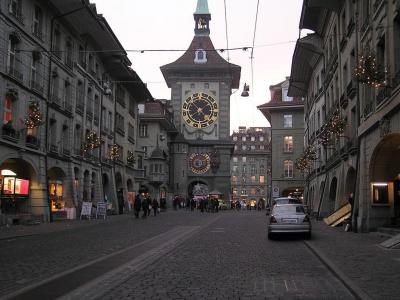
The tower rises 54.5 metres and can be identified by its sandstone and limestone exterior, decorative corner blocks, late Gothic cornice, and steep red-tiled spire. The upper section was largely shaped during an 18th-century renovation. Ornamental urns, spire lights, a gilded knob, and a weather vane displaying Bern’s coat of arms crown the structure.
Its greatest attraction is the astronomical clock. The external astronomical display face and puppet show date back to the 15th century, while the heavy internal mechanical gear movement was completely replaced in 1530. Stand east of the tower and examine the lower-middle section of the stone facade to find the Astro-Dial, which uses a rotating disc and gilded pointers to track the zodiac signs, solar position, and moon phases.
If the figures' performance interests you, glance just to the left of this dial to find the small stone niche-stage, where you can watch the automated figurines move in sequence. A golden rooster crows, a jester rings bells, bears parade across the façade, and Chronos, the figure of Time, turns an hourglass before the hour is struck. The display is especially impressive at noon, when more strikes and movements can be observed.
Guided tours reveal the tower’s interior, including the massive gears, weights, and historic rooms once used for administrative purposes. Since 1979, these upper spaces have been cleared and opened mainly for tours. Visitors who climb the approximately 130 steps are rewarded with panoramic views over Bern’s tiled rooftops, narrow streets, and, on clear days, the Bernese Alps.
The tower rises 54.5 metres and can be identified by its sandstone and limestone exterior, decorative corner blocks, late Gothic cornice, and steep red-tiled spire. The upper section was largely shaped during an 18th-century renovation. Ornamental urns, spire lights, a gilded knob, and a weather vane displaying Bern’s coat of arms crown the structure.
Its greatest attraction is the astronomical clock. The external astronomical display face and puppet show date back to the 15th century, while the heavy internal mechanical gear movement was completely replaced in 1530. Stand east of the tower and examine the lower-middle section of the stone facade to find the Astro-Dial, which uses a rotating disc and gilded pointers to track the zodiac signs, solar position, and moon phases.
If the figures' performance interests you, glance just to the left of this dial to find the small stone niche-stage, where you can watch the automated figurines move in sequence. A golden rooster crows, a jester rings bells, bears parade across the façade, and Chronos, the figure of Time, turns an hourglass before the hour is struck. The display is especially impressive at noon, when more strikes and movements can be observed.
Guided tours reveal the tower’s interior, including the massive gears, weights, and historic rooms once used for administrative purposes. Since 1979, these upper spaces have been cleared and opened mainly for tours. Visitors who climb the approximately 130 steps are rewarded with panoramic views over Bern’s tiled rooftops, narrow streets, and, on clear days, the Bernese Alps.
13) Kindlifresserbrunnen (Child Eater Fountain)
The Child Eater Fountain is one of Bern’s most unusual and mysterious Renaissance landmarks. Standing in Granary Square, it was created between 1545 and 1546 to replace an earlier wooden fountain dating from the 15th century. It was originally known as the Plaza Fountain, while the name Child Eater Fountain was first recorded in 1666.
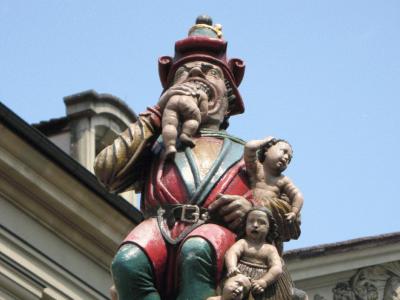
The sculpture depicts a seated ogre biting into a naked child, with a sack containing other children beside him. Pay attention to the left side of the giant's torso to find a sculpted leather pouch overflowing with the helpless children awaiting their fate.
Its exact meaning has never been conclusively established, giving rise to several interpretations.The ogre’s pointed hat has led some scholars to connect the figure with medieval antisemitic imagery and blood-libel traditions. Other theories identify it as Krampus, the frightening creature of Alpine folklore who punishes disobedient children, or as the Greek Titan Cronus, who devoured his own offspring. The figure may also have originated as a carnival character intended to frighten unruly children during the traditional pre-Lenten festivities.
Stepping away from the sinister symbolism, another artistic highlight is the decorative ring beneath the pedestal. It features a painted relief of bears in military armor parading around the column.
Whatever its original purpose, the fountain has fascinated and unsettled generations of visitors for almost five centuries. It also appears prominently in Jacques Chessex’s novel The Ogre.
The sculpture depicts a seated ogre biting into a naked child, with a sack containing other children beside him. Pay attention to the left side of the giant's torso to find a sculpted leather pouch overflowing with the helpless children awaiting their fate.
Its exact meaning has never been conclusively established, giving rise to several interpretations.The ogre’s pointed hat has led some scholars to connect the figure with medieval antisemitic imagery and blood-libel traditions. Other theories identify it as Krampus, the frightening creature of Alpine folklore who punishes disobedient children, or as the Greek Titan Cronus, who devoured his own offspring. The figure may also have originated as a carnival character intended to frighten unruly children during the traditional pre-Lenten festivities.
Stepping away from the sinister symbolism, another artistic highlight is the decorative ring beneath the pedestal. It features a painted relief of bears in military armor parading around the column.
Whatever its original purpose, the fountain has fascinated and unsettled generations of visitors for almost five centuries. It also appears prominently in Jacques Chessex’s novel The Ogre.
14) Marktgasse (Market Street)
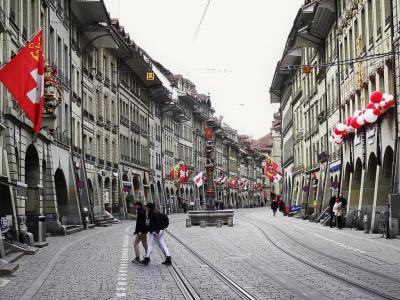
Market Street is one of the oldest and liveliest streets in Bern, running through the heart of the medieval Old Town between the Prison Tower in the west and the Clock Tower in the east. Part of the UNESCO World Heritage Site, it has been the city's principal commercial thoroughfare since the 13th century. First recorded in 1286, the street was originally known as Inner New Town before gradually adopting the name Market Street, which became widely accepted in the early 20th century.
Walking along the broad, cobbled street, visitors will immediately notice the continuous arcades that shelter shops, cafés, restaurants, bakeries, and boutiques. These covered walkways, extending throughout much of the Old Town, are among the longest shopping arcades in Europe and allow pedestrians to explore comfortably in almost any weather. The elegant sandstone buildings, decorated bay windows, and steep tiled roofs preserve much of Bern's medieval character.
Market Street is also renowned for its Renaissance fountains, which once supplied drinking water and served as important gathering places. Among the most notable are the Marksman Fountain, depicting an armed rifleman carrying a banner and sword in honor of the city's marksmen's guild, and the Anna Seiler Fountain, commemorating the founder of Bern's first hospital.
The eastern end of the street is dominated by the famous Clock Tower, whose astronomical clock has become one of Bern's best-known landmarks.
Walking along the broad, cobbled street, visitors will immediately notice the continuous arcades that shelter shops, cafés, restaurants, bakeries, and boutiques. These covered walkways, extending throughout much of the Old Town, are among the longest shopping arcades in Europe and allow pedestrians to explore comfortably in almost any weather. The elegant sandstone buildings, decorated bay windows, and steep tiled roofs preserve much of Bern's medieval character.
Market Street is also renowned for its Renaissance fountains, which once supplied drinking water and served as important gathering places. Among the most notable are the Marksman Fountain, depicting an armed rifleman carrying a banner and sword in honor of the city's marksmen's guild, and the Anna Seiler Fountain, commemorating the founder of Bern's first hospital.
The eastern end of the street is dominated by the famous Clock Tower, whose astronomical clock has become one of Bern's best-known landmarks.
15) Käfigturm (Prison Tower) (must see)
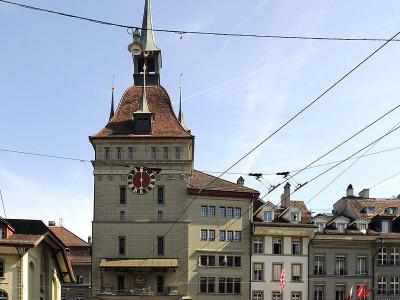
The Prison Tower is one of Bern’s most recognizable historic landmarks and a reminder of the city’s former defensive walls. Standing in the middle of Market Street, only a short walk from Federal Square, it once served both as a city gate and as a prison. The first tower was built in 1256 as part of Bern’s second line of fortifications, created after the city expanded westward. By the 17th century, however, the original structure had fallen into poor condition and was demolished.
The present tower was constructed in 1640. Designed to hold approximately 60 to 70 prisoners, it remained in use as a jail until the late 19th century. Common criminals, debtors, and other detainees were once confined in its cells, giving the building its English name.
After the prison closed, the tower took on several different functions. At various times, it was used to store state archives and court records, and it later housed a wine shop, a library, and an exhibition center. Today, it is associated with public exhibitions and events, particularly those dealing with politics, democracy, and civic life.
Approaching along Market Street, visitors can easily identify the tower by its massive arched gateway, tall sandstone walls, decorative upper section, and prominent clock. The bell above the arch dates from 1643 and was cast in eastern France. Its inscription asks that its voice terrify evil spirits. Originally struck by hand, it later received a mechanical striking system during the 19th century and still rings when the clock mechanism is properly wound.
Visitors can walk or ride a streetcar directly through the gateway, just as travelers once passed through the medieval city entrance. Although many tours focus mainly on the exterior, the building can sometimes be entered for exhibitions.
The present tower was constructed in 1640. Designed to hold approximately 60 to 70 prisoners, it remained in use as a jail until the late 19th century. Common criminals, debtors, and other detainees were once confined in its cells, giving the building its English name.
After the prison closed, the tower took on several different functions. At various times, it was used to store state archives and court records, and it later housed a wine shop, a library, and an exhibition center. Today, it is associated with public exhibitions and events, particularly those dealing with politics, democracy, and civic life.
Approaching along Market Street, visitors can easily identify the tower by its massive arched gateway, tall sandstone walls, decorative upper section, and prominent clock. The bell above the arch dates from 1643 and was cast in eastern France. Its inscription asks that its voice terrify evil spirits. Originally struck by hand, it later received a mechanical striking system during the 19th century and still rings when the clock mechanism is properly wound.
Visitors can walk or ride a streetcar directly through the gateway, just as travelers once passed through the medieval city entrance. Although many tours focus mainly on the exterior, the building can sometimes be entered for exhibitions.
