Custom Walk in Vancouver, Canada by markafox_eca292 created on 2026-07-18
Guide Location: Canada » Vancouver
Guide Type: Custom Walk
# of Sights: 12
Tour Duration: 5 Hour(s)
Travel Distance: 11.6 Km or 7.2 Miles
Share Key: ARLEZ
Guide Type: Custom Walk
# of Sights: 12
Tour Duration: 5 Hour(s)
Travel Distance: 11.6 Km or 7.2 Miles
Share Key: ARLEZ
How It Works
Please retrieve this walk in the GPSmyCity app. Once done, the app will guide you from one tour stop to the next as if you had a personal tour guide. If you created the walk on this website or come to the page via a link, please follow the instructions below to retrieve the walk in the app.
Retrieve This Walk in App
Step 1. Download the app "GPSmyCity: Walks in 1K+ Cities" on Apple App Store or Google Play Store.



Step 2. In the GPSmyCity app, download(or launch) the guide "Vancouver Map and Walking Tours".
Step 3. Tap the menu button located at upper right corner of the "Walks" screen and select "Retrieve custom walk". Enter the share key: ARLEZ
1) Canada Place (must see)
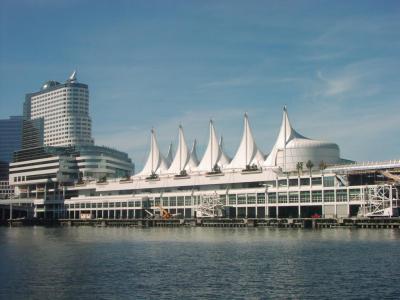
Situated along the Burrard Inlet waterfront, the Canada Place edifice boasts a collection of notable establishments, including the Vancouver Convention & Exhibition Centre, the Pan Pacific Hotel, the Vancouver World Trade Centre, and in the past, the world's pioneer permanent IMAX 3D theater (ceased operations in 2009). Furthermore, it serves as the primary cruise ship terminal, catering to the majority of sea voyages to Alaska. Undoubtedly, this locale stands as the central hub for cruises to and from Vancouver, offering a delightful promenade for enjoying the shoreline.
Conceived by architect Eberhard Zeidler, the structure reached completion in 1985, designed as the Canada pavilion in anticipation of Expo 86. Notably distinct, it stood as the sole venue beyond the fair's principal site on the northern shore of False Creek.
Another significant draw tied to Canada Place is the FlyOver Canada theater, inaugurated in 2013. Here, visitors embark on a virtual flight traversing the nation; a single journey accommodates up to 61 individuals, transporting them to a 19-meter (62-foot) diameter spherical screen that employs simulated wind, mist, and various scents to heighten the experience.
Within the Convention Centre, exhibits from the 2010 Vancouver Olympics are on display, while the Olympic Cauldron against the backdrop of Stanley Park and the mountains offers a picturesque setting for capturing Christmas card-worthy photos.
Navigational signage is well-placed, and a plethora of staff members are typically accessible to facilitate your journey to the appropriate destination.
Tip:
For the 'Fly Over Canada' movie, it's a good idea to pay for your timed tickets in advance over the Internet to avoid lines.
Conceived by architect Eberhard Zeidler, the structure reached completion in 1985, designed as the Canada pavilion in anticipation of Expo 86. Notably distinct, it stood as the sole venue beyond the fair's principal site on the northern shore of False Creek.
Another significant draw tied to Canada Place is the FlyOver Canada theater, inaugurated in 2013. Here, visitors embark on a virtual flight traversing the nation; a single journey accommodates up to 61 individuals, transporting them to a 19-meter (62-foot) diameter spherical screen that employs simulated wind, mist, and various scents to heighten the experience.
Within the Convention Centre, exhibits from the 2010 Vancouver Olympics are on display, while the Olympic Cauldron against the backdrop of Stanley Park and the mountains offers a picturesque setting for capturing Christmas card-worthy photos.
Navigational signage is well-placed, and a plethora of staff members are typically accessible to facilitate your journey to the appropriate destination.
Tip:
For the 'Fly Over Canada' movie, it's a good idea to pay for your timed tickets in advance over the Internet to avoid lines.
2) Gastown (must see)
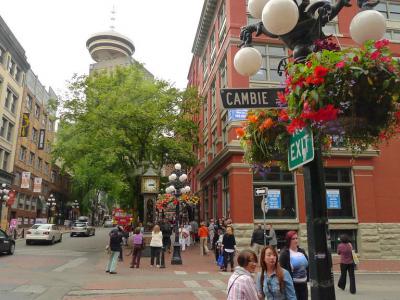
Gastown stands as the historical enclave of Vancouver, tracing its roots to the namesake of a steamboat captain, "Gassy" Jack Deighton. In the year 1867, this captain inaugurated Vancouver's inaugural saloon. As time flowed, this vicinity burgeoned into a thriving hub of commerce. In the 1960s, an imminent threat emerged as plans to construct a freeway through Gastown materialized. Yet, Vancouver's populace united fervently to safeguard its architectural legacy and distinctive essence. Consequently, the enduring charm of Gastown persists in its cobbled pathways and meticulously preserved Victorian structures.
A centerpiece of Gastown's allure is the Steam Clock. While not the oldest spectacle in the area, the Steam Clock remains a defining emblem of Gastown. Its creation atop a steam vent was a masterstroke, ingeniously harnessing steam's energy and deterring cold weather vagrancy. Nestled within the clock, a diminutive steam engine propels the pendulum mechanics, bestowing the clock with perpetual motion and obviating the need for winding.
Beyond its historical landmarks, Gastown pulsates with contemporary vivacity. It houses a medley of sophisticated boutiques, vibrant clubs, inviting bars, evocative art galleries, harmonious music studios, and attractions for visitors. A case in point is Fabric, previously known as The Town Pump, a pivot in Vancouver's music scene since the 1960s. Notwithstanding Gastown's venerable age in the annals of Vancouver, it remains an influential force in shaping the visage of the city's culture.
Why You Should Visit:
Lovely characterful traditional Canadian / North American area which is indeed a delight to stroll through – just follow the crowd, as there's real life & history all around.
Tip:
Most of the shops are closed by 9pm, and that's considered being open "late".
A centerpiece of Gastown's allure is the Steam Clock. While not the oldest spectacle in the area, the Steam Clock remains a defining emblem of Gastown. Its creation atop a steam vent was a masterstroke, ingeniously harnessing steam's energy and deterring cold weather vagrancy. Nestled within the clock, a diminutive steam engine propels the pendulum mechanics, bestowing the clock with perpetual motion and obviating the need for winding.
Beyond its historical landmarks, Gastown pulsates with contemporary vivacity. It houses a medley of sophisticated boutiques, vibrant clubs, inviting bars, evocative art galleries, harmonious music studios, and attractions for visitors. A case in point is Fabric, previously known as The Town Pump, a pivot in Vancouver's music scene since the 1960s. Notwithstanding Gastown's venerable age in the annals of Vancouver, it remains an influential force in shaping the visage of the city's culture.
Why You Should Visit:
Lovely characterful traditional Canadian / North American area which is indeed a delight to stroll through – just follow the crowd, as there's real life & history all around.
Tip:
Most of the shops are closed by 9pm, and that's considered being open "late".
3) Gastown Steam Clock
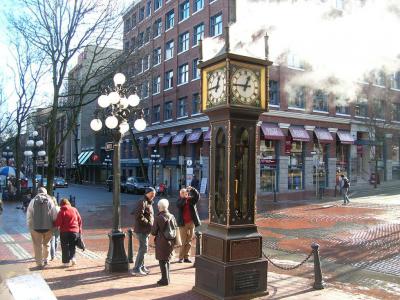
Among Gastown's many attractions, none holds as much renown as the Gastown Steam Clock. Although this clock isn't the oldest fixture in the neighborhood (and similar steam clocks can be found elsewhere), it stands as one of the rare functioning steam-powered clocks remaining worldwide.
Originally constructed above a steam grate, this engineering endeavor served several purposes. It concealed the unappealing grate from view, harnessed the otherwise wasted steam power from the local heating system, and deterred transient individuals from using it for warmth during chilly spells.
As steam ascends from the grate, it propels a petite engine that initiates the motion of a lifting chain. This chain, in turn, guides steel balls upwards until they transition onto a descending chain, their weight propelling the clock's pendulum and enabling timekeeping without the need for manual winding. The steam, crucial for the clock's time-marking whistles, also fuels the chiming mechanism.
Following a period of operation, the original clockwork mechanism faltered, necessitating the introduction of electricity to maintain functionality. At a certain juncture, local businesses' contributions facilitated the restoration of the steam mechanism, which endures and operates to this day.
When the clock chimes – at quarter intervals, each full hour, and notably at midday – it delivers a captivating spectacle. To capture this event, consider setting your camera to video mode. Exercise patience, as the experience promises rewarding results!
Originally constructed above a steam grate, this engineering endeavor served several purposes. It concealed the unappealing grate from view, harnessed the otherwise wasted steam power from the local heating system, and deterred transient individuals from using it for warmth during chilly spells.
As steam ascends from the grate, it propels a petite engine that initiates the motion of a lifting chain. This chain, in turn, guides steel balls upwards until they transition onto a descending chain, their weight propelling the clock's pendulum and enabling timekeeping without the need for manual winding. The steam, crucial for the clock's time-marking whistles, also fuels the chiming mechanism.
Following a period of operation, the original clockwork mechanism faltered, necessitating the introduction of electricity to maintain functionality. At a certain juncture, local businesses' contributions facilitated the restoration of the steam mechanism, which endures and operates to this day.
When the clock chimes – at quarter intervals, each full hour, and notably at midday – it delivers a captivating spectacle. To capture this event, consider setting your camera to video mode. Exercise patience, as the experience promises rewarding results!
4) Gaoler's Mews
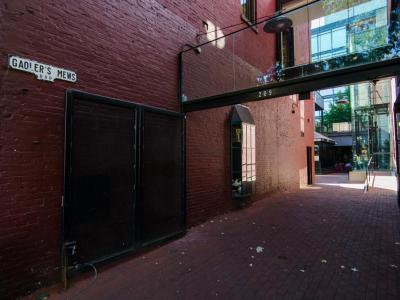
Gastown's Gaoler's Mews is where Vancouver's first jail used to be. Over the years, this spot has seen the great Vancouver fire of 1886, a pub, and over 40 public executions by hanging. Though it has the same old-time appeal as the rest of Gastown, Gaoler's Mews is probably more famous for its unseen inhabitants.
Stories abound of the hauntings that supposedly take place in Gaoler's Mews. One of the contractors, working on the Irish Heather pub, discovered that his tools would regularly be moved, and one of the owners heard a woman calling her name when nobody else was there. Visitors have also seen a mysterious woman dressed in black, moving along the area near where Vancouver's scaffold used to be. Another spirit, a man in black, was seen multiple times by the Irish Heathers' staff, as well as the staff of the coffee house next door. When the building was renovated, the figure could be seen moving through a wall where a door used to be.
Though neither the Irish Heather nor Blake's Coffee Parlour are still in Gaoler's Mews, this building is still a popular destination for tourists. People from all over come with infra-red cameras, Geiger counters and other paraphernalia to, hopefully, record some evidence of the area's famous hauntings.
Stories abound of the hauntings that supposedly take place in Gaoler's Mews. One of the contractors, working on the Irish Heather pub, discovered that his tools would regularly be moved, and one of the owners heard a woman calling her name when nobody else was there. Visitors have also seen a mysterious woman dressed in black, moving along the area near where Vancouver's scaffold used to be. Another spirit, a man in black, was seen multiple times by the Irish Heathers' staff, as well as the staff of the coffee house next door. When the building was renovated, the figure could be seen moving through a wall where a door used to be.
Though neither the Irish Heather nor Blake's Coffee Parlour are still in Gaoler's Mews, this building is still a popular destination for tourists. People from all over come with infra-red cameras, Geiger counters and other paraphernalia to, hopefully, record some evidence of the area's famous hauntings.
5) Maple Tree Square
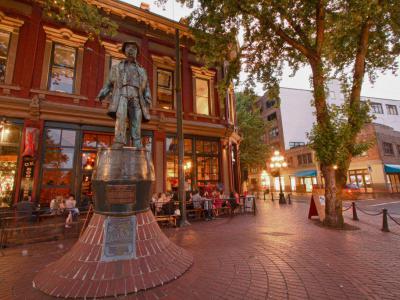
Maple Tree Square, the meeting point of Water, Powell, Alexander, and Carrall streets, is best approached as the historic heart of Gastown. Stand near the center of this intersection and slowly turn around: the converging streets, brick façades, old commercial buildings, cafés, and shopfronts help explain why this is one of Vancouver’s most photographed corners.
Look toward Water Street, the main historic axis of Gastown. This was once part of the small settlement of Granville, long before modern Vancouver emerged. Nearby stood the Globe Saloon, opened in 1867 by one John Deighton, better known as “Gassy Jack” because of his talkative nature and love of storytelling. The former saloon itself no longer survives, but this area marks the beginning of Gastown’s identity.
As you face the square, look for the open space where the Gassy Jack statue once stood. The statue was toppled in 2022, and its removal has become part of the site’s more complicated modern story. For tourists, this makes Maple Tree Square not only a picturesque historic corner, but also a place where Vancouver’s colonial past is being reconsidered.
Now turn your attention to the surrounding heritage buildings, especially the older brick blocks along Water Street. Their narrow façades, decorative cornices, and ground-floor shops give the square its late-19th-century atmosphere. These buildings recall the commercial district that grew around saloons, sawmills, shipping, and trade.
From here, continue along Water Street to experience the wider Gastown area. The cobblestone-style paving, vintage-style streetlamps, souvenir shops, galleries, restaurants, and nearby steam clock all help create the district’s old-world character. Maple Tree Square is therefore both a starting point and a symbol: a small intersection where Vancouver’s frontier settlement, drinking culture, Indigenous history, urban growth, and modern tourism all meet.
Look toward Water Street, the main historic axis of Gastown. This was once part of the small settlement of Granville, long before modern Vancouver emerged. Nearby stood the Globe Saloon, opened in 1867 by one John Deighton, better known as “Gassy Jack” because of his talkative nature and love of storytelling. The former saloon itself no longer survives, but this area marks the beginning of Gastown’s identity.
As you face the square, look for the open space where the Gassy Jack statue once stood. The statue was toppled in 2022, and its removal has become part of the site’s more complicated modern story. For tourists, this makes Maple Tree Square not only a picturesque historic corner, but also a place where Vancouver’s colonial past is being reconsidered.
Now turn your attention to the surrounding heritage buildings, especially the older brick blocks along Water Street. Their narrow façades, decorative cornices, and ground-floor shops give the square its late-19th-century atmosphere. These buildings recall the commercial district that grew around saloons, sawmills, shipping, and trade.
From here, continue along Water Street to experience the wider Gastown area. The cobblestone-style paving, vintage-style streetlamps, souvenir shops, galleries, restaurants, and nearby steam clock all help create the district’s old-world character. Maple Tree Square is therefore both a starting point and a symbol: a small intersection where Vancouver’s frontier settlement, drinking culture, Indigenous history, urban growth, and modern tourism all meet.
6) Dr. Sun Yat-Sen Garden
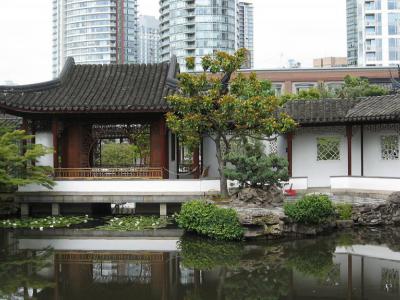
The Dr. Sun Yat-Sen Garden in Vancouver stands as the inaugural Chinese or "scholars" garden constructed beyond China's borders. Its inception took place from 1985 to 1986, timed to coincide with Expo 86. Funding for the project materialized through a collaboration between the Chinese and Canadian governments, along with contributions from Vancouver's Chinese community, as well as various public and private benefactors.
The garden got its name as a tribute to Dr. Sun Yat-Sen, acclaimed as the pioneering president of the Republic of China and revered as the "father" of the contemporary Chinese nation. In his pursuit of advancing the Chinese nationalist movement during the early 20th century, Sun Yat-Sen found himself in Vancouver on three separate occasions for extended stays.
This venue seamlessly incorporates a public park and a traditional Chinese garden, distinct yet interconnected by way of an artificial pond. The exterior park design was masterminded by local architects, while the inner garden's conception was guided by experts hailing from Suzhou, China.
The classical garden embodies Taoist and Feng Shui ideals for balance through opposites. The public park combines Western and Chinese styles, using local North American materials. Park entry is free, while the garden charges for admission, providing guided tours for an enriched visit.
Due to the similar winter climates of Vancouver and Suzhou, many plants in the garden look much like those in Suzhou. Carefully chosen to highlight seasonal changes, especially the spring rejuvenation, these plants are deliberately arranged with restraint. Unlike exuberant Western gardens, this design adds color to the landscape throughout the year.
Visitor's Tip:
If you're unsure about the fee, you can always try the free public park first, as it also has a little pond, bridges, and beautiful views.
The garden got its name as a tribute to Dr. Sun Yat-Sen, acclaimed as the pioneering president of the Republic of China and revered as the "father" of the contemporary Chinese nation. In his pursuit of advancing the Chinese nationalist movement during the early 20th century, Sun Yat-Sen found himself in Vancouver on three separate occasions for extended stays.
This venue seamlessly incorporates a public park and a traditional Chinese garden, distinct yet interconnected by way of an artificial pond. The exterior park design was masterminded by local architects, while the inner garden's conception was guided by experts hailing from Suzhou, China.
The classical garden embodies Taoist and Feng Shui ideals for balance through opposites. The public park combines Western and Chinese styles, using local North American materials. Park entry is free, while the garden charges for admission, providing guided tours for an enriched visit.
Due to the similar winter climates of Vancouver and Suzhou, many plants in the garden look much like those in Suzhou. Carefully chosen to highlight seasonal changes, especially the spring rejuvenation, these plants are deliberately arranged with restraint. Unlike exuberant Western gardens, this design adds color to the landscape throughout the year.
Visitor's Tip:
If you're unsure about the fee, you can always try the free public park first, as it also has a little pond, bridges, and beautiful views.
7) Historic Shanghai Alley
This historic alley marks the area of Vancouver's earliest Chinese settlement. Originally comprising the Canton and Shanghai alley, the neighborhood housed more than 1,000 Asian-Canadian residents and was home to stores, restaurants, Chinese opera, and other cultural activities.
Shanghai Alley was the first part of the Historic Alley to be constructed and inhabited. Later, in 1904, Canton Alley was added. Eventually, this was followed by a Chinese-style courtyard surrounded by residential and commercial buildings running in two parallel, southward rows. The heart of Historic Alley was the 500-seat theater, built in 1898, surrounded by restaurants and shops. This gave residents of Chinatown a way to enjoy Chinese-language entertainment, food, and company without having to leave their Vancouver home district, and ultimately resulted in a tightly woven Chinese-Canadian community, within the boundaries of which one could spend one's entire life.
The end result of Historical Alley is a Chinatown that is the second largest in all of North America, and one of the most visited by ethnic Chinese from outside of Vancouver. People of all races and nationalities come to Historical Alley for food, shopping, entertainment, and cultural events, as well as to view the Millennium Gate, which crowns the Chinatown entrance.
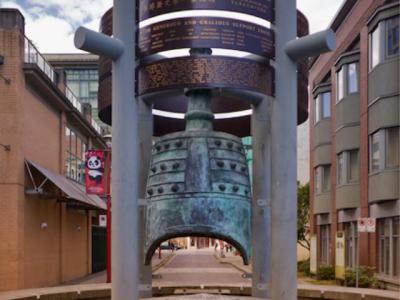
Another key sight to behold here, set in the centre of Shanghai Alley, is the Western Han Dynasty Bell. This bell is a replica of the one unearthed in 1983 during an excavation in Guangzhou, China, and was gifted to the people of Vancouver from the city of Guangzhou on the occasion of the 15th anniversary of the twinning of the two cities. While the original bell dates back over two millennia and symbolizes the age of settlement in the Pearl River delta in Guangzhou, its replica marks the spot of the first Chinese settlement in the lower mainland of British Columbia.
Shanghai Alley was the first part of the Historic Alley to be constructed and inhabited. Later, in 1904, Canton Alley was added. Eventually, this was followed by a Chinese-style courtyard surrounded by residential and commercial buildings running in two parallel, southward rows. The heart of Historic Alley was the 500-seat theater, built in 1898, surrounded by restaurants and shops. This gave residents of Chinatown a way to enjoy Chinese-language entertainment, food, and company without having to leave their Vancouver home district, and ultimately resulted in a tightly woven Chinese-Canadian community, within the boundaries of which one could spend one's entire life.
The end result of Historical Alley is a Chinatown that is the second largest in all of North America, and one of the most visited by ethnic Chinese from outside of Vancouver. People of all races and nationalities come to Historical Alley for food, shopping, entertainment, and cultural events, as well as to view the Millennium Gate, which crowns the Chinatown entrance.
Another key sight to behold here, set in the centre of Shanghai Alley, is the Western Han Dynasty Bell. This bell is a replica of the one unearthed in 1983 during an excavation in Guangzhou, China, and was gifted to the people of Vancouver from the city of Guangzhou on the occasion of the 15th anniversary of the twinning of the two cities. While the original bell dates back over two millennia and symbolizes the age of settlement in the Pearl River delta in Guangzhou, its replica marks the spot of the first Chinese settlement in the lower mainland of British Columbia.
8) Chinatown
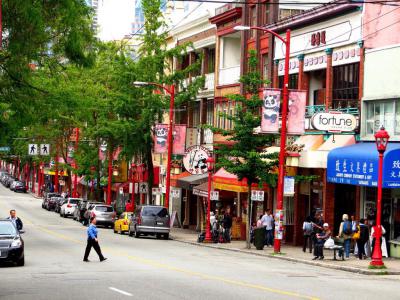
Chinatown, situated in Vancouver, stands as Canada's most expansive Chinatown. It revolves around Pender Street and is encircled by various areas: Gastown to the north, the western Downtown financial and central business districts, the Georgia Viaduct and False Creek inlet to the south, the northeastern Downtown Eastside and remnants of old Japantown, and the southeastern residential enclave of Strathcona.
Vancouver boasts a significant ethnic Chinese presence, predominantly composed of Cantonese-speaking multi-generational Chinese Canadians and first-generation immigrants from Hong Kong. This cultural blend has earned the city the moniker "Hongcouver." However, recent immigration trends have shown a rise in Mandarin-speaking individuals from Mainland China.
In the present day, the neighborhood boasts an array of traditional restaurants, banks, markets, clinics, tea shops, apparel boutiques, and various stores catering to both the local community and visitors. The Vancouver branch of Sing Tao Daily, one of the city's four Chinese-language newspapers, maintains its presence in Chinatown. From 2003 to 2010, OMNI British Columbia (formerly Channel M) operated its television studio in the same vicinity. Additionally, the Chinatown locale hosts a satellite location of the Vancouver Film School. Notably, nestled within the heart of Chinatown (formerly Ming’s Restaurant) is the renowned bar and nightclub recognized as the ‘Fortune Sound Club.’
Chinatown continues to allure a substantial number of tourists and holds the distinction of being one of the most expansive historic Chinatowns in North America. In recognition of its historical and cultural significance, the neighborhood received the designation of a National Historic Site of Canada in 2011.
Tip:
Don't go after 6pm because most of the shops will be closed.
You will be approached by panhandlers at any time of day, but if you just say "no" firmly then they will not trouble you further.
Vancouver boasts a significant ethnic Chinese presence, predominantly composed of Cantonese-speaking multi-generational Chinese Canadians and first-generation immigrants from Hong Kong. This cultural blend has earned the city the moniker "Hongcouver." However, recent immigration trends have shown a rise in Mandarin-speaking individuals from Mainland China.
In the present day, the neighborhood boasts an array of traditional restaurants, banks, markets, clinics, tea shops, apparel boutiques, and various stores catering to both the local community and visitors. The Vancouver branch of Sing Tao Daily, one of the city's four Chinese-language newspapers, maintains its presence in Chinatown. From 2003 to 2010, OMNI British Columbia (formerly Channel M) operated its television studio in the same vicinity. Additionally, the Chinatown locale hosts a satellite location of the Vancouver Film School. Notably, nestled within the heart of Chinatown (formerly Ming’s Restaurant) is the renowned bar and nightclub recognized as the ‘Fortune Sound Club.’
Chinatown continues to allure a substantial number of tourists and holds the distinction of being one of the most expansive historic Chinatowns in North America. In recognition of its historical and cultural significance, the neighborhood received the designation of a National Historic Site of Canada in 2011.
Tip:
Don't go after 6pm because most of the shops will be closed.
You will be approached by panhandlers at any time of day, but if you just say "no" firmly then they will not trouble you further.
9) Millennium Gate
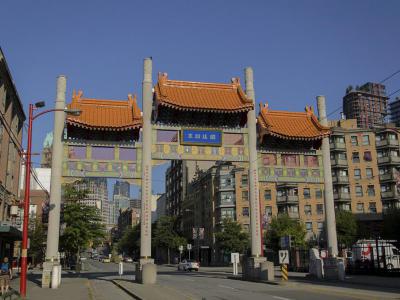
Standing on West Pender Street at the intersection with Taylor Street, you'll find yourself directly beneath the Millennium Gate, the ceremonial entrance to Vancouver's historic Chinatown. For the clearest view, step back across the street and face the structure head-on. From there, you can appreciate the gate's impressive proportions: a three-story structure supported by four massive pillars and crowned with a sweeping orange-tiled roof.
Completed in 2002 to mark the beginning of the new millennium, the gate also commemorates the generations of Chinese immigrants who helped shape Vancouver, from the first laborers who arrived in the late 19th century to later Chinese communities that settled here from Latin America.
Now move closer to the center of the gate and look upward. The design deliberately combines tradition with modern symbolism, representing a journey between past and future. Notice how the slender vertical supports appear almost too delicate to carry the heavy roof, creating a striking visual contrast. Above them, broad gray stone panels and richly carved roof beams blend contemporary architectural forms with the familiar appearance of a traditional Chinese paifang, or ceremonial gateway.
Before passing underneath, examine the two stone guardian lions at the base of the pillars. Facing the gate from West Pender Street, the male lion stands on your left, resting one paw on a carved ball that symbolizes authority and protection over the world. The female lion is on your right, gently holding a playful cub beneath her paw, representing family, nurturing, and the continuation of future generations. Lift your eyes to the upper sections of the gate, where sculpted human figures dressed in clothing from different regions of China celebrate the diversity of Chinese culture rather than depicting a single tradition. The gate's vibrant palette also reflects this blending of cultures, combining classic Chinese reds, greens, and golds with cleaner, more contemporary design elements.
As you walk underneath, look at the lower pillars for plaques and dedications naming the people and organizations involved in the project. These details remind visitors that the gate is not only decorative, but also a community monument.
Continue beyond the gate into Chinatown, where restaurants, bakeries, herbal shops, markets, and cultural landmarks keep the area lively. The Millennium Gate acts as a symbolic threshold: behind you is downtown Vancouver; ahead is one of the city’s most historic and multicultural neighborhoods.
Completed in 2002 to mark the beginning of the new millennium, the gate also commemorates the generations of Chinese immigrants who helped shape Vancouver, from the first laborers who arrived in the late 19th century to later Chinese communities that settled here from Latin America.
Now move closer to the center of the gate and look upward. The design deliberately combines tradition with modern symbolism, representing a journey between past and future. Notice how the slender vertical supports appear almost too delicate to carry the heavy roof, creating a striking visual contrast. Above them, broad gray stone panels and richly carved roof beams blend contemporary architectural forms with the familiar appearance of a traditional Chinese paifang, or ceremonial gateway.
Before passing underneath, examine the two stone guardian lions at the base of the pillars. Facing the gate from West Pender Street, the male lion stands on your left, resting one paw on a carved ball that symbolizes authority and protection over the world. The female lion is on your right, gently holding a playful cub beneath her paw, representing family, nurturing, and the continuation of future generations. Lift your eyes to the upper sections of the gate, where sculpted human figures dressed in clothing from different regions of China celebrate the diversity of Chinese culture rather than depicting a single tradition. The gate's vibrant palette also reflects this blending of cultures, combining classic Chinese reds, greens, and golds with cleaner, more contemporary design elements.
As you walk underneath, look at the lower pillars for plaques and dedications naming the people and organizations involved in the project. These details remind visitors that the gate is not only decorative, but also a community monument.
Continue beyond the gate into Chinatown, where restaurants, bakeries, herbal shops, markets, and cultural landmarks keep the area lively. The Millennium Gate acts as a symbolic threshold: behind you is downtown Vancouver; ahead is one of the city’s most historic and multicultural neighborhoods.
10) Victory Square Cenotaph
Vancouver's Victory Square is a small urban park, located on the site of the old Vancouver courthouse. The park itself is notable for accidentally setting the great Vancouver fire – when the heavily forested land was cleared to make way for the courthouse, a pile of trees and branches built up. This wood pile acted as kindling for the great fire, which levelled much of Vancouver in 1886.
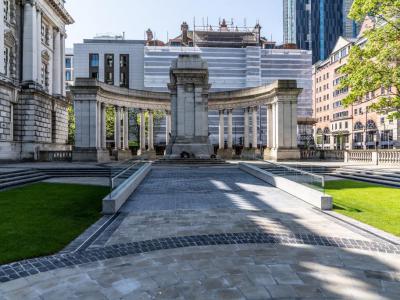
One of the square's key features is the Cenotaph. The Victory Square Cenotaph is a war memorial, carved from Nelson Island granite and standing roughly 30 feet in height. It is engraved with an image of a longsword, a wreath of laurels, and a wreath of poppies, both of which are entwined with maple leaves. Biblical inscriptions on the Cenotaph read, “Their name liveth forevermore,” “Is it nothing to you,” and “All ye that pass by.”
The location of the Cenotaph is historically significant, since the monument was erected where the base of the steps of the old courthouse used to be. This was where men stood to sign up for World War I, and where the main presentations of royal visits to Vancouver took place. Every year, the Cenotaph is the center of Vancouver's Remembrance Day services.
One of the square's key features is the Cenotaph. The Victory Square Cenotaph is a war memorial, carved from Nelson Island granite and standing roughly 30 feet in height. It is engraved with an image of a longsword, a wreath of laurels, and a wreath of poppies, both of which are entwined with maple leaves. Biblical inscriptions on the Cenotaph read, “Their name liveth forevermore,” “Is it nothing to you,” and “All ye that pass by.”
The location of the Cenotaph is historically significant, since the monument was erected where the base of the steps of the old courthouse used to be. This was where men stood to sign up for World War I, and where the main presentations of royal visits to Vancouver took place. Every year, the Cenotaph is the center of Vancouver's Remembrance Day services.
11) False Creek (must see)
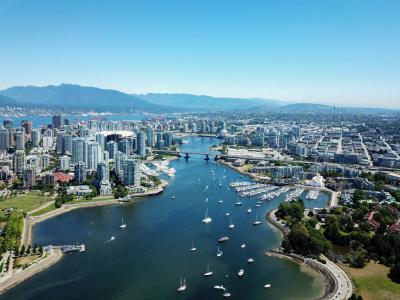
False Creek is best understood as a long, sheltered inlet cutting between downtown Vancouver on the north side and the city’s southern neighbourhoods on the other. Stand anywhere along the seawall and orient yourself by the bridges: Burrard Bridge is toward the west, Granville Bridge is in the middle, Cambie Bridge lies farther east, and the rounded, silver dome of Science World marks the eastern end.
The name “False Creek” comes from Captain George Henry Richards, who surveyed this coast between 1856 and 1863. While exploring the southern edge of Burrard Inlet, he thought he had found a creek; when he realized it was only a short inlet, the mistaken impression remained in the name.
Start at the eastern end, beside Science World. Look for the large geodesic dome rising above the water; this is one of the easiest landmarks to identify, originally associated with Expo 86. From here, turn west and follow the seawall. Ahead, the first major crossing is the Cambie Bridge, with the Canada Line tunnel passing underwater nearby. Continue west, and you will come to Granville Bridge, close to Granville Island, one of the creek’s busiest visitor areas. Farther along, Burrard Bridge frames the western end, where False Creek opens toward English Bay.
The water itself is part of the attraction. Watch for dragon boats, kayaks, canoes, small ferries, charter boats, and private vessels moving between the marinas. False Creek has ten marinas with space for around 1,500 boats, along with paddling clubs and rental facilities. Since 1986, it has also hosted major paddling events, including the Canadian International Dragon Boat Festival, making it not just a scenic inlet but one of Vancouver’s liveliest urban waterfronts.
The name “False Creek” comes from Captain George Henry Richards, who surveyed this coast between 1856 and 1863. While exploring the southern edge of Burrard Inlet, he thought he had found a creek; when he realized it was only a short inlet, the mistaken impression remained in the name.
Start at the eastern end, beside Science World. Look for the large geodesic dome rising above the water; this is one of the easiest landmarks to identify, originally associated with Expo 86. From here, turn west and follow the seawall. Ahead, the first major crossing is the Cambie Bridge, with the Canada Line tunnel passing underwater nearby. Continue west, and you will come to Granville Bridge, close to Granville Island, one of the creek’s busiest visitor areas. Farther along, Burrard Bridge frames the western end, where False Creek opens toward English Bay.
The water itself is part of the attraction. Watch for dragon boats, kayaks, canoes, small ferries, charter boats, and private vessels moving between the marinas. False Creek has ten marinas with space for around 1,500 boats, along with paddling clubs and rental facilities. Since 1986, it has also hosted major paddling events, including the Canadian International Dragon Boat Festival, making it not just a scenic inlet but one of Vancouver’s liveliest urban waterfronts.
12) Girl in a Wetsuit
Girl in a Wetsuit is one of the attractions in Stanley Park. This bronze statue was intended to mimic Copenhagen's famous statue of Hans Christian Andersen's Little Mermaid. When the Park was unable to secure the rights to replicate the Copenhagen statue, Hungarian sculptor and painter Elek Imredy was commissioned to make a modern variation of it for Stanley Park, instead.
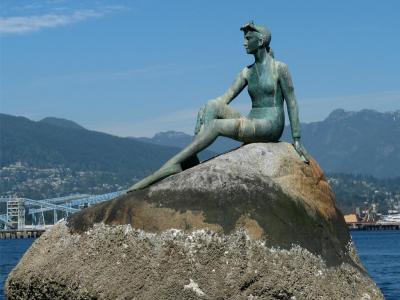
Girl in a Wetsuit is a life-sized bronze statue of a girl seated on a boulder, located just before Lumberman's Arch and the waterfront park. Instead of resembling Copenhagen's Little Mermaid, the Girl in a Wetsuit is a modern variation wearing swim fins, a wetsuit, and a diving mask. The statue was placed on June 9th of 1972, and has remained in place ever since.
At first blush, it's easy to mistake the Girl for a harbor seal. When the water level is high, she appears to be hovering on the surface of the water. Canada geese swim nearby, and seagulls perch on the Girl's head and knees. Over the years, the bronze statue has weathered to a subtle verdigris patina, that matches the blue-green of the water and the moss clinging to the boulder.
Girl in a Wetsuit is a life-sized bronze statue of a girl seated on a boulder, located just before Lumberman's Arch and the waterfront park. Instead of resembling Copenhagen's Little Mermaid, the Girl in a Wetsuit is a modern variation wearing swim fins, a wetsuit, and a diving mask. The statue was placed on June 9th of 1972, and has remained in place ever since.
At first blush, it's easy to mistake the Girl for a harbor seal. When the water level is high, she appears to be hovering on the surface of the water. Canada geese swim nearby, and seagulls perch on the Girl's head and knees. Over the years, the bronze statue has weathered to a subtle verdigris patina, that matches the blue-green of the water and the moss clinging to the boulder.
