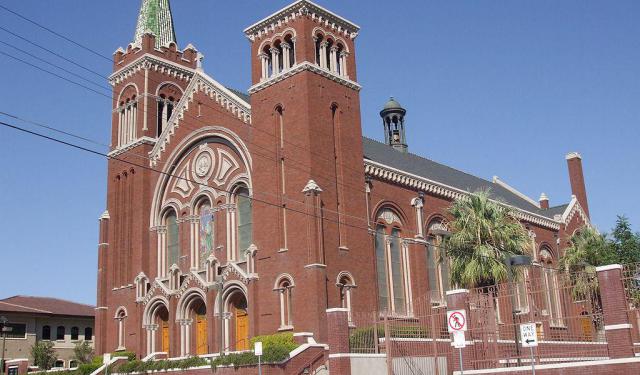


Historical Churches, El Paso

Historical Churches (Self Guided), El Paso

There are many places of worship in El Paso which are worthy ones visit. The churches in the city belong to various denominations and this results in different architectural styles. You will be thrilled at the sight of these gorgeous structures. Take the following self-guided tour and visit the most outstanding religious venues of El Paso.
How it works: Download the app "GPSmyCity: Walks in 1K+ Cities" from Apple App Store or Google Play Store to your mobile phone or tablet. The app turns your mobile device into a personal tour guide and its built-in GPS navigation functions guide you from one tour stop to next. The app works offline, so no data plan is needed when traveling abroad.

Download The GPSmyCity App

Historical Churches Map

Guide Name: Historical Churches
Guide Location: USA » El Paso (See other walking tours in El Paso)
Guide Type: Self-guided Walking Tour (Sightseeing)
# of Attractions: 8
Tour Duration: 2 Hour(s)
Travel Distance: 5.4 Km or 3.4 Miles
Author: HelenF
Sight(s) Featured in This Guide:
  • Montana Spanish Seventh Day Adventists Church
  • El Paso Grace Chinese Baptist Church
  • St. Clement's Church
  • Cathedral Parish of Saint Patrick
  • Trinity-First United Methodist Church
  • Immaculate Conception Church
  • Sacred Heart Church
  • Saint Ignatius Catholic Church
1
Montana Spanish Seventh Day Adventists Church

1) Montana Spanish Seventh Day Adventists Church

Montana Spanish Seventh-day Adventist Church belongs to the Seventh-day Adventist denomination, officially organized on May 21, 1863, in Battle Creek, Michigan. The church teaches regular Bible study, the belief in the soon return of Jesus, and a strong focus on health and education. Like other Adventist congregations, it observes the biblical Sabbath from Friday sunset to Saturday sunset. This congregation serves Spanish-speaking members, reflecting the cultural character of communities along the border.

The building is simple and functional, designed mainly as a space for gathering rather than decoration. Inside, a main hall hosts sermons, prayer, and congregational singing. The layout is clear and practical, creating an atmosphere centered on worship and fellowship.

Services are usually held on Saturdays. In addition to weekly worship, the church offers Bible study groups, youth activities, and community programs in Spanish, showing how an international denomination adapts to local language and daily life.
2
El Paso Grace Chinese Baptist Church

2) El Paso Grace Chinese Baptist Church

El Paso Grace Chinese Baptist Church reflects a long history of Chinese Baptist ministry in the region. Although the “Grace” name dates to the early 2000s, a formally organized Chinese Baptist church was established in 1964, with outreach efforts beginning as early as 1930. These milestones mark more than six decades of continuous congregational life grounded in faith and cultural continuity.

The church serves primarily Mandarin-speaking families and plays an active role in preserving language and heritage. Since 2005, the Faith-Hope Chinese School has offered instruction in Mandarin using simplified characters and Pinyin, alongside lessons in Chinese culture. This educational mission complements regular worship services and reinforces intergenerational ties within the community. In this way, the church functions not only as a religious centre but also as a cultural anchor for families of Chinese descent in the border region.

Architecturally, the building follows a practical Protestant layout, with a simple exterior marked by a cross and a sanctuary arranged around a raised pulpit. Multipurpose rooms host Bible studies, youth activities, and community events. Seasonal celebrations, including Lunar New Year, combine worship with shared cultural traditions, reflecting the community’s long-standing presence in the region.
3
St. Clement's Church

3) St. Clement's Church

St. Clement’s Church is one of the oldest Anglican congregations in the border region. The parish was founded in 1870, when the Rev. Joseph Wilkin Tays began holding Episcopal services for local residents. As the community grew, the congregation needed a more permanent place of worship. In 1882, members built a wooden chapel that served the parish for several years while plans developed for a larger and more durable church building.

The present church was built in the early twentieth century. The cornerstone was laid in 1907, and the building was completed in 1908. It was designed by architect S. E. Patton in the Gothic Revival style. Built from local bluestone, the church includes pointed arches, tall windows, and a bell tower.

Inside, the church has a central nave that leads toward the altar, following a layout common in Anglican worship spaces. Stained-glass windows bring color and light into the interior and depict scenes from Christian tradition. Wooden furnishings and simple details create a calm setting for worship. In 2007, the congregation joined the Anglican Church in North America, and the church continues to hold regular services and community activities today.
4
Cathedral Parish of Saint Patrick

4) Cathedral Parish of Saint Patrick

The Cathedral Parish of Saint Patrick is the seat of the Roman Catholic Diocese of El Paso and the mother church for about 670,000 Catholics in the region. Since July 9, 2013, the diocese has been led by Bishop Mark J. Seitz, appointed earlier that year by Pope Francis. The cathedral also remains closely connected to Cathedral High School and Saint Patrick Elementary School located beside it.

The building was designed by the St. Louis architectural firm Barnett, Haynes & Barnett in the form of a Byzantine basilica shaped by Italian Renaissance influence. Groundbreaking took place on April 8, 1914, and the cornerstone was blessed on November 12, 1916. Its design reflects early 20th-century church architecture in the United States, combining traditional European models with the needs of a growing border diocese.

Inside, Roman columns frame the central nave and lead toward the altar. Frescoes depict biblical scenes across the upper walls and ceiling, while the Stations of the Cross appear in bas-relief carvings along the interior walls. The balance of painted surfaces, sculpted detail, and filtered light creates a calm setting suited to both daily worship and major liturgical celebrations.
5
Trinity-First United Methodist Church

5) Trinity-First United Methodist Church

Trinity-First United Methodist Church traces its roots to the late 1800s as Methodist activity grew with new railroads, businesses, and neighborhoods. One early effort was the Union Sunday School, opened in 1881 in a small adobe building. That same year the Trinity congregation laid its first cornerstone. In 1979, Trinity United Methodist and First United Methodist merged to form the present church.

The present church building was completed in 1939 and designed by the architectural firm Trost & Trost, led by Gustavus A. Trost. Built of stone and brick, the structure reflects Spanish Renaissance architectural influences. Arched openings, decorative details, and a tower above the entrance shape its appearance. Some stained-glass windows inside were moved from earlier church buildings, preserving parts of the congregation’s history.

Inside, the church has a traditional sanctuary with rows of wooden pews facing the pulpit and chancel. Stained-glass windows add color and natural light, while the open layout allows large gatherings for services and events. The church also helped establish Providence Memorial Hospital in 1946 and opened an early preschool in 1952. Today the congregation continues to hold regular services and community programs.
6
Immaculate Conception Church

6) Immaculate Conception Church

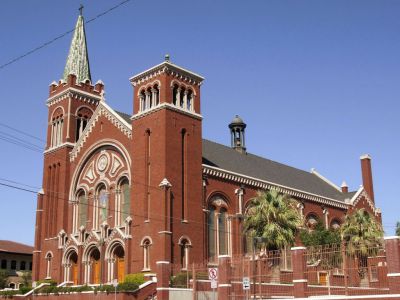
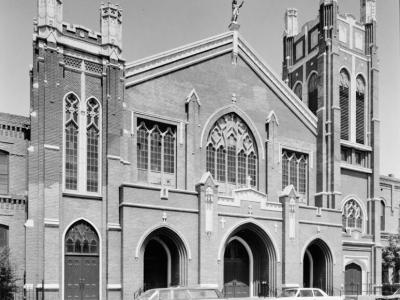
Immaculate Conception Church was completed in 1893 and dedicated on June 11 of that year. It was planned and built by Father Carlos Pinto, S.J., and became one of the city’s two oldest Catholic parishes. From the beginning, it served as the English-speaking parish, at a time when many Catholics in the area otherwise attended services across the border.

Built in 1893 in a Gothic style with red pressed brick, the church features a front tower topped by an octagonal cupola and dome. In the early 1900s, Trost & Trost remodeled it, adding Italian Renaissance and Baroque elements and raising the towers. In 1902, the wooden roof was replaced with a paneled steel ceiling and a new altar was installed. Stained-glass windows from the Bavarian Art Institute in Munich depict scenes from the lives of Christ and the Virgin Mary.

The church also played an important role in diocesan history. From 1914 to 1917, it served as the Pro-Cathedral of the Diocese until St. Patrick Cathedral opened. In 1902, it became the founding site of the Knights of Columbus in Texas. Today, the parish is known for celebrating the traditional Latin Mass, continuing a form of worship that connects present-day visitors with earlier Catholic traditions in the region.
7
Sacred Heart Church

7) Sacred Heart Church

Sacred Heart Church is a Catholic parish that has served the Hispanic community of the border region for more than a century. It was founded in 1893 by Jesuit Father Carlos M. Pinto, an Italian missionary often called the “Apostle of El Paso,” to support Spanish-speaking Catholics. The first church building was dedicated on June 9, 1893, and the parish soon became a centre for worship and community support.

In the early twentieth century, the congregation grew quickly as refugees arrived from Mexico during the Mexican Revolution and later religious persecution. To serve the expanding community, the church began major renovations around 1923, with the building reaching its present form between 1928 and 1929.

The church reflects Gothic Revival architecture, with pointed arches, clustered columns, tall stained-glass windows, and a central bell tower. The parish remains active today, holding Masses in both English and Spanish and offering community programs such as a food pantry, job assistance, and adult education including ESL and GED classes.
8
Saint Ignatius Catholic Church

8) Saint Ignatius Catholic Church

Saint Ignatius Catholic Church, also called Temple San Ignacio de Loyola, has served the community since construction of the present church began in 1913 at a cost of about $22,000. An earlier church and school were dedicated in 1905, and the parish was formally established in 1917. Jesuit priests from the Mexican Province began administering the church in 1914, and during the Mexican Revolution it became an important centre for families in Segundo Barrio and soldiers from nearby Camp Cotton (established in 1916).

The church is built of reddish brick. Its Italian Renaissance façade and two towers were added during a remodel designed by architect Gustavus A. Trost of Trost & Trost and dedicated on April 2, 1922. The central section of the façade was inspired by the Ospedale degli Innocenti in Florence. Inside, a central nave leads toward the altar, and the ceiling above it is decorated with elaborate paintings.

Today the parish continues to serve a largely bilingual congregation as part of the Catholic Diocese of El Paso. Masses and parish activities are often held in Spanish, with some bilingual services as well. The church organizes catechism classes, youth programs, and celebrations for holidays such as Christmas and Easter, continuing its long tradition of supporting immigrant and migrant communities.

Walking Tours in El Paso, Texas

Create Your Own Walk in El Paso

Create Your Own Walk in El Paso

Creating your own self-guided walk in El Paso is easy and fun. Choose the city attractions that you want to see and a walk route map will be created just for you. You can even set your hotel as the start point of the walk.
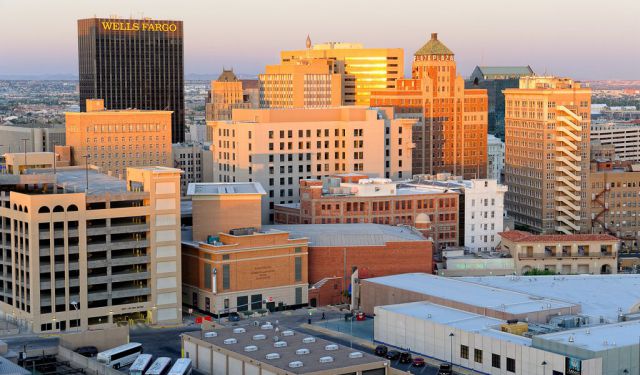
El Paso Introduction Walking Tour

El Paso Introduction Walking Tour

Every city in the world has its unique characteristics, and El Paso is no exception! It is a prosperous city with extremely beautiful architectural monuments of historical importance, fiberglass statues of ferocious alligators and brave cowboys and many other characters. You can see a different side of the city by taking the following tour to guide you through its streets.

Tour Duration: 2 Hour(s)
Travel Distance: 3.5 Km or 2.2 Miles