

Lviv's Monuments and Statues, Lviv

Lviv's Monuments and Statues (Self Guided), Lviv

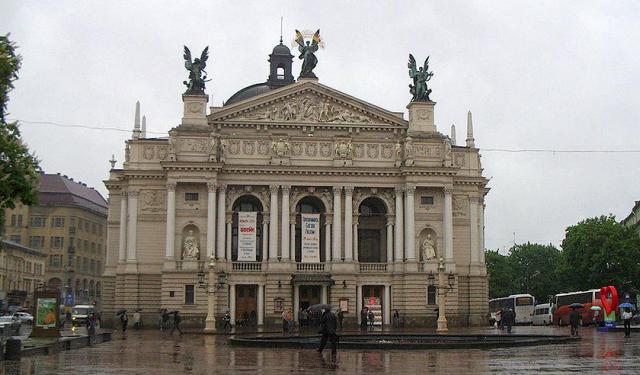
The city of Lviv has many historical monuments that make it a living history. Monuments and statues are dedicated to outstanding Ukrainians that contributed to the cultural development of Lviv and played important roles in its history. Take this self-guided tour to discover the rich history of Lviv through its great monuments and statues.
How it works: Download the app "GPSmyCity: Walks in 1K+ Cities" from Apple App Store or Google Play Store to your mobile phone or tablet. The app turns your mobile device into a personal tour guide and its built-in GPS navigation functions guide you from one tour stop to next. The app works offline, so no data plan is needed when traveling abroad.

Download The GPSmyCity App

Lviv's Monuments and Statues Map

Guide Name: Lviv's Monuments and Statues
Guide Location: Ukraine » Lviv (See other walking tours in Lviv)
Guide Type: Self-guided Walking Tour (Sightseeing)
# of Attractions: 6
Tour Duration: 2 Hour(s)
Travel Distance: 4.3 Km or 2.7 Miles
Author: vickyc
Sight(s) Featured in This Guide:
  • Monument "Prosvita"
  • Monument to Ivan Fyodorov
  • Statue of Liberty
  • Monument to the Virgin Mary
  • Adam Mickiewicz Monument
  • Monument to the Victims of Communist Crimes
1
Monument "Prosvita"

1) Monument "Prosvita"

The Monument to Prosvita stands as a tribute to one of the most influential cultural organisations in Ukraine’s modern history. Founded in 1868, “Prosvita” played a crucial role in promoting the Ukrainian language, literature, and national identity during a period of political restriction and growing cultural awareness. The monument, unveiled to mark the society’s 125th anniversary, honours this legacy and highlights the enduring importance of education and cultural development in Lviv.

Situated near the Church of the Transfiguration, the monument occupies a meaningful place within the historic core of the city. Its location reflects the deep connection between civic initiatives and spiritual life that shaped Lviv’s intellectual landscape. The monument’s design combines clean, modern lines with symbolic elements that reference the society’s mission, creating a visual link between past efforts and present aspirations.

The sculptural composition features a central figure representing enlightenment and the spread of knowledge, themes closely tied to “Prosvita’s” work in establishing libraries, reading rooms, and educational programs across Western Ukraine. The restrained aesthetic allows visitors to focus on the message behind the monument rather than elaborate decoration. This clarity is part of what makes the site a thoughtful stop for those exploring Lviv’s cultural history.

Today, the monument serves not only as a commemorative marker but also as a reminder of the city’s long-standing engagement with education and national consciousness. Visitors often pause here to reflect on the role of civic organisations in shaping Lviv’s identity, making it a fitting point of interest for anyone tracing the city’s cultural development.
2
Monument to Ivan Fyodorov

2) Monument to Ivan Fyodorov (must see)

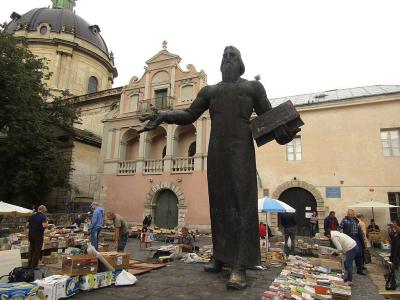
The Monument to Ivan Fyodorov stands in one of Lviv’s most historically layered areas, near the entrance to the city’s old book market. It honours Ivan Fyodorov, the pioneering 16th-century printer whose work helped shape the development of printing across Eastern Europe. Fyodorov settled in Lviv after leaving Moscow, and in 1574, he produced the Apostolos, considered one of the earliest dated printed books in Ukrainian territory. His workshop and legacy turned the city into an early regional centre of book production, making him a key figure in Lviv’s cultural identity.

Created in 1977 by sculptors Valentyn Borysenko and Valentyn Podolskyi, the monument presents Fyodorov holding an open book, captured in a calm yet purposeful pose. Its modernist style contrasts with the surrounding architecture, allowing the sculpture to stand out in a space defined by older façades and narrow streets. The design emphasizes Fyodorov’s role as a transmitter of knowledge, highlighting the moment when printed texts began to transform literacy and learning in the region.

Nearby, the open-air book market extends the monument’s theme into everyday life. Vendors set up tables filled with old volumes, postcards, maps, and prints, creating a lively environment that reflects the city’s long relationship with literature. The square naturally draws both casual passersby and visitors who come specifically to see one of Lviv’s cultural landmarks.

For tourists, the monument offers a clear link between the city’s past and its ongoing appreciation for books and scholarship. It stands not only as a tribute to an influential printer but also as a reminder of Lviv’s historical place within the broader story of publishing and intellectual exchange in Eastern Europe.
3
Statue of Liberty

3) Statue of Liberty

The so-called “Statue of Liberty” in Lviv is one of the city’s most unexpected landmarks—an elegant seated figure perched atop the Museum of Ethnography and Crafts. Installed between 1891 and 1893, it was created by sculptor Leandro Marconi for the former Galicia Savings Bank, which originally occupied the building. Although locals affectionately call it the Statue of Liberty, its true purpose was quite different: the figure was designed as an allegory of Thrift, or Savings, reflecting the institution’s focus on financial stability and economic progress.

The sculpture’s symbolism blends classical motifs with late 19th-century civic ideals. The central figure holds a torch and a tablet, echoing the language of freedom and enlightenment associated with the famous monument in New York. Yet here, these elements highlight economic knowledge and responsibility rather than political liberty. At the base of the composition, two male figures represent agriculture and industry, the key sectors that fuelled Galicia’s development and the prosperity that the Savings Bank aimed to promote.

One of the work’s most distinctive features is its seated pose. Unlike most traditional allegorical sculptures, this figure does not stand tall but rests gracefully, a detail that produced ironic comments during the Soviet era—most famously the quip that “even Freedom is sitting in the USSR.” Despite these interpretations, the sculpture was always intended to symbolize practical virtues, not political statements.

Today, the figure remains an intriguing highlight on the museum’s roofline. Restored in 2016–2017, it continues to capture visitors’ attention with its blend of elegance, symbolism, and subtle humour woven into Lviv’s architectural landscape.
4
Monument to the Virgin Mary

4) Monument to the Virgin Mary (must see)

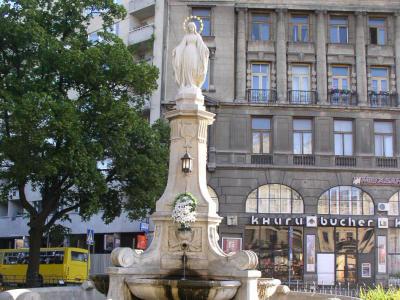
The Monument to the Virgin Mary stands as one of the quiet spiritual anchors of central Lviv, positioned on Svobody Avenue near the busy edge of Mickiewicz Square. Set atop a fountain, the sculpture forms a gentle contrast to the surrounding traffic and movement, offering a small but meaningful place of pause for residents and visitors alike. Although the statue seen today is a modern copy, it follows the form of the 1904 original that once occupied this very spot.

The monument’s history reflects the broader story of the city. The original statue, installed in 1904, was removed during the Soviet period and transferred to the Bernardine Church, where it spent decades away from public view. After Ukraine’s independence, the decision was made to restore the site’s historic appearance. On October 14, 1997, a faithful reproduction of the original figure was placed back on the fountain, returning the monument to its early-20th-century setting.

Beyond its historical layers, the site retains deep significance for locals. Many come to pray quietly, light candles, or leave flowers at the base of the statue, creating an atmosphere of personal reflection despite its central location. Its presence has helped maintain a sense of continuity and community within the ever-changing urban landscape.

In recent years, the surrounding area has also become a place of remembrance. Posters and small displays often appear nearby, commemorating victims of the conflict in Eastern Ukraine. This adds a contemporary dimension to the monument, connecting spiritual tradition with the realities of present-day life and making it a meaningful stop for those exploring Lviv’s cultural heart.
5
Adam Mickiewicz Monument

5) Adam Mickiewicz Monument (must see)

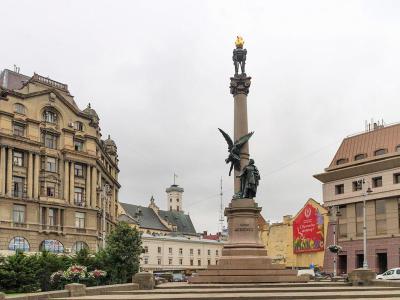
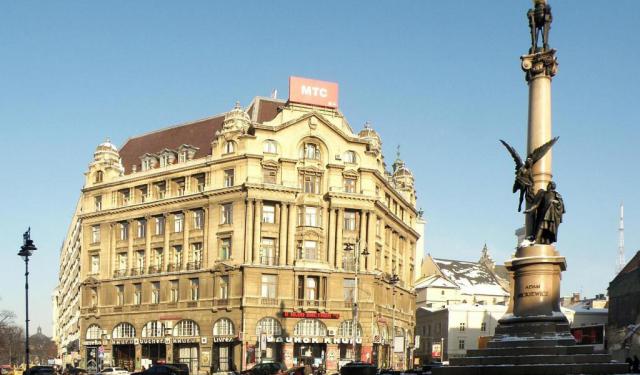
The Adam Mickiewicz Monument stands prominently on Mickiewicz Square, offering one of Lviv’s most recognisable landmarks—and a clear tribute to the celebrated Polish Romantic poet whose works shaped cultural life across Central and Eastern Europe. Completed in 1904, the monument was commissioned at a time when Lviv was part of the Austro-Hungarian Empire, reflecting the city’s diverse heritage and its long-standing ties to Polish literary tradition. Its placement in a lively public square underscores Mickiewicz’s enduring influence as a figure who transcended borders, languages, and political eras.

At the centre of the composition is a tall column topped by a winged bronze figure symbolising the “Genius of Poetry,” holding a flaming torch that represents artistic inspiration. Below it stands Mickiewicz himself, rendered in bronze and shown in a calm, thoughtful pose. The contrast between the soaring allegorical figure and the grounded, human-scale statue conveys both the poet’s personal presence and the larger ideals he came to embody. The structure rises nearly 21 metres, giving it a commanding position within the urban landscape.

The monument is the work of sculptor Antoni Popiel and architects Alfred Zachariewicz and Józef Sosnowski, whose collaboration produced a design that balances classical motifs with a sense of movement and grace. Their craftsmanship contributed to the monument’s reputation as one of the most elegant public sculptures in Lviv, admired for its harmonious proportions and refined details. Over the decades, it has become a familiar point of orientation for residents and visitors alike.

Today, Mickiewicz Square remains a popular gathering place, framed by historical buildings, cafés, and tram lines that highlight the rhythm of daily life in the city. The monument serves not only as a tribute to a major European literary figure but also as a reminder of Lviv’s multicultural past.
6
Monument to the Victims of Communist Crimes

6) Monument to the Victims of Communist Crimes

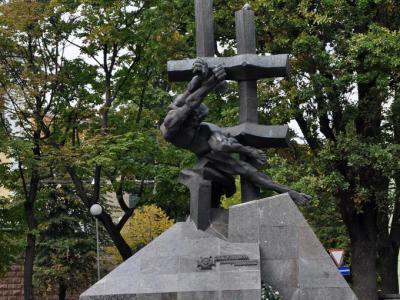
The Monument to the Victims of Communist Crimes stands on Stepana Bandera Street, just steps from the former “Prison on Lontskoho,” one of Lviv’s most sombre historic sites. Unveiled on November 8, 1997, the memorial was created to acknowledge the suffering endured under Soviet totalitarian rule and to honour the countless individuals whose lives were shaped or destroyed by political repression. Its location beside a former interrogation and detention facility reinforces the gravity of the history it confronts.

The monument’s design presents a powerful visual language. Created by P. Shtaier and R. Syvenkyi, it features a brutalist figure straining against iron prison bars, capturing the struggle for freedom and the resilience of the human spirit. The stark forms and rough surfaces underscore the harsh conditions faced by victims of the regime, while the figure’s emergence suggests a move toward liberation, memory, and justice.

As a historical landmark, the site serves both as a place of reflection and as a public reminder of the city’s turbulent 20th-century experience. It conveys the scale of suffering endured across Ukraine and pays tribute to those who resisted in ways large and small. The monument invites visitors to pause and consider the profound impact of state-imposed violence on families, communities, and national identity.

Today, the memorial remains an active point of remembrance. Annual ceremonies held here bring together survivors, families, and local residents to honour those lost and to reaffirm the importance of safeguarding human rights. For visitors, this quiet but weighty monument offers a meaningful encounter with Lviv’s modern history and the endurance of collective memory.

Walking Tours in Lviv, Ukraine

Create Your Own Walk in Lviv

Create Your Own Walk in Lviv

Creating your own self-guided walk in Lviv is easy and fun. Choose the city attractions that you want to see and a walk route map will be created just for you. You can even set your hotel as the start point of the walk.
Historical Churches

Historical Churches

Lviv is an old beautiful city with many churches in impressive buildings with majestic interiors. Some of the churches are architectural monuments listed as UNESCO World Heritage Site. Take this self-guided tour to see the most beautiful churches of Lviv.

Tour Duration: 1 Hour(s)
Travel Distance: 1.7 Km or 1.1 Miles
Lviv's Architectural Jewels

Lviv's Architectural Jewels

Lviv has many historical buildings, such as churches and palaces. The city's architecture will show you the best of European styles from various periods. While walking through the streets of Lviv you will see baroque, renaissance and classic architecture. Take this self-guided tour to explore the majestic architecture of Lviv.

Tour Duration: 2 Hour(s)
Travel Distance: 2.8 Km or 1.7 Miles
Lviv Introduction Walking Tour

Lviv Introduction Walking Tour

The largest city in the western part of Ukraine, Lviv stands out in its historic beauty and deservedly holds a place on the UNESCO World Heritage List. To find out exactly why, follow this self-guided tour and discover the most notable historic and architectural sights of the city.

Tour Duration: 3 Hour(s)
Travel Distance: 3.6 Km or 2.2 Miles