

Historical Churches, Lviv

Historical Churches (Self Guided), Lviv

Lviv is an old beautiful city with many churches in impressive buildings with majestic interiors. Some of the churches are architectural monuments listed as UNESCO World Heritage Site. Take this self-guided tour to see the most beautiful churches of Lviv.
How it works: Download the app "GPSmyCity: Walks in 1K+ Cities" from Apple App Store or Google Play Store to your mobile phone or tablet. The app turns your mobile device into a personal tour guide and its built-in GPS navigation functions guide you from one tour stop to next. The app works offline, so no data plan is needed when traveling abroad.

Download The GPSmyCity App

Historical Churches Map

Guide Name: Historical Churches
Guide Location: Ukraine » Lviv (See other walking tours in Lviv)
Guide Type: Self-guided Walking Tour (Sightseeing)
# of Attractions: 8
Tour Duration: 1 Hour(s)
Travel Distance: 1.7 Km or 1.1 Miles
Author: vickyc
Sight(s) Featured in This Guide:
  • Bernardine Cathedral and Monastery
  • Boim Chapel
  • Latin Cathedral
  • Jesuit Church
  • Armenian Cathedral of Lviv
  • Church of Transfiguration
  • Dominican Church
  • Carmelite Church
1
Bernardine Cathedral and Monastery

1) Bernardine Cathedral and Monastery (must see)

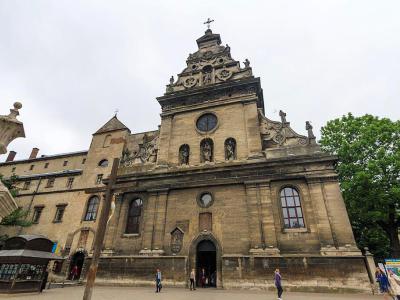
The Bernardine Cathedral and Monastery in Lviv stands as one of the city’s most striking architectural ensembles, shaped by centuries of religious life and cultural exchange. Founded in the early 17th century by the Bernardine monks, the complex reflects Lviv’s position as a crossroads of European influences. Its construction began after earlier wooden structures were destroyed, and the new stone complex was designed to withstand conflicts and fires—an approach that gives the site its fortress-like character. Over time, it became an important spiritual centre, closely connected to the city’s religious communities and traditions.

Architecturally, the cathedral blends Mannerist and early Baroque styles, with a façade rich in sculptural decoration and symbolic motifs. Stone figures of saints, intricate reliefs, and ornamental details introduce visitors to the craftsmanship of Lviv’s artists during its Renaissance and Baroque periods. Inside, the cathedral reveals an atmosphere shaped by dark wooden altars, gilded ornamentation, and frescoes that highlight the artistic sophistication of the monastic workshops. The contrast between the austere exterior and the warm, elaborate interior offers a sense of the spiritual life that once thrived here.

The adjoining monastery, surrounded by high defensive walls and a tower, reinforces the site’s historical role as both a religious house and a place of refuge. Over the centuries, the complex hosted monastic life, scholarly activity, and charitable work, contributing to the cultural development of the surrounding district. Although the monks were forced to leave during the Soviet era, the buildings endured and later reopened to the public.

Today, the cathedral—dedicated to Saint Andrew—and the former monastery form a key landmark in Lviv’s historic centre. Visitors can admire its architectural details, explore the courtyard, and take in the atmosphere of a place that reflects both the resilience and layered history of the city. The complex remains an essential stop for those interested in Lviv’s architectural heritage and religious past.
2
Boim Chapel

2) Boim Chapel (must see)

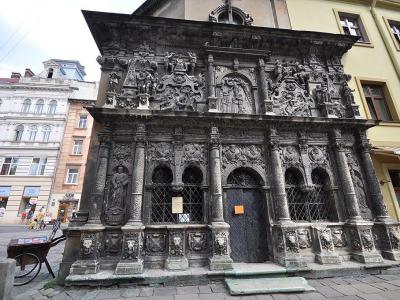
The Boim Chapel in Lviv stands as one of the city’s most distinctive architectural landmarks, offering a striking example of early 17th-century funerary art. Commissioned by the wealthy merchant family of Hungarian origin, the Boims, the chapel was built between 1609 and 1615 as a private mausoleum beside the Latin Cathedral. Its creation coincided with a period when Lviv was a thriving multicultural hub within the Polish-Lithuanian Commonwealth, and its design reflects the artistic influences circulating through the region at the time. Today, the chapel is admired not only for its craftsmanship but also for its role in illustrating the city’s layered past.

The exterior immediately captures attention with its dark, almost sculptural façade, richly decorated with biblical reliefs, ornamental motifs, and expressive figures. This elaborate stonework, carved by masters believed to be associated with the workshop of Andrzej Bemer, blends Renaissance principles with Mannerist detail. The dominant image of Christ above the entrance, framed by dense iconography, gives the façade its memorable, almost theatrical character. Over the centuries, the stone has darkened naturally, making its intricate carvings even more visually dramatic.

Inside, visitors encounter a more intimate setting, where vibrant frescoes and carved altarpieces illuminate the Boim family’s religious devotion. The interior dome, decorated with detailed scenes and ornamental patterns, draws the eye upward, offering a contrast to the darker tones of the exterior. Many of the interior elements have undergone careful restoration to preserve their original colour and clarity, allowing today’s visitors to appreciate the chapel’s artistic richness.

The chapel’s central figure is George Boim, whose effigy appears in a kneeling position before the altar. His presence reinforces the building’s purpose as both a family mausoleum and a statement of status, typical of the era’s affluent merchant class. As Lviv developed around it, the chapel retained its intimate scale and solemn atmosphere, becoming a familiar landmark for generations.

Today, the Boim Chapel stands as a compact yet powerful testament to Lviv’s Renaissance heritage. Its extraordinary façade and carefully preserved interior make it a highlight for visitors exploring the city’s historic centre, offering a glimpse into the artistic traditions and social history that shaped early modern Lviv.
3
Latin Cathedral

3) Latin Cathedral

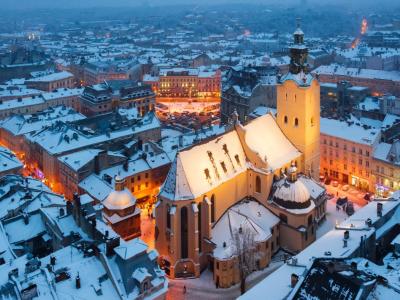
The Latin Cathedral, officially known as the Archcathedral Basilica of the Assumption of the Blessed Virgin Mary, is one of Lviv’s most enduring landmarks and a focal point of the city’s historic centre. Its origins date back to the mid-14th century, when King Casimir III of Poland initiated construction to serve the Catholic community of the growing medieval city. Over the centuries, the cathedral has witnessed royal ceremonies, civic gatherings, and major historical events, making it an essential part of Lviv’s cultural story.

Architecturally, the cathedral reflects a layered history shaped by successive renovations and additions. The original Gothic framework remains visible in the tall pointed arches and slender proportions of the nave, while later Baroque and Renaissance influences appear in chapels, altars, and decorative details. Many side chapels were funded by prominent local families, each contributing its own artistic character to the building. The cathedral’s exterior, with its high tower and stone façade, offers a clear view of its medieval foundations blended with later stylistic updates.

Inside, visitors will find an atmosphere shaped by centuries of devotion and artistry. The interior contains notable features such as the Boim family altar, richly carved confessionals, and stained-glass windows created in the late 19th and early 20th centuries. Frescoes and sculptures highlight different artistic periods, reflecting the shifting tastes and traditions of Lviv’s multicultural population. The mix of Gothic structure and Baroque ornamentation gives the space a distinctive, layered character.

The cathedral has also played a symbolic role during moments of political and social transition. It has survived fires, wars, and regime changes, remaining an active place of worship and an important cultural anchor. Its connections to Polish, Ukrainian, and broader European history illustrate the city’s longstanding identity as a crossroads of cultures.

Today, the Latin Cathedral welcomes visitors as both a historical monument and a working parish church. Its central location on Cathedral Square makes it easy to explore, and its carefully preserved interior offers insight into Lviv’s artistic and religious heritage. A visit provides a quiet, reflective pause amid the lively streets of the old town.
4
Jesuit Church

4) Jesuit Church

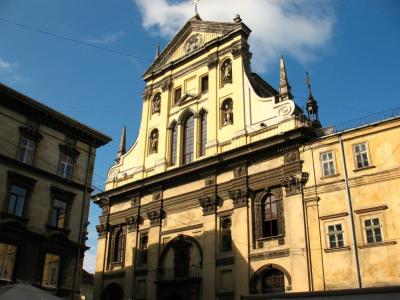
The Jesuit Church in Lviv, officially known as the Church of Saints Peter and Paul, stands as one of the city’s most imposing Baroque landmarks. Completed in the early 17th century, it was built during a period of significant Jesuit activity in the region, when the order sought to create grand architectural statements that reflected both spiritual authority and cultural influence. Its façade, inspired by Roman Baroque models, immediately conveys this ambition with strong vertical lines, sculptural detail, and a monumental presence within the historic centre.

Inside, the church continues to impress with a richly decorated interior that once belonged to one of the largest and most influential Jesuit complexes in Eastern Europe. Visitors will notice the high vaulted ceilings, elaborate stucco work, and side chapels that form a cohesive blend of grandeur and devotional intimacy. Although many original furnishings were lost over the centuries, recent restoration efforts have helped bring back much of the church’s visual impact, revealing frescoes and architectural details long hidden beneath layers of time.

Historically, the Jesuit Church played a significant role in the city’s religious and intellectual life. The Jesuit college adjacent to it was an early centre of education that contributed to Lviv’s reputation as a multicultural and scholarly hub. Even during periods of political change, the church retained its status as a prominent spiritual site, adapting to evolving civic and cultural landscapes.

Today, the church is an active place of worship and a remarkable architectural monument. Its atmospheric interior and careful preservation make it a compelling stop for visitors exploring Lviv’s rich heritage.
5
Armenian Cathedral of Lviv

5) Armenian Cathedral of Lviv (must see)

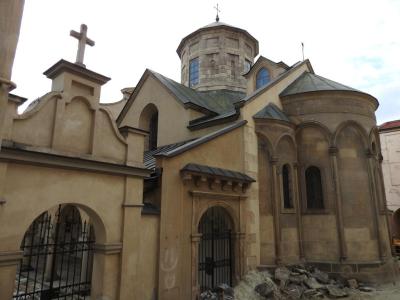
The Armenian Cathedral of Lviv stands among the city’s oldest and most atmospheric religious landmarks, reflecting the deep-rooted presence of the Armenian community that settled in the city in the 13th century. Completed in the 1360s, the cathedral originally served as the spiritual centre of Armenians who played a significant role in Lviv’s trade networks and urban life. Its early foundation, medieval layout, and long continuity of worship make it one of the few places in the city where visitors can still sense the layered history of a multicultural past.

Architecturally, the cathedral seamlessly blends influences from across continents. Its oldest section, the northern nave, draws inspiration from Armenian churches of Crimea and the Caucasus, giving it a compact, fortress-like appearance. Later additions—particularly the 15th-century southern nave and the Renaissance-era sacristy—introduced European elements while preserving the site’s distinctive identity. Fragile frescoes painted by Jan Henryk Rosen in the early 20th century add another chapter to its evolving character, known for their expressive colours and dramatic symbolism.

The courtyard and surrounding complex contribute to the cathedral’s quiet, enclosed atmosphere. The arcaded gallery, dating from the 17th century, frames a small space where stone crosses, memorial slabs, and fragments of earlier structures offer glimpses into generations of community life. Nearby, the former Armenian Archbishop’s Palace and bell tower broaden the picture of a once-thriving quarter centred on faith, learning, and craftsmanship.

Today, the Armenian Cathedral remains an active place of worship for the Armenian Apostolic Church, and its doors are open to visitors interested in Lviv’s cultural mosaic. The mix of medieval architecture, artistic layers, and living tradition provides insight into the city’s historical openness, making the cathedral a rewarding stop for anyone exploring Lviv’s diverse heritage.
6
Church of Transfiguration

6) Church of Transfiguration (must see)

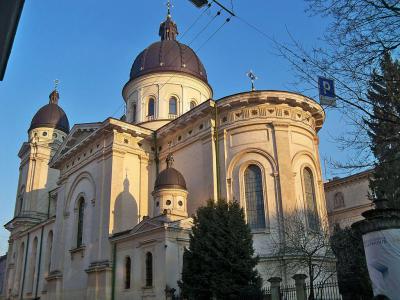
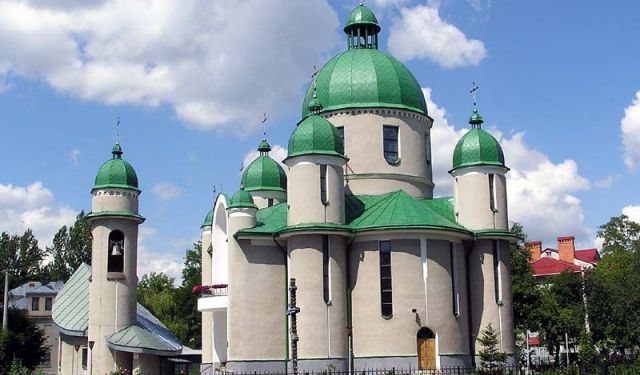
The Church of the Transfiguration in Lviv is one of the most historically layered sacred sites in the Old Town, reflecting centuries of religious change, architectural evolution, and cultural resilience. The church stands on the site of an earlier Roman Catholic church built for the Trinitarian Order between 1703 and 1731. That original structure, designed in a French classicist style with a richly Baroque interior, served the order until 1783, when Emperor Joseph II dissolved the monastery and converted the building into the Lviv University Library.

Its story took a dramatic turn in 1848 during the Spring of Nations, when Austrian artillery fire almost completely destroyed the library and the church that preceded it. The ruins remained for decades until they were given to the Greek Catholic community in 1875. Reconstruction began shortly after, and the new church was completed in 1898. In 1906, Metropolitan Andrey Sheptytsky consecrated the renewed Church of the Transfiguration, establishing it as a major spiritual centre for the Ukrainian Greek Catholic Church.

Architecturally, the current building is a three-nave basilica designed by Sylvester Havryshkevych in a Historicist style that merges classical forms with motifs drawn from Ukrainian ecclesiastical tradition. Its façade, framed by two towers and a graceful central dome, gives the church a distinct presence within Lviv’s dense historic fabric. The dome, visible from the interior, creates a bright vertical accent to the otherwise balanced basilica plan.

Inside, the church is richly decorated in accordance with Eastern Rite traditions. The gold iconostasis, crafted by Tadeusz Popiel between 1900 and 1901, dominates the sanctuary. Popiel and Kornylo Ustiyanovych contributed numerous paintings, including the prominent image of the Transfiguration behind the altar. Sculptor Leonard Marconi created twelve expressive statues of the apostles, while the cupola frescoes depict the four evangelists, adding depth and colour to the lofty interior.

The church also holds great symbolic importance: in October 1989, after decades of Soviet repression, it became the first parish in Lviv to return to the Greek Catholic community. Today, it stands not only as an architectural treasure but as a testament to the city’s enduring spiritual heritage.
7
Dominican Church

7) Dominican Church (must see)

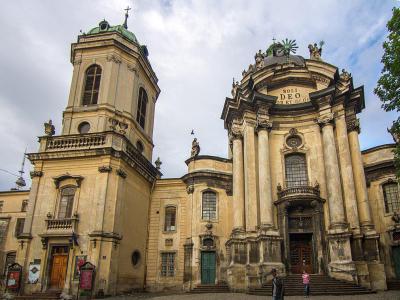
The Dominican Church in Lviv, officially known as the Church of the Holy Eucharist, is one of the city’s most recognisable Baroque landmarks. Its origins trace back to the 13th century, when the first wooden Dominican monastery was founded under the protection of King Lev. That early structure evolved over time, but the present church emerged in the mid-18th century, built between 1749 and 1764. Designed by architect Jan de Witte, its sweeping curves and monumental dome reflect the influence of Central European Baroque, giving the building a commanding presence within Lviv’s historic centre.

The church’s defining feature is its grand elliptical shape, crowned by a high dome that rises above the old town rooftops. A dramatic façade, accented with columns and sculptural details by Sebastian Fesinger, introduces visitors to an interior known for its spaciousness and balanced proportions. The play of light against pale walls and gilded accents creates a calm, contemplative atmosphere, aligning with the church’s long liturgical tradition.

Over the centuries, the Dominican Church has shifted roles, mirroring Lviv’s complex history. It functioned as a Roman Catholic sanctuary for generations, survived political transitions, and was converted into a Museum of Religion during the Soviet era. After Ukraine regained independence, the building resumed its religious purpose, becoming the Church of the Holy Eucharist under the Ukrainian Greek Catholic Church.

Today, the church attracts visitors who appreciate both its architecture and its layered past. Its large dome offers excellent acoustics for concerts and cultural events, while its location within Lviv’s UNESCO-listed historic area makes it an essential stop for those exploring the city’s diverse architectural heritage.
8
Carmelite Church

8) Carmelite Church

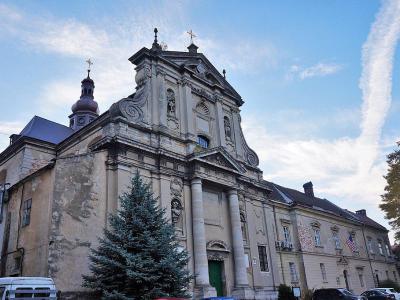
The Carmelite Church, officially known as the Church of Saint Michael the Archangel, stands as one of the city’s most atmospheric Baroque landmarks. Established in the early 17th century by the Discalced Carmelites, it once formed part of a fortified monastic complex that reflected both spiritual devotion and the turbulent history of the region. The monks, who arrived in Lviv in the 1600s, created a place of contemplation that also served as a defensive outpost during periods of conflict, making the site an intriguing blend of religious purpose and military function.

The current church building, completed in the 17th century, showcases mature Baroque design with a distinctive two-tower façade. Its exterior, marked by sculptural ornamentation and strong vertical lines, adds a commanding presence to the surrounding streets. The adjoining monastery buildings, though more subdued, help illustrate how the entire complex once functioned as a self-contained spiritual centre. Visitors approaching the site can still sense the layered history embedded in its architecture.

Inside, the church reveals a rich interior shaped by centuries of artistic contributions. Elaborate stucco decoration, altarpieces, and surviving elements of original fresco work offer a look into the craftsmanship that defined Lviv’s Baroque period. The main altar dedicated to Saint Michael the Archangel anchors the nave, while side chapels present quieter, more intimate spaces for reflection. The design creates a balanced and immersive atmosphere, inviting visitors to appreciate both its historical depth and artistic detail.

The church’s location near Lviv’s historic centre makes it an accessible stop for those exploring the city’s religious heritage. Its blend of grand Baroque architecture, monastic history, and preserved artistic features offers insight into the spiritual life of Lviv from the early modern period onward.

Walking Tours in Lviv, Ukraine

Create Your Own Walk in Lviv

Create Your Own Walk in Lviv

Creating your own self-guided walk in Lviv is easy and fun. Choose the city attractions that you want to see and a walk route map will be created just for you. You can even set your hotel as the start point of the walk.
Lviv Introduction Walking Tour

Lviv Introduction Walking Tour

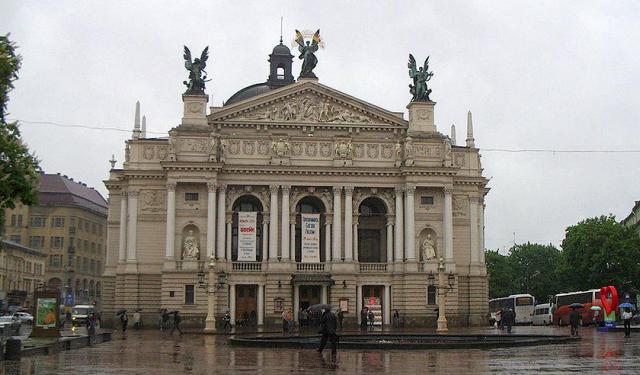
The largest city in the western part of Ukraine, Lviv stands out in its historic beauty and deservedly holds a place on the UNESCO World Heritage List. To find out exactly why, follow this self-guided tour and discover the most notable historic and architectural sights of the city.

Tour Duration: 3 Hour(s)
Travel Distance: 3.6 Km or 2.2 Miles
Lviv's Monuments and Statues

Lviv's Monuments and Statues

The city of Lviv has many historical monuments that make it a living history. Monuments and statues are dedicated to outstanding Ukrainians that contributed to the cultural development of Lviv and played important roles in its history. Take this self-guided tour to discover the rich history of Lviv through its great monuments and statues.

Tour Duration: 2 Hour(s)
Travel Distance: 4.3 Km or 2.7 Miles
Lviv's Architectural Jewels

Lviv's Architectural Jewels

Lviv has many historical buildings, such as churches and palaces. The city's architecture will show you the best of European styles from various periods. While walking through the streets of Lviv you will see baroque, renaissance and classic architecture. Take this self-guided tour to explore the majestic architecture of Lviv.

Tour Duration: 2 Hour(s)
Travel Distance: 2.8 Km or 1.7 Miles