

Audio Guide: Seattle Center Walking Tour (Self Guided), Seattle
Seattle Center occupies a site with a layered history that predates its modern landmarks. Before becoming a cultural campus, the area just north of downtown Seattle was a mix of low-rise neighborhoods, industrial uses, and civic facilities. In the early 20th century, it was already associated with public life through venues such as the city’s original Civic Auditorium and nearby sports facilities, reflecting Seattle’s growing interest in shared gathering spaces. These earlier roles laid the groundwork for a transformation that would give the area national and international visibility.
That change arrived with the 1962 World’s Fair, officially known as the Century 21 Exposition. Conceived as a forward-looking event during the Space Age, the fair reshaped the district into a planned ensemble of pavilions, plazas, and performance venues. It introduced bold modern architecture and reinforced themes of science, technology, and culture. Rather than being dismantled after the fair closed, much of the site was retained and adapted, allowing it to evolve into a permanent civic campus with a long-term public function.
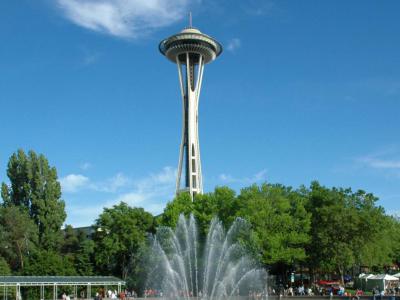
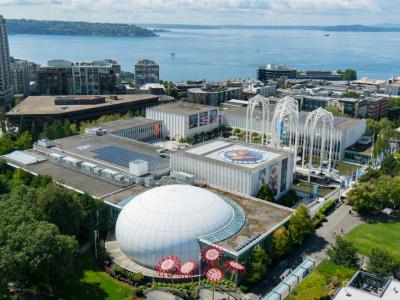
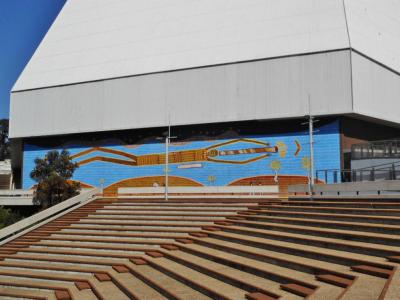
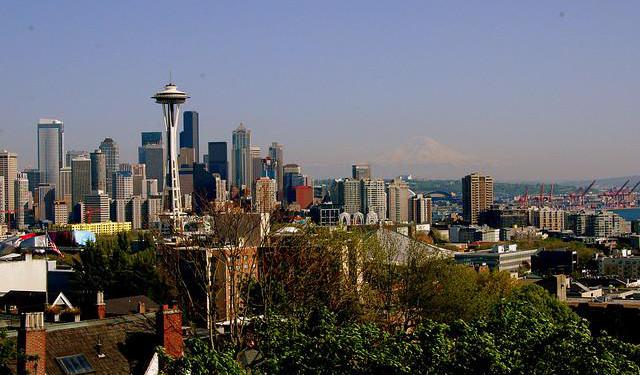
Today, Seattle Center covers roughly 30 hectares (or 74 acres) immediately north of downtown and serves as one of the city’s main arts and entertainment hubs. At its core stands the Space Needle, built for the World’s Fair and now one of Seattle’s most recognizable structures, offering panoramic views over the city, Puget Sound, and the surrounding mountains. Nearby, the Pacific Science Center continues the fair’s educational focus through interactive exhibits, while the adjacent Mural Amphitheater supports outdoor performances and seasonal programming.
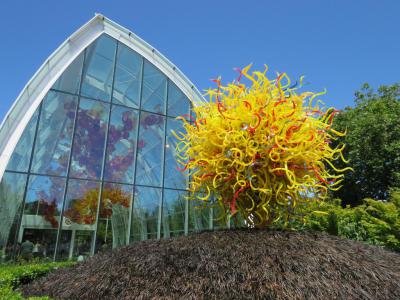
Other attractions are distributed across the campus and are easily explored on foot. Chihuly Garden and Glass presents large-scale glass installations by artist Dale Chihuly, while the Seattle Children’s Museum emphasizes hands-on learning for younger visitors. The International Fountain remains a central meeting point, known for its choreographed water displays. The Seattle Center Armory offers food and casual dining options, along with small shops. Close by, the Museum of Pop Culture examines music, film, and contemporary culture, and the Bill and Melinda Gates Foundation Discovery Center focuses on global philanthropy and social initiatives.
Taken together, these sites show how Seattle Center operates as a shared public space where culture, education, and recreation intersect. The compact layout encourages exploration at a relaxed pace, linking landmark architecture with everyday cultural activity and highlighting how the legacy of the World’s Fair continues to shape life in the city.
That change arrived with the 1962 World’s Fair, officially known as the Century 21 Exposition. Conceived as a forward-looking event during the Space Age, the fair reshaped the district into a planned ensemble of pavilions, plazas, and performance venues. It introduced bold modern architecture and reinforced themes of science, technology, and culture. Rather than being dismantled after the fair closed, much of the site was retained and adapted, allowing it to evolve into a permanent civic campus with a long-term public function.
Today, Seattle Center covers roughly 30 hectares (or 74 acres) immediately north of downtown and serves as one of the city’s main arts and entertainment hubs. At its core stands the Space Needle, built for the World’s Fair and now one of Seattle’s most recognizable structures, offering panoramic views over the city, Puget Sound, and the surrounding mountains. Nearby, the Pacific Science Center continues the fair’s educational focus through interactive exhibits, while the adjacent Mural Amphitheater supports outdoor performances and seasonal programming.
Other attractions are distributed across the campus and are easily explored on foot. Chihuly Garden and Glass presents large-scale glass installations by artist Dale Chihuly, while the Seattle Children’s Museum emphasizes hands-on learning for younger visitors. The International Fountain remains a central meeting point, known for its choreographed water displays. The Seattle Center Armory offers food and casual dining options, along with small shops. Close by, the Museum of Pop Culture examines music, film, and contemporary culture, and the Bill and Melinda Gates Foundation Discovery Center focuses on global philanthropy and social initiatives.
Taken together, these sites show how Seattle Center operates as a shared public space where culture, education, and recreation intersect. The compact layout encourages exploration at a relaxed pace, linking landmark architecture with everyday cultural activity and highlighting how the legacy of the World’s Fair continues to shape life in the city.
How it works: Download the app "GPSmyCity: Walks in 1K+ Cities" from Apple App Store or Google Play Store to your mobile phone or tablet. The app turns your mobile device into a personal tour guide and its built-in GPS navigation functions guide you from one tour stop to next. The app works offline, so no data plan is needed when traveling abroad.
Seattle Center Walking Tour Map
Guide Name: Seattle Center Walking Tour
Guide Location: USA » Seattle (See other walking tours in Seattle)
Guide Type: Self-guided Walking Tour (Sightseeing)
# of Attractions: 9
Tour Duration: 1 Hour(s)
Travel Distance: 1.1 Km or 0.7 Miles
Author: doris
Sight(s) Featured in This Guide:
Guide Location: USA » Seattle (See other walking tours in Seattle)
Guide Type: Self-guided Walking Tour (Sightseeing)
# of Attractions: 9
Tour Duration: 1 Hour(s)
Travel Distance: 1.1 Km or 0.7 Miles
Author: doris
Sight(s) Featured in This Guide:
- Space Needle
- Pacific Science Center
- Mural Amphitheater
- Chihuly Garden and Glass
- Seattle Center Armory
- Seattle Children's Museum
- International Fountain
- Museum of Pop Culture
- Bill and Melinda Gates Foundation Discovery Center
1) Space Needle (must see)
Only one World's Fair was the setting for an Elvis Presley movie ("It Happened at the World's Fair") and that was the one held in Seattle in 1962. However, Seattle residents are proudest of the fair's most tangible legacy: the internationally recognized Space Needle.
The Space Needle is an iconic observation tower and landmark located in Seattle. Built for the 1962 World's Fair, the Space Needle has become a symbol of the city and a must-visit attraction for visitors from around the world. With its unique design and breathtaking views, it offers an unforgettable experience that showcases the beauty of Seattle and its surrounding landscapes.
Designed by architects John Graham, Victor Steinbrueck, and John Ridley, the Space Needle was inspired by the futuristic vision of the World's Fair. Standing at a height of 605 feet (or 184 meters), the tower features a distinctive saucer-shaped structure with a rotating restaurant and an observation deck at the top. The design is characterized by its slender profile and the iconic 100-foot (or 30-meter) wide observation deck, providing visitors with unparalleled panoramic views.
Riding the elevator to the top, visitors are greeted by the observation deck, which offers 360-degree views of the Seattle skyline, Puget Sound, Mount Rainier, and the Cascade and Olympic mountain ranges. On clear days, the visibility stretches for miles, allowing visitors to fully appreciate the beauty of the region. The deck features floor-to-ceiling windows that provide unobstructed vistas, as well as outdoor viewing platforms for an even closer look at the scenery.
The Space Needle also features the SkyCity restaurant, which revolves 360 degrees as guests dine, completing a full rotation in approximately 47 minutes. This unique dining experience allows visitors to enjoy a delicious meal while taking in ever-changing views of Seattle and the surrounding landscape.
The Space Needle is not only a popular tourist attraction but also an integral part of Seattle's cultural fabric. It has been featured in numerous films, television shows, and photographs, becoming an iconic symbol of the city's skyline.
Tip:
Try to get your tickets and your reservation for the café a few days in advance – especially if visiting on a weekend. Note that if you eat at the restaurant, you can go to the viewing tower free of charge.
The Space Needle is an iconic observation tower and landmark located in Seattle. Built for the 1962 World's Fair, the Space Needle has become a symbol of the city and a must-visit attraction for visitors from around the world. With its unique design and breathtaking views, it offers an unforgettable experience that showcases the beauty of Seattle and its surrounding landscapes.
Designed by architects John Graham, Victor Steinbrueck, and John Ridley, the Space Needle was inspired by the futuristic vision of the World's Fair. Standing at a height of 605 feet (or 184 meters), the tower features a distinctive saucer-shaped structure with a rotating restaurant and an observation deck at the top. The design is characterized by its slender profile and the iconic 100-foot (or 30-meter) wide observation deck, providing visitors with unparalleled panoramic views.
Riding the elevator to the top, visitors are greeted by the observation deck, which offers 360-degree views of the Seattle skyline, Puget Sound, Mount Rainier, and the Cascade and Olympic mountain ranges. On clear days, the visibility stretches for miles, allowing visitors to fully appreciate the beauty of the region. The deck features floor-to-ceiling windows that provide unobstructed vistas, as well as outdoor viewing platforms for an even closer look at the scenery.
The Space Needle also features the SkyCity restaurant, which revolves 360 degrees as guests dine, completing a full rotation in approximately 47 minutes. This unique dining experience allows visitors to enjoy a delicious meal while taking in ever-changing views of Seattle and the surrounding landscape.
The Space Needle is not only a popular tourist attraction but also an integral part of Seattle's cultural fabric. It has been featured in numerous films, television shows, and photographs, becoming an iconic symbol of the city's skyline.
Tip:
Try to get your tickets and your reservation for the café a few days in advance – especially if visiting on a weekend. Note that if you eat at the restaurant, you can go to the viewing tower free of charge.
2) Pacific Science Center (must see)
The Pacific Science Center is one of Seattle Center’s key cultural institutions and holds a notable place in the history of science museums in the United States. It was the first U.S. museum founded specifically as a science and technology center, with the aim of increasing public understanding of science through direct engagement. The complex was designed by architect Minoru Yamasaki, also known for designing the original World Trade Center in New York, and consists of five interconnected buildings arranged around open courtyards and reflecting pools.
Inside, the Science Center offers a wide range of interactive exhibits that appeal to visitors of different ages and interests. Hands-on displays focused on mathematics and basic scientific principles are especially engaging for school-age children, while more advanced installations explore topics such as virtual reality, computer science, and robotics. Among the permanent exhibitions, Dinosaurs: A Journey Through Time stands out for its large robotic dinosaurs, some full-size and some scaled down, complete with movement and sound. Another long-running favorite is the Insect Village, which combines live insects, robotic models, and a working beehive to illustrate insect behavior and ecosystems.
Beyond its exhibition halls, the Pacific Science Center includes two IMAX theaters, an advanced planetarium, a Butterfly House, and laser shows where music is synchronized with projected light displays. These attractions expand the experience beyond traditional exhibits and allow visitors to tailor their visit according to interest and time. Admission options are flexible, with tickets available for exhibits alone or combined with films and shows.
The Science Center also includes a well-stocked gift shop offering science-themed books, educational toys, and practical souvenirs at accessible prices.
Tip:
If looking to do lots of things downtown, make sure you take advantage of the CityPass as it will save you 40-50% and you can knock out lots of attractions.
Inside, the Science Center offers a wide range of interactive exhibits that appeal to visitors of different ages and interests. Hands-on displays focused on mathematics and basic scientific principles are especially engaging for school-age children, while more advanced installations explore topics such as virtual reality, computer science, and robotics. Among the permanent exhibitions, Dinosaurs: A Journey Through Time stands out for its large robotic dinosaurs, some full-size and some scaled down, complete with movement and sound. Another long-running favorite is the Insect Village, which combines live insects, robotic models, and a working beehive to illustrate insect behavior and ecosystems.
Beyond its exhibition halls, the Pacific Science Center includes two IMAX theaters, an advanced planetarium, a Butterfly House, and laser shows where music is synchronized with projected light displays. These attractions expand the experience beyond traditional exhibits and allow visitors to tailor their visit according to interest and time. Admission options are flexible, with tickets available for exhibits alone or combined with films and shows.
The Science Center also includes a well-stocked gift shop offering science-themed books, educational toys, and practical souvenirs at accessible prices.
Tip:
If looking to do lots of things downtown, make sure you take advantage of the CityPass as it will save you 40-50% and you can knock out lots of attractions.
3) Mural Amphitheater
Located in the heart of Seattle, the Mural Amphitheater stands as one of the premier destinations for live outdoor concerts and film festivals in the city. Nestled against the iconic Space Needle, this enchanting venue offers a captivating setting for entertainment and cultural events, attracting locals and tourists alike.
One of the main attractions of the Mural Amphitheater is its remarkable 60-foot-long cycloramic mural, created by the renowned Japanese artist Paul Horiuchi in 1962. Horiuchi employed his distinctive collage technique to craft this masterpiece, which features 54 panels of Italian-made Venetian glass in a stunning array of 160 color variations. Not only does this mural serve as a visually captivating backdrop, but it also acts as a sound-reflecting acoustic element for the stage, enhancing the overall auditory experience for the audience.
The design of the theater itself is a testament to the visionary work of local architect Paul Thiry, often referred to as the father of architectural modernism in the Pacific Northwest. Thiry's expertise shines through in the terraced lawn layout of the amphitheater, providing optimal sightlines and seating arrangements for concertgoers and film enthusiasts. The open-air setting allows attendees to bask in the natural beauty of Seattle while immersing themselves in the magic of live performances.
During the summer months, the Mural Amphitheater plays host to a beloved event called 'Movies at the Mural.' This popular series invites people of all ages to enjoy free outdoor evening screenings of classic and contemporary films. The combination of captivating movies and picturesque surroundings creates an unforgettable cinematic experience.
One of the main attractions of the Mural Amphitheater is its remarkable 60-foot-long cycloramic mural, created by the renowned Japanese artist Paul Horiuchi in 1962. Horiuchi employed his distinctive collage technique to craft this masterpiece, which features 54 panels of Italian-made Venetian glass in a stunning array of 160 color variations. Not only does this mural serve as a visually captivating backdrop, but it also acts as a sound-reflecting acoustic element for the stage, enhancing the overall auditory experience for the audience.
The design of the theater itself is a testament to the visionary work of local architect Paul Thiry, often referred to as the father of architectural modernism in the Pacific Northwest. Thiry's expertise shines through in the terraced lawn layout of the amphitheater, providing optimal sightlines and seating arrangements for concertgoers and film enthusiasts. The open-air setting allows attendees to bask in the natural beauty of Seattle while immersing themselves in the magic of live performances.
During the summer months, the Mural Amphitheater plays host to a beloved event called 'Movies at the Mural.' This popular series invites people of all ages to enjoy free outdoor evening screenings of classic and contemporary films. The combination of captivating movies and picturesque surroundings creates an unforgettable cinematic experience.
4) Chihuly Garden and Glass (must see)
Chihuly Garden and Glass is a captivating museum and art exhibition located in Seattle. Dedicated to the stunning works of renowned glass artist Dale Chihuly, the museum offers visitors an immersive and awe-inspiring experience that celebrates the beauty and versatility of glass as an artistic medium.
Chihuly Garden and Glass is situated at the foot of the iconic Space Needle. The museum's indoor exhibition space presents a mesmerizing display of Chihuly's sculptures, installations, and intricate glass creations. The artwork explores a wide range of forms, colors, and textures, showcasing the artist's mastery of the glassblowing technique and his innovative approach to sculptural design. Visitors can marvel at the intricate details and vibrant hues of Chihuly's signature works, which often evoke natural elements like flowers, sea creatures, and organic shapes.
In addition to the indoor galleries, Chihuly Garden and Glass features an expansive outdoor garden that beautifully integrates art with nature. The garden exhibits Chihuly's sculptures against a backdrop of carefully curated plantings, creating a harmonious blend of color and form. The glass artwork interacts with the surrounding flora, water features, and natural light, creating a dynamic and ever-changing visual experience throughout the seasons.
Visitors can stroll through the garden pathways, discovering hidden nooks and unexpected displays at every turn. The juxtaposition of the delicate glass artistry against the ruggedness of nature creates a sense of wonder and exploration. The garden also features a stunning glasshouse, showcasing one of Chihuly's largest suspended installations-an extraordinary chandelier-like structure that spans the entire ceiling and is illuminated to create a breathtaking spectacle.
Chihuly Garden and Glass offers visitors more than just visual delight. The museum provides educational insights into Chihuly's creative process, the history of glass art, and the evolution of his artistic career. Interactive exhibits, videos, and informative displays shed light on the intricate techniques and craftsmanship behind the glassblowing process, further enriching the visitor experience.
Tip:
Since this exhibit doesn't take too long, try getting tickets at or after 4pm if possible, as they are significantly discounted.
Chihuly Garden and Glass is situated at the foot of the iconic Space Needle. The museum's indoor exhibition space presents a mesmerizing display of Chihuly's sculptures, installations, and intricate glass creations. The artwork explores a wide range of forms, colors, and textures, showcasing the artist's mastery of the glassblowing technique and his innovative approach to sculptural design. Visitors can marvel at the intricate details and vibrant hues of Chihuly's signature works, which often evoke natural elements like flowers, sea creatures, and organic shapes.
In addition to the indoor galleries, Chihuly Garden and Glass features an expansive outdoor garden that beautifully integrates art with nature. The garden exhibits Chihuly's sculptures against a backdrop of carefully curated plantings, creating a harmonious blend of color and form. The glass artwork interacts with the surrounding flora, water features, and natural light, creating a dynamic and ever-changing visual experience throughout the seasons.
Visitors can stroll through the garden pathways, discovering hidden nooks and unexpected displays at every turn. The juxtaposition of the delicate glass artistry against the ruggedness of nature creates a sense of wonder and exploration. The garden also features a stunning glasshouse, showcasing one of Chihuly's largest suspended installations-an extraordinary chandelier-like structure that spans the entire ceiling and is illuminated to create a breathtaking spectacle.
Chihuly Garden and Glass offers visitors more than just visual delight. The museum provides educational insights into Chihuly's creative process, the history of glass art, and the evolution of his artistic career. Interactive exhibits, videos, and informative displays shed light on the intricate techniques and craftsmanship behind the glassblowing process, further enriching the visitor experience.
Tip:
Since this exhibit doesn't take too long, try getting tickets at or after 4pm if possible, as they are significantly discounted.
5) Seattle Center Armory
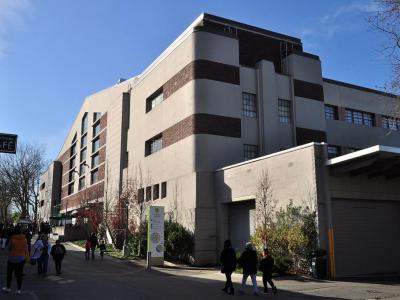
The Seattle Center Armory is a central gathering place within Seattle Center, combining dining, culture, and public activity under one roof. Originally built in 1939 as a military armory, the building once housed half-ton tanks and the 146th Field Artillery. Its solid, symmetrical exterior reflects its original purpose, but a major renovation in 2012 transformed the interior into a welcoming public space designed for everyday use by residents and visitors alike.
Today, the Armory is best known for its large food court, which offers a wide range of dining options suitable for quick bites or relaxed meals. Popular choices include Mod Pizza, Premier Meat Pies, and Plum Pantry, a well-regarded vegan bistro. The variety reflects Seattle’s diverse food scene, with options that range from comfort food to plant-based dishes. Ample seating throughout the building makes it easy to pause, eat, and recharge between visits to nearby attractions, concerts, or events at Seattle Center.
Beyond food, the Armory also plays a role in the area’s cultural life. It houses the Seattle Children’s Museum, making it a practical stop for families traveling with young children. The building also includes a performance area that hosts thousands of free public performances each year, along with rotating exhibits, small vendors, and occasional pop-up markets featuring crafts, international foods, and cultural displays. While dining is the main draw, these additional elements give the Armory a dynamic feel that changes throughout the year.
Conveniently located near major Seattle Center landmarks, the Seattle Center Armory works as both a destination and a pause point.
Today, the Armory is best known for its large food court, which offers a wide range of dining options suitable for quick bites or relaxed meals. Popular choices include Mod Pizza, Premier Meat Pies, and Plum Pantry, a well-regarded vegan bistro. The variety reflects Seattle’s diverse food scene, with options that range from comfort food to plant-based dishes. Ample seating throughout the building makes it easy to pause, eat, and recharge between visits to nearby attractions, concerts, or events at Seattle Center.
Beyond food, the Armory also plays a role in the area’s cultural life. It houses the Seattle Children’s Museum, making it a practical stop for families traveling with young children. The building also includes a performance area that hosts thousands of free public performances each year, along with rotating exhibits, small vendors, and occasional pop-up markets featuring crafts, international foods, and cultural displays. While dining is the main draw, these additional elements give the Armory a dynamic feel that changes throughout the year.
Conveniently located near major Seattle Center landmarks, the Seattle Center Armory works as both a destination and a pause point.
6) Seattle Children's Museum
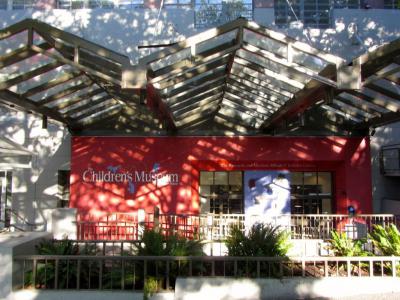
The Seattle Children’s Museum is a family-focused institution designed specifically for hands-on learning through play. It began in 1979 as a nonprofit project created by a group of Seattle parents who wanted an engaging and educational environment for young children. What started with a single exhibit has grown into a well-organized museum offering around 22,000 square feet play space, with a dozen interactive, child-scale exhibits that introduce themes drawn from world cultures, art, technology, and the humanities.
The museum is especially well suited to children between the ages of one and five. Many of the exhibits are structured around familiar real-world activities, including a small supermarket, a post office, and a construction zone, all designed to encourage imagination, problem-solving, and social interaction. These spaces allow children to explore independently while remaining within clear, safe boundaries. Because of its popularity, the museum can become busy on weekends, and families looking for a calmer experience may prefer to visit on a weekday.
Parents and caregivers are required to supervise their children at all times, as the museum is not intended for drop-off visits. The layout makes it easy to step in and out of different activity areas while keeping children within view. For families planning a longer stay, the food court upstairs offers convenient dining options, making it easy to combine playtime with a meal before younger children head off for a nap.
The museum’s location within Seattle Center adds to its appeal. It sits close to some of the city’s best outdoor play structures, and on clear days, families often extend their visit to the nearby International Fountain, where children can watch or interact with the water displays.
Tip:
Ask at the desk about the jungle gym with huge slides and go there first if you so desire.
The museum is especially well suited to children between the ages of one and five. Many of the exhibits are structured around familiar real-world activities, including a small supermarket, a post office, and a construction zone, all designed to encourage imagination, problem-solving, and social interaction. These spaces allow children to explore independently while remaining within clear, safe boundaries. Because of its popularity, the museum can become busy on weekends, and families looking for a calmer experience may prefer to visit on a weekday.
Parents and caregivers are required to supervise their children at all times, as the museum is not intended for drop-off visits. The layout makes it easy to step in and out of different activity areas while keeping children within view. For families planning a longer stay, the food court upstairs offers convenient dining options, making it easy to combine playtime with a meal before younger children head off for a nap.
The museum’s location within Seattle Center adds to its appeal. It sits close to some of the city’s best outdoor play structures, and on clear days, families often extend their visit to the nearby International Fountain, where children can watch or interact with the water displays.
Tip:
Ask at the desk about the jungle gym with huge slides and go there first if you so desire.
7) International Fountain
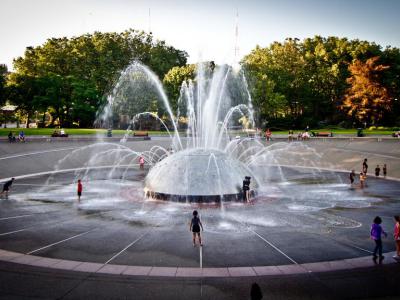
The International Fountain underwent a thorough renovation in July 2021, following a three-month closure. The renovation included the replacement of 56 out of the fountain's 274 water jets, the installation of vibrant LED lighting, and the re-caulking of 5,000 feet of sealant around the large metal water dome. Additionally, the technology and electrical systems were upgraded.
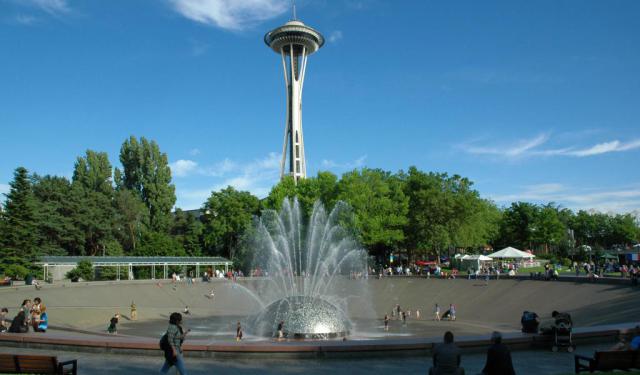
Originally built as a prominent feature for the 1962 Seattle World's Fair, the fountain was designed to evoke the spirit of outer space exploration. The presence of protruding nozzles and jagged, irregular white rocks surrounding the original silver metal dome aimed to create a "lunar landscape" ambiance. However, these elements made the fountain less accessible to visitors. In a rebuild carried out in 1995, the nozzles and rocks were removed, and numerous flat jets were installed on the new stainless steel dome's surface. This modification allowed for more interactive play and engagement. Consequently, the fountain quickly became a focal point of the grounds, with children splashing in its basin and attempting to outwit its super shooters.
The recent maintenance work focused on updating the mechanical components of the fountain, ensuring its longevity as a beloved attraction for the community well into the future.
It is worth noting that the International Fountain also prioritizes environmental stewardship. The fountain operates with a water recycling system and undergoes three types of natural treatment processes before the water reaches the public, making it perhaps the cleanest water feature in the city.
Originally built as a prominent feature for the 1962 Seattle World's Fair, the fountain was designed to evoke the spirit of outer space exploration. The presence of protruding nozzles and jagged, irregular white rocks surrounding the original silver metal dome aimed to create a "lunar landscape" ambiance. However, these elements made the fountain less accessible to visitors. In a rebuild carried out in 1995, the nozzles and rocks were removed, and numerous flat jets were installed on the new stainless steel dome's surface. This modification allowed for more interactive play and engagement. Consequently, the fountain quickly became a focal point of the grounds, with children splashing in its basin and attempting to outwit its super shooters.
The recent maintenance work focused on updating the mechanical components of the fountain, ensuring its longevity as a beloved attraction for the community well into the future.
It is worth noting that the International Fountain also prioritizes environmental stewardship. The fountain operates with a water recycling system and undergoes three types of natural treatment processes before the water reaches the public, making it perhaps the cleanest water feature in the city.
8) Museum of Pop Culture (must see)
The Museum of Pop Culture (MoPOP), located in Seattle, Washington, is a captivating and dynamic institution dedicated to the exploration and celebration of popular culture.
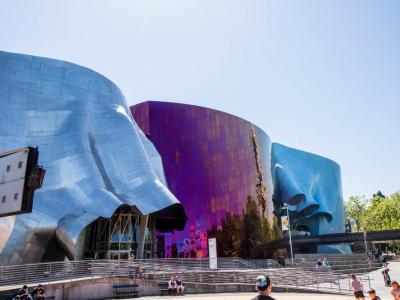
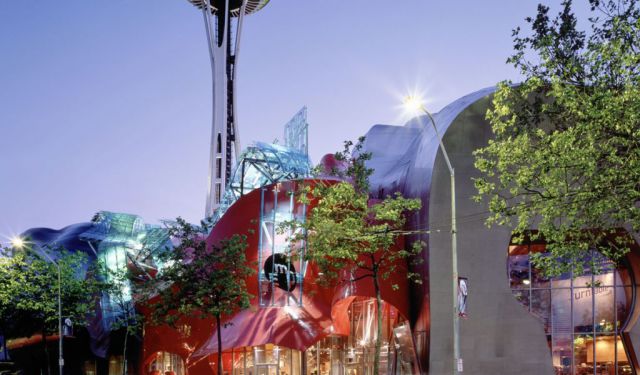
MoPOP stands out for its striking architecture, designed by acclaimed architect Frank Gehry. The building's unconventional design features a mix of curving, colorful metallic panels that resemble flowing sheets of music or distorted guitars. It has become an iconic landmark in Seattle's skyline, drawing visitors with its bold and distinctive aesthetic.
The museum's mission is to engage visitors in a multi-disciplinary exploration of popular culture across various mediums, including music, film, television, video games, science fiction, and more. It offers a vast array of exhibits and interactive displays that immerse visitors in the rich tapestry of pop culture.
One of the museum's notable attractions is the Sound Lab, where visitors can experiment with musical instruments, recording equipment, and technology to create their own music. The interactive nature of the exhibit encourages visitors to engage with music and gain a deeper understanding of its cultural impact.
MoPOP also boasts an extensive collection of artifacts and memorabilia, showcasing the history and influence of popular culture icons. Visitors can explore exhibits dedicated to legendary musicians, such as Jimi Hendrix, Nirvana, and Prince, examining their impact on music and society. The museum also hosts rotating exhibitions that delve into diverse aspects of pop culture, from science fiction and fantasy to horror and comics.
Beyond music, MoPOP pays homage to other forms of popular culture through its exhibitions. Visitors can delve into the world of science fiction and fantasy, exploring iconic franchises like Star Trek, Star Wars, and The Lord of the Rings. The museum also highlights the artistry and cultural significance of video games, featuring exhibits that delve into the evolution of gaming, influential titles, and the creative minds behind them.
The museum is also home to the Science Fiction and Fantasy Hall of Fame, honoring the most influential and groundbreaking contributors to the genre. Inductees include renowned authors, filmmakers, artists, and visionaries who have shaped the landscape of science fiction and fantasy.
Tip:
Either get a CityPass (available inside) or a combo ticket to the Space Needle and Chihuly's Garden and Glass exhibit to bring the price down. If you're short on time, dare to ask when buying ticket/s if there's a way to reenter the following day.
MoPOP stands out for its striking architecture, designed by acclaimed architect Frank Gehry. The building's unconventional design features a mix of curving, colorful metallic panels that resemble flowing sheets of music or distorted guitars. It has become an iconic landmark in Seattle's skyline, drawing visitors with its bold and distinctive aesthetic.
The museum's mission is to engage visitors in a multi-disciplinary exploration of popular culture across various mediums, including music, film, television, video games, science fiction, and more. It offers a vast array of exhibits and interactive displays that immerse visitors in the rich tapestry of pop culture.
One of the museum's notable attractions is the Sound Lab, where visitors can experiment with musical instruments, recording equipment, and technology to create their own music. The interactive nature of the exhibit encourages visitors to engage with music and gain a deeper understanding of its cultural impact.
MoPOP also boasts an extensive collection of artifacts and memorabilia, showcasing the history and influence of popular culture icons. Visitors can explore exhibits dedicated to legendary musicians, such as Jimi Hendrix, Nirvana, and Prince, examining their impact on music and society. The museum also hosts rotating exhibitions that delve into diverse aspects of pop culture, from science fiction and fantasy to horror and comics.
Beyond music, MoPOP pays homage to other forms of popular culture through its exhibitions. Visitors can delve into the world of science fiction and fantasy, exploring iconic franchises like Star Trek, Star Wars, and The Lord of the Rings. The museum also highlights the artistry and cultural significance of video games, featuring exhibits that delve into the evolution of gaming, influential titles, and the creative minds behind them.
The museum is also home to the Science Fiction and Fantasy Hall of Fame, honoring the most influential and groundbreaking contributors to the genre. Inductees include renowned authors, filmmakers, artists, and visionaries who have shaped the landscape of science fiction and fantasy.
Tip:
Either get a CityPass (available inside) or a combo ticket to the Space Needle and Chihuly's Garden and Glass exhibit to bring the price down. If you're short on time, dare to ask when buying ticket/s if there's a way to reenter the following day.
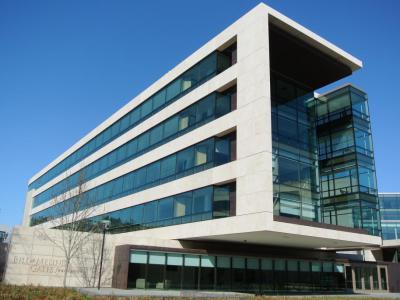
9) Bill and Melinda Gates Foundation Discovery Center
Considering it's free to visit and only a quick walk from the Space Needle area, a walk to the Bill & Melinda Gates Foundation is recommended to learn about the legacy this family seeks to leave. The inspiring stories, cool innovations, and impacts presented are quite interesting and should make you feel a little bit better about humanity.
If you don't have time for the tour, there are plenty of displays, videos and interactive kiosks to view, including some hands-on things for the kids (and adults and teens) towards the back room, and lots of questions and topics to get you really thinking how we can each "make a difference" (for example, the little topic cards placed all around the Center encourage visitors to volunteer, learn, use their voice, show kindness, donate, or raise money for their own causes) – so, if anything, you will learn something and be inspired to do your part, too.
There's a great attention to displaying the various exhibit portions in an eye-pleasing way, while also allowing for the video/sound components of exhibits to be appreciated – all without being too distracting to those viewing other portions of the space.
If you don't have time for the tour, there are plenty of displays, videos and interactive kiosks to view, including some hands-on things for the kids (and adults and teens) towards the back room, and lots of questions and topics to get you really thinking how we can each "make a difference" (for example, the little topic cards placed all around the Center encourage visitors to volunteer, learn, use their voice, show kindness, donate, or raise money for their own causes) – so, if anything, you will learn something and be inspired to do your part, too.
There's a great attention to displaying the various exhibit portions in an eye-pleasing way, while also allowing for the video/sound components of exhibits to be appreciated – all without being too distracting to those viewing other portions of the space.
Walking Tours in Seattle, Washington

Create Your Own Walk in Seattle
Creating your own self-guided walk in Seattle is easy and fun. Choose the city attractions that you want to see and a walk route map will be created just for you. You can even set your hotel as the start point of the walk.
Seattle Introduction Walking Tour
Overlooking Puget Sound's Elliott Bay on the West Coast of the United States, the port city of Seattle is renowned for its surrounding waters, mountains, evergreen forests, and thousands of acres of parkland. The largest metropolitan area in today's Washington State had been inhabited by Native Americans for at least 4,000 years prior to the European pioneers. The first European to set... view more
Tour Duration: 2 Hour(s)
Travel Distance: 4.3 Km or 2.7 Miles
Tour Duration: 2 Hour(s)
Travel Distance: 4.3 Km or 2.7 Miles
Historical Religious Buildings Tour
Seattle, Washington, boasts a wealth of religious sites of various denominations – together reflecting the city's diverse spiritual heritage. Besides being purely centers of faith, these buildings are an important part of the city's historical heritage, some of them standing as architectural marvels, each with its unique story.
Trinity Parish Church, founded in 1865, is... view more
Tour Duration: 2 Hour(s)
Travel Distance: 3.1 Km or 1.9 Miles
Trinity Parish Church, founded in 1865, is... view more
Tour Duration: 2 Hour(s)
Travel Distance: 3.1 Km or 1.9 Miles
Pioneer Square District Walking Tour
Pioneer Square is the district where Seattle first took shape in the mid-19th century, and its streets still reflect the cycles of ambition, disaster, and renewal that defined the city’s early years. After rapid growth fueled by trade, railroads, and the Gold Rush, the neighborhood suffered decline before a determined preservation effort in the mid-20th century gave it a second life. Today,... view more
Tour Duration: 1 Hour(s)
Travel Distance: 1.2 Km or 0.7 Miles
Tour Duration: 1 Hour(s)
Travel Distance: 1.2 Km or 0.7 Miles
Seattle Architecture Walking Tour
In terms of towering skyscrapers abuzz with commerce, upscale shopping & dining, and splendid theaters, Downtown Seattle resembles many American cities. At the same time, it is also unexpectedly pleasant with hills, outdoor sculptures, and peek-a-boo views of Elliot Bay's sparkling water. Still, the diverse architectural landscape of the city is distinctive primarily for its landmark... view more
Tour Duration: 2 Hour(s)
Travel Distance: 2.1 Km or 1.3 Miles
Tour Duration: 2 Hour(s)
Travel Distance: 2.1 Km or 1.3 Miles
Belltown Neighborhood Walking Tour
Belltown is one of Seattle’s most energetic neighborhoods, sitting between two of the city’s best-known landmarks—Space Needle and Pike Place Market—and stretching toward the waters of Elliott Bay and the wider Puget Sound. This lively district blends culture and counterculture, cosmopolitan dining and creative expression. For visitors exploring Seattle on foot, Belltown offers an inviting... view more
Tour Duration: 1 Hour(s)
Travel Distance: 2.2 Km or 1.4 Miles
Tour Duration: 1 Hour(s)
Travel Distance: 2.2 Km or 1.4 Miles
Fremont Neighborhood Walking Tour
Fremont is a vibrant neighborhood in Seattle, renowned for its quirky and artistic character. Among other things, this famous district is home to some of Seattle's most beloved and controversial sculptures.
One of its most iconic landmarks is the Fremont Troll, a massive sculpture of a troll lurking underneath the Aurora Bridge.
At the height of its counterculture days, Fremont renamed... view more
Tour Duration: 2 Hour(s)
Travel Distance: 3.3 Km or 2.1 Miles
One of its most iconic landmarks is the Fremont Troll, a massive sculpture of a troll lurking underneath the Aurora Bridge.
At the height of its counterculture days, Fremont renamed... view more
Tour Duration: 2 Hour(s)
Travel Distance: 3.3 Km or 2.1 Miles
Useful Travel Guides for Planning Your Trip

14 Distinctively Seattle Things to Buy as Souvenirs
With the penchant for coffee they have in Seattle, no wonder they go sleepless. Other than that, the Emerald City is renowned for quite a few "distinctively Seattle" things that make it stand out from the crowd of other major urban U.S. destinations. Here are some tips as to which they are...
Best Coffee Shops in Seattle
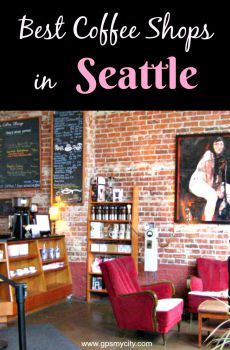
Explore Seattle’s top coffee shops to get a real sense of the eclectic and culturally diverse caffeine buzzed city. Whether you desire a chic downtown coffee café with lots of windows and swanky décor or a dark coffee shop with mix-matched furniture, strong espresso, free wireless and lots of...
The Most Popular Cities
/ view all