

Sochi Introduction Walking Tour, Sochi

Sochi Introduction Walking Tour (Self Guided), Sochi

The city of Sochi is famous for its beaches, mountains and natural beauty, but there are also many amazing monuments, cathedrals and parks that set the city apart and make it a premier travel destination. Take this tour to visit Sochi's most notable landmarks.
How it works: Download the app "GPSmyCity: Walks in 1K+ Cities" from Apple App Store or Google Play Store to your mobile phone or tablet. The app turns your mobile device into a personal tour guide and its built-in GPS navigation functions guide you from one tour stop to next. The app works offline, so no data plan is needed when traveling abroad.

Download The GPSmyCity App

Sochi Introduction Walking Tour Map

Guide Name: Sochi Introduction Walking Tour
Guide Location: Russia » Sochi (See other walking tours in Sochi)
Guide Type: Self-guided Walking Tour (Sightseeing)
# of Attractions: 11
Tour Duration: 3 Hour(s)
Travel Distance: 4.7 Km or 2.9 Miles
Author: Linda
Sight(s) Featured in This Guide:
  • The Monument of the Archangel Michael
  • Japan Garden
  • The Square of Art
  • Art Museum
  • Archangel Michael Cathedral
  • Sea Port
  • Singing Fountains
  • Komsomol Square
  • Riviera Park
  • Feat for Life
  • Oceanarium
1
The Monument of the Archangel Michael

1) The Monument of the Archangel Michael (must see)

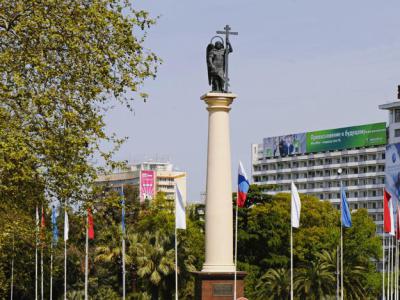
The Monument of the Archangel Michael stands in an open public area close to the coast and is easy to recognize because of its height. The bronze statue of Archangel Michael is about 7 meters tall. It stands on a 5-meter pedestal made of red granite, which is placed on a reinforced concrete column around 20 meters high. Together, the total height reaches about 32 meters. The archangel is shown as a warrior holding a sword and a cross, symbols commonly used in Orthodox tradition to represent protection and faith.

The monument was unveiled on May 10, 2006. It was built to mark the end of the Caucasian War, which lasted from 1817 to 1864, and to honor soldiers who died during that time. Archangel Michael is considered the patron saint of the region, which gives the monument a clear religious role. On certain memorial days and religious holidays, small ceremonies and official events are sometimes held here.

For visitors, the monument is easy to reach and fits well into a walking route. It stands near a busy traffic circle, so the area feels lively rather than quiet. Many people stop for a short time to take photos or read the plaques at the base. Nearby is the Cathedral of St. Michael the Archangel, built between 1874 and 1890, which helps explain why this place is important for local religious traditions. In the evening, lights illuminate the column and statue, making them clearly visible while keeping the monument’s simple and formal look.
2
Japan Garden

2) Japan Garden

Japan Garden was founded in 1981 as the Garden of Russian-Japanese Friendship, created to mark the partnership between Sochi and its twin city, Atami in Japan. The garden is small, covering about 0.6 hectares, and was planned as a quiet place for short walks and rest. Its curved paths guide visitors slowly through the space, with views opening gradually rather than all at once.

A central pond is the main feature of the garden. It is home to fish and red-eared turtles, which are easy to spot from the paths and bridges nearby. Stone lanterns in the Tachi-gata style, carefully placed rocks, and low wooden elements surround the water. These features are arranged to suggest natural scenes such as riverbanks and hills, using simple forms and clear structure instead of decoration.

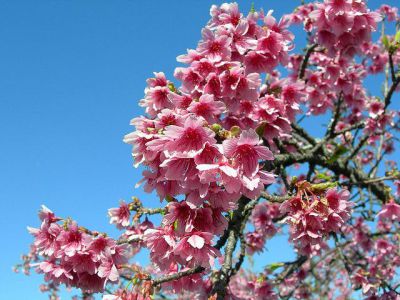
Planting focuses on shape and seasonal change. Evergreen shrubs keep the garden visually stable throughout the year, while maples, bamboo, and flowering cherry trees add variation in different seasons. Benches are placed in quiet corners, making the garden suitable for photography, short breaks, or calm observation. The space is not designed for crowds, and it works best when explored slowly and quietly.
3
The Square of Art

3) The Square of Art

The Square of Art is an open public space that was formed in the 1970s, together with the development of nearby museums and exhibition buildings. It serves mainly as a place to walk, rest, and move between cultural sites. The layout is simple, with wide paved paths, open lawns, and groups of trees that provide shade. People often pass through on foot, meet friends, or stop briefly on benches. The space feels open and easy to use, without gates or strict boundaries.

One of the main features of the square is its outdoor sculpture display. Sculptures are placed directly along the walking paths, so visitors can see them up close. They include realistic figures as well as more modern, abstract forms. Some pieces have small information signs that explain the artist or the idea behind the work. This makes the walk more engaging without turning it into a formal museum visit.

The square is sometimes used for temporary cultural events, especially in warmer months. Small art fairs, open-air exhibitions, and local festivals take place here, with light tents or stands set up and later removed. On regular days, the space stays quiet and calm. In the evening, soft lighting highlights the paths and sculptures, making it pleasant for short walks and brief visits.
4
Art Museum

4) Art Museum (must see)

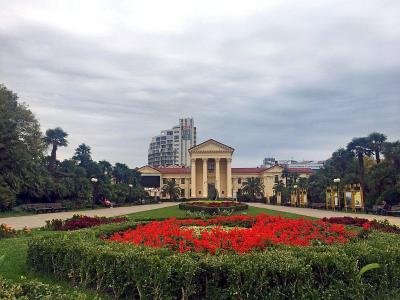
The Sochi Art Museum is located in a large public building completed in 1936. It was designed by Soviet architect Ivan Vladislavovich Zholtovsky. The building was not built as a museum. It first served state authorities and later the city committee of the Communist Party. Designed in the Stalinist Empire style, it has a symmetrical plan, columns, and large interiors. Exhibitions began here in 1972, and it became an art museum in 1976.

The museum’s collection includes more than 6,000 objects and covers a wide time range. Visitors can see items from antiquity, such as ancient silver pieces and weapons, as well as works from the 19th, 20th, and early 21st centuries. The main focus is on Russian art, shown through painting, graphic works, and sculpture.

The permanent exhibition features works by well-known Russian artists, including Ivan Aivazovsky, Ivan Shishkin, Vasily Polenov, and Kuzma Petrov-Vodkin. These works are shown alongside Soviet-era art, making it easy to compare different periods and styles. Temporary exhibitions change often, usually every month, and focus on regional artists, contemporary Russian art, or selected themes from the collection.

The museum also works as an educational space. Along with guided tours and lectures, it includes modern features such as a virtual branch of the Russian Museum, interactive video displays, and 3D cinema equipment. Even with these additions, the atmosphere stays calm. The halls are spacious and well lit, encouraging visitors to move slowly and spend time with each artwork.
5
Archangel Michael Cathedral

5) Archangel Michael Cathedral

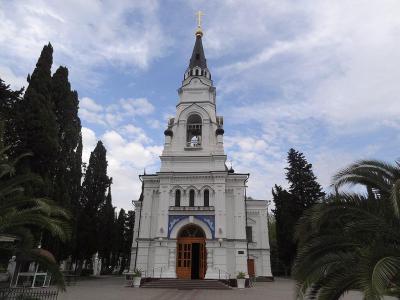
Archangel Michael Cathedral is the oldest Orthodox church on the Black Sea coast. Construction began in 1874 and was completed in 1891. The cathedral was dedicated to Archangel Michael, who was traditionally seen as a protector of the area. Its construction marked the growing presence of the Orthodox Church after the region became part of the Russian Empire.

The cathedral follows a traditional Orthodox design. It has a cross-shaped plan, a central dome, and a bell tower that rises above the surrounding trees. The exterior is simple, with light-colored walls and little decoration. Inside, attention is drawn to the iconostasis. Icons of Christ, the Virgin Mary, and Archangel Michael are arranged in the standard Orthodox order, following church tradition.

During the Soviet period, the church was closed and used for other purposes, which damaged parts of the interior. Services returned in the late 20th century, followed by restoration work. Today, the cathedral is active and holds regular services. Visitors may enter outside service times to see the interior, light candles, or quietly observe church practices. Modest clothing is expected, and photography inside is usually limited.
6
Sea Port

6) Sea Port (must see)

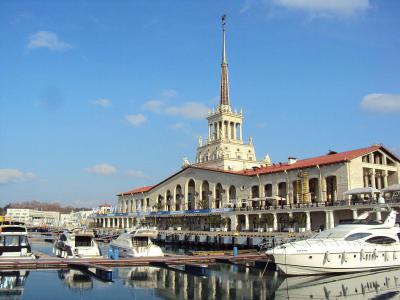
The Sea Port is both a working harbor and a public place by the water. The main terminal building was completed in 1955 and is a clear example of Stalinist Empire style, also known as Soviet Neoclassicism. The design is solid and symmetrical, with a strong focus on balance and order. From the start, the port was built to serve both passenger travel and cargo transport, and it continues to operate in these roles today.

One of the most noticeable features is the central spire, which rises 71 meters above the building. It is topped with a five-pointed star and can be seen from far along the shoreline, making it an easy landmark for visitors. The spire helps define the port’s silhouette and reflects the style and symbolism of the period when the building was constructed.

The terminal is also known for its decorative details. Sculptures by Valentin Ingal are placed on the building and represent the four seasons and the four cardinal points, linking architecture with ideas of time and direction. In front of the terminal, there is a fountain with a statue of the goddess of navigation, which adds a clear maritime reference and marks the main entrance area.

Around the building, the waterfront is arranged for pedestrians. Wide paths follow the edge of the harbor, with benches and open terraces facing the water. Visitors can watch cruise ships, yachts, and smaller sightseeing boats arrive and depart, often from close range. The mix of port activity and open walking space makes it easy to observe daily harbor life while spending time outdoors by the sea.
7
Singing Fountains

7) Singing Fountains (must see)

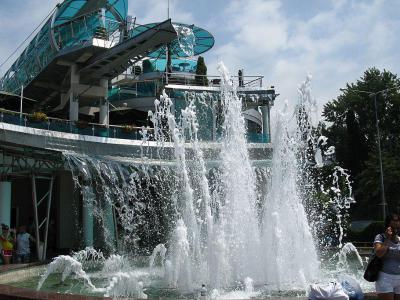
The Singing Fountains are set in a large open space inside the Olympic Park, surrounded by major sports arenas built for the Winter Games. They were planned as a central feature of the area and stand in a wide open square. The design is based on the Firebird from Russian folklore, with a small central basin holding the Olympic flame and a much larger circular fountain area around it.

The fountain uses more than 250 water jets, often described as over 260 nozzles. Several of these are powerful jets that can send water up to about 70 meters high at key moments.This allows the fountain to switch between low water movements and tall vertical streams. The large size mainly describes the overall fountain area, not just the small central bowl with the flame.

The fountains usually work only in the evening and at night, when the lighting effects are clearly visible. Shows follow a fixed seasonal schedule and, in summer, often run from around 9:00 PM to 10:00 PM. During shows, the water moves to music as colored lights change across the fountain. The program mixes classical and popular music and follows a fixed order.

The open layout allows many people to watch at once. Visitors stand around the fountain or along nearby paths, and stepping farther back helps to see the full movement of the water. There are no fences or tickets. When no show is scheduled, the fountain is usually turned off, but the surrounding area remains open for evening walks.
8
Komsomol Square

8) Komsomol Square

Komsomol Square is one of the oldest planned public spaces from the Soviet period. It was created as part of an early city layout that focused on public life. From the beginning, it was meant to be an open square for walking, meeting people, and taking short breaks, not a closed park.

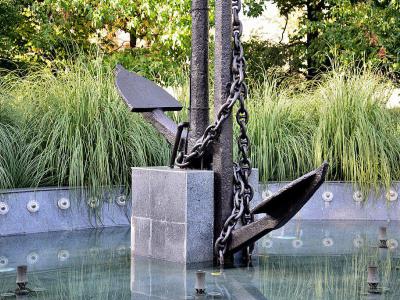
The main feature of the square is the Two Anchors Fountain (Dva Yakorya), designed by sculptor Victor Glukhov. Instead of being decorative, the fountain includes two real anchors from the Russian military fleet, dated to the first half of the 19th century. These anchors give the square a clear connection to maritime history. The water jets are simple, and the fountain is designed to be seen up close, which is why it often works as a meeting point.

Mature trees and planted areas surround the square, softening the paved space and providing shade. Nearby buildings show features of the Stalinist Empire style, especially those linked to the seaport and marine terminal, creating a formal architectural background. Benches and open paths are meant for short stops, not long visits. For visitors, the square shows how historical objects and public art are part of everyday city life in a space that is still practical and in regular use.
9
Riviera Park

9) Riviera Park (must see)

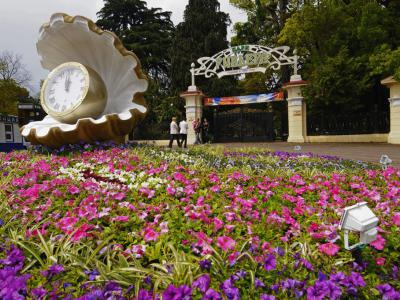
Riviera Park is one of the oldest public parks on the Black Sea coast. It opened in 1898, created by merchant Vasily Khludov as part of an early resort area. From the start, it was planned as a place for walking and rest. The layout has changed little over time, with long straight alleys, open grassy areas, and shaded paths meant for calm walks rather than fast movement.

The park is known for its mix of plants, including palm trees, magnolias, cedars, cypresses, and local species. Some trees are labeled, adding useful context during a walk. Wide, flat paths make the area easy to move through, and benches along the alleys provide spots for short rests and casual meetings.

There is also a small amusement area inside the park. It includes classic rides, a Ferris wheel, and simple game zones. Cafés and kiosks are nearby, creating a lively but manageable atmosphere. Along the paths, you will notice sculptures, fountains, and small memorial signs. Some of them are linked to artists and figures connected with the resort’s early history, adding context without taking over the space.

During warmer months, the park hosts concerts, children’s activities, and public events, often near open stages or main alleys. Even when events are happening, quieter corners remain easy to find. This mix of daily use, light entertainment, and historical details explains why the park remains part of everyday life as well as a place visitors often return to.
10
Feat for Life

10) Feat for Life

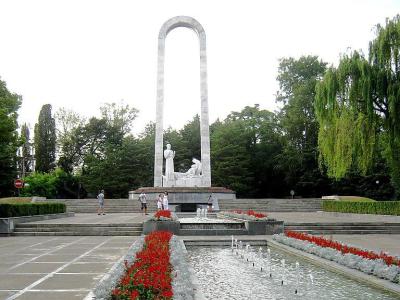
Feat for Life is a memorial dedicated to medical workers who treated wounded soldiers during the Great Patriotic War. Doctors, nurses, and hospital staff worked in local wartime hospitals, where more than 335,000 soldiers received care. The monument focuses on this everyday but demanding work, showing how medical help played a major role in saving lives away from the battlefield.

The memorial was designed in the late Soviet period. Construction began in 1974, but it was officially opened on May 8, 1995, for the 50th anniversary of Victory Day. The main feature is a steel arch about 20 meters high, often seen as a symbol of the “road to life.” Beneath it is a sculptural group made of marble and granite, showing a surgeon, a nurse, and a wounded soldier. A fountain placed in front of the figures adds movement through flowing water, giving the scene a sense of life.

The area around the memorial has paths, trees, and flower beds, making it a quiet place for a short stop. On commemorative dates, especially May 9, people come to lay flowers. For visitors, the site shows the wartime role of medical workers and how monuments can express this history through simple forms and clear symbols.
11
Oceanarium

11) Oceanarium (must see)

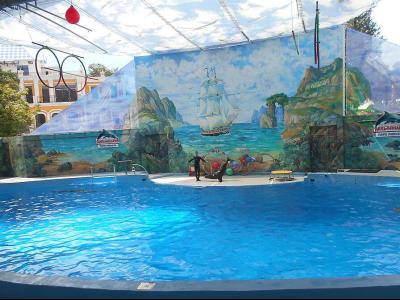
The Oceanarium in Riviera Park was added in 2007 and works as a small, indoor aquarium that is easy to visit in any season. It is often described as compact, so most people can see everything in a short visit without feeling lost or overwhelmed. The space is arranged as a simple walk-through route with dim lighting near the tanks to cut reflections and help visitors see the fish more clearly. Signs are short and easy to follow, making it suitable for families and first-time visitors.

Instead of large-scale features like a long underwater tunnel, this oceanarium focuses on smaller themed displays. You will see saltwater tanks with reef fish and tropical species, as well as freshwater sections with fish from rivers and lakes. The tanks are built for close viewing, making it easy to notice colors, movement, and behavior. The displays are simple and focused on clear observation rather than scale.

Shows and scheduled activities are a big part of the visit. The oceanarium is known for mermaid shows and for fish-feeding sessions that can include scuba divers, which gives visitors a closer look at how the animals are cared for. Simple educational panels explain basic facts like habitats, feeding habits, and how aquarium systems keep the water clean. With wide paths, places to pause, and a calm indoor setting, it works well as a short stop during a park visit—especially if the weather is hot or rainy.

Walking Tours in Sochi, Russia

Create Your Own Walk in Sochi

Create Your Own Walk in Sochi

Creating your own self-guided walk in Sochi is easy and fun. Choose the city attractions that you want to see and a walk route map will be created just for you. You can even set your hotel as the start point of the walk.
Architectural Landmarks

Architectural Landmarks

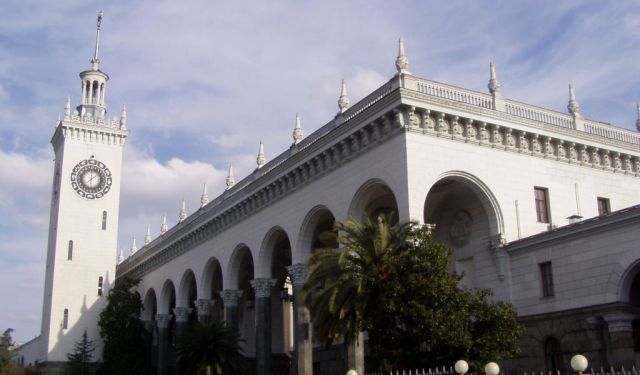
Sochi is home to a variety of architectural forms, although the prevalent style blends the man-made and the natural, as is fitting for a sea-side resort. On this self-guided tour you will visit the most notable buildings in Sochi.

Tour Duration: 3 Hour(s)
Travel Distance: 7.7 Km or 4.8 Miles