

Top Religious Buildings (Self Guided), Hamilton
Religious life in Hamilton is channelled into many congregations, which are spreading different religions and providing space for worship for everybody. Take this tour and discover the oldest and most attractive churches with very impressive architecture and rich history.
How it works: Download the app "GPSmyCity: Walks in 1K+ Cities" from Apple App Store or Google Play Store to your mobile phone or tablet. The app turns your mobile device into a personal tour guide and its built-in GPS navigation functions guide you from one tour stop to next. The app works offline, so no data plan is needed when traveling abroad.
Top Religious Buildings Map
Guide Name: Top Religious Buildings
Guide Location: Canada » Hamilton (See other walking tours in Hamilton)
Guide Type: Self-guided Walking Tour (Sightseeing)
# of Attractions: 8
Tour Duration: 2 Hour(s)
Travel Distance: 3.4 Km or 2.1 Miles
Author: Linda
Sight(s) Featured in This Guide:
Guide Location: Canada » Hamilton (See other walking tours in Hamilton)
Guide Type: Self-guided Walking Tour (Sightseeing)
# of Attractions: 8
Tour Duration: 2 Hour(s)
Travel Distance: 3.4 Km or 2.1 Miles
Author: Linda
Sight(s) Featured in This Guide:
- Christ Church Cathedral
- St. John's Evangelical Lutheran Church
- St. Paul's Presbyterian Church
- James St. Baptist Church
- McNab Presbyterian Church
- Central Presbyterian Church
- St. Joseph's Church
- Melrose United Church
1) Christ Church Cathedral
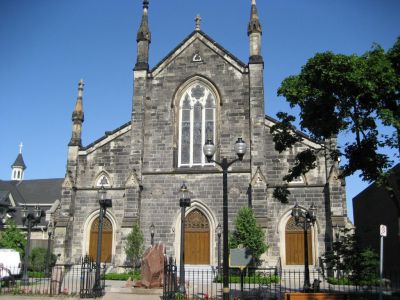
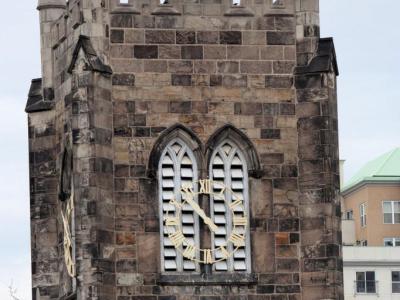
Christ Church Cathedral was founded in 1835 and became the seat of the Anglican Diocese of Niagara in 1876. The first church was a wooden building designed by Robert Charles Wetherell. In the 1850s, William Thomas added stone sections, creating an uneven structure known as “the humpback church.” Henry Langley later completed the stone nave in 1873, and the cathedral was consecrated on January 1, 1876. The chancel was extended again in 1925 by William Palmer Witton.
The cathedral is an example of English Decorated Gothic Revival architecture. Its stone exterior, pointed arches, and tall tower follow medieval English models. Inside, visitors can see a ribbed barrel-vaulted plaster ceiling with carved bosses and a hammer-beam truss roof over the chancel. Behind the altar stands a carved Caen stone reredos. The stained-glass windows span more than a century, from 1853 to 1954, reflecting changing artistic styles and memorial traditions.
Music has long been central to cathedral life. The current pipe organ is a Casavant instrument, Opus 1048, first installed in 1924 and rebuilt several times, most recently in 1998. It now has 59 stops and 3,898 pipes. Beyond worship, the cathedral helped establish groups such as the Hamilton Children’s Choir and St. Matthew’s House, and it continues to support community outreach, including programs that serve unhoused neighbours.
The cathedral is an example of English Decorated Gothic Revival architecture. Its stone exterior, pointed arches, and tall tower follow medieval English models. Inside, visitors can see a ribbed barrel-vaulted plaster ceiling with carved bosses and a hammer-beam truss roof over the chancel. Behind the altar stands a carved Caen stone reredos. The stained-glass windows span more than a century, from 1853 to 1954, reflecting changing artistic styles and memorial traditions.
Music has long been central to cathedral life. The current pipe organ is a Casavant instrument, Opus 1048, first installed in 1924 and rebuilt several times, most recently in 1998. It now has 59 stops and 3,898 pipes. Beyond worship, the cathedral helped establish groups such as the Hamilton Children’s Choir and St. Matthew’s House, and it continues to support community outreach, including programs that serve unhoused neighbours.
2) St. John's Evangelical Lutheran Church
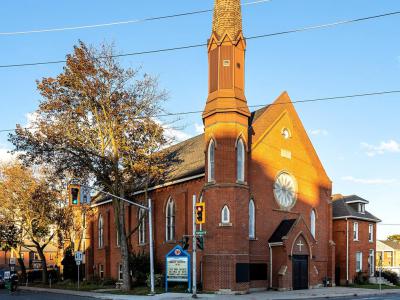
The present brick building was erected in 1882 as St. Paul’s Baptist Church. In the late 19th century, a German Lutheran congregation purchased the property and rededicated it as St. Paul’s Evangelical Lutheran Church, establishing a permanent parish for worship in their own language. In 1955, following a broader Lutheran reorganisation, the congregation adopted the name St. John’s Evangelical Lutheran Church, which it continues to use today.
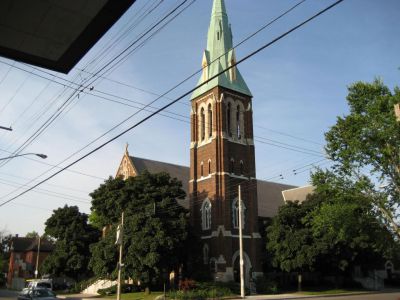
Architecturally, the church is a clear example of Gothic Revival design. Red brick walls, pointed-arch windows, and a modest square-based steeple define its exterior. Later additions expanded the complex and adjusted the entrance, yet the original sanctuary remains central to the structure. The building’s proportions are straightforward and consistent with late 19th-century Protestant church design.
Inside, the sanctuary is simple and bright, with wooden pews, stained glass, and a historic pipe organ that supports regular worship and music. Services are still offered in both English and German, reflecting the congregation’s immigrant roots. The church is active in social ministry, welcoming refugees, partnering with local institutions for winter street outreach to people experiencing homelessness, and providing space for community programs.
Architecturally, the church is a clear example of Gothic Revival design. Red brick walls, pointed-arch windows, and a modest square-based steeple define its exterior. Later additions expanded the complex and adjusted the entrance, yet the original sanctuary remains central to the structure. The building’s proportions are straightforward and consistent with late 19th-century Protestant church design.
Inside, the sanctuary is simple and bright, with wooden pews, stained glass, and a historic pipe organ that supports regular worship and music. Services are still offered in both English and German, reflecting the congregation’s immigrant roots. The church is active in social ministry, welcoming refugees, partnering with local institutions for winter street outreach to people experiencing homelessness, and providing space for community programs.
3) St. Paul's Presbyterian Church (must see)
St. Paul's Presbyterian Church traces its origins to 1830, when Scottish immigrants established a Presbyterian congregation originally known as St. Andrew’s Church. In its earliest years, worship took place in a local courthouse before a small frame church was built on the present site in 1835.
The current stone structure was constructed between 1854 and 1857, reflecting the confidence of Canadian Presbyterianism in the years following the “Great Disruption” of 1843–44. In 1873, after internal congregational conflicts, the church adopted the name St. Paul’s.
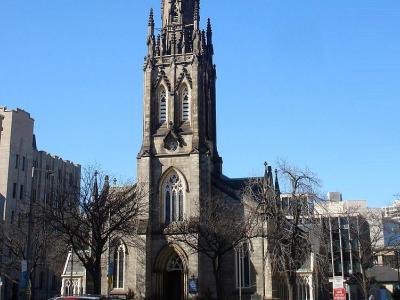
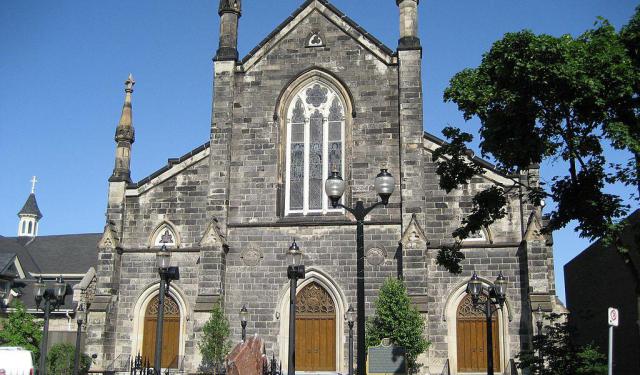
The building is a strong example of Ecclesiological Gothic Revival design. Constructed of local grey limestone, it features pointed-arch windows, buttresses, and a tall steeple rising about 180 feet. The steeple is composed of a 100-foot tower crowned by an 80-foot octagonal spire, forming a clear vertical landmark within the downtown skyline. The structure’s proportions and masonry give it both visual clarity and durability.
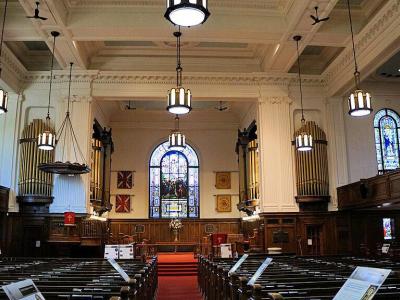
Inside, the sanctuary combines scale with craftsmanship. Dark wood finishes, a large all-oak balcony, and an exposed truss ceiling shape the interior space. While Presbyterian tradition places emphasis on preaching and congregational singing, later additions added decorative detail. In 1906, the chancel was extended and enriched with carved foliage capitals, introducing a subtle layer of ornament to the otherwise restrained setting.
Today, St. Paul’s continues as an active congregation, holding regular Sunday services at 11 am and hosting concerts, weddings, and community events such as the annual Doors Open program. Its long history and architectural presence make it an important witness to early Scottish settlement and Presbyterian life in the region.
The current stone structure was constructed between 1854 and 1857, reflecting the confidence of Canadian Presbyterianism in the years following the “Great Disruption” of 1843–44. In 1873, after internal congregational conflicts, the church adopted the name St. Paul’s.
The building is a strong example of Ecclesiological Gothic Revival design. Constructed of local grey limestone, it features pointed-arch windows, buttresses, and a tall steeple rising about 180 feet. The steeple is composed of a 100-foot tower crowned by an 80-foot octagonal spire, forming a clear vertical landmark within the downtown skyline. The structure’s proportions and masonry give it both visual clarity and durability.
Inside, the sanctuary combines scale with craftsmanship. Dark wood finishes, a large all-oak balcony, and an exposed truss ceiling shape the interior space. While Presbyterian tradition places emphasis on preaching and congregational singing, later additions added decorative detail. In 1906, the chancel was extended and enriched with carved foliage capitals, introducing a subtle layer of ornament to the otherwise restrained setting.
Today, St. Paul’s continues as an active congregation, holding regular Sunday services at 11 am and hosting concerts, weddings, and community events such as the annual Doors Open program. Its long history and architectural presence make it an important witness to early Scottish settlement and Presbyterian life in the region.
4) James St. Baptist Church
James Street Baptist Church began in 1827, when a small Baptist congregation met in private homes. As the community expanded in the 19th century, a larger church was commissioned. Completed in 1878, the stone church was built in the Gothic Revival style, with pointed arch windows, buttresses, and a square tower. For generations, it served as a place of worship and community gatherings.
Inside, the layout followed Baptist tradition, with attention directed toward the pulpit rather than a formal altar. Wooden pews, stained glass, and a high ceiling shaped a space used for services, music, and public meetings. Over time, however, structural problems and a declining congregation made maintaining the large building increasingly difficult.
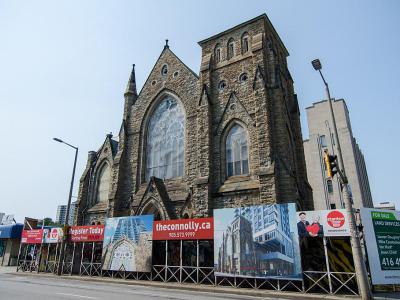
In 2014, most of the church was demolished, leaving only the front façade and square tower as heritage elements. A condominium project called The Connolly was planned for the site, but it ran into financial problems, including bankruptcy and receivership. As of late 2024, the high-rise has not been built, and the preserved façade and tower stand alone as reminders of the former church.
Inside, the layout followed Baptist tradition, with attention directed toward the pulpit rather than a formal altar. Wooden pews, stained glass, and a high ceiling shaped a space used for services, music, and public meetings. Over time, however, structural problems and a declining congregation made maintaining the large building increasingly difficult.
In 2014, most of the church was demolished, leaving only the front façade and square tower as heritage elements. A condominium project called The Connolly was planned for the site, but it ran into financial problems, including bankruptcy and receivership. As of late 2024, the high-rise has not been built, and the preserved façade and tower stand alone as reminders of the former church.
5) McNab Presbyterian Church
MacNab Street Presbyterian Church began in 1854 as a Free Church congregation. A simple wooden building was first put up that year. The present stone church followed soon after, with its foundation stone laid in 1856 by Isaac Buchanan, and services starting around 1857. Although the street carries the name of Sir Allan Napier MacNab, the congregation itself was formed through Presbyterian leadership and has remained Presbyterian ever since.
Built in the Gothic Revival style, the church uses Dundas and Ancaster limestone. Pointed-arch windows and buttresses shape its vertical design, and the tower, planned with a spire, remains flat-topped. The original architect is unknown, though often linked to Albert H. Hills or William Thomas. A Manse was added in 1871 and a School Building in 1878, while the sanctuary changed little.
In the 1930s, the interior was redesigned. Floors were lowered, side galleries were removed, and a wide centre aisle was created. Nine stained-glass windows by Scottish artists William Wilson and James Ballantyne bring colour into the space. The Casavant Frères organ, installed in 1934 with two manuals and later expanded to three, replaced an earlier 1877 instrument while keeping some of its original pipes.
Built in the Gothic Revival style, the church uses Dundas and Ancaster limestone. Pointed-arch windows and buttresses shape its vertical design, and the tower, planned with a spire, remains flat-topped. The original architect is unknown, though often linked to Albert H. Hills or William Thomas. A Manse was added in 1871 and a School Building in 1878, while the sanctuary changed little.
In the 1930s, the interior was redesigned. Floors were lowered, side galleries were removed, and a wide centre aisle was created. Nine stained-glass windows by Scottish artists William Wilson and James Ballantyne bring colour into the space. The Casavant Frères organ, installed in 1934 with two manuals and later expanded to three, replaced an earlier 1877 instrument while keeping some of its original pipes.
6) Central Presbyterian Church
Central Presbyterian Church began in 1841 with ten members and two adherents, meaning supporters who attended but were not yet full members. The group first met in a schoolhouse, then built a stone church in 1858. That building was destroyed by fire on June 21, 1906. The current church opened on June 14, 1908, and has served the community ever since.
The church was designed by John M. Lyle, a respected Canadian architect and the son of the congregation’s minister. It is the only church he ever designed. The building reflects a Beaux-Arts, often described as Georgian, style, with a balanced and symmetrical layout. Visitors can notice semi-circular stairwells, an open-arch tower, and a tapering octagonal spire. The design focuses on proportion and clear lines rather than Gothic details.
Music has long shaped the church’s identity, although an organ was not permitted until 1875. After the 1906 fire, a Casavant Frères pipe organ from Quebec was installed in the new building. In 1950, the church became known for its significant Möller pipe organ installation. Together, these instruments highlight a strong musical tradition that continues to be part of the church’s life today.
The church was designed by John M. Lyle, a respected Canadian architect and the son of the congregation’s minister. It is the only church he ever designed. The building reflects a Beaux-Arts, often described as Georgian, style, with a balanced and symmetrical layout. Visitors can notice semi-circular stairwells, an open-arch tower, and a tapering octagonal spire. The design focuses on proportion and clear lines rather than Gothic details.
Music has long shaped the church’s identity, although an organ was not permitted until 1875. After the 1906 fire, a Casavant Frères pipe organ from Quebec was installed in the new building. In 1950, the church became known for its significant Möller pipe organ installation. Together, these instruments highlight a strong musical tradition that continues to be part of the church’s life today.
7) St. Joseph's Church
St. Joseph’s Parish began about 130 years ago as a small wooden German mission church at the corner of Jackson and Charles Streets. As the congregation grew, a larger church was built at a new site. Bishop Thomas J. Dowling laid the cornerstone on September 24, 1893, and the church was dedicated on June 24, 1894. It mainly served working-class Catholic families from nearby railway and industrial areas.
The church is built in the Gothic Revival style. Its red brick exterior includes pointed-arch windows and a cemented tower topped with a cross. The vertical lines and balanced proportions reflect late 19th-century church design. Inside, high vaulted arches and dark wood cladding across the ceiling shape the interior. The church is known for its strong acoustics, and several stained-glass windows date to 1894, with ten more added later.
Parish education grew with the church. Before 1920, it was linked to St. Vincent’s School. In September 1920, St. Joseph School opened in a former Presbyterian church and was run by the Loretto Sisters until 1958. In 1924, Fr. Alban J. Leyes led major interior renovations without canceling Mass. The parish was entrusted to the Congregation of the Resurrection in 1933 and returned to diocesan leadership on March 31, 2022.
The church is built in the Gothic Revival style. Its red brick exterior includes pointed-arch windows and a cemented tower topped with a cross. The vertical lines and balanced proportions reflect late 19th-century church design. Inside, high vaulted arches and dark wood cladding across the ceiling shape the interior. The church is known for its strong acoustics, and several stained-glass windows date to 1894, with ten more added later.
Parish education grew with the church. Before 1920, it was linked to St. Vincent’s School. In September 1920, St. Joseph School opened in a former Presbyterian church and was run by the Loretto Sisters until 1958. In 1924, Fr. Alban J. Leyes led major interior renovations without canceling Mass. The parish was entrusted to the Congregation of the Resurrection in 1933 and returned to diocesan leadership on March 31, 2022.
8) Melrose United Church
Melrose United Church was founded on November 13, 1925, when Charlton Avenue Methodist Church and Westmount Presbyterian Church merged. This happened soon after the United Church of Canada was formed that same year. The name “Melrose” was chosen in honour of Melrose Abbey in Scotland, reflecting both Presbyterian and Methodist roots.
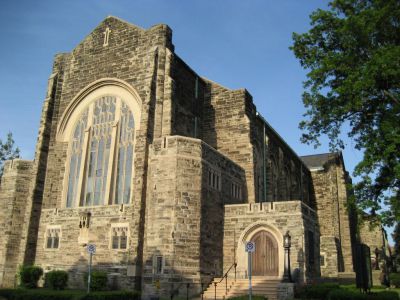
The present building opened on March 31, 1929, Easter Sunday. Designed in the Neo-Gothic style and inspired by Melrose Abbey in Scotland, it is defined by its mottled limestone walls and strong vertical lines that lead the eye toward the tower and pointed windows. Although some brick is used, the limestone and Gothic details shape its overall appearance.
Inside, the sanctuary is bright and spacious, with attention focused on the pulpit and choir area. The stained-glass windows stand out, illustrating biblical stories in rich colours. Many of these windows were donated as memorials, linking the church to families who supported it over generations. Today, the church continues to serve as an active place of worship and a community gathering space, hosting services, concerts, and local events.
The present building opened on March 31, 1929, Easter Sunday. Designed in the Neo-Gothic style and inspired by Melrose Abbey in Scotland, it is defined by its mottled limestone walls and strong vertical lines that lead the eye toward the tower and pointed windows. Although some brick is used, the limestone and Gothic details shape its overall appearance.
Inside, the sanctuary is bright and spacious, with attention focused on the pulpit and choir area. The stained-glass windows stand out, illustrating biblical stories in rich colours. Many of these windows were donated as memorials, linking the church to families who supported it over generations. Today, the church continues to serve as an active place of worship and a community gathering space, hosting services, concerts, and local events.
Walking Tours in Hamilton, Canada

Create Your Own Walk in Hamilton
Creating your own self-guided walk in Hamilton is easy and fun. Choose the city attractions that you want to see and a walk route map will be created just for you. You can even set your hotel as the start point of the walk.

Hamilton Introduction Walking Tour
Hamilton, a port city on the western tip of Lake Ontario in Canada, is dominated by the Niagara Escarpment, a massive, forested ridge commonly referred to as "the mountain". Aside from this, there are other, man-made, attractions in the city, including HMCS Haida, a naval warship moored at the city's lakefront, and the Hamilton Military Museum, showcasing Canada's military... view more
Tour Duration: 2 Hour(s)
Travel Distance: 5.1 Km or 3.2 Miles
Tour Duration: 2 Hour(s)
Travel Distance: 5.1 Km or 3.2 Miles
Westdale Tour
Westdale Village is a neighbourhood in Hamilton, bustling with specialty shops and interesting places. Locals and visitors are delighted by the plethora of boutiques, bakeries, pubs and stores with unique items. Be ready to devote some of your time to visiting the worthwhile places in Westdale, presented in this self-guided tour.
Tour Duration: 1 Hour(s)
Travel Distance: 0.7 Km or 0.4 Miles
Tour Duration: 1 Hour(s)
Travel Distance: 0.7 Km or 0.4 Miles
The Most Popular Cities
/ view all