

Shopping Streets (Self Guided), Frankfurt
Frankfurt may well be an international business center in the first place, but not everything, by far, revolves here around finance. The city can also provide a top shopping experience for those seeking to invest in international and best German designer merchandise.
"Frankfurt is a shopping paradise - if you're a bird!" they say. This is a humorous way of saying that Frankfurt is expensive, especially when it comes to shopping, and may not be suitable for those on a tight budget. But then again, "Frankfurt's shopping is like a box of chocolates - you never know what you're going to get." - This joking twist on a famous line from the Forrest Gump movie suggests that shopping in Frankfurt can be unpredictable and surprising, with a range of unique and unexpected finds.
The main shopping district of Frankfurt is the Zeil, a pedestrianized street running through the city center. Here you will find an abundance of department stores, fashion boutiques, and souvenir outlets. Some of the most popular names on the street include Galeria Kaufhof, Zara, and H&M.
If you're looking for luxury shopping, head to Goethe Street, home to high-end designer brands like Gucci, Prada, and Louis Vuitton. This neighborhood is known for its exclusive retailers and is a popular destination for those looking to splurge on designer goods.
Another popular destination is Neue Kräme. It gets particularly charming during the winter, lined with Christmas markets that offer a wide range of traditional holiday items, such as ornaments, handmade gifts, and seasonal foods and drinks.
Speaking of food, a popular proverb "I went to Frankfurt for shopping and came back with a sausage" offers a play on words regarding the renowned "Frankfurter" sausage, which is the most common snack to buy when out shopping.
While these sayings are meant to be humorous and light-hearted, they also reflect some of the quirks and unique aspects of shopping in Frankfurt. If you come for a leisurely shopping spree or just wish to explore the most popular and sophisticated shopping locations in the city, albeit out of sheer curiosity, take this self-guided walk and have a good time!
"Frankfurt is a shopping paradise - if you're a bird!" they say. This is a humorous way of saying that Frankfurt is expensive, especially when it comes to shopping, and may not be suitable for those on a tight budget. But then again, "Frankfurt's shopping is like a box of chocolates - you never know what you're going to get." - This joking twist on a famous line from the Forrest Gump movie suggests that shopping in Frankfurt can be unpredictable and surprising, with a range of unique and unexpected finds.
The main shopping district of Frankfurt is the Zeil, a pedestrianized street running through the city center. Here you will find an abundance of department stores, fashion boutiques, and souvenir outlets. Some of the most popular names on the street include Galeria Kaufhof, Zara, and H&M.
If you're looking for luxury shopping, head to Goethe Street, home to high-end designer brands like Gucci, Prada, and Louis Vuitton. This neighborhood is known for its exclusive retailers and is a popular destination for those looking to splurge on designer goods.
Another popular destination is Neue Kräme. It gets particularly charming during the winter, lined with Christmas markets that offer a wide range of traditional holiday items, such as ornaments, handmade gifts, and seasonal foods and drinks.
Speaking of food, a popular proverb "I went to Frankfurt for shopping and came back with a sausage" offers a play on words regarding the renowned "Frankfurter" sausage, which is the most common snack to buy when out shopping.
While these sayings are meant to be humorous and light-hearted, they also reflect some of the quirks and unique aspects of shopping in Frankfurt. If you come for a leisurely shopping spree or just wish to explore the most popular and sophisticated shopping locations in the city, albeit out of sheer curiosity, take this self-guided walk and have a good time!
How it works: Download the app "GPSmyCity: Walks in 1K+ Cities" from Apple App Store or Google Play Store to your mobile phone or tablet. The app turns your mobile device into a personal tour guide and its built-in GPS navigation functions guide you from one tour stop to next. The app works offline, so no data plan is needed when traveling abroad.
Shopping Streets Map
Guide Name: Shopping Streets
Guide Location: Germany » Frankfurt (See other walking tours in Frankfurt)
Guide Type: Self-guided Walking Tour (Sightseeing)
# of Attractions: 6
Tour Duration: 1 Hour(s)
Travel Distance: 2.1 Km or 1.3 Miles
Author: helenp
Sight(s) Featured in This Guide:
Guide Location: Germany » Frankfurt (See other walking tours in Frankfurt)
Guide Type: Self-guided Walking Tour (Sightseeing)
# of Attractions: 6
Tour Duration: 1 Hour(s)
Travel Distance: 2.1 Km or 1.3 Miles
Author: helenp
Sight(s) Featured in This Guide:
- Neue Kräme
- Tongesgasse
- Zeil Shopping Lane
- Goethestrasse (Goethe Street)
- Fressgass (Grosse Bockenheimer Strasse)
- Schillerstrasse
1) Neue Kräme
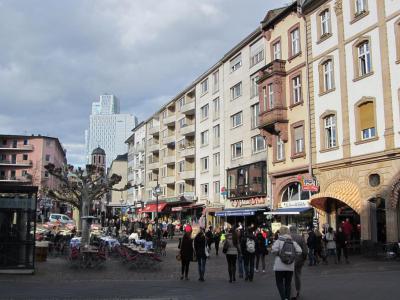
Steeped in history, Neue Kräme is one of the main shopping streets in the densely built-up Old Town of Frankfurt. While it is home to some well-known specialty stores, unlike other thoroughfares in the city, the proportion of chain stores here is quite low. The name of the street indicates that, back in Medieval times, it was used as a marketplace (fairground) for selling crockery, glassware, and other household items. The Gothic hall on the first floor of the Römer Town Hall served as the main exhibition space, while the nearby Nürnberger Hof (“Nuremberg Court”) and Steinerne Haus (“Stone House”) served as quarters for the merchants.
On March 22, 1944, an Allied air bombing almost completely destroyed the Old Town. In Neue Kräme, however, some of the more massive commercial buildings survived the attack. After the war, the city administration launched a large-scale reconstruction according to the principles of urban modernism. The destroyed street block between Paulsplatz and Neuer Kräme, the location of the old stock exchange, was not rebuilt, so, today, Neue Kräme curbs the east side of the enlarged Paulsplatz.
In summer, part of the square is occupied by street cafes. In winter, the Frankfurt Christmas market stretches along the entire length of Neuer Kräme, from Römerberg via Paulsplatz to Liebfrauenberg. As a link between the Schnellbahn junction at the Hauptwache and the tourist attractions of the Old Town, Neue Kräme plays an important role in inner-city pedestrian traffic. Being a pedestrian zone since 1968, it connects, north to south, two major city squares – Liebfrauenberg and Römerberg, reaching all the way down, via Fahrtor, to the Main River.
On March 22, 1944, an Allied air bombing almost completely destroyed the Old Town. In Neue Kräme, however, some of the more massive commercial buildings survived the attack. After the war, the city administration launched a large-scale reconstruction according to the principles of urban modernism. The destroyed street block between Paulsplatz and Neuer Kräme, the location of the old stock exchange, was not rebuilt, so, today, Neue Kräme curbs the east side of the enlarged Paulsplatz.
In summer, part of the square is occupied by street cafes. In winter, the Frankfurt Christmas market stretches along the entire length of Neuer Kräme, from Römerberg via Paulsplatz to Liebfrauenberg. As a link between the Schnellbahn junction at the Hauptwache and the tourist attractions of the Old Town, Neue Kräme plays an important role in inner-city pedestrian traffic. Being a pedestrian zone since 1968, it connects, north to south, two major city squares – Liebfrauenberg and Römerberg, reaching all the way down, via Fahrtor, to the Main River.
2) Tongesgasse
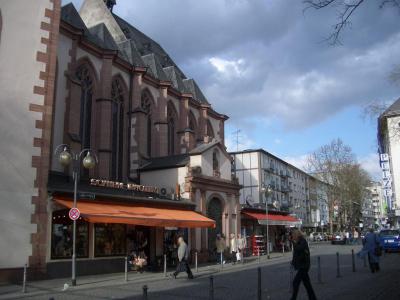
Another major shopping street in Frankfurt's Old Town, Töngesgasse is not a designated pedestrian zone and, therefore, has less pedestrian traffic than the prime locations, like the Zeil or Neue Kräme. The street runs south, from Liebfrauenberg to Fahrgasse, parallel to the Zeil. In contrast to the Zeil, though, the Töngesgasse retailers are not part of the regional chains but are rather privately-owned specialty stores. Some of them have been in place for more than 100 years, like the W. Wächtershäuser haberdashery shop – open since 1822, the Hensler optician's shop – since 1864, the Andreas seed shop – since 1868, the Gabler leather shop – since 1877, or the Dotzert knife and weapon shop – since 1879. The local Café Mozart is one of the most famous coffee houses in the city. An ideal place to spend an afternoon.
The street was built after the Hohenstaufen city expansion in the 12th century. In 1236, the Antonine monks founded a farm in the area, to which later was added a church, the Antoniterkloster. The emerged monastery gave its name to the street (Antonius = Tönges). The monastery itself, hardly used since the Reformation, was demolished in 1803. In its place, the city architect Johann Georg Christian Hess put a number of multi-storey classicist apartment buildings in 1810.
In March 1944, almost the entire Old Town of Frankfurt, including Töngesgasse, was destroyed by Allied air raids. Among those that survived were only the Baroque rear building and the Renaissance-period octagonal stair tower of the Rosenberg house, built circa 1600, known as Schönborner Hof.
After the war, the street was rebuilt, and the urban layout and the adjacent road network changed completely. Today, local retailers are united in the Töngesgasse interest group. Each year in August, the group organizes a street festival, called the Antoniterfest.
The street was built after the Hohenstaufen city expansion in the 12th century. In 1236, the Antonine monks founded a farm in the area, to which later was added a church, the Antoniterkloster. The emerged monastery gave its name to the street (Antonius = Tönges). The monastery itself, hardly used since the Reformation, was demolished in 1803. In its place, the city architect Johann Georg Christian Hess put a number of multi-storey classicist apartment buildings in 1810.
In March 1944, almost the entire Old Town of Frankfurt, including Töngesgasse, was destroyed by Allied air raids. Among those that survived were only the Baroque rear building and the Renaissance-period octagonal stair tower of the Rosenberg house, built circa 1600, known as Schönborner Hof.
After the war, the street was rebuilt, and the urban layout and the adjacent road network changed completely. Today, local retailers are united in the Töngesgasse interest group. Each year in August, the group organizes a street festival, called the Antoniterfest.
3) Zeil Shopping Lane
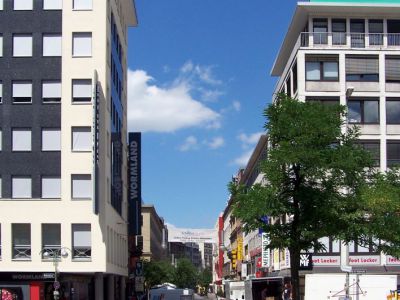
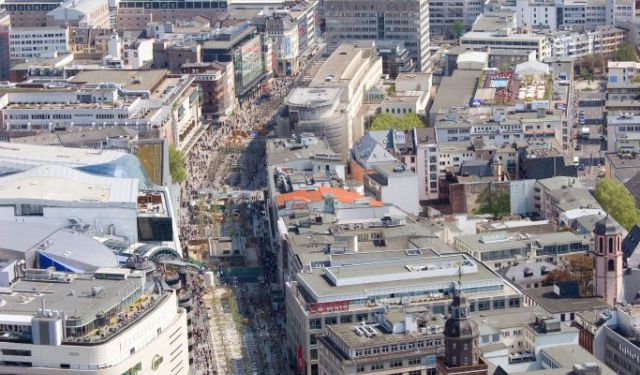
Zeil is Frankfurt’s main shopping street and one of the busiest retail areas in Germany. The wide boulevard runs between the major city squares Hauptwache and Konstablerwache, forming the central commercial corridor of the city. Most of the street is pedestrianized, creating a lively space filled with shops, department stores, cafés, and restaurants. Because of its central location and variety of stores, Zeil attracts both locals and visitors throughout the day.
Historically, Zeil has been one of Frankfurt’s most important commercial streets for centuries. Before the Second World War it was lined with elegant historic buildings and was often called one of the finest shopping avenues in Europe. Much of the street was destroyed during the air raids of 1944 and later rebuilt with modern architecture. Today the area reflects postwar reconstruction combined with contemporary retail buildings.
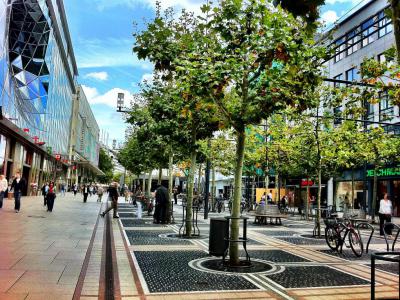
One of the most striking landmarks along the street is MyZeil, a modern shopping mall opened in 2009. Its glass façade features a dramatic swirling design often described as a “glass vortex,” making it one of the most recognizable modern buildings in Frankfurt. Inside, several floors of shops, restaurants, and entertainment spaces attract large numbers of visitors.
At both ends of Zeil are two important city squares that serve as transportation hubs. Hauptwache Square marks the western entrance to the street, while Konstablerwache Square forms its eastern end and frequently hosts weekly markets and food stalls.
Historically, Zeil has been one of Frankfurt’s most important commercial streets for centuries. Before the Second World War it was lined with elegant historic buildings and was often called one of the finest shopping avenues in Europe. Much of the street was destroyed during the air raids of 1944 and later rebuilt with modern architecture. Today the area reflects postwar reconstruction combined with contemporary retail buildings.
One of the most striking landmarks along the street is MyZeil, a modern shopping mall opened in 2009. Its glass façade features a dramatic swirling design often described as a “glass vortex,” making it one of the most recognizable modern buildings in Frankfurt. Inside, several floors of shops, restaurants, and entertainment spaces attract large numbers of visitors.
At both ends of Zeil are two important city squares that serve as transportation hubs. Hauptwache Square marks the western entrance to the street, while Konstablerwache Square forms its eastern end and frequently hosts weekly markets and food stalls.
4) Goethestrasse (Goethe Street)
Goethe Street is Frankfurt’s best-known luxury shopping street and one of the most elegant retail areas in the city. Located in the center of Frankfurt, it connects the busy shopping district around Hauptwache with the square in front of the Old Opera, the city’s historic opera house. Named after the famous writer Johann Wolfgang von Goethe, who was born in Frankfurt, the street reflects the city’s reputation as both a cultural and financial center.
The street is lined with high-end boutiques and flagship stores belonging to many of the world’s leading fashion houses. Brands such as Chanel, Louis Vuitton, Gucci, Prada, and Cartier have shops here, making Goethe Street Frankfurt’s main destination for luxury shopping. Because of the concentration of designer stores, it is often compared with the most prestigious shopping streets in other major European cities.
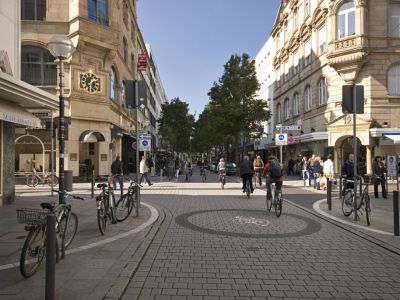
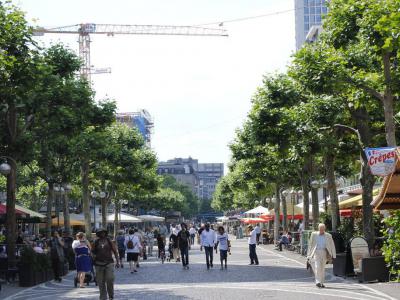
Compared with the nearby Zeil, which attracts large crowds of shoppers, Goethe Street has a more refined atmosphere. The wide boulevard is bordered by modern shop façades, carefully designed storefront displays, and rows of trees that add a sense of elegance to the street.
The street is lined with high-end boutiques and flagship stores belonging to many of the world’s leading fashion houses. Brands such as Chanel, Louis Vuitton, Gucci, Prada, and Cartier have shops here, making Goethe Street Frankfurt’s main destination for luxury shopping. Because of the concentration of designer stores, it is often compared with the most prestigious shopping streets in other major European cities.
Compared with the nearby Zeil, which attracts large crowds of shoppers, Goethe Street has a more refined atmosphere. The wide boulevard is bordered by modern shop façades, carefully designed storefront displays, and rows of trees that add a sense of elegance to the street.
5) Fressgass (Grosse Bockenheimer Strasse)
Fressgass (literally, "Grazing Street") is an upmarket shopping street in the heart of Frankfurt, shared between the district of Innenstadt and the central business area, known as Bankenviertel. It is commonly regarded as Frankfurt's culinary main street. Fressgass has a broad pedestrian zone, located between Opernplatz (Opera Square – home to the Alte Oper) and Börsenstrasse (Stock Exchange Street) housing the Frankfurt Stock Exchange. The street is also the direct continuation (in the western direction) of the Zeil and runs parallel to Goethestrasse, one of Germany's busiest luxury shopping lanes.
Fressgass was originally an unofficial name, adopted around 1900 by the locals for the streets Kalbächer Gasse and Grosse Bockenheimer Strasse because of their many high-end food shops, bakeries, and butcheries, making it the most famous food shopping destination serving the bourgeoisie of the Westend. Today, Fressgass is famous as the area where bankers from the Bankenviertel meet for lunch. In 1977, the word Fressgass became an official name for the streets Kalbächer Gasse and Grosse Bockenheimer Strasse. Since 1977, the Rheingau Wine Festival takes place here annually during late summer, showcasing wineries from Rheingau and Rheinhessen.
6) Schillerstrasse
Home to nearly 40 shops and several dining facilities, Schillerstrasse is, nonetheless, one of the shortest shopping streets in Frankfurt. Its main attraction is the weekly market, called Schillermarkt, held each Friday, from 9 am to 6:30 pm.
The market sits in the pedestrian lane near the Börse (Frankfurt Stock Exchange), and is not too big – some 40 or so stalls and booths only to nose around. There is a wealth of fresh produce to be found, though, as farmers from all over the north of Germany bring their meat, dairy, fruit and vegetables, and even handicrafts here, thus offering a unique and often tastier alternative to the commonplace fare available at supermarkets. Naturally, such an alternative comes at a price.
The market is particularly popular with those whose offices are close to Schillerstrasse; there is no shortage of bankers and other well-dressed folk mingling here during the lunch break or after work seeking to grab some delicious street food – a glass of wine, maybe, with a hearty farmer's sausage or some other drinks or snacks.
The overall relaxed vibe of the market, combined with a mix of colorful characters and the nice buildings of the quaint district, makes it a nice place for a walk and to see the way locals live. The adjacent Börsenplatz, with its bear and bull statues, also provides a great selfie opportunity and is definitely well worth checking out.
The market sits in the pedestrian lane near the Börse (Frankfurt Stock Exchange), and is not too big – some 40 or so stalls and booths only to nose around. There is a wealth of fresh produce to be found, though, as farmers from all over the north of Germany bring their meat, dairy, fruit and vegetables, and even handicrafts here, thus offering a unique and often tastier alternative to the commonplace fare available at supermarkets. Naturally, such an alternative comes at a price.
The market is particularly popular with those whose offices are close to Schillerstrasse; there is no shortage of bankers and other well-dressed folk mingling here during the lunch break or after work seeking to grab some delicious street food – a glass of wine, maybe, with a hearty farmer's sausage or some other drinks or snacks.
The overall relaxed vibe of the market, combined with a mix of colorful characters and the nice buildings of the quaint district, makes it a nice place for a walk and to see the way locals live. The adjacent Börsenplatz, with its bear and bull statues, also provides a great selfie opportunity and is definitely well worth checking out.
Walking Tours in Frankfurt, Germany

Create Your Own Walk in Frankfurt
Creating your own self-guided walk in Frankfurt is easy and fun. Choose the city attractions that you want to see and a walk route map will be created just for you. You can even set your hotel as the start point of the walk.
Historical Churches Walking Tour
Today Frankfurt is a predominantly secular city, but it still has a significant Christian presence.
The history of Christianity in Frankfurt dates back to the Middle Ages when, as a free city-state, it became an essential segment of the Holy Roman Empire. As the city grew, so did its Christian community. Several important churches appeared during that period, including the Old Nicholas Church... view more
Tour Duration: 1 Hour(s)
Travel Distance: 2.0 Km or 1.2 Miles
The history of Christianity in Frankfurt dates back to the Middle Ages when, as a free city-state, it became an essential segment of the Holy Roman Empire. As the city grew, so did its Christian community. Several important churches appeared during that period, including the Old Nicholas Church... view more
Tour Duration: 1 Hour(s)
Travel Distance: 2.0 Km or 1.2 Miles
Old Town Walking Tour
The German city of Frankfurt, also known as Frankfurt am Main, has a long and complex history, spanning more than a thousand years. The Romans established a military camp called "Nida" in the area that is now Frankfurt, on the northern bank of the River Main, in the 1st century AD.
The town itself was founded by the Franks, a Germanic tribe, in the 9th century. Its name comes from... view more
Tour Duration: 2 Hour(s)
Travel Distance: 3.2 Km or 2 Miles
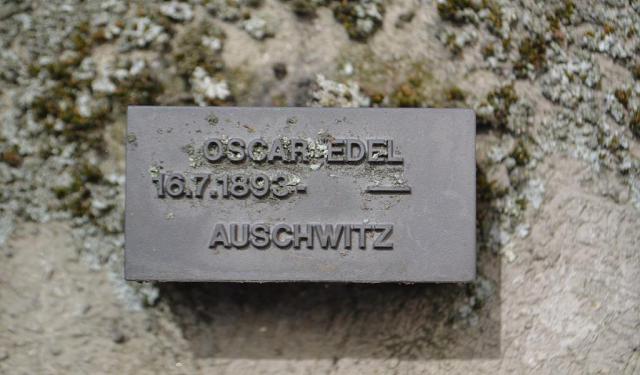
The town itself was founded by the Franks, a Germanic tribe, in the 9th century. Its name comes from... view more
Tour Duration: 2 Hour(s)
Travel Distance: 3.2 Km or 2 Miles
Jewish History Walking Tour
The history of Jews in Frankfurt dates back almost 900 years, which is more than in any other German city. Attesting to this fact alone is one of the oldest Jewish cemeteries in Europe, the Old Jewish Cemetery of Frankfurt, first recorded in the 12th century.
At some point, the city was even referred to as "Jerusalem of the West", highlighting its importance as a center of Jewish life... view more
Tour Duration: 1 Hour(s)
Travel Distance: 2.4 Km or 1.5 Miles
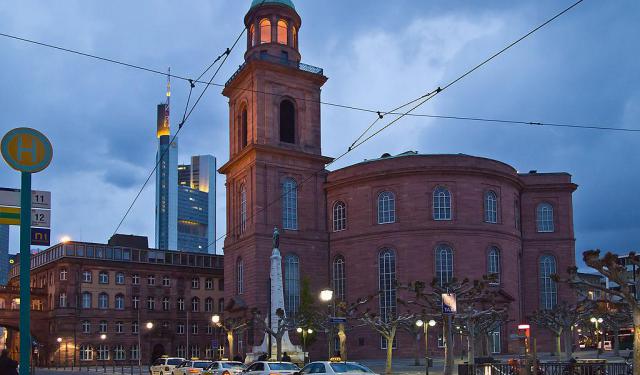
At some point, the city was even referred to as "Jerusalem of the West", highlighting its importance as a center of Jewish life... view more
Tour Duration: 1 Hour(s)
Travel Distance: 2.4 Km or 1.5 Miles
Useful Travel Guides for Planning Your Trip
15 Distinctively German Things to Buy in Frankfurt
Home to the European currency (ECB) and namesake sausages, Frankfurt is undoubtedly one of, if not "the", most known destination in Germany. For this there are quite a few reasons. Listed here are some of the things behind those reasons, which now can be picked up as...
Frankfurt's Best Authentic Restaurants
Frankfurt is a dynamic and popular city located right in the center of western Europe. More than 10,000 people move to Frankfurt every year; over the past decades, it has become a highly international city -- about half of all children born here had non-German parents. Being the main hub for the...
The Most Popular Cities
/ view all