

Sorrento Introduction Walking Tour, Sorrento

Sorrento Introduction Walking Tour (Self Guided), Sorrento

The Greek historian Diodorus Siculus claimed that Sorrento was founded by Liparus, who also founded the city of Lipari on the island of the same name. According to the legend, three mermaids settled on the tip of the Sorrentine Peninsula, enchanting the seafarers in transit through those waters. Even the legendary Ulysses had to use stratagems to resist the deadly song of the Sirens. Thus, the name Sorrento likely derives from the Greek Sirentum, linked to the mythic Sirens said to have inhabited the nearby coast.

Sorrento’s history stretches back to ancient Greek and Oscan settlements before becoming a Roman resort town famed for its villas and mild climate. In the Middle Ages, it endured Saracen raids and shifted control among Byzantines, Normans, and later the Kingdom of Naples. There were periods of self-rule, followed by more duchies. The town thrived on maritime trade and agriculture, especially citrus cultivation.

In 1558, the town was devastated by a major Ottoman raid, one of several attacks during that era. The 17th century brought Spanish rule and outbreaks of plague, while the 18th century saw shifting Neapolitan governments. In 1861, Sorrento was unified with the newly formed Kingdom of Italy. The waves of invaders finally subsided, but tourists soon began answering the Sirens’ call.

From the 18th and 19th centuries onward, Sorrento charmed literary and artistic giants such as Lord Byron, John Keats, Johann Wolfgang von Goethe, Charles Dickens, Richard Wagner, Henrik Ibsen, and Friedrich Nietzsche. The great Italian poet Torquato Tasso was born here, and the town’s main square is named after him.

Today, Sorrento’s old town offers narrow cobblestone streets lined with pastel buildings, artisan shops, and family-run cafés. Visitors can browse handmade ceramics, leather sandals, and bottles of local limoncello. Lemon-scented courtyards, tiny bakeries, and sea-view terraces add charm, while hidden lanes lead to peaceful cloisters and viewpoints overlooking the Bay of Naples.

Tourists—famous and ordinary alike—visit the Big Marina, the Port of Sorrento, Tasso Square, the Correale Museum, the bustling San Cesareo Street, the 14th-century Cathedral of Sorrento, the Church and Monastery of Saint Francis, and the dramatic Valley of the Mills.

Today, the song of the Sirens is as irresistible as ever, and people still hum the tune of “Come back to Sorrento.” And once you set foot in Sorrento, you will want to return again and again.
How it works: Download the app "GPSmyCity: Walks in 1K+ Cities" from Apple App Store or Google Play Store to your mobile phone or tablet. The app turns your mobile device into a personal tour guide and its built-in GPS navigation functions guide you from one tour stop to next. The app works offline, so no data plan is needed when traveling abroad.

Download The GPSmyCity App

Sorrento Introduction Walking Tour Map

Guide Name: Sorrento Introduction Walking Tour
Guide Location: Italy » Sorrento (See other walking tours in Sorrento)
Guide Type: Self-guided Walking Tour (Sightseeing)
# of Attractions: 10
Tour Duration: 2 Hour(s)
Travel Distance: 2.2 Km or 1.4 Miles
Author: Linda
Sight(s) Featured in This Guide:
  • Piazza Tasso (Tasso Square)
  • Valley of the Mills
  • Cattedrale di Sorrento (Sorrento Cathedral)
  • Corso Italia (Italy Avenue)
  • Via San Cesareo (San Cesareo Street)
  • Chiesa di Sant'Antonino (Church of Saint Antonino)
  • Chiostro di San Francesco (Church and Cloister of Saint Francis)
  • Villa Comunale Park
  • Piazza della Vittoria (Victory Square)
  • Marina Grande (Big Marina)
1
Piazza Tasso (Tasso Square)

1) Piazza Tasso (Tasso Square) (must see)

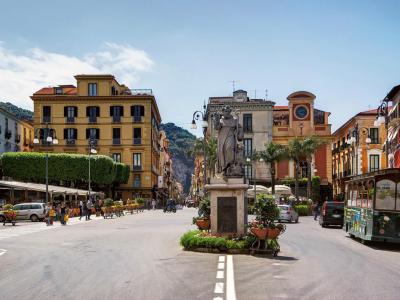
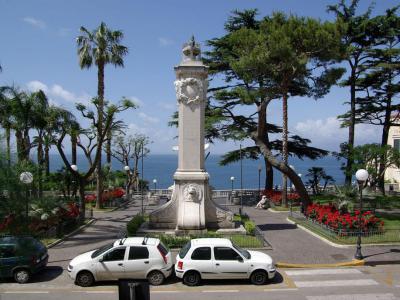
Torquato Tasso, born in 1544, stands on a granite pedestal in the square named for him. Tasso was the greatest poet of his era. He died in 1595, days before being crowned King of Poets by Pope Clement VIII. His statue shares the square with that of Saint Antonino, who sought asylum in Sorrento during the Lombard invasions of the 6th century.

The square was initially called Castle Square. Where the statue of Saint Antonino stands today was once the location of the 15th-century castle of Ferdinand of Aragon, demolished in 1843. The monument of Torquato Tasso was dedicated in 1870. The square sits astride the deep gorge that divides the center of Sorrento.

Surrounding the square are several notable historical buildings. In the southwestern part, you will find the Correale Palace, with its tiled courtyard, rebuilt in 1768. On the northern side of the square stands the Church of Santa Maria del Carmine. Inside, don’t miss the 1710 ceiling painting by Onofrio Avellino depicting the Virgin with Saint Simon, as well as the 16th-century gilded reliquaries containing saints’ bones.

Tasso Square is the entry point to the historic old town. Shops, restaurants, and bars line the square, creating a lively atmosphere. The Fauno Bar, located near the statue of Torquato Tasso, is a popular spot for cappuccino and pastries. Corso Italia, the main shopping street, branches off from the square, while smaller side streets offer additional boutiques and local shops to explore.

Cross over the forbidding gorge to find access to Sorrento Big Marina. It is where one may catch the water bus to the Isla of Capri, Tiberius's exotic playground. There are tour trolleys and hop-on, hop-off open-top sight-seeing busses from the square. Did we mention horse carriages as well? Yes, we did, just now.

As inviting as it is, Tasso Square stays busy throughout the day, so keep an eye out for scooters and traffic as you explore.
2
Valley of the Mills

2) Valley of the Mills

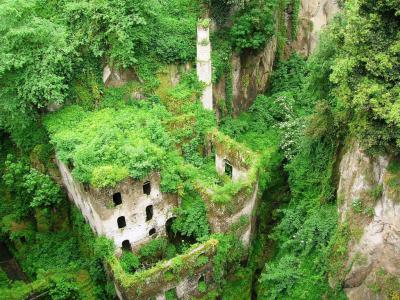
Some 35,000 years ago, in today's Sorrento, a volcano erupted. It cut a deep gorge through the limestone on the spot where the city's center is currently located. Waters, moving through the canyon, sculpted out fast-running channels to the sea. Over the centuries, settlements arose, leaving historical evidence of their passing in the area's caves.

There are mysteries and legends about the caves. Many people of Sorrento believed the gorge was patrolled at night by a huge medieval figure, armed head to foot. It was the mission of the ghost to kill anyone who did not know the magic words to unlock the treasure of the caves.

While there may not have been a ghost, there was "treasure." In 1885, Leonardo Lorenzoni, director of the Technical School of Vigiano, discovered several rare and precious artifacts of early settlers. He donated his find to professor Justinian Nicolucci of the University of Naples. He called the artifact cave "Nicolucci's Cave."

A good view of the mills is from behind Tasso Square. There are two streams, the Casariano-Cesarano, and Saint Antonino. Where the two streams meet is where the mills were built. Mills of one sort or another have been in the gorge since the 10th century. A grain mill, a sawmill, and an old washhouse are among the ruins.

The mills were isolated from the sea when Tasso Square was built in 1866. They were later abandoned. The gorge was taken over by exotic vegetation and rare ferns.
3
Cattedrale di Sorrento (Sorrento Cathedral)

3) Cattedrale di Sorrento (Sorrento Cathedral)

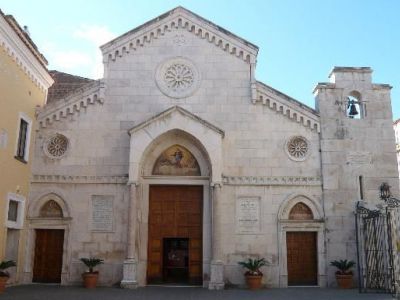
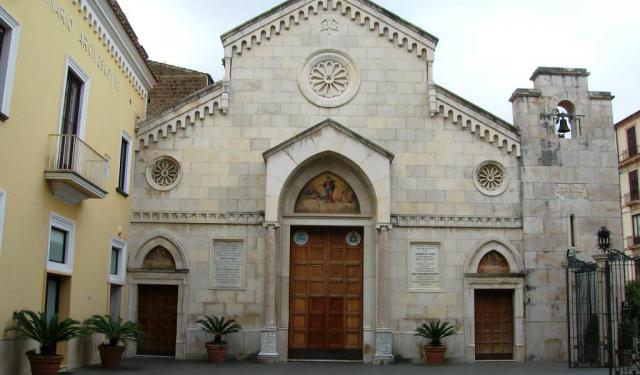
The Sorrento Cathedral, dedicated to the Virgin of the Assumption and the Apostles Philip and James, stands at the heart of the town. Consecrated in 1113, the cathedral has undergone several transformations, particularly between 1450 and 1573. Its current facade, completed in 1924, reflects a neo-Gothic style, while the church itself was originally built in Baroque fashion on the site of an ancient Greek temple, thought to have been dedicated to Zeus.

As you approach, notice the three entrances. The 16th-century central doorway, framed by antique marble columns, is topped with an ogival arch. Each entrance features a lunette: the larger central one honors the Virgin Mary, while the smaller ones depict Saints Philip and James. Above, the facade rises with battlements and a blind rose window, adding an unusual but charming character to the building.

Step inside, and you will see a Latin-cross layout with three naves, separated by fourteen sturdy pillars. The ceiling is flat, adorned with paintings of 2nd-century martyrs, and the dome, frescoed in 1902 by Pietro Barone and Augusto Moriani, adds a soft luminosity to the interior. On the right side of the altar, don’t miss the small chapel where the poet Torquato Tasso was baptized, linking the cathedral to one of Sorrento’s most celebrated historical figures.

Almost 200 feet away, the bell tower stands slightly apart from the main structure. Its 11th-century Romanesque base supports four square sections featuring arches, niches, cornices, ceramic tiles, and a clock, giving visitors a glimpse of architectural layers spanning centuries.
4
Corso Italia (Italy Avenue)

4) Corso Italia (Italy Avenue) (must see)

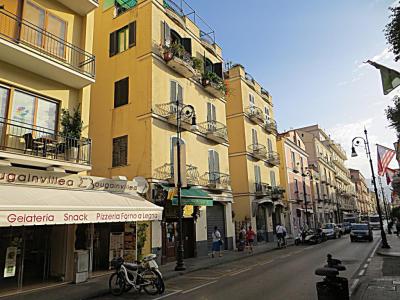
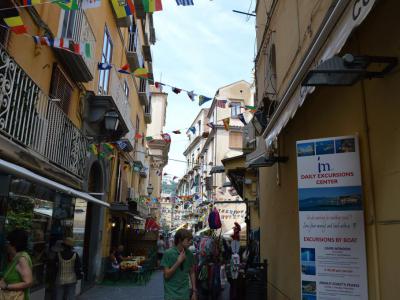
Italy Avenue is Sorrento’s main shopping street and one of the busiest areas in the town center. The avenue is lined with bars, cafés, restaurants, and stores, making it an easy place to stroll at any time of day. Much of it is pedestrianized, so you can walk freely without worrying about passing traffic. Even nearby Tasso Square functions as a Controlled Traffic Zone, reducing the presence of cars and giving the area a more relaxed feel.

Shops along Italy Avenue offer a wide range of goods. Prices here are often more moderate than those on the surrounding side streets, which tend to feature boutique shops and smaller artisan studios. Common finds include leather bags and belts, hand-sewn tablecloths, local olive oil, wines, groceries, and souvenirs. Sorrento’s connection to lemons is also on full display; visitors can browse lemon candy, lemon-scented soaps, and bottles of limoncello, the region’s traditional lemon liqueur.

The street is also well known for its wood-inlay craftsmanship, a local tradition that dates back centuries. Many shops sell hand-carved and inlaid wooden items such as small tables, jewelry boxes, and music boxes. Even if you do not plan to buy anything, it’s interesting to step inside and watch how detailed the designs are.

For a break, stop at Primavera Gelateria Sorrento, a popular spot with dozens of gelato flavors. It’s a convenient place to rest and enjoy a treat before continuing your walk.

As you move along the avenue, the atmosphere gradually shifts from commercial to more residential, and the street eventually leads toward viewpoints overlooking the Big Marina. This small fishing village at the water’s edge provides a contrast to the busy shopping district and helps visitors appreciate how Sorrento blends tourism, daily life, and maritime heritage.
5
Via San Cesareo (San Cesareo Street)

5) Via San Cesareo (San Cesareo Street)

San Cesareo Street is one of Sorrento’s oldest and most active thoroughfares. In Roman times, it served as the central cross street of ancient Sorrento, and despite the centuries, its function has changed very little. Today the street is slightly shorter than Italy Avenue, but far more compact. While Italy Avenue offers wider sidewalks and larger storefronts, San Cesareo Street often feels packed, with people and merchandise sharing nearly every inch of space.

The crowding contributes to the lively atmosphere. Shops spill into the street with ceramics, inlaid woodwork, leather goods, and plenty of bottles of Sorrento’s famous lemon liqueur. Visitors often find San Cesareo Street more entertaining than Italy Avenue, partly because of its tight layout and constant movement. The street eventually merges into Fuoro Street, which continues the same pattern of small shops, food stops, and steady pedestrian flow.

Midway along the route stands the Dominova Seat (Sedile Dominova), built in 1319. Once a gathering place for local nobles, it now hosts groups of card players who keep the tradition of community meetings alive. Next to it is the Addolorata Church, a Baroque structure from 1739 that adds a historical pause to the busy street. Sorrento Cathedral, located on nearby Italy Avenue, is only a short walk away.

For centuries, San Cesareo Street has remained a hub for shopping. Visitors can fill their bags with souvenirs, crafts, curios, and countless small finds, making it one of the city’s most engaging places to explore.
6
Chiesa di Sant'Antonino (Church of Saint Antonino)

6) Chiesa di Sant'Antonino (Church of Saint Antonino) (must see)

Leaving San Cesareo Street, a short walk will bring you to Saint Antonino Square, a small urban space filled with local activity. On your right stands the Church of Saint Antonino, dedicated to the patron saint of Sorrento.

According to tradition, Antonino arrived here in the 6th century during the Lombard invasions and later became known as a protector of the town and its seafarers. One of the most repeated stories tells of a boy swallowed by a whale on the Sorrento shoreline. Antonino intervened and saved him, and the whale bones displayed at the church entrance recall this event.

The church you see today was built in the 11th century on top of a 7th-century oratory that once held the saint’s remains. Its grey tuff facade reflects modifications made in the 18th century, featuring a Romanesque style and an understated appearance from the outside.

Enter the Church of Saint Antonino through the main doors and step into the central nave, flanked by three aisles. Take a moment to admire the 12 marble columns, some of which were salvaged from Roman-era buildings. As you look up, notice the frescoes covering the ceiling and walls, illustrating key moments from Saint Antonino’s life and miracles. One standout is the 1734 ceiling painting by Giovan Battista Lama, showing the saint rescuing a noble’s daughter from demonic possession.

Walk toward the main altar, where a statue of Saint Antonino greets you. Pause at the side altars to see relics of other saints. Behind the altar, a double-ramp staircase leads down to the crypt, the heart of the church. Here rests the tomb of Saint Antonino, surrounded by ex-voto offerings, including silver plaques and maritime tokens from sailors saved from shipwrecks. Don’t miss the wooden crucifix with a silver cover, used in historical processions. A 15th-century fresco of the Madonna delle Grazie adorns one side of the crypt, while the processional crucifix sits on the other.

If you have access, visit the sacristy, which resembles a small museum. You’ll find period paintings, a 16th-century silver statue of Saint Antonino, and a detailed nativity scene with figures from the 17th and 18th centuries, alongside other devotional artworks donated over time.
7
Chiostro di San Francesco (Church and Cloister of Saint Francis)

7) Chiostro di San Francesco (Church and Cloister of Saint Francis) (must see)

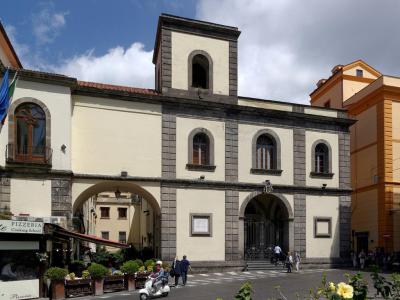
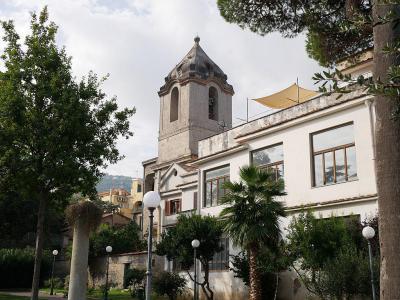
The Church and Cloister of Saint Francis stand near the public gardens of Sorrento, offering panoramic views of the Gulf of Naples. The church originates in the 8th century as an oratory founded by Saint Antonino and dedicated to Saint Martin of Tours. It was later entrusted to the Franciscans and reconstructed in the 16th century in the Baroque style.

The facade is simple and white, divided into two horizontal sections. The lower portion features a well-preserved 14th-century portal framed by five pilasters on each side. Two arched blind windows flank the entrance: the left contains a painted image of Saint Francis, while the right holds a portrait of Saint Antonino. Above, the upper section displays a mullioned rose window bordered by paired pilasters, all crowned by a scalloped roofline rising above crenelated edges.

Step through the main doors of the Church and enter the nave, where Gothic and Baroque elements blend with quiet elegance. Walk straight toward the main altar and pause before the 1735 altarpiece, Saint Francis Receiving the Stigmata, its vivid colors and dramatic composition drawing your eye immediately.

Continue into the side chapels along the nave. On both the left and right, you will see statues of revered saints, including Santa Rita da Cascia and the Immaculate Madonna, each displayed with centuries-old devotional care.

In the first chapel on the right you will find the 17th-century wooden statue of Saint Francis with Christ Crucified, a deeply expressive work donated by the Vulcano family and originally placed above the high altar.

Don't leave this place without visit the cloister. Walk along the arcaded courtyard, where fountains and greenery create a serene space for reflection. The space remains a cultural hub, frequently hosting exhibitions, musical performances, and weddings.
8
Villa Comunale Park

8) Villa Comunale Park (must see)

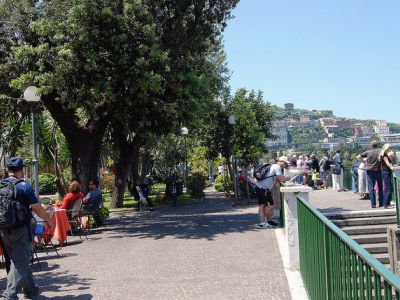
Villa Comunale Park in Sorrento is a beautiful and historically significant location that attracts visitors with its natural charm. Positioned near the Saint Francis Church and Cloister, this small park is a lush haven filled with palm trees, oaks, holm oaks, and ancient pines. Perched on the cliffs of Sorrento, it offers stunning views of Marina Grande and the coastline, making it more famous for its panoramic vistas than its greenery.

One distinctive feature of the park is its elevators, which provide access to Marina Piccola ferry and the San Francisco swim towers, offering a convenient route to the sea. Elevated above the bay and Mount Vesuvius, the park boasts well-maintained flower beds, manicured lawns, and tall palm trees. A cozy café within the park serves espresso, pastries, and ice cream, with sunset being the ideal time to enjoy its tranquil atmosphere.

Located a short walk from Tasso Square in the city center, the path to Villa Comunale Park passes by the historic 11th-century Church of Saint Antonino, adding a touch of history to the journey. Established between 1877 and 1879 on the former gardens of Franciscan friars, the park reflects the region's cultural heritage. Visitors can relax in the shade, stroll through well-kept gardens, and admire centuries-old olive trees.

The park also features two notable busts from the early twentieth century, honoring historian Bartolomeo Capasso and magistrate Francesco Saverio Gargiulo, contributing to its cultural ambiance. Additionally, it houses a museum displaying archaeological discoveries from Sorrento and a precious mosaic depicting a nymphaeum, adding to the historical appeal.

Villa Comunale Park serves not only as a natural oasis but also as a cultural center. Its terrace often hosts musical and theatrical performances, and during the Christmas season, it is adorned with festive lights. For those interested in exploring the beach below, the park offers access to the sea and an elevator for convenience, ensuring that all visitors can enjoy Sorrento's beauty and the majestic Gulf of Naples, with Vesuvius in the background.
9
Piazza della Vittoria (Victory Square)

9) Piazza della Vittoria (Victory Square)

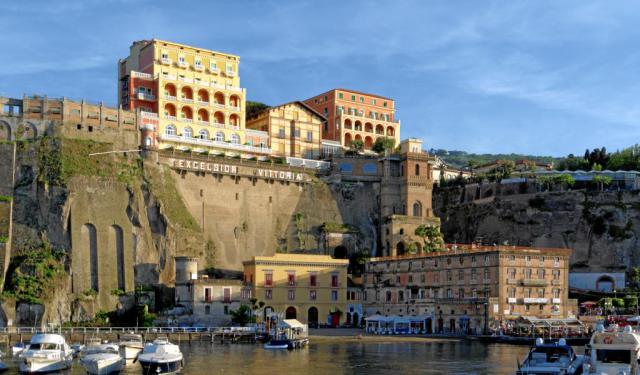
Victory Square sits between Sorrento’s Big Marina and Small Marina. At its center is a small garden shaded by palm trees, a comfortable place to pause during a walk. From here, visitors enjoy clear views across the Bay of Naples, a scene that naturally slows the pace and encourages people to linger.

Along one edge of the square stands the Imperial Hotel Tramontano, a historic property closely tied to the cultural life of Sorrento. In 1881, the Norwegian playwright Henrik Ibsen lived here for six months. During his stay he completed Ghosts, one of his major works. Ibsen had left Norway feeling disheartened by criticism at home, and he moved with his family to Sorrento, where he spent four productive years. His time here is remembered with a plaque placed on the corner of Victory Square and Vittoria Veneto Street, just beside the hotel’s graceful bridge crossing the road.

The history of the site reaches even farther back. Part of the current hotel incorporates the former Villa Laurito Mastrogiudice, the birthplace of Sorrento’s celebrated poet Torquato Tasso. He was born there on March 11, 1544, long before the area became a center of international tourism.

Today, Victory Square brings together views, history, and a relaxed coastal atmosphere. It is a natural stopping point for visitors exploring the town or making their way between the marinas, offering a short but meaningful connection to the artists and thinkers who once found inspiration in the same landscape.
10
Marina Grande (Big Marina)

10) Marina Grande (Big Marina) (must see)

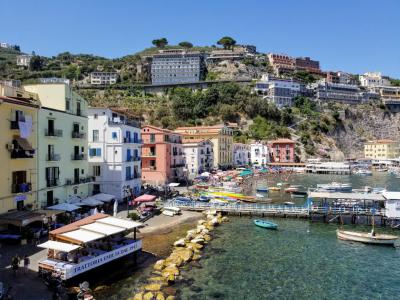
Despite its name, Marina Grande, or “Big Marina,” is actually smaller than Marina Piccola. Rather than being a transport hub, it is a fishing village and a destination in itself. As you walk through the marina, you will find restaurants and bars serving fresh seafood, small hotels, and even a local church. The area has preserved a sense of rustic charm, making it feel like a little world tucked away from the bustle of Sorrento’s main streets.

The marina lies in a protected nook of the Amalfi Coast, secluded by a rocky promontory. Local tradition says this was once the site of a Roman villa belonging to Marcellus, the nephew of Emperor Augustus. As you stroll along the waterfront, notice the small details that reflect its pre-industrial life. At sunset, fishermen pull in their nets, prepare their boats for the next day, and go about daily routines that have changed little over the centuries. Watching this is a way to experience the rhythms of a Sorrento that existed long before tourism became the town’s main industry.

Walking through Big Marina, you will see how it maintains a balance between community life and hospitality for visitors. Small shops and trattorias line narrow streets, while paths along the water offer calm places to pause and enjoy the view. This is a living village, not just a scenic stop, so take time to absorb the sounds, smells, and everyday life that give Big Marina its distinctive character. By the time you leave, you will understand why many visitors feel it is one of Sorrento’s most authentic corners.

Walking Tours in Sorrento, Italy

Create Your Own Walk in Sorrento

Create Your Own Walk in Sorrento

Creating your own self-guided walk in Sorrento is easy and fun. Choose the city attractions that you want to see and a walk route map will be created just for you. You can even set your hotel as the start point of the walk.
Sorrento's Historical Buildings Walking Tour

Sorrento's Historical Buildings Walking Tour

Much like many other places in Italy, the charming coastal town of Sorrento has no shortage of cultural heritage. The influence of different historical periods is seen particularly well in the center of the town, where a number of notable buildings have proudly withstood the test of time. Among these are several beautiful churches and monasteries that still keep some of Sorrento's valuable...  view more

Tour Duration: 1 Hour(s)
Travel Distance: 1.2 Km or 0.7 Miles