Custom Walk in Rhodes, Greece by david_bothwell47_a893d created on 2025-08-30
Guide Location: Greece » Rhodes
Guide Type: Custom Walk
# of Sights: 16
Tour Duration: 3 Hour(s)
Travel Distance: 3.6 Km or 2.2 Miles
Share Key: VD2SJ
Guide Type: Custom Walk
# of Sights: 16
Tour Duration: 3 Hour(s)
Travel Distance: 3.6 Km or 2.2 Miles
Share Key: VD2SJ
How It Works
Please retrieve this walk in the GPSmyCity app. Once done, the app will guide you from one tour stop to the next as if you had a personal tour guide. If you created the walk on this website or come to the page via a link, please follow the instructions below to retrieve the walk in the app.
Retrieve This Walk in App
Step 1. Download the app "GPSmyCity: Walks in 1K+ Cities" on Apple App Store or Google Play Store.



Step 2. In the GPSmyCity app, download(or launch) the guide "Rhodes Map and Walking Tours".
Step 3. Tap the menu button located at upper right corner of the "Walks" screen and select "Retrieve custom walk". Enter the share key: VD2SJ
1) St. Paul's Gate
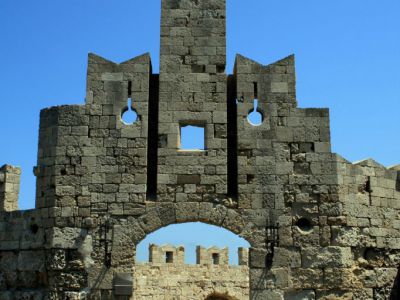
Southeast of Mandráki Harbour, a scenic walk along the waterfront leads you through Saint Paul's Gate, an outer defensive bastion of the Old Town. This gate opens up at the northwest end of Kolóna, the central of Rhodes' three ports, buzzing with activity from colorful fishing boats, ferries arriving from Turkey, cruise ships, and large catamarans.
The bastion at the gate showcases expert construction techniques and serves as a point of reference for fortification experts: it features twelve cannon holes strategically positioned to cover a broad range between the two harbors and the mole of Saint Nicholas ("Agios Nikolaos"). A common element between this gate, the Saint Athanasius Gate, and the D'Amboise Gate is the drawbridge mechanism, believed to have operated through a system of beams and counterweights. Evidence of this system is visible in the vertical slots on the external wall, where the drawbridge beams would have been mounted.
Inside the semi-cylindrical tower on the inner wall, there's a marble sculpture displaying the coat of arms of the House of Grand Master d’Aubusson (1476-1503), adjacent to those of the Hospitallers Order and Pope Sixtus IV. Below these emblems is an effigy of Paul the Apostle and an inscription in Gothic characters reading "Sanctus Paul". These heraldic symbols date the completion of this section of the fortifications to around 1477, during a broader initiative led by Grand Master d’Aubusson to restore the northern walls.
During World War II, Saint Paul's Gate sustained significant damage and nearly collapsed, but was rebuilt in the early 1950s. Today, one of the best spots to appreciate the views is from the foundations of the now-gone Naillac Tower, just east of the gate. This location offers unparalleled views of Mandráki, especially at dawn and dusk, making it a favorite spot for both locals and visitors.
The bastion at the gate showcases expert construction techniques and serves as a point of reference for fortification experts: it features twelve cannon holes strategically positioned to cover a broad range between the two harbors and the mole of Saint Nicholas ("Agios Nikolaos"). A common element between this gate, the Saint Athanasius Gate, and the D'Amboise Gate is the drawbridge mechanism, believed to have operated through a system of beams and counterweights. Evidence of this system is visible in the vertical slots on the external wall, where the drawbridge beams would have been mounted.
Inside the semi-cylindrical tower on the inner wall, there's a marble sculpture displaying the coat of arms of the House of Grand Master d’Aubusson (1476-1503), adjacent to those of the Hospitallers Order and Pope Sixtus IV. Below these emblems is an effigy of Paul the Apostle and an inscription in Gothic characters reading "Sanctus Paul". These heraldic symbols date the completion of this section of the fortifications to around 1477, during a broader initiative led by Grand Master d’Aubusson to restore the northern walls.
During World War II, Saint Paul's Gate sustained significant damage and nearly collapsed, but was rebuilt in the early 1950s. Today, one of the best spots to appreciate the views is from the foundations of the now-gone Naillac Tower, just east of the gate. This location offers unparalleled views of Mandráki, especially at dawn and dusk, making it a favorite spot for both locals and visitors.
2) Eleftherias (Liberty) Gate
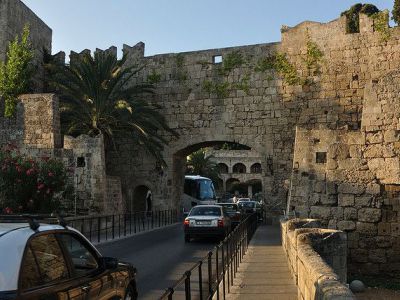
Sitting right in front of Symi Square, otherwise known as Place de l’Arsenal, is one of the main entrances into the medieval city of Rhodes – the Liberty Gate. The original gate on this site dates back to the time of Grand Master Heredia (1377-1396) and used to link the northern flank of the seaside wall to the Mandraki Harbour. Back then it was also colloquially referred to as the Shipyard Gate or Shipyard Vaults, being a short distance from the local arsenal and the knightly shipyards that formed part of the domain of the Langue (Tongue) of France.
Two square towers that once flanked the gate on both sides were razed by the Ottomans in 1910. Historic records indicate that one of them appears on the coat of arms of Grand Master d'Aubusson (1476-1503). The structure shows a pronounced influence of Byzantine architecture, and its dimensions (9.9 meters wide, 5.2 meters high) support the projected use of the passage – letting through voluminous vessels or appurtenances thereof en route to the shipyard. Under Ottoman rule, this gate may have also operated as a bridge over the water to a basin designated in Turkish as "Eğri Liman" ("Concealed Harbour").
The ramparts currently seen on top of the wall were erected during Italian rule (1912-1943). The Italians, who deserve much credit for historical reconstruction in Rhodes, created this gate in 1924 after they had taken possession of the island during WWI. Portraying themselves as liberators from the Ottoman rule, they called it Liberty Gate. Although modern as such, it was built in a strict accordance with medieval architectural practice.
Two square towers that once flanked the gate on both sides were razed by the Ottomans in 1910. Historic records indicate that one of them appears on the coat of arms of Grand Master d'Aubusson (1476-1503). The structure shows a pronounced influence of Byzantine architecture, and its dimensions (9.9 meters wide, 5.2 meters high) support the projected use of the passage – letting through voluminous vessels or appurtenances thereof en route to the shipyard. Under Ottoman rule, this gate may have also operated as a bridge over the water to a basin designated in Turkish as "Eğri Liman" ("Concealed Harbour").
The ramparts currently seen on top of the wall were erected during Italian rule (1912-1943). The Italians, who deserve much credit for historical reconstruction in Rhodes, created this gate in 1924 after they had taken possession of the island during WWI. Portraying themselves as liberators from the Ottoman rule, they called it Liberty Gate. Although modern as such, it was built in a strict accordance with medieval architectural practice.
3) Marine Gate
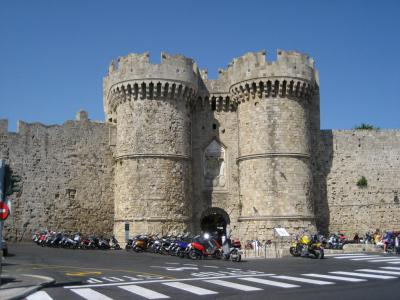
Just south of Kolóna's fishing port, the Marine Gate stands as a dramatic entry point into the walled town of Rhodes, complete with two large round towers. This gate is where visitors arriving by sea enter the city, providing a grand first impression. Built in 1478 during the era of the Knights Hospitaller, it was designed to imitate the Gate to Villeneuve-lès-Avignon in France, which dates back 200 years earlier.
The exterior features several reliefs, including one of the Virgin holding Christ, and others featuring Saint John the Baptist and Saint Peter. One can also spot the coats of arms of France, the Order of Saint John, and the blazon of the House of d'Aubusson. On the interior side, additional relief work includes an effigy of an angel with the coats of arms of the Order of Saint John.
Strategically built close to the water, the gate's positioning and the narrow space between the sea and the walls made it difficult for any army, regardless of size, to gather and launch an attack from this side; moreover, the towers were equipped with devices designed to pour boiling oil on any possible attackers. The gate was last restored in 1951, following repairs to the north tower, which had been damaged during World War II bombings.
The exterior features several reliefs, including one of the Virgin holding Christ, and others featuring Saint John the Baptist and Saint Peter. One can also spot the coats of arms of France, the Order of Saint John, and the blazon of the House of d'Aubusson. On the interior side, additional relief work includes an effigy of an angel with the coats of arms of the Order of Saint John.
Strategically built close to the water, the gate's positioning and the narrow space between the sea and the walls made it difficult for any army, regardless of size, to gather and launch an attack from this side; moreover, the towers were equipped with devices designed to pour boiling oil on any possible attackers. The gate was last restored in 1951, following repairs to the north tower, which had been damaged during World War II bombings.
4) Hippocrates Square
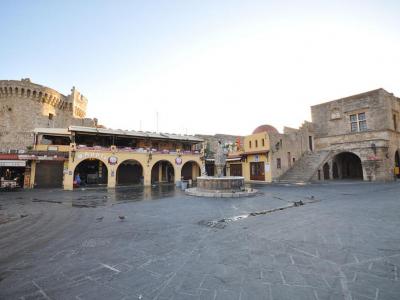
Upon entering the Old Town through the Marine Gate and its imposing towers, you'll find yourself in Hippocrates Square, an ideal starting point for exploring this UNESCO World Heritage Site. The square serves as one of the main gathering spots in the area and features the Syndriváni at its center-a fountain topped by an Italian ornament and often surrounded by pigeons.
In the southeastern corner of the square, you'll find the Kastellanía, originally a medieval courthouse and commercial tribunal for the Knights. Completed in 1507 and later restored by the Italians between 1925 and 1935, the building now functions as the public library and town archives, housing a rich collection of ancient books and documents. This spot also marks the beginning of Socrates Street ("Odós Sokrátous"), one of the island's most frequented thoroughfares.
The square is a favorite among both locals and tourists, who enjoy sipping coffee, dining, or having drinks at the numerous alfresco cafes and bars lining its edges. You might consider relaxing at one of these cafes to absorb the local ambiance before venturing further into the Old Town. As you continue along the main street and ascend a gentle hill, you'll also catch sight of the historic clock tower.
In the southeastern corner of the square, you'll find the Kastellanía, originally a medieval courthouse and commercial tribunal for the Knights. Completed in 1507 and later restored by the Italians between 1925 and 1935, the building now functions as the public library and town archives, housing a rich collection of ancient books and documents. This spot also marks the beginning of Socrates Street ("Odós Sokrátous"), one of the island's most frequented thoroughfares.
The square is a favorite among both locals and tourists, who enjoy sipping coffee, dining, or having drinks at the numerous alfresco cafes and bars lining its edges. You might consider relaxing at one of these cafes to absorb the local ambiance before venturing further into the Old Town. As you continue along the main street and ascend a gentle hill, you'll also catch sight of the historic clock tower.
5) Kahal Shalom Synagogue (must see)
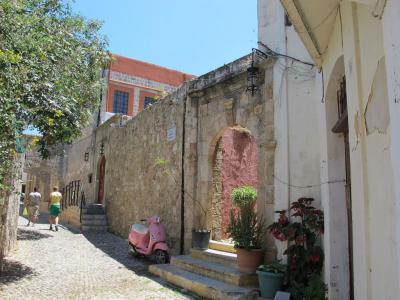
Completed in 1577, Kahal Shalom stands as Greece's oldest surviving synagogue still in active use. Its worshipers prospered under Ottoman rule into the 20th century; however, the Kingdom of Italy took over the Dodecanese Islands in 1912, and large numbers of the Jews of Rhodes had begun to emigrate during the 1930s, as they felt menaced by the Fascist Italian regime.
The architectural layout of the structure reflects typical Sephardic synagogue design, featuring a central 'biham' from which the Sefer Torah is read. Inside, the sanctuary has a striking mosaic floor crafted from local black and white stones, while two unique Torah arks can be spotted on either side of the door leading into the interior courtyard. In the courtyard, there is also a fountain used for handwashing.
A commemorative plaque within the synagogue pays tribute to the countless local Jews who tragically lost their lives under Nazi rule. Today, Kahal Shalom remains a site of worship and pilgrimage, with its former women's gallery now transformed into the Jewish Museum of Rhodes, preserving and sharing the rich heritage of the island's Jewish community.
The architectural layout of the structure reflects typical Sephardic synagogue design, featuring a central 'biham' from which the Sefer Torah is read. Inside, the sanctuary has a striking mosaic floor crafted from local black and white stones, while two unique Torah arks can be spotted on either side of the door leading into the interior courtyard. In the courtyard, there is also a fountain used for handwashing.
A commemorative plaque within the synagogue pays tribute to the countless local Jews who tragically lost their lives under Nazi rule. Today, Kahal Shalom remains a site of worship and pilgrimage, with its former women's gallery now transformed into the Jewish Museum of Rhodes, preserving and sharing the rich heritage of the island's Jewish community.
6) Socrates Street
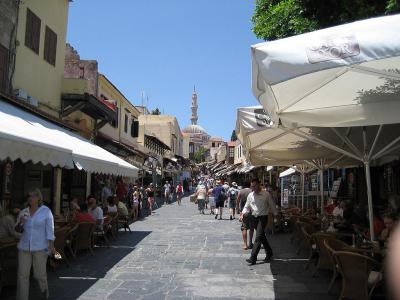
Every resort town has a grand shopping lane for picking up souvenirs and tasting local flavors, and Rhodes, the capital of the island, is no different with its own Socrates Street. Named after the renowned ancient Greek philosopher, this cobblestoned artery is lined with a diverse array of shops, bars, eateries, and entertainment venues, buzzing with activity from evening until the early morning hours.
A stroll down Socrates Street can sometimes turn into a fully-fledged excursion due to the assortment of goods on display. You'll find clothing, fabrics, shoes, all sorts of sweets, numerous figurines that celebrate Ancient Greek themes, and an array of local handicrafts that fill the stalls each day. The sellers here are equally diverse, with many being multilingual, contributing to the vibrant and colorful atmosphere that draws visitors day and night.
Walking along the street, you'll also encounter significant medieval landmarks such as the massive fortified walls of the Old Town complete with ramparts and a defensive moat, Byzantine churches, Ottoman mosques, as well as quaint squares, gardens, and courtyards that invite curiosity. Notable sights along the way include the Archbishop's Palace, which dominates the square of the same name, and the nearby Commercial Tribunal dating back to the turn of the 16th century. The Marine Gate and the charming Seahorse Fountain are also located along this route. Further down, you'll pass the luxurious Suleiman Baths, which boast a richly decorated interior and are still operational today. The Sultan Mustafa Mosque, another remnant of Rhodes' Muslim period, captures the classic oriental aesthetic.
Towards the southern end, a maze of narrow lanes leads to Pythagoras Street, home to the 16th-century Ibrahim Pasha Mosque, and to Fanourios Street, home to the small Orthodox Church of Saint Fanourios, built in 1335 and known for being partially underground.
A stroll down Socrates Street can sometimes turn into a fully-fledged excursion due to the assortment of goods on display. You'll find clothing, fabrics, shoes, all sorts of sweets, numerous figurines that celebrate Ancient Greek themes, and an array of local handicrafts that fill the stalls each day. The sellers here are equally diverse, with many being multilingual, contributing to the vibrant and colorful atmosphere that draws visitors day and night.
Walking along the street, you'll also encounter significant medieval landmarks such as the massive fortified walls of the Old Town complete with ramparts and a defensive moat, Byzantine churches, Ottoman mosques, as well as quaint squares, gardens, and courtyards that invite curiosity. Notable sights along the way include the Archbishop's Palace, which dominates the square of the same name, and the nearby Commercial Tribunal dating back to the turn of the 16th century. The Marine Gate and the charming Seahorse Fountain are also located along this route. Further down, you'll pass the luxurious Suleiman Baths, which boast a richly decorated interior and are still operational today. The Sultan Mustafa Mosque, another remnant of Rhodes' Muslim period, captures the classic oriental aesthetic.
Towards the southern end, a maze of narrow lanes leads to Pythagoras Street, home to the 16th-century Ibrahim Pasha Mosque, and to Fanourios Street, home to the small Orthodox Church of Saint Fanourios, built in 1335 and known for being partially underground.
7) Medieval Clock Tower (must see)
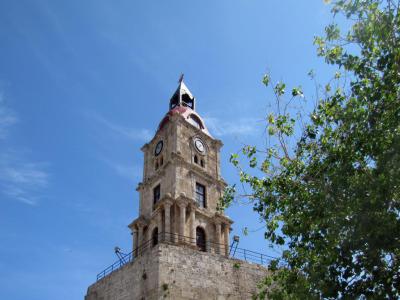
Perched at the highest point in the Old Town, the robust clock tower, still in perfect working order, offers a spectacular panoramic view. Originally built in the 7th century, it suffered damage from an explosion in 1856 but was rebuilt with baroque elements by Fethi Pasha. Historically, it served an important function, keeping Greek locals aligned with Turkish time-a necessity due to the strict regulations imposed by the Turks regarding the comings and goings in Rhodes, where precise timing was crucial for adherence to these rules.
Visitors can ascend fifty-three steep wooden steps to reach a small chamber at the top that provides 360-degree views of the surroundings. The entrance fee includes a complimentary drink at the charming terrace cafe situated below. As you make your way up, you'll encounter photographs documenting the various stages of the clock tower's restoration, adding a historical layer to your visit.
Visitors can ascend fifty-three steep wooden steps to reach a small chamber at the top that provides 360-degree views of the surroundings. The entrance fee includes a complimentary drink at the charming terrace cafe situated below. As you make your way up, you'll encounter photographs documenting the various stages of the clock tower's restoration, adding a historical layer to your visit.
8) Fortifications of Rhodes (must see)
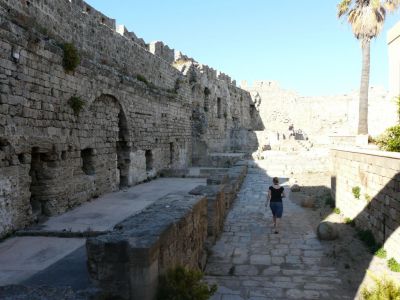
The first and arguably most impressive feature of Rhodes' Old Town are the fortified walls themselves. Stretching 4 kilometers, these formidable barriers were constructed to shield Rhodes from attacks by foreign empires and corsairs who roamed the waters of the Mediterranean and Aegean Seas during the Middle Ages. Although long deemed impenetrable, they were eventually breached by the Ottoman Turks in the early 16th century.
Mostly dating from the preparations for the 1480 siege, the walls stand strong and majestic, casting a beautiful glow at dawn with the sun's first rays or at night, illuminated by wrought-iron lamps. The Knights Hospitaller, who controlled Rhodes from 1309 to 1522, built upon what were initially modest Byzantine defenses. They created eight sections of curtain walls, each overseen by a different "langue" (or knightly division). Originally, each curtain section had a gate, but today, twelve gates remain in use, each with its unique design.
The walls are also dotted with several bastions and towers open to visitors, each filled with intriguing aspects that bring the ancient military history of Rhodes to life. Along the top, catwalks and ramparts, once patrolled by sentries or used for defense during sieges, offer a glimpse into medieval vigilance and warfare. An admission fee is required to explore these historic defenses more closely, with tickets available at the Palace of the Grand Master. Visitors can climb several of the towers and walk along the walls, perhaps imagining themselves as medieval knights.
Mostly dating from the preparations for the 1480 siege, the walls stand strong and majestic, casting a beautiful glow at dawn with the sun's first rays or at night, illuminated by wrought-iron lamps. The Knights Hospitaller, who controlled Rhodes from 1309 to 1522, built upon what were initially modest Byzantine defenses. They created eight sections of curtain walls, each overseen by a different "langue" (or knightly division). Originally, each curtain section had a gate, but today, twelve gates remain in use, each with its unique design.
The walls are also dotted with several bastions and towers open to visitors, each filled with intriguing aspects that bring the ancient military history of Rhodes to life. Along the top, catwalks and ramparts, once patrolled by sentries or used for defense during sieges, offer a glimpse into medieval vigilance and warfare. An admission fee is required to explore these historic defenses more closely, with tickets available at the Palace of the Grand Master. Visitors can climb several of the towers and walk along the walls, perhaps imagining themselves as medieval knights.
9) St. Athanasios (St. Anthony's) Gate
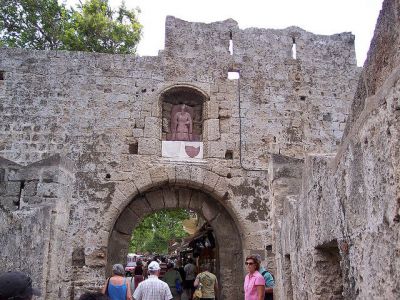
A popular historic entrance to the walled city of Rhodes, this gate is habitually referred to by locals as Saint Francis' Gate due to the church of Saint Francis of Assisi, built by the Italians in the first part of the 20th century, located just outside. As for the gate itself, judging by the coat of arms displayed above the entrance, it dates back to the times of Grand Master Jean de Lastic (1437-1454), and came into being as a result of the modification to the part of the wall near D'Amboise Gate. The round tower of Saint Mary, designed to guard the gate, dates from the same period (1441).
Under the rule of Grand Master Pierre d’Aubusson (1476-1503), two bulwarks came to reinforce the fortification around the Gate of Saint Athanasius, giving the stocky bastion its actual, massive outlook. Right above the opening of the drawbridge there is the coat of arms of the House of d'Aubusson seen along with the inscription "hoc antemurale", reminiscent of the commissioning of the bastion in 1487.
Following the Ottoman conquest of Rhodes in 1522, the victorious troops of Sultan Suleiman the Magnificent marched through this gate into the city. An inscription in Farsi quotes reinstatement works of part of the bulwarks commissioned by the Ottoman Governor Abdülcelil, in the wake of the fall of Rhodes into the hands of the Ottomans.
This gate was subsequently closed by the Sultan in a bid to prevent any further conqueror from passing through it, ever. It was only re-opened, by the Italians, in 1922 to mark the 400th anniversary of the Ottoman conquest of the city and the island.
Under the rule of Grand Master Pierre d’Aubusson (1476-1503), two bulwarks came to reinforce the fortification around the Gate of Saint Athanasius, giving the stocky bastion its actual, massive outlook. Right above the opening of the drawbridge there is the coat of arms of the House of d'Aubusson seen along with the inscription "hoc antemurale", reminiscent of the commissioning of the bastion in 1487.
Following the Ottoman conquest of Rhodes in 1522, the victorious troops of Sultan Suleiman the Magnificent marched through this gate into the city. An inscription in Farsi quotes reinstatement works of part of the bulwarks commissioned by the Ottoman Governor Abdülcelil, in the wake of the fall of Rhodes into the hands of the Ottomans.
This gate was subsequently closed by the Sultan in a bid to prevent any further conqueror from passing through it, ever. It was only re-opened, by the Italians, in 1922 to mark the 400th anniversary of the Ottoman conquest of the city and the island.
10) Palace of the Grand Master of the Knights of Rhodes (must see)
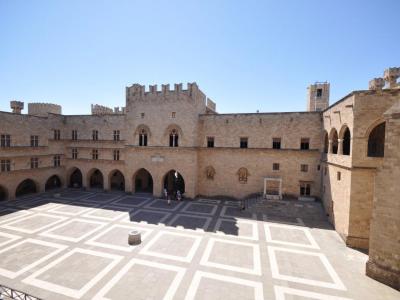
At the top of the Street of the Knights stands the Palace of the Grand Master, which once served as the administrative core of the Order of the Knights of Saint John and the centerpiece of the Knights’ Quarter. Neglected during the Ottoman era and used as a prison before being nearly destroyed by an explosion in 1856, the palace was later restored by the Italians in a renovation that remains contentious. The rebuild did not adhere to the original floor plan and introduced modern elements to the interior, including statues and mosaics from other Dodecanese islands, much to the chagrin of those islands that still mourn their loss.
Despite these controversies, the palace continues to awe visitors with its regal presence at the highest point in Rhodes. The use of columns and capitals from ancient sites throughout the interior, and the exterior's stone cladding, illustrate the architectural grandeur of the Knights’ Quarter at its peak. Notable features include the splendid wooden ceilings and the onyx window panes that cast a soft light inside. Many of the main rooms display magnificent Hellenistic and Roman mosaics, sourced from nearby Kos, and while their presence here raises ethical questions, they are nonetheless well-preserved.
Visitors enter the palace between two grand semicircular towers and are greeted by a large marble staircase that leads to the spacious upper-story rooms, deliberately kept sparsely furnished to highlight the architecture and mosaics. These mosaics include depictions of the Nine Muses, a nymph on a sea-horse, and Medusa's head, with motifs of fish and dolphins also prevalent.
The ground floor, once used as stables or as storage for grain and munitions during sieges, now encloses a courtyard adorned with Classical statues and houses a permanent exhibition that spans the first 2,400 years of Rhodes' history. This includes a medieval gallery up to the time of the Ottoman conquest, along with temporary exhibitions. The collections are exceptionally well-organized and labeled, even more so than those of the Archaeological Museum.
Despite these controversies, the palace continues to awe visitors with its regal presence at the highest point in Rhodes. The use of columns and capitals from ancient sites throughout the interior, and the exterior's stone cladding, illustrate the architectural grandeur of the Knights’ Quarter at its peak. Notable features include the splendid wooden ceilings and the onyx window panes that cast a soft light inside. Many of the main rooms display magnificent Hellenistic and Roman mosaics, sourced from nearby Kos, and while their presence here raises ethical questions, they are nonetheless well-preserved.
Visitors enter the palace between two grand semicircular towers and are greeted by a large marble staircase that leads to the spacious upper-story rooms, deliberately kept sparsely furnished to highlight the architecture and mosaics. These mosaics include depictions of the Nine Muses, a nymph on a sea-horse, and Medusa's head, with motifs of fish and dolphins also prevalent.
The ground floor, once used as stables or as storage for grain and munitions during sieges, now encloses a courtyard adorned with Classical statues and houses a permanent exhibition that spans the first 2,400 years of Rhodes' history. This includes a medieval gallery up to the time of the Ottoman conquest, along with temporary exhibitions. The collections are exceptionally well-organized and labeled, even more so than those of the Archaeological Museum.
11) Street of the Knights (must see)
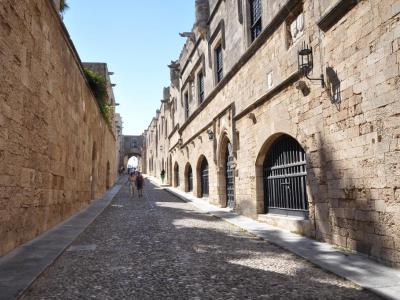
The Street of the Knights ("Odós Ippotón") is lined with many of the inns that housed the crusading order. Recognized as one of the most intact medieval streets in the world, it features buildings made from finely chiseled sandstone, presenting a unified facade that culminates in a striking double archway that spans the road at its highest point. The masonry is punctuated by small square windows and elegant arched doorways, wide enough to accommodate a horse and carriage or a knight on horseback. Intricate carvings, commemorative plaques, and other detailed ornamentation enhance the historic ambiance.
During the day, the street buzzes with tourists and large groups moving about, which can somewhat obscure the historical atmosphere of Knights convening for meetings or attending to their duties. However, at night, the atmosphere transforms; the soft, waxy glow from the streetlights, reminiscent of medieval oil lamps, casts a magical aura that more easily transports you back to the 14th century.
At the start of the street, on the right (north) side, stands the Inn of Italy, marked by a plaque honoring Grand Master Fabrizio del Carretto (1513–21) above its entrance. Adjacent is the smaller Palace of Philippe Villiers de l’Isle-Adam, Carretto's immediate successor and the Grand Master who was ousted by Sultan Süleyman in 1522. Further uphill, across the street, there is a quaint garden with an Ottoman fountain, part of the courtyard of the 15th-century Villaragut Mansion, restored in 2002 but only accessible via application to the Archaeological Museum. Directly opposite is the highly ornate Inn of France, housing a magnificent life-sized stone carving of a knight-possibly originally a tombstone-located just inside the courtyard. This courtyard also contains a chapel from the time of Grand Master Raymond Berenger (1365–74), although the facade facing the street is from more than a century later.
During the day, the street buzzes with tourists and large groups moving about, which can somewhat obscure the historical atmosphere of Knights convening for meetings or attending to their duties. However, at night, the atmosphere transforms; the soft, waxy glow from the streetlights, reminiscent of medieval oil lamps, casts a magical aura that more easily transports you back to the 14th century.
At the start of the street, on the right (north) side, stands the Inn of Italy, marked by a plaque honoring Grand Master Fabrizio del Carretto (1513–21) above its entrance. Adjacent is the smaller Palace of Philippe Villiers de l’Isle-Adam, Carretto's immediate successor and the Grand Master who was ousted by Sultan Süleyman in 1522. Further uphill, across the street, there is a quaint garden with an Ottoman fountain, part of the courtyard of the 15th-century Villaragut Mansion, restored in 2002 but only accessible via application to the Archaeological Museum. Directly opposite is the highly ornate Inn of France, housing a magnificent life-sized stone carving of a knight-possibly originally a tombstone-located just inside the courtyard. This courtyard also contains a chapel from the time of Grand Master Raymond Berenger (1365–74), although the facade facing the street is from more than a century later.
12) New Market (Nea Agora)
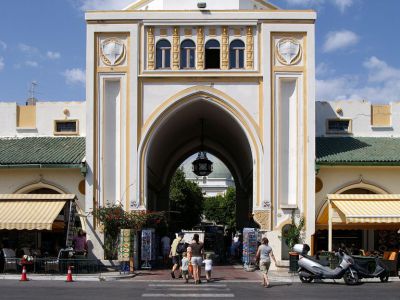
Right by the harbor at Mandraki and adjacent to the Old Town, the New Market really stands out. This large, seven-sided building features a magnificent entrance, round domes, and an outdoor central courtyard where the old fish market once was. Built back in the 1920s by the Italians in an Arabic style, it really shows off the island's architectural mix.
While no longer functioning as a traditional market with stalls and local produce, the building remains a hub of activity. Surrounding the exterior are several small jewelry and souvenir shops catering to tourists, plus some cafes and food takeaway places. Inside the courtyard, there are even more shops and places to eat. The highlight is definitely the fancy domed building right in the middle of it all.
Whether you're looking to explore the architecture or simply kick back with a drink or grab a quick lunch, the New Market offers a cozy and inviting atmosphere for everyone to enjoy.
While no longer functioning as a traditional market with stalls and local produce, the building remains a hub of activity. Surrounding the exterior are several small jewelry and souvenir shops catering to tourists, plus some cafes and food takeaway places. Inside the courtyard, there are even more shops and places to eat. The highlight is definitely the fancy domed building right in the middle of it all.
Whether you're looking to explore the architecture or simply kick back with a drink or grab a quick lunch, the New Market offers a cozy and inviting atmosphere for everyone to enjoy.
13) Mandraki Harbor and Windmills (must see)
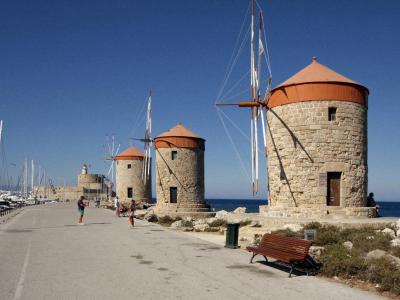
Mandráki Harbour, historically the main port of the ancient city, today provides anchorage for numerous private sailboats along its lengthy eastern quay. During the summer months, the southwest quays come alive with colorful excursion boats that ferry passengers down the coast to Líndos or to nearby islands.
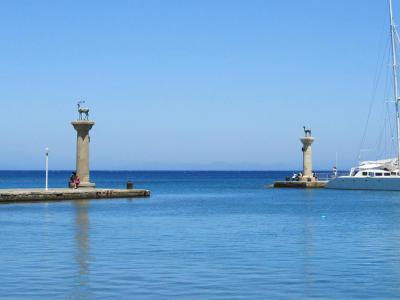
The harbor features a 400-meter-long breakwater jetty, at the end of which stands the Fort of Saint Nicholas ("Ágios Nikólaos"). Originally constructed by the Knights, the fort was last used militarily during World War II and now houses a lighthouse that aids modern vessels entering the port from the north. Despite popular myths perpetuated by local souvenirs like tea-towels, T-shirts, and posters, the ancient Colossus never actually stood here. Instead, the entrance to the harbor is marked by two columns, each topped with a bronze statue of a doe and stag, symbols of Rhodes.
Visitors to Mandráki Harbor can also admire three iconic medieval windmills on the jetty, once used to grind grain from moored vessels. Originally, there may have been as many as 13 or 14 windmills. The remaining three have been extensively renovated and provide a picturesque setting for photographs, particularly stunning at sunrise when their silhouettes are cast against the dawn sky.
The harbor features a 400-meter-long breakwater jetty, at the end of which stands the Fort of Saint Nicholas ("Ágios Nikólaos"). Originally constructed by the Knights, the fort was last used militarily during World War II and now houses a lighthouse that aids modern vessels entering the port from the north. Despite popular myths perpetuated by local souvenirs like tea-towels, T-shirts, and posters, the ancient Colossus never actually stood here. Instead, the entrance to the harbor is marked by two columns, each topped with a bronze statue of a doe and stag, symbols of Rhodes.
Visitors to Mandráki Harbor can also admire three iconic medieval windmills on the jetty, once used to grind grain from moored vessels. Originally, there may have been as many as 13 or 14 windmills. The remaining three have been extensively renovated and provide a picturesque setting for photographs, particularly stunning at sunrise when their silhouettes are cast against the dawn sky.
14) Rhodian Deer Statues
Standing on slender columns at the entrance of Mandraki Harbor are sculptures depicting Rhodian deer-a stag and a doe-symbols of the elegant and cosmopolitan island of Rhodes. Legend has it that Crusaders brought deer to the island in medieval times to protect their camps from snakes. (While the deer don't directly kill snakes, their horns produce a substance that repels them.) However, findings suggest that deer have inhabited Rhodes since ancient times; in fact, in the 6th century BC, the island was named "Elafousa", meaning "deer island", due to the abundance of this species.
Interestingly, this location is also believed to be the site of one of the Seven Wonders of the Ancient World-the famed Colossus of Rhodes. Today, these two deer statues have become iconic symbols of the island and are among the most photographed sights.
Tip:
For the best photo opportunities, visit early in the morning when there are fewer tourists around.
Interestingly, this location is also believed to be the site of one of the Seven Wonders of the Ancient World-the famed Colossus of Rhodes. Today, these two deer statues have become iconic symbols of the island and are among the most photographed sights.
Tip:
For the best photo opportunities, visit early in the morning when there are fewer tourists around.
15) Colossus of Rhodes
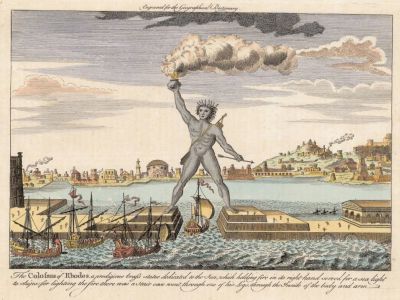
Despite widespread myths, the Colossus of Rhodes did not actually span the entrance to Mandráki Harbour-as many depictions suggest. The reality is that its immense weight, consisting of twenty tonnes of bronze, would have caused it to sink into the soft seabed immediately. More credible theories suggest that this monumental statue of the sun god Helios, erected to memorialize Rhodes' successful defeat of Demetrius Poliorcetes, who attacked Rhodes for a year, was located near the Palace of the Grand Master.
The sculptor Khares of Lindos spent twelve years crafting the 35-meter (114-foot) tall Colossus, with each finger reportedly as large as a man. Tragically, Khares took his own life after discovering a critical design flaw in the statue, and his work was subsequently completed by his disciple, Lakhes. Less than 70 years after its completion, the Colossus suffered a catastrophic failure during an earthquake, snapping at the knees and collapsing, which some say confirmed Khares' fears about its structural integrity.
Following the disaster, the people of Rhodes sought guidance from the Delphic Oracle, which ominously advised them against restoring the statue. Heeding this warning, the ruins of the Colossus remained where they fell for nearly 900 years. It wasn't until AD 653 that Arab pirates pillaged Rhodes, ultimately selling the statue's bronze as scrap to a Jewish merchant from Syria. According to legend, it took 900 camels to transport all the bronze, marking a dramatic end to one of the ancient world's most famous statues.
The sculptor Khares of Lindos spent twelve years crafting the 35-meter (114-foot) tall Colossus, with each finger reportedly as large as a man. Tragically, Khares took his own life after discovering a critical design flaw in the statue, and his work was subsequently completed by his disciple, Lakhes. Less than 70 years after its completion, the Colossus suffered a catastrophic failure during an earthquake, snapping at the knees and collapsing, which some say confirmed Khares' fears about its structural integrity.
Following the disaster, the people of Rhodes sought guidance from the Delphic Oracle, which ominously advised them against restoring the statue. Heeding this warning, the ruins of the Colossus remained where they fell for nearly 900 years. It wasn't until AD 653 that Arab pirates pillaged Rhodes, ultimately selling the statue's bronze as scrap to a Jewish merchant from Syria. According to legend, it took 900 camels to transport all the bronze, marking a dramatic end to one of the ancient world's most famous statues.
16) Fort of St. Nicholas (must see)
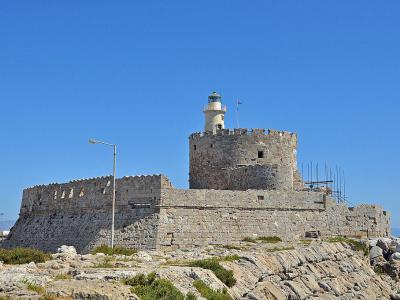
The Fort of Saint Nicholas stands as a commanding presence over Mandráki Harbor, a site with a rich military history. Originally, in the 15th century, only a guard tower constructed by the Knights of Saint John occupied this location. Following the first siege of Rhodes, the tower was significantly fortified, eventually transforming into a robust stronghold that was later named after the chapel situated within its walls. This fortification played a crucial role in enabling the Knights Hospitaller to resist Turkish attacks for many years, including during major sieges in 1480 and again from 1522-23. While the initial Ottoman assault was repelled, the subsequent one in 1522 eventually led to the Knights being ousted from the city.
The fort's design was strategically planned to counter the Ottoman's use of cannons and other siege weapons, featuring thick walls that remained impervious for many years and still stand in excellent condition today. Currently, the Fort of Saint Nicholas is a major attraction, drawing visitors who are keen to explore its well-preserved structure. Visitors can enjoy a walk along the path where the moat once flowed-now a dry, scenic walkway lined with trees, providing a tranquil and picturesque experience of this historic site.
The fort's design was strategically planned to counter the Ottoman's use of cannons and other siege weapons, featuring thick walls that remained impervious for many years and still stand in excellent condition today. Currently, the Fort of Saint Nicholas is a major attraction, drawing visitors who are keen to explore its well-preserved structure. Visitors can enjoy a walk along the path where the moat once flowed-now a dry, scenic walkway lined with trees, providing a tranquil and picturesque experience of this historic site.
